

SUBSCRIBE TO OUR FREE NEWSLETTER
Daily news & progressive opinion—funded by the people, not the corporations—delivered straight to your inbox.
5
#000000
#FFFFFF
To donate by check, phone, or other method, see our More Ways to Give page.
Daily news & progressive opinion—funded by the people, not the corporations—delivered straight to your inbox.
"It's an impossible situation, because even if we prioritize the little fuel that is left to the most urgent departments, we know that they won't last more than 36 to 48 hours," said Julie Faucon, MSF medical team leader in Gaza.
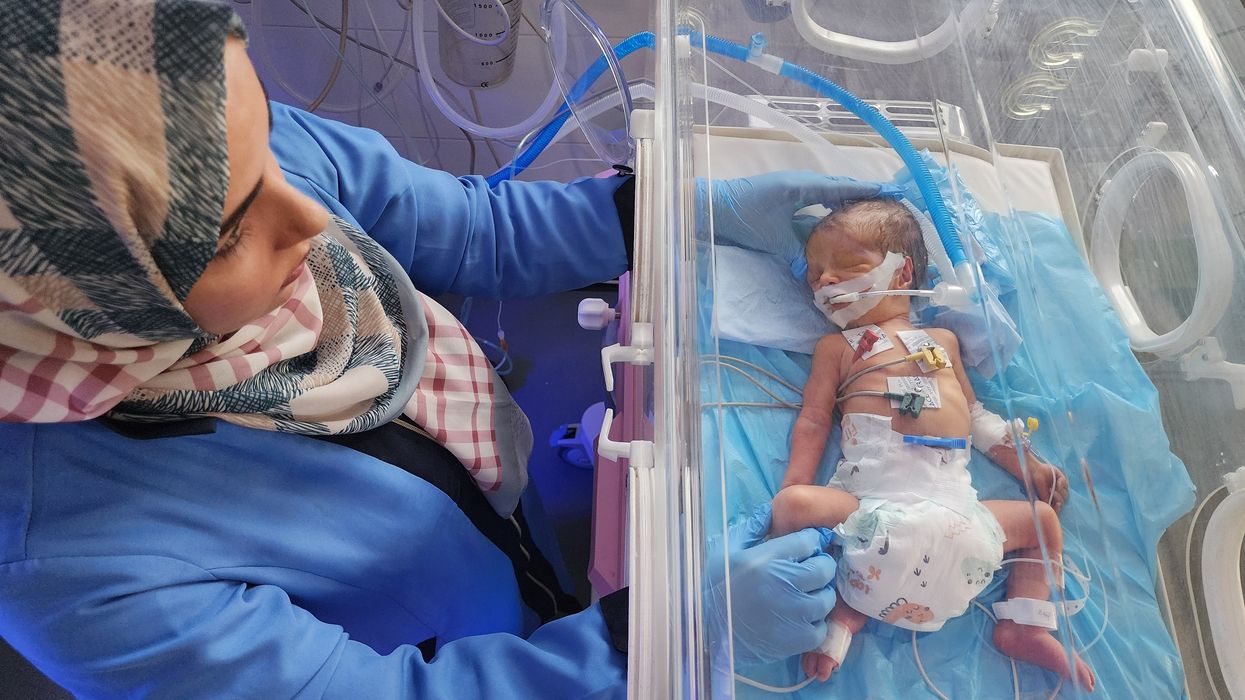
The international humanitarian group Médecins Sans Frontières, also known as Doctors Without Borders or MSF, warned in a Wednesday statement that newborn babies and other patients are at dire risk as southern Gaza's Nasser Hospital runs out of fuel.
The group warned that electricity for the MSF-supported Nasser Hospital, where MSF members are providing emergency, maternity, pediatric, burn, and trauma care, may be cut off for some hospital departments leaving patients without "lifesaving care." The hospital's neonatal intensive care unit is currently treating children and newborns who are reliant on mechanical ventilation and incubators. All of these young patients are dependent on electricity from fuel generators, MSF wrote.
Nasser Hospital, as well as two other facilities in the Gaza Strip, Al-Aqsa Hospital and European Gaza Hospital, are nearing the need to close due to lack of fuel, the group reported Wednesday.
"It's an impossible situation, because even if we prioritize the little fuel that is left to the most urgent departments, we know that they won't last more than 36 to 48 hours," said Julie Faucon, MSF medical team leader in Gaza, according to the statement. "While some patients are hanging on by a thread, the lack of sustained electricity is impacting the level of care we can provide to those with burns and trauma."
Pascale Coissard, MSF emergency coordinator, said that the situation is "a consequence of Israel's ongoing blockade and continuous criminal looting of lifesaving supplies."
In mid-July, the United Nations reported that "Israeli authorities continue to tightly control allocations of incoming fuel, thereby limiting humanitarian operations, especially by local partners," and just last week the body noted that only 16 of the region's 36 hospitals remained partially in operation.
Pointing to lack of medical supplies, equipment, and personnel, Rik Peeperkorn, the World Health Organization representative for the West Bank and Gaza, told a recent U.N. Security Council meeting that "the health sector is being systematically dismantled."
Attacks by the Israeli military have left northern Gaza's three hospitals—the Kamal Adwan Hospital, al-Awda Hospital, and the Indonesian Hospital—either entirely out of service or barely functioning.
Hussam Abu Safia, the head of the Kamal Adwan Hospital, was detained by Israeli forces during their raid on Kamal Adwan Hospital in late December.
Human rights defenders and the medical community have called for his release, it's believed that he is being held in an Israeli detention center, though the Israeli officials had given news media and human rights groups conflicting messages about his whereabouts.
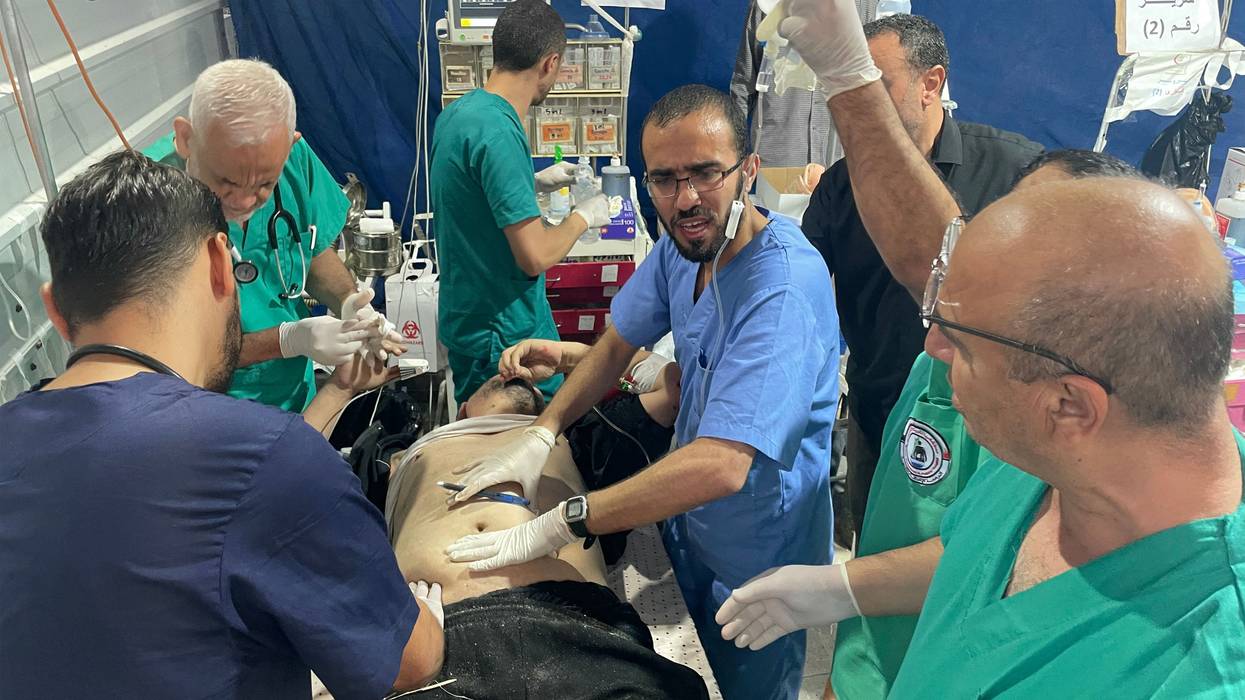
Fresh demands for a major increase in humanitarian aid and an end to the bombing came as Gaza's only cancer hospital shut down due to a lack of fuel.
As the World Health Organization warns of an "imminent public health catastrophe" in Gaza amid Israeli attacks on medical workers and infrastructure, doctors and other frontline medics said Wednesday that only an immediate cease-fire would give them a fighting chance to save countless lives.
Responding Wednesday to the shutdown of the Turkish-Palestinian Friendship Hospital—Gaza's only cancer treatment center—due to lack of fuel and damage from Israeli airstrikes, WHO Director-General Tedros Adhanom Ghebreyesus said that "no words can describe our concern for the patients who have just lost the only possibility to receive lifesaving cancer treatment or palliative care."
Tedros added: "I urge and I plead—for full medical and fuel aid access NOW! The more we wait, the more we put these fragile lives at risk."
The WHO chief's plea came a day after Christian Lindmeier, a spokesperson for the Geneva-based United Nations agency,
warned that "an imminent public health catastrophe... looms with the mass displacement, the overcrowding, the damage to water and sanitation infrastructure."
Meanwhile, James Elder, a spokesperson for the United Nations Children's Fund (UNICEF), said Tuesday that "child deaths due to dehydration, particularly infant deaths due to dehydration, are a growing threat."
The U.N. Office for the Coordination of Humanitarian Affairs (OCHA) called Gaza a "graveyard" for children, more than 3,600 of whom have been killed by Israeli bombardment, with another 1,000 minors reported missing, according to Palestinian and other officials.
Israeli forces have attacked numerous hospitals, clinics, ambulances, and medical workers, including the Turkish-Palestinian Friendship Hospital and al-Hilu Hospital. The Gaza Health Ministry said Wednesday that the bombardment that damaged al-Hilu "endangers the lives of women in the maternity wards and medical staff."
According to an "urgent call for protecting healthcare workers in Gaza" published Tuesday in the British medical journal The Lancet, Israeli forces have attacked 57 medical facilities since launching the war on Gaza on October 7, killing 73 workers—including doctors, nurses, paramedics, and others—as of October 24. Sixteen of the medical personnel were killed while on duty.
As Israel's bombardment of Gaza exacts a heavy toll on overwhelmed medical workers and infrastructure in the besieged strip, frontline medics like Dr. Noureddein al-Khateeb—a 38-year-old resident doctor in the emergency department at the Nasser Medical Center in the southern Gaza city of Khan Younis—say they are living "in a constant state of threat and fear."
"It's constant fear on top of the exhaustion we're experiencing," al-Khateeb told The New Humanitarian on Wednesday. "But one shouldn't think of that too much. I can't. If I do, I won't get any work done."
Al-Khateeb added that "we're also afraid for our families' safety, but what can we do?"
Dr. Mohamed Abu Mousa, a radiologist at Nasser, said one of the few trips he's made outside the hospital since Israeli bombardment began was to bury his 7-year-old son after he was killed in an October 15 Israeli airstrike on their family home.
"We don't have the luxury of pausing to grieve," he told The New Humanitarian. "The heartache is immense, but the wounded are endless. We have to keep going."
Conditions are dire inside Gaza's hospitals, which are running out of or low on fuel, medicines, equipment, and other essential services and supplies.
"We're operating on children without anesthetics," Léo Cans, who heads the Doctors Without Borders (MSF) mission in Palestine, told CNN Tuesday. "We don't have morphine for them."
On Wednesday, MSF international president Dr. Christos Christou said in a video published on social media that "we've seen and heard the stories of the hell being unleashed on Gaza" as "helpless people are being subjected to horrific bombing" and "families have nowhere to run or hide."
Christou continued:
So many people need help. What medical staff can do is just a drop in the ocean compared to the immense needs. Our teams working in Gaza are exhausted and terrified. Our staff tell us that pregnant women can't get to hospitals to deliver. People are stuck under the rubble of shelled-out buildings. Children are having limbs amputated while lying on the floor.
"An immediate cease-fire is the only way the people of Gaza can find safety and the essential aid they urgently need," Christou asserted. "The bombing, the all-out assault, needs to stop now... As a human being, I beg—stop the bombing and allow people in Gaza to live."
The Gaza Health Ministry said Wednesday afternoon that at least 8,796 Palestinians—including nearly 2,300 women and over 3,600 children—have been killed in Israeli attacks, while around 23,000 other people have been injured.
"This is simply the wrong way to address this humanitarian crisis," said the U.N. human rights chief of a new law that imposes new regulations on migrant rescue ships in the Mediterranean.
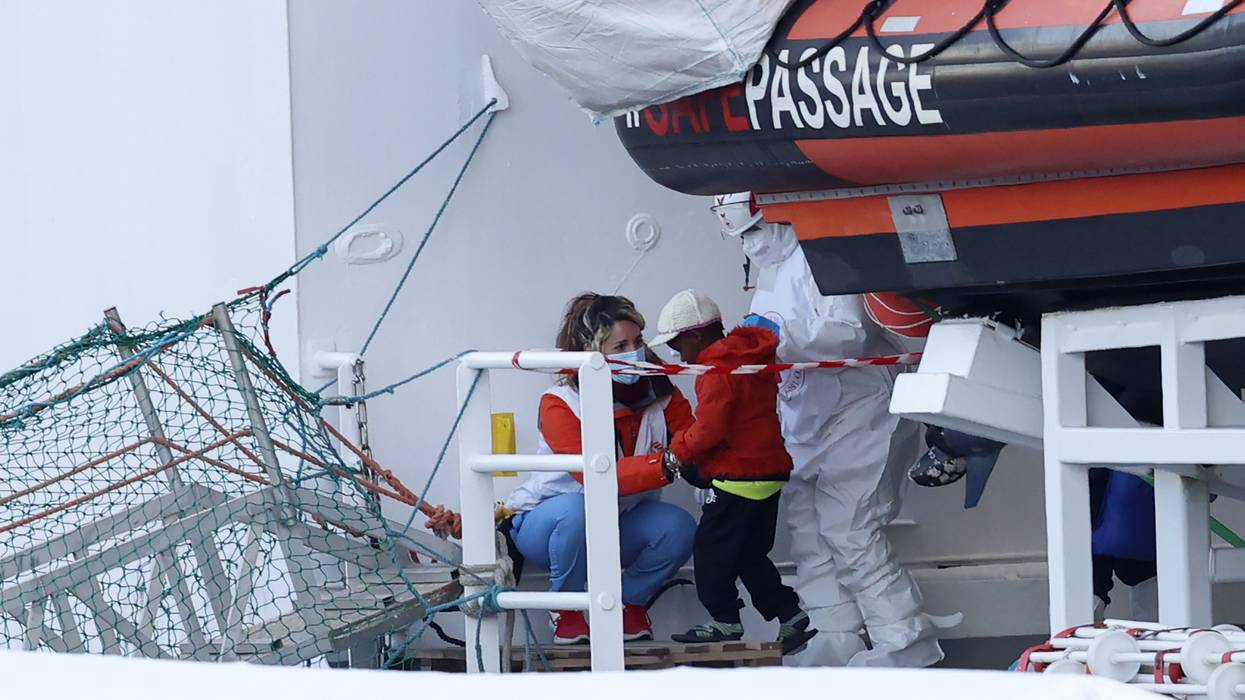
The international charity Medicins Sans Frontiers said late Thursday it is "assessing what legal actions" the group can take to contest a new anti-refugee law passed in Italy, under which the group was informed its rescue ship is being detained and prevented from rescuing migrants for 20 days.
The group, also known as MSF or its English name, Doctors Without Borders, said Italian authorities entered its rescue ship, Geo Barents, on Thursday evening to inform the crew of a new law passed by the country's parliament.
The law requires ships to request access to a port and proceed to Italy "without delay" after rescuing migrants trying to cross the Mediterranean Sea, like the more than 630,000 people whose lives have been saved by Geo Barents and other ships since 2015.
Charities say the new "code of conduct" also requires crews to dock in ports in northern Italy, far from where rescues take place.
Previously, the Geo Barents has conducted multiple rescues and brought dozens of people on board before proceeding to a port where they can disembark in Italy and apply for asylum.
The ship is now in administrative detention for 20 days and MSF has been ordered to pay a $10,500 fine.
"This is not acceptable!" tweeted MSF.
Organizations that disobey the new code could be fined more than $53,000 and have their rescue vessels impounded, Al Jazeera reported.
"Today our team was supposed to be back at sea to prevent more deaths in the Central Mediterranean," said MSF Friday. "Who will pay the real price of the detention imposed on Geo Barents?"
The International Organization for Migration says that less than two months into 2023, at least 157 people have been reported as missing and presumed dead after attempting to cross the Mediterranean from northern Africa.
Far-right Italian Premier Giorgia Meloni has been denounced by human rights experts for her hardline anti-immigration stance. Her government has previously refused to allow rescue ships to enter ports and has barred refugees from leaving ships after they arrive in Italy.
Meloni's government has claimed the Mediterranean rescues by MSF and other humanitarian groups encourage people to make the dangerous journey across the sea, but MSF has said its work is vital, as refugees will attempt to reach Europe regardless of whether they believe they'll encounter a rescue ship.
"We all watch with horror the plight of those crossing the Mediterranean, and the desire to end that suffering is profound," said U.N. human rights high commissioner Volker Türk this week, after the new code of conduct was proposed. "But this is simply the wrong way to address this humanitarian crisis. The law would effectively punish both migrants and those who seek to help them. This penalization of humanitarian actions would likely deter human rights and humanitarian organizations from doing their crucial work."
Other rights groups expressed solidarity with MSF after it temporarily lost its ability to operate Geo Barents.
"Once again, the central Mediterranean is emptied of a vital rescue asset," said SOS Mediterranee, which operates a ship called Ocean Viking. "Civil rescue ships are only filling the deadly gap left by E.U. States in the central Mediterranean. Criminalization of search and rescue at sea must end."
Doctors Without Borders said Thursday that a hospital it supported in the Syrian city of Aleppo was bombed, destroying the key pediatric facility and killing at least 14 people.
The medical humanitarian aid group, also known by its French acronym, MSF, said in a statement that two doctors were among the casualties, including one of the last pediatricians in Aleppo, and that other medical structures in the city had also been attacked this week.
Witnesses said the Al Quds hospital was hit by a missile from a fighter jet Wednesday, according to CNN.
"MSF categorically condemns this outrageous targeting of yet another medical facility in Syria," said Muskilda Zancada, MSF head of mission for Syria. "This devastating attack has destroyed a vital hospital in Aleppo and the main referral center for pediatric care in the area. Where is the outrage among those with the power and obligation to stop this carnage?"
MSF, along with the International Committee of the Red Cross (ICRC), which also supported the Al Quds hospital, took to Twitter to express outrage over what appeared to be a deliberate targeting of the life-saving facility.
"The recent attack on the ICRC-supported Quds hospital is unacceptable and sadly this is not the first time the lifesaving medical services have been hit," said Marianne Gasser, head of the ICRC mission in Syria, in a press statement. "We urge all the parties to spare the civilians. Don't attack hospitals, don't use weapons that cause widespread damage. Otherwise, Aleppo will be pushed further to the brink of humanitarian disaster."
The organizations didn't lay blame on any particular party, the Guardian notes, "but the Syrian and Russian air forces have carried out almost all the aerial strikes on the opposition-controlled east of the city."
Speaking at a press conference Wednesday, UN special envoy for Syria Staffan de Mistura described the "worrisome deterioration of the cessation of hostilities" as the country's five-year civil war continues and referenced the Aleppo hospital strike. He added, "In the last 48 hours, we have had an average of one Syrian killed every 25 minutes. One Syrian wounded every 13 minutes."
He said that for those inside of Syria, "The perception is that [the cessation of hostilities] could collapse at any time," adding that Russia and the U.S. are key, as they were in February, to make the truce "urgently revitalized."
Physicians for Human Rights (PHR) similarly described the nearly two-month truce as having "nearly disintegrated" while peace talks in Geneva have stalled. As Reuters explains,
The Geneva talks aim to end a war that has killed more than 250,000 people, created the world's worst refugee crisis, allowed for the rise of Islamic State and drawn in regional and major powers but the negotiations have all but failed and a truce to allow them to take place has collapsed."
"If Syria's leaders and the international community cannot reach a peace accord, there's no doubt attacks on health care will continue, and the consequences will be deadly for everyday Syrians. How many more doctors and patients have to die before the international community musters the will to end this bloodshed?" asked PHR Syria researcher Elise Baker.
And there's been no sign of an end to bloodshed over the past few days as fighting has intensified, with fresh airstrikes Thursday on the city killing dozens. According to reporting by the Associated Press, "About 200 civilians have been killed in the past week, nearly half of them around Aleppo."
"With the civilian death toll rising and hundreds of thousands of people fleeing the country, key powers need to be focused on protecting civilians in all parts of Syria," said Nadim Houry, Human Rights Watch's deputy Middle East director. "There are decisive measures that key powers, particularly those on the Security Council, can take to deter abusive parties and improve protection for civilians," he said.
Meanwhile, military officials told NBC News that the U.S. would release on Friday a redacted version of its investigation into U.S. airstrikes on MSF's trauma hospital in Kunduz, Afghanistan, that killed at least 30 people.
The Associated Press provided new evidence Monday that the U.S. military knew that the Doctors Without Borders (MSF) hospital in Kunduz, Afghanistan, was an active medical facility before they bombed it, bolstering the aid agency's charge that the attack--which killed at least 30 people--amounted to a war crime.
"A day before an American AC130 gunship attacked the hospital, a senior officer in the Green Beret unit wrote in a report that U.S. forces had discussed the hospital with the country director of the medical charity group, presumably in Kabul, according to two people who have seen the document," reports journalist Ken Dilanian.
In addition, MSF spokesperson Tim Shenk told the AP that in the days leading up to the bombing, a U.S. official asked the aid agency whether their Kunduz hospital "had a large group of Taliban fighters in it." According to Shenk, the group "replied that this was not the case. We also stated that we were very clear with both sides to the conflict about the need to respect medical structures."
"Taken together, the revelations add to the growing possibility that U.S. forces destroyed what they knew was a functioning hospital, which would be a violation of the international rules of war," notes Dilanian.
MSF executive director Jason Cone argued in a strongly-worded op-ed published Friday in the New York Times: "Assertions that armed Taliban combatants were on the grounds of our hospital have been discredited, both in this newspaper and elsewhere. Neither our staff members nor Kunduz residents reported seeing armed combatants or any fighting within the hospital compound before the airstrikes."
"Even if there had been 'enemy' activity within the compound," Cone continued, "the warring parties would still have been obligated to uphold basic tenets of the laws of war, including respecting the protected status of hospitals, understanding the nature of targeted structures, and factoring in the potential toll on civilians of any intended attack."
What's more, MSF says that it informed coalition and Afghan officials of its GPS coordinates before and during the attack--to no avail.
Therefore, MSF has charged that the bombing of the hospital--a protected space under humanitarian law--amounts to a war crime, and only an independent probe can be trusted to reveal the truth about the attack. While the U.S., NATO, and Afghan authorities have launched their investigations, MSF argues, "it is impossible to expect parties involved in the conflict to carry out independent and impartial investigations of military actions in which they are themselves implicated."
Earlier this month, the group launched a petition asking the U.S. to consent to "an independent international investigation into the events of October 3 by the International Humanitarian Fact-Finding Commission (IHFFC), the only permanent body set up specifically to investigate violations of international humanitarian law." The petition has attracted nearly 325,000 signatures so far.
The AP reporting comes just days after MSF announced that the death toll from the attack "is still rising," with the number of known dead including 10 patients, 13 staff, and seven unrecognizable bodies.
Doctors Without Borders/Medecins Sans Frontieres (MSF) on Wednesday are waiting for a response from the U.S. and Afghanistan to approve a formal investigation into the bombing of its charity hospital earlier this month.
MSF announced that a formal request had been made to the International Humanitarian Fact-Finding Commission (IHFFC) to investigate the U.S. military airstrike in Kunduz, Afghanistan, marking the first time the Commission has been activated since its inception in 1991 under the Geneva Conventions.
"The IHFFC stands ready to undertake an investigation but can only do so based on the consent of the concerned State or States," the commission wrote in a statement Wednesday.
It is unclear if the U.S. or Afghanistan will permit the investigation. MSF has consistently said it cannot rely on internal investigations by the U.S. Department of Defense, Afghan officials, or the North Atlantic Treaty Organization (NATO), which are currently underway and previously called on both governments to allow for an independent probe of the October 3 bombing that killed 22 people, including patients and staff.
President Obama formally apologized to the medical charity, and the Pentagon has said it plans to give "condolence payments" to victims' families. Still, MSF international president Dr. Joanne Liu has maintained that the organization's biggest priority is an impartial inquiry into the airstrike.
"We have received apologies and condolences, but this is not enough. We are still in the dark about why a well-known hospital full of patients and medical staff was repeatedly bombarded for over an hour," Liu said Wednesday. "We need to understand what happened and why."
"We need to know if the rules of war have changed, not just for Kunduz, but for the safety of our teams working in frontline hospitals all over the world," Liu said.
While ignoring repeated calls for an independent inquiry, the U.S. Department of Defense announced it would make "condolence payments" to the families of victims of a U.S. airstrike on a Doctors Without Borders/Medecins Sans Frontieres (MSF) hospital in Kunduz, Afghanistan, earlier this month, which killed 22 people.
The Pentagon made its announcement Saturday after two weeks of scrambling to solidify its narrative on the bombing. MSF has labeled the attack a war crime and consistently stated that the airstrike deliberately targeted the hospital, even after the medical charity circulated its coordinates to fighters on both sides.
As the New York Times explained in an article published Sunday, condolence payments are "a way for the United States, without admitting any wrongdoing, to compensate civilians who have been injured, lost a loved one or suffered property damage at the hands of the military."
Though the Pentagon refuses to make available a catalog or record of how often it makes such payments, the Times used public records and media reports to provide a few examples from recent years.
"The Department of Defense believes it is important to address the consequences of the tragic incident at the Doctors Without Borders hospital in Kunduz, Afghanistan," said Pentagon spokesperson Peter Cook. He added that the department would also pay to fix the hospital, although MSF staff withdrew from Kunduz following the bombing.
MSF has not directly responded to the Pentagon's announcement. However, on Monday, the medical charity released a "photo story" of its hospital under attack, which included a series of images from MSF staff around the world holding up messages calling for an independent investigation into the bombing.
Currently, three probes are underway by the U.S. military, Afghan officials, and the North Atlantic Treaty Organization (NATO).
However, following the attack, Doctors Without Borders international president Dr. Joanne Liu said that "given the inconsistencies in the U.S. and Afghan accounts.... We cannot rely on only internal military investigations by the U.S., NATO, and Afghan forces."
President Barack Obama called MSF officials last week to apologize personally for the airstrike, a rare move by a commander-in-chief. However, MSF rebuffed his statement and called again for the U.S. to consent to an investigation led by the International Humanitarian Fact-Finding Commission (IHFFC).
Doctors Without Borders (MSF) officials signaled on Wednesday that they are not satisfied with President Barack Obama's apology for his military's deadly bombing of their hospital in Kunduz, Afghanistan, and reiterated their demand for the U.S. to "consent" to a global, independent investigation.
In a sharply-worded statement, MSF International president Dr. Joanne Liu said, "We received President Obama's apology today for the attack against our trauma hospital in Afghanistan."
"However," Liu continued, "we reiterate our ask that the U.S. government consent to an independent investigation led by the International Humanitarian Fact-Finding Commission [IHFFC] to establish what happened in Kunduz, how it happened, and why it happened."
"Whatever apology or excuse Obama has prepared he can save it because, at the end of the day, what counts here is accountability."
--Suraia Sahar, Afghans United for Justice
Obama's rare phone call from the Oval Office came five days after the deadly attack and followed reluctance from the White House to issue a formal apology. It followed at least four changes in the U.S. military's official story about how and why its forces carried out the bombing that killed 22 people--three of them children--and wounded 37.
According to a statement from the White House, the president "assured Dr. Liu of his expectation that the Department of Defense investigation currently underway would provide a transparent, thorough, and objective accounting of the facts and circumstances of the incident and pledged full cooperation with the joint investigations being conducted with NATO and the Afghan Government."
However, the pledge falls far short of what MSF is asking for: an independent investigation by the International Humanitarian Fact-Finding Commission, created in 1991 under the Geneva Conventions. The humanitarian organization declared, "The IHFFC is set up for precisely this purpose: to independently investigate humanitarian law violations, such as attacks on hospitals, which are protected in conflict zones. "
In a less publicized development on Wednesday, the president also called Afghan President Ashraf Ghani to express "his condolences for the Afghan civilians killed and injured" in the attack on the MSF hospital.
However, the U.S. bombing of the MSF-run hospital was by no means unique. As Jon Schwarz pointed out at The Intercept on Wednesday, the United States has a long history of bombing civilian facilities and infrastructure, from the Al Jazeera office in Kabul, Afghanistan (November 13, 2001) to the Palestine Hotel in Baghdad, Iraq (April 8, 2003).
"Whatever apology or excuse Obama has prepared, he can save it because, at the end of the day, what counts here is accountability," Suraia Sahar, an organizer with Afghans United for Justice, told Common Dreams. MSF's status as a well-known foreign organization is "the only reason this even got attention," Sahar said.
"If we were to collect the number of times they killed Afghans," she added, "Obama should have given countless apologies."
Meanwhile, General John Campbell, who oversees U.S. troops in Afghanistan, is using the bombing to bolster his argument to prolong the war in Afghanistan, which entered its 15th year on Wednesday.