

SUBSCRIBE TO OUR FREE NEWSLETTER
Daily news & progressive opinion—funded by the people, not the corporations—delivered straight to your inbox.
5
#000000
#FFFFFF
To donate by check, phone, or other method, see our More Ways to Give page.
Daily news & progressive opinion—funded by the people, not the corporations—delivered straight to your inbox.
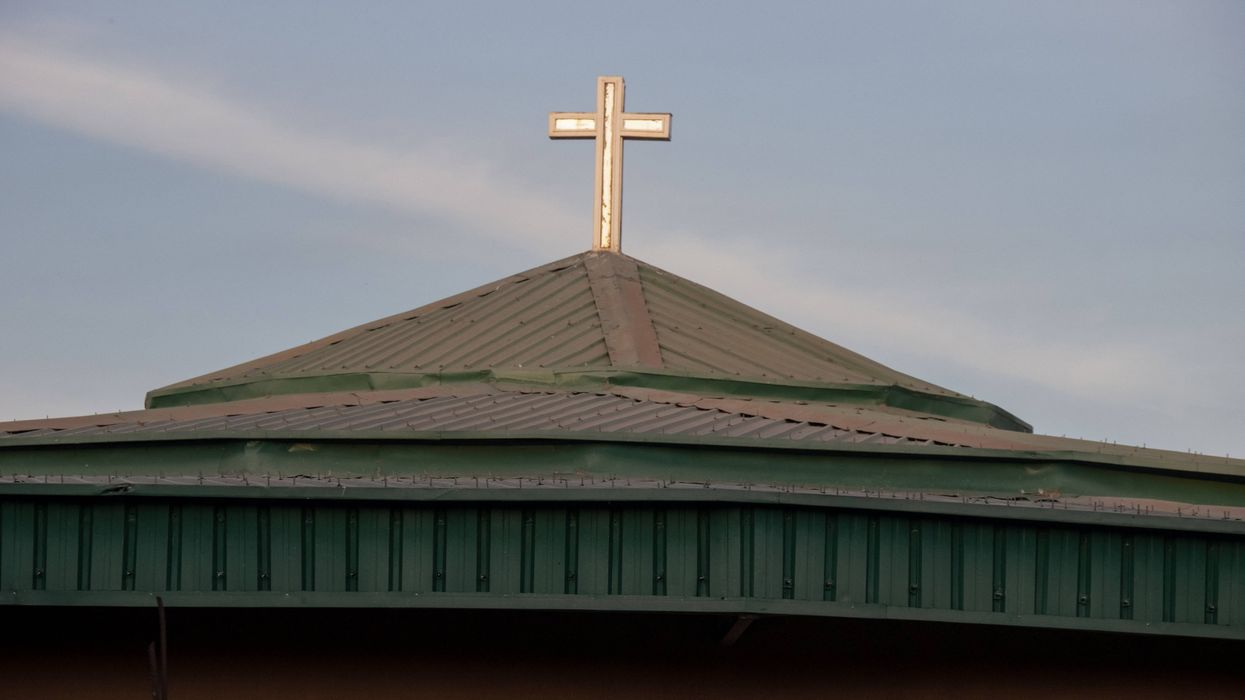
“Portraying Nigeria’s security challenges as a targeted campaign against a single religious group is a gross misrepresentation of reality,” said Nigeria's information minister.
When President Donald Trump launched a series of airstrikes in Nigeria on Christmas, he described it as an attack against "ISIS Terrorist Scum in Northwest Nigeria who have been targeting and viciously killing, primarily, innocent Christians."
But locals in a town that was hit during the strike say terrorism has never been a problem for them. On Friday, CNN published a report based on interviews with several residents of Jabo, which was hit by a US missile during Thursday's attack, which landed just feet away from the town's only hospital.
The rural town of Jabo is part of the Sokoto state in northwestern Nigeria, which the Trump administration and the Nigerian government said was hit during the strike.
Both sides have said militants were killed during the attack, but have not specified their identities or the number of casualties.
Kabir Adamu, a security analyst from Beacon Security and Intelligence in Abuja, told Al Jazeera that the likely targets are members of “Lakurawa,” a recently formed offshoot of ISIS.
But the Trump administration's explanation that their home is at the center of a "Christian genocide" left many residents of Jabo confused. As CNN reported:
While parts of Sokoto face challenges with banditry, kidnappings and attacks by armed groups including Lakurawa–which Nigeria classifies as a terrorist organization due to suspected affiliations with [the] Islamic State–villagers say Jabo is not known for terrorist activity and that local Christians coexist peacefully with the Muslim majority.
Bashar Isah Jabo, a lawmaker who represents the town and surrounding areas in Nigeria's parliament, described the village to CNN as “a peaceful community” that has “no known history of ISIS, Lakurawa, or any other terrorist groups operating in the area.”
While the town is predominantly Muslim, resident Suleiman Kagara, told reporters: "We see Christians as our brothers. We don’t have religious conflicts, so we weren’t expecting this."
Nigeria, Africa's most populous nation with more than 237 million people, has a long history of violence between Christians and Muslims, with each making up about half the population.
However, Nigerian officials have disputed claims by Republican leaders—including US Sen. Ted Cruz (Texas)—who have claimed that the government is “ignoring and even facilitating the mass murder of Christians.”
The senator recently claimed, without citing a source for the figures, that "since 2009, over 50,000 Christians in Nigeria have been massacred, and over 18,000 churches and 2,000 Christian schools have been destroyed" by the Islamist group Boko Haram.
Cruz is correct that many Christians have been killed by Boko Haram. But according to reports by the US-based Armed Conflict Location and Event Data Project and the Council on Foreign Relations, the majority of the approximately 53,000 civilians killed by the group since 2009 have been Muslim.
Moreover, the areas where Boko Haram is most active are in northeastern Nigeria, far away from where Trump's strikes were conducted. Attacks on Christians cited in October by Cruz, meanwhile, have been in Nigeria's Middle Belt region, which is separate from violence in the north.
The Nigerian government has pushed back on what they have called an "oversimplified" narrative coming out of the White House and from figures in US media, like HBO host Bill Maher, who has echoed Cruz's overwrought claims of "Christian genocide."
“Portraying Nigeria’s security challenges as a targeted campaign against a single religious group is a gross misrepresentation of reality,” said Nigerian information minister Mohammed Idris Malagi. “While Nigeria, like many countries, has faced security challenges, including acts of terrorism perpetrated by criminals, couching the situation as a deliberate, systematic attack on Christians is inaccurate and harmful. It oversimplifies a complex, multifaceted security environment and plays into the hands of terrorists and criminals who seek to divide Nigerians along religious or ethnic lines."
Anthea Butler, a religious scholar at the University of Pennsylvania, has criticized the Trump administration's attempts to turn the complex situation in Nigeria into a "holy war."
"This theme of persecution of Christians is a very politically charged, and actually religiously charged, theme for evangelicals across the world. And when you say that Christians are being persecuted, that’s a thing," she told Democracy Now! in November. "It fits this sort of savior narrative of this American sort of ethos right now that is seeing itself going into countries for a moral war, a moral suasion, as it were, to do something to help other people."
Nigeria also notably produces more crude oil than any other country in Africa. Trump has explicitly argued that the US should carry out regime change in Venezuela for the purposes of "taking back" that nation's oil.
Butler has doubted the sincerity of Trump's concern for the nation's Christians due to his administration's denial of entry for Nigerian refugees, as well as virtually every other refugee group, with the exception of white South Africans.
She said: "I think this is sort of disingenuous to say you’re going to go in and save Christianity in Nigeria, when you have, you know, banned Nigerians from coming to this country."
"The IAEA, which did not even formally condemn the attack on Iran’s nuclear facilities, has put its international credibility up for sale," said Iran's parliament speaker, Mohammad Baqer Qalibaf.
The Iranian parliament approved a bill Wednesday suspending its cooperation with the International Atomic Energy Agency (IAEA).
The resolution states that weapons inspectors with the United Nations nuclear watchdog organization will not be allowed to enter the country unless it guarantees the security of Iran's nuclear facilities and their ability to pursue peaceful nuclear activities.
Ahead of the vote, lawmakers denounced the IAEA, accusing it of enabling U.S. airstrikes on Iranian nuclear facilities Saturday—strikes Iran, as well as other observers of international law, have denounced as a clear violation of its sovereignty.
"The IAEA, which did not even formally condemn the attack on Iran’s nuclear facilities, has put its international credibility up for sale," said Iran's parliament speaker, Mohammad Baqer Qalibaf. "For this reason, the [Atomic Energy Organization of Iran] will suspend its cooperation with the Agency until the security of its nuclear facilities is guaranteed, and Iran's peaceful nuclear program will proceed at an even faster pace."
In response to the resolution, IAEA chief Rafael Grossi said that "the return of inspectors to Iran's nuclear facilities is a top priority."
Independent inspectors have not yet been able to inspect the damage to the three nuclear sites—Fordow, Natanz, and Esfahan—hit by the U.S.
Following the strikes, U.S. President Donald Trump claimed that Iran's nuclear sites were "completely and fully obliterated."
However, reporting by CNN and The New York Times on Tuesday, based on unnamed sources familiar with an internal assessment by the U.S. Defense Intelligence Agency, undercut that claim, stating that the strikes only set back Iran's nuclear program by a matter of months.
Grossi said Monday that the airstrikes likely inflicted "very significant damage" at Fordo, but that no conclusions could be reached until independent inspectors are allowed to examine the site and account for Iran's uranium stockpile.
The latest IAEA report issued on May 31 found "no credible indications of an ongoing, undeclared structured nuclear program" being pursued by Iran—a finding echoed by U.S. intelligence agencies.
However, the IAEA did find that Iran had significantly increased its uranium stockpile enriched to 60%, near weapons-grade, which it said was a violation of the Nuclear Non-Proliferation Treaty (NPT).
Despite no "imminent threat," according to the most recent intelligence assessments, the Trump administration cited those IAEA findings to justify its attacks.
As a result, Iran's nuclear organization has questioned the IAEA's credibility as a neutral broker, accusing them of "deliberate inaction," following American and Israeli strikes. It said in a statement Sunday that these strikes were carried out "with the IAEA's silence, if not complicity."
Some critics have argued that the IAEA's decision to declare Iran in violation of the NPT was the result of significant U.S. arm-twisting and that the IAEA has not applied similar scrutiny to Israel's nuclear weapons program.
Iran maintains that its nuclear program is entirely peaceful and that strikes upon its nuclear facilities violate the NPT, which grants countries an "inalienable right" to develop nuclear energy for nonmilitary purposes.
Nuclear experts warn that the U.S. strikes on Iran have undermined the credibility of the NPT, prompting some factions in Iran to call for the nation's exit altogether.
Kelsey Davenport, the director for nonproliferation policy at the Arms Control Association, suggested Monday that U.S. attacks may only embolden Iran and other nations to violate the treaty and pursue nuclear weapons, perceiving them as necessary for their protection.
"From a nonproliferation perspective, Trump's decision to strike Iran was a reckless, irresponsible escalation that is likely to push Iran closer to nuclear weapons in the long term," Davenport said. "Politically, there's greater impetus now to weaponize."
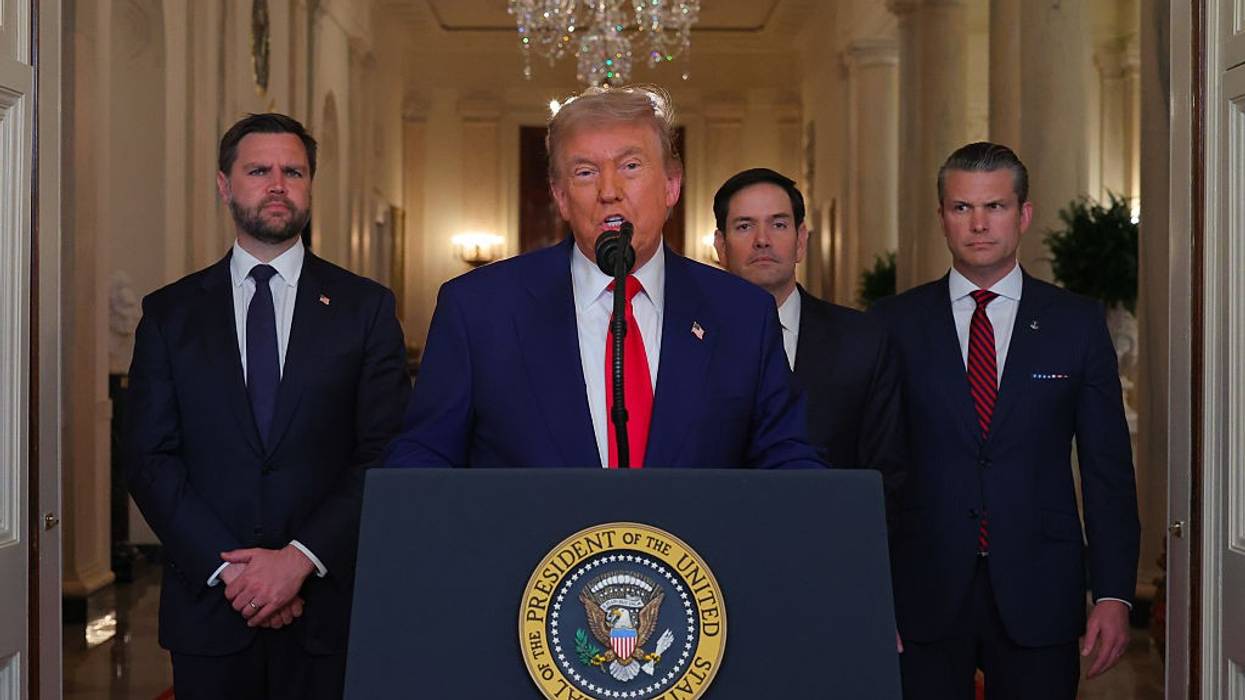
Trump campaigned to stop "endless war," but now he's bringing the U.S. into a dangerous new one.
During his run to retake the White House in 2024, U.S. President Donald Trump promised to avoid "endless war" and serve as a "peace president."
"We will measure our success not only by the battles we win," Trump said during his second inaugural address in January, "but also by the wars that we end and, perhaps most importantly, the wars that we never get into."
But after he launched airstrikes on Iranian nuclear sites and called for "regime change" this weekend, critics accused him of blatantly misleading the American public.
"Trump, who proclaimed upon his inauguration he wanted to be remembered as a 'peacemaker,' couldn't even wait a half a year into his term to do the thing that he had told everyone he wouldn’t do, and which he built his entire political brand on opposing," wrote columnist Branko Marcetic in Jacobin.
On the campaign trail, Trump lambasted his predecessor, Joe Biden, as a "warmonger," promising to end the conflicts in Ukraine and Gaza. However, both conflicts not only continue to rage, but have grown bloodier.
Massacres by Israel Defense Forces soldiers in U.S.-administered aid sites have ramped up in recent months as Israel advances with what Prime Minister Benjamin Netanyahu described in February as "U.S. President Trump's plan for the creation of a different Gaza.”
As Trump has abandoned talks with Ukrainian President Volodymyr Zelenskyy, Russian aerial attacks on Ukraine have likewise surged in recent weeks. Shortly after Trump's airstrikes on Iran, the Kremlin launched over 300 drones and dozens of missiles at Kyiv, leaving seven people dead and 31 injured, according to The Washington Post.
"Trump said he could end Russia’s war against Ukraine before his inauguration. He said he would negotiate an end to the war in Gaza with a phone call," wrote civil and labor rights leader Rev. Dr. William J. Barber II on X. "He said Biden was going to drag the US into World War III, but he would be a peace president. It was all lies."
Since he entered the political arena Trump has railed against the wars launched by former President George W. Bush. On the Republican primary debate stage in 2015, he described the Iraq War as a "big, fat mistake," building his credibility with Americans seeking a break from the GOP's interventionist foreign policy consensus.
After Trump's airstrikes on Saturday, his associates attempted to downplay the obvious comparisons with Bush's disastrous legacy.
Vice President JD Vance—who on the campaign trail called out Democratic presidential nominee Kamala Harris' coziness with Bush's vice president, Dick Cheney, and his ex-congresswoman daughter, Liz Cheney—went on NBC to do damage control and explain how Trump's actions were somehow different from those of the 43rd president.
"I empathize with Americans who are exhausted after 25 years of foreign entanglements in the Middle East. I understand the concern," he said. "But the difference is that back then we had dumb presidents and now we have a president who actually knows how to accomplish America's national security objectives."
Defense Secretary Pete Hegseth and Secretary of State Marco Rubio both assured the public that this would not be another war of "regime change," like Bush waged in Iraq.
But Trump thoroughly undermined their claims on Sunday night, when he posted on Truth Social: "It's not politically correct to use the term, 'Regime Change' but if the current Iranian Regime is unable to MAKE IRAN GREAT AGAIN, why wouldn't there be a Regime change??? MIGA!!"
In a Sunday column for The Guardian, Mohamad Bazzi, director of the Kevorkian Center for Near Eastern Studies and an associate professor of journalism at New York University, argued that Trump is following Bush's model.
" Donald Trump has dragged the U.S. into another war based on exaggerations and manipulated intelligence," Bazzi wrote. "The people of the Middle East will pay the highest price for yet another reckless war built on a lie."
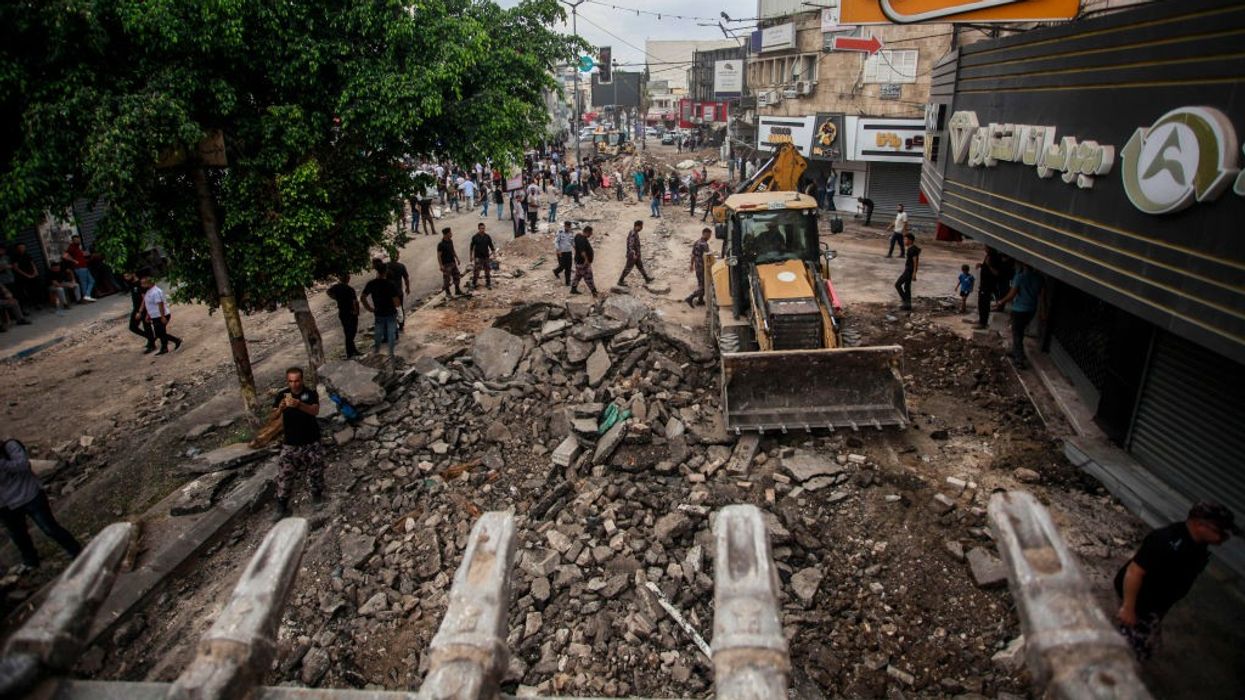
"We watched their bulldozers tear up streets, demolish businesses, pharmacies, schools," said one local leader. "They even bulldozed the town soccer field, and a tree in the middle of a road."
As the world watched Israel's assaults on Lebanon and the Gaza Strip, The New York Times on Wednesday also directed attention to the West Bank, detailing how "Israeli military bulldozers tore up mile after mile" of Jenin and Tulkarm in recent weeks.
While "nearly nightly raids" by the Israel Defense Forces (IDF) "have become the norm" in the West Bank since the Hamas-led October 7 attack, the military last month "launched one of its most extensive and deadliest raids" in the illegally occupied Palestinian territory in years, the newspaper reported, citing videos and interviews with residents.
"We watched their bulldozers tear up streets, demolish businesses, pharmacies, schools. They even bulldozed the town soccer field, and a tree in the middle of a road," said Kamal Abu al-Rub, governor of Jenin. "What was the point of all of this?"
In addition to ground operations in the West Bank, the IDF has increased airstrikes that critics say run afoul of international law. The military defended the strikes and told the Times that in recent raids, troops found weapon stockpiles and killed or arrested dozens of militants—but also caused some "unavoidable harm to certain civilian structures."
In response to videos included in the reporting, freelance journalist Pete Tucker accused Israeli soldiers of "methodically laying waste to" the West Bank.
Malini Ranganathan, an associate professor at American University's School of International Service, said on social media that "Israel's criminality knows no limits. IDF bulldozers have been obliterating the West Bank, even tearing up roundabouts."
Israeli forces have damaged homes, shops, and roads along with internet, electricity, phone, water, and sewage lines in the West Bank. Emergency crews have been unable to respond to hundreds of calls per day, because they can't reach people in need.
"They are imposing conditions, materially and psychologically, that make people feel: Gaza is coming to you," Al Haq director Shawan Jabarin told the Times. "There is a feeling among Palestinians across the West Bank that what is coming is very bad—that it will be a plan to kill and expel us."
Since the October 7 attack on Israel that killed more than 1,100 people, Israeli forces have slaughtered at least 41,455 Palestinians in Gaza and 716 in the West Bank. Across the Palestinian territories, over 100,000 others have been injured over the past year. The bloodshed led to an ongoing genocide case at the International Court of Justice (ICJ).
The ICJ in July issued a nonbinding advisory opinion that Israel's decadeslong occupation of Gaza and the West Bank, including East Jerusalem, is illegal and must end "as rapidly as possible." Instead, Israel has ramped up attacks on not only the Palestinian territories, but also Lebanon, home to the political and paramilitary group Hezbollah.
This week's bombing campaign in Lebanon—which has killed at least 569 people—sparked fresh calls for the Biden administration to finally cut off weapons to Israel, as did the new reporting from the Times, which has been accused of pro-Israel bias in its coverage of the assault on Gaza.
Meanwhile, Israeli destruction in the West Bank continues. The International Middle East Media Center reported that "on Wednesday, Israeli soldiers invaded the town of Beit Ula, west of Hebron in the occupied West Bank's southern part, [and] bulldozed over 20 dunams of land, uprooting more than 600 fruit-bearing trees, and demolishing several agricultural structures and wells."
As war continues to rage uninterrupted in Yemen, a humanitarian pause is badly needed as the country spirals down to chaos, leaving the majority of the population in urgent need of medical care. Restrictions on access to medical supplies and care are key impediments to improving the situation of people in need. A five-day humanitarian pause would allow supplies and care to reach those people and relieve their dire health situation.
At the same time, attacks on health facilities continue. Last October, the World Health Organization (WHO) condemned the bombing of a Medecins Sans Frontieres' (MSF) supported hospital in Saada province in northern Yemen. MSF believes that, as a consequence, 200,000 people were left without medical care. That attack, which violated International Humanitarian Law, was the second one on an MSF-run facility in a month.
Since the beginning of Saudi Arabia's attacks on Yemen, conducted with U.S. support, more than 5,700 have died (almost half of them civilians) -including hundreds of women and children- and 28,753 injuries have been reported. Several health workers have also been killed, and 47 health facilities in 11 governorates have been damaged or closed as a result of the continuous violence.
Healthcare services in all public hospitals have been reduced, especially operating theaters and intensive care units. At the same time, disrupted immunization activities have increased the risks for measles and poliomyelitis, even though Yemen is presently free of polio. The breakdown of the water supply and sanitation systems has facilitated the spread of diseases such as malaria and dengue fever, as well as acute diarrheal diseases, particularly affecting children. Also, the early warning alert system for diseases has been seriously affected because of limited communication possibilities.
The country has one of the highest rates of chronic malnutrition in the world. According to UNICEF, 1.3 million Yemeni children younger than five years now suffer from acute malnutrition, compared to 850.000 before the war started. 320.000 are severely malnourished, twice the amount before the crisis. The little cash people have is to pay for food and gas -at greatly increased prices- leaving no money to afford health care.
The Lancet reports that approximately a quarter of the country's healthcare facilities are no longer functional. To make matters worse, Ronald Kremer from MSF says, "People do not dare to go to hospitals because they are afraid that they are targeted, and even if they want to go,, they may not have the means—even where public transport does exist, it is very expensive because of the fuel problems."
Fuel problems have increased the difficulty of obtaining clean water. The lack of a proper water supply and dire sanitation and hygiene have led to outbreaks of dengue and malaria. Many Yemenis store water in open containers, which becomes an ideal breeding ground for disease-transmitting mosquitoes.
So far, there are more than 2.5 million people who have become internally displaced persons (IDPs). To compound an already difficult situation, disrupted immunization campaigns have led to an increasing number of children affected with measles and rubella, particularly among IDPs living in overcrowded conditions. As a result of the conflict, many hospitals, laboratories, health warehouses, and administrative offices have closed. Primary care facilities have minimum access to medicines, supplies, and equipment. The fuel shortage has affected the proper operations of ambulances.
In this situation, a humanitarian pause is urgently needed. As proposed by the World Health Organization, a five-day pause would allow humanitarian organizations to respond to some of the most life-threatening needs of the people, particularly women and children caught in the middle of the conflict. An MSF doctor taking care of a badly hurt child in Syria realized that the child was desperately trying to tell him something. When he asked his translator what the child was saying, the translator responded, "Don't they realize that we are children?" A similar question could be asked in Yemen today.
Although the Saudis have promised a high-level committee to investigate civilian deaths from their airstrikes in Yemen, they continue to strike civilian targets with countless deaths and destructions.
For instance, among those recently killed in an airstrike on an abandoned cement factory were "people in parked cars, a grocery store owner, a pharmacist, and shoppers." The nationalist insurgents, the Houthis, have also unfortunately contributed to the increased casualties as they try to repel the invaders and defeat the local groups opposed to them.
"To add to the misery of the Yemeni people, the United States just approved the sale of weapons to the Saudis worth $1.3 billion."
The civil war in Yemen, compounded by the Saudi invasion, has so far displaced 2.3 million people. It has left 5,700 dead, among them 2,500 civilians. Two-thirds of the deaths have resulted from airstrikes. And 82% of the population requires assistance and medical supplies. The United States fears that 14.4 million Yemenis are at risk of "severe hunger."
To add to the misery of the Yemeni people, the United States just approved the sale of weapons to the Saudis worth $1.3 billion. Among the weaponry are air-to-ground ordinances that included 22,000 bombs. From 2010 to 2014, the United States sold $90 billion worth of weapons to Saudi Arabia. Initially, among the U.S. weapons sold to the Saudis were the internationally banned cluster bombs.
The Saudis have feared Yemen for a long time. They worry that the Houthis and their allies will destabilize the Saudi regime and export revolutionary zeal to the Saudi people. The fear of losing their power is why the Saudi royals, with the help of the majority Sunni regimes in the Gulf, launched an air and ground war against Yemen. Riyadh hopes to reinstate the former government of President Abd-Rabbu Mansoor Hadi and make Yemen a satellite country of Saudi Arabia. Facing an onslaught by the highly equipped Saudi forces with American help, the Houthis were obliged to ally with the unsavory former president, Ali Abdullah Saleh, to defend Yemen. Although calls for talks have gone nowhere, a new effort is underway to hold negotiations in Europe under the auspices of the UN.
"The United States bears the moral and legal responsibility for facilitating a potential genocide in Yemen that results from the current war and the population's lack of food, basic health, and sanitation."
The Saudis have made the poorly supported claim that they are fighting a proxy war with Iran in Yemen. Unfortunately, the Obama administration parrots these lies in its official statements, which the major media then repeat. The Saudis and the Gulf States have conjured up Iranian involvement to justify their war on Yemen. In the meantime, al-Qaeda is deepening its roots and widening its reach in and around the country.
US support for the Saudi regime has continued despite the invasion and the resulting humanitarian disaster. The United States provides the Saudis with intelligence and helps to enforce the current naval blockade. Moreover, in January, Secretary John Kerry said, "We have as solid a relationship, as clear an alliance, and as strong a friendship with the Kingdom of Saudi Arabia as we ever had, and nothing has changed." Kerry's level of support for the Saudis contrasts sharply with the U.S. claims of supporting freedom, democracy, and human rights worldwide.
Yemen is one of the poorest countries in the world. The Saudis and the Gulf states are some of the richest countries in the world. And yet the Saudis, the Gulf States, and the United States are destroying Yemen, which had been a potential outpost of democracy in the region. Again, the United States derailed a potential democracy to serve a totalitarian regime, Saudi Arabia.
The United States bears the moral and legal responsibility for facilitating a potential genocide in Yemen that results from the current war and the population's lack of food, essential health, and sanitation. The United States keeps wondering why the people of the region continue to harbor the worst terrorists. The reason lies in part because the United States has chosen alliances with dictators for the sake of oil and the stability of corrupt regimes.
A U.S. military attack that killed nearly a dozen Iraqi soldier allies was a "mistake," Defense Secretary Ash Carter admitted on Saturday.
"These kinds of things happen when you're fighting side by side as we are," Carter told reporters of Friday's airstrike near Falluja, which killed an estimated 10 people.
One U.S. military official told CBS that the attack was reportedly made in coordination with Iraqi forces and that bad weather could have been a factor in the accident. "The folks on the ground who we were communicating with were closer to the targeting area than we understood," the official said.
CBS continues:
Asked if he was worried the deaths might further anger Iraqi citizens who may not be happy with the American and coalition presence in Iraq, Carter said, "I hope Iraqis will understand that this is a reflection of things that happen in combat. But it's also a reflection of how closely we are working with the government" of Iraq.
No other details of the attack were provided, though a U.S. military statement indicated it was one of a number of strikes that occurred that day.
Update 5:15 PM Eastern Standard Time:
Doctors Without Borders/Medecins Sans Frontieres confirmed Tuesday afternoon that one of its small hospitals, located in the Haydan district in Saada Province, "was hit by several airstrikes beginning at 10:30 p.m. last night."
"Hospital staff and two patients managed to escape before subsequent airstrikes occurred over two hours," the organization said in a statement. "One staff member was slightly injured while escaping. With the hospital destroyed, at least 200,000 people now have no access to lifesaving medical care."
Hassan Boucenine, MSF head of mission in Yemen, denounced the attack as "another illustration of a complete disregard for civilians in Yemen, where bombings have become a daily routine."
Earlier:
A Doctors Without Borders/Medecins sans Frontieres (MSF) hospital in northern Yemen was bombed Monday night by the Saudi Arabia-led military coalition.
Tim Shenk, press officer for MSF, confirmed to Common Dreams that the active medical facility, based in the Saada governorate, has been hit. The strike was initially reported by the aid agency's Yemen bureau, which noted that there were several patients and staff members in the facility at the time of the attack.
"Our hospital in the Heedan district of Saada governorate was hit several times. Fortunately, the first hit damaged the operations theater while it was empty, and the staff were busy with people in the emergency room. They just had time to run off as another missile hit the maternity ward," MSF country director Hassan Boucenine told Reuters.
"It could be a mistake, but the fact is it's a war crime. There's no reason to target a hospital," Boucenine continued. "We provided (the coalition) with all of our GPS coordinates about two weeks ago."
The bureau also released images of the facility following the bombing:
This is not the first such attack. Since the Saudi-led and U.S.-backed military campaign began over six months ago, the coalition has bombed medical facilities, markets, schools, power plants, refugee camps, factories, and warehouses storing humanitarian supplies. In addition, the Saudi-led naval blockade has left 80 percent of Yemen's population in dire need of food, water, and medical assistance, according to aid agencies.
The World Health Organization estimates that the conflict has so far killed roughly 5,600 people, the majority of them civilian. According to a recent report by Action On Armed Violence and the United Nations Office for the Coordination of Humanitarian Affairs, in 2015, 93 percent of people killed or wounded in populated areas as a result of "air-launched explosive weapons" were civilians.
The Saudi-led coalition is responsible for the vast majority of these killings. The office of the United Nations High Commissioner for Human Rightsreported last month that "almost two-thirds of reported civilian deaths had allegedly been caused by coalition airstrikes, which were also responsible for almost two-thirds of damaged or destroyed civilian public buildings."
Monday's bombing comes just over three weeks after the U.S. military bombed a functioning MSF hospital in Kunduz, Afghanistan, killing at least 30 people.
I just watched the 5 pm news hour on CNN anchored by Wolf Blitzer, and the editors had decided that the lead was that the Russian bombing in south Aleppo risks creating a new wave of refugees. They also stuck to the cover story that the Russians are only attacking the "moderate rebels."
American bombing of populated areas has never been reported in that way on mainstream cable news. The US bombing that killed Sanafi al-Nasr said to have been the no. 2 man in the Syrian branch of al-Qaeda, the Support Front, was reported on the same show as a great victory. But was he in a completely deserted area? Were any civilians killed around him? It has now come out that most US drone strikes don't even kill the intended target; probably, it is the landlord's family that mainly dies. Was al-Nasr a renter?
Nor did CNN lead with civilian casualties when it covered Israeli PM Netanyahu's bombardment of defenseless little Gaza in the summer of 2014.
Russian bombing of populated areas, like all such bombing, is killing civilians, of course. The point isn't that CNN is wrong but that it is selective.
Whether Russian bombing is more or less egregious than any other can could be debated. I suspect it is less egregious than the Syrian air force, though that wouldn't be saying much. Robert Fisk reports that the Syrian Arab Army is frustrated with the Russians precisely because their air force is very cautious about civilian casualties:
"The Syrians have found that the Russians do not want to fire at targets in built-up areas; they intend to leave burning hospitals and dead wedding parties to the Americans in Afghanistan. This policy could always change, of course. No air force bombs countries without killing civilians. Nor without crossing other people's frontiers. But the Russians are now telling the Turks - and by logical extension, this information must go to the Americans - their flight coordinates."
Note that the Syrian regime has been dropping barrel bombs on civilian areas for years now, and no CNN news hour has begun with this headline. It appears to me that they mind when Russia bombs but not when anyone else does. I should underline that I oppose the Russian intervention in Syria and think it will likely go to dark places. But I also insist that it be reported and analyzed exactly as the actions of the US and its allies are. And this is not the case. The Fisk point of view should be noted, as I just did, even if one has reservations about it (as I do).
As for the "moderate rebels," who have suddenly reappeared in American official discourse only after Russia intervened, former Chairman of the Joint Chiefs of Staff Gen. Martin Dempsey wrote Congress in the fall of 2013 that he did not want to intervene in Syria because he could not be sure that the victorious rebels would support US interests:
" In an August 19 letter to Representative Eliot Engel, obtained by the Associated Press, Gen. Dempsey effectively ruled out even limited intervention, including US cruise missile attacks and other options that wouldn't require US troops on the ground. "Syria today is not about choosing between two sides but rather about choosing one among many sides," he said. "It is my belief that the side we choose must be ready to promote their interests and ours when the balance shifts in their favour. Today, they are not."
What he was saying was that by the middle of 2013, the democratic forces in the Free Syrian Army had either collapsed or their units had joined or closely allied with one of the two major al-Qaeda offshoots, Daesh (ISIS, ISIL) or the Support Front (Jabhat al-Nusra, which reports to al-Qaeda 9/11 mastermind Ayman al-Zawahiri).
There are many small rebel groups in the hinterlands of Homs, Hama, and Aleppo, as well as in Idlib province, who are not al-Qaeda. But most have become hard-line Salafis a la Saudi Arabia who want Sharia law and allow how they might not kill all the Alawis, Christians, Druze, and other minorities that come under their rule but keep them as second-class citizens under a dictatorship. Some are still Muslim Brotherhood, some of whom want a Muslim state but with elections.
However, these groups are small and not very effective fighters and have been forced to ally with al-Qaeda to avoid being killed by the Syrian Arab Army and in hopes of taking more territory. Moreover, the amount of Syrian territory now held by rebels who want democratic elections and full legal equality for all Syrians would be, in my estimation, zero percent. Almost all Syrian rebels now want a society ruled by Sharia or a hard-line medieval notion of Islamic law. (Sharia itself, as private practice and individual choice, is as inoffensive as Jewish Halakha or Roman Catholic canon law, but making a fundamentalist interpretation of it the basis for national law is a whole set of human rights crimes waiting to happen).
Note the irony. The same GOP politicians who denounce all US Muslims for allegedly wanting to impose Sharia or Muslim law on all Americans are talking about the Syrian rebels who want a Sharia society as "moderates" and "US allies" being targeted by Russia. (The allegation about American Muslims, who, in my experience, love the US Constitution half to death, is incorrect).
When Wolf Blitzer interviewed Rep. Adam Schiff, he asked a leading question about the Russians attacking the "moderate rebels." Schiff concurred that that was what Moscow was doing and spoke of these forces as being backed by US allies in the Gulf. He did, however, veer off script by admitting that Russia is also attacking al-Qaeda in Syria. He complained, however, that Russia is not attacking Daesh/ ISIL.
Russia is, of course, occasionally bombing Daesh. However, that organization mainly holds territory in the country's far east, away from the western population centers. It is Syrian al-Qaeda that holds a great deal of Idlib Province and spearheads the Army of Conquest coalition of Salafi jihadis who control the rest of Idlib Province.
So why is it objectionable that Russia is attacking an organization reporting to al-Qaeda chief Ayman al-Zawahiri, who killed nearly 3,000 Americans in 2011? Or that Russia is attacking groups that have political or tactical alliances with al-Qaeda in Syria? Wouldn't that make them like the Taliban in Afghanistan? Is the US wrong to bomb the latter because they were only allied with al-Qaeda?
And how can the same news hour report positively on the killing by American bombing of al-Qaeda's al-Nasr and slam the Russians for bombing . . . al-Qaeda?
This isn't news reporting. This is government propaganda.
The US response to Russia's new Syrian military campaign in support of the Assad regime has struck a pose of moral superiority by arguing that the Russians have not been targeting the Islamic State but rather the non-ISIS Syrian opposition to the Assad regime.
That US response is superficially accurate but deliberately misleading. Although the Russians are not focusing on targets in ISIS-controlled territory, there is a very good reason: it is not ISIS but the forces aligned with al-Qaeda's Syrian franchise, Jabhat al-Nusra or al-Nusra Front, that pose the most immediate threat to the very existence of the Assad regime.
In a series of statements on the Russian military campaign, the US Defence Department has hammered the Russians for not targeting ISIS as Moscow initially claimed. Later on, the Russian rhetoric shifted to "terrorists." The US statements strongly implied that it was the US-backed "moderate" Syrian groups opposed to the Assad regime that was being attacked.
Major news media have taken the same line in covering the Russian offensive. In an Associated Press story on 13 October, for example, Ken Delanian described the CIA as supplying "so-called moderate rebels to oppose Assad" for more than two years, along with its "Arab allies," and that American officials "have watched in recent days as the Russian bombs and missiles have targeted those groups."
Delanian even quoted Jeffrey White of the Washington Institute for Near East Policy (WINEP), the think tank supporting Israeli interests, who complained that the United States had abandoned its moderate allies. "We've aligned ourselves to these guys; we trained them and paid them and sent them off to battle, and when the going gets tough, we're not there," said White.
But this framing of the issue fundamentally misrepresents the situation in Syria by conjuring up a non-existent powerful US-backed "moderate" force while diverting attention from the real threat posed by al-Qaeda's Syrian franchise. The Russians are not hitting some imaginary set of "moderate" Syrian armed groups opposing the Assad regime; they are overwhelmingly focused on targeting the military command in which the al-Nusra Front is the central strategic force.
The maps pinpointing the locations of the Russian strikes since 30 September published in various newspapers and on the website of the Institute for Study of War - the source for the other maps - all show very clearly that they are overwhelmingly concentrated in Idlib province the adjoining Hama province, and areas of Latakia province near Idlib. But that fact does not take on significance unless it is recalled that the al-Nusra Front - al Qaeda's franchise in Syria - and the "Army of Conquest" linked to it unexpectedly took control of Idlib province in a major military offensive in March.
The victory in Idlib was widely reported at the time as the biggest turning point in the Syrian war in well over two years and represented by far the most serious challenge to the Assad regime since the beginning of the war. Although several smaller commands were involved in the Idlib offensive, the al-Nusra Front's 3,000 troops represented most of the forces involved in the fight. According to a well-informed source, al-Nusra and its close jihadist ally Ahrar al-Sham accounted for 90 percent of the troops.
We now know, moreover, that the Idlib campaign was the direct result of a policy decision by Saudi Arabia and Qatar, with US approval, to support the creation of the "Army of Conquest" and provide it with new military hardware that was a crucial factor in that campaign: the TOW anti-tank missile. Liz Sly of the Washington Post revealed in a story on 11 October that TOW missiles had been delivered to Syrian armed groups under a program coordinated between the CIA and the Saudis. Sly further notes that the CIA-supplied TOW missiles were so important to rebels who made "gains in northwest Syria" that they have called the missile the "Assad Tamer."
"It is no accident," Sly reported, "that the first targets of Russian airstrikes in Syria were the locations where rebels armed with TOW missiles have made the most substantial gain and where they most directly threaten Assad's hold on power." That is an obvious reference to the forces that took over Idlib province in March. But Sly never refers to the "Army of Conquest" victory in Idlib or acknowledges that the al-Nusra Front was the principal benefactor of the CIA program. Her story quotes a proponent of the program, former US ambassador Robert Ford, as assuring us that the system prevented the missiles from "falling into extremist hands" and that he was aware of only two TOW missiles having been obtained by al-Nusra.
Sly reported a very different story in March, however, after the dissolution of Harakat Hazm, the main CIA-supported "moderate rebel group" remaining in the north, following its complete defeat by al-Nusra Front. The victorious al-Nusra announced publicly, according to Sly's report, that it had seized the TOW anti-tank missiles the CIA had supplied to Harakat Hazm when it occupied the group's headquarters near Aleppo. Moreover, the Saudis reportedly had ownership of TOW missiles, and they and the Qataris had already been funneling arms to the al-Nusra Front, as Vice-President Joe Biden revealed in October 2014.
It is astonishing that at this late date, anyone in the media could still be seriously suggesting that the CIA somehow managed to turn the "moderate" Syrian rebels into a powerful offensive force threatening the Assad regime in the north. Since the Idlib victory, it is generally understood that the primary threat to drive the Assad regime from power comes from the al-Nusra Front and the forces allied with it, and not from the Islamic State - and certainly not the mythical "moderate rebels."
It is easy to understand why the Obama administration is not interested in discussing al-Nusra's role in the present Syrian political-military situation. According to Sly's source, the covert operation to provide the TOW missiles to the Army of Conquest was aimed at putting "sufficient pressure on Assad's forces to persuade him to compromise but not so much that his government would precipitously collapse and leave a dangerous power vacuum."
The Obama administration strategy on Syria assumed a degree of control that is so obviously unrealistic that it was inherently risky to the point of recklessness. That is why no one in the administration or the news media is discussing the reality that the Russian offensive is targeting the biggest jihadist threat to the Assad regime.