

SUBSCRIBE TO OUR FREE NEWSLETTER
Daily news & progressive opinion—funded by the people, not the corporations—delivered straight to your inbox.
5
#000000
#FFFFFF
To donate by check, phone, or other method, see our More Ways to Give page.
Daily news & progressive opinion—funded by the people, not the corporations—delivered straight to your inbox.

Kabul reacted with outrage and demanded clarification Tuesday after U.S. President Donald Trump said he has military plans that could wipe Afghanistan "off the face of the Earth," killing millions of people.
Following Trump's remarks, the office of Afghan President Ashraf Ghani said in a statement that Afghanistan "will never allow any foreign power to determine its fate."
"While the Afghan government supports the U.S. efforts for ensuring peace in Afghanistan," the statement read, "the government underscores that foreign heads of state cannot determine Afghanistan's fate in absence of the Afghan leadership."
Trump's comments came during a meeting in the Oval Office Monday with Pakistani Prime Minister Imran Khan.
"We're not fighting a war," Trump said of the U.S.-led conflict that has lasted nearly 18 years, the longest war in American history. "If we wanted to fight a war in Afghanistan and win it, I could win that war in a week. I just don't want to kill 10 million people."
"I have plans on Afghanistan that, if I wanted to win that war, Afghanistan would be wiped off the face of the Earth. It would be gone," the president added. "It would be over in, literally, in 10 days. And I don't want to do that--I don't want to go that route."
Watch:
The Afghan public expressed revulsion at Trump's remarks, which came as U.S. envoy to Afghanistan Zalmay Khalizad arrived in the Middle East for talks with the Taliban.
Shakib Noori, an entrepreneur based in Kabul, told Reuters that Trump's comments were "embarrassing and an insult to all Afghans."
Afghan-American author Khaled Hosseini expressed a similar sentiment, calling Trump's statement "reckless" and "appalling."
Rahmatullah Nabil, former Afghan intelligence chief and presidential candidate, slammed Trump on Twitter.
"Your insulting message to [Afghanistan]," Nabil wrote, "is either accept the [Pakistan] proposal for peace or eventually you may have to use nukes."

It's difficult to explain the nature of the Afghanistan peace talks. There is no single table with the combatants arrayed on either side. Talks are not even taking place in the same city, since there are at least two sets of discussions ongoing. One location for the peace talks is Doha, Qatar, where the Taliban is meeting with the U.S. government. The other location is Moscow, Russia, where the Taliban has been holding meetings with Afghan opposition leaders--including the former president Hamid Karzai. Absent from both meetings is the incumbent President Ashraf Ghani and his government. The Taliban sees them as illegitimate and irrelevant. Everyone--except President Ghani--says that the talks have made "progress." But seasoned diplomats say that this "progress" is far too slow for a war that has now lasted 18 years.
Qatar
Between February and March of this year, U.S. envoy Zalmay Khalilzad and Taliban co-founder Mullah Abdul Ghani Baradar met during the fifth round of peace talks. The Taliban says that there can be no peace unless all foreign forces withdraw from the country. On a practical level, the withdrawal of the 15,000 foreign--mostly U.S.--troops will deliver the country to the hands of the Taliban.
Last week, Taliban forces struck the Afghan government's troops across the country. Each spring, since 2002, the Taliban and its allies have left their mountain hideouts to conduct guerrilla and conventional attacks on U.S., NATO and Afghan government forces. The epicenter of these attacks has been in Afghanistan's southeast--Ghazni and Helmand provinces in particular--as well as in the western province of Ghor. Fierce fighting in these areas came alongside suicide attacks in Kabul.
Two changes in U.S. policy suggest that the U.S. government knows that the game is up in Afghanistan. In October 2017, the United States stopped counting casualties for Afghan security forces. This year, the U.S. government has stopped measuring how much territory and how much of the Afghan population is under government control. The last U.S. study showed that the Afghan government controlled territory in which about 63.5 percent of the population lived, while the rest was in Taliban hands or remained contested. All signs show that the balance is shifting, with the Taliban taking control of more territory. This is why the U.S. government has stopped its tally.
It is likely that whether the U.S. troops remain or go, the Taliban will soon have control of key districts--including access roads out of landlocked Afghanistan. If a deal is reached in Qatar to have the U.S. forces withdraw, the Taliban will eventually take Kabul.
Moscow
Having made his call for the withdrawal of foreign forces in Qatar, Baradar went to Moscow for the Russia-backed peace talks. Here the Taliban co-founder found a willing ear in Russian Foreign Minister Sergei Lavrov. Both affirmed the need for the departure of U.S. troops from the country as a precondition for further talks.
Karzai, who has emerged as the leader of a section of Afghanistan's opposition, agreed with this position. Karzai's former interior minister--Mohammad Hanif Atmar--has now said he would run against Ashraf Ghani in September's presidential election. Although Atmar fell out with Karzai about eight years ago, the two men are now said to be close. Atmar favors a full deal with the Taliban, whom he sees as a necessary ally in the Afghan government's fight against ISIS. Ghani, whose term ended on May 22, will face Atmar, who many believe was responsible for Ghani's victory in 2014.
Russia is eager to see an end to the 18-year war in Afghanistan. Threats of insurgency from Afghanistan have long troubled the Central Asian states, which continue to have close ties to Moscow. Chinese ambitions of the Belt and Road Initiative have suffered from the trouble in Afghanistan, which would be key territory not only for rail and road lines but also for the mining of minerals. Pressure from China on Pakistan--a key Chinese ally--will certainly mount. The Taliban is close to Pakistan, which would like to see the Taliban share power in Kabul in order to protect its interests and to sideline India. In June 2017, China and Russia brought both India and Pakistan into the Shanghai Cooperation Organization, and one of the group's main mandates is to settle the instability in Afghanistan. Both China and Russia are pushing for a peace deal--even if this means that the Taliban will emerge as a political force in Kabul.
War
The war on Afghanistan has been ugly. Untold numbers of Afghans have died in this conflict, whose aims are not easy to formulate. United Nations figures show that in 2018 the civilian death count was 3,804--with 900 of them being children. This is the deadliest year for civilians since the United States first began to bomb Afghanistan in 2001.
Death is one consequence of war. Starvation is another. The UN Office for the Coordination of Humanitarian Affairs (OCHA) in Afghanistan said that half of the population would need food assistance over the course of this year. These 3.3 million people will starve as a result of crop failures and dry irrigation channels. Drought in western Afghanistan sent an additional 275,000 people in search of food, walking across the country, bewildered. Hunger will intensify malnutrition and illness. There is little sign of any help for these people.
All signs point to the desire in the Trump administration to withdraw U.S. troops. The International Criminal Court had tried to open a war crimes investigation on the basis of a preliminary finding that U.S. troops had violated international law in Afghanistan. The Trump administration blocked the investigation. On June 7, however, the ICC's chief prosecutor Fatou Bensouda filed a request to continue her work. It appears that Bensouda is unwilling to allow the case to be politically closed down. On the table in Qatar is a side deal from the United States to accept some of the Taliban's demands if the Afghan government that will emerge asks the ICC to withdraw the case.
Many European states have begun to deport Afghan asylum seekers on the grounds that they are not "refugees" but are merely "economic migrants." A Norwegian Refugee Council report from 2018 shows, however, that those deported are forced to flee again. None of this matters to the European states. The rejuvenation of European racism and xenophobia drives the policy. Pressure from Europe to end this war is growing daily. It is likely that this pressure will mount at NATO headquarters, which will have an impact on the timetable for a U.S. withdrawal.
The peace talks in Qatar and Russia will not immediately result in any direct outcome. Afghanistan is damaged beyond belief, its own future less important to the external parties than their own petty gains.
This article was produced by Globetrotter, a project of the Independent Media Institute.

In an "unprecedented" revelation that highlights the consequences of the seemingly endless war in Afghanistan, the United Nations announced Wednesday that U.S.-backed forces killed more Afghan civilians than the Taliban and other armed anti-government groups did in the first three months of this year.
A new quarterly report (pdf) from the U.N. Assistance Mission in Afghanistan (UNAMA) shows that "pro-government forces," including both Afghan and international troops, killed 305 civilians from January to the end of March.
That compared with 227 civilians killed by "anti-government elements" such as the Taliban and ISIS. There were 49 unattributable deaths, which includes those caught in crossfire.
"A shocking number of civilians continue to be killed and maimed each day," Tadamichi Yamamoto, the U.N. secretary-general's special representative for Afghanistan, said in a statement Wednesday.
While encouraging all parties to "do more to safeguard civilians," Yamamoto specifically urged anti-government elements--which injured more civilians in early 2019 than pro-government forces did--to stop targeting civilians, particularly with improvised explosive devices (IEDs).
Yamamoto also called on pro-government forces "to take immediate measures to mitigate the rising death toll and suffering caused by airstrikes and search operations." Such tactics drove an overall increase in civilian casualties (deaths and injuries) from those forces, according to the report.
"In Afghanistan, massive airstrikes, drone operations, and brutal night raids are killing more civilians in these days than any insurgent group does," Emran Feroz, a Austro-Afghan independent journalist and founder of Drone Memorial, tweeted Wednesday, citing the report. "This is not a surprise for those who are researching for years."
The UNAMA report details the "increased harm to civilians from aerial and search operations" this year.
Pro-government forces carried out 43 aerial operations in the first quarter of 2019 that resulted in 228 civilian casualties (145 deaths, 83 injured), with international military forces responsible for 39 of these operations resulting in 219 civilian casualties (140 deaths, 79 injured). Women and children comprised half of the civilian casualties from all aerial operations...
Pro-government forces caused 102 civilian casualties (72 deaths and 30 injured) across 32 search operations, which is an 85 percent increase in civilian casualties as compared to the first quarter of 2018. The majority--80 percent--of the search operations resulting in civilian casualties were attributed to either the National Directorate of Security Special Forces or the Khost Protection Force, both of which are supported by international military forces. UNAMA reiterates its concern that these forces appear to act with impunity, outside of the governmental chain of command.
The report reiterates UNAMA's demands for greater transparency and accountability for search operations and for the Afghan government "to either disband the Khost Protection Force or formally incorporate members into its armed forces."
In response to the report, U.S. forces spokesman in Afghanistan Colonel Dave Butler told Al Jazeera: "We reserve the right of self defense of our forces as well as the Afghan Security Forces. The best way to end the suffering of non-combatants is to end the fighting through an agreed-upon reduction in violence on all sides."
"It's not just my family, there are dozens of families just like mine who have been lost in bombings. The people have no power... We are the ones who are dying."
--Masih Rahman, Afghan civilian
Both Afghan President Ashraf Ghani and the Taliban, which controls nearly half the country, recently have urged their respective fighters to take care to avoid civilian casualties, The Associated Press reported Wednesday.
After reaching a record high last year, Afghan civilian casualties declined overall in the first quarter of 2019, which the report notes was possibly influenced by harsh winter conditions in the country. The report says "it is unclear whether the decrease in civilian casualties was influenced by any measures taken by parties to the conflict to better protect civilians, or by the ongoing talks between parties to the conflict."
In recent months, the Taliban has engaged in talks with United States but refused to negotiate directly with Ghani's government. But as long the war continues, civilians remain at risk.
Per AP:
In September, Masih Rahman's family of 12--his wife, four daughters, three sons and four nephews--were killed when a bomb flattened their home in the Taliban-controlled Mullah Hafiz village in central Maidan Wardak province.
"It's not just my family, there are dozens of families just like mine who have been lost in bombings," Rahman told The Associated Press this week. "The people have no power... We are the ones who are dying."
Rahman, who was working in Iran at the time of the airstrike, blamed both pro-government forces and the Taliban, saying a Taliban-run prison was located just 400 meters (yards) from his home.
He has since sought redress from the U.N. and has also taken his case to Afghanistan's Independent Human Rights Commission, which put out its own report on civilian casualties on Tuesday.
The commission found that from March 2018 to March 2019, more than 11,000 Afghan civilians were killed or injured, and over the past decade, the conflict has killed at least 75,316 civilians.
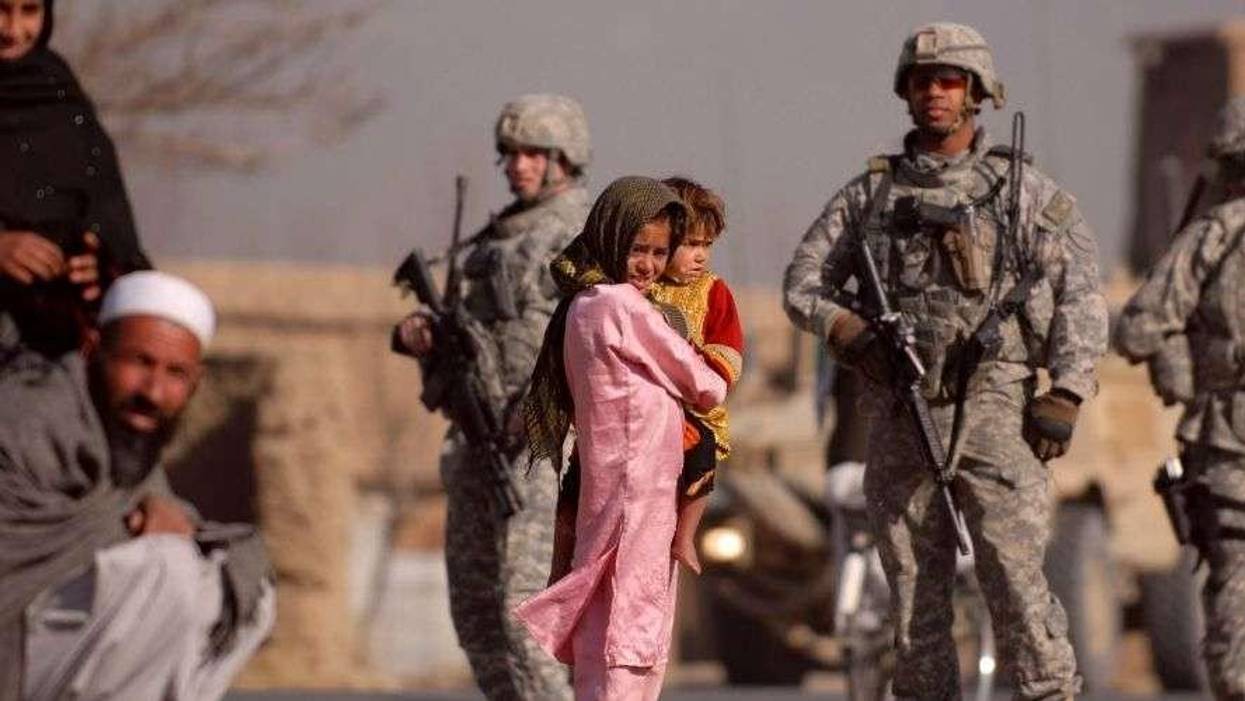
On January 27th, 2019, the Taliban and the U.S. government each publicly stated acceptance, in principle, of a draft framework for ongoing negotiations that could culminate in a peace deal to end a two-decade war in Afghanistan.
As we learn more about the negotiations, it's important to remember others working toward dialogue and negotiation in Afghanistan. Troublingly, women's rights leaders have not, thus far, been invited to the negotiating table. But several have braved potential persecution to assert the importance of including women in any framework aiming to create peace and respect human rights.
A young medical graduate student told me she was deprived of schooling during the Taliban era. "If government doesn't protect women's basic rights," she said, "we could lose access to health care and education."
"We in the U.S. have much to learn from Afghan women human rights advocates and the People's Peace Movement regarding the futility of war."
"The war was started by men, the war will be ended by men," an aide to Rula Ghani, the wife of President Ashraf Ghani, recently told a Reuters reporter. "But it's the women and children who suffer the most and they have a right to define peace." In 2018, the UN expressed alarm at the increased use of airstrikes by U.S. and Afghan forces which caused a rising death toll among women and children. In the run-up to the past week of negotiations and even during the negotiations, attacks and counter attacks between the warring parties killed dozens of civilians, including women and children. Both the Taliban and the U.S. seemed intent on showing strength and leverage by demonstrating their willingness to slaughter the innocent.
Another group not represented at the negotiating table is the "People's Peace Movement." Beginning in May of 2018, they chose a path which pointedly eschews attacks, revenge or retaliation. Following deadly attacks in their home province of Helmand, initiators of this movement humbly walked, sometimes even barefoot, hundreds of miles, asking people to reject the entire institution of war. They've urged an end to revenge and retaliation and called on all warring parties to support a peace process. Their journeys throughout the country have become venues for informal hearings, allowing opportunity for people to collectively imagine abolishing war.

We in the U.S. have much to learn from Afghan women human rights advocates and the People's Peace Movement regarding the futility of war.
Since 2001, and at a cost of $800 billion, the U.S. military has caused irreparable and horrific losses in Afghanistan. Afghan civilians have endured invasion, occupation, aerial bombings, ground attacks, drone warfare, extensive surveillance, internal displacement, soaring refugee populations, environmental degradation and the practice of indefinite detention and torture. How would U.S. citizens bear up under even a fraction of this misery?
It stands to reason this litany of suffering would lead to increased insurgent resistance, to rising support for the Taliban, and to spiraling violence.
By late 2018, even a top military commander, Army General Scott Miller, told CNN the U.S. had no chance of a military victory in Afghanistan. He stated the fight will continue until there is a political settlement,
Danny Sjursen, an exceptionally honest Major General and author, wrote in December 2018 the only thing left for the U.S. military to do in Afghanistan was to lose.
Major General Sjursen was correct to concede inevitable U.S. military defeat in Afghanistan, but there is something more U.S. people can and should do. Namely, pay reparations for 17 years of suffering we've caused in Afghanistan. This is, as Professor Noam Chomsky once said, "what any civilized country would do."
Some might counter the U.S. has already provided over $132 billion dollars for reconstruction in Afghanistan. But, did that sum make a significant difference in the lives of Afghan people impoverished by displacement and war? I think not.
Since 2008, John Sopko, the Special Inspector General for Afghan Reconstruction, has submitted quadrennial reports to the U.S. Congress detailing ways waste, embezzlement, fraud and abuse have consistently resulted in failed reconstruction efforts. Sopko and his teams of researchers and analysts offered a chance for people in the U.S. to see ourselves as we're often seen by an increasingly cynical Afghan public. But we seldom even hear of the SIGAR reports. In fact, when President Trump heard of these watchdog reports during his first Cabinet meeting of 2019, he was infuriated and said they should be locked up!
It's telling that SIGAR was preceded by SIGIR, (the Special Inspector General for Iraq Reconstruction) which filed similarly critical yet largely unnoticed reports.
U.S. citizens often regard their country as a civilized nation that goes to war against demonic tyrants. Dr. Martin Luther King held forth a different vision. He urged us to see the humanity of other so-called enemies, to ask how we're seen by other people, and to thereby gain a needed understanding of our own weaknesses. If we could hear from other people menaced by militarism, including ours, if we could see how our wars have contributed to terrorism, corruption and authoritarianism that has turned the U.S. into a permanent warfare state, we might find the same courage that inspires brave people in Afghanistan to speak up and resist the all-encompassing tyranny of war.
We might find ourselves guided by an essential ethical question: how can we learn to live together without killing one another? If we finally grasp the terrible and ever-increasing urgency of this lesson, then we might yearn to be trusted global neighbors who humbly pay reparations rather than righteously bankroll endless wars.

Trump's petty cancellation of Speaker of the House Nancy Pelosi's trip on military transport to Brussels and Afghanistan was clearly his revenge for her cancellation of his State of the Union message until he ends the shutdown of the government.
Here are the top 5 things wrong with this step:
1. It is invidious and unfair, since First Lady Melania Trump took off for Mar-a-Lago in a government plane soon thereafter. Given that 800,000 government employees are not getting their paychecks, is this the right time for Melania to vacation in Florida?
2. Although Ivanka and Jared Kushner did not fly a government plane down there, they are also vacationing in Mar-a-Lago. They are supposedly high-powered White House employees. Jared is supposed to be bringing peace to the Mideast and Ivanka is supposed to be picking the next World Bank head. Why are they on vacation when so many government employees in the security area, as with TSA agents, and being made to work, and made to work without pay as long as the shutdown lasts? Isn't Pelosi's determination to carry out US security consultations in Brussels and Kabul much more admirable than high level essential personnel sipping Mai Tais in a Florida resort? And by the way, a trip to Mar-a-Lago by the Kushners is estimated to cost tax payers tens of thousands of dollars in, ironically, security costs. Are the Secret Service agents being paid, or are they working for the Trumps for free while the latter are exfoliating?
3. Trump's Cabinet of Grifters has routinely abused the taxpayers by using military transport for purely political campaign events or for what appear to be personal or corruption-related trips. Scott Pruitt, the head of the Environmental Protection Agency who turned the EPA into the Environmental Destruction Agency, charged taxpayers $163,000 in just his first year, using a combination of first class commercial flights and charters and requisitioning military flights.
CNBC reported that "Pruitt and staffers flew by Air Force jet to Cincinnati from Washington for an event with President Donald Trump. That flight alone cost more than $36,000." Then there was the $120,000 trip to Italy. Was he visiting sunny Tuscany to admire the coal plants and sniffing in the thick black particles?
Pruitt is under ethics investigations over his travel abuses.
4. Pelosi is number 2 in line to succeed if the president is incapacitated, after the vice president. Trump does seem non compos mentis, and though Pence seems more immobile than incapacitated, given the parlous state of the Republic, it certainly is legitimate for No. 3 to seek to get up to speed on our national security commitments. More especially at a time when Trump is trashing those commitments.
5. Headlines have in the past week carried the news that privately, Trump spoke of withdrawing from the North Atlantic Treaty Organization. Breaking up NATO has been a prime goal of Russian president Vladimir Putin, who appears to have some powerful hold on Trump. Some lawmakers even want to pass a law preventing him from trying to do that unilaterally. The congressional delegation intended to reassure NATO members of US commitment to the organization.
6. Trump has underlined to Republican lawmakers that he intends to withdraw from Afghanistan. The Speaker of the House who has a powerful majority in that chamber should be consulting with Afghan president Ashraf Ghani (especially since Trump has not bothered to go visit the latter).
I suggest Speaker Pelosi consult with Rep. Rashida Tlaib about how to deal with Trump's erratic mind games. I believe she has blueprints for something called "Operation Mofo."

After 17 bloody years, the longest war in U.S. history continues without relent or purpose in Afghanistan.
There, a valiant, fiercely-independent people, the Pashtun (Pathan) mountain tribes, have battled the full might of the U.S. Empire to a stalemate that has so far cost American taxpayers $4 trillion, and 2,371 dead and 20,320 wounded soldiers. No one knows how many Afghans have died. The number is kept secret.
Pashtun tribesmen in the Taliban alliance and their allies are fighting to oust all foreign troops from Afghanistan and evict the western-imposed and backed puppet regime in Kabul that pretends to be the nation's legitimate government. Withdraw foreign troops and the Kabul regime would last for only days.
The whole thing smells of the Vietnam War. Lessons so painfully learned by America in that conflict have been completely forgotten and the same mistakes repeated. The lies and happy talk from politicians, generals and media continue apace.
This week, Taliban forces occupied the important strategic city of Ghazni on the road from Peshawar to Kabul. It took three days and massive air attacks by U.S. B-1 heavy bombers, Apache helicopter gun ships, A-10 ground attack aircraft, and massed warplanes from U.S. bases in Afghanistan, Pakistan, Qatar and the 5th U.S. Fleet to finally drive back the Taliban assault. Taliban also overran key military targets in Kabul and the countryside, killing hundreds of government troops in a sort of Afghan Tet offensive.
Afghan regime police and army units put up feeble resistance or ran away. Parts of Ghazni were left in ruins. It was a huge embarrassment to the U.S. imperial generals and their Afghan satraps who had claimed 'the corner in Afghanistan has finally been turned.'
Efforts by the Trump administration to bomb Taliban into submission have clearly failed. U.S. commanders fear using American ground troops in battle lest they suffer serious casualties. Meanwhile, the US is running low on bombs.
Roads are now so dangerous for the occupiers that most movement must be by air. Taliban is estimated to permanently control almost 50% percent of Afghanistan. That number would rise to 100 percent were it not for omnipresent US air power. Taliban rules the night.
Taliban are not and never were 'terrorists' as Washington's war propaganda falsely claimed. I was there at the creation of the movement--a group of Afghan religious students armed by Pakistan whose goal was to stop post-civil war banditry, the mass rape of women, and to fight the Afghan Communists. When Taliban gained power, it eliminated 95 percent of the rampant Afghanistan opium-heroin trade. After the U.S. invaded, allied to the old Afghan Communists and northern Tajik tribes, opium-heroin production soared to record levels. Today, U.S.-occupied Afghanistan is the world's largest producer of opium, morphine and heroin.
U.S. occupation authorities claim drug production is run by Taliban. This is another big lie. The Afghan warlords who support the regime of President Ashraf Ghani entirely control the production and export of drugs. The army and secret police get a big cut. How else would trucks packed with drugs get across the border into Pakistan and Central Asia?
The United States has inadvertently become one of the world's leading drug dealers. This is one of the most shameful legacies of the Afghan War. But just one. Watching the world's greatest power bomb and ravage little Afghanistan, a nation so poor that some of its people can't afford sandals, is a huge dishonor for Americans.
Even so, the Pashtun defeated the invading armies of Alexander the Great, Genghis Khan, Tamerlane, the Mogul Emperors and the mighty British Raj. The U.S. looks to be next in the Graveyard of Empires.
Nobody in Washington can enunciate a good reason for continuing the colonial war in Afghanistan. One hears talk of minerals, women's rights and democracy as a pretext for keeping U.S. forces in Afghanistan. All nonsense. A possible real reason is to deny influence over Afghanistan, though the Chinese are too smart to grab this poisoned cup. They have more than enough with their rebellious Uighur Muslims.
Interestingly, the so-called 'terrorist training camps' supposedly found in Afghanistan in 2001 were actually guerilla training camps run by Pakistani intelligence to train Kashmiri rebels and CIA-run camps for exiled Uighur fighters from China.
The canard that the US had to invade Afghanistan to get at Osama bin Laden, alleged author of the 9/11 attacks, is untrue. The attacks were made by Saudis and mounted from Hamburg and Madrid, not Afghanistan. I'm not even sure bin Laden was behind the attacks.
My late friend and journalist Arnaud de Borchgrave shared my doubts and insisted that the Taliban leader Mullah Omar offered to turn bin Laden over to a court in a Muslim nation to prove his guilt or innocence.
President George Bush, caught sleeping on guard duty and humiliated, had to find an easy target for revenge--and that was Afghanistan.

President Donald Trump is back on the stump, trumpeting his alleged triumphs since the 2016 election. Somehow, he never mentions Afghanistan.
For years, Trump has denounced endless foreign wars, including Afghanistan. For example, he tweeted in 2012 that Afghanistan is "a complete waste. Time to come home!"
Once in power, however, Trump filled top adviser and cabinet positions with generals and neocons who advocate permanent occupation of Afghanistan. He suddenly became interested in the country's estimated $1 trillion in rare earth minerals, which are vital to manufacturing such high-tech products as cell phones.
Then, one year ago, Trump announced plans to send 4,000 more troops to Afghanistan. At the time, I and many other commentators said a few thousand more troops couldn't possibly shift the tide of war when 100,000 failed under Obama.
To date, the war in Afghanistan has claimed the lives of more than 2,300 U.S. soldiers; another 20,000 have been wounded. An estimated 110,000 Afghans have died in the conflict. U.S. taxpayers have spent more than a trillion dollars on the war so far.
And, sure enough, the military situation has gotten worse for the United States and its corrupt allies in Kabul. When the U.S. military intensified its air war, the Taliban retaliated with devastating attacks on Kabul and other major cities. In the latest example, on August 10, the Taliban attacked and held the key city of Ghazni for several days.
To date, the war in Afghanistan has claimed the lives of more than 2,300 U.S. soldiers; another 20,000 have been wounded. An estimated 110,000 Afghans have died in the conflict. U.S. taxpayers have spent more than a trillion dollars on the war so far, not counting the billions in future veteran's benefits.
Kathy Kelly--co-coordinator of Voices for Creative Non Violence, which supports humanitarian work in Afghanistan--told me her group has long advocated that all U.S. and allied troops pull out, and the United States pay reparations for the damage it's done.
"This is a failed war, as are all wars," she said.
During my first reporting trips to Afghanistan in the aughts, I stayed in inexpensive guest houses, walked to interviews when practical, and visited sources in their homes. Those days are long gone.
"This is a failed war, as are all wars."
Dr. Hakim Young, a medical doctor originally from Singapore, has seen dramatic changes during his fourteen years of humanitarian work in Afghanistan. Today any government building could be attacked by insurgents, even the military and intelligence headquarters in Kabul.
"We avoid government, political, and religious buildings," he told me from Kabul. "We vary daily movements and schedules."
One year ago, Trump announced plans to send 4,000 more troops to Afghanistan. Sure enough, the military situation has gotten worse for the United States and its corrupt allies in Kabul.
Even talking or walking with a Westerner can put local Afghans in danger because of popular anger at foreign occupation. So Westerners try avoid notice by dressing in local clothes.
Hakim, meanwhile, says "it helps that I look like an Afghan, and speak their language."
Among Afghans in general, he said, "the mood is one of stress, trauma, uncertainty, insecurity, frustration, anger, distrust and hopelessness. This mood is reflected in the continual outflow of Afghans seeking asylum elsewhere."
Most Afghans don't support the Taliban or the Islamic State, the two main insurgent groups. But it's not as though the United States, having allied itself with brutal drug-dealing warlords, has provided a viable alternative.
Take Afghan General Abdul Rashid Dostum, a warlord with a long history of human rights abuses who as been accused of beating and ordering the rape of a rival politician. Oh, did I mention, he's also Afghanistan's first vice president?
Last year, he fled to Turkey in the middle of the night. Dostum's supporters among the Uzbek ethnic minority have recently engaged in violent demonstrations against the government. In a surprise move, Dostum returned to Kabul in July and met with major government leaders including President Ashraf Ghani. It seems unlikely that Dostum will face trial for the rape, let alone for decades of human rights abuses.
"There are multiple warlords in Afghanistan and the Taliban is just one of them," Kelly said. "There is no functioning government right now. It's a failed narco state."
It's little wonder the people of Afghanistan want the United States and its corrupt government partners to leave.
It's little wonder the people of Afghanistan want the United States and its corrupt government partners to leave.
The Helmand Peace Convoy, now called the People's Peace Movement, presents a few rays of hope. In March, unknown bombers killed seventeen civilians and wounded fifty in the southern province of Helmand. So a group of elders, relatives of injured civilians, and civil society activists set up a peace tent in protest.
They called for a ceasefire and peace talks between warring factions and withdrawal of foreing forces. Encouraged by the positive response from the public, they marched 400 miles to the capital of Kabul.
According to Hakim, people are generally supportive of the protestors. "The Movement has shifted the mood a little," he said, adding, "We need to remain optimistic in taking tiny positive actions. The alternative would allow the exploitative, violent actors to worsen the multiple crises gripping Afghanistan."
When the marchers reached Kabul, among other actions, they held a sit-in at the U.S. embassy.
"If the U.S. can topple a regime in fifteen days," the Movement wrote in a statement, "then why has it not been able to bring peace in the past seventeen years?"

Donald Trump's antics over the past week have sent the world into a tizzy. With his preferential treatment of Russian President Vladimir Putin over his own Justice Department and intelligence agencies fueling calls of "treason," we've all but forgotten the incredible firestorm Trump ignited less than a week ago at the NATO summit in Brussels or the reports of his collusion with retiring Justice Anthony Kennedy to replace Kennedy on the Supreme Court with Judge Brett Kavanaugh. As has been typical of the Trump presidency, each week's news is so jaw-dropping that we forget the horrors of the week before, while our president tramples like a bull in a china shop over expectations, diplomatic norms and the difference between truth and lies. What important stories and contexts were eclipsed by Trump's global tantrums over the past week?
There has been little discussion of the U.S. and NATO's goal in the never-ending war, why more NATO troops will make things better when previous troop increases didn't, and what the Western military operation has achieved so far.
Starting with his attendance at the annual NATO summit in Brussels, Trump called for an increase in military spending by NATO members to match the United States' 4 percent of the national budget. But he didn't mention the war in Afghanistan, where NATO's only current military operations are ongoing. That long war, sparked by the U.S. after the Sept. 11, 2001, attacks, was meant to be on the agenda in Brussels--especially because NATO is expanding its mission with an increased troop presence--from 13,000 to 16,000--and is even starting a new mission in Iraq at the request of the United States. Afghan President Ashraf Ghani was at the summit, but, as this Guardian report details, he was asked to leave after Trump singlehandedly transformed the agenda. Since then, as well as before the summit, there has been little discussion of the U.S. and NATO's goal in the never-ending war, why more NATO troops will make things better when previous troop increases didn't, and what the Western military operation has achieved so far.
Also largely overlooked in coverage of the summit was the story of the U.S.-EU split over the Iran nuclear deal. U.S. Secretary of State Mike Pompeo arrived in Brussels just before the summit expecting to impress upon European allies the importance of abandoning the nuclear deal President Obama's administration had carefully brokered and to push for harsher sanctions instead. It is not clear whether Pompeo's meetings actually took place, but Trump himself referred to Iran only briefly during a news conference when asked a question by a reporter. In his answer, Trump may have inadvertently revealed his logic for abandoning the Obama Iran deal, saying, "At a certain point, they're going to call me and they're going to say, 'Let's make a deal,' and we'll make a deal. But they are--they're feeling a lot of pain right now." Rather than preserve the deal the U.S. and Europe already made with Iran, Trump appears to want the glory of deal-making for himself. Europeans have not yet capitulated to his demands.
What has not received much attention is how social justice organizations around the U.K. are opposed to any trade deal between the U.S. and U.K., not because of ties to the EU but because of the pro-corporate bent of the deal
After blowing up the NATO summit, Trump headed to the U.K., where he continued his trail of devastation, starting with an interview he gave to the tabloid paper The Sun ahead of his meeting with Prime Minister Theresa May. During that interview, Trump boasted of how he mansplained to May the best way to conduct her nation's tricky Brexit negotiations, saying, "I actually told Theresa May how to do it, but she didn't agree; she didn't listen to me." In that same interview, Trump explained that if May opts for a "soft" Brexit process to keep the U.K. tethered to the European Union, a proposed U.S.-U.K. trade deal will be off. "If they do a deal like that, we would be dealing with the European Union instead of dealing with the U.K., so it will probably kill the deal," Trump said. What has not received much attention is how social justice organizations around the U.K. are opposed to any trade deal between the U.S. and U.K., not because of ties to the EU but because of the pro-corporate bent of the deal. Global Justice Now has urged May to kill any deal because it would be "a massive attack on our food standards, our National Health Service, our environmental protection and much more. It will leave U.S. multinational corporations in the driving seat--able to sue our government whenever they step out of line."
What ought to have taken center stage was the ongoing brutal Syrian war, in which Russia is openly aiding Syrian dictator Bashar Assad in the destruction of his country.
Also overshadowed by the Trump-Putin debacle was the Nuclear Weapon Ban Treaty, which one journalist was hoping to raise in a question at the Helsinki news conference before being dragged out. Sam Husseini, credentialed by The Nation magazine to cover the story, held a piece of paper in his hand that simply read, "Nuclear Weapon Ban Treaty," but rather than focus on what that treaty is and why the U.S. and Russia have not joined it, media outlets have instead focused on the rough treatment of the journalist. The Treaty on the Prohibition of Nuclear Weapons was passed last year and is a groundbreaking weapons ban that nearly 60 countries have signed. If Trump was really interested in preventing nuclear weapons development by North Korea and Iran, he would sign the treaty and pressure those countries to sign on as well. But neither the U.S. nor Russia are interested in a world free of nuclear weapons--only a world where they alone (and perhaps Israel) remain capable of such mass destruction.
Also entirely missing from the coverage of intelligence agencies' findings of Russian interference in the 2016 election is the historical context of U.S. interventions in other democracies the world over for many decades now.
Also entirely missing from the coverage of intelligence agencies' findings of Russian interference in the 2016 election is the historical context of U.S. interventions in other democracies the world over for many decades now. The CIA and other American agencies have changed the course of world history through interventions that have carried bloody legacies and whose effects are felt today from Iran to Honduras. This history does not excuse Russian efforts to change U.S. election outcomes; it is simply a crucial piece of information to remind us that Russian intelligence officers are taking a page out of the CIA's handbook.
It is far too easy to get deluged by information, overwhelmed by the endless posturing, backtracking, lying and corruption emanating from Washington, D.C., these days. But the corporate media is still the corporate media, and its framing of current issues remains far too narrow.

This past Friday in Afghanistan's Ghazni province, Hazara girls joined young Pashto boys to sing Afghanistan's national anthem as a welcome to Pashto men walking 400 miles from Helmand to Kabul. The walkers are calling on warring parties in Afghanistan to end the war. Most of the men making the journey are wearing sandals. At rest stops, they must tend to their torn and blistered feet. But their mission grows stronger as they walk. In Ghazni, hundreds of residents, along with religious leaders, showed remarkable readiness to embrace the courage and vision of the Helmand-to-Kabul peace walk participants. It seems likely that ordinary Afghans, no matter their tribal lineages, share a profound desire to end forty years of war. The 17-year U.S. war in Afghanistan exceeds the lifetimes of the youngsters in Ghazni who greeted the peace walkers.
On June 7th, Afghanistan's president, Ashraf Ghani, declared a week-long halt to attacks against the Taliban. Spokespersons representing an undetermined number of Taliban affiliates accepted the ceasefire on June 9th, with the U.S. also agreeing to suspend attacks against Taliban fighters.
"Rather than extending a hand of friendship to people in other lands and, in the case of Afghanistan, paying reparations for the terrible suffering we've caused, the U.S. continues to seek security through dominance and military might. It's a futile effort."
Can the declared cease-fire lead to negotiations and an end to the war? Given the desperate circumstances I saw during a visit to Kabul in early June, it seems clear that a lasting peace will require finding ways to employ people and enable them to provide food and water for their families.
Destitution has caused numerous Afghan people to enlist in military forces, pro-government or insurgent. It's extremely difficult to earn a living wage in Afghanistan, but military and paramilitary units, answerable to various warlords, including the U.S., pay wages which many Afghan families can't afford to dismiss. My young friends in Kabul assure me their family members who joined military groups don't want to cause bloodshed and they don't want to be killed. They simply don't have other viable options.
Almost 54 percent of Afghan citizens live below the poverty line, according to Afghanistan's Tolo News coverage of a recent joint survey undertaken by the Central Statistics Organization and an international NGO.
The Afghan Peace Volunteers (APV), who welcomed me as their guest last week, want to help build a more egalitarian economy that will provide basic human needs. This year, they're forging ahead in establishing worker cooperatives. During my visit, they celebrated the opening of a shoe-making cooperative. They've also devised a one-year plan for seamstresses to form a tailoring cooperative and explored possibilities for a carpentry cooperative.
"Once up-and-running," their blog explains, "these worker cooperatives will pledge part of their earnings to the long-term, self-reliant work of the Afghan Peace Volunteers."
The APV find inspiration in the story of Badshah Khan, sometimes referred to as "the Muslim Gandhi."
After meeting Gandhi in 1919, Badshah Khan educated and organized members of the Pashtun (or "Pathan") tribe, in an area that is now a border between Pakistan and Afghanistan, steadily building a movement to rebel against British occupation. The "khidmatgyars" - Servants of God - refused to cooperate with the British and instead practiced self-reliance. They created their own constructive projects and persisted even when British repression became increasingly brutal.
Describing the growth of the "Servants" movement, Michael Nagler writes: "After perpetrating a terrible massacre in 1930 in Peshawar, the British saw the ranks of the Servants swell from several hundred to 80,000." They continued rejecting armed struggle, choosing instead to experiment with Gandhi's methods of nonviolent resistance. To the astonishment of onlookers, they were a key element in the eventual liberation from British rule.
"The Helmand to Kabul peace walkers display a better means of securing peace: the path of fellowship with our neighbors on this planet, of living simply so that others might simply live, and of willingness to share, even partially, in the human hardship and precarity others face."
Badshah Kahn's preferred method of transportation was walking. He trod along paths linking mountain villages and small towns, relying upon goodwill and the truth of his cause, not on weaponry, for his defense.
A likeness of Badshah Khan decorates the entrance to the APV center in Kabul. Stenciled underneath is his fundamental belief: "My religion is truth, love and service to God and humankind."
I worry that in my country, the U.S., the dominant religion has become militarism. Rather than extending a hand of friendship to people in other lands and, in the case of Afghanistan, paying reparations for the terrible suffering we've caused, the U.S. continues to seek security through dominance and military might. It's a futile effort. The Helmand to Kabul peace walkers display a better means of securing peace: the path of fellowship with our neighbors on this planet, of living simply so that others might simply live, and of willingness to share, even partially, in the human hardship and precarity others face.
I hope those walking for peace, working for equality, and imploring a different way forward can be heard and celebrated not only in Afghanistan, but in every country and amongst every group that has ever caused bloodshed and ruin in Afghanistan.
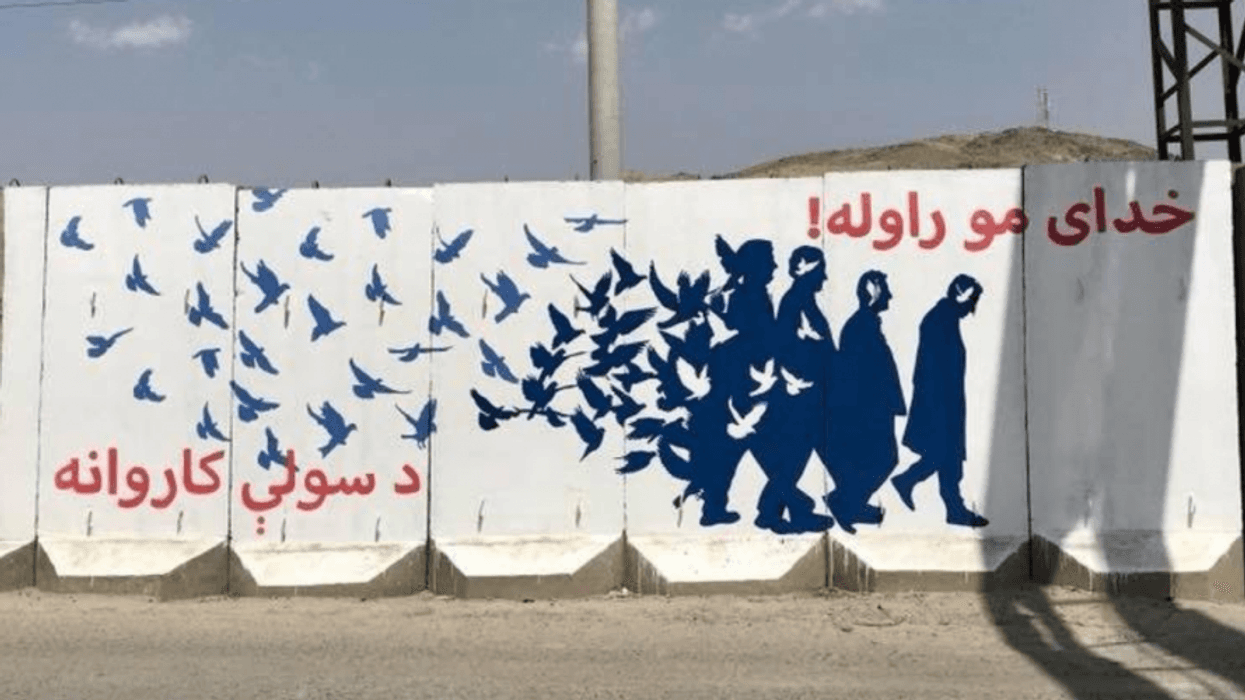
Demanding an end to war, dozens of Afghans are making an over 400-mile trek on foot from Helmand to Kabul.
"We are tired of this war and bloodshed," Zaheer Ahmad Zindani, who was blinded in a roadside explosion, told Agence France-Presse.
The peace march to the Afghan capital followed from a protest in reaction to a deadly car bombing last month and comes amidst a declaration by Afghan president Ashraf Ghani of a temporary ceasefire with the Taliban, though not with other groups. The U.S. said it would honor it, yet ramp up attacks on the Islamic State and other militant groups in the same time period.
"We have four demands" that will be presented to Afghan leaders, said Bacha Khan Mawladad, a member of the peace convoy. "First, the warring parties should announce a ceasefire during Ramadan; second, specify an address (for peace talks), third, establish a joint government, fourth, sit together and fix a date for the withdrawal of 'foreigners' (from Afghanistan)."
At The Progressive, peace activist and author Kathy Kelly, just back from a trip to Afghanistan, recently wrote that "throngs of people in cities and towns along their route have shown solidarity with the walkers." According to AFP, citing information from organizers, "Nine people began the weeks-long anti-war march in May, but their numbers have since swollen to around 50."
Upon arriving in Ghazni, said one member of the peace group, "We were welcomed unexpectedly. Thousands of people came out. The religious scholars said in public that this is the voice of justice and the ongoing war in the country should stop." A YouTube video shows the group receiving a warm--and musical--greeting upon their arrival:
Speaking to Democracy Now! last week, Kelly said "the Helmand peace walk is very, very unusual. And I think it is bringing a measure of hope in the idea that people could assert themselves outside of the very, very, very corrupt government controls."
A federal watchdog recently declared the U.S. occupation a $5 billion failure, and the United Nations estimates that over 2,200 civilians were killed in Afghanistan as a result of armed conflict in the first three months of 2018 alone, with the deaths attributed to pro-government forces as well as extremist groups. The U.S. presence in the country, however, appears to have no end date, and President Donald Trump has doubled down on the U.S. military involvement there, fueling civilian casualties.
"I can be killed if I stay home or if I go to my shop, so I have decided it is much better to die for peace so the next generation of my family can enjoy peace," Mohammad Sarwari, who uses crutches after suffering from polio, told AFP.
Kelly urged those who have contributed to the desperate situation in Afghanistan, including the "most sophisticated and heavily armed warring party in Afghanistan...the U.S. military," to heed the group's message.
"I worry that in my country, the U.S., the dominant religion has become militarism," Kelly wrote in a column for Common Dreams on Monday. She added:
Rather than extending a hand of friendship to people in other lands and, in the case of Afghanistan, paying reparations for the terrible suffering we've caused, the U.S. continues to seek security through dominance and military might. It's a futile effort. The Helmand to Kabul peace walkers display a better means of securing peace: the path of fellowship with our neighbors on this planet, of living simply so that others might simply live, and of willingness to share, even partially, in the human hardship and precarity others face.
I hope those walking for peace, working for equality, and imploring a different way forward can be heard and celebrated not only in Afghanistan, but in every country and amongst every group that has ever caused bloodshed and ruin in Afghanistan.