SUBSCRIBE TO OUR FREE NEWSLETTER
Daily news & progressive opinion—funded by the people, not the corporations—delivered straight to your inbox.
5
#000000
#FFFFFF
To donate by check, phone, or other method, see our More Ways to Give page.


Daily news & progressive opinion—funded by the people, not the corporations—delivered straight to your inbox.
"Public officials should be deeply concerned by what we found."
A detailed investigation released Thursday reveals that the e-commerce behemoth Amazon is using its market dominance and political influence to gain a foothold in local governments' purchasing systems, locking school districts into contracts that let the corporation drive up prices for pens, sticky notes, and other basic supplies.
The new report by the Institute for Local Self-Reliance (ILSR), titled Turning Public Money Into Amazon’s Profits: The Hidden Cost of Ceding Government Procurement to a Monopoly Gatekeeper, is based on purchasing records from nearly 130 cities representing more than 50 million Americans.
ILSR found that "cities, counties, and school districts spent $2.2 billion with Amazon in 2023—a nearly fourfold increase since 2016."
"Through its Amazon Business platform, the company has maneuvered to become the default source for office products, classroom materials, cleaning supplies, and other routine goods," the report states. "Today, it is embedded in most local governments, making inroads into state agencies, and dominating a new program designed to reshape how federal agencies buy commercial products."
Unlike the fixed pricing that's typical for government contracts, the agreements that Amazon has secured with local governments across the US entail "algorithm-driven pricing" to "covertly raise prices and inflate costs for governments."
"The result is dramatic price variation: One city bought a 12-pack of Sharpie markers for $8.99, while a nearby school district paid $28.63 for the identical pack that same day," ILSR said. "Our data contain thousands of similar examples, with some agencies paying double or even triple what others paid for the same items."
1. Hard to believe, but Amazon has persuaded schools and cities across the country to abandon competitive bidding and fixed price contracts. Instead, they're signing contracts with Amazon that specify dynamic pricing. The result: Paying $37 for 12 pens or $74 for 36 markers. pic.twitter.com/afIIkPucZL
— Stacy Mitchell (@stacyfmitchell) December 5, 2025
Overall, ILSR found that school districts bound to Amazon contracts spend twice as much per student as school districts without an agreement with the $2.5 trillion company.
“Public officials should be deeply concerned by what we found,” Stacy Mitchell, co-executive director of ILSR, said in a statement. “Amazon is reshaping public procurement in ways that expose taxpayer dollars to waste and risk. It has persuaded cities and schools to abandon safeguards meant to ensure fair prices and accountability—while driving out independent suppliers, eroding competition, and putting Amazon in a position to dictate terms.”
Having gained sweeping access to local government purchasing processes, Amazon is increasingly inserting itself into state and federal systems. ILSR noted that "Amazon dominates the General Services Administration’s Commercial Platforms Program, a new system for agencies to make purchases below $15,000 that do not require competitive bids."
"During the first two years of the program’s pilot phase," the group found, "Amazon captured 96% of sales."
ILSR emphasized that Amazon's dominance is by no means inevitable and can, with concerted action, be rolled back.
"A handful of cities and counties have recognized the risks of relying on Amazon and taken steps to restore transparency and keep public dollars local," the report observes. "Tempe, Arizona rejected an Amazon group-purchasing contract after hearing concerns from a local business owner. Between 2017 and 2023, the city cut its Amazon spending by 84% while increasing purchases from local suppliers. Phoenix likewise prioritizes local bids and has spent almost nothing with Amazon over the last decade."
Kennedy Smith, co-author of the report, said that "when local officials put real safeguards in place and prioritize local suppliers, they save money, strengthen their economies, and restore public control over public dollars."
To keep their procurement system free of the kinds of tactics Amazon uses to line its pockets with taxpayer money, ILSR urged state and local governments to prohibit so-called "dynamic pricing" in purchasing contracts and to prioritize buying from local businesses.
"By reclaiming control of public procurement, governments can safeguard dollars, strengthen local businesses, and ensure that the goods that sustain our schools and public services are supplied through systems that are transparent, competitive, and democratic," the group said.
"Caremark, ESI, and Optum—as medication gatekeepers—have extracted millions of dollars off the backs of patients who need lifesaving medications," said one agency leader.
The Federal Trade Commission on Friday initiated a legal process against middlemen that collectively administer about 80% of all prescriptions in the United States, accusing them of artificially inflating the list price of insulin drugs and blocking patients from accessing cheaper products.
The FTC action targets the "Big Three" pharmacy benefit managers (PBMs): CVS Health's Caremark Rx, Cigna's Express Scripts (ESI), and UnitedHealth Group's OptumRx. It also involves their affiliated group purchasing organizations (GPOs): Zinc Health Services, Ascent Health Services, and Emisar Pharma Services.
"Millions of Americans with diabetes need insulin to survive, yet for many of these vulnerable patients, their insulin drug costs have skyrocketed over the past decade thanks in part to powerful PBMs and their greed," said Rahul Rao, deputy director of the FTC's Bureau of Competition.
"Caremark, ESI, and Optum—as medication gatekeepers—have extracted millions of dollars off the backs of patients who need lifesaving medications," Rao continued. "The FTC's administrative action seeks to put an end to the Big Three PBMs' exploitative conduct and marks an important step in fixing a broken system—a fix that could ripple beyond the insulin market and restore healthy competition to drive down drug prices for consumers."
The FTC's vote to begin the legal process by filing a complaint was 3-0. Led by Chair Lina Khan, the Democrats supported the move while the two Republicans, Commissioners Melissa Holyoak and Andrew N. Ferguson, recused.
The American Prospect executive editor David Dayen noted that "the complaint, which was filed in an administrative court, has not yet been made public, as it is undergoing redactions. Agency officials expect it to be made public on Monday."
However, in a statement after the vote, the FTC shared some details about the complaint's arguments that "Caremark, ESI, and Optum and their respective GPOs engaged in unfair methods of competition and unfair acts or practices under Section 5 of the FTC Act by incentivizing manufacturers to inflate insulin list prices, restricting patients' access to more affordable insulins on drug formularies, and shifting the cost of high list price insulins to vulnerable patient populations."
Rao emphasized that while the commission on Friday "exercised its discretion to move forward with suing only the PBMs and GPOs now, FTC staff's investigation has also shed light on the concerning and active role that the insulin manufacturers—Eli Lilly, Sanofi, and Novo Nordisk—play in the challenged conduct."
"All drug manufacturers should be on notice that their participation in the type of conduct challenged here can raise serious concerns, with a potential for significant consumer harm, and that the Bureau of Competition reserves the right to recommend naming drug manufacturers as defendants in any future enforcement actions over similar conduct," he said.
Emma Freer, senior policy analyst for healthcare at the American Economic Liberties Project, pointed out that "the FTC's case adds to the mounting, bipartisan criticism of the 'Big Three' PBMs, which for far too long have exploited their monopoly power to inflate drug prices and enrich shareholders at the expense of patients' health and pocketbooks."
"The lawsuit also exposes their industrywide abuse, using insulin—the price of which has soared over 1,200% since 1999—as a flagship example of how PBMs' rebate schemes distort markets and drive up costs for lifesaving drugs," Freer said. "While PBMs bear much of the blame, the FTC is right to also put brand-name manufacturers like Eli Lilly, Novo Nordisk, and Sanofi on notice for their role in this crisis. We're thrilled to see the commission bring this long overdue challenge against healthcare's most notorious middlemen, and hope to see it result in concrete reform and accountability."
As The New York Times reported:
Just weeks before the presidential election, the agency is tackling an issue that Vice President Kamala Harris has signaled an interest in. Campaigning at a community college in Raleigh, North Carolina, in August, Ms. Harris promised to "demand transparency from the middlemen who operate between Big Pharma and the insurance companies, who use opaque practices to raise your drug prices and profit off your need for medicine."
Former President Donald J. Trump has not campaigned on the issue, but in 2018, his administration proposed a sweeping change that would have threatened the benefit managers' business model. The proposal was never enacted. Mr. Trump's administration also created a model for capping Medicare patients' out-of-pocket costs for some insulin products that was later expanded under President [Joe] Biden.
The Times also noted that "some Republicans in Congress have proposed curbing some of the benefit managers' business practices. But other top Republicans have defended PBMs and said the FTC is overreaching."
Among the GOP's critics of PBMs is House Committee on Oversight and Accountability Chairman James Comer (R-Ky.), who highlighted his panel's investigations into the companies and praised the FTC move.
Another leading congressional critic of PBMs—and the country's failing for-profit healthcare system more broadly—is Senate Committee on Health, Education, Labor, and Pensions (HELP) Chair Bernie Sanders (I-Vt.), who caucuses with Democrats.
After a public pressure campaign led Eli Lilly, Novo Nordisk, and Sanofi to cut list prices of insulin products last year, Sanders held a hearing with their CEOs as well as PBM executives. At the time, he welcomed the voluntary reductions but also stressed that as "Americans pay outrageously high prices for prescription drugs, the pharmaceutical industry and the PBMs make enormous profits."
While the FTC's Friday action was widely praised—other than by the PBMs, who denied the allegations—some advocates hope the commission and other decision-makers will go even further in the future.
Stacy Mitchell, co-executive director of the Institute for Local Self-Reliance, called PBMs "some of the most predatory corporations in healthcare" and highlighted that "these companies have incredibly long rap sheets and convictions at the state level."
"I'm thrilled the FTC is going after these criminal enterprises," she said. "I hope this lawsuit, with its focus on kickbacks, is just the beginning. We also need action on how PBMs harm local pharmacies. Ultimately, these corporations need to be broken up."
Dollar General, Dollar Tree, and Kroger rake in a combined $90 million a year from cash-back fees, according to a new report by the Consumer Financial Protection Bureau.
The Consumer Financial Protection Bureau published a report Tuesday highlighting how large retailers such as Dollar General and Kroger exploit low-income communities' lack of access to local banking to hit consumers with predatory cash-back fees.
The CFPB found that while many retailers still offer free cash back at the register, Dollar General, Dollar Tree, and Kroger collectively rake in $90 million a year from fees imposed on people using the retail locations to access their own money.
"At Dollar General and Dollar Tree/Family Dollar, cash-back fees for small withdrawal amounts are the highest in the sample ($1 fee or more for cash-back amounts under $50)," the bureau found. "Kroger, the country's largest grocery chain, recently announced new charges at their Harris Teeter stores (75 cents for $100 cash back or less), and charges 50 cents for up to $100 cash back at their other brand stores such as Ralph's, Fred Meyer, and others."
The CFPB emphasized that such fees are disproportionately levied against people with lower incomes, who are more likely to live in areas with fewer banking options—forcing residents to rely on dollar stores for easy access to cash. The report notes that banking industry consolidation and branch closures have left a "void" of cash access spots that retailers like Dollar General have rushed to fill.
"While retail chains had long provided cash back on debit card purchases for free, the CFPB has found that dollar store chains and other retailers are now charging fees for access to cash," Rohit Chopra, the CFPB's director, said in a statement Tuesday. "Many people living in small towns no longer have access to a local bank where they can withdraw money from their account for free. This has created the competitive conditions for retailers to charge fees for cash back."
"Dollar General alone chalked up gross profits of $11.82 billion in 2023. But they nonetheless find new ways to squeeze even more money from their shoppers."
Stacy Mitchell, co-executive director of the Institute for Local Self-Reliance (ILSR), applauded the CFPB's new research as an "important report" that "exposes yet another way in which dollar stores' exploitative business practices take advantage of consumers."
"The three big dollar store chains make enormous profits," said Mitchell. "Dollar General alone chalked up gross profits of $11.82 billion in 2023. But they nonetheless find new ways to squeeze even more money from their shoppers—in this case, by charging them a few dollars to get cash back on their transactions, which average only a modest $25 or so. All three major dollar store chains have been fined for overcharge errors, and all use their market muscle to force suppliers to create 'cheater' sizes for them. CFPB's report will help alert shoppers to these abusive retailing practices."
ILSR has long worked to shine light on the abuses of dollar stores, releasing a report last year detailing how the retailers have invaded low-income communities and preyed on vulnerable consumers as well as workers.
"One might assume that the dollar chains are simply filling a need, providing basic retail options in cash-strapped communities. But the evidence shows something else," reads ILSR's report. "These stores aren't merely a byproduct of economic distress, they are a cause of it."
"In small towns and urban neighborhoods alike," the report adds, "dollar stores drive grocery stores and other retailers out of business, leave more people without access to fresh food, extract wealth from local economies, sow crime and violence, and further erode the prospects of the communities they target."
"By suing to block the Kroger-Albertsons merger, the FTC is keeping grocery bills down and workers in their jobs," said one anti-monopoly campaigner.
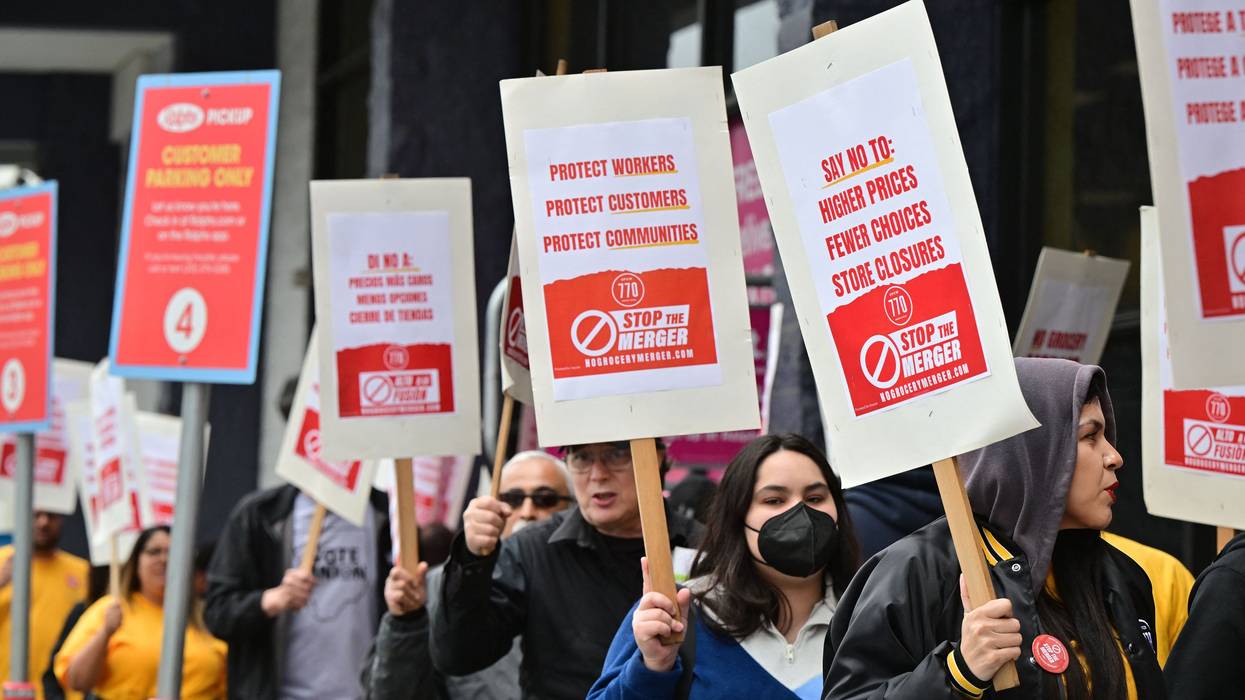
The Federal Trade Commission and a bipartisan group of state attorneys general joined forces Monday on a lawsuit aimed at blocking the supermarket giant Kroger from buying up the Albertsons grocery chain, warning the merger would hamper competition, further drive up food prices, and harm workers.
If completed, the $24.6 billion deal would mark the largest supermarket merger in U.S. history at a time when grocery chains are facing growing scrutiny for driving up prices to pad their bottom lines. A Kroger-Albertsons grocery behemoth would control more than 5,000 stores and 4,000 retail pharmacies across the country, according to the FTC.
"This supermarket mega merger comes as American consumers have seen the cost of groceries rise steadily over the past few years," said Henry Liu, director of the FTC's Bureau of Competition. "Kroger's acquisition of Albertsons would lead to additional grocery price hikes for everyday goods, further exacerbating the financial strain consumers across the country face today."
"Essential grocery store workers would also suffer under this deal, facing the threat of their wages dwindling, benefits diminishing, and their working conditions deteriorating," Liu added.
The attorneys general of Arizona, California, Washington, D.C., Illinois, Maryland, Nevada, New Mexico, Oregon, and Wyoming are joining the FTC's suit, which was filed in the U.S. District Court for the District of Oregon.
The lawsuit drew immediate praise from progressive advocacy groups and opponents of food industry consolidation.
Stacy Mitchell, co-executive director at the Institute for Local Self-Reliance (ILSR), said the decision to sue shows that the FTC "sees what we have long argued—there was no upside to this merger for anybody other than the top executives at these two companies and their investors."
ILSR has estimated that if the deal survives legal challenges, Kroger-Albertsons and Walmart—the largest low-wage employer in the U.S.—would control 70% of the grocery market in over 160 cities.
"Concentration in grocery retail has already caused food prices to skyrocket," said Mitchell. "We know from past grocery mergers that this one would have sent prices for consumers even higher. It would have left many communities, especially on the West Coast, with little to no competition or choice about where to shop. And it would have hurt retail workers by giving the combined companies even more leverage to push down wages and dictate terms."
Grocery prices have outpaced overall inflation in the U.S. over the past four years, surging by roughly 25%—and they remain stubbornly high even as inflation has fallen substantially from its peak of 9.1% in the summer of 2022.
The FTC, which has been assessing the proposed merger for more than a year, said Monday that because Kroger and Albertsons are direct competitors, a merger of the two "would eliminate head-to-head price and quality competition, which have driven both supermarkets to lower their prices and improve their product and service offerings."
"If the merger takes place, grocery prices will increase, and Kroger and Albertsons' incentive to improve product quality and customer service will decrease, further harming customers," the agency said.
The deal would also bring economic pain for workers, according to merger opponents. The Economic Policy Institute (EPI) has estimated that if the acquisition is completed, roughly 746,000 grocery store workers in over 50 metropolitan areas of the U.S. would see their annual earnings fall by a combined $334 million.
"Workers' ability to negotiate better pay and working conditions rests on their capacity to switch jobs," EPI senior economist Ben Zipperer explained in a 2023 memo. "By decreasing the number of outside options available to workers, the merger will limit competition for hiring and retaining employees, and grocery store worker earnings will fall as a result."
The FTC said Monday that executives at both Kroger and Albertsons have admitted that the proposed merger is anticompetitive. The agency quotes one unnamed executive as saying, "You are basically creating a monopoly in grocery with the merger."
Morgan Harper, director of policy and advocacy at the American Economic Liberties Project, said in a statement that "by suing to block the Kroger-Albertsons merger, the FTC is keeping grocery bills down and workers in their jobs."
"From higher prices for consumers, worse wages and benefits for workers, a tighter squeeze on producers and farmers, to an increased risk of grocery and pharmacy deserts across the 48 states this merger affects, the harms of this deal were clear from the start," said Harper. "No divestiture or concession would make it work—which is why over 100,000 workers and countless advocates have spoken out against this disastrous merger."
"Kroger and Albertsons would be wise to save everyone's time and abandon this deal," she added.
"Breaking up Amazon is key to repairing the online market and opening the way for competition," said one expert.
Economic justice advocates applauded on Tuesday as the Federal Trade Commission and 17 states filed a sweeping antitrust lawsuit against Seattle-based Amazon.com for illegally dominating the online retail economy at the expense of consumers.
"Freedom of commerce is a fundamental liberty of American democracy," declared Open Markets Institute executive director Barry Lynn in response to the suit. "Today the FTC took a first step to restoring the liberty of every individual and business who relies on essential internet platforms to exchange goods, services, and ideas with one another."
Lynn praised the commission for "targeting some of the most egregious abuses by Amazon of the dominant position it has acquired over vast swaths of online commerce, and the corporation's routinized manipulation of other people's business for its own private purposes."
"Seldom in the history of U.S. antitrust law has one case had the potential to do so much good for so many people."
The 172-page complaint "lays out how Amazon has used a set of punitive and coercive tactics to unlawfully maintain its monopolies," said FTC Chair Lina Khan in a statement. "The complaint sets forth detailed allegations noting how Amazon is now exploiting its monopoly power to enrich itself while raising prices and degrading service for the tens of millions of American families who shop on its platform and the hundreds of thousands of businesses that rely on Amazon to reach them."
The document—filed in a federal court in Washington state—alleges that Amazon maintains "durable monopoly power" in the online superstore and marketplace services markets, including by stifling price competition and coercing sellers into using its fulfillment service. The section on its algorithmic tool "Project Nessie" is heavily redacted.
"Seldom in the history of U.S. antitrust law has one case had the potential to do so much good for so many people," noted John Newman, deputy director of the FTC's Bureau of Competition. States led by both Democrats and Republicans—Connecticut, Delaware, Maine, Maryland, Massachusetts, Michigan, Minnesota, New Jersey, New Hampshire, New Mexico, Nevada, New York, Oklahoma, Oregon, Pennsylvania, Rhode Island, and Wisconsin—joined the highly anticipated lawsuit.
Amazon—which was founded by Jeff Bezos, one of the richest people on the planet, and is now the second-largest private employer in the United States—swiftly pushed back on Tuesday.
David Zapolsky, the company's senior vice president of global public policy and general counsel, claimed the FTC case "is wrong on the facts and the law." He said the challenged practices "have helped to spur competition and innovation across the retail industry, and have produced greater selection, lower prices, and faster delivery speeds for Amazon customers and greater opportunity for the many businesses that sell in Amazon's store."
Meanwhile, critics of the company joined Open Markets in celebrating the development—echoing praise for FTC in June, when the commission sued Amazon over its "yearslong effort to enroll consumers into its Prime program without their consent while knowingly making it difficult for consumers to cancel their subscriptions."
Matt Stoller, director of research at the American Economic Liberties Project, said Tuesday that "the FTC is right to challenge Amazon, a company that appears to offer low prices under the guise of free shipping but in fact inflates prices across the whole economy."
"In order to reach most online customers, sellers must sell through Amazon. This market power enables Amazon to set the price floor on almost every online retail item offered by sellers, extract a 50% cut from each sale, and punish sellers who try to sell elsewhere at lower prices," he explained. "At the same time, it leverages its dominance to block rivals from entering the markets in which it offers services, while its own marketplace is increasingly saturated with pay-to-play junk ads."
"There's no such thing as 'free shipping' just as there's no such thing as a free lunch, Amazon is just hiding from consumers how much they have to pay," Stoller stressed. "Amazon is a monopoly, and we're thrilled to see the FTC end its coercive tactics."
Stacy Mitchell, co-director at the Institute for Local Self-Reliance—which has spent over a decade sounding the alarm about the retail giant's practices—charged that "for too long Amazon has been allowed to maintain a stranglehold on the online market."
"The filing of this lawsuit is a victory for freedom and self-governance; it marks a crucial rekindling of public authority to check unaccountable private power," said Mitchell. "This is one of the most important antitrust cases in U.S. history."
"Breaking up Amazon is key to repairing the online market and opening the way for competition," she argued. "As this lawsuit shows, Amazon's anti-competitive tactics largely hinge on leveraging the interplay between its retail division, third-party marketplace, and logistics operation. Separating them would eliminate Amazon's ability to monopolize the market. We are encouraged that both the scope of this case and the FTC's request for the court to consider structural remedies show that the agency intends to tackle Amazon's monopoly power at its root."
Demand Progress communications director Maria Langholz called the case "long overdue," given the company's record of "shamelessly engaging in exclusionary and unfair tactics to trap third-party sellers in its own marketplaces, gouge them with predatory fees, and punish them for trying to offer lower prices to consumers."
"This marks a historic step in challenging Amazon's abuse of its market dominance and its anti-consumer, anti-worker, anti-small business practices," Langholz said. Like Mitchell, she also suggested that the suit should be "a catalyst for a broader conversation about the need to break up Amazon as the best and most effective remedy."
A day after Amazon faced grilling at a U.S. House hearing, the European Commission announced Wednesday it's launching an antitrust probe into the online behemoth.
Commissioner Margrethe Vestager said in a statement that she will "take a very close look at Amazon's business practices and its dual role as marketplace and retailer, to assess its compliance with E.U. competition rules."
"Based on the Commission's preliminary fact-finding," the body said in its statement announcing the formal investigation, "Amazon appears to use competitively sensitive information--about marketplace sellers, their products, and transactions on the marketplace."
The probe's two focal points, per the statement, are:
Sen. Elizabeth Warren (D-Mass.), who released a plan for breaking up big tech as part of her presidential campaign, outlined similar problems with Amazon earlier this year, a point noted Wednesday by Tommaso Valletti, the European Commission's chief competition economist, when he shared news of the probe on social media.
Minnesota Attorney General Keith Ellison, a Democrat, has also suggested there's good reason for the EU to take on the investigation. "If you believe in competitive markets," told the BBC recently, "you cannot ignore the problem Amazon presents."
Laying out the problem in detail, Stacy Mitchell, co-director of the U.S.-based Institute for Local Self-Reliance (ILSR)--which has authored a report on the company's "stranglehold"--explained how Amazon is picking "winners and losers."
Speaking to the BBC's "World Business Report," Mitchell said: "Most shoppers in the U.S. and increasingly around the world when they want to buy something online, they are starting right at Amazon."
That means that "any other company out there that produces anything or retails any product, if they want to reach the market, increasingly [has] to be on Amazon's platform," she said. "And that means that Amazon essentially control[s] the underlying infrastructure."
Amazon, she continued, is able to "decide who can be there, which companies show up well in the search results, and they can use the information that they glean from the companies that are riding on their platform in order to undermine them as competitors."
"In some cases," said Mitchell, Amazon has "spotted products that are selling really well that are being offered by another company on their platform, and then they brought those products into their own inventory. Or, in some cases they've begun to manufacture them themselves."
She dismissed the notion that Amazon is offering a public good by offering low prices and a wide variety of products. "Increasingly," said Mitchell, "it's not the market, it's not consumers who are picking winners and losers. It's Amazon."
"Amazon," added Mitchell, "can effectively determine the fate of a product because it chooses so."
News of the European scrutiny comes right after tech giants, including Amazon, were questioned by U.S. lawmakers.
"Republicans and Democrats on Capitol Hill who no longer seem able to agree on the color of the sky," Axios reported, "found common ground Tuesday across three committee hearings in both houses of Congress: Big Tech is too powerful and needs to be knocked down a peg."
At one of those hearings, as Reuters reported, Democratic Rep. David Cicilline (R.I.) challenged Amazon's collection of data.
Lawmakers on the House Judiciary Committee's antitrust panel pressed an executive from Amazon.com Inc. on Tuesday about allegations that it competed against its own sellers and pushed them to buy advertising and fulfillment services. [...]
Representative David Cicilline, chair of the antitrust committee, pressed Nate Sutton, an associate general counsel at Amazon, about allegations that the online retailer used data about independent sellers on its platform to develop products to sell, thus competing against its own sellers.
"You said we do not consult data to compete with other sellers online. You do collect enormous data about prices, [and] what's popular," Cicilline said skeptically. "You're saying that you don't use that in any way to promote Amazon products? I remind you, sir, you're under oath."
As part of her testimony (pdf) before the same committee Tuesday, ILSR's Mitchell summed up the problem succinctly.
"Amazon doesn't just dominate the online market," she said, "it controls access to it."
Are you ready to divest from Amazon Prime? How about Whole Foods?
If the idea makes you break into a nervous cold sweat, no worries. You don't need to divest from either.
Yet.
That's the idea behind non-profit Threshold's new campaign, Cancel Prime.
The idea is for people to pledge to cancel their Prime accounts and stop shopping at Whole Foods--when there is a critical mass of people who will divest together.
"It's a way for people to take collective action, so that it will likely work," says Kipchoge Spencer, Threshold's founder.
Founded in August 2018, Threshold has developed a platform that enables people to pledge to take action, and, when enough people pledge, calls upon them to take action.
When a mass of consumers quit Amazon and its subsidiaries together, Amazon will notice--and, perhaps, pay attention to some consumer-demanded changes.
Think of it as a potentially effective replacement for the lone boycott of a particular place, or for online activism that revolves around sharing petitions on Facebook, or airing and sharing daily grievances on Twitter as if every day were Festivus.
"Engaging in activism is so uninspiring and disempowering" these days, says Spencer. "I think there's this common format with digital activism, which starts with a petition designed to get you angry or sad or donate money. And it's effective to some degree to build organizational power, to build mailing lists. But it's cynical because those petitions almost always fail."
Inspired by the progressive issues of the day receiving support--but not much action--Spencer came up with the Threshold strategy. "More than 50 percent of people think we should do something about climate change, but I wondered why we aren't able to achieve something supported by the majority of people, especially in a democracy. We wanted to develop a way that would motivate people more and more by inspiration, that this is probably going to work," says Spencer.
Spencer suggests one of the reasons more action isn't being taken on climate change is that the user experience of engaging in activism is "so uninspiring and disempowering, that it basically prevents a critical mass of people from taking action. People get burned out and turned off."
He uses the example of a petition you might receive from a friend, asking you to protest something the EPA is doing. There is a zero percent chance it will inspire change at the EPA, but you still sign, perhaps out of guilt--and that's your first disempowering action. You're never told it doesn't work, but you intuitively know it didn't. Worse, you're asked to spam your friends with it, which serves the organization's purpose to grow its mailing list, and spreads the disempowerment around.
"I don't want to be broadly critical of the progressive advocacy world, but this is a failure in the system, because people sign a petition, they feel bad, then they feel worse, and then they feel completely disempowered," says Spencer.
Hence, Threshold, which doesn't ask you to do anything besides pledge--until a critical mass is reached. If a critical mass isn't reached, you're not asked to do anything.
"Many people love Amazon. It's revered," he concedes. "They use it all the time and depend on it. Asking them to quit is significant."
With the Cancel Prime campaign, you're not asked to "put any skin in the game, unless the game is likely to go your way," Spencer says. It's like "Kickstarter for activism."
What's really important, says Spencer, is for people to understand that when they're asked to make a sacrifice, it will work.
Much has been written about the ethical, environmental, and labor horrors of Amazon, and yet it maintains its hold over the lives of Americans. A big part of Cancel Prime is the education component--not just why to divest, but how to divest.
The "why" list is long, and might differ from person to person. Some people who might agree with the principles motivating Cancel Prime may still feel Amazon is a necessary part of their lives and there is no desire to divest. Spencer says, "that's okay. My perspective on activism isn't that we need to spend a lot of energy on convincing people. It's convincing people who already are convinced to take action collectively together."
For Spencer, among other reasons, Amazon is "morally offensive [because] they make so much money, and some of their workers are living in poverty, with widely reported medical issues that aren't treated well. You're one of the richest companies in the history of the universe. You won capitalism. Now start treating people well."
It's also appalling they pay no taxes, make $11 billion dollars, and get a tax rebate. "That seems pretty egregious," says Spencer.
Then there's Amazon's "support for infrastructure that supports ICE," which is currently separating children from their families in the ongoing immigration crackdown. "That just feels completely unconscionable," Spencer says. "It's getting uncomfortable to think I'm buying something from Amazon while they support the infrastructure of ICE. It's not just incidental, but it's critically important to ICE's mission. I think there's a place to take a stand there."
Amazon also clearly takes advantage of the public's goodwill to win tax breaks--just look at the massive data grab that the war for HQ2 created. "They should be positive forces in communities instead of wrecking them," says Spencer. "They have a big opportunity to be a global leader because of how much wealth they have."
What's more is Amazon has an opportunity to be a global leader around climate, energy, and plastics. But it's not. In fact, Amazon is not only failing to fulfill even a quarter of its renewable energy commitment, but actually growing in energy demand.
Over half of all U.S. households are Prime members--more than 100 million Americans. Amazon is also a big player in entertainment, with its hand in film, television and Twitch. Its fingers pull the strings of search engines, digital assistants, the cloud, logistics, pharmaceuticals, banking, fashion, Whole Foods, and real-world retail, in addition to tech and actual book sales (where Amazon got its start), and an overall, overwhelming share of e-commerce.
Considering their reach and wealth, there are countless things the company can do to have a positive climate impact instead of a negative one--yet it doesn't.
Meanwhile, Amazon keeps growing, aiming to be the infrastructure for all commerce as we know it. Stacy Mitchell at the Institute for Local Self-Reliance calls it the Amazon tax, where if you choose to buy through a third party, it's still through Amazon.
Amazon, Mitchell told Chris Hayes at NBC, is "like a gatekeeper. Essentially you've got to ride their rails to market. They can decide what the terms are, they can use the data they gather on what you're doing to out-compete you and to undermine you as a competitor. They can levy a kind of tax on your trade. Essentially what Jeff Bezos has set up by owning the pipelines ... It's not just the platform... by owning the pipelines, what Amazon can do is it can decide, okay, here are the most lucrative streams of consumer spending. Then, for all the other stuff in the economy that they don't really want to deal with or that isn't that profitable... let other sellers do that. [Amazon will] just levy a tax on their trade. Every transaction they do," says Mitchell, Amazon gets a cut. As Amazon's power grows, Amazon is going to get a bigger and bigger cut, she adds.
"That doesn't feel very safe to have a healthy economy," says Spencer.
Traditionally in the United States, we've valued competition.
Also traditionally, the United States has frowned upon the idea of one entity controlling everything in commerce. If it was the U.S. government, for example, that owned and operated all the platforms Amazon does, people would be outraged, perhaps even shouting words like "communists!" at the government. And yet, it might be argued that even communist countries don't rely on their governments as heavily as the U.S. consumer has come to rely on Amazon.
Which brings us to another point: Are we citizens first, or are we consumers first?
That might be yet another question America as a nation and as a people need to grapple with.
In the interim, if we do want to take action that Amazon will notice and perhaps even make changes for, the harmonization of consumer action might be key. But what's a consumer to do when their lives are so intertwined with Amazon's?
Threshold has a guide online to much of what Amazon owns and alternatives to each one. Some, arguably, have their shortcomings, but switching to them when the time is right might be worth it to make a point. (Spencer hopes this part of the campaign will be crowdsourced, for optimum impact both in terms of divestment from Amazon and reinvestment in healthy companies in line with individual values.)
"It only takes 3.5% of the population to make a change," says Spencer, referencing a study by Erica Chenoweth, of Harvard Kennedy School. "In every single instance, where it mobilized at least 3.5%, it won."
"That's one of the most inspiring pieces of data there is," he says. "We don't need 50%. We don't need 60%. We need 3.5%. Really, that's what it boils down to in our job as movement organizers. We're putting it out in front, because we think it's important for people to know."
When mass divestment from Amazon does occur, Spencer expects the company to take the issues of the people seriously and do better, online and in the communities in which they operate. "If they were to do that, it would be a victory, in terms of influencing their direction and impact on the world. And it would be a victory for people power."
Spencer himself hasn't completely divested from Amazon, choosing to wait until critical mass is reached. "I've gone from a very-frequent to an almost-never Amazon shopper. It's made my life better," says Spencer. "I think it's intrinsically valuable to align my values and my lifestyle; not supporting a company that harms so many things I care about is a simple way to do that and feel more whole."
In addition, says Spencer, "Although I've been a longtime critic of consumer culture, the truth is that I found myself pushing Bezos' 'buy now' button multiple times a week. Consumerism is a disease. Buying things gives you a shot of endorphins. The more you do it, the more you need to do it to get the hit. I wouldn't have easily admitted this was happening to me; but when I started avoiding Amazon so I could research alternatives in earnest, I realized that I had broken a cycle and my overall level of buying dropped significantly."
There's no shame in confessing an Amazon habit. With Threshold's pledge, there's no reason to give it up cold turkey either. And when it is time to quit, knowing you're doing it with tens of thousands of other people will create support and inspiration to stick with it.
In addition, by getting off the Amazon habit, "I'm not dealing with the pain of having over-packaged crap show up at my door and triggering guilt about wasting money, abusing the planet, and being a victim of my own base impulses," says Spencer.
"Instead, I'm back to my old self who normally gives long and due consideration to anything I buy, and that makes me happier." An interesting personal revelation to have.
Has Amazon changed who you are?
"The dream is this kind of activism will inspire all companies" and politics, to do better, says Spencer. "Amazon is just a stepping stone in our theory of change."
This article was produced by Local Peace Economy, a project of the Independent Media Institute.
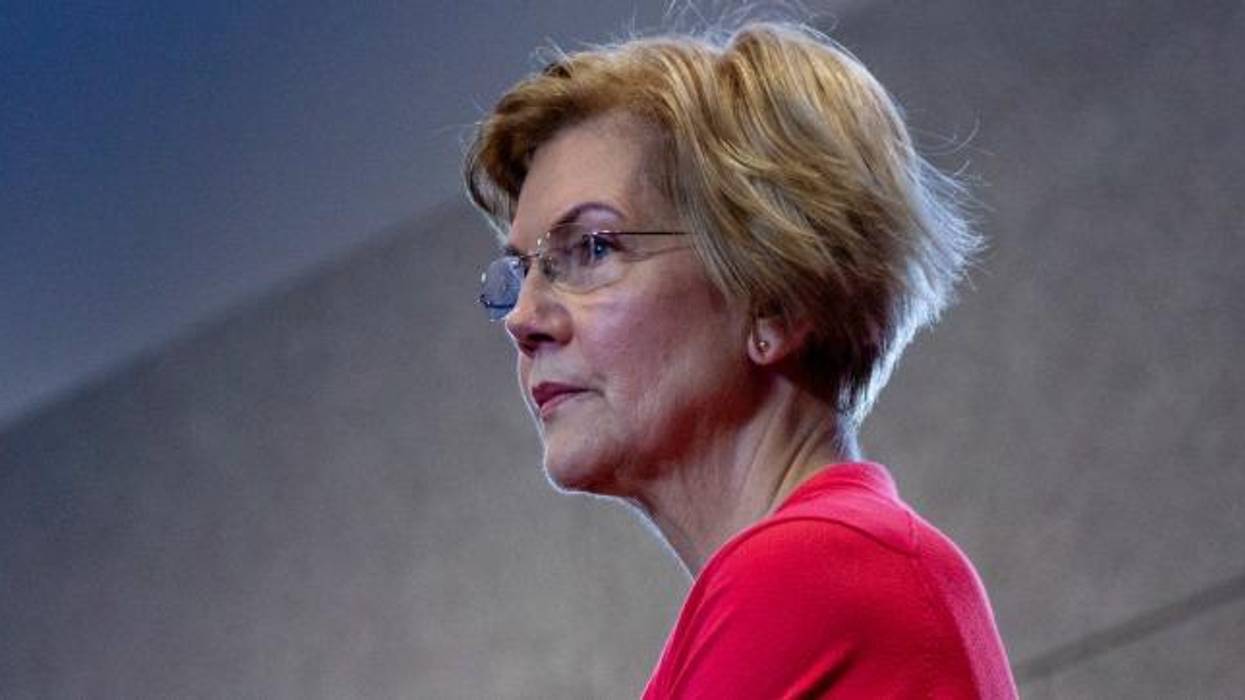
Sen. Elizabeth Warren unveiled her plan for how to break up the nation's technology behemoths on Friday.
The Democratic senator from Massachusetts, who's seeking the Democratic nomination for president, laid out her proposal in a Medium post entitled "Here's How We Can Break Up Big Tech." In the post, Warren argued that it's essential to crack down on the unfair market advantage enjoyed by Amazon, Facebook, and Google in order to boost competition and fuel innovation.
Fordham law professor Zephyr Teachout praised the plan, calling it as a sign that a "new anti-monopoly movement is happening, and Warren is coming out swinging at the right targets!" Agreeing with Warren, she added, "The big tech monsters are conglomerates with too much power that they use to extract wealth and data from all us of us as if we are subjects in their feudal regimes."
Warren described the problem thusly:
Today's big tech companies have too much power -- too much power over our economy, our society, and our democracy. They've bulldozed competition, used our private information for profit, and tilted the playing field against everyone else.
The impacts of this power, she wrote, are clear:
With fewer competitors entering the market, the big tech companies do not have to compete as aggressively in key areas like protecting our privacy. And some of these companies have grown so powerful that they can bully cities and states into showering them with massive taxpayer handouts in exchange for doing business, and can act--in the words of Mark Zuckerberg--"more like a government than a traditional company."
The tech giants have utilized a two-pronged strategy to amass this power, Warren said: using mergers to eat up potential competitors--like Facebook buying Instagram--and getting passes from federal regulators who've failed to assert their authority to block anti-competitive mergers.
Warren proposed her own two-pronged strategy to counter the tech giants:
First, by passing legislation that requires large tech platforms to be designated as "Platform Utilities" and broken apart from any participant on that platform. [...]
Second, my administration would appoint regulators committed to reversing illegal and anti-competitive tech mergers.
Making such changes, she argued, would make sure "that the next generation of technology innovation is as vibrant as the last."
"Sen. Warren's proposal rightly recognizes that digital platforms have become the core infrastructure of our economy," said Stacy Mitchell, co-director of the Institute for Local Self-Reliance, and author of multiple deep-dives into Amazon's threats to an open market. "If we're going to restore competition and protect the free exchange of goods and ideas, then we cannot allow Amazon and other big tech companies to continue to use their control of this infrastructure to privilege their own goods and services at the expense of their competitors."
Calling Warren's proposal "smart and practical," Open Markets Institute fellow Matt Stoller said it also showed that it's been a "good week for anti-monopolists."
The European Union's Competition Commissioner Margrethe Vestager may be onto the location of the soft spot on Amazon's armor, where a well-placed antitrust arrow could be used to bring the digital behemoth down to size.
The region's antitrust enforcer announced on Wednesday that she is launching an inquiry into Amazon's relationships with its third-party resellers, zeroing in on the data that Amazon collects from those resellers and whether that data is exploited with the ultimate goal of putting those resellers out of business--or at least out of business that Amazon wants exclusively for itself.
"Amazon is a prime symbol of the concentration of economic power across a range of sectors that has in the past two decades led to suppressed wage growth for a majority of workers in America and the narrowing of paths that used to exist to the middle class."
It is the kind of inquiry that people like Stacy Mitchell, the director of the Institute for Local Self-Reliance, has been pushing for. In an interview this week for The Next System Podcast, a project of the Democracy Collaborative, Mitchell explained that Amazon is to the 21st century what railroads were to the late 19th century. Amazon's third-party reseller program underscores the parallel.
"What happened then was you had a few industrialists who got control of the railroads," said Mitchell, whose organization focuses on promoting the growth of local economies and grassroots democratic governance. "They often had interests in other businesses and they would use their control of the railroads to privilege their other businesses. They would knock their competitors out and say, 'Oh, sorry. You can't ride my rails or you have to pay more money if you want to,' and they would privilege their own goods' access to markets."
The response was antitrust laws that said to the railroads "you can't have this cross interest in other industries and you have to be common carriers. You have to treat all commerce equally," Mitchell said. "So I think we need to look at Amazon's platform in that context. And I think in order to have that sort of public interest, common-carrier kind of regulation of the platform, we have to cleave off Amazon as a retailer manufacturer. That has to be a completely separate company. So we have to break up Amazon."
Amazon has far outstripped its role as a digital big-box retailer. It is a digital mall that happens to also be the mall's biggest tenant. It both sells merchandise and is the landlord of the space other stores use to sell their merchandise. It collects rent from these merchants based on their sales. It also gains knowledge about the customers who use these stores and what they buy. As both mall tenant and mall landlord, it has the power to decide when to aggressively compete against a third-party reseller, taking the whole business for itself rather than just a cut.
That power is magnified by the increasing control that Amazon has over the information people receive about products and sellers as shoppers use that site instead of search engines.
"To talk about Amazon as a retailer really misses the true nature of this company," Mitchell said. "What Amazon's ambition is, is to really be the underlying infrastructure of the economy. It's ambition is not so much to dominate markets, but to become the market."
Amazon is a prime symbol of the concentration of economic power across a range of sectors that has in the past two decades led to suppressed wage growth for a majority of workers in America and the narrowing of paths that used to exist to the middle class.
"We think we're this country of entrepreneurs. But, in fact, we're creating new businesses at about one-third the rate that we were in the 1980s; it's really quite dramatic," Mitchell said.
For many people, Amazon has earned its place in the market by offering convenience and competitive prices. But the cost of Amazon's business practices--as it extends its tentacles into such areas as government contracting, where it threatens to block a key avenue many small- and medium-sized businesses use to grow--is proving to be way too high for the economy as a whole. That cost includes our loss of democratic control.
The United States should be asking the same questions the European Union regulators are beginning to ask. Amazon CEO Jeff Bezos is a modern-day railroad baron. Ohio Sen. John Sherman, the man from whom the Sherman Antitrust Act gets its name, had this response to the railroad barons of the 1880s: "If we will not endure a king as a political power we should not endure a king over the production, transportation, and sale of any of the necessaries of life."
It's time to agitate for the next John Sherman to step up.
The billions in tax breaks cities are offering Amazon to host its "HQ2," Amazon's bare-knuckled push to squash a business tax in Seattle, and recent strikes for better working conditions in Amazon facilities have all fueled a growing conversation about the retail behemoth's toll on communities.
But one element of Amazon's business strategy has fallen under the radar, and this one could really bite where you live: its bid to dominate local government purchasing.
In January 2017, Amazon won a contract with U.S. Communities, a purchasing cooperative made up of government agencies, school districts, and other public or nonprofit agencies. The cooperative wields the heft of its more than 55,000 members to negotiate better prices. With this contract, they can now opt to buy their goods through Amazon Business, which advertises greater product selection, free shipping, and pricing discounts.
While the contract is a big boon for Amazon -- a potential for $5.5 billion in sales over 11 years -- recent analysis from the Institute for Local Self Reliance (ILSR) seriously questions how good a deal the public is getting out of this.
For one thing, the Amazon contract lacks the pricing protections that are usually standard in public procurement. Rather than relying on a catalog of fixed prices, governments are at the whim of Amazon's dynamic pricing model, much like the "surge pricing" of ride-sharing services.
The Amazon contract also makes it harder for agencies to buy from local vendors. ILSR notes that while local businesses can join Amazon's Marketplace to compete for U.S. Communities contracting opportunities, Amazon takes a 15 percent cut. That's enough, given the already thin margins of public procurement, to push many local businesses out of the running.
For the 1,500 members that have signed onto this contract so far, that means a significant missed opportunity to help their local economies thrive. The good news is that a growing number of governments and nonprofits are realizing that getting the lowest bid isn't the same as getting the best deal.
Local governments spend money every day. They can use that spending to build up local businesses, create jobs for residents, and grow their tax base, something impossible to do with Amazon's virtual footprint. This purchasing strategy is more efficient, too: Dollars spent at independent local businesses recirculate at a greater rate than money spent at national chains, creating a multiplier effect.
By shifting their everyday spending, city governments from Phoenix to New Orleans are joining hospitals, universities, and other anchor institutions to spark inclusive economic growth.
Cleveland, Ohio is a great example. There, local anchor institutions like the Cleveland Clinic and University Hospitals helped launch Evergreen Cooperatives, a network of worker-owned businesses established to provide some of the goods and services these institutions routinely need, such as laundry services and food.
The businesses have an explicit goal of hiring local residents facing barriers to employment, and the cooperative structure gives these workers opportunities to participate in decision-making and build wealth through profit-sharing. Evergreen Cooperatives employs more 220 residents and is growing.
Local governments weighing whether to sign on to Amazon's marketplace should consider this growing movement around inclusive, local procurement. Instead of being lured by Amazon's come-on of lowest-price promises, stewards of local tax dollars should ask what would bring the best value for their communities.
Instead of going into Amazon CEO Jeff Bezos' deepening pockets, the money they spend on goods and services should help everyday residents build wealth.