

SUBSCRIBE TO OUR FREE NEWSLETTER
Daily news & progressive opinion—funded by the people, not the corporations—delivered straight to your inbox.
5
#000000
#FFFFFF
To donate by check, phone, or other method, see our More Ways to Give page.
Daily news & progressive opinion—funded by the people, not the corporations—delivered straight to your inbox.
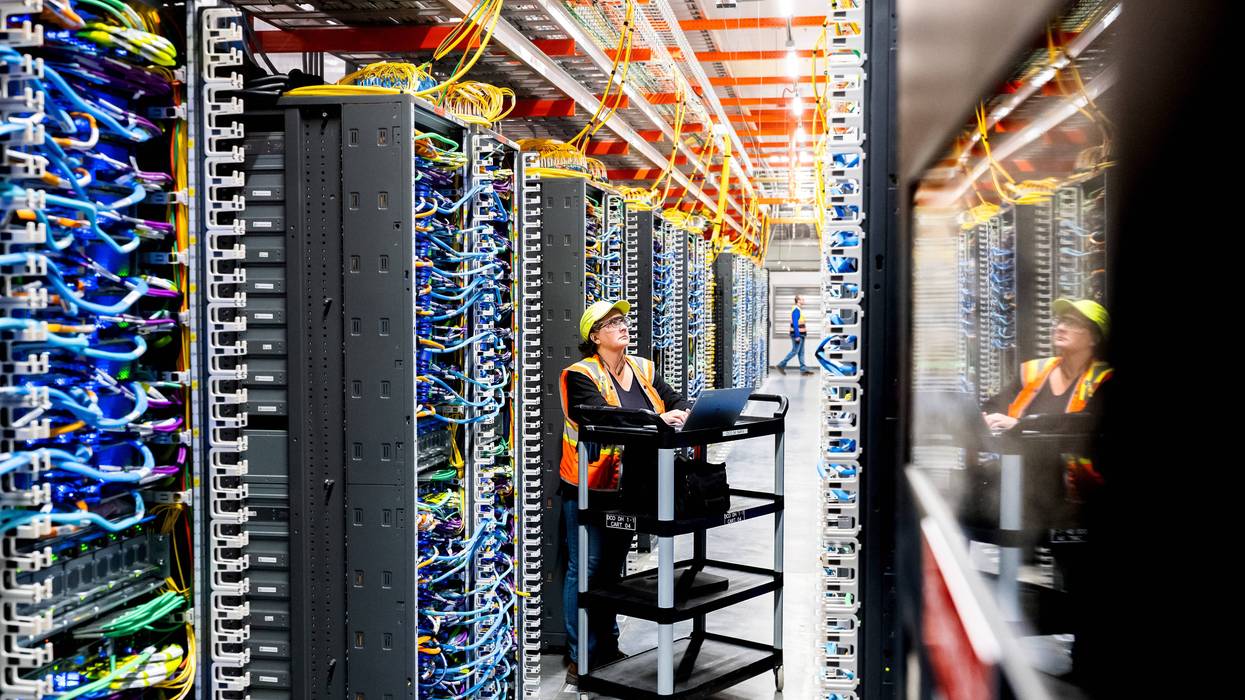
Amazon and the rest of the once aspirationally green tech industry are adding 19th-century smoking chimneys to their facilities in order to churn out more Compute, the 21st century equivalent of wool or steel.
Return with me now to the thrilling days of yesteryear. In 2020, Jeff Bezos announced that Amazon had paid a few hundred million dollars for the naming rights to the new hockey rink in Seattle. But instead of calling it Amazon Arena, he instead decided to commemorate his recent signature on a pledge to go carbon neutral. The name Climate Pledge Arena, if not as mellifluous as Wrigley Field or Candlestick Park, was intended, he said in an Instagram post, to be
a regular reminder of the urgent need for climate action.
Oh, and it would also be
the first net zero carbon certified arena in the world, generate zero waste from operations and events, and use reclaimed rainwater in the ice system to create the greenest ice in the NHL.
Look, even then this seemed mostly PR. Amazon first committed to the Climate Pledge itself—net zero by 2040—the day before a giant 2019 walkout organized by Amazon Employees for Climate Justice. The arena seemed kind of gimmicky from the start. As Ken Belson reported at the time:
Watermelons are served as vegan sashimi, and their rinds are pickled and used in salads. Carrot tops are turned into gremolata, a condiment.
Still, credit Bezos with recognizing the spirit of the moment. Greta Thunberg and her numerous compatriots had scared the oligarchs and financiers of the world into at least rhetorical action. (He could have named it Greta Garden). As he said at the time:
Climate change is the biggest threat to our planet. I want to work alongside others both to amplify known ways and to explore new ways of fighting the devastating impact of climate change on this planet we all share.
But that fright has faded over time, even as the effects of the climate crisis have become ever more legible. And in the eternal battle between fear and greed, the latter has taken on more prominence in the last couple of years. In fact, it would make sense to rename the hockey rink, perhaps AI Avarice Arena.
That’s because Amazon—and, as we shall see, the rest of the once aspirationally green tech industry—are adding 19th-century smoking chimneys to their facilities in order to churn out more Compute, the 21st century equivalent of wool or steel. It’s hard to keep track of the ever-mutating list of grand new plans, often named things like “Prometheus” (or, in the weird case of one Ohio behemoth, “Socrates the Younger”), though here’s a brand new attempt to do so from the folks at Climate Power.
On at least one list of the most polluting proposed data centers, Amazon’s planned facility in Pecos, Texas comes in at the top; indeed, by some calculations it would be the single largest source of climate pollution in the US, with 35 giant natural gas turbines burning through vast quantities of fracked gas. On that same list, if you look carefully, Amazon’s planned “energy campus” in Pennsylvania would come in fourth on the list. Anyway, far from heading for net zero, Amazon’s greenhouse gas emissions were up 16% last year.
Amazon’s chief sustainability officer, Kara Hurst, was designated to go to New York and take the company’s lumps during Climate Week; she told a gathering organized by the news site Semafor that the company needed to “do better.” Not on lessening its environmental impact, but on “communicating its environmental impact.”
There is a lot of debate, backlash against data centers in this country right now, and one of the things that we’re doing is taking a look at what have we done well and where have we fallen down and what do we need to do better. And so, we’re revising a number of our practices. We’re calling for a lot more transparency and accountability because that’s what people in these communities deserve. We’re saying, "Hold us accountable for our practices."
I read this to mean: "It’s getting harder to build data centers, so we’re going to try and up the ante for local communities with more payouts." (Word came today of one Pennsylvania data center that will offer $10,000 to every family in town if they’ll just change the zoning code and let them build).
But of course even if they figure out how to buy off the communities where they want to build their factories, it won’t affect by an iota the quantity of greenhouse gases they plan on pouring into the air—or the fact that this vitiates all their proud climate pledges.
Amazon is not alone, of course. Meta, for instance, had joined RE100, a renewable energy campaign all the way back in 2016, when it was still known as Facebook. It left this summer because… it wanted to use gas, not renewables, to power its data centers. As ESG News reported:
"After several in-depth conversations between Meta and Climate Group, Meta has withdrawn from the RE100 initiative, as it is no longer able to meet the technical criteria due to investments made in new gas power,” a Climate Group spokesperson told the website.
The withdrawal comes as Meta expands its global data center footprint. The company has entered arrangements that support new natural gas generation to supply growing electricity demand.
In Louisiana, utilities are expected to bring 10 new gas plants online to support Meta’s Hyperion data center.
Google reported an 18% increase in emissions in 2025. If you want to talk about an example of fairly comprehensive corporate failure, consider this. As Heather Clancy reports:
Google’s cumulative emissions have risen more than 80% since 2019, the baseline year for the company’s “intentionally aspirational” pledge to cut its operational emissions and certain supply chain emissions in half by 2030.
Planning to cut your emissions in half and instead raising them by eighty% led the company’s chief sustainability officer to change the title of her office to tell investors that they were “navigat[ing]the tension between hyper-growth and environmental stewardship.” In this case, “navigating” seems to involve accelerating full speed ahead into the iceberg that you identified a decade ago.
And of course there’s Elon Musk, whose Colossus data centers in the Tennessee-Mississippi corridor set the early standard for environmental irresponsibility, pouring pollution into poor Black neighborhoods and triggering a wave of lawsuits. Dave Roberts and I were on a panel early in Climate Week with LaTricea Adams of Young, Gifted, and Green and Abre’ Conner, director of Environmental and Climate Justice at the NAACP, and I would not bet against their ability to bedevil the richest man in the history of the world.
In fact, that pushback is now beginning, and the oligarchs behind these hyperscalers are clearly an important target. Not the only target. As Amy Westervelt notes: “We gotta start referring to data centers by both their mother and father's last names, Spain style. The Microsoft-Chevron data center, the Meta-ExxonMobil data center.” And of course we should keep beating on the dirty truth that much of the data center capacity is directly employed in raising the planet’s temperature—as Emily Atkin pointed out last month, companies like Amazon are marketing their AI services to the oil and gas companies to help them find more crude, and this may ultimately do even more damage than their emissions.
Still, the easiest way for organizers to operate may be simply to connect the much-despised oligarchs with the increasingly-despised data centers and in turn with every climate disaster that now unfolds. This is starting to happen. I got to join a demonstration outside Amazon HQ in Manhattan last week, and a day later the folks from Climate Defiance managed to shut down a program with the company’s sustainability guru “in less time than their warehouse worker’s pee break.” It’s definitely worth watching the action. As organizers explained:
A company that co-founded something called "The Climate Pledge" is now building the single largest source of climate pollution in the country, on purpose, in 2026. Lol. No really, it's utterly fucked.
But don't worry guys, because we have a pledge too. And one that we won't break...
We solemnly pledge to keep disrupting all the BS "sustainability" directors doing Simone Biles-level backflips to make emissions sound like a hipster yoga retreat while the planet burns. We pledge to keep confronting all the cowardly politicians who take corrupt death-enabling money while calling it economic development. And we pledge to keep coming for ANYONE who thinks merely uttering the word "pledge" is a substitute for actually keeping one.
Remember, as I said above, that for a jerk like Bezos the equation is always going to be greed versus fear. If he had a mild moment of social responsibility a decade ago, greed has ruled him in recent years (his one useful action this decade was trading in his wife for a younger model, thus freeing McKenzie Scott to become one of the most remarkably effective philanthropists in American history). But fear—of damage to reputation, of investigation by new majorities in Congress, maybe even someday of consumer boycotts of his ever-shabbier and more self-serving empire—might inspire change. (And if you want another reason to dislike them, read this account of waves of drones dropping packages across a test area in suburban Texas. “We hear them zoom, zoom, zoom, back and forth from morning until past dinnertime,” one resident explained).
If you think this is confined to America, think again. Ketan Joshi provides an excellent report from Down Under, where they threaten the country’s efforts to truly rein in emissions. Meanwhile, from Denmark, I had an email today from Søren Hermansen, the hero of the pioneering wind power buildout on Samsø Island, which became a model copied around the world:
I am struggling with Microsoft here in Denmark. They want to establish 2-3 data centers in one municipality and several more all over Denmark.
The two I am involved in are among the largest in Denmark covering 60-70 hectares of building and 110 hectares of land used for diesel-gas turbine back up with a depot of 25.000 tonnes fuel oil for emergencies.
Microsoft is acting like colonial criminals and there is no way we can find the head of the dragon. Every time we find a CEO it is always a lower ranking person who can not answer anything but has to go back and ask someone higher in the system…
The already proposed data centers in Denmark will more than double the total Danish electricity consumption. In other words we will return to the fossil fuel area 30-40 years ago and carbon emissions will skyrocket.
It is all dire. But it can be fought—we are winning plenty of battles.
Earlier this summer, for instance, Microsoft backed away from its commitment to build a giant gas-fired data center in West Virginia. It never said why, but the folks at Stand.Earth speculate that “the groundswell of community resistance and threat to its 'climate leader' public image played a bigger role than they’d like to admit.” As Monica Nickelsburg had reported:
An analysis by Michael Thomas, CEO of the renewable energy research firm Cleanview, estimates the project could increase Microsoft’s data center emissions by 40%.
AI is proving to be plenty unpopular for its own reasons. Microsoft’s Bill Gates warned on Meet the Press yesterday that it could cause “a billion deaths” if “something goes wrong.”
But of course on the climate front something is already going wrong. The closest thing we have to a number comes from a 2021 study, which found that for “every 4,434 metric tons of CO2 that we add beyond the 2020 rate of emissions, we will kill one person.” The Amazon Pecos Ranch project is projected to generate 33 million tons of carbon equivalent annually. You don’t need to ask ChatGPT, you just need a calculator. That’s about 7,442 lives right there.
Ridicule is useful too, of course. I’m grateful to Brian Kahn for an alternate list of names for Bezos’ arena. I think my favorite is The Plunderdome, though The Arena of Public Relations isn’t bad either.

"AI companies are engineering a future where only the wealthiest incumbents can build high-quality AI models and operate as the sole holders of humanity's written works."
A coalition of American civil society groups on Friday called for a federal investigation into reports that artificial intelligence giants are mass-purchasing physical books, scanning them to train their AI models, and destroying them without regard for historical artifacts or the public good.
In a letter to the Federal Trade Commission (FTC), the coalition notes that "at least one top AI company, Anthropic, is known to have acquired millions of print books in bulk, scanned them into digital form, and discarded the physical originals." The letter notes that "this process leaves only the digitized text in the company's proprietary database for use in training its large language models behind products such as Claude."
The coalition, led by the Demand Progress Education Fund, pointed to an internal Anthropic memo that was made public as part of a copyright lawsuit against the company. The memo is headlined "Project Panama," which is described as "our effort to destructively scan all the books in the world."
"We use a 'soft codename' for it because we don't want it to be known that we are working on this," the memo states. "This document is visible to all Anthropic employees, but you should avoid talking about it in public areas, and the fact that we are working on this should not be shared with anyone outside Anthropic."
At one point, Anthropic reportedly considered approaching US libraries such as the New York Public Library for its massive book-consumption campaign. One court document describes how an Anthropic vendor's "hydraulic powered cutting machine" would "neatly cut" books for scanning. The scanning company would then "schedule with the recycling company to pick up the completed books," according to the filing.
Amazon is also reportedly engaged in a large book-buying operation, under which employees "cut the bindings off in order to scan the books more quickly."
"The AI industry is acquiring books on vast commercial scales to scan and destroy, all to keep that scanned text in a private database walled off from the world and subject to corporate censorship and manipulation."
The new letter to the FTC observes that "proxies and intermediaries now function as sourcing partners for AI companies, offering the buyers anonymity and brokering bulk book orders—including rare, out-of-print titles with few surviving copies." 404 Media reported last month that ISBNdb, which markets itself as "the world's largest book database," is offering "high-volume book acquisition services for AI companies."
"Books published before the rise of generative AI (such as Claude, ChatGPT, and Gemini) command a premium because they are free of the AI-sourced text common in today's writing," the new letter adds.
The coalition argues that AI giants' mass book buying and subsequent destruction—dubbed the "hoard and destroy" practice—is part of an effort to "build and entrench their market dominance" by "corner[ing] the essential inputs of AI development."
"We ask the FTC to use its investigative authorities, including potentially under Section 6(b) of the FTC Act, to determine whether and to what extent this practice forecloses competing AI developers and the public from a scarce, non-reproducible input and whether it constitutes an unfair method of competition under Section 5 of the FTC Act," the groups write.
"Through their practice of permanently destroying books en masse and thus removing those non-renewable resources from broader access, AI companies are engineering a future where only the wealthiest incumbents can build high-quality AI models and operate as the sole holders of humanity's written works—after having destroyed the originals to get there."
Kate Oh, special adviser to the Demand Progress Education Fund, said in a statement Friday that "the secretive and reckless way that major AI companies like Anthropic and Amazon are acting shows that there is real smoke here that the FTC needs to investigate."
"There is credible reporting that the AI industry is acquiring books on vast commercial scales to scan and destroy, all to keep that scanned text in a private database walled off from the world and subject to corporate censorship and manipulation," Oh added.

If passed, the Delivery Protection Act would be the first law in the US to regulate Amazon's vast network of subcontractors that handle the company's deliveries.
New York City Mayor Zohran Mamdani has thrown his support behind legislation that could become a first-in-the-nation law to regulate Amazon's network of subcontractors that deliver the $3 trillion company's packages—an "exploitative business model" that shields the e-commerce giant from accountability, as Mamdani said Monday.
The Democratic mayor endorsed the Delivery Protection Act, proposed by New York City Council Member Tiffany Cabán, which would establish new safety, training, and labor standards for "last-mile" warehouses and distribution facilities in New York City, and hold the companies that operate the facilities, such as Amazon and FedEx, liable for employing the workers who make hundreds of deliveries per day across the city.
As the mayor's office said Monday, at least 11 last-mile facilities have opened across New York City since 2020, with subcontractors running the warehouses as Amazon directs the hiring of delivery drivers, the routes they use, and requires them to use Amazon-branded vehicles and uniforms.
But while exerting control over the deliveries, Amazon pushes responsibility for the vehicles used onto the subcontractors, as delivery workers explained in a video released on social media by Mamdani on Monday.
"When injuries and worker accidents skyrocket, Amazon says they have nothing to do with it. They can't have it both ways," said the workers.
If it looks like an Amazon delivery and drives like an Amazon delivery, then it's an Amazon delivery, right? Not according to Amazon.
Big companies like Amazon have built a vast network of subcontractors who deliver their packages while shielding them from accountability.
It… pic.twitter.com/6hQVV8GoNH
— Mayor Zohran Kwame Mamdani (@NYCMayor) August 10, 2026
According to a report by the Office of the Comptroller in New York City last year, 78% of areas surrounding last-mile facilities saw an increase in injury-causing crashes after the warehouses opened.
“Corporations like Amazon build billion-dollar business models by insulating themselves from accountability through a system of exploitative subcontracting," said Mamdani in a statement. "As last-mile delivery centers have exploded across New York, so too have traffic accidents and worker injuries. The Delivery Protection Act is commonsense regulation that protects delivery workers, safeguards the communities where these facilities operate, and ensures that the corporations benefiting from workers’ labor are responsible for the consequences of their business practices."
"The people who make these companies run deserve dignity, stability, and a safe workplace," he added. "It's time to end the subcontracting model that puts profits over people and build an economy that works for working New Yorkers.”
By using subcontractors, Amazon can avoid municipal regulations regarding minimum pay and benefits. A nationwide survey by the Shift Project at the Harvard Kennedy School’s Malcolm Wiener Center for Social Policy last year found that Amazon delivery drivers are paid an average of $19 per hour, compared with $35 per hour at UPS and $25 per hour at FedEx. Pay does not rise with tenure at Amazon, as opposed to its delivery competitors, and fewer than half of Amazon drivers have access to health insurance, paid vacation, and retirement plans that are provided to nearly all UPS delivery workers.
In New York City, pay for the drivers who make Amazon's deliveries is higher, starting at about $20 per hour and averaging close to $24 per hour. But one driver in Queens, Luc Rene, told The New York Times that Amazon controls the volume of packages he delivers and has refused to allow the subcontractor he works for, DNA Logistics, to lighten the workload during extreme heat and other inclement weather.
The company could not be reached for a comment to the Times, and Amazon did not address Rene's allegations but claimed it adjusts drivers' routes due to inclement weather.
Amazon has claimed that the Delivery Protection Act—which would require last-mile facilities to obtain licenses from the city's Department of Consumer and Worker Protection, ensure worker protections, and hold companies accountable for delivery quotas, schedules, and routes—would raise costs for people who use delivery services, with one Amazon-commissioned study claiming households would spend $664 more annually if the company had to comply with the law.
But Brendan Griffith, president of the New York City Central Labor Council, AFL-CIO, said the workers and communities in New York City are already "paying the price" for Amazon's reliance on subcontractors.
“The Delivery Protection Act will establish stronger protections for worker safety, employment, and responsible operations while bringing long-overdue oversight to an industry where major operators have too often hidden behind subcontractors," said Griffith. "To be clear: when these companies 'raise the alarm' of fewer jobs, higher prices, or service reductions, they are describing choices that they may make, not in the best interest of consumers and workers but to protect their bottom line. We thank Mayor Mamdani for standing with the Amazon Teamsters and the labor movement in support of this legislation that puts NYC workers—who are also consumers—first, and we urge the City Council to pass it without delay.”
Mamdani's advocacy for the legislation in New York City caught the attention of at least one lawmaker across the country.
"We should pass something like this in Colorado," said state Rep. Javier Mabrey (D-1).
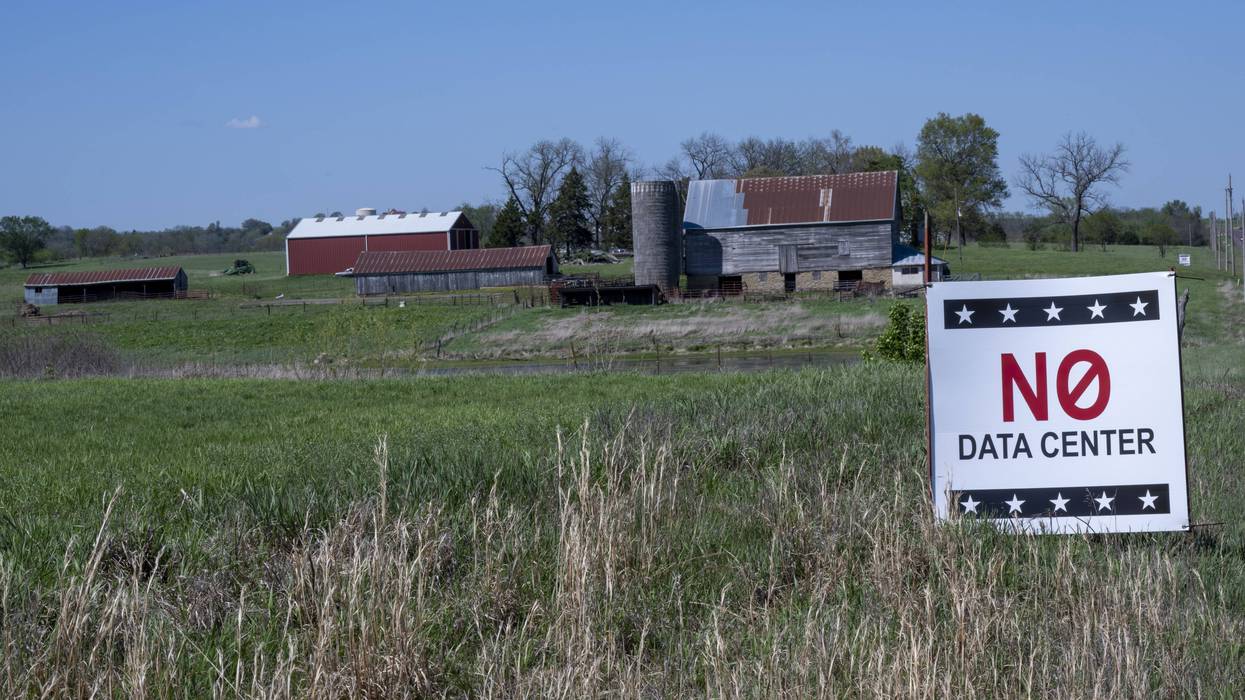
"Instead of building a modern, clean energy source to power its increased AI-driven electricity demand, Amazon chose to invest in a massive natural gas power plant to fuel its giant Texas data center."
Amazon is boasting that the new data center it plans to build in Pecos County, Texas will be self-sustaining in its use of electricity, as the company has acquired permits to build a 7.65 gigawatt gas plant to power the massive facility, ensuring it won't raise electricity prices for households in the area.
But the savings on utility bills will likely come at a cost for the US at large and the planet, as well as locals in West Texas.
According to reporting from Cleanview Newsletter on Friday, the site acquired by Amazon, GW Ranch, has a permit from the state allowing the construction of a gas power plant that could emit 33 million tons of carbon pollution, which would make it by far the largest single source of pollution in the US.
The James H. Miller Jr. Power Plant, which burns coal in Quinton, Alabama, is currently the biggest emitter of carbon dioxide, sending about 16 million tons of pollution into the atmosphere each year.
Power plants generally emit less than the maximum amount of carbon permitted, but the unprecedented limit for the new plant, which is being developed for Amazon by Pacifico Energy and will have 35 natural gas turbines, means it is likely that the company's project will far exceed the pollution caused by the plant in Alabama.
The permits viewed by Cleanview, which tracks data centers and sustainable energy development, show that the power plant would be disconnected from the state's electricity grid, at least at first, and an Amazon spokesperson said the company "believes in paying the full costs of powering our operations" and would not "raise electricity costs for Texas families."
The on-site power generation will be "designed to transition to grid-connected service as interconnection timelines allow," the spokesperson added—suggesting the data center could ultimately raise household electricity costs as well as supercharging carbon pollution in the area.
The company further tried to allay fears of the impact of the new data center and its dedicated power plant by saying it plans to use brackish water that isn't safe for irrigation or consumption at GW Ranch; along with data centers' impact on utility costs, communities have protested against the facilities across the country due to their massive water consumption.
But the advocacy group Climate Action Campaign said Sunday that in its rush to join the nationwide artificial intelligence data center buildout as President Donald Trump has demanded, Amazon "chose dirty power over clean."
"Instead of building a modern, clean energy source to power its increased AI-driven electricity demand, Amazon chose to invest in a massive natural gas power plant to fuel its giant Texas data center," said Margie Alt, the group's director. "During this excessively hot and dry summer, riddled with forest fires and unbearable air pollution, a move like this is truly unacceptable."
With Amazon pledging to eliminate its pollution-causing emissions by 2040, the company's decision to join Meta, Microsoft, and Google in investing in its own power plant to build a data center was an example of "yet another major corporation dodging accountability," said Alt.
"This isn’t innovation," she said. "Despite its massive resources, Amazon is shirking its own responsibility and the industry’s promises of computing progress without the economic or health burdens to local communities. The result of that broken promise is that communities will pay the consequences with their health and their wallets."
According to Cleanview, Pacifico Energy has plans to eventually build up to 750 megawatts of solar generation and 1.8 gigawatts for battery storage capacity at GW Ranch.
As it potentially doubles the amount of planet-heating carbon emissions that are currently sent into the atmosphere by the James H. Miller Jr. Power Plant, the plant at the GW Ranch site could heighten the risk of developing heart disease, asthma, chronic respiratory illnesses, and other health problems for people living and working in the area.
"Progress shouldn’t come at the expense of the rest of us just to power billionaires’ ambitions," said Alt. "Shame on you, Amazon!”
The project, Kathryn Guerra, a campaign director at the watchdog group Public Citizen, told The New York Times, will "absolutely have a huge impact on the environment, and on public health."
The project was made public weeks after Trump insisted that "smart" communities want data centers to be built in their vicinity—but numerous polls have shown the facilities, which offer few long-term jobs as they raise costs for families, are sparking outcry from across the political spectrum.
About 70% of respondents to a Gallup poll in March said they would oppose the construction of a data center in their area. About half of those who expressed opposition said they were mostly concerned with the environmental impact associated with data centers, or the potential for resources to be gobbled up by the facilities.

Consumers bore the vast majority of the costs of Trump's illegal tariffs, but it's the large corporations that raised prices who are seeing massive refunds.
Congressional Progressive Caucus Chair Greg Casar (D-Texas) said on Monday that "every single cent" of the refunds for President Donald Trump's illegal tariffs should go to consumers who bore the brunt of the financial strain rather than the large corporations currently receiving them.
"Apple got a $2.2 billion tariff refund. Amazon got $600 million," Casar wrote in a post to social media. "Trump is sending the 'refunds' to the companies, not working people."
The Supreme Court struck down many of Trump's sweeping tariffs in February, ruling that he could not impose them unilaterally using powers under the International Emergency Economic Powers Act of 1977.
A group of 25 Democratic states sued the Trump administration on Monday for once again attempting to reimpose the tariffs under a different law, the 1974 Trade Act.
According to the Congressional Budget Office report from February 2026, about 70% of the tariffs were being passed onto consumers in the form of higher prices, while businesses absorbed about 30% of the cost.
Companies were able to pass on even more of the costs to consumers by hiking prices of domestic goods as well, meaning ordinary people were forced to swallow about 95% of the overall cost.
Yale's Budget Lab estimated that Trump's full tariff regime was costing the average household about $2,400 annually. Even after the Supreme Court rolled them back, the Budget Lab estimates that households will pay an extra $1,100 per year.
But the system for refunding the approximately $166 billion taken as part of the unlawful tariff regime allows only "importers" to apply for reimbursement, meaning the refunds have largely flowed to big companies who get to decide how much, if any, of the windfall they want to trickle down. So far, it does not seem to be very much.
Amazon disclosed on Thursday that it was participating in the refund process and that it had received over $600 million from the federal government in quarter two.
Brian Olsavsky, Amazon’s finance chief, said there was a "limited set of circumstances” in which the company could find examples of it directly passing prices along to consumers, since third-parties are the importers for most products, but said it would refund them when they could be identified.
He added that the refunds would also be invested in “low prices for customers," though he provided no details on how that would work.
Apple, meanwhile, is one of the biggest beneficiaries of the refunds. In a press release on Thursday, the company celebrated that the tariff refunds on their own were worth “2 percentage points” of its 50.1% gross margin, which AppleInsider calculated put the total refund at about $2.2 billion, though its most recent earnings report did not disclose the full amount.
But there's no indication that any of that windfall will be seen by consumers, even through lowered prices, let alone through any sort of reimbursement program.
"While Apple is celebrating its margins, it won’t stop your next MacBook Air from becoming more expensive and more scarce," wrote Kyle Barr on Monday for Gizmodo. "Last month, Apple increased prices for practically all its various products."
Other companies have also received or are expecting refunds in the billions or hundreds of millions, including Ford, General Motors, UPS, Nike, and Walmart, though only some have indicated plans to pass on even part of the savings to consumers.
Rep. Mark Pocan said it was "just another transfer of wealth from everyday Americans to mega-corporations."
Several pieces of legislation have been introduced in Congress aiming to provide tariff relief for consumers.
One bill introduced by Reps. Rosa DeLauro (D-Conn.) and Frank Mrvan (D-Ind.) would require companies to reduce prices in accordance with the size of the refund they receive. Another from Rep. Mike Thompson (D-Calif.) would create an individual tariff refund tax credit and tax corporations unless they absorbed tariff costs rather than passing them to consumers.
None of these bills have advanced out of committee or received a floor vote.
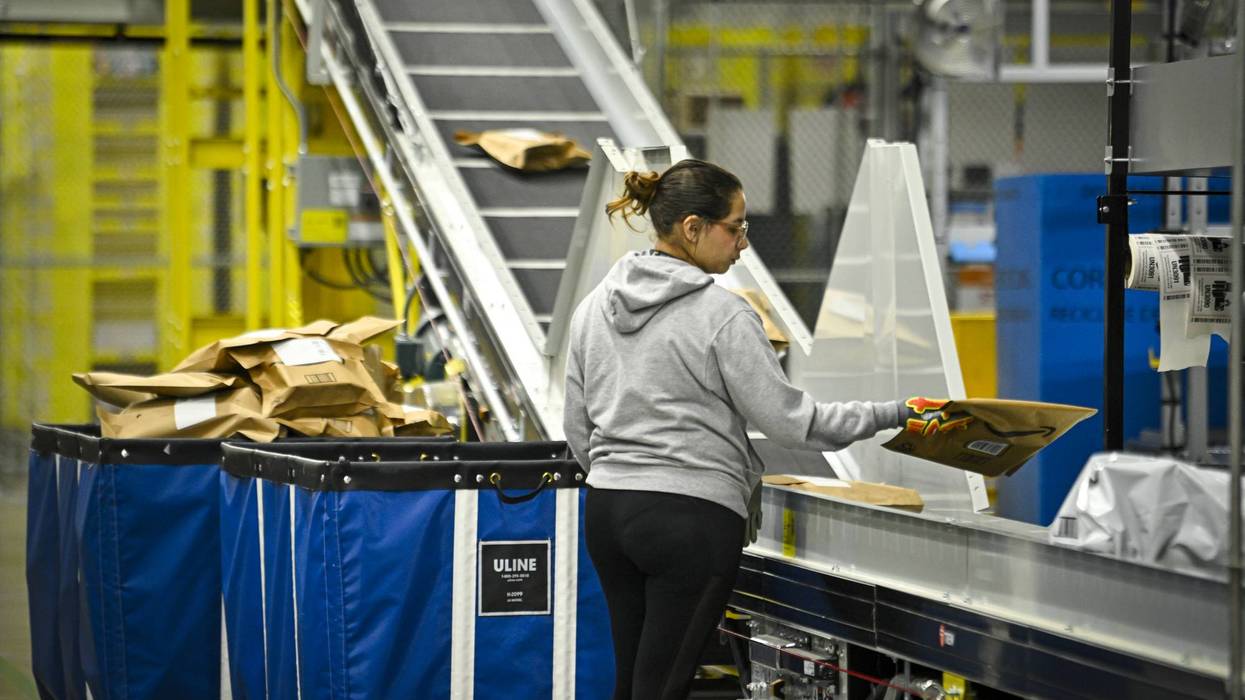
"No one who works for a company making billions in profits should be living in poverty," said Sen. Bernie Sanders.
US Sen. Bernie Sanders recently commissioned a government analysis of federal aid programs and how much employees of some of the largest and most politically influential corporations in the country are relying on food and healthcare benefits due to the chronically low wages paid by Amazon, Walmart, and other firms.
On Wednesday, the nonpartisan Government Accountability Office (GAO) released the results of its research, revealing trends that Sanders (I-Vt.), a longtime critic of economic inequality and poverty wages and the ranking member of the Senate Health, Education, Labor, and Pensions Committee, called "beyond unacceptable."
Six years after the GAO first analyzed low-wage workers' use of Medicaid and the Supplemental Nutrition Assistance Program (SNAP), the report found that the number of Amazon employees who required federal assistance has nearly tripled since 2020, despite the fact that the e-commerce giant has increased its annual profits from $11.59 billion to $77.67 billion in that time.
The analysis focused on 11 states—Arkansas, Georgia, Indiana, Maine, Massachusetts, Nebraska, North Carolina, Oklahoma, Rhode Island, Tennessee, and Washington—whose combined populations comprise about one-fifth of the US population.
Last year, 12,346 of Amazon's employees needed SNAP assistance, for which households must earn less than 130% of the federal poverty level to qualify. A family of three would have to make around $35,000 or less to qualify for the program. Millions of people were shut out of the crucial program by the One Big Beautiful Bill Act (OBBBA), which required states to impose strict limits on eligibility.
More than 11,000 Amazon workers also relied on Medicaid last year in the states surveyed.
"Corporations underpay workers, don't provide healthcare, and outsource core worker needs to the government," said the labor-focused media organization More Perfect Union.
While Walmart topped the list of corporations whose employees used Medicaid benefits, as it did in 2020, its share of workers who rely on the two federal programs went up only slightly over the five-year period, while Amazon's share grew significantly.
Amazon spokesperson Rachael Lighty told The Washington Post—owned by billionaire Amazon founder Jeff Bezos—that the company's hiring spree since the coronavirus pandemic contributed to its increased share of Medicaid and SNAP beneficiaries, and noted that Amazon offers "part-time options for those who want them," which makes more employees eligible for the benefits.
But the Post noted that many people who may want full-time employment and the higher wages it offers can only find part-time work. The Federal Reserve Bank of St. Louis has found an increase in part-time employment since the pandemic.
Sanders noted that Walmart increased its annual profits from $14.88 billion in 2020 to $21.89 billion in 2025, but the number of workers who relied on Medicaid grew by 55% to more than 16,000 people in the 11 states sampled by the GAO.
“American taxpayers should not be forced to subsidize the starvation wages of large corporations like Walmart and Amazon," said the senator. "These corporations are making record-breaking profits, paying their CEOs exorbitant compensation packages, and spending billions of dollars on stock buybacks to enrich their wealthy shareholders. It is beyond unacceptable that these corporations, owned by some of the wealthiest people on the planet, are receiving corporate welfare from the federal government."
Rideshare and delivery apps like Uber and DoorDash, which were not significantly featured in the GAO's 2020 report, are now the top employers of people who use SNAP benefits and are in the top three employers of workers on Medicaid.
Nicole Moore, president of Rideshare Drivers United, told the Post that gig workers across the country struggle to make ends meet with "absolutely precarious income."
The analysis comes a year after the passage of the OBBBA, which delivered $4.5 trillion in tax cuts to corporations and the rich and which Republican proponents said was partially focused on eliminating waste and fraud in government programs like Medicaid. The law includes work requirements for the program and is expected to slash $1 trillion from Medicaid over the next decade.
Republicans have intensified their fixation on "fraud" in social services in recent months after fraudulent payments were found in Minnesota's public programs.
Warren Gunnels, the minority staff director for the Senate HELP Committee, said the GAO analysis shows that "the problem isn't the single mom getting $6 a day in food stamps."
"The problem is Jeff Bezos, worth $269 billion, more than doubled his wealth since 2020 while paying wages so low the number of Amazon workers on food stamps and Medicaid nearly tripled," said Gunnels. "Bezos is the welfare queen."
Sanders called on Bezos and the Walton family, which owns Walmart, "to get off of welfare and pay their workers a living wage with good benefits."
"No one who works for a company making billions in profits should be living in poverty," said the senator. "This is especially true after these corporations and their multibillionaire owners received a massive tax break from President Trump’s so-called ‘Big, Beautiful Bill,’ paid for by the largest cuts to Medicaid and nutrition assistance in history.”
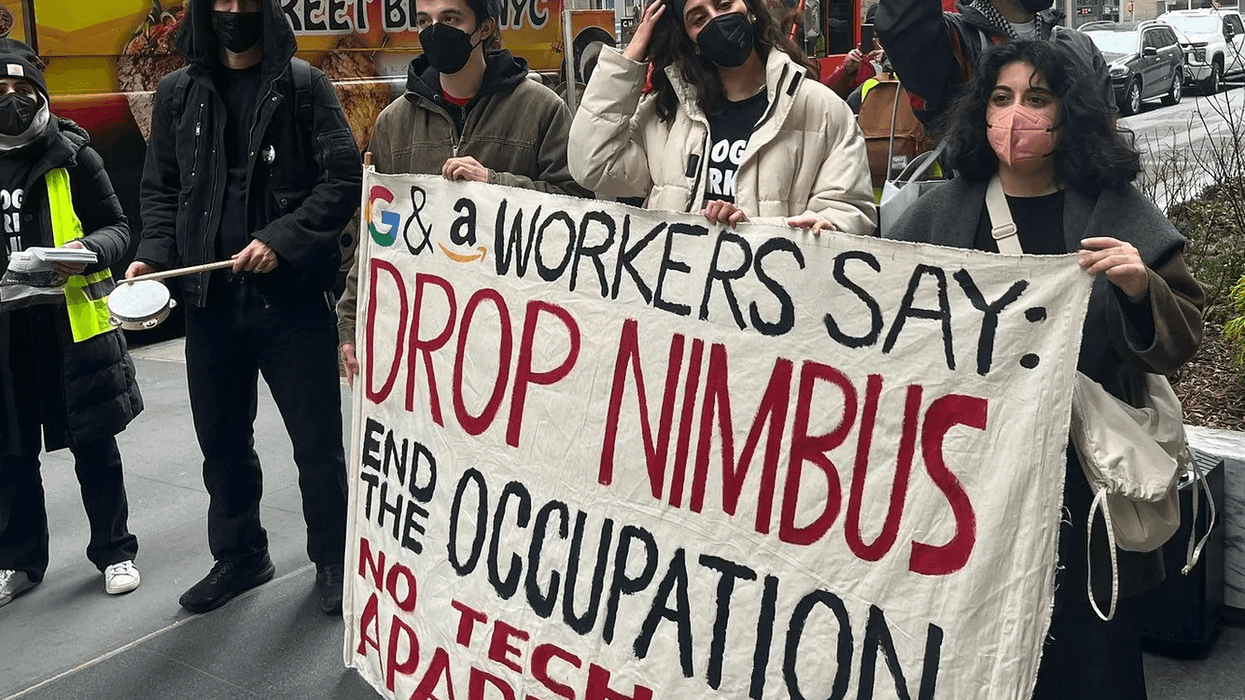
"Is this the future you want to see? Where AI executives pretend like they have the answers, that they are doing good, and you're giving them a stage?"
A protester was violently removed from the United Nations AI for Good Global Summit in Geneva on Wednesday after Palestine defenders disrupted a presentation by a senior Amazon executive to denounce Big Tech's complicity in Israel's genocidal war on Gaza.
Pro-Palestine activists linked to the global Boycott, Divestment, and Sanctions (BDS) movement are protesting the UN International Telecommunications Union (ITU) conference over its partnerships with tech titans, especially Amazon and Google. In 2021, the pair signed a $1.2 billion contract for Project Nimbus, which provides cloud services to the Israeli government and military.
Under the deal, Amazon Web Services and Google Cloud provide the Israel Defense Forces and Israeli government agencies with cloud infrastructure, artificial intelligence tools, and data storage. The contract prohibits Google or Amazon from refusing service to Israeli government, military, or intelligence agencies.
Project Nimbus sparked the #NoTechForApartheid campaign, in which disaffected tech workers and dozens of advocacy groups rose up against Big Tech’s complicity in Israeli human rights crimes in Palestine, including the Gaza genocide; apartheid; and illegal occupation, settler colonization, and ethnic cleansing in the West Bank.
On Wednesday, activists interrupted a summit speech by Amazon vice president and chief technology officer (CTO) Werner Vogels, with protesters taking the stage—two of them holding a large sign reading "No Tech for Apartheid"—as others in the audience chanted "Drop Project Nimbus!"
"You are making Project Nimbus, a project of billions of dollars that Amazon is investing so that Israel has free access to your servers," the man who upstaged Vogels said as the Amazon CTO stood by with his hands on his hips. "You are investing billions in that. Your technology, Project Nimbus, develops Lavender, develops the software Where's Daddy, that actively tracks, using AI, people in Palestine, and when they come back, they kill them together with their families."
"And you know this... and you're making millions out of this," the protester continued. "You're sitting here as if you're trying to do good, as if you're trying to be for the good of AI. What do you have to say for yourself? How do you sleep at night?"
"Maybe that's why you're looking so panicked. Maybe that's why you cannot even stand on this stage anymore and look at these people, because you know exactly what your technology is being used for," the activist said after Vogels stepped off the stage.
"They know exactly where their profits are coming from, and they continue anyway," the protester added, drawing loud cheers.
As the activists holding the sign were removed from the stage, the man speaking gestured to Vogels and others and said: "You should be stopping them! You should be stopping those criminals right here! Why are you facilitating genocide? Why are you continuing to be complicit in the deaths of innocent people three years on?"
Security personnel then removed the man from the stage as he said: "No violence. No violence."
"Why are you putting me in a chokehold?" he asked as he was violently ejected. "Is this the future you want to see?... Where AI executives pretend like they have the answers, like they are doing good, and you're giving them a stage? Shame on you, Amazon! Drop Project Nimbus!"
Activists with the BDS movement and other groups also protested at last year's AI for Good summit, which came on the heels of a report by UN independent Palestine expert Francesca Albanese detailing corporate complicity and direct participation in Israeli crimes against Palestinians and specifically naming dozens of companies, including Amazon and Google parent company Alphabet.
More than 250,000 Palestinians have been killed or wounded, including thousands of people who are missing and presumed dead and buried beneath the rubble of the flattened Gaza Strip, since Israel launched its US-backed war on October 7, 2023, when Hamas led the deadliest attack on Israel in the country's 78-year history. Around 2 million Palestinians have been forcibly displaced, while Israel's "complete siege" of Gaza fueled famine and disease.
Israel is facing a genocide case filed by South Africa at the International Court of Justice in The Hague. The International Criminal Court, also located in the Dutch city, has issued arrest warrants for Israeli Prime Minister Benjamin Netanyahu and former Defense Minister Yoav Gallant for alleged crimes against humanity and war crimes in Gaza.
The Geneva summit follows the creation earlier this month of the ITU's AI for Good Global Commission, which is co-chaired by Salesforce CEO Marc Benioff and Rwandan President Paul Kagame, whose repressive 32-year rule has been criticized for persistent human rights abuses. Both Amazon and Google are represented on the commission.
The summit also comes amid growing worldwide opposition to the unchecked development of AI technology, which experts warn will lead to job losses on an unprecedented scale, widening economic inequality, environmental and climate harms, social isolation, increased government surveillance, "killer robots," and, in the long term, possibly even human extinction.
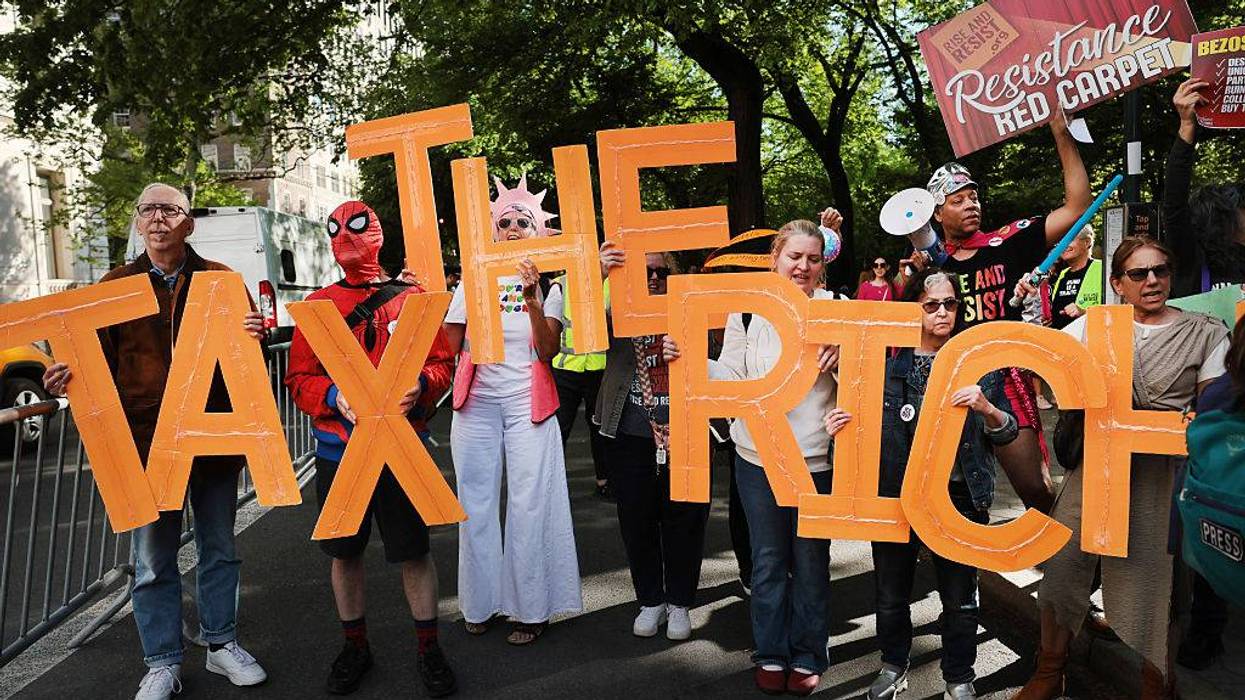
Sen. Bernie Sanders noted that the billionaire spent $10 million on the Met Gala, $120 million on a penthouse, and $500 million on a yacht while "planning to throw 600,000 Amazon workers out on the streets and replace them with robots."
Amazon founder Jeff Bezos in recent weeks has come under fire for a wide variety of reasons, including his involvement with the 2026 Met Gala and his plans to build a robot workforce.
A Monday report from The Hollywood Reporter noted that Bezos, despite being a lead sponsor of this year's Met Gala, did not make an appearance at the event's red carpet as he had in past years.
Bezos' sponsorship of the Gala has been hit with heavy criticism in recent weeks, as many activists slammed the New York Metropolitan Museum of Art for taking the tech mogul's money despite his company's labor practices and reported involvement in helping US Immigration and Customs Enforcement (ICE) operations.
According to The Hollywood Reporter, other critics "accused the billionaire of buying influence with the major event and speculation swirled that some stars may boycott the event due to his involvement."
In addition to not appearing at the Met Gala red carpet, Bezos is reportedly trying to lower his profile by selling his $500 million luxury yacht.
The New York Post reported on Monday that Bezos has decided that the 417-foot vessel has become "too recognizable," and is also a headache to maintain, costing an estimated $30 million per year to operate.
Sen. Bernie Sanders (I-Vt.) on Tuesday argued that Bezos' lavish spending and his plan to build an army of robots to replace human workers was symbolic of American capitalism in 2026.
"The reality of American life today," Sanders wrote in a social media post. "Jeff Bezos, worth $290 billion, spent: $10 million on the Met Gala, $120 million on a penthouse, $500 million on a yacht. Meanwhile, he‘s planning to throw 600,000 Amazon workers out on the streets and replace them with robots. Unacceptable."
Warren Gunnels, Sanders' staff director, similarly made the case that Bezos' spending spree was yet another argument for raising taxes on the wealthiest Americans.
"Jeff Bezos, who paid $10 million for the Met Gala," Gunnels wrote, "got $62 billion richer since [President Donald] Trump was elected and spent $500 million on a yacht to sail to his $55 million wedding in Venice to give his wife a $5 million ring because his tax rate is less than 1%. Four words: Tax the damn rich."
Labor unions, which have long clashed with Bezos over Amazon's aggressive union-busting tactics, held their own rival "Ball Without Billionaires" on Monday evening to protest the Bezos-funded Met Gala.
As reported by Democracy Now!, the gala featured "Amazon, Whole Foods, Washington Post, Starbucks, and Uber workers" who "walked the runway in looks by immigrant designers."
April Verrett, president of the Service Employees International Union, said the Ball Without Billionaires was "not just about fashion" but "about power" and "telling the truth that people who sew and care and drive and cook and clean and secure and those that create are the ones who make everything possible."
Workers at the New York Metropolitan Museum of Art, who earlier this year voted to unionize, registered their own disapproval of this year's Met Gala, posting a message on Instagram informing followers that "91% of hourly Met staff in our unit earn less than a living wage."
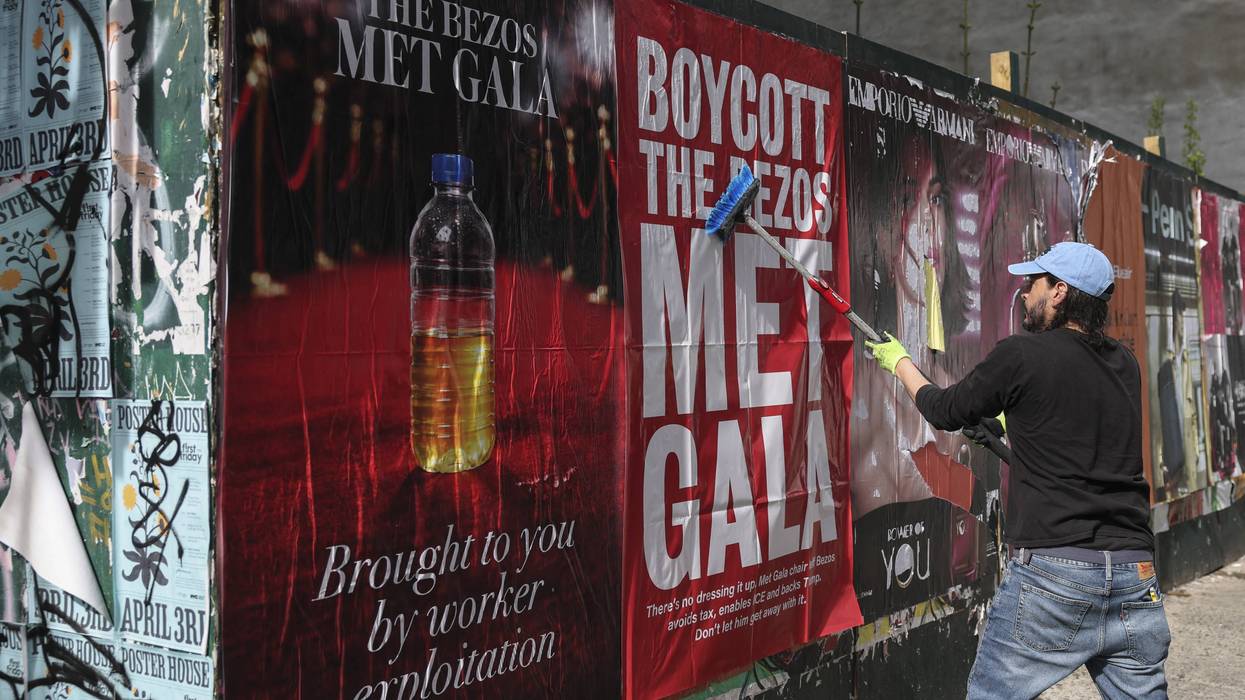
"It's a thin line between celebrating glamor and artwashing extreme wealth," said the Tax Justice Network.
As celebrities prepared to attend the 2026 Met Gala at the Metropolitan Museum of Art in New York on Monday, a coalition of nearly three dozen civil society groups warned that with Amazon founder Jeff Bezos—currently the fourth-richest person on Earth—chairing the annual fundraiser, the gala risks "artwashing the harms of extreme wealth."
Groups including Greenpeace International, Patriotic Millionaires, and War on Want signed a letter organized by the Tax the Superrich Alliance, calling on the museum and Vogue magazine, which hosts the event, not to honor Bezos and warning that the billionaire is using the two cultural institutions as tools "to launder his public image."
The Metropolitan Museum of Art has a celebrated collection of art spanning centuries, many of it made "in defiance of power—work that exposed injustice, gave voice to the silenced, and held the powerful to account," reads the letter.
But the tech mogul chosen to chair the gala "has made his loyalties clear" since President Donald Trump first took office in 2017 and during the Republican's second term, said the groups, pointing to Bezos' purchase of The Washington Post, the mass firing of hundreds of the newspaper's reporters this year, and his remaking of the publication's opinion section into one focusing on "free markets."
He "gutted" the Post "while reportedly pouring $75 million into a film promoting Melania Trump," reads the letter, referring to the Amazon-produced documentary film Melania.
"A 2% wealth tax on just three necklaces previously worn by celebrities to the Met Gala’s red carpet could fully fund New York City’s home energy assistance program, helping 1 million households heat and cool their homes."
"He is not just a bystander to Trump’s administration," wrote the organizations. "He is one of its enablers. This is not philanthropy. This effectively is influence bought and paid for by Bezos’ pocket change—and the Met Gala is his latest purchase."
The groups added that in addition to aligning himself with the White House through his ownership of the Post, Bezos and Amazon—a government contractor where he is still the largest individual shareholder—is working with Trump to "make possible a concentration of power that not only threatens lives in the US but across the world as well."
"While so many of these policies aren’t new, they have been exacerbated under Trump and with the help of people like Bezos—from families torn apart by ICE [US Immigration and Customs Enforcement] raids reportedly enabled by Amazon's own technology, to a White House emboldened to threaten and carry out military action against sovereign nations without consequence—including to ‘destroy a whole civilization’ in Iran—with no accountability," reads the letter.
The Tax Justice Network, one of the signatories, emphasized that just a fraction of the money that goes to the $100,000-per ticket Met Gala could alleviate the economic inequality that's grown worse under the Trump administration.
"A 2% wealth tax on just three necklaces previously worn by celebrities to the Met Gala’s red carpet could fully fund New York City’s home energy assistance program, helping 1 million households heat and cool their homes," said the Tax Justice Network, citing its analysis released Monday.
Bezos is among the billionaires who have contributed donations to Trump's pet projects—a luxury ballroom and a 250-foot-tall arch in Washington, DC—while the president has tried to cut the home energy assistance program, said the group.
“There’s a thin line between celebrating glamorous fashion and artwashing extreme wealth, and that line gets bulldozed when your poster boy is an ICE-profiteering billionaire bankrolling Trump’s vanity projects and a top spender on anti-worker lobbying,” said Alex Cobham, chief executive at the Tax Justice Network.
In the first two hours of the Met Gala, Cobham added, "Bezos’s wealth will grow by the equivalent of 130,000 hours of a teacher’s labor... This extreme distortion throws economies out of whack. Our economies are supposed to let people earn the wealth they need to lead secure and comfortable lives, but most countries’ tax rules make it easier for the superrich to collect wealth than for the rest of us to earn it."
It's a thin line between celebrating glamor & artwashing extreme wealth. That line gets bulldozed when your patron is an ICE-profiteering billionaire bankrolling Trump’s vanity projects & a top spender on antiworker lobbying. Don't let Bezos artwash his at the Met Gala taxjustice.net/press/2-tax-...
[image or embed]
— Tax Justice Network (@taxjustice.net) May 4, 2026 at 3:25 AM
"In Bezos’ case, it’s easy to see how that undertaxed collected wealth goes towards lobbying further against workers’ rights and pay, while his company Amazon remains one of the biggest recipients of US subsidies," said Cobham.
According to the Tax Justice Network's analysis, Bezos accumulated $3.8 million every house from 2023-25, when his total wealth grew by more than $100 billion.
"If Bezos were to continue to accumulate wealth at this rate," said the group, "he would accumulate $7.6 million in the first two hours of the Met Gala event, which is the equivalent of 110 NYC Public Schools teachers’ starting salaries"—$68,902.
Those organizing the gala can and must "stop celebrating those destroying our countries and humanity itself," reads the letter sent by the Tax the Superrich Alliance, by not honoring Bezos and backing the fair taxation of the wealthiest households and corporations.
"End the oligarchy," reads the letter. "Tax the super rich. Now."
New York City Mayor Zohran Mamdani, a proponent of taxing the rich to pay for crucial public programs and services, planned to skip the Met Gala in a break with tradition. Last month Mamdani announced plans for a tax on second homes valued at $5 million or more in New York City.
Celebrities who are reportedly planning to skip the event include Palestinian-American model Bella Hadid, who has spoken out against ICE and in favor of Palestinian rights, and actress Zendaya.
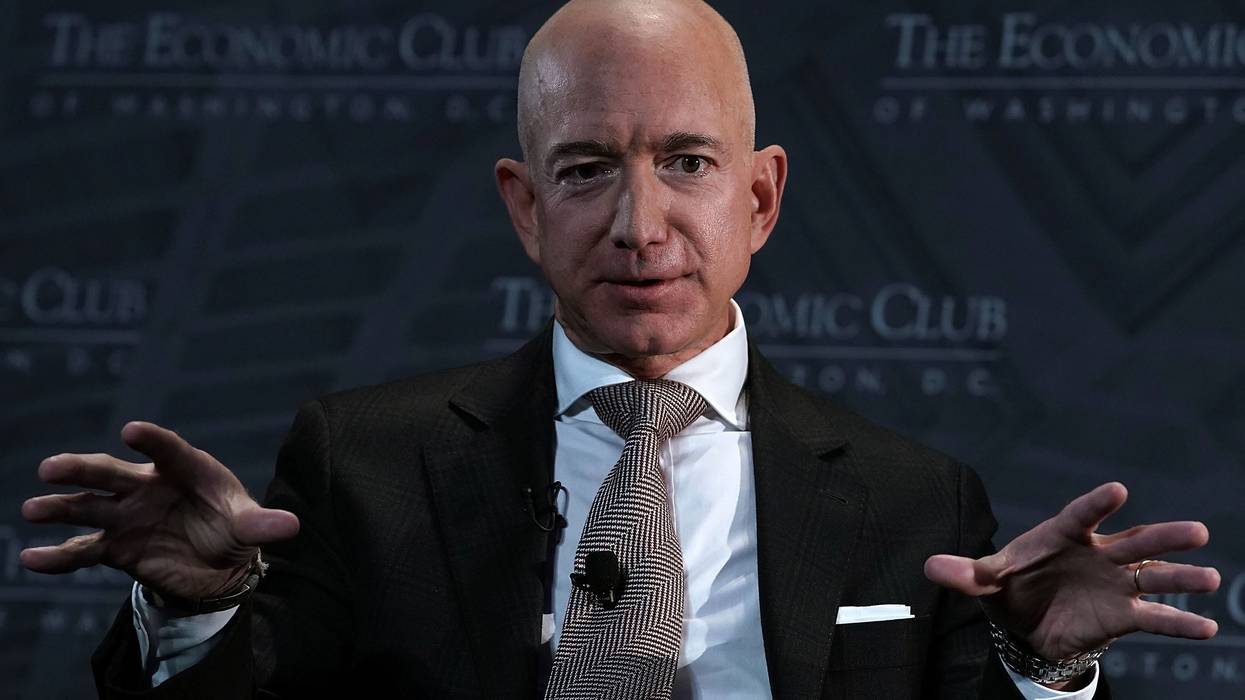
Like the robber barons of the first Gilded Age, Bezos’s consumption is of the conspicuous kind. But is luxurious lifestyle is not his biggest crime.
I’m tempted to give Elon Musk the title of world's worst neo robber baron. But when it comes to greedy and irresponsible corporate behavior, one CEO is outdoing even Musk.
When the history of this sordid second Gilded Age is written, the list of neo robber barons will obviously include Musk as well as Meta’s (Facebook’s) Mark Zuckerberg, Palantir’s Alex Karp, Palantir’s co-founder and board chair Peter Thiel, Oracle’s Larry Ellison (and his son, David), Google’s Sundar Pichai, Blackstone’s Stephen Schwarzman, and the Trump Organization’s monumentally corrupt Donald Trump, Donald Trump Jr., and Eric Trump.
But one greedy, public-be-damned CEO stands out even above Musk, Trump, and the rest. His name: Jeff Bezos. His corporation: Amazon.
It is difficult for the human mind to comprehend all the ways Bezos is shafting Americans.
Start with prices. According to a newly unsealed filing released Monday in an antitrust lawsuit brought by California Attorney General Rob Bonta, Amazon has pressured major brands like Levi’s and Hanes to demand that competing retailers raise prices on their products.
At a time when most Americans are having trouble making ends meet, Amazon’s push to raise prices — to enlarge its profits (and put more money into Jeff Bezos’s pockets) — is beyond unconscionable.
The New York Times’s David McCabe reports on unsealed evidence that Amazon punishes sellers on its marketplace for offering lower prices on other websites, like those of Walmart or Target. When it spots a competitor’s lower price, Amazon tells the brands to demand that rival sites raise their prices for the products.
The filing includes an email to Hanes from Amazon, with links to Target’s and Walmart’s lower prices, along with Hanes’s apologetic response that it “reached out to Target and Walmart to have the prices increased.” And an email to Levi’s from Amazon, with links to lower-priced khakis on Walmart’s website, along with Levi’s response that Walmart had agreed to raise its price.
According to the lawsuit, Amazon has been able to exert pressure on different brands to raise their prices because of Amazon’s power and reach.
At a time when most Americans are having trouble making ends meet, Amazon’s push to raise prices — to enlarge its profits (and put more money into Jeff Bezos’s pockets) — is beyond unconscionable.
This is hardly Bezos’s and Amazon’s first brush with antitrust law. In 2023, the Federal Trade Commission and 17 states accused Amazon of illegally maintaining a monopoly in online retail by squeezing merchants who sell on its site and prioritizing its own products, resulting in “artificially higher prices.”
In September, the FTC agreed to settle another lawsuit against Amazon that accused it of making it difficult for consumers to cancel its Prime subscription service. Amazon agreed to pay up to $2.5 billion — including $1 billion in penalties and additional payouts to consumers — but didn’t admit or deny wrongdoing.
Meanwhile, The American Prospect’s Harold Meyerson reports that Virginia is subsidizing Amazon’s “second headquarters” in Crystal City, Virginia — just across the Potomac from Washington, D.C. — with $750 million in taxpayer funds, yet the corporation is wildly behind its job-creation pledge. Having promised to create 25,000 new jobs by 2038, it created a mere 1,600 jobs last year and is up to just 29 percent of the number of jobs it promised by now.
Speaking of Amazon jobs: Until earlier this month, attorneys for the National Labor Relations Board were prosecuting Amazon for firing employees that make Amazon deliveries because they’d voted to join the Teamsters, a clear violation of labor laws.
But then, a few weeks ago, the NLRB attorneys — now firmly under control of Trump’s NLRB general counsel — announced they’d reached a “settlement” with Amazon in which Amazon agreed to pay the workers who’d been laid off for more than two years, two weeks’ worth of wages. Two weeks.
Amazon’s workers are among the worst-treated in America.
Ryan Haas of The Western Edge reports that on April 6, an Amazon warehouse worker collapsed and died on the floor of Amazon’s warehouse in Troutdale, Oregon. A co-worker trained in CPR tried to help but was told by a manager to turn around. For more than an hour, employees said, they were instructed to continue picking items and loading trucks as the man lay dead. One manager reportedly told workers to “just turn around and not look” and get back to work.
Jeff Bezos couldn’t care less. As of April 2026, his net worth is estimated to be between $259 billion and $269 billion, making him one of the three richest people in the world.
Like the robber barons of the first Gilded Age, Bezos’s consumption is of the conspicuous kind.
He celebrated his wedding last year to Lauren Sánchez with a multi-day star-studded event in Venice, Italy, estimated to cost more than $50 million, featuring guests like Oprah Winfrey and Kim Kardashian, and including a ceremony on the island of San Giorgio Maggiore and a pajama-themed afterparty at the Arsenal.
His “homes” include three adjacent properties on Indian Creek Island in Florida, costing over $230 million; the former Warner estate in Beverly Hills, California, which features a 13,600-square-foot mansion and a golf course, which he purchased for $165 million; a 14-acre compound on Maui with a 4,500-square-foot main house and 700-square-foot pool; a $23 million mansion in Washington, D.C.; and a massive multi-lot compound with waterfront frontage in Medina, Washington.
But what puts Bezos at the head of all the other robber barons in this second Gilded Age is his slavish sycophancy toward the worst president in American history.
Bezos bought the legendary Washington Post for $250 million in October 2013 and has turned it into a Trump cheerleader — prohibiting its editorial page from endorsing Kamala Harris in 2024 and barring it from writing anything critical about American capitalism or Trump.
(That’s not all Bezos has done to ruin the Post. In February, he fired more than 300 Post journalists, about a third of its staff.)
Then he shamelessly paid $40 million to license the documentary “Melania” plus $35 million to market it — and earned back a tiny percentage. It was a blatant bribe of Trump.
And he does whatever Trump asks. After Trump complained to Bezos about a report that Amazon planned to display for consumers the costs of Trump’s tariffs, Bezos immediately canceled the plan.
Bezos has sucked up to Trump presumably to secure Pentagon contracts for his Blue Origin rocket company, which landed a $2.3 billion NASA contract early in Trump's second term. And to avoid further antitrust lawsuits or labor law scrutiny.
That he has zero scruples does not necessarily distinguish Bezos from the other robber barons of this despicable era.
But his public-be-damned business practices, his especially conspicuous consumption, and his excessive sucking up to Trump make Jeff Bezos the worst CEO of them all.
What can you do? You might share this post and boycott Amazon.