

SUBSCRIBE TO OUR FREE NEWSLETTER
Daily news & progressive opinion—funded by the people, not the corporations—delivered straight to your inbox.
5
#000000
#FFFFFF
To donate by check, phone, or other method, see our More Ways to Give page.
Daily news & progressive opinion—funded by the people, not the corporations—delivered straight to your inbox.
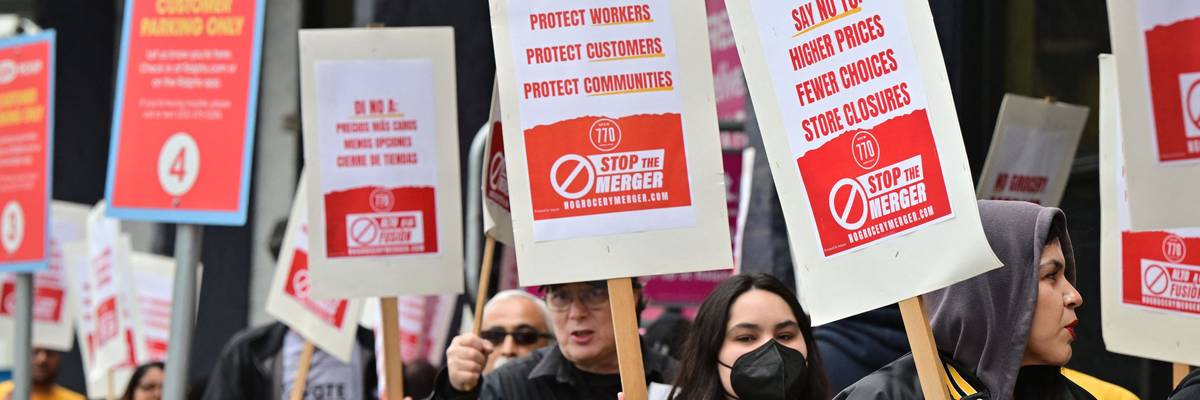
Unionized grocery store workers rally to oppose the proposed merger of Kroger and Albertsons on April 13, 2023 in Los Angeles, California.
"By suing to block the Kroger-Albertsons merger, the FTC is keeping grocery bills down and workers in their jobs," said one anti-monopoly campaigner.
The Federal Trade Commission and a bipartisan group of state attorneys general joined forces Monday on a lawsuit aimed at blocking the supermarket giant Kroger from buying up the Albertsons grocery chain, warning the merger would hamper competition, further drive up food prices, and harm workers.
If completed, the $24.6 billion deal would mark the largest supermarket merger in U.S. history at a time when grocery chains are facing growing scrutiny for driving up prices to pad their bottom lines. A Kroger-Albertsons grocery behemoth would control more than 5,000 stores and 4,000 retail pharmacies across the country, according to the FTC.
"This supermarket mega merger comes as American consumers have seen the cost of groceries rise steadily over the past few years," said Henry Liu, director of the FTC's Bureau of Competition. "Kroger's acquisition of Albertsons would lead to additional grocery price hikes for everyday goods, further exacerbating the financial strain consumers across the country face today."
"Essential grocery store workers would also suffer under this deal, facing the threat of their wages dwindling, benefits diminishing, and their working conditions deteriorating," Liu added.
The attorneys general of Arizona, California, Washington, D.C., Illinois, Maryland, Nevada, New Mexico, Oregon, and Wyoming are joining the FTC's suit, which was filed in the U.S. District Court for the District of Oregon.
The lawsuit drew immediate praise from progressive advocacy groups and opponents of food industry consolidation.
Stacy Mitchell, co-executive director at the Institute for Local Self-Reliance (ILSR), said the decision to sue shows that the FTC "sees what we have long argued—there was no upside to this merger for anybody other than the top executives at these two companies and their investors."
ILSR has estimated that if the deal survives legal challenges, Kroger-Albertsons and Walmart—the largest low-wage employer in the U.S.—would control 70% of the grocery market in over 160 cities.
"Concentration in grocery retail has already caused food prices to skyrocket," said Mitchell. "We know from past grocery mergers that this one would have sent prices for consumers even higher. It would have left many communities, especially on the West Coast, with little to no competition or choice about where to shop. And it would have hurt retail workers by giving the combined companies even more leverage to push down wages and dictate terms."
Grocery prices have outpaced overall inflation in the U.S. over the past four years, surging by roughly 25%—and they remain stubbornly high even as inflation has fallen substantially from its peak of 9.1% in the summer of 2022.
The FTC, which has been assessing the proposed merger for more than a year, said Monday that because Kroger and Albertsons are direct competitors, a merger of the two "would eliminate head-to-head price and quality competition, which have driven both supermarkets to lower their prices and improve their product and service offerings."
"If the merger takes place, grocery prices will increase, and Kroger and Albertsons' incentive to improve product quality and customer service will decrease, further harming customers," the agency said.
The deal would also bring economic pain for workers, according to merger opponents. The Economic Policy Institute (EPI) has estimated that if the acquisition is completed, roughly 746,000 grocery store workers in over 50 metropolitan areas of the U.S. would see their annual earnings fall by a combined $334 million.
"Workers' ability to negotiate better pay and working conditions rests on their capacity to switch jobs," EPI senior economist Ben Zipperer explained in a 2023 memo. "By decreasing the number of outside options available to workers, the merger will limit competition for hiring and retaining employees, and grocery store worker earnings will fall as a result."
The FTC said Monday that executives at both Kroger and Albertsons have admitted that the proposed merger is anticompetitive. The agency quotes one unnamed executive as saying, "You are basically creating a monopoly in grocery with the merger."
Morgan Harper, director of policy and advocacy at the American Economic Liberties Project, said in a statement that "by suing to block the Kroger-Albertsons merger, the FTC is keeping grocery bills down and workers in their jobs."
"From higher prices for consumers, worse wages and benefits for workers, a tighter squeeze on producers and farmers, to an increased risk of grocery and pharmacy deserts across the 48 states this merger affects, the harms of this deal were clear from the start," said Harper. "No divestiture or concession would make it work—which is why over 100,000 workers and countless advocates have spoken out against this disastrous merger."
"Kroger and Albertsons would be wise to save everyone's time and abandon this deal," she added.
Dear Common Dreams reader, It’s been nearly 30 years since I co-founded Common Dreams with my late wife, Lina Newhouser. We had the radical notion that journalism should serve the public good, not corporate profits. It was clear to us from the outset what it would take to build such a project. No paid advertisements. No corporate sponsors. No millionaire publisher telling us what to think or do. Many people said we wouldn't last a year, but we proved those doubters wrong. Together with a tremendous team of journalists and dedicated staff, we built an independent media outlet free from the constraints of profits and corporate control. Our mission has always been simple: To inform. To inspire. To ignite change for the common good. Building Common Dreams was not easy. Our survival was never guaranteed. When you take on the most powerful forces—Wall Street greed, fossil fuel industry destruction, Big Tech lobbyists, and uber-rich oligarchs who have spent billions upon billions rigging the economy and democracy in their favor—the only bulwark you have is supporters who believe in your work. But here’s the urgent message from me today. It's never been this bad out there. And it's never been this hard to keep us going. At the very moment Common Dreams is most needed, the threats we face are intensifying. We need your support now more than ever. We don't accept corporate advertising and never will. We don't have a paywall because we don't think people should be blocked from critical news based on their ability to pay. Everything we do is funded by the donations of readers like you. When everyone does the little they can afford, we are strong. But if that support retreats or dries up, so do we. Will you donate now to make sure Common Dreams not only survives but thrives? —Craig Brown, Co-founder |
The Federal Trade Commission and a bipartisan group of state attorneys general joined forces Monday on a lawsuit aimed at blocking the supermarket giant Kroger from buying up the Albertsons grocery chain, warning the merger would hamper competition, further drive up food prices, and harm workers.
If completed, the $24.6 billion deal would mark the largest supermarket merger in U.S. history at a time when grocery chains are facing growing scrutiny for driving up prices to pad their bottom lines. A Kroger-Albertsons grocery behemoth would control more than 5,000 stores and 4,000 retail pharmacies across the country, according to the FTC.
"This supermarket mega merger comes as American consumers have seen the cost of groceries rise steadily over the past few years," said Henry Liu, director of the FTC's Bureau of Competition. "Kroger's acquisition of Albertsons would lead to additional grocery price hikes for everyday goods, further exacerbating the financial strain consumers across the country face today."
"Essential grocery store workers would also suffer under this deal, facing the threat of their wages dwindling, benefits diminishing, and their working conditions deteriorating," Liu added.
The attorneys general of Arizona, California, Washington, D.C., Illinois, Maryland, Nevada, New Mexico, Oregon, and Wyoming are joining the FTC's suit, which was filed in the U.S. District Court for the District of Oregon.
The lawsuit drew immediate praise from progressive advocacy groups and opponents of food industry consolidation.
Stacy Mitchell, co-executive director at the Institute for Local Self-Reliance (ILSR), said the decision to sue shows that the FTC "sees what we have long argued—there was no upside to this merger for anybody other than the top executives at these two companies and their investors."
ILSR has estimated that if the deal survives legal challenges, Kroger-Albertsons and Walmart—the largest low-wage employer in the U.S.—would control 70% of the grocery market in over 160 cities.
"Concentration in grocery retail has already caused food prices to skyrocket," said Mitchell. "We know from past grocery mergers that this one would have sent prices for consumers even higher. It would have left many communities, especially on the West Coast, with little to no competition or choice about where to shop. And it would have hurt retail workers by giving the combined companies even more leverage to push down wages and dictate terms."
Grocery prices have outpaced overall inflation in the U.S. over the past four years, surging by roughly 25%—and they remain stubbornly high even as inflation has fallen substantially from its peak of 9.1% in the summer of 2022.
The FTC, which has been assessing the proposed merger for more than a year, said Monday that because Kroger and Albertsons are direct competitors, a merger of the two "would eliminate head-to-head price and quality competition, which have driven both supermarkets to lower their prices and improve their product and service offerings."
"If the merger takes place, grocery prices will increase, and Kroger and Albertsons' incentive to improve product quality and customer service will decrease, further harming customers," the agency said.
The deal would also bring economic pain for workers, according to merger opponents. The Economic Policy Institute (EPI) has estimated that if the acquisition is completed, roughly 746,000 grocery store workers in over 50 metropolitan areas of the U.S. would see their annual earnings fall by a combined $334 million.
"Workers' ability to negotiate better pay and working conditions rests on their capacity to switch jobs," EPI senior economist Ben Zipperer explained in a 2023 memo. "By decreasing the number of outside options available to workers, the merger will limit competition for hiring and retaining employees, and grocery store worker earnings will fall as a result."
The FTC said Monday that executives at both Kroger and Albertsons have admitted that the proposed merger is anticompetitive. The agency quotes one unnamed executive as saying, "You are basically creating a monopoly in grocery with the merger."
Morgan Harper, director of policy and advocacy at the American Economic Liberties Project, said in a statement that "by suing to block the Kroger-Albertsons merger, the FTC is keeping grocery bills down and workers in their jobs."
"From higher prices for consumers, worse wages and benefits for workers, a tighter squeeze on producers and farmers, to an increased risk of grocery and pharmacy deserts across the 48 states this merger affects, the harms of this deal were clear from the start," said Harper. "No divestiture or concession would make it work—which is why over 100,000 workers and countless advocates have spoken out against this disastrous merger."
"Kroger and Albertsons would be wise to save everyone's time and abandon this deal," she added.
The Federal Trade Commission and a bipartisan group of state attorneys general joined forces Monday on a lawsuit aimed at blocking the supermarket giant Kroger from buying up the Albertsons grocery chain, warning the merger would hamper competition, further drive up food prices, and harm workers.
If completed, the $24.6 billion deal would mark the largest supermarket merger in U.S. history at a time when grocery chains are facing growing scrutiny for driving up prices to pad their bottom lines. A Kroger-Albertsons grocery behemoth would control more than 5,000 stores and 4,000 retail pharmacies across the country, according to the FTC.
"This supermarket mega merger comes as American consumers have seen the cost of groceries rise steadily over the past few years," said Henry Liu, director of the FTC's Bureau of Competition. "Kroger's acquisition of Albertsons would lead to additional grocery price hikes for everyday goods, further exacerbating the financial strain consumers across the country face today."
"Essential grocery store workers would also suffer under this deal, facing the threat of their wages dwindling, benefits diminishing, and their working conditions deteriorating," Liu added.
The attorneys general of Arizona, California, Washington, D.C., Illinois, Maryland, Nevada, New Mexico, Oregon, and Wyoming are joining the FTC's suit, which was filed in the U.S. District Court for the District of Oregon.
The lawsuit drew immediate praise from progressive advocacy groups and opponents of food industry consolidation.
Stacy Mitchell, co-executive director at the Institute for Local Self-Reliance (ILSR), said the decision to sue shows that the FTC "sees what we have long argued—there was no upside to this merger for anybody other than the top executives at these two companies and their investors."
ILSR has estimated that if the deal survives legal challenges, Kroger-Albertsons and Walmart—the largest low-wage employer in the U.S.—would control 70% of the grocery market in over 160 cities.
"Concentration in grocery retail has already caused food prices to skyrocket," said Mitchell. "We know from past grocery mergers that this one would have sent prices for consumers even higher. It would have left many communities, especially on the West Coast, with little to no competition or choice about where to shop. And it would have hurt retail workers by giving the combined companies even more leverage to push down wages and dictate terms."
Grocery prices have outpaced overall inflation in the U.S. over the past four years, surging by roughly 25%—and they remain stubbornly high even as inflation has fallen substantially from its peak of 9.1% in the summer of 2022.
The FTC, which has been assessing the proposed merger for more than a year, said Monday that because Kroger and Albertsons are direct competitors, a merger of the two "would eliminate head-to-head price and quality competition, which have driven both supermarkets to lower their prices and improve their product and service offerings."
"If the merger takes place, grocery prices will increase, and Kroger and Albertsons' incentive to improve product quality and customer service will decrease, further harming customers," the agency said.
The deal would also bring economic pain for workers, according to merger opponents. The Economic Policy Institute (EPI) has estimated that if the acquisition is completed, roughly 746,000 grocery store workers in over 50 metropolitan areas of the U.S. would see their annual earnings fall by a combined $334 million.
"Workers' ability to negotiate better pay and working conditions rests on their capacity to switch jobs," EPI senior economist Ben Zipperer explained in a 2023 memo. "By decreasing the number of outside options available to workers, the merger will limit competition for hiring and retaining employees, and grocery store worker earnings will fall as a result."
The FTC said Monday that executives at both Kroger and Albertsons have admitted that the proposed merger is anticompetitive. The agency quotes one unnamed executive as saying, "You are basically creating a monopoly in grocery with the merger."
Morgan Harper, director of policy and advocacy at the American Economic Liberties Project, said in a statement that "by suing to block the Kroger-Albertsons merger, the FTC is keeping grocery bills down and workers in their jobs."
"From higher prices for consumers, worse wages and benefits for workers, a tighter squeeze on producers and farmers, to an increased risk of grocery and pharmacy deserts across the 48 states this merger affects, the harms of this deal were clear from the start," said Harper. "No divestiture or concession would make it work—which is why over 100,000 workers and countless advocates have spoken out against this disastrous merger."
"Kroger and Albertsons would be wise to save everyone's time and abandon this deal," she added.

