

SUBSCRIBE TO OUR FREE NEWSLETTER
Daily news & progressive opinion—funded by the people, not the corporations—delivered straight to your inbox.
5
#000000
#FFFFFF
To donate by check, phone, or other method, see our More Ways to Give page.
Daily news & progressive opinion—funded by the people, not the corporations—delivered straight to your inbox.
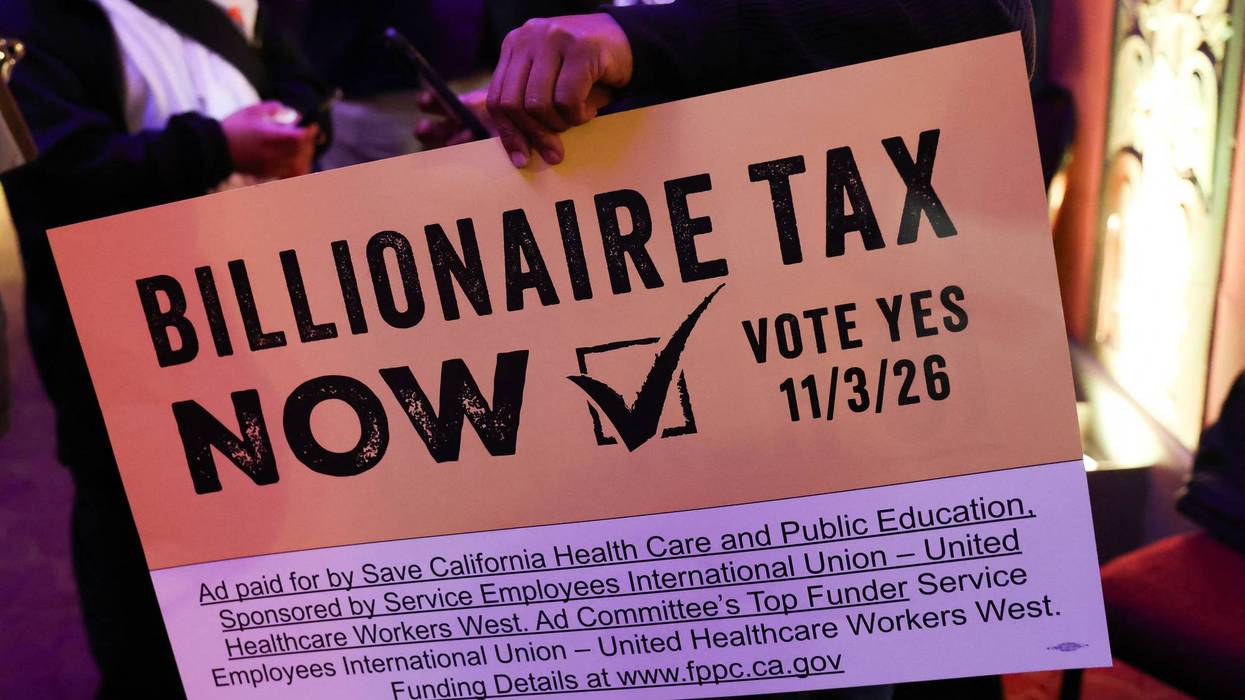
“What will allow California to thrive in the future," the economists said, "is not letting a handful of billionaires live tax-free: it is adequate public spending on health, education, and public infrastructure, key engines of economic growth."
As California voters head to the polls this November, their vote on whether to enact a first-of-its-kind billionaire wealth tax may mark "a turning point in the battle between democracy and oligarchy," says a group of Nobel Prize-winning economists.
The fight over Proposition 40—a ballot measure that would impose a one-time 5% tax on the net worth of those with $1 billion or more in order to fund the state's healthcare system—has heated up in recent weeks.
The initiative remains popular, with 52% of voters in the state supporting it, according to a poll out last week. But California's elite have lined up at least $156 million behind an aggressive campaign to kill it, with Google co-founder Sergey Brin alone giving at least $102 million.
And while the proposal has strong backing from progressive politicians and labor unions, some prominent Democrats have tried to stop it, most notably Gov. Gavin Newsom.
As the rich flood the airwaves with ads warning that taxing their wealth would bring about economic ruin, six Nobel laureates, all of whom have won the prestigious prize for their work in economics, signed an open letter on Saturday endorsing Prop. 40.
They are inequality scholar Daron Acemoglu, global poverty researcher Abhijit Banerjee, labor and public finance economist Peter Diamond, anti-poverty economist Esther Duflo, trade economist and columnist Paul Krugman, and inequality and globalization economist Joseph Stiglitz.
"Proposition 40 would be the first-ever tax on billionaire wealth enacted anywhere in the world," the economists wrote. "California is the right place to take this historic step."
They explained that the growing number of billionaires in the state in recent decades has helped to make California "one of the most unequal places in America." While the state's richest 0.001% of residents were worth a combined $700 billion a decade ago, its 250 billionaires are now worth about $2.3 trillion—equivalent to the entire annual income of the state's 20 million taxpayers.
"This extreme wealth has translated into extraordinary power," the economists wrote, citing data showing that during the 2024 election, billionaires accounted for 19% of all federal election spending in the US and that these same billionaires are now marshaling huge sums of money to oppose a tax that would affect them.
While acknowledging that many of California's wealthiest have "made important contributions, for which they have been amply rewarded," the researchers noted their use of loopholes in the tax system to effectively pay a lower tax rate than the average Californian.
Most billionaire wealth is held in the form of stocks and other assets whose gains are not generally subject to income tax until they are sold.
As a result, billionaires in the state paid about $3 billion in state income taxes per year from 2019-25, while their fortunes increased by about $1.4 trillion over the period. Dividing total state income tax by that increase equals roughly 1.6%. Meanwhile, the average California family pays about 5-6% of their annual income in state income taxes.
The economists argued that enacting a wealth tax would allow the state to play "catch-up," raising about $100 billion—enough to offset federal cuts to the state's Medicaid program enacted in the Republican budget legislation last year, which have helped to fuel thousands of layoffs at hospitals around the state.
They also disputed a common counterargument that the tax will spur billionaire flight from the state and "doom" Silicon Valley.
Not only would the tax apply to any billionaire living in the state as of January 1, 2026, meaning most would not have had time to relocate; they also pointed out that in 2026, after Prop. 40 was announced, California has attracted 80% of the nation's venture capital funding, compared to just 50% prior to 2025, according to data from PitchBook's Venture Monitor.
“What will allow California to thrive in the future," the economists said, "is not letting a handful of billionaires live tax-free: It is adequate public spending on health, education, and public infrastructure, key engines of economic growth to which it is only fair to ask the ultrawealthy to contribute.”
They added that passing Prop. 40 "isn’t just critical for Californians," but could "kickstart a movement to tax ultra-high-net-worth individuals in other states—and eventually at the federal level and in other countries."
The six Nobel laureates who signed Saturday's letter are not the first prominent economists to publicly advocate for the wealth tax. University of California, Berkeley economist Emmanuel Saez helped draft the proposal, while Gabriel Zucman, a chaired professor at the Paris School of Economics, has conducted research underpinning it. Paris School professor Thomas Piketty and former US Labor Secretary Robert Reich have also come out in support of the ballot initiative.
Responding to the letter from the Nobel laureates, Dutch historian and wealth tax advocate Rutger Bregman—whose School for Moral Ambition has worked alongside Zucman to promote similar initiatives around the world—said it was "really great to see" more celebrated economists speaking up in favor of the proposal.
"You don't have to be a radical leftist to see why it's a good idea," Bregman wrote on social media. "This is not going to be some kind of socialist revolution. The proposal is about restoring balance to a mixed economy. You could even argue it's about saving capitalism itself from oligarchs like Sergey Brin. I think that's exactly why Nobel Prize-winning economists are coming out in favor of this tax."

Failure to raise the borrowing limit, the economists warned, could spark "a swift and severe economic downturn" and "unnecessary layoffs across the economy."
More than 200 top U.S. economists warned congressional leaders Thursday that a failure to raise the debt ceiling would likely spark a devastating economic crisis, rattling global financial markets and killing jobs nationwide.
"The economic consequences of a federal default are unpredictable, but frightening," the economists warned in a letter to House Speaker Kevin McCarthy (R-Calif.), House Minority Leader Hakeem Jeffries (D-N.Y.), Senate Majority Leader Chuck Schumer (D-N.Y.), and Senate Minority Leader Mitch McConnell (R-Ky.).
"A swift and severe economic downturn could follow, with unnecessary layoffs across the economy," the experts wrote. "Chaos in world financial markets is highly likely. Higher borrowing costs for the federal government, and indeed for all Americans, could remain with us for a long time—an unwanted legacy of a foolish decision. We should not run the experiment."
The list of letter signatories includes Joseph Stiglitz, a recipient of the Nobel Memorial Prize in Economic Sciences, as well as former Federal Reserve Vice Chair Roger Ferguson, former Labor Secretary Robert Reich, Groundwork Collaborative chief economist Rakeen Mabud, and former Fed Chair Ben Bernanke.
"We have a wide range of views on economic policies, some 'conservative' some 'liberal,'" the economists wrote, "but we all agree that Congress should raise the debt limit promptly and without conditions in order to eliminate the risk of default."
The letter was sent as congressional debt ceiling talks remain at a standstill, with the House Republican majority refusing to drop its push for deep federal spending cuts in exchange for lifting the borrowing limit. In 2011, congressional Republicans leveraged the debt ceiling to push through an austerity measure that—according to one economist—helps explain "why the recovery from the Great Recession was so agonizingly slow."
The current impasse has forced the Treasury Department to take "extraordinary measures" to prevent the federal government from defaulting on its obligations, which include Social Security and Medicare benefits.
But the department's actions can only buy lawmakers so much time. Last month, the Congressional Budget Office said the U.S. will default this summer unless a deal is reached to raise the debt limit.
One analysis released during the last congressional debt ceiling standoff in 2021 estimated that a U.S. default would wipe out upwards of $15 trillion in household wealth and eliminate nearly 6 million jobs.
"It's clear that defaulting on the national debt would not only imperil the progress we've made over the past three years toward an equitable and long-lasting recovery, but would also risk a completely avoidable and historically severe economic crisis," Shayna Strom, president and CEO of the Washington Center for Equitable Growth, said in a statement Thursday.
"Economic research tells us that austerity measures can have negative long-term effects on workers, their families, and the economy," Strom added. "By raising the federal debt limit, Congress can avoid bringing unnecessary hardship on Americans and the economy and, in doing so, will take another needed step toward ensuring economic growth in the future is stronger, more stable, and more broadly shared."

As the U.S. Federal Reserve on Wednesday raised interest rates--the fourth consecutive 0.75% increase and the sixth hike of the year--progressives stressed that Fed policy boosts the likelihood of a global recession and disproportionately harms low-income workers and other marginalized people.
"Working people should not be the target of lowering inflation, it should be corporations that are earning record profits."
Fed Chair Jerome Powell explained that the move was necessary to ease inflation, which has hit a 40-year-high due to factors including corporate profiteering, Russia's invasion of Ukraine, and the climate emergency.
"We've always said it was going to be difficult," he said, "but to the extent rates have to go higher and stay higher for longer it becomes harder to see the path" to avoiding recession.
"I would say the path has narrowed over the course of the last year," Powell added.
Progressive economists and activists refuted the Fed's approach.
Accountable.US spokesperson Liz Zelnick noted in a statement that "a chorus of economic experts have warned hiking interest rates again is a recipe for millions of Americans receiving pink slips, yet the Fed has decided to triple down on what is not working."
"Throughout the pandemic, the Fed should have been acting as stewards of the fragile economic recovery but instead have prioritized demands from big banks, hedge funds, and other Wall Street special interests at the great expense of average working families," she contended.
"If excessive interest rate hikes hasten the arrival of an otherwise avoidable recession, will the Fed take responsibility," added Zelnick, "or try to pass the buck as they keep making matters worse?"
AFL-CIO president Liz Shuler said the Fed's latest rate hike "will have a direct and harmful impact on working people and our families" and "will not address the underlying causes of inflation."
"The Fed seems determined to raise interest rates, though it openly admits those rates could ruin our current economy as unemployment remains low and people are able to find jobs," she continued. "A recession would instead cause companies to hire fewer people, making it harder for young workers, workers of color, and others who have greater barriers finding jobs, and put downward pressure on the wages of all working people who will bear the brunt of an overactive monetary policy."
"Working people should not be the target of lowering inflation," Schuler added, "it should be corporations that are earning record profits."
Anticipating Wednesday's rate hike, Groundwork Collaborative chief economist Rakeen Mabud argued Tuesday that the move is a "misguided policy with catastrophic outcomes for the millions around the country who are already struggling to make ends meet."
"The Fed's rate-hiking frenzy is doing everything but lowering prices," she said. "Wage growth is slowing and mortgage rates are the highest in 20 years. If Powell wants to be taken seriously as a responsible steward of the economy, he should think twice before raising rates again."
Progressive former U.S. Labor Secretary Robert Reich tweeted: "Memo to the Fed: Interest rate hikes aren't working because inflation is being driven by corporations using it as cover to price gouge the people."

Hotter-than-expected inflation data published Wednesday intensified fears among progressive economists that the Federal Reserve--in its single-minded drive to tame price increases--will needlessly lock in another major interest rate hike at its policy meeting later this month, further suppressing economic demand and moving the country closer to a recession.
"This morning's report highlights the fact that aggressive interest rate hikes by the Fed have done little to combat the inflation that continues to take a toll on workers, families, and small businesses across the country," said Dr. Rakeen Mabud, chief economist at the Groundwork Collaborative. "Additional rate hikes would push millions out of work and... raise the risk of a recession that would only worsen economic pain."
"I'm deeply concerned that the Fed is ill-equipped to respond and rate hikes could cause a recession."
While the Labor Department's consumer price index (CPI) figure for June landed above analyst forecasts at 9.1% year over year--an indication of sustained inflationary pressures across the economy--experts stressed that the numbers don't reflect key developments that could signal a slowdown in price surges, which have eaten away at workers' wages and increased economic strain for households in the form of higher rent, grocery costs, and other expenses.
"A similar reading last month led to a large overreaction by many, including the Federal Reserve, who raised policy rates by 0.75 percentage points," noted Josh Bivens, research director at the Economic Policy Institute. "There is even less reason this time to overreact to a hot inflation reading."
"We all know that the main drivers of today's large number is commodity prices (mostly energy and food)," he added, "and we also know that many of these prices have fallen sharply in recent weeks."
The average price of gas in the U.S., for instance, has declined for 28 consecutive days, hitting $4.66 per gallon on Tuesday--significantly lower than the unprecedented $5.01 national average recorded in mid-June.
"It is hard to feel good about this report, but with wage growth slowing sharply in the last six months to around 4% (compared to 3.4% in 2019), it's hard to see how an inflation rate north of 9% can be sustained," Dean Baker, senior economist at the Center for Economic and Policy Research, wrote in a brief analysis of the newly released price data. "Lower gas prices should pull July inflation lower."
There's little indication that Fed officials will be moved by such arguments, however.
At its July 26-27 meeting, the central bank is widely expected to enact another rate hike of at least 75 basis points--and there's some concern that the Fed will go even further with a 100-basis-point increase.
The central bank appears hellbent on imposing additional rate hikes even though top officials, including Fed Chair Jerome Powell, have admitted that the blunt policy tool will do nothing to tackle sky-high energy and food prices.
Rate hikes also won't repair supply chain snags stemming from the coronavirus pandemic or tackle corporate profiteering, which progressive economists and lawmakers have argued is a major factor in persistent inflation.
But rate hikes are virtually certain to have deleterious impacts on investment, wages, and employment--and they could ultimately hurl the economy into recession, something the Fed has done before in the name of fighting inflation.
"If the Fed unnecessarily jacks up rates, it can throw millions out of work. It will also mean lower pay for tens of millions," Baker warned over the weekend. "It will take a hell of a lot of anti-poverty programs to offset the negative impact of a 2-3 percentage point rise in the unemployment rate."
As the Fed appears set to pursue its fourth rate increase of the year, there's already plenty of evidence indicating that the economy has slowed substantially in recent months, further heightening concerns of an imminent recession that could unravel the still-incomplete labor market recovery.
"An energy shock from Putin's war, supply chains still reeling from a pandemic, and corporate monopolies raising prices are all driving inflation," Sen. Elizabeth Warren (D-Mass.) said Wednesday. "I'm deeply concerned that the Fed is ill-equipped to respond and rate hikes could cause a recession."
"Congress needs to step up, too," Warren added. "Congress can fight inflation by making billionaire corporations pay a minimum in taxes, invest in affordable child care, and empower Medicare to negotiate lower prescription drug prices. We must use every tool to lower costs for working families."
Mabud of the Groundwork Collaborative echoed Warren, saying in a statement that "policymakers must tackle inflation at its source: by addressing the rampant corporate profiteering and snarled supply chains that are causing significant financial hardship across the country."
How can it be that the largest pending trade deal in history - a deal backed both by a Democratic president and Republican leaders in Congress - is nearly dead?
The Trans-Pacific Partnership may yet squeak through Congress, but its near-death experience offers an important lesson.
It's not that labor unions have regained political power (union membership continues to dwindle and large corporations have more clout in Washington than ever) or that the President is especially weak (no president can pull off a major deal like this if the public isn't behind him).
The biggest lesson is most Americans no longer support free trade.
It used to be an article of faith that trade was good for America.
Economic theory told us so: Trade allows nations to specialize in what they do best, thereby fueling growth. And growth, we were told, is good for everyone.
But such arguments are less persuasive in this era of staggering inequality.
For decades almost all the gains from growth have been going to a small sliver of Americans at the top - while most peoples' wages have stagnated, adjusted for inflation.
Economists point to overall benefits from expanded trade. All of us gain access to cheaper goods and services.
But in recent years the biggest gains from trade have gone to investors and executives, while the burdens have fallen disproportionately on those in the middle and below who have lost good-paying jobs.
So even though everyone gains from trade, the biggest winners are at the top. And as the top keeps moving higher compared to most of the rest of us, the vast majority feels relatively worse off.
To illustrate the point, consider a simple game I conduct with my students. I have them split up into pairs and ask them to imagine I'm giving $1,000 to one member of each pair.
I tell them the recipients can keep some of the money only on condition they reach a deal with their partner on how it's to be divided up. They have to offer their partner a portion of the $1,000, and their partner must either accept or decline. If the partner declines, neither of them gets a penny.
You might think many recipients of the imaginary $1,000 would offer their partner one dollar, which the partner would gladly accept. After all, a dollar is better than nothing. Everyone is better off.
But that's not what happens. Most partners decline any offer under $250 - even though that means neither of them gets anything.
This game, and variations of it, have been played by social scientists thousands of times with different groups and pairings, and with remarkably similar results.
A far bigger version of the game is being played on the national stage as a relative handful of Americans receive ever-larger slices of the total national income while most Americans, working harder than ever, receive smaller ones.
And just as in the simulations, those receiving the smaller slices are starting to say "no deal."
Some might attribute this response to envy or spite. But when I ask my students why they refused to accept anything less than $250 and thereby risked getting nothing at all, they say it's worth the price of avoiding unfairness.
Remember, I gave out the $1,000 arbitrarily. The initial recipients didn't have to work for it or be outstanding in any way.
When a game seems arbitrary, people are often willing to sacrifice gains for themselves in order to prevent others from walking away with far more - a result that strikes them as inherently wrong.
The American economy looks increasingly arbitrary, as CEOs of big firms now rake in 300 times more than the wages of average workers, while two-thirds of Americans live paycheck to paycheck.
Some of my students who refused anything less than $250 also say they feared allowing the initial recipient to keep a disproportionately large share would give him the power to rig the game even more in the future.
Here again, America's real-life distributional game is analogous, as a few at the top gain increasing political power to alter the rules of the game to their advantage.
If the American economy continues to create a few big winners and many who feel like losers by comparison, opposition to free trade won't be the only casualty.
Losers are likely to find many other ways to say "no deal."