SUBSCRIBE TO OUR FREE NEWSLETTER
Daily news & progressive opinion—funded by the people, not the corporations—delivered straight to your inbox.
5
#000000
#FFFFFF
To donate by check, phone, or other method, see our More Ways to Give page.
Daily news & progressive opinion—funded by the people, not the corporations—delivered straight to your inbox.
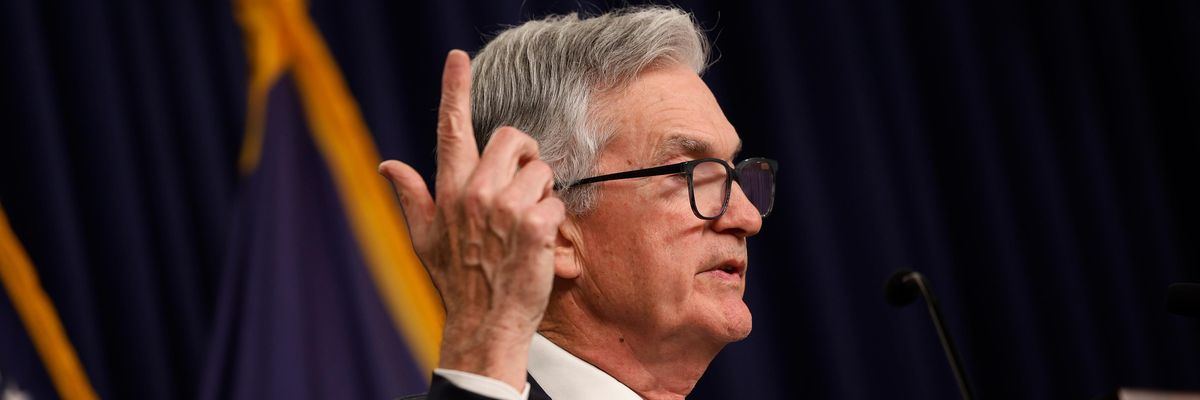
U.S. Federal Reserve Bank Board Chairman Jerome Powell answers reporters' questions during a news conference in Washington, D.C. on November 2, 2022.
As the U.S. Federal Reserve on Wednesday raised interest rates--the fourth consecutive 0.75% increase and the sixth hike of the year--progressives stressed that Fed policy boosts the likelihood of a global recession and disproportionately harms low-income workers and other marginalized people.
"Working people should not be the target of lowering inflation, it should be corporations that are earning record profits."
Fed Chair Jerome Powell explained that the move was necessary to ease inflation, which has hit a 40-year-high due to factors including corporate profiteering, Russia's invasion of Ukraine, and the climate emergency.
"We've always said it was going to be difficult," he said, "but to the extent rates have to go higher and stay higher for longer it becomes harder to see the path" to avoiding recession.
"I would say the path has narrowed over the course of the last year," Powell added.
Progressive economists and activists refuted the Fed's approach.
Accountable.US spokesperson Liz Zelnick noted in a statement that "a chorus of economic experts have warned hiking interest rates again is a recipe for millions of Americans receiving pink slips, yet the Fed has decided to triple down on what is not working."
"Throughout the pandemic, the Fed should have been acting as stewards of the fragile economic recovery but instead have prioritized demands from big banks, hedge funds, and other Wall Street special interests at the great expense of average working families," she contended.
"If excessive interest rate hikes hasten the arrival of an otherwise avoidable recession, will the Fed take responsibility," added Zelnick, "or try to pass the buck as they keep making matters worse?"
AFL-CIO president Liz Shuler said the Fed's latest rate hike "will have a direct and harmful impact on working people and our families" and "will not address the underlying causes of inflation."
"The Fed seems determined to raise interest rates, though it openly admits those rates could ruin our current economy as unemployment remains low and people are able to find jobs," she continued. "A recession would instead cause companies to hire fewer people, making it harder for young workers, workers of color, and others who have greater barriers finding jobs, and put downward pressure on the wages of all working people who will bear the brunt of an overactive monetary policy."
"Working people should not be the target of lowering inflation," Schuler added, "it should be corporations that are earning record profits."
Anticipating Wednesday's rate hike, Groundwork Collaborative chief economist Rakeen Mabud argued Tuesday that the move is a "misguided policy with catastrophic outcomes for the millions around the country who are already struggling to make ends meet."
"The Fed's rate-hiking frenzy is doing everything but lowering prices," she said. "Wage growth is slowing and mortgage rates are the highest in 20 years. If Powell wants to be taken seriously as a responsible steward of the economy, he should think twice before raising rates again."
Progressive former U.S. Labor Secretary Robert Reich tweeted: "Memo to the Fed: Interest rate hikes aren't working because inflation is being driven by corporations using it as cover to price gouge the people."
Dear Common Dreams reader, It’s been nearly 30 years since I co-founded Common Dreams with my late wife, Lina Newhouser. We had the radical notion that journalism should serve the public good, not corporate profits. It was clear to us from the outset what it would take to build such a project. No paid advertisements. No corporate sponsors. No millionaire publisher telling us what to think or do. Many people said we wouldn't last a year, but we proved those doubters wrong. Together with a tremendous team of journalists and dedicated staff, we built an independent media outlet free from the constraints of profits and corporate control. Our mission has always been simple: To inform. To inspire. To ignite change for the common good. Building Common Dreams was not easy. Our survival was never guaranteed. When you take on the most powerful forces—Wall Street greed, fossil fuel industry destruction, Big Tech lobbyists, and uber-rich oligarchs who have spent billions upon billions rigging the economy and democracy in their favor—the only bulwark you have is supporters who believe in your work. But here’s the urgent message from me today. It's never been this bad out there. And it's never been this hard to keep us going. At the very moment Common Dreams is most needed, the threats we face are intensifying. We need your support now more than ever. We don't accept corporate advertising and never will. We don't have a paywall because we don't think people should be blocked from critical news based on their ability to pay. Everything we do is funded by the donations of readers like you. When everyone does the little they can afford, we are strong. But if that support retreats or dries up, so do we. Will you donate now to make sure Common Dreams not only survives but thrives? —Craig Brown, Co-founder |
As the U.S. Federal Reserve on Wednesday raised interest rates--the fourth consecutive 0.75% increase and the sixth hike of the year--progressives stressed that Fed policy boosts the likelihood of a global recession and disproportionately harms low-income workers and other marginalized people.
"Working people should not be the target of lowering inflation, it should be corporations that are earning record profits."
Fed Chair Jerome Powell explained that the move was necessary to ease inflation, which has hit a 40-year-high due to factors including corporate profiteering, Russia's invasion of Ukraine, and the climate emergency.
"We've always said it was going to be difficult," he said, "but to the extent rates have to go higher and stay higher for longer it becomes harder to see the path" to avoiding recession.
"I would say the path has narrowed over the course of the last year," Powell added.
Progressive economists and activists refuted the Fed's approach.
Accountable.US spokesperson Liz Zelnick noted in a statement that "a chorus of economic experts have warned hiking interest rates again is a recipe for millions of Americans receiving pink slips, yet the Fed has decided to triple down on what is not working."
"Throughout the pandemic, the Fed should have been acting as stewards of the fragile economic recovery but instead have prioritized demands from big banks, hedge funds, and other Wall Street special interests at the great expense of average working families," she contended.
"If excessive interest rate hikes hasten the arrival of an otherwise avoidable recession, will the Fed take responsibility," added Zelnick, "or try to pass the buck as they keep making matters worse?"
AFL-CIO president Liz Shuler said the Fed's latest rate hike "will have a direct and harmful impact on working people and our families" and "will not address the underlying causes of inflation."
"The Fed seems determined to raise interest rates, though it openly admits those rates could ruin our current economy as unemployment remains low and people are able to find jobs," she continued. "A recession would instead cause companies to hire fewer people, making it harder for young workers, workers of color, and others who have greater barriers finding jobs, and put downward pressure on the wages of all working people who will bear the brunt of an overactive monetary policy."
"Working people should not be the target of lowering inflation," Schuler added, "it should be corporations that are earning record profits."
Anticipating Wednesday's rate hike, Groundwork Collaborative chief economist Rakeen Mabud argued Tuesday that the move is a "misguided policy with catastrophic outcomes for the millions around the country who are already struggling to make ends meet."
"The Fed's rate-hiking frenzy is doing everything but lowering prices," she said. "Wage growth is slowing and mortgage rates are the highest in 20 years. If Powell wants to be taken seriously as a responsible steward of the economy, he should think twice before raising rates again."
Progressive former U.S. Labor Secretary Robert Reich tweeted: "Memo to the Fed: Interest rate hikes aren't working because inflation is being driven by corporations using it as cover to price gouge the people."
As the U.S. Federal Reserve on Wednesday raised interest rates--the fourth consecutive 0.75% increase and the sixth hike of the year--progressives stressed that Fed policy boosts the likelihood of a global recession and disproportionately harms low-income workers and other marginalized people.
"Working people should not be the target of lowering inflation, it should be corporations that are earning record profits."
Fed Chair Jerome Powell explained that the move was necessary to ease inflation, which has hit a 40-year-high due to factors including corporate profiteering, Russia's invasion of Ukraine, and the climate emergency.
"We've always said it was going to be difficult," he said, "but to the extent rates have to go higher and stay higher for longer it becomes harder to see the path" to avoiding recession.
"I would say the path has narrowed over the course of the last year," Powell added.
Progressive economists and activists refuted the Fed's approach.
Accountable.US spokesperson Liz Zelnick noted in a statement that "a chorus of economic experts have warned hiking interest rates again is a recipe for millions of Americans receiving pink slips, yet the Fed has decided to triple down on what is not working."
"Throughout the pandemic, the Fed should have been acting as stewards of the fragile economic recovery but instead have prioritized demands from big banks, hedge funds, and other Wall Street special interests at the great expense of average working families," she contended.
"If excessive interest rate hikes hasten the arrival of an otherwise avoidable recession, will the Fed take responsibility," added Zelnick, "or try to pass the buck as they keep making matters worse?"
AFL-CIO president Liz Shuler said the Fed's latest rate hike "will have a direct and harmful impact on working people and our families" and "will not address the underlying causes of inflation."
"The Fed seems determined to raise interest rates, though it openly admits those rates could ruin our current economy as unemployment remains low and people are able to find jobs," she continued. "A recession would instead cause companies to hire fewer people, making it harder for young workers, workers of color, and others who have greater barriers finding jobs, and put downward pressure on the wages of all working people who will bear the brunt of an overactive monetary policy."
"Working people should not be the target of lowering inflation," Schuler added, "it should be corporations that are earning record profits."
Anticipating Wednesday's rate hike, Groundwork Collaborative chief economist Rakeen Mabud argued Tuesday that the move is a "misguided policy with catastrophic outcomes for the millions around the country who are already struggling to make ends meet."
"The Fed's rate-hiking frenzy is doing everything but lowering prices," she said. "Wage growth is slowing and mortgage rates are the highest in 20 years. If Powell wants to be taken seriously as a responsible steward of the economy, he should think twice before raising rates again."
Progressive former U.S. Labor Secretary Robert Reich tweeted: "Memo to the Fed: Interest rate hikes aren't working because inflation is being driven by corporations using it as cover to price gouge the people."