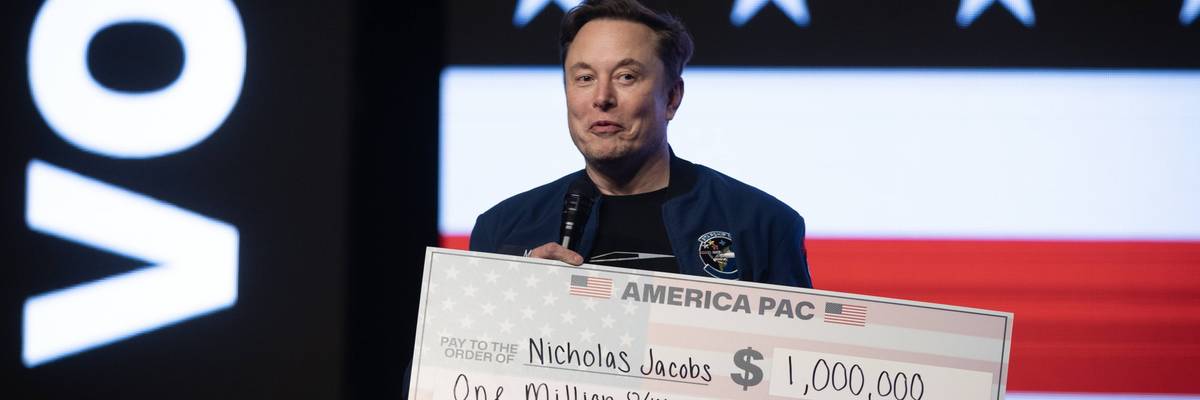
Billionaire businessman Elon Musk prepares to give $1,000,000 to a Wisconsin voter during a town hall meeting he was hosting at the KI Convention Center on March 30, 2025 in Green Bay, Wisconsin.
‘Astonishing Stat’: Billionaires Gave Nearly 20% of Donations in 2024 US Federal Elections
"For a representative democracy like ours to work, citizens must have some confidence that, through... political engagement, they have a fighting chance to turn their priorities into government policy," said an elections expert.
Billionaires exerted an unprecedented amount of influence over the 2024 US federal elections, accounting for almost one-fifth of the nearly $16 billion spent to elect candidates during that cycle, according to a New York Times analysis published Monday.
Just 300 billionaires and their immediate families poured an unprecedented $3 billion into the election, either giving directly to candidates or through political action committees.
These individuals represent just about 0.0087% of the 3.46 million people who donated more than $200 to one or multiple candidates during the election cycle.
And yet, with an average donation of $10 million apiece—equivalent to what 100,000 typical donors would give—they amounted to about 19% of all spending, allowing their interests to be pushed to the center of major races.
The Times highlighted the extraordinary role that billionaire fundraisers played in pushing Sen. Tim Sheehy (R-Mont.) over the finish line in his bid to unseat the three-term incumbent Democrat, then-Sen. Jon Tester.
Sheehy's long shot campaign was given a boost by Blackstone CEO Stephen Schwarzman, who donated $8 million to his super PAC after previously investing $150 million in the candidate's struggling firefighting business, which helped seed his campaign.
As the report explains, Schwarzman "was not the only financial heavyweight in Mr. Sheehy’s corner":
At least 64 billionaires and 37 of their immediate family members donated directly to his campaign, a New York Times analysis found. When also accounting for money that flowed through political committees that support Mr. Sheehy, an analysis shows that billionaires contributed about $47 million in the race that Mr. Sheehy went on to win.
Sheehy's campaign drew support from a who's who of GOP power brokers: Jeff Yass, the founder of the Pennsylvania-based trading firm Susquehanna International Group and a major funder of Trump's massive White House ballroom project; the Uihlein family, which owns Uline shipping and has been central to backing anti-abortion, anti-immigrant, and election-denialist causes; and Florida hedge fund founder Ken Griffin, who spent $12 million to stop an initiative in the state to legalize marijuana.
In installing Sheehy, the ultrawealthy bought themselves "a key ally on tax policies that benefit the wealthy" who "cosponsored a proposal to eliminate the estate tax," the Times reported.
While billionaires still have their talons in both political parties, the Times noted a distinct shift toward Republicans in 2024—for every one dollar given to Democrats, five went to the GOP in the election.
Trump, who openly begged for donations from oil tycoons on the campaign trail, was the single largest beneficiary of this avalanche of spending.
According to a study by Americans for Tax Fairness in October 2024, less than a month before election day, Trump had already received $450 million from 150 billionaire families, 75% of their $600 million total to major candidates, and three times Democratic presidential candidate Kamala Harris's $143 million.
By the end of the campaign, Trump and his affiliated PACs would amass more than $250 million from Tesla and SpaceX CEO Elon Musk, and more than $100 million from both the pro-Israel megadonor Miriam Adelson and the banking heir Timothy Mellon, according to OpenSecrets.
Trump has since appointed more than a dozen billionaires to administration positions, including Musk, who was tasked with eviscerating public spending as the de facto head of the so-called "Department of Government Efficiency" (DOGE).
But as the Times reported, "Many of those billionaires are not only hoping to reshape the federal government... but to win influence in state legislatures, city councils, school boards, and courthouses."
"Ultrawealthy donors... have helped overhaul political leadership and policy in states across the country, expanding private charter schools, restricting abortion rights, advancing artificial intelligence in government, and blocking laws that would make it harder to evict tenants," the report explained.
As the 2026 midterm cycle begins, another spending blitz is coming. As the Times reported last month, the artificial intelligence industry, crypto industry, the pro-Israel lobby, and Trump's super PAC have each amassed war chests of tens, if not hundreds, of millions of dollars to help elect their allies to Congress.
Silicon Valley billionaires, including PayPal co-founder Peter Thiel and Google co-founder Sergey Brin, meanwhile, have collectively dumped tens of millions into stopping a proposal in California for a one-time 5% tax on billionaires in the state, which would replace Medicaid funding slashed by Republicans' massive budget law last year.
The explosion in spending by the ultrarich has come quickly. Where billionaires spent just $16.6 million to influence the 2008 election cycle, that number has steadily ballooned up to $3 billion in 2024, a more than 12,000% increase when adjusted for inflation.
Daniel Weiner, the director of the Brennan Center for Justice's elections and government program, said that the "astonishing stat" was a "legacy of the Supreme Court's Citizens United decision" in 2010, which allowed billionaire-funded dark money groups to spend unlimited amounts of cash on political communication advocating for candidates.
"The resulting collapse of campaign finance rules has combined with a resurgence in the sort of high-level self-dealing that was pervasive during the Gilded Age, when bribery and graft were common, and corporations used their wealth to secure monopolies, government subsidies, and other benefits," Weiner wrote for TIME on Monday.
"As in the past, the question now is who will offer Americans a real alternative, including a commitment to stamp out self-dealing in all three branches of the government," he said, recommending a constitutional amendment to restore campaign finance limits tossed aside by the Supreme Court, a ban on spending by government contractors seeking contracts, and bans on congressional stock trading.
"For a representative democracy like ours to work, citizens must have some confidence that, through voting and other forms of political engagement, they have a fighting chance to turn their priorities into government policy," he concluded. "Far too many Americans have lost that faith, and they identify pervasive corruption at the top of our government as a big part of the reason. But cycles of corruption followed by reform are an enduring feature of American history. A new round of ambitious reform is overdue."
We are at a crossroads
This country and this world are at a monumental crossroads. In a few short weeks, US voters will have an opportunity to beat back the forces of fascism and confront the billionaires who are rigging the economy, our media system, and our democracy, making it increasingly impossible for ordinary people to get by. We’re not just talking about the election. We’re talking about what must be done once these fascist elements are vanquished from power. We need a bolder set of solutions than what either major party has so far been willing to offer and a working-class movement ready to fight like hell for it. Trump didn't emerge from nowhere. The conditions that fueled MAGA authoritarianism were created by decades of radical neoliberal economic policies and a corrupt political system dominated by corporate interests. They slashed taxes on the super-rich, promising that the benefits would trickle down. They said giveaways to the corporate titans would make life more affordable for the rest of us. It was all bullshit. And when a bitter, betrayed populace searches for someone to blame, right-wing demagogues have little trouble finding scapegoats. People know when they're being lied to, but you won't hear any of this from the corporate media. Only independent journalism—powered and funded by people who believe in building a better world—can deliver truly trustworthy daily news. Our Fall Campaign is underway, and we need your help. To power our newsroom through the rest of the year, we need to raise $125,000 by midnight on October 31. So if you share our vision, please contribute whatever you can to sustain our work. |
Billionaires exerted an unprecedented amount of influence over the 2024 US federal elections, accounting for almost one-fifth of the nearly $16 billion spent to elect candidates during that cycle, according to a New York Times analysis published Monday.
Just 300 billionaires and their immediate families poured an unprecedented $3 billion into the election, either giving directly to candidates or through political action committees.
These individuals represent just about 0.0087% of the 3.46 million people who donated more than $200 to one or multiple candidates during the election cycle.
And yet, with an average donation of $10 million apiece—equivalent to what 100,000 typical donors would give—they amounted to about 19% of all spending, allowing their interests to be pushed to the center of major races.
The Times highlighted the extraordinary role that billionaire fundraisers played in pushing Sen. Tim Sheehy (R-Mont.) over the finish line in his bid to unseat the three-term incumbent Democrat, then-Sen. Jon Tester.
Sheehy's long shot campaign was given a boost by Blackstone CEO Stephen Schwarzman, who donated $8 million to his super PAC after previously investing $150 million in the candidate's struggling firefighting business, which helped seed his campaign.
As the report explains, Schwarzman "was not the only financial heavyweight in Mr. Sheehy’s corner":
At least 64 billionaires and 37 of their immediate family members donated directly to his campaign, a New York Times analysis found. When also accounting for money that flowed through political committees that support Mr. Sheehy, an analysis shows that billionaires contributed about $47 million in the race that Mr. Sheehy went on to win.
Sheehy's campaign drew support from a who's who of GOP power brokers: Jeff Yass, the founder of the Pennsylvania-based trading firm Susquehanna International Group and a major funder of Trump's massive White House ballroom project; the Uihlein family, which owns Uline shipping and has been central to backing anti-abortion, anti-immigrant, and election-denialist causes; and Florida hedge fund founder Ken Griffin, who spent $12 million to stop an initiative in the state to legalize marijuana.
In installing Sheehy, the ultrawealthy bought themselves "a key ally on tax policies that benefit the wealthy" who "cosponsored a proposal to eliminate the estate tax," the Times reported.
While billionaires still have their talons in both political parties, the Times noted a distinct shift toward Republicans in 2024—for every one dollar given to Democrats, five went to the GOP in the election.
Trump, who openly begged for donations from oil tycoons on the campaign trail, was the single largest beneficiary of this avalanche of spending.
According to a study by Americans for Tax Fairness in October 2024, less than a month before election day, Trump had already received $450 million from 150 billionaire families, 75% of their $600 million total to major candidates, and three times Democratic presidential candidate Kamala Harris's $143 million.
By the end of the campaign, Trump and his affiliated PACs would amass more than $250 million from Tesla and SpaceX CEO Elon Musk, and more than $100 million from both the pro-Israel megadonor Miriam Adelson and the banking heir Timothy Mellon, according to OpenSecrets.
Trump has since appointed more than a dozen billionaires to administration positions, including Musk, who was tasked with eviscerating public spending as the de facto head of the so-called "Department of Government Efficiency" (DOGE).
But as the Times reported, "Many of those billionaires are not only hoping to reshape the federal government... but to win influence in state legislatures, city councils, school boards, and courthouses."
"Ultrawealthy donors... have helped overhaul political leadership and policy in states across the country, expanding private charter schools, restricting abortion rights, advancing artificial intelligence in government, and blocking laws that would make it harder to evict tenants," the report explained.
As the 2026 midterm cycle begins, another spending blitz is coming. As the Times reported last month, the artificial intelligence industry, crypto industry, the pro-Israel lobby, and Trump's super PAC have each amassed war chests of tens, if not hundreds, of millions of dollars to help elect their allies to Congress.
Silicon Valley billionaires, including PayPal co-founder Peter Thiel and Google co-founder Sergey Brin, meanwhile, have collectively dumped tens of millions into stopping a proposal in California for a one-time 5% tax on billionaires in the state, which would replace Medicaid funding slashed by Republicans' massive budget law last year.
The explosion in spending by the ultrarich has come quickly. Where billionaires spent just $16.6 million to influence the 2008 election cycle, that number has steadily ballooned up to $3 billion in 2024, a more than 12,000% increase when adjusted for inflation.
Daniel Weiner, the director of the Brennan Center for Justice's elections and government program, said that the "astonishing stat" was a "legacy of the Supreme Court's Citizens United decision" in 2010, which allowed billionaire-funded dark money groups to spend unlimited amounts of cash on political communication advocating for candidates.
"The resulting collapse of campaign finance rules has combined with a resurgence in the sort of high-level self-dealing that was pervasive during the Gilded Age, when bribery and graft were common, and corporations used their wealth to secure monopolies, government subsidies, and other benefits," Weiner wrote for TIME on Monday.
"As in the past, the question now is who will offer Americans a real alternative, including a commitment to stamp out self-dealing in all three branches of the government," he said, recommending a constitutional amendment to restore campaign finance limits tossed aside by the Supreme Court, a ban on spending by government contractors seeking contracts, and bans on congressional stock trading.
"For a representative democracy like ours to work, citizens must have some confidence that, through voting and other forms of political engagement, they have a fighting chance to turn their priorities into government policy," he concluded. "Far too many Americans have lost that faith, and they identify pervasive corruption at the top of our government as a big part of the reason. But cycles of corruption followed by reform are an enduring feature of American history. A new round of ambitious reform is overdue."
Billionaires exerted an unprecedented amount of influence over the 2024 US federal elections, accounting for almost one-fifth of the nearly $16 billion spent to elect candidates during that cycle, according to a New York Times analysis published Monday.
Just 300 billionaires and their immediate families poured an unprecedented $3 billion into the election, either giving directly to candidates or through political action committees.
These individuals represent just about 0.0087% of the 3.46 million people who donated more than $200 to one or multiple candidates during the election cycle.
And yet, with an average donation of $10 million apiece—equivalent to what 100,000 typical donors would give—they amounted to about 19% of all spending, allowing their interests to be pushed to the center of major races.
The Times highlighted the extraordinary role that billionaire fundraisers played in pushing Sen. Tim Sheehy (R-Mont.) over the finish line in his bid to unseat the three-term incumbent Democrat, then-Sen. Jon Tester.
Sheehy's long shot campaign was given a boost by Blackstone CEO Stephen Schwarzman, who donated $8 million to his super PAC after previously investing $150 million in the candidate's struggling firefighting business, which helped seed his campaign.
As the report explains, Schwarzman "was not the only financial heavyweight in Mr. Sheehy’s corner":
At least 64 billionaires and 37 of their immediate family members donated directly to his campaign, a New York Times analysis found. When also accounting for money that flowed through political committees that support Mr. Sheehy, an analysis shows that billionaires contributed about $47 million in the race that Mr. Sheehy went on to win.
Sheehy's campaign drew support from a who's who of GOP power brokers: Jeff Yass, the founder of the Pennsylvania-based trading firm Susquehanna International Group and a major funder of Trump's massive White House ballroom project; the Uihlein family, which owns Uline shipping and has been central to backing anti-abortion, anti-immigrant, and election-denialist causes; and Florida hedge fund founder Ken Griffin, who spent $12 million to stop an initiative in the state to legalize marijuana.
In installing Sheehy, the ultrawealthy bought themselves "a key ally on tax policies that benefit the wealthy" who "cosponsored a proposal to eliminate the estate tax," the Times reported.
While billionaires still have their talons in both political parties, the Times noted a distinct shift toward Republicans in 2024—for every one dollar given to Democrats, five went to the GOP in the election.
Trump, who openly begged for donations from oil tycoons on the campaign trail, was the single largest beneficiary of this avalanche of spending.
According to a study by Americans for Tax Fairness in October 2024, less than a month before election day, Trump had already received $450 million from 150 billionaire families, 75% of their $600 million total to major candidates, and three times Democratic presidential candidate Kamala Harris's $143 million.
By the end of the campaign, Trump and his affiliated PACs would amass more than $250 million from Tesla and SpaceX CEO Elon Musk, and more than $100 million from both the pro-Israel megadonor Miriam Adelson and the banking heir Timothy Mellon, according to OpenSecrets.
Trump has since appointed more than a dozen billionaires to administration positions, including Musk, who was tasked with eviscerating public spending as the de facto head of the so-called "Department of Government Efficiency" (DOGE).
But as the Times reported, "Many of those billionaires are not only hoping to reshape the federal government... but to win influence in state legislatures, city councils, school boards, and courthouses."
"Ultrawealthy donors... have helped overhaul political leadership and policy in states across the country, expanding private charter schools, restricting abortion rights, advancing artificial intelligence in government, and blocking laws that would make it harder to evict tenants," the report explained.
As the 2026 midterm cycle begins, another spending blitz is coming. As the Times reported last month, the artificial intelligence industry, crypto industry, the pro-Israel lobby, and Trump's super PAC have each amassed war chests of tens, if not hundreds, of millions of dollars to help elect their allies to Congress.
Silicon Valley billionaires, including PayPal co-founder Peter Thiel and Google co-founder Sergey Brin, meanwhile, have collectively dumped tens of millions into stopping a proposal in California for a one-time 5% tax on billionaires in the state, which would replace Medicaid funding slashed by Republicans' massive budget law last year.
The explosion in spending by the ultrarich has come quickly. Where billionaires spent just $16.6 million to influence the 2008 election cycle, that number has steadily ballooned up to $3 billion in 2024, a more than 12,000% increase when adjusted for inflation.
Daniel Weiner, the director of the Brennan Center for Justice's elections and government program, said that the "astonishing stat" was a "legacy of the Supreme Court's Citizens United decision" in 2010, which allowed billionaire-funded dark money groups to spend unlimited amounts of cash on political communication advocating for candidates.
"The resulting collapse of campaign finance rules has combined with a resurgence in the sort of high-level self-dealing that was pervasive during the Gilded Age, when bribery and graft were common, and corporations used their wealth to secure monopolies, government subsidies, and other benefits," Weiner wrote for TIME on Monday.
"As in the past, the question now is who will offer Americans a real alternative, including a commitment to stamp out self-dealing in all three branches of the government," he said, recommending a constitutional amendment to restore campaign finance limits tossed aside by the Supreme Court, a ban on spending by government contractors seeking contracts, and bans on congressional stock trading.
"For a representative democracy like ours to work, citizens must have some confidence that, through voting and other forms of political engagement, they have a fighting chance to turn their priorities into government policy," he concluded. "Far too many Americans have lost that faith, and they identify pervasive corruption at the top of our government as a big part of the reason. But cycles of corruption followed by reform are an enduring feature of American history. A new round of ambitious reform is overdue."