SUBSCRIBE TO OUR FREE NEWSLETTER
Daily news & progressive opinion—funded by the people, not the corporations—delivered straight to your inbox.
5
#000000
#FFFFFF
To donate by check, phone, or other method, see our More Ways to Give page.
Daily news & progressive opinion—funded by the people, not the corporations—delivered straight to your inbox.
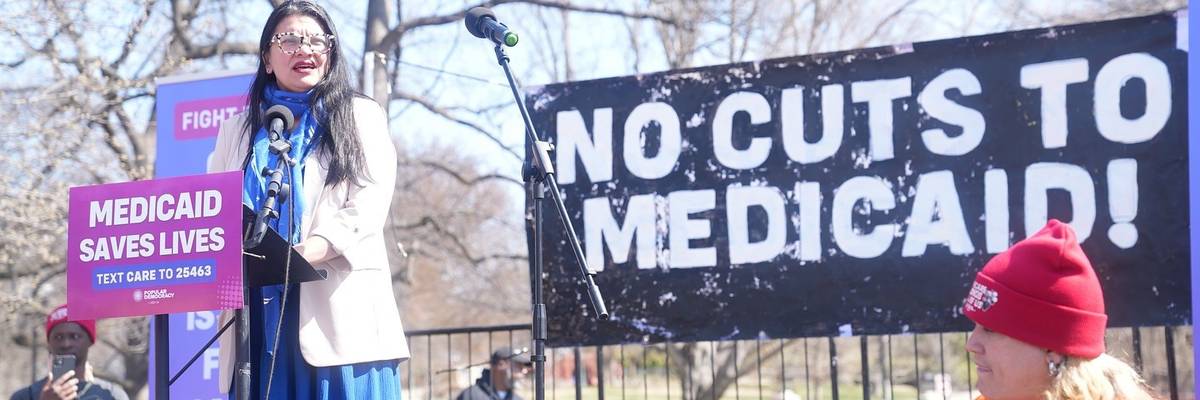
Congresswoman Rashida Tlaib (D-Mich.) spoke at a "Save Our Healthcare" rally on Capitol Hill in Washington, DC on March 12, 2025.
"Over half the provisions of the Big Ugly Bill have already gone into effect, and the negative results are already devastating."
Independent healthcare analyst Charles Gaba on Thursday published a detailed report estimating that up to 10 million people living in the US have lost their healthcare coverage since the start of President Donald Trump's second term.
In his analysis, Gaba brought together the most recent enrollment data for Medicaid, the Children's Health Insurance Program (CHIP), Medicare, and the Affordable Care Act (ACA).
Breaking things down by program, Gaba estimated there are 5.9 million fewer people enrolled in Medicaid and CHIP, as well as at least 4.5 million fewer people enrolled in the ACA, since Trump returned to power in January 2025.
These losses in coverage are somewhat mitigated by Medicare, whose enrollment has increased by around 1.6 million people during Trump's second term.
Losing access to these programs doesn't mean that the people were on them have gotten well paying jobs and are receiving insurance from their employer, Gaba wrote. Given that the unemployment rate has risen during Trump's second term, Gaba suggested it is highly unlikely that there are now more people who get employer-sponsored coverage now than in January 2025.
Depending on a number of variables, Gaba concluded, somewhere between 8.8 million to 10.3 million fewer people now have healthcare coverage.
Adjusting for population growth, Gaba added, "you get a grand total of between 10.27 million and 11.75 million more Americans not enrolled in a public healthcare coverage program as of May 2026 than in were as of January 2025."
The healthcare analyst noted that "this isn't quite the same thing as counting how many lost coverage, but not having healthcare sucks regardless of how you slice it."
He also pointed out that the lost in healthcare coverage all came before the Medicaid work requirements from the GOP's 2025 budget law are put into effect.
"Over half the provisions of the Big Ugly Bill have already gone into effect," wrote Gaba, "and the negative results are already devastating."
Gaba's analysis was published just days after the Georgetown University Center for Children and Families released a report estimating that nearly 2.5 million children in the US have lost access to Medicaid or CHIP during Trump's second term.
Trump and congressional Republicans have taken a number of actions that have made healthcare less affordable.
First, they cut spending on Medicaid by an estimated $900 billion over a 10-year period when they enacted the One Big Beautiful Bill Act in 2025. The Congressional Budget Office projects these cuts will leave more than 10 million fewer people enrolled in the program by 2034.
GOP lawmakers last year also refused to extend enhanced subsidies for insurance plans purchased through the ACA, even as insurers raised premiums on those plans by an average of 26% this year, according to an analysis published by KFF.
According to Wednesday reporting by Politico, hospitals are sounding the alarm about new regulations being proposed by the Centers for Medicare and Medicaid Services that they say would cost hundreds of billions of dollars in lost revenue.
"If the rules are finalized and they lose hundreds of billions on top of Congress’ funding cuts," Politico reported, "hospitals say they’ll be forced to reduce services, lay off workers, consolidate operations or shutter entirely."
Dear Common Dreams reader, It’s been nearly 30 years since I co-founded Common Dreams with my late wife, Lina Newhouser. We had the radical notion that journalism should serve the public good, not corporate profits. It was clear to us from the outset what it would take to build such a project. No paid advertisements. No corporate sponsors. No millionaire publisher telling us what to think or do. Many people said we wouldn't last a year, but we proved those doubters wrong. Together with a tremendous team of journalists and dedicated staff, we built an independent media outlet free from the constraints of profits and corporate control. Our mission has always been simple: To inform. To inspire. To ignite change for the common good. Building Common Dreams was not easy. Our survival was never guaranteed. When you take on the most powerful forces—Wall Street greed, fossil fuel industry destruction, Big Tech lobbyists, and uber-rich oligarchs who have spent billions upon billions rigging the economy and democracy in their favor—the only bulwark you have is supporters who believe in your work. But here’s the urgent message from me today. It's never been this bad out there. And it's never been this hard to keep us going. At the very moment Common Dreams is most needed, the threats we face are intensifying. We need your support now more than ever. We don't accept corporate advertising and never will. We don't have a paywall because we don't think people should be blocked from critical news based on their ability to pay. Everything we do is funded by the donations of readers like you. When everyone does the little they can afford, we are strong. But if that support retreats or dries up, so do we. Will you donate now to make sure Common Dreams not only survives but thrives? —Craig Brown, Co-founder |
Independent healthcare analyst Charles Gaba on Thursday published a detailed report estimating that up to 10 million people living in the US have lost their healthcare coverage since the start of President Donald Trump's second term.
In his analysis, Gaba brought together the most recent enrollment data for Medicaid, the Children's Health Insurance Program (CHIP), Medicare, and the Affordable Care Act (ACA).
Breaking things down by program, Gaba estimated there are 5.9 million fewer people enrolled in Medicaid and CHIP, as well as at least 4.5 million fewer people enrolled in the ACA, since Trump returned to power in January 2025.
These losses in coverage are somewhat mitigated by Medicare, whose enrollment has increased by around 1.6 million people during Trump's second term.
Losing access to these programs doesn't mean that the people were on them have gotten well paying jobs and are receiving insurance from their employer, Gaba wrote. Given that the unemployment rate has risen during Trump's second term, Gaba suggested it is highly unlikely that there are now more people who get employer-sponsored coverage now than in January 2025.
Depending on a number of variables, Gaba concluded, somewhere between 8.8 million to 10.3 million fewer people now have healthcare coverage.
Adjusting for population growth, Gaba added, "you get a grand total of between 10.27 million and 11.75 million more Americans not enrolled in a public healthcare coverage program as of May 2026 than in were as of January 2025."
The healthcare analyst noted that "this isn't quite the same thing as counting how many lost coverage, but not having healthcare sucks regardless of how you slice it."
He also pointed out that the lost in healthcare coverage all came before the Medicaid work requirements from the GOP's 2025 budget law are put into effect.
"Over half the provisions of the Big Ugly Bill have already gone into effect," wrote Gaba, "and the negative results are already devastating."
Gaba's analysis was published just days after the Georgetown University Center for Children and Families released a report estimating that nearly 2.5 million children in the US have lost access to Medicaid or CHIP during Trump's second term.
Trump and congressional Republicans have taken a number of actions that have made healthcare less affordable.
First, they cut spending on Medicaid by an estimated $900 billion over a 10-year period when they enacted the One Big Beautiful Bill Act in 2025. The Congressional Budget Office projects these cuts will leave more than 10 million fewer people enrolled in the program by 2034.
GOP lawmakers last year also refused to extend enhanced subsidies for insurance plans purchased through the ACA, even as insurers raised premiums on those plans by an average of 26% this year, according to an analysis published by KFF.
According to Wednesday reporting by Politico, hospitals are sounding the alarm about new regulations being proposed by the Centers for Medicare and Medicaid Services that they say would cost hundreds of billions of dollars in lost revenue.
"If the rules are finalized and they lose hundreds of billions on top of Congress’ funding cuts," Politico reported, "hospitals say they’ll be forced to reduce services, lay off workers, consolidate operations or shutter entirely."
Independent healthcare analyst Charles Gaba on Thursday published a detailed report estimating that up to 10 million people living in the US have lost their healthcare coverage since the start of President Donald Trump's second term.
In his analysis, Gaba brought together the most recent enrollment data for Medicaid, the Children's Health Insurance Program (CHIP), Medicare, and the Affordable Care Act (ACA).
Breaking things down by program, Gaba estimated there are 5.9 million fewer people enrolled in Medicaid and CHIP, as well as at least 4.5 million fewer people enrolled in the ACA, since Trump returned to power in January 2025.
These losses in coverage are somewhat mitigated by Medicare, whose enrollment has increased by around 1.6 million people during Trump's second term.
Losing access to these programs doesn't mean that the people were on them have gotten well paying jobs and are receiving insurance from their employer, Gaba wrote. Given that the unemployment rate has risen during Trump's second term, Gaba suggested it is highly unlikely that there are now more people who get employer-sponsored coverage now than in January 2025.
Depending on a number of variables, Gaba concluded, somewhere between 8.8 million to 10.3 million fewer people now have healthcare coverage.
Adjusting for population growth, Gaba added, "you get a grand total of between 10.27 million and 11.75 million more Americans not enrolled in a public healthcare coverage program as of May 2026 than in were as of January 2025."
The healthcare analyst noted that "this isn't quite the same thing as counting how many lost coverage, but not having healthcare sucks regardless of how you slice it."
He also pointed out that the lost in healthcare coverage all came before the Medicaid work requirements from the GOP's 2025 budget law are put into effect.
"Over half the provisions of the Big Ugly Bill have already gone into effect," wrote Gaba, "and the negative results are already devastating."
Gaba's analysis was published just days after the Georgetown University Center for Children and Families released a report estimating that nearly 2.5 million children in the US have lost access to Medicaid or CHIP during Trump's second term.
Trump and congressional Republicans have taken a number of actions that have made healthcare less affordable.
First, they cut spending on Medicaid by an estimated $900 billion over a 10-year period when they enacted the One Big Beautiful Bill Act in 2025. The Congressional Budget Office projects these cuts will leave more than 10 million fewer people enrolled in the program by 2034.
GOP lawmakers last year also refused to extend enhanced subsidies for insurance plans purchased through the ACA, even as insurers raised premiums on those plans by an average of 26% this year, according to an analysis published by KFF.
According to Wednesday reporting by Politico, hospitals are sounding the alarm about new regulations being proposed by the Centers for Medicare and Medicaid Services that they say would cost hundreds of billions of dollars in lost revenue.
"If the rules are finalized and they lose hundreds of billions on top of Congress’ funding cuts," Politico reported, "hospitals say they’ll be forced to reduce services, lay off workers, consolidate operations or shutter entirely."