SUBSCRIBE TO OUR FREE NEWSLETTER
Daily news & progressive opinion—funded by the people, not the corporations—delivered straight to your inbox.
5
#000000
#FFFFFF
To donate by check, phone, or other method, see our More Ways to Give page.
Daily news & progressive opinion—funded by the people, not the corporations—delivered straight to your inbox.
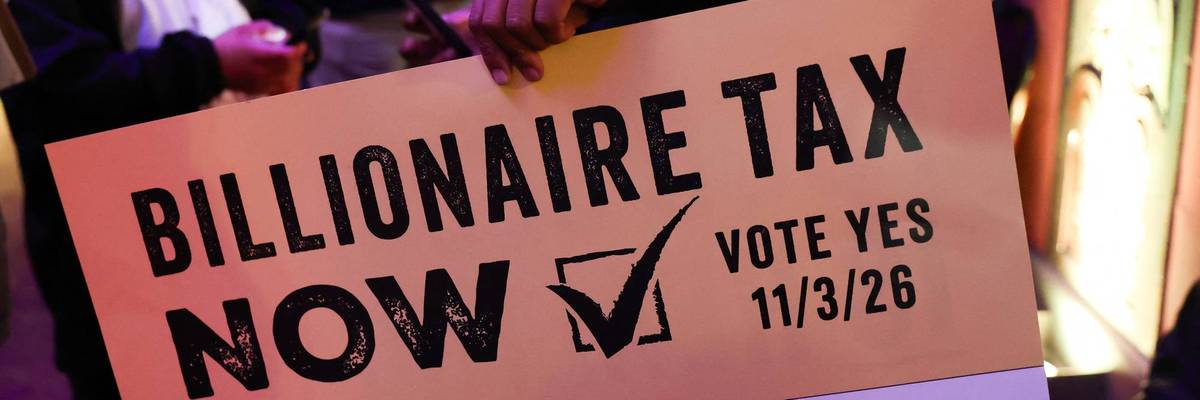
An attendee holds a sign before the start of a rally during the campaign kickoff for the California Billionaire Tax Act at The Wiltern in Los Angeles, February 18, 2026.
“What will allow California to thrive in the future," the economists said, "is not letting a handful of billionaires live tax-free: it is adequate public spending on health, education, and public infrastructure, key engines of economic growth."
As California voters head to the polls this November, their vote on whether to enact a first-of-its-kind billionaire wealth tax may mark "a turning point in the battle between democracy and oligarchy," says a group of Nobel Prize-winning economists.
The fight over Proposition 40—a ballot measure that would impose a one-time 5% tax on the net worth of those with $1 billion or more in order to fund the state's healthcare system—has heated up in recent weeks.
The initiative remains popular, with 52% of voters in the state supporting it, according to a poll out last week. But California's elite have lined up at least $156 million behind an aggressive campaign to kill it, with Google co-founder Sergey Brin alone giving at least $102 million.
And while the proposal has strong backing from progressive politicians and labor unions, some prominent Democrats have tried to stop it, most notably Gov. Gavin Newsom.
As the rich flood the airwaves with ads warning that taxing their wealth would bring about economic ruin, six Nobel laureates, all of whom have won the prestigious prize for their work in economics, signed an open letter on Saturday endorsing Prop. 40.
They are inequality scholar Daron Acemoglu, global poverty researcher Abhijit Banerjee, labor and public finance economist Peter Diamond, anti-poverty economist Esther Duflo, trade economist and columnist Paul Krugman, and inequality and globalization economist Joseph Stiglitz.
"Proposition 40 would be the first-ever tax on billionaire wealth enacted anywhere in the world," the economists wrote. "California is the right place to take this historic step."
They explained that the growing number of billionaires in the state in recent decades has helped to make California "one of the most unequal places in America." While the state's richest 0.001% of residents were worth a combined $700 billion a decade ago, its 250 billionaires are now worth about $2.3 trillion—equivalent to the entire annual income of the state's 20 million taxpayers.
"This extreme wealth has translated into extraordinary power," the economists wrote, citing data showing that during the 2024 election, billionaires accounted for 19% of all federal election spending in the US and that these same billionaires are now marshaling huge sums of money to oppose a tax that would affect them.
While acknowledging that many of California's wealthiest have "made important contributions, for which they have been amply rewarded," the researchers noted their use of loopholes in the tax system to effectively pay a lower tax rate than the average Californian.
Most billionaire wealth is held in the form of stocks and other assets whose gains are not generally subject to income tax until they are sold.
As a result, billionaires in the state paid about $3 billion in state income taxes per year from 2019-25, while their fortunes increased by about $1.4 trillion over the period. Dividing total state income tax by that increase equals roughly 1.6%. Meanwhile, the average California family pays about 5-6% of their annual income in state income taxes.
The economists argued that enacting a wealth tax would allow the state to play "catch-up," raising about $100 billion—enough to offset federal cuts to the state's Medicaid program enacted in the Republican budget legislation last year, which have helped to fuel thousands of layoffs at hospitals around the state.
They also disputed a common counterargument that the tax will spur billionaire flight from the state and "doom" Silicon Valley.
Not only would the tax apply to any billionaire living in the state as of January 1, 2026, meaning most would not have had time to relocate; they also pointed out that in 2026, after Prop. 40 was announced, California has attracted 80% of the nation's venture capital funding, compared to just 50% prior to 2025, according to data from PitchBook's Venture Monitor.
“What will allow California to thrive in the future," the economists said, "is not letting a handful of billionaires live tax-free: It is adequate public spending on health, education, and public infrastructure, key engines of economic growth to which it is only fair to ask the ultrawealthy to contribute.”
They added that passing Prop. 40 "isn’t just critical for Californians," but could "kickstart a movement to tax ultra-high-net-worth individuals in other states—and eventually at the federal level and in other countries."
The six Nobel laureates who signed Saturday's letter are not the first prominent economists to publicly advocate for the wealth tax. University of California, Berkeley economist Emmanuel Saez helped draft the proposal, while Gabriel Zucman, a chaired professor at the Paris School of Economics, has conducted research underpinning it. Paris School professor Thomas Piketty and former US Labor Secretary Robert Reich have also come out in support of the ballot initiative.
Responding to the letter from the Nobel laureates, Dutch historian and wealth tax advocate Rutger Bregman—whose School for Moral Ambition has worked alongside Zucman to promote similar initiatives around the world—said it was "really great to see" more celebrated economists speaking up in favor of the proposal.
"You don't have to be a radical leftist to see why it's a good idea," Bregman wrote on social media. "This is not going to be some kind of socialist revolution. The proposal is about restoring balance to a mixed economy. You could even argue it's about saving capitalism itself from oligarchs like Sergey Brin. I think that's exactly why Nobel Prize-winning economists are coming out in favor of this tax."
Dear Common Dreams reader, It’s been nearly 30 years since I co-founded Common Dreams with my late wife, Lina Newhouser. We had the radical notion that journalism should serve the public good, not corporate profits. It was clear to us from the outset what it would take to build such a project. No paid advertisements. No corporate sponsors. No millionaire publisher telling us what to think or do. Many people said we wouldn't last a year, but we proved those doubters wrong. Together with a tremendous team of journalists and dedicated staff, we built an independent media outlet free from the constraints of profits and corporate control. Our mission has always been simple: To inform. To inspire. To ignite change for the common good. Building Common Dreams was not easy. Our survival was never guaranteed. When you take on the most powerful forces—Wall Street greed, fossil fuel industry destruction, Big Tech lobbyists, and uber-rich oligarchs who have spent billions upon billions rigging the economy and democracy in their favor—the only bulwark you have is supporters who believe in your work. But here’s the urgent message from me today. It's never been this bad out there. And it's never been this hard to keep us going. At the very moment Common Dreams is most needed, the threats we face are intensifying. We need your support now more than ever. We don't accept corporate advertising and never will. We don't have a paywall because we don't think people should be blocked from critical news based on their ability to pay. Everything we do is funded by the donations of readers like you. When everyone does the little they can afford, we are strong. But if that support retreats or dries up, so do we. Will you donate now to make sure Common Dreams not only survives but thrives? —Craig Brown, Co-founder |
As California voters head to the polls this November, their vote on whether to enact a first-of-its-kind billionaire wealth tax may mark "a turning point in the battle between democracy and oligarchy," says a group of Nobel Prize-winning economists.
The fight over Proposition 40—a ballot measure that would impose a one-time 5% tax on the net worth of those with $1 billion or more in order to fund the state's healthcare system—has heated up in recent weeks.
The initiative remains popular, with 52% of voters in the state supporting it, according to a poll out last week. But California's elite have lined up at least $156 million behind an aggressive campaign to kill it, with Google co-founder Sergey Brin alone giving at least $102 million.
And while the proposal has strong backing from progressive politicians and labor unions, some prominent Democrats have tried to stop it, most notably Gov. Gavin Newsom.
As the rich flood the airwaves with ads warning that taxing their wealth would bring about economic ruin, six Nobel laureates, all of whom have won the prestigious prize for their work in economics, signed an open letter on Saturday endorsing Prop. 40.
They are inequality scholar Daron Acemoglu, global poverty researcher Abhijit Banerjee, labor and public finance economist Peter Diamond, anti-poverty economist Esther Duflo, trade economist and columnist Paul Krugman, and inequality and globalization economist Joseph Stiglitz.
"Proposition 40 would be the first-ever tax on billionaire wealth enacted anywhere in the world," the economists wrote. "California is the right place to take this historic step."
They explained that the growing number of billionaires in the state in recent decades has helped to make California "one of the most unequal places in America." While the state's richest 0.001% of residents were worth a combined $700 billion a decade ago, its 250 billionaires are now worth about $2.3 trillion—equivalent to the entire annual income of the state's 20 million taxpayers.
"This extreme wealth has translated into extraordinary power," the economists wrote, citing data showing that during the 2024 election, billionaires accounted for 19% of all federal election spending in the US and that these same billionaires are now marshaling huge sums of money to oppose a tax that would affect them.
While acknowledging that many of California's wealthiest have "made important contributions, for which they have been amply rewarded," the researchers noted their use of loopholes in the tax system to effectively pay a lower tax rate than the average Californian.
Most billionaire wealth is held in the form of stocks and other assets whose gains are not generally subject to income tax until they are sold.
As a result, billionaires in the state paid about $3 billion in state income taxes per year from 2019-25, while their fortunes increased by about $1.4 trillion over the period. Dividing total state income tax by that increase equals roughly 1.6%. Meanwhile, the average California family pays about 5-6% of their annual income in state income taxes.
The economists argued that enacting a wealth tax would allow the state to play "catch-up," raising about $100 billion—enough to offset federal cuts to the state's Medicaid program enacted in the Republican budget legislation last year, which have helped to fuel thousands of layoffs at hospitals around the state.
They also disputed a common counterargument that the tax will spur billionaire flight from the state and "doom" Silicon Valley.
Not only would the tax apply to any billionaire living in the state as of January 1, 2026, meaning most would not have had time to relocate; they also pointed out that in 2026, after Prop. 40 was announced, California has attracted 80% of the nation's venture capital funding, compared to just 50% prior to 2025, according to data from PitchBook's Venture Monitor.
“What will allow California to thrive in the future," the economists said, "is not letting a handful of billionaires live tax-free: It is adequate public spending on health, education, and public infrastructure, key engines of economic growth to which it is only fair to ask the ultrawealthy to contribute.”
They added that passing Prop. 40 "isn’t just critical for Californians," but could "kickstart a movement to tax ultra-high-net-worth individuals in other states—and eventually at the federal level and in other countries."
The six Nobel laureates who signed Saturday's letter are not the first prominent economists to publicly advocate for the wealth tax. University of California, Berkeley economist Emmanuel Saez helped draft the proposal, while Gabriel Zucman, a chaired professor at the Paris School of Economics, has conducted research underpinning it. Paris School professor Thomas Piketty and former US Labor Secretary Robert Reich have also come out in support of the ballot initiative.
Responding to the letter from the Nobel laureates, Dutch historian and wealth tax advocate Rutger Bregman—whose School for Moral Ambition has worked alongside Zucman to promote similar initiatives around the world—said it was "really great to see" more celebrated economists speaking up in favor of the proposal.
"You don't have to be a radical leftist to see why it's a good idea," Bregman wrote on social media. "This is not going to be some kind of socialist revolution. The proposal is about restoring balance to a mixed economy. You could even argue it's about saving capitalism itself from oligarchs like Sergey Brin. I think that's exactly why Nobel Prize-winning economists are coming out in favor of this tax."
As California voters head to the polls this November, their vote on whether to enact a first-of-its-kind billionaire wealth tax may mark "a turning point in the battle between democracy and oligarchy," says a group of Nobel Prize-winning economists.
The fight over Proposition 40—a ballot measure that would impose a one-time 5% tax on the net worth of those with $1 billion or more in order to fund the state's healthcare system—has heated up in recent weeks.
The initiative remains popular, with 52% of voters in the state supporting it, according to a poll out last week. But California's elite have lined up at least $156 million behind an aggressive campaign to kill it, with Google co-founder Sergey Brin alone giving at least $102 million.
And while the proposal has strong backing from progressive politicians and labor unions, some prominent Democrats have tried to stop it, most notably Gov. Gavin Newsom.
As the rich flood the airwaves with ads warning that taxing their wealth would bring about economic ruin, six Nobel laureates, all of whom have won the prestigious prize for their work in economics, signed an open letter on Saturday endorsing Prop. 40.
They are inequality scholar Daron Acemoglu, global poverty researcher Abhijit Banerjee, labor and public finance economist Peter Diamond, anti-poverty economist Esther Duflo, trade economist and columnist Paul Krugman, and inequality and globalization economist Joseph Stiglitz.
"Proposition 40 would be the first-ever tax on billionaire wealth enacted anywhere in the world," the economists wrote. "California is the right place to take this historic step."
They explained that the growing number of billionaires in the state in recent decades has helped to make California "one of the most unequal places in America." While the state's richest 0.001% of residents were worth a combined $700 billion a decade ago, its 250 billionaires are now worth about $2.3 trillion—equivalent to the entire annual income of the state's 20 million taxpayers.
"This extreme wealth has translated into extraordinary power," the economists wrote, citing data showing that during the 2024 election, billionaires accounted for 19% of all federal election spending in the US and that these same billionaires are now marshaling huge sums of money to oppose a tax that would affect them.
While acknowledging that many of California's wealthiest have "made important contributions, for which they have been amply rewarded," the researchers noted their use of loopholes in the tax system to effectively pay a lower tax rate than the average Californian.
Most billionaire wealth is held in the form of stocks and other assets whose gains are not generally subject to income tax until they are sold.
As a result, billionaires in the state paid about $3 billion in state income taxes per year from 2019-25, while their fortunes increased by about $1.4 trillion over the period. Dividing total state income tax by that increase equals roughly 1.6%. Meanwhile, the average California family pays about 5-6% of their annual income in state income taxes.
The economists argued that enacting a wealth tax would allow the state to play "catch-up," raising about $100 billion—enough to offset federal cuts to the state's Medicaid program enacted in the Republican budget legislation last year, which have helped to fuel thousands of layoffs at hospitals around the state.
They also disputed a common counterargument that the tax will spur billionaire flight from the state and "doom" Silicon Valley.
Not only would the tax apply to any billionaire living in the state as of January 1, 2026, meaning most would not have had time to relocate; they also pointed out that in 2026, after Prop. 40 was announced, California has attracted 80% of the nation's venture capital funding, compared to just 50% prior to 2025, according to data from PitchBook's Venture Monitor.
“What will allow California to thrive in the future," the economists said, "is not letting a handful of billionaires live tax-free: It is adequate public spending on health, education, and public infrastructure, key engines of economic growth to which it is only fair to ask the ultrawealthy to contribute.”
They added that passing Prop. 40 "isn’t just critical for Californians," but could "kickstart a movement to tax ultra-high-net-worth individuals in other states—and eventually at the federal level and in other countries."
The six Nobel laureates who signed Saturday's letter are not the first prominent economists to publicly advocate for the wealth tax. University of California, Berkeley economist Emmanuel Saez helped draft the proposal, while Gabriel Zucman, a chaired professor at the Paris School of Economics, has conducted research underpinning it. Paris School professor Thomas Piketty and former US Labor Secretary Robert Reich have also come out in support of the ballot initiative.
Responding to the letter from the Nobel laureates, Dutch historian and wealth tax advocate Rutger Bregman—whose School for Moral Ambition has worked alongside Zucman to promote similar initiatives around the world—said it was "really great to see" more celebrated economists speaking up in favor of the proposal.
"You don't have to be a radical leftist to see why it's a good idea," Bregman wrote on social media. "This is not going to be some kind of socialist revolution. The proposal is about restoring balance to a mixed economy. You could even argue it's about saving capitalism itself from oligarchs like Sergey Brin. I think that's exactly why Nobel Prize-winning economists are coming out in favor of this tax."