

SUBSCRIBE TO OUR FREE NEWSLETTER
Daily news & progressive opinion—funded by the people, not the corporations—delivered straight to your inbox.
5
#000000
#FFFFFF
To donate by check, phone, or other method, see our More Ways to Give page.
Daily news & progressive opinion—funded by the people, not the corporations—delivered straight to your inbox.
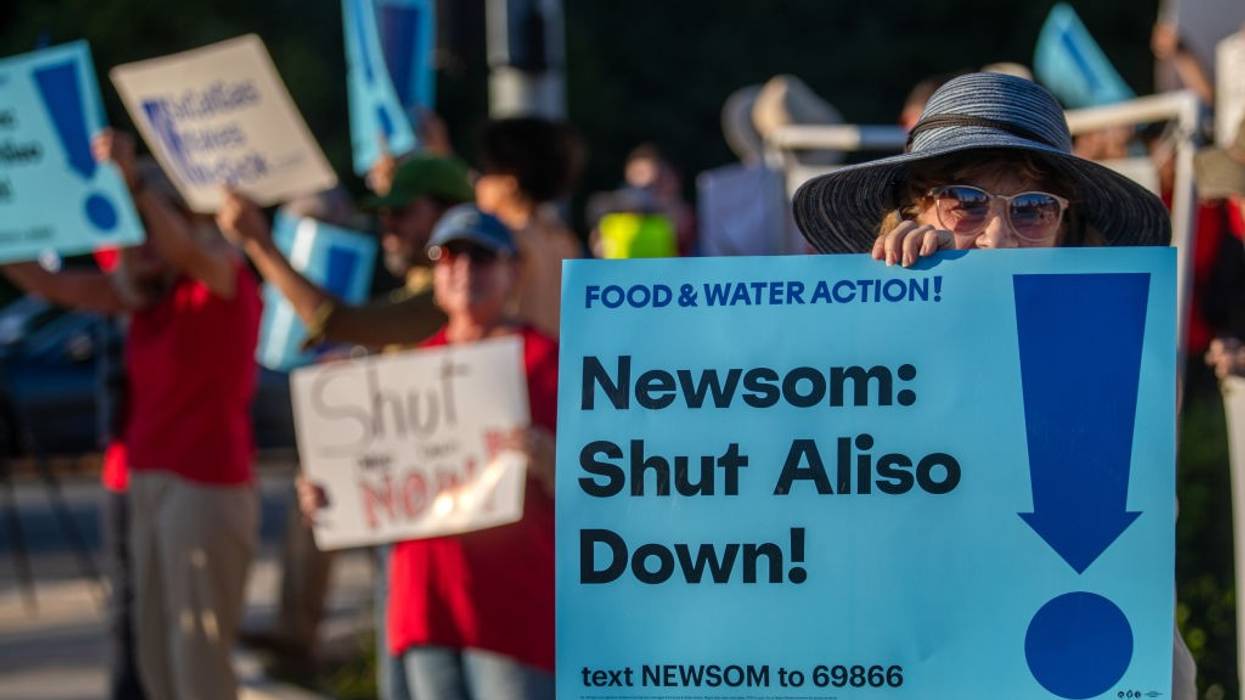
Trump and his “drill baby, drill” agenda poses an existential threat to our climate. We need governors to step up, lead the opposition, and advance bold policies at the state level to protect our people and planet.
The upcoming Trump presidency poses an existential threat to our already fragile climate. Trump has appointed a cabinet filled with climate deniers, and promised to ramp up oil drilling and gut industry regulations. In response, Governor Gavin Newsom has promised to fight Trump and advance climate progress in California.
Gov. Newsom has a national profile and has aspirations for national office. He has a chance to provide much-needed national climate leadership, but to effectively battle Trump and advance a bold agenda; he’ll need to walk back some of his prior positions and fulfill promises that are at odds with the wishes of some of his biggest corporate backers. His first early test will be to fulfill his commitment to shut down Aliso Canyon, site of the largest gas blowout in U.S. history.
No issue more strongly illustrates Newsom’s allegiance to the utility industry than the ongoing saga of Aliso Canyon.
In many ways, Newsom has indeed led on climate. Under his watch the state instituted a 3,200-foot setback between new oil wells and homes, schools and hospitals. Overall new drilling permits have declined, the legislature passed a measure to take on price gouging, and California has finally instituted a fracking ban—something that communities had demanded for years. He has also been outspoken on the national stage, challenging Florida Governor DeSantis over climate policy and generally challenging the oil and gas industry in the press.
Yet Newsom has also taken a number of positions that undermine climate progress. His Public Utilities Commission voted unanimously, for example, to gut incentives for rooftop solar. These incentives are critical for encouraging the deployment of solar across the state. This move has undermined the state’s solar industry and stalled its buildout. Pushing this action were major utilities like PG&E that are undermined by distributed energy generation. Meanwhile, he extended the life of three gas-fired power plants.
Newsom has also embraced a number of projects and programs advanced by the fossil fuel industry that masquerade as climate solutions. These include carbon capture, hydrogen and biogas (gas produced from filthy factory farm waste). The latter was recently a topic of debate before the California Air Resources Board, the vast majority of which were appointed by Newsom. The board voted to continue the state policy of incentivizing biogas under the low-carbon fuel standard program despite strong opposition from environmental groups and frontline communities.
But no issue more strongly illustrates Newsom’s allegiance to the utility industry than the ongoing saga of Aliso Canyon. The 2015 blowout there spewed more than 100,000 tons of methane and toxic chemicals over nearby Los Angeles communities, forcing thousands to temporarily relocate and making many sick. Shortly after being elected, Governor Newsom promised community members that he would “fast track” the closure of Aliso, after former Governor Brown said it should be shuttered by 2027.
Yet Aliso Canyon is operated by SoGalGas, a subsidiary of Sempra Energy, which has been a big backer of Governor Newsom. In all, utilities have donated $241,200 to Newsom’s political campaigns, including $31,200 from Sempra. Despite coming in on a promise to shut down Aliso, Newsom’s Public Utilities Commission has continually expanded its use. On December 19 the commission will be considering a proposal that could keep Aliso Canyon open indefinitely. The CPUC must either continue the proceeding for additional consideration or reject this proposal outright. The only just solution is to shut down Aliso Canyon by 2027.
Trump and his “drill baby, drill” agenda poses an existential threat to our climate. We need governors to step up, lead the opposition, and advance bold policies at the state level to protect our people and planet. Gov. Newsom has a chance to be that leader, but only if he’s able to advance a policy agenda that directly takes on fossil fuel interests and big utilities at all levels, and provides a clear counterweight to what Trump is pushing. This will mean reversing course on rooftop solar, rejecting industry plans like biogas and carbon capture, and—in his next big test—shutting down the dirty and dangerous Aliso Canyon gas storage facility.
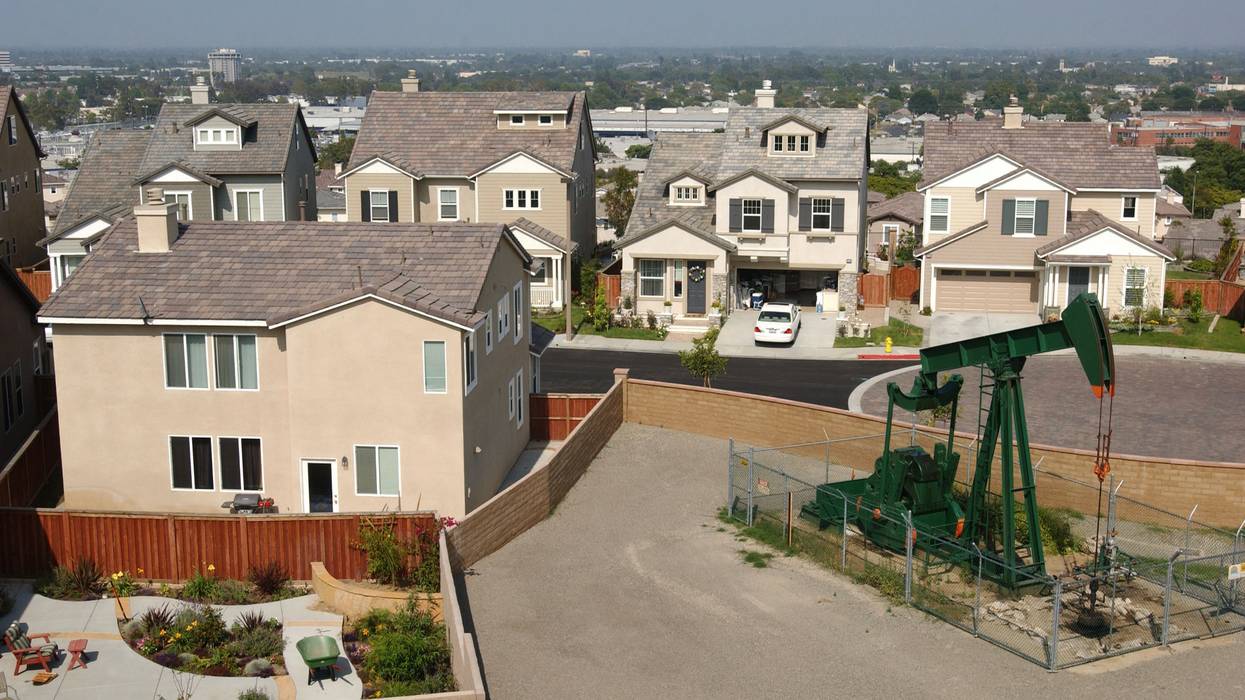
"Big Oil spent tens of millions of dollars trying to fool voters," said one campaigner, "but it was no match for the groundswell of people power and community support."
Environmental, climate, and public health advocates on Thursday cheered what one green group called a "historic win" as a Big Oil industry group dropped a California ballot measure challenging a law banning oil drilling near homes, schools, and businesses.
The Sacramento Bee reported that the California Independent Petroleum Association (CIPA) will withdraw its ballot measure seeking to overturn the state's ban on drilling for oil within 3,200 feet of residential, educational, and commercial buildings.
Democratic California Gov. Gavin Newsom signed the bill—introduced by then-state Assemblywoman Lorena Gonzalez (D-80)—in September 2022.
"We just won our David vs. Goliath battle," the Protect California Communities campaign said on social media. "Big Oil officially withdrew their deceitful initiative!"
"Our law is safe and will finally take effect," the group added. "We just protected California neighborhoods from toxic oil drilling!"
CIPA chairman Jonathan Gregory issued a salty statement following the ballot measure's withdrawal.
"Supporters of the energy shutdown can make unfounded claims in the press and in paid advertisements, but they can't make those claims in court without evidence," he said, according to the Bee. "That's why we are pivoting from the referendum to a legal strategy."
However, Newsom said CIPA's move "ends harmful drilling in our communities and enforces common-sense pollution controls."
"Big Oil saw what they were up against—and they folded, again," the governor said on Thursday. "No parent in their right mind would vote to allow drilling next to daycares and playgrounds. This is a huge win for all Californians, especially the two million living within a half-mile of these operations."
Food & Water Watch California director Chirag Bhakta said in a statement that "while this is a moment to celebrate the power of people coming together to take on Big Oil, we must continue to get toxic oil drilling out of neighborhoods, as well as all fossil fuel infrastructure, which also poses a huge risk to public health and causes pollution to our water and air."
Bhakta added that Newsom must now "immediately shut down the dangerous Aliso Canyon gas storage facility which was the site of the biggest methane blowout in U.S. history almost a decade ago and is an ongoing threat to nearby residents."
Communities for a Better Environment Darryl Molina Sarmiento said that "Big Oil spent tens of millions of dollars trying to fool voters, using the profits made at the expense of community health, but it was no match for the groundswell of people power and community support we were able to unite all across California."
Food & Water Watch's Bhakta said that public opposition to repealing the law "proves once again that Californians do not want dangerous and polluting oil rigs in their backyards, near where their children go to school and play or near hospitals."
"We will not sacrifice our communities anymore," he vowed. "This victory is due to the dedication of so many, and particularly frontline communities who are experiencing the brunt of the oil industry's pollution and have been advocating for years to get dirty oil drilling out of their backyards."
Nalleli Cobo is one of those people. The 22-year-old activist—who helped found the grassroots group People Not Pozos (Spanish for wells)—is recovering from illness related to growing up alonside an oil well and has been tirelessly fighting against Big Oil's plans to drill near residential communities.
"When I was about 11, I was diagnosed with asthma. By the time I turned 19, we had shut down the drilling in our South L.A. neighborhood, but not before I was diagnosed with stage 2 reproductive cancer," Cobo explained. "I lost my ability to bear children as a result. After three surgeries, eight minor procedures, three rounds of chemotherapy, and six weeks of radiation, I was cancer-free as of two years ago, at 20."
"My experience, like that of others who live in neighborhoods polluted by oil drilling, is a constant reminder that those in power do not value our health and wellbeing," she added. "It's a signal that some communities are expendable, that our lives don't matter as much as the fossil fuel industry's profits."

A Stanford University climate scientist on Wednesday called for war crimes charges against whoever is found to have ordered the apparent sabotage of the Nord Stream pipeline system, an incident that experts say could result in the largest-ever recorded release of methane emissions.
"Whoever ordered this should be prosecuted for war crimes and go to jail," Stanford's Rob Jackson told the Associated Press as scientists assessed the potentially massive environmental impact of the pipeline damage, which European countries and NATO have formally concluded is the result of a deliberate attack.
"This is a colossal amount of gas, in really large bubbles."
On Thursday, Swedish authorities announced the discovery of a fourth leak in the Nord Stream pipeline network that carries Russian gas to Germany under the Baltic Sea, adding to the three leaks found earlier this week. Sweden said it detected two underwater blasts the same day the first three leaks were discovered.
While speculation and finger-pointing abound--with European Union officials suggesting Russia is to blame and Moscow hinting that the U.S. or another NATO country may have been behind the attack--it's not yet clear who was responsible and no credible evidence has been presented by those making accusations.
In a statement Thursday, NATO said that "all currently available information indicates that this is the result of deliberate, reckless, and irresponsible acts of sabotage."
"These leaks are causing risks to shipping and substantial environmental damage. We support the investigations underway to determine the origin of the damage," the alliance added. "Any deliberate attack against allies' critical infrastructure would be met with a united and determined response."
Since the leaks were first detected earlier this week, scientists have voiced alarm about the climate disaster that could result, given the quantity of gas pouring out of the pipelines and the planet-warming potency of methane.
Danish authorities have estimated that the two pipelines contained a combined 778 million cubic meters of gas when they were breached--and gas is still flowing out of the pipelines days after the leaks were detected.
"This is a colossal amount of gas, in really large bubbles," Grant Allen, an environmental science expert at Manchester University, told The Guardian on Wednesday. "If you have small sources of gas, nature will help out by digesting the gas. In the Deepwater Horizon spill [in the Gulf of Mexico], there was a lot of attenuation of methane by bacteria."
"My scientific experience is telling me that--with a big blow-up like this--methane will not have time to be attenuated by nature," Allen added. "So a significant proportion will be vented as methane gas."
The AP reported Wednesday that early estimates indicate the damaged pipelines could "discharge as much as five times as much of the potent greenhouse as was released by the Aliso Canyon disaster, the largest known terrestrial release of methane in U.S. history."
That leak, discovered in California in 2015, unleashed around 100,000 metric tons of methane into the atmosphere.
Rowan Emslie, a spokesperson with the Clean Air Task Force, told CNN Thursday that "the unprecedented aspect" of the Nord Stream damage and resulting methane release "is that we don't think we've seen a leak this large, this fast before, which is why it's so worrying."

The revelation Monday that a blowout last year at an Ohio natural gas well owned by an ExxonMobil subsidiary was one of the country's largest-ever leaks of the potent greenhouse gas methane provoked impassioned calls for a rapid, just transition to 100% renewable energy nationwide.
"The next time some paid liar in the fossil fuel industry insists fracked gas is helping solve the climate crisis, remind them that a single Exxon fracking site 'leaked more methane in 20 days than all but three European nations emit over an entire year,'" tweeted David Sirota, a speechwriter and adviser for Bernie Sanders' 2020 presidential campaign.
Sirota quoted The Washington Post's report on the findings of a study published Monday in the Proceedings of the National Academy of Sciences. A team of American and Dutch scientists studied satellite data and found that the Feb. 15, 2018 blowout at a Belmont County well--which was hydraulically fractured or fracked before the incident--resulted in an "extreme" leakage of methane.
The team of 15 scientists explained that "from these data, we derive a methane emission rate of 120 +- 32 metric tons per hour. This hourly emission rate is twice that of the widely reported Aliso Canyon event in California in 2015." The incident in California, which lasted four months, is the largest known accidental methane leak in the United States. Methane is 84-87 times more potent than carbon dioxide over a 20-year period.
"The Ohio episode triggered about 100 residents within a one-mile radius to evacuate their homes while workers scrambled to plug the well," The New York Times reported Monday. "At the time, the Exxon subsidiary, XTO Energy, said it could not immediately determine how much gas had leaked."
Critics of continuing fossil fuel production pointed to new findings about the blowout and its consequences as evidence of the dangers of using natural gas as a "bridge" in a national--and global--transition to 100% clean energy.
Author and activist Naomi Klein tweeted a link to the "terrifying" Times report and highlighted commentary from a scientist at the U.S.-based nonprofit advocacy group Environmental Defense Fund (EDF).
Terrifying story about a blowout in Ohio that released "as much methane as the entire oil and gas industries of some nations release in a year." EDF - which has aggressively pushed NatGas as a "bridge fuel" - explains that this could be happening every day https://t.co/ghGT74IjBx
-- Naomi Klein (@NaomiAKlein) December 17, 2019
"Right now, you have one-off reports, but we have no estimate globally of how frequently these things happen," Steven Hamburg, EDF's chief scientist and a co-author of the new study told the Times. "Is this a once a year kind of event? Once a week? Once a day? Knowing that will make a big difference in trying to fully understand what the aggregate emissions are from oil and gas."
Bill McKibben, co-founder of the global environmental advocacy group 350.org--who also shared the Times report on Twitter--concluded that "natural gas [is] clearly a bridge fuel, it's just that the bridge leads to hell."
Morgan Harper, a progressive Democrat currently campaigning to represent the Ohio's 3rd Congressional District--which includes the state capital, Columbus--also tweeted a short response to reporting on the study: "Green. New. Deal."
ExxonMobil, for its part, did not indicate any intention to reconsider fracking or natural gas production in response to the new findings. Julie L. King, a spokesperson for the fossil fuel giant, told the Post by email that "we deeply regret this incident occurred and are committed to identifying and managing risks associated with our activities to prevent recurrence."
"We are eager to learn more about their study," King added. "ExxonMobil is working with government laboratories, universities, NGOs, and other industry participants to identify the most cost-effective and best-performing technology, including satellites, that can be adopted by all producers to detect, repair, and accurately measure methane."
The Aliso Canyon natural gas well blowout, which lasted for months and sickened scores of nearby residents, has been confirmed as the largest methane leak in history.
According to a peer-reviewed study published Thursday in the journal Science, the nearly four-month leak released roughly 100,000 tons of methane, doubling the methane emissions rate of the entire Los Angeles Basin. Southern California Gas Co. said it stopped the leak earlier this month. State Division of Oil, Gas and Geothermal Resources engineers confirmed the leak was halted last week.
"Aliso Canyon will certainly be the biggest single [methane] source of the year," said co-lead study author Stephen Conley of UC Davis and Scientific Aviation. "It's definitely a monster."
Beyond that, he told Inside Climate News, "It's the biggest leak in U.S. history."
As the Los Angeles Times reports, "Conley piloted a single-engine plane rigged with methane and ethane sensors through the plume and analyzed it during 13 different research flights between Nov. 7 and Feb. 13, with the last readings taken just two days after the well was temporarily halted."
The newspaper continues:
With each flight, he would start very low -- perhaps a couple hundred feet off the ground - fly through the plume, turn around and go back through at about 100 feet higher. He would do this until he reached the top of the plume, which could take anywhere from about 16 to 35 passes. Adding these slices up would give him the total emissions from the plume at that time.
Even after the first flight, the methane readings alarmed him.
"It was 20 times larger than anything else we'd ever measured -- it was just kind of a shock," said Conley, who recalled thinking, "What in the world was this big?"
With the leak's pollution equivalent to annual emissions from half a million cars, the disaster will substantially affect California's ability to meet greenhouse gas emission targets for the year, added Tom Ryerson of the National Oceanic and Atmospheric Association (NOAA). "Our results show how failures of natural gas infrastructure can significantly impact greenhouse gas control efforts," he said.
In a blog post Thursday, Environmental Defense Fund chief scientist Steven Hamburg noted that Conley's results were "much higher than those provided by the gas company."
But that's not surprising, he continued, explaining that "accurately measuring these large sources is difficult using ground-based approaches like those used by the gas company to estimate the size of emissions from the facility."
"As long as we rely on fossil fuels for energy--and much of the methane that's leaking from Aliso Canyon was intended for California's power plants--we will be fighting climate disruption with both hands tied behind our backs."
--Michael Brune, Sierra Club
Significantly, Hamburg wrote, the study comes days after the Environmental Protection Agency (EPA) released draft results of their updated accounting of methane emissions from the nation's oil and gas supply chain that shows that emissions are up 27 percent above the agency's early estimate.
"The more we know about methane emissions, the higher they get," he said. "The new findings show not just the massive scale of the oil and gas industry's methane problem, but also how critical it is to get the science right to both understand this source of a potent climate pollutant and reduce it. We know that cutting methane is one of the fastest, most cost-effective ways to curb today's warming, and when combined with critical efforts to reduce carbon dioxide pollution, substantial climate progress can be made."
The Aliso Canyon disaster has prompted calls from members of Congress for the federal Pipeline and Hazardous Materials Safety Administration to create the first federal standards for underground gas storage.
However, with more than 300 such facilities across the U.S., the leak "is just the latest and most public example showing that we need to keep natural gas in the ground, not burn it," as Earthworks executive director Jennifer Krill wrote last month.
Indeed, Sierra Club's Michael Brune declared in a January blog post: "As long as we rely on fossil fuels for energy--and much of the methane that's leaking from Aliso Canyon was intended for California's power plants--we will be fighting climate disruption with both hands tied behind our backs."
"Only when we achieve 100 percent clean energy will we truly be able to safeguard our health, our environment, and our climate," he said. "For the unlucky people in the path of the next fossil fuel disaster--and they could be anywhere--that day can't come soon enough."
While others demonstrated below, a pair of climate activists in San Francisco on Tuesday scaled the headquarters of the California Public Utilities Commission (PUC) to protest the regulatory body's failure to adequately address the danger posed by underground natural gas storage facilities in the state.
| #porterranchgasleak Tweets |
Highlighted by the nearly four-month leak at the natural gas facility run by SoCalGas company at Aliso Canyon near the town of Porter Ranch, the group of campaigners outside the PUC building--in addition to the two who scaled its front and dropped a large banner above the entrance--say that failure to monitor such sites properly is both a risk to local residents as well as the planet due to the clear climate impacts of gas and oil drilling.
Those on the ground held signs reading, "Natural Gas Hurts Communities" and "Stop Climate Change: Keep Fossil Fuels in the Ground," while the larger banner hung from the building said, "Natural Gas Leaks: Shut It All Down" in large black letters.
"It is unconscionable that these regulators are putting people at risk while giving companies a pass," said Kelsey Baker from Occupy San Francisco Environmental Justice and one of the two people currently occupying the ledge.
The dramatic protest was scheduled to coincide with the arrival of U.S. Energy Secretary Ernest Moniz in southern California, where he is expected to tour the Aliso Canyon facility later on Tuesday. Since the leak began in October, an estimated 96,000 metric tons of methane have escaped into the atmosphere, leaving many area residents sick and forcing thousands from their homes.
Even though SoCalGas has now claimed it has stopped the leak at the Aliso Canyon site, one of a dozen such facilities in the states, the demonstrators say the fact that this particular operation had not faced a significant inspection since 1976 proves just how sparsely regulated the gas industry is by the state.
"While plugging the leak at Aliso Canyon has been a good step, today we are demanding that the PUC shut down all gas storage facilities," said Christy Tennery-Spalding from Diablo Rising Tide, the San Francisco Bay Area chapter of Rising Tide North America. "Until they do," she said, "we are occupying the PUC."
Southern California Gas Co. announced Thursday that it had "temporarily controlled" the massive Porter Ranch gas leak, but the mood for many is nowhere near celebratory.
The months-long leak at the Aliso Canyon natural gas storage facility forced thousands of residents to relocate, caused thousands of children to switch schools, and prompted many to complain of health effects, including nausea, headaches, and nosebleeds. California Governor Jerry Brown issued a state of emergency over the disaster, which, according to Environmental Defense Fund (EDF), caused "at least 95,000 metric tons of potent, climate-forcing methane [to] have escaped--the same 20-year climate impact as burning nearly a billion gallons of gasoline."
In a statement (pdf) released by the utility company, Jimmie Cho, SoCalGas senior vice president of gas operations and system integrity, and SoCalGas incident commander said, "We have temporarily controlled the natural gas flow from the leaking well and begun the process of sealing the well and permanently stopping the leak."
It adds that the permanent seal of cement "could occur over the next several days."
The final word on permanency will come from California Department of Conservation.
"After Southern California Gas Company injects cement into the leaking well to form a permanent seal and that cement seal has dried, several tests mandated by the Division of Oil, Gas, and Geothermal Resources will be conducted to confirm the leaking well has been sealed. We will issue a public notice that the well is officially sealed only after this state verification and testing is complete," the body's Chief Deputy Director Jason Marshall stated Thursday.
As many residents and environmental organizations see it, the dangers won't stop even when the seal is verified, as the dangers reach beyond this one well's failure.
Alexandra Nagy, southern California organizer with Food and Water Watch, called the utility's announcement "just more hot air."
"The Gas Company consistently underplays the risks and overplays their progress. Of course the community wants the leak stopped, but that doesn't go far enough. This facility needs to be shut down permanently because it's too dangerous and we can't trust this company to operate in good faith," she stated.
"Now comes the critical process of making sure this doesn't happen again and holding the company accountable," said Tim O'Connor, California Oil & Gas Director at EDF.
And this one leak is merely a symptom of a larger problem, he said.
"This disaster is what happens when aging infrastructure meets lax oversight, and it's just one example of a problem that is plaguing the oil and gas industry across the country. We need comprehensive national action to hold industry accountable for reducing these emissions and keeping disasters like this from happening again in the future."
Many residents are still wary as well.
"We have no idea what's really going on," Reza Sadeghi told the Los Angeles Times. "Who's to say it's not going to be fully [stopped] for three months?"
Jennifer Milbauer told the LA Daily News, "This isn't about if it happens again, but when."
The ill-fated well is one of over 100 on the former oil field, which is now used as a gas storage facility.
"As long as we look up at those hills," she said, "we'll always wonder, what's behind them?"
David Donah, who lives in Porter Ranch with his wife and two children, told CNN, "So, I'm supposed to somehow tell my kids that they are safe with 114 ticking time bombs essentially up on the hill above their homes."
"You want to talk about mad, mad doesn't describe what I'm feeling."
As the ongoing Porter Ranch disaster highlights the dangers of aging natural gas infrastructure around the country, presidential candidate Bernie Sanders and environmental experts are now arguing that the leaking well serves as "yet another example of the urgent national need to transition away from fossil fuels."
"The Porter Ranch gas leak is a climate disaster," Sanders said in a tweet on Thursday after being asked about the situation at a town hall meeting at Southern New Hampshire University.
What's more, the failure at the Aliso Canyon well--which has for months been spewing thousands of tons of methane gas into the air and sickening residents of the town just 25 miles outside of Los Angeles--"is illustrative of a problem that is happening every day," Mark Brownstein, the vice president of the Environmental Defense Fund's climate and energy program, told the Huffington Post.
"It's a problem at gas storage facilities across the U.S.," he said. "I don't want people to lose sight of the fact that while this is a big pollution event with huge impacts to the community, and [one that] certainly upends a lot of progress that California has been trying to make on climate change, it really is symptomatic of a larger, more systemic problem of the oil and gas industry."
Brownstein explained: "A fair chunk of the emissions associated with the oil and gas industry in the U.S. come from these types of events: leaks on systems, equipment that fails, equipment that malfunctions."
In fact, according to a Reuters exclusive on Friday, "[u]tilities and regulators have been 'gambling' with wells that in many cases were drilled in the 1950s, [California State Senator Fran] Pavley said. She described their standard practice as, 'Don't fix it until it leaks or cracks or breaks.'" The Aliso Canyon facility comprises depleted oil wells from the 1950s that were converted in the 1970s to a natural gas storage reservoir.
Barring storm interference, President Barack Obama is expected to propose new rules on Friday to curb leaks from oil and natural gas production on public lands.
And earlier this month, California Gov. Jerry Brown ordered the state Division of Oil, Gas and Geothermal Resources to issue emergency safety regulations for underground gas storage. Last week, the agency proposed requiring facilities to submit plans for inspections and leak detection and to test all safety valve systems every six months.
But such fixes are merely band-aids in the face of a national emergency, said Linda Capato Jr., the fracking campaign coordinator for the environmental group 350.org. Porter Ranch and similar recent disasters, she continued, are "indicators of a failing regulatory system that can't keep us safe from things that are inherently dangerous."
For instance, consider that newly uncovered documents show that hydraulic fracturing, or fracking, was "commonly used in the Aliso Canyon gas storage wells--including a well less than a half-mile from the leak," wrote Center for Biological Diversity attorney Maya Golden-Krasner in an op-ed for the Sacramento Bee on Thursday.
Golden-Krasner continued:
The public is not notified of this practice. That's because California's new fracking notification law, Senate Bill 4, contains a little-noticed provision exempting well stimulation for gas storage. And officials with the state's Division of Oil, Gas and Geothermal Resources know disturbingly little about fracking in Aliso Canyon wells or other gas storage operations around the state.
That's consistent with the Brown administration's hands-off approach to regulating oil and gas companies' underground injection activities. In 2011, Brown fired two oil regulators who raised safety concerns. Last year, state regulators even admitted they had let oil companies drill thousands of injection wells into legally protected underground water supplies.
[...] Despite the widespread use of this practice, most Californians have no idea that gas storage wells near their homes are being fracked. That's absolutely unacceptable and must end immediately.
It also provides more evidence of the need to keep natural gas in the ground, not burn it.
The climate-destroying debacle at Porter Ranch said Sanders, "is yet another reason why I have called for a ban on all fracking. Porter Ranch is simply one more tragic cautionary tale in our dependence on oil and gas."
He continued: "That is why I have put forth the most far-reaching climate plan of any candidate for the presidency. I opposed Keystone XL from Day One. I am the only candidate for president who has opposed the Bakken Pipeline in Iowa, and the proposed pipelines in New Hampshire and Vermont carrying fracked gas."
As 350.org noted in a statement Thursday, Sanders' fellow Democratic candidates, Hillary Clinton and Martin O'Malley, have yet to comment on the Porter Ranch crisis or come out with strong positions against fracking.
It's early December, and I'm siting in a mega-church packed with more than 500 people. They're here to listen to an update on the efforts to contain an enormous natural gas blowout that occurred more than a month before. Gas from the leak is being blown by prevailing winds right into their community of Porter Ranch, in Los Angeles County, CA.
People are mad.
Hundreds of families have left their homes to get away from the rotten-egg smell of the gas, and moved into temporary homes elsewhere. Children are attending other schools further from the leak, which is spewing some 110,000 pounds of methane per hour from a broken well less than a mile from the neighborhood.
Trust between the gas company, regulators, and community members seems absent.
People question what else is in the gas that might have long-term health impacts. They want to know why many are suddenly reporting headaches and bloody noses.
I'm sitting in this church because my colleague Hilary Lewis and I were invited to Porter Ranch with our infrared gas-finding camera to see what this high profile disaster actually looks like. Before we arrived, the public had no access to images or video of the gas itself, as it's invisible to the naked eye.
We meet a local organizer in a supermarket parking lot, exit the vehicle, and even my horrible sense of smell instantly reacts to the scent of the gas more than two miles from where we stand. It's coming from a well at the Aliso Canyon natural gas storage facility, an 8,000-foot deep sandstone formation -- a depleted oil field -- that SoCalGas uses to hold vast quantities of gas. In fact, it's one of the largest gas storage fields in the nation, comprising some 115 extraction and injection wells, some of which operate at pressures above 2,000 pounds per square inch -- a hefty load for well casings over 60 years old.
We hike the hills and document the gas blowing sideways and downhill into town. Later that night, we see a plume of gas at least a mile long spanning Aliso Canyon. Of all the sites I've shot as a certified infrared thermographer nationwide, this is, hands down, the largest volume of spewing methane gas I've ever seen -- and I've visited nearly a hundred sites around the country, including the Bakken oil fields in North Dakota. Each day, the leak is releasing the same amount of greenhouse gases as the average daily emissions of more than 7 million cars.
This video footage -- aired nationally on NBC's The Rachel Maddow's Show and many other media outlets -- has helped to draw widespread attention to the leak, and has assisted local residents in their efforts to get justice and to hold industry, regulators, and policymakers accountable.
Just ten days later, I return to Aliso Canyon to shoot additional infrared footage for the Environmental Defense Fund from a small chartered aircraft. We fly as close as is safe, seeing a plume nearly 1,000 feet high under calmer wind conditions. The pilot can't help but note the pungent smell not long after gaining altitude.
We get a view of the well pad itself -- a mangled looking mess coated in mud. This mud was used to try to "drown" the well during the first several attempts to plug the leak. Nothing worked. There are huge craters around the well, and no one wants to get too close with machines for fear of a spark turning the entire scene into an enormous fireball.
The footage I shot for EDF makes an even bigger mark on the national consciousness. Soon thereafter, California Governor Jerry Brown declares a state of emergency regarding the leak, and the Los Angeles Times editorializes against fossil fuels, referencing the Aliso Canyon leak.
Right now, as the leak enters its tenth week, the underground pressure has been reduced by half of its original rate, due to the gas escaping from the leak and other actions taken by SoCalGas -- the company operating the facility -- to withdraw gas in a controlled manner.
It will be months before the leak is repaired. SoCalGas is currently drilling two relief wells to divert the gas below the leak source, much like what was done during the Deepwater Horizon blowout in the Gulf of Mexico in 2010. But by the time the wells are drilled, most of the gas will be gone anyway.
Methane, the primary component of natural gas, is 87 times more harmful to the climate than carbon dioxide over a 20-year period. So far, an estimated 79,000 metric tons of methane have escaped from this one facility -- so much that California's goals to reduce climate pollution have been seriously compromised. It's estimated that, at its height, the leak increased the state's daily methane emissions by 25 percent.
What has this disaster taught us? For one thing, it's yet another affirmation that fossil fuels are not safe or clean, and that things often go horribly wrong when it's least expected. But more specifically, it highlights the woeful state of regulatory oversight on underground gas storage facilities such as Aliso Canyon. For example, the well casing at the site of the blowout failed hundreds of feet below the surface, likely due to the predictable corrosion of 60 year old well casings. To add insult to injury, the safety shut-off device for this well was removed long ago and never replaced.
So there you have it -- a well operating at the upper limit of its pressure tolerance, with a safety valve deliberately removed long before, and a well casing that failed with no safeguards in place to prepare for when that time might come. Aliso Canyon has 114 other wells that could fail at any time unless adequate safeguards are in place.
Thankfully, Governor Brown's declaration of a state of emergency will force a number of much-needed steps -- both immediate and medium-term -- that will address the situation. His declaration was much needed because, for example, the California Air Resources Board is considering new regulations that would address leak detection and repair for natural gas infrastructure, but these wouldn't have applied to underground facilities like Aliso Canyon. Yes, you read that correctly. Now, due to Brown's declaration, California regulatory bodies, including the Air Resources Board, will be required to assess the long-term viability of natural gas storage facilities in California.
It's long past time to regulate these facilities properly, or take them offline entirely. Hundreds of underground natural gas storage facilities exist throughout the nation, and many of them could also experience catastrophic failures, in addition to other problems already occurring, such as groundwater contamination.
To prevent more disasters like Aliso Canyon in California and around the country (there are 326 similar facilities nationwide) we need an emergency statewide effort to shut down facilities that lack basic safety equipment, including Aliso Canyon. Gas storage wells that lack shut off valves should be taken offline before other Porter Ranches happen. We also need increased oversight and management of these facilities, not to mention support for residents affected by pollution, including health care and financial compensation.
Moving forward, we also need a rapid transition away from gas. The Solutions Project, an organization working to accelerate the transition to renewable energy, has mapped out a plan for California to achieve 100 percent fossil fuel-free energy by 2050. This transition would protect communities from underground storage risks, gas line leakage, and explosions like the one in San Bruno.
Because nearby communities -- and the global climate -- cannot afford any more disasters, Earthworks, a nonprofit that works to protect communities from the adverse impacts of energy development, is working hand-in-hand with community groups to push for significant regulatory changes and enforcement. Learn more about Earthworks' work here.
Following months of pressure from activists and residents, California Governor Jerry Brown issued a state of emergency on Wednesday over the Porter Ranch gas leak that has been pouring tens of thousands of kilograms of methane into the air surrounding the community since October.
The order means "all necessary and viable actions" will be taken to stop the leak and ensure that the Southern California Gas Company (SoCal Gas), which owns the leaking natural gas injection well, is held accountable for the damage.
"It's about time," Alexandra Nagy, Southern California organizer at Food and Water Watch, told Common Dreams. "It's incredible. Now residents can actually get the assistance that they need."
Brown issued the state of emergency after making a quiet visit to the area earlier this week to tour the facility and meet with the Porter Ranch neighborhood council. According to a press release from the governor's office, Wednesday's order also directs action to protect public health.
"It is really going to...amplify the urgency of this issue and really expose how bad the problem is," Nagy said.
The leak, which has been ongoing since October, gained limited media attention after environmental and public health advocate Erin Brockovich declared it "a catastrophe the scale of which has not been seen since the 2010 BP oil spill." Residents living in proximity to the well, which is situated in Aliso Canyon, roughly 30 miles northwest of Los Angeles, reported having symptoms of methane exposure, including headaches, nausea, and in some cases, bleeding eyes and gums.
Brown's hesitance to issue an emergency order in the face of a growing public health crisis raised questions over a possible conflict of interest between the governor and SoCal Gas. Brown's sister, Kathleen L. Brown, is a paid member of the company's board.
On Monday, a constituent affairs representative with Brown's office told Common Dreams that he was unaware of any plans to declare a state of emergency, stating, "I think maybe he wants to wait until the situation develops a little bit more.... state of emergencies are a pretty big deal."
Nagy credited the swift turnaround to pressure from the community, stating Wednesday, "We've just been mounting pressure from all sides... This is a hard fought win for the residents of Porter Ranch and beyond affected by this noxious blowout."
"It was interesting that he wanted to do it in the quiet and in the dark, because he doesn't want to be held accountable publicly, and this is his opportunity to look like a hero and a leader on this," Nagy continued. "He's moving with it because that's where it's going."
While the order was welcome, activists have a broader objective--to shut down the Aliso Canyon facility and, ultimately, end the state's reliance on fossil fuels, Nagy said, declaring, "Addiction to natural gas is a problem."
To that end, activists in the area are organizing a hearing with city officials on Saturday to discuss an order for abatement, which requires companies acting out of compliance to shut down their operations. The order, issued by the South Coast Air Quality Management District (SCAQMD), "has the potential to shut down the Aliso Canyon Storage Facility temporarily or permanently," organizers explained in a Facebook post. "We need to rally and testify at the hearing this Saturday to demand AQMD uses their authority to #ShutItALLDown."
Activists plan to gather at Granada Hills Charter High School on Saturday for an 8 am rally ahead of the 9 am hearing.
"We are on a path to transitioning to clean energy," Nagy said. "[The leak has] been a wake-up call for this community.... We're all on the front lines of climate change."