

SUBSCRIBE TO OUR FREE NEWSLETTER
Daily news & progressive opinion—funded by the people, not the corporations—delivered straight to your inbox.
5
#000000
#FFFFFF
To donate by check, phone, or other method, see our More Ways to Give page.
Daily news & progressive opinion—funded by the people, not the corporations—delivered straight to your inbox.
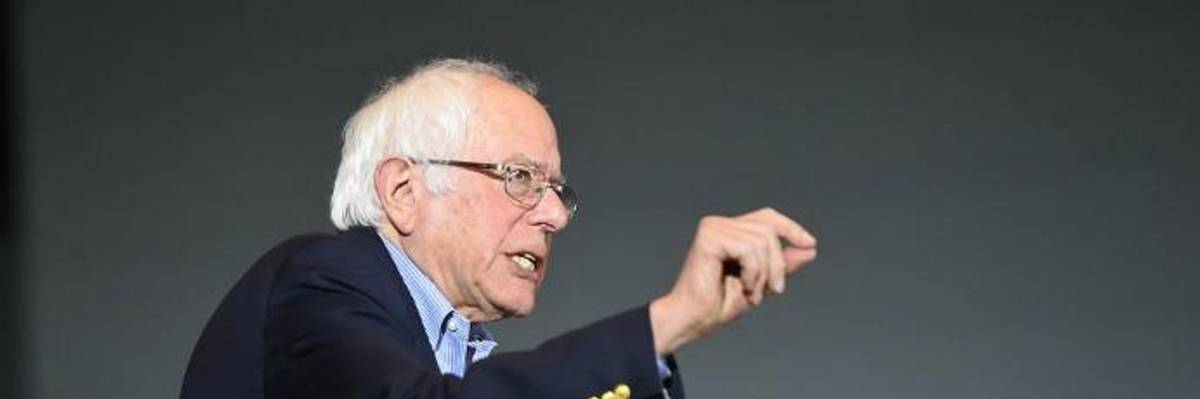
Sen. Bernie Sanders and Pennsylvanians rally to demand that Sen. Pat Toomey (R-Pa.) vote against Trumpcare during an Emergency Rally with MoveOn.org to Stop Trumpcare held at the Pittsburgh Convention Center on June 24, 2017. (Photo by Jason Merritt/Getty Images for MoveOn.org)
After months of aggressively rallying support for domestic objectives like Medicare for All, union rights, and a $15 minimum wage, Sen. Bernie Sanders (I-Vt.) in a speech on Thursday turned his attention to American foreign policy and the so-called war on terror, which he says has been a "disaster" for the world and for the United States.
The address covered a wide range of topics--from the history of U.S. interventionism to the threats posed by climate change and nuclear proliferation--and called for an "expansive" view of foreign policy that encompasses such issues as global inequality, the power of multinational corporations, and the rise of racist movements in the United States and abroad.
"Foreign policy is about whether we continue to champion the values of freedom, democracy, and justice, values which have been a beacon of hope for people throughout the world, or whether we support undemocratic, repressive regimes, which torture, jail, and deny basic rights to their citizens," Sanders said.
Watch the speech:
Earlier:
According to excerpts obtained by The Daily Beast ahead of the speech, Sanders will argue that American interventionism abroad feeds the very problem it claims to be eradicating.
"Orienting U.S. national security strategy around terrorism essentially allowed a few thousand violent extremists to dictate policy for the most powerful nation on earth," Sanders will say. "It responds to terrorists by giving them exactly what they want."
The speech is set to take place at Westminster College in Fulton, Missouri, the site of Winston Churchill's famous "Iron Curtain" speech, and many progressives are suggesting that the address could be a defining moment for Sanders, who is widely viewed as a leading 2020 presidential candidate.
Some are drawing early comparisons between Sanders's planned speech and the address delivered by U.K. Labour Leader Jeremy Corbyn, who similarly denounced the war on terror as a failure and drew a link between British foreign policy and the spread of terrorism.
To offer an example of what diplomacy can achieve, Sanders will also look to draw attention to the Iran nuclear deal, which is currently under threat from the Trump administration. The agreement, Sanders will argue, offers a counterpoint to the decades of American interventionist policy that has led to endless conflict overseas.
"There are two things he's going to compare and contrast: the Iraq War, which most now agree was a disaster, and the Iran agreement, which is an example of how American leadership should work, where we used diplomacy and mobilized international consensus to address a shared challenge," a Sanders aide told the Huffington Post.
"President Trump's bombastic rhetoric is not appropriate when we are dealing with the possibility of a nuclear war that could kill millions of people."
--Sen. Bernie Sanders
The aide added that Sanders' speech Thursday will attempt to make clear that American foreign policy has massive consequences at home.
"[S]ending troops abroad and the money we wasted in Iraq that could have gone to infrastructure or to healthcare or even to effective foreign aid," the aide said.
Sanders' remarks will come at a time of soaring global tensions and on the heels of President Donald Trump's first address to the United Nations, in which he threatened to "totally destroy" North Korea--a remark denounced by critics as "genocidal."
"President Trump's bombastic rhetoric is not appropriate when we are dealing with the possibility of a nuclear war that could kill millions of people," Sanders said in August after Trump's "fire and fury" comments, concluding that a "a comprehensive diplomatic strategy" must be pursued.
As the New Republic's Graham Vyse noted in a piece earlier this week, Sanders' speech will aim to fill a crucial void--the lack of a clearly articulated progressive foreign policy vision.
"Given the constant domestic crisis of the Trump administration--the latest insanity being another last-ditch effort to repeal Obamacare--it's understandable that the Democrats haven't focused as much on his foreign policy," Vyse noted. "Yet Trump's U.N. speech heightens the need for the opposition to communicate its own international agenda, clearly articulating how Democrats would engage with the world if they retook power."
Dear Common Dreams reader, It’s been nearly 30 years since I co-founded Common Dreams with my late wife, Lina Newhouser. We had the radical notion that journalism should serve the public good, not corporate profits. It was clear to us from the outset what it would take to build such a project. No paid advertisements. No corporate sponsors. No millionaire publisher telling us what to think or do. Many people said we wouldn't last a year, but we proved those doubters wrong. Together with a tremendous team of journalists and dedicated staff, we built an independent media outlet free from the constraints of profits and corporate control. Our mission has always been simple: To inform. To inspire. To ignite change for the common good. Building Common Dreams was not easy. Our survival was never guaranteed. When you take on the most powerful forces—Wall Street greed, fossil fuel industry destruction, Big Tech lobbyists, and uber-rich oligarchs who have spent billions upon billions rigging the economy and democracy in their favor—the only bulwark you have is supporters who believe in your work. But here’s the urgent message from me today. It's never been this bad out there. And it's never been this hard to keep us going. At the very moment Common Dreams is most needed, the threats we face are intensifying. We need your support now more than ever. We don't accept corporate advertising and never will. We don't have a paywall because we don't think people should be blocked from critical news based on their ability to pay. Everything we do is funded by the donations of readers like you. When everyone does the little they can afford, we are strong. But if that support retreats or dries up, so do we. Will you donate now to make sure Common Dreams not only survives but thrives? —Craig Brown, Co-founder |
After months of aggressively rallying support for domestic objectives like Medicare for All, union rights, and a $15 minimum wage, Sen. Bernie Sanders (I-Vt.) in a speech on Thursday turned his attention to American foreign policy and the so-called war on terror, which he says has been a "disaster" for the world and for the United States.
The address covered a wide range of topics--from the history of U.S. interventionism to the threats posed by climate change and nuclear proliferation--and called for an "expansive" view of foreign policy that encompasses such issues as global inequality, the power of multinational corporations, and the rise of racist movements in the United States and abroad.
"Foreign policy is about whether we continue to champion the values of freedom, democracy, and justice, values which have been a beacon of hope for people throughout the world, or whether we support undemocratic, repressive regimes, which torture, jail, and deny basic rights to their citizens," Sanders said.
Watch the speech:
Earlier:
According to excerpts obtained by The Daily Beast ahead of the speech, Sanders will argue that American interventionism abroad feeds the very problem it claims to be eradicating.
"Orienting U.S. national security strategy around terrorism essentially allowed a few thousand violent extremists to dictate policy for the most powerful nation on earth," Sanders will say. "It responds to terrorists by giving them exactly what they want."
The speech is set to take place at Westminster College in Fulton, Missouri, the site of Winston Churchill's famous "Iron Curtain" speech, and many progressives are suggesting that the address could be a defining moment for Sanders, who is widely viewed as a leading 2020 presidential candidate.
Some are drawing early comparisons between Sanders's planned speech and the address delivered by U.K. Labour Leader Jeremy Corbyn, who similarly denounced the war on terror as a failure and drew a link between British foreign policy and the spread of terrorism.
To offer an example of what diplomacy can achieve, Sanders will also look to draw attention to the Iran nuclear deal, which is currently under threat from the Trump administration. The agreement, Sanders will argue, offers a counterpoint to the decades of American interventionist policy that has led to endless conflict overseas.
"There are two things he's going to compare and contrast: the Iraq War, which most now agree was a disaster, and the Iran agreement, which is an example of how American leadership should work, where we used diplomacy and mobilized international consensus to address a shared challenge," a Sanders aide told the Huffington Post.
"President Trump's bombastic rhetoric is not appropriate when we are dealing with the possibility of a nuclear war that could kill millions of people."
--Sen. Bernie Sanders
The aide added that Sanders' speech Thursday will attempt to make clear that American foreign policy has massive consequences at home.
"[S]ending troops abroad and the money we wasted in Iraq that could have gone to infrastructure or to healthcare or even to effective foreign aid," the aide said.
Sanders' remarks will come at a time of soaring global tensions and on the heels of President Donald Trump's first address to the United Nations, in which he threatened to "totally destroy" North Korea--a remark denounced by critics as "genocidal."
"President Trump's bombastic rhetoric is not appropriate when we are dealing with the possibility of a nuclear war that could kill millions of people," Sanders said in August after Trump's "fire and fury" comments, concluding that a "a comprehensive diplomatic strategy" must be pursued.
As the New Republic's Graham Vyse noted in a piece earlier this week, Sanders' speech will aim to fill a crucial void--the lack of a clearly articulated progressive foreign policy vision.
"Given the constant domestic crisis of the Trump administration--the latest insanity being another last-ditch effort to repeal Obamacare--it's understandable that the Democrats haven't focused as much on his foreign policy," Vyse noted. "Yet Trump's U.N. speech heightens the need for the opposition to communicate its own international agenda, clearly articulating how Democrats would engage with the world if they retook power."
After months of aggressively rallying support for domestic objectives like Medicare for All, union rights, and a $15 minimum wage, Sen. Bernie Sanders (I-Vt.) in a speech on Thursday turned his attention to American foreign policy and the so-called war on terror, which he says has been a "disaster" for the world and for the United States.
The address covered a wide range of topics--from the history of U.S. interventionism to the threats posed by climate change and nuclear proliferation--and called for an "expansive" view of foreign policy that encompasses such issues as global inequality, the power of multinational corporations, and the rise of racist movements in the United States and abroad.
"Foreign policy is about whether we continue to champion the values of freedom, democracy, and justice, values which have been a beacon of hope for people throughout the world, or whether we support undemocratic, repressive regimes, which torture, jail, and deny basic rights to their citizens," Sanders said.
Watch the speech:
Earlier:
According to excerpts obtained by The Daily Beast ahead of the speech, Sanders will argue that American interventionism abroad feeds the very problem it claims to be eradicating.
"Orienting U.S. national security strategy around terrorism essentially allowed a few thousand violent extremists to dictate policy for the most powerful nation on earth," Sanders will say. "It responds to terrorists by giving them exactly what they want."
The speech is set to take place at Westminster College in Fulton, Missouri, the site of Winston Churchill's famous "Iron Curtain" speech, and many progressives are suggesting that the address could be a defining moment for Sanders, who is widely viewed as a leading 2020 presidential candidate.
Some are drawing early comparisons between Sanders's planned speech and the address delivered by U.K. Labour Leader Jeremy Corbyn, who similarly denounced the war on terror as a failure and drew a link between British foreign policy and the spread of terrorism.
To offer an example of what diplomacy can achieve, Sanders will also look to draw attention to the Iran nuclear deal, which is currently under threat from the Trump administration. The agreement, Sanders will argue, offers a counterpoint to the decades of American interventionist policy that has led to endless conflict overseas.
"There are two things he's going to compare and contrast: the Iraq War, which most now agree was a disaster, and the Iran agreement, which is an example of how American leadership should work, where we used diplomacy and mobilized international consensus to address a shared challenge," a Sanders aide told the Huffington Post.
"President Trump's bombastic rhetoric is not appropriate when we are dealing with the possibility of a nuclear war that could kill millions of people."
--Sen. Bernie Sanders
The aide added that Sanders' speech Thursday will attempt to make clear that American foreign policy has massive consequences at home.
"[S]ending troops abroad and the money we wasted in Iraq that could have gone to infrastructure or to healthcare or even to effective foreign aid," the aide said.
Sanders' remarks will come at a time of soaring global tensions and on the heels of President Donald Trump's first address to the United Nations, in which he threatened to "totally destroy" North Korea--a remark denounced by critics as "genocidal."
"President Trump's bombastic rhetoric is not appropriate when we are dealing with the possibility of a nuclear war that could kill millions of people," Sanders said in August after Trump's "fire and fury" comments, concluding that a "a comprehensive diplomatic strategy" must be pursued.
As the New Republic's Graham Vyse noted in a piece earlier this week, Sanders' speech will aim to fill a crucial void--the lack of a clearly articulated progressive foreign policy vision.
"Given the constant domestic crisis of the Trump administration--the latest insanity being another last-ditch effort to repeal Obamacare--it's understandable that the Democrats haven't focused as much on his foreign policy," Vyse noted. "Yet Trump's U.N. speech heightens the need for the opposition to communicate its own international agenda, clearly articulating how Democrats would engage with the world if they retook power."

