

SUBSCRIBE TO OUR FREE NEWSLETTER
Daily news & progressive opinion—funded by the people, not the corporations—delivered straight to your inbox.
5
#000000
#FFFFFF
To donate by check, phone, or other method, see our More Ways to Give page.
Daily news & progressive opinion—funded by the people, not the corporations—delivered straight to your inbox.
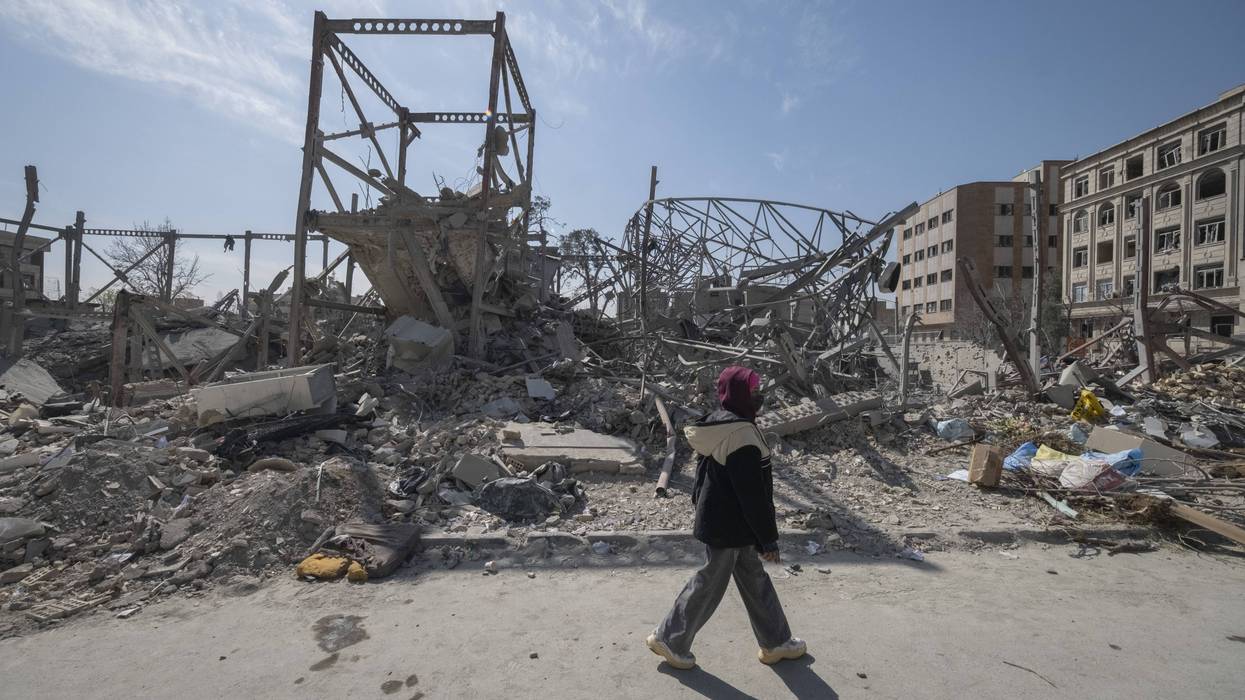
The Pennsylvania Democrat "and his GOP colleagues now share ownership of Trump's stupid, unpopular, unjustified, and already tragic war—and the fallout," said Indivisible.
Democratic US Sen. John Fetterman of Pennsylvania voted with nearly every Senate Republican on Wednesday to block a war powers resolution intended to halt President Donald Trump and Israeli Prime Minister Benjamin Netanyahu's war on Iran.
Only Sen. Rand Paul (R-Ky.), who co-sponsored S.J.Res.104 with Sen. Tim Kaine (D-Va.), joined Democrats for the 47-53 vote on the motion to discharge the measure, which would direct the removal of US armed forces from hostilities with Iran.
"This is shameful," declared the anti-war group CodePink, calling out the senators who voted to let the war continue. "The blood is on their hands."
The grassroots group Indivisible similarly said that Fetterman "and his GOP colleagues now share ownership of Trump's stupid, unpopular, unjustified, and already tragic war—and the fallout."
So far, over 1,000 people have been killed in Iran—including around 175 in an attack on a girls' elementary school in Minab—according to the Iranian government, and six US service members are dead.
Cavan Kharrazian, senior policy adviser at the group Demand Progress, said in a statement that "the American people will remember who voted to continue an illegal, unnecessary war. Every senator who voted against the war powers resolution also voted against the wishes of the American people and against the safety of the service members they are sworn to protect."
"The stakes are clear, and there is no more time for political games," Kharrazian continued. "We cannot accept anything except full opposition to Trump's war. This means no votes to authorize it for any period of time and no votes for spending a single penny on it."
The vote came after Senate Democrats left a Tuesday night classified briefing even more concerned that the US-Israeli war on Iran will involve a ground invasion and drag on "forever." The Pentagon is reportedly planning to seek around $50 billion to fund the war, which has not been authorized by Congress and has been widely condemned as illegal under international law.
In the lead-up to the vote, Senate Minority Leader Chuck Schumer (D-NY) had urged Democrats and Republicans alike to "stand with the American people who are tired of war in the Middle East" and "act to stop Trump’s belligerence" by voting "yes."
Pointing to US Defense Secretary Pete Hegseth's Wednesday morning press conference, during which he suggested the war could last at least eight weeks, Schumer said that "one thing is crystal clear: America is at war with no plan, no strategy."
Schumer—who has faced criticism for not leading a strong enough opposition to Trump in general—continued:
In his own words, Hegseth said, "We are just getting started." Hegseth says, "We are accelerating, not decelerating." And in the wake of six brave Americans who died in uniform, Trump simply says: "There will likely be more. That's the way it is." This, my colleagues, is madness. Americans spent the last two decades fighting and dying in the Middle East. Parents watched their kids shipped off to foreign lands.
So many lives lost. So many billions wasted. So much suffering and anguish that scarred an entire generation. Why is Donald Trump hellbent on making history repeat itself? Why is he plunging America headfirst into a war that Americans do not want, and which he cannot even explain? Enough is enough. The American people deserve a say. And that is what our resolution is about.
As the voting got underway, Dylan Williams, vice president for government affairs at the Center for International Policy, a Washington, DC-based think tank, highlighted on social media that "Democrats are at their desks, while the Republican side is empty. The message is unmistakable. For Democrats this is a solemn moment. For Republicans it's just another vote."
The Senate blocked Kaine and Paul's measure from advancing to a final vote as the US House of Representatives on Wednesday debated H.Con.Res.38, a war powers resolution led by Reps. Thomas Massie (R-Ky.) and Ro Khanna (D-Calif.).
"The Constitution entrusts Congress to declare war—not the president," noted Alix Fraser, vice president of advocacy at Issue One. "Today's Senate vote on Sens. Tim Kaine's and Rand Paul's war powers resolution is the first step in setting a precedent to reclaim war powers from the president. We thank Kaine and Paul for bringing this resolution to the floor in a bipartisan manner and Paul for his bravery in standing up and exercising Congress' Article I responsibilities."
"War puts the lives of American military personnel at risk, and the potential economic fallout is massive. The disruption of energy supply chains risks raising the price of everything from fuel to food for everyday Americans. This is why the representatives of we the people must make this decision," he continued. "We hope that tomorrow, the House will follow the Senate's lead and vote on a war powers resolution. Even if the House votes down a war powers resolution like the Senate, this will be an important step in reclaiming our experiment in self-government that our founders intended."
Promoting the We the People Playbook crafted by his and other groups, Fraser stressed that "it is clear that more must be done to ensure that Congress plays its constitutional role. In two months, President Trump has started military conflicts in Iran and Venezuela without congressional approval, and it seems likely he will continue this course unless Congress steps up and reasserts its power."

The survey found Platner with a 33-point lead among independent voters.
The Pan Atlantic Research poll from December was something of an outlier survey in the Maine Senate race, finding that Democratic Gov. Janet Mills was leading progressive combat veteran Graham Platner by 10 points while a number of other polls at the time had Platner, a political newcomer, in the lead.
But on Wednesday, the research firm released its latest survey results after speaking with a random sampling of 1,120 Mainers again between February 13 and March 2. It found that respondents now more closely matched the findings of other polls, with Platner leading Mills by seven points ahead of the June Democratic primary.
Platner had the support of 46% of respondents, up nine points since December, while the governor polled at 39%, down eight points.
Voters ages 18-34 overwhelmingly support Platner, according to the new poll, with 61% backing him compared to 45% supporting Mills. Independent voters also expressed more support for the progressive candidate, by a 33-point margin.
Platner had more support among voters who earn less than $50,000 per year, with 43% supporting him and 41% backing Mills, and significantly more support among voters who make $100,000 per year or more, while Mills was one point ahead among middle-income voters.
The poll also asked respondents who they would support in the general election in potential matchups between the two Democratic candidates and Sen. Susan Collins (R-Maine). Collins and Mills were tied at 44% each, while Platner was ahead of the longtime Republican lawmaker by four points.
The survey also found that Platner—who has been holding packed campaign events across the state, supports Medicare for All and a billionaire minimum tax, and has loudly condemned the Trump administration's attacks on Venezuela and Iran—is the second-most popular politician in the state, after Sen. Angus King (I-Maine).
Pan Atlantic Research released the poll days after a University of New Hampshire survey found Platner ahead of Mills by 38 points in the primary and with an 11-point lead over Collins; Mills was found to be just one point ahead of the Republican.
Platner's support has steadily risen since he announced his candidacy last August. He was endorsed early on by US Sen. Bernie Sanders (I-Vt.) and has spoken out frequently against oligarchy, US support for Israel's assault on Gaza, Republican attacks on transgender rights, and President Donald Trump's deployment of US Immigration and Customs Enforcement agents in Maine and elsewhere.
Controversies that broke soon after Mills entered the race—at the behest of Senate Minority Leader Chuck Schumer (D-NY)—regarding a tattoo Platner had that resembled a Nazi symbol and posts he had written on Reddit years ago, have done little to dent the candidate's lead in polls.
Earlier this week he won his second endorsement from a US senator when Sen. Ruben Gallego (D-Ariz.) announced his support, and as the latest poll was released Wednesday, Democratic Maine gubernatorial candidate Troy Jackson offered his endorsement.
"I'm sick to death of the establishment telling us what we have to do," said Jackson, who has also been endorsed by Sanders. "And until we elect people like Graham Platner up and down this state, up and down this country, we're never going to change it."

"Instead of helping, Trump made the largest healthcare cuts in American history and doubled down on his costly tariff taxes," said Rep. Brendon Boyle.
Even as President Donald Trump has declared that the US is in a "golden age" with the "greatest" economy on record, the Wall Street Journal reported on Wednesday that a record number of US workers are dipping into their retirement savings.
The Journal cited recent data from Vanguard Group showing that 6% of the 401(k) plans it administers took a hardship withdrawal in 2025, up from 4.8% that took such a withdrawal in 2024.
The top reasons for such withdrawals last year were avoiding eviction or paying off medical expenses, according to Vanguard.
The Journal noted that the Vanguard data about hardship withdrawals comes as "more Americans are falling behind on debt payments, including on some types of mortgages, putting them at risk of foreclosure," and "the average income of clients seeking help from credit-counseling agencies is rising."
Some Democrats quickly pounced on the Journal report, which they said undercut Trump's rosy assessment of the US economy.
"Record numbers of Americans are raiding their 401(k)s to avoid eviction or pay medical bills," wrote Rep. Mike Levin (D-Calif.). "That's not winning."
Rep. Brendan Boyle (D-Pa.) pointed to the Journal report and accused Trump and the GOP of exacerbating these problems with the cuts to Medicaid contained in the One Big Beautiful Bill Act that the party passed in 2025.
"A record number of Americans are dipping into their retirement savings just to stay afloat," wrote Boyle, the ranking member of the House Budget Committee. "A leading cause: Skyrocketing healthcare costs. Instead of helping, Trump made the largest healthcare cuts in American history and doubled down on his costly tariff taxes."
Senate Minority Leader Chuck Schumer (D-NY) responded to the report by saying, "This is not the golden age Donald Trump promised."
Andrew Bates, former senior deputy press secretary for President Joe Biden, also pointed to the GOP budget law as a key reasons for Americans' deteriorating financial security.
"The GOP in Washington makes the biggest healthcare and energy cuts in history, just to lower taxes for the rich," he wrote. "'Golden Age' for Jeffrey Epstein’s surviving friends, shittiness for everyone else."
Ann Larson, co-founder of Debt Collective, noted that while the data on 401(k) withdrawals is disturbing, it doesn't tell the whole story of the dire overall state of Americans' finances.
"This is bad, but add in the almost half of older Americans who have ZERO retirement savings to pull from," Larson wrote, "and the picture is even more horrifying."

As it pushes further into Lebanon, Israel ordered around 200,000 people living south of the Litani River to "immediately" flee.
Israel ordered residents in southern Lebanon to "immediately" leave their homes as it advanced troops further into the country on Wednesday, prompting "serious concern" from the United Nations as its assault on the country ramps up.
"Residents of southern Lebanon—you must move immediately to areas north of the Litani River," Israeli military spokesperson Avichay Adraee posted in Arabic on X as Israel escalated a campaign of airstrikes and moved troops into several villages.
The region south of the Litani River spans hundreds of square kilometers and makes up about 9% of Lebanon's total territory, according to the Associated Press.
Around 200,000 people live in the area south of the river, which has served as the beginning of a buffer zone between Israel and Hezbollah since Israel's withdrawal from Lebanon in 2006 as part of United Nations Resolution 1701.
On Monday, Israel's Defense Minister Israel Katz said that he and Prime Minister Benjamin Netanyahu "have approved for the military to advance and seize additional controlling areas in Lebanon and to defend the border settlements from there."
According to Nora Ingdal, Save the Children’s Country Director for Lebanon, evacuation orders given by Israel as it entered villages in the past three days have created a situation of "pure chaos" for civilians forced to flee their homes.
Lebanon's Ministry of Social Affairs reported that about 58,000 people, including an estimated 16,000 children, had already been displaced as of Tuesday.
"Our team is hearing cases of children across Lebanon sleeping in cars, on cold pavements, and in partially damaged classrooms with cracks in the walls, while parents are sitting on the side of the streets crying, exhausted from little sleep after being unable to get into proper shelters with their children," Ingdal said.
Sana Kawtharani, a community health educator for Doctors Without Borders, described the impossible choice that over 12,000 people had to make after being ordered to leave the town of Sarafand on Tuesday, after having sought shelter there earlier.
"We know how hard it is to leave our home, our people, our villages, and our memories," Kawtharani said. "Around us in the neighborhood, some were forced to leave because they have children and elderly who are terrified by the sound of Israeli shelling."
"They carried what they could and left in cars, not knowing where they were going," she said. "There are children, the elderly, and the sick stuck on the road in very harsh conditions."
Israeli attacks in Lebanon since 2023 have killed more than 4,000 people and injured more than 16,000, according to the Lebanese health ministry, which says most of the victims have been civilians. More than 370 have been killed since a ceasefire in November 2024.
"This war began 15 months ago, and until today, it hasn't stopped," Kawtharani said. "Every day there is shelling, despite everything we hear about a ceasefire, but this has not been implemented on the ground."
Israel’s evacuation order for all of southern Lebanon came following an intensification of airstrikes overnight around Beirut the previous evening, which killed at least 12 people according to state media.
On Tuesday, Israel also reportedly carried out another "double-tap" strike in the Tyre district of southern Lebanon, killing three paramedics with the World Health Organization (WHO) and injuring six more who were in the process of helping others wounded in a previous strike.
Though Lebanon was already being struck by Israel on a near-daily basis despite the 2024 ceasefire, hostilities exploded over the weekend following Israel and the United States' attack on Iran, sparking retaliatory strikes on Israel from the Iranian-aligned militia Hezbollah.
According to Middle East Eye, Israel had authorized a barrage of strikes on Lebanon even before the first retaliatory rockets and drones were fired by Hezbollah following the killing of Iranian Supreme Leader Ayatollah Ali Khamenei on Saturday.
Israel has not reported any deaths from Hezbollah's attacks, though two soldiers sustained moderate injuries on Wednesday from anti-tank fire in southern Lebanon.
According to Lebanese authorities, Israeli strikes on dozens of sites across the country have killed at least 72 people and wounded 437 as of Wednesday.
Lebanese media reported on Wednesday that Israeli troops have pushed into the town of Khiam, which is roughly six kilometers from Israel’s border, marking their furthest advance into the country since the war broke out in 2024.
The United Nations Interim Force in Lebanon (UNIFIL), the peacekeeping force that has operated in southern Lebanon for nearly 50 years, said on Wednesday that it had “serious concern” about Israel’s order “demanding evacuation of the civilian population from UNIFIL’s area of operations to north of the Litani River.”
UNIFIL said on Wednesday that “peacekeepers observed today several [Israel Defense Forces] movements and military activities, including near El Khiam, Beit Lif, Yaroun, Houla, Kfar Kila, Kherbeh, and Kfar Shouba. All of these are happening while Israeli airstrikes and other air activities continue.”
It said these actions "not only violate Resolution 1701, but also Lebanon’s sovereignty and territorial integrity."