

SUBSCRIBE TO OUR FREE NEWSLETTER
Daily news & progressive opinion—funded by the people, not the corporations—delivered straight to your inbox.
5
#000000
#FFFFFF
To donate by check, phone, or other method, see our More Ways to Give page.
Daily news & progressive opinion—funded by the people, not the corporations—delivered straight to your inbox.
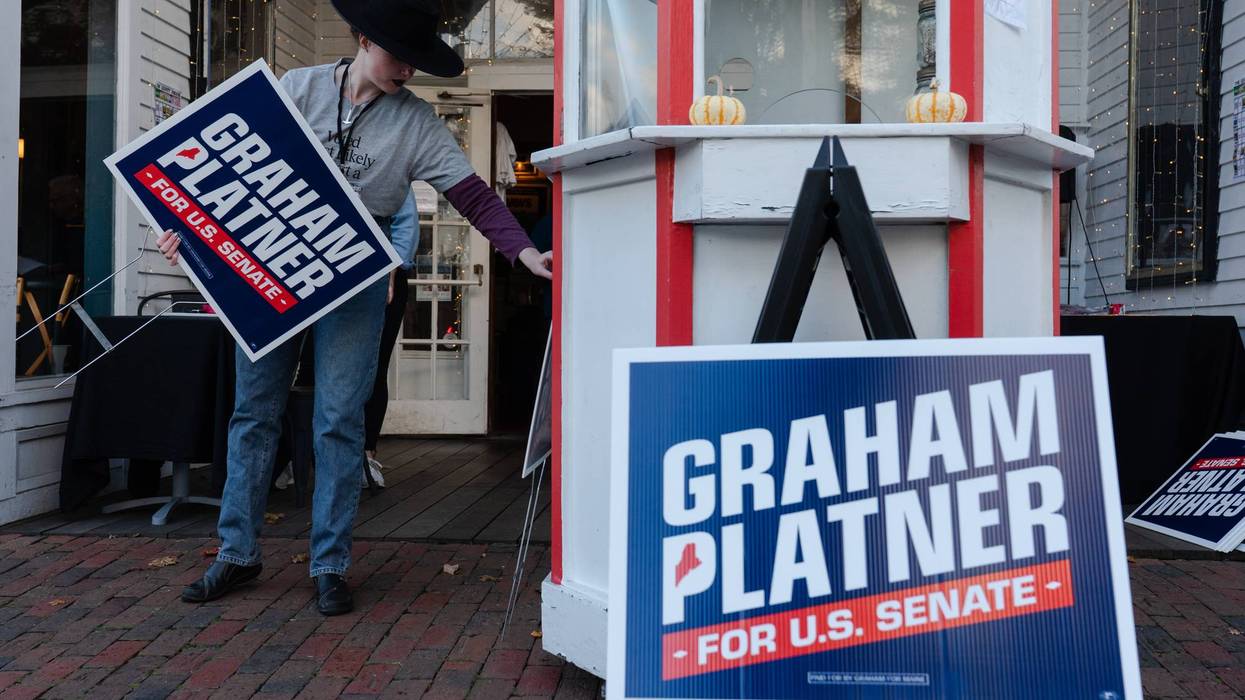
“If the party’s selected nominee does not publicly adopt this platform... this statewide volunteer network will not organize, fundraise, or mobilize on that candidate’s behalf."
As Graham Platner officially ended his US Senate campaign in Maine Friday after being accused of sexual assault and other misconduct, the volunteer network powering his campaign warned that it will not support any new Democratic nominee who does not align with the disgraced democratic socialist's progressive platform.
Platner notified the Maine Secretary of State's office that he is formally withdrawing his candidacy, just a month and a day after winning the Democratic Senate Primary.
The Secretary of State's office subsequently said that Platner's name will no longer appear on the ballot, and that his party has until July 27 to replace him with a qualified candidate.
Also on Friday, Drop Site News obtained a draft letter from the 15,000-strong volunteer network that was instrumental to Platner's erstwhile success, presenting the Maine Democratic Party and prospective candidates with policy platform demands including “healthcare as a right, housing affordability, an economy that works for regular people and not billionaires, strengthening workers and unions, end forever wars, oppose complicity in atrocities, an end to mass deportation enforcement, energy and climate accountability, and human rights for all.”
“The volunteer infrastructure that this movement built—the organizers, door-knockers, the small-dollar donors, the hosts, the people who make phone calls and staff tables between now and November—does not transfer automatically to whoever the party selects," the letter warns. "That infrastructure exists because people believe in a specific platform. It will only continue to exist and only continue to be deployed for a nominee who publicly and explicitly adopts these core commitments as their own." (emphasis original)
“If the party’s selected nominee does not publicly adopt this platform, we want to be transparent now, before the convention, rather than silent until after it: This statewide volunteer network will not organize, fundraise, or mobilize on that candidate’s behalf," the letter continues, adding, “that is not a threat, but rather a statement of fact about what motivates the people who make up this movement.”
As Drop Site noted:
The Maine Democratic Party’s 100-person state committee voted to approve a process by which 600 delegates, 500 county committee elected delegates, and the 100 state committee members themselves will select the new nominee from a slate of candidates vying to replace Platner. Troy Jackson, Shenna Bellows, Nirav Shah, Dan Kleban, Jordan Wood, and Vallie Geiger are running for the spot. All the candidates lost their respective Democratic gubernatorial and congressional primaries in June, aside from Geiger, who serves as a state representative for the Rockland area.
Drop Site obtained private Maine Democratic Party information showing that the 500 delegates will be proportionally appointed based on 2024 election Democratic vote totals in their respective counties. How those 500 delegates will be elected is still under debate.
Ben Chin, who managed Platner's campaign, on Wednesday accused the Maine Democratic Party of working "behind closed doors" with national party leaders to choose a replacement candidate.
"Both the state and national parties cut our team, our volunteers, and our vast networks of supporters out of the conversation completely," Chin alleged in a text to supporters. “We firmly believe that the supporters and volunteers who built this movement deserve to have a real role in any nomination process."

Because of Morris Katz and Chuck Schumer's failures, we're left with a broken Maine Democratic Party now scrambling to find a replacement for Graham Platner in less than two weeks.
The Maine Senate race may be the most consequential in the country. If Susan "Kavanaugh promised me he wouldn't overturn Roe v Wade" Collins is reelected to the Senate, it may guarantee a small Republican Senate majority that will approve young extremist right-wing Supreme Court Justices to replace Samuel Alito and Clarence Thomas and control the law for the next 30-40 years.
But young "progressive" Democratic consultants like Morris Katz and old "moderate" Democratic politicians like Sen. Chuck Schumer (NY) may have collectively f**cked up the process.
Graham Platner was recruited to run with minimal vetting by Katz, a 20-something political consultant from Tribeca who produces brilliant campaign ads. Chuck Schumer used his political muscle to ensure that 78-year old Maine Gov. Janet Mills would be the other contender in the Democratic primary. After Platner took a commanding lead in the polls, Mills dropped out, virtually assuring that Platner would be the then-likely nominee.
Katz is a 26-year old (or maybe 28-year-old since he previously lied about his age)) who grew up in a Tribeca to family of writers and film producers. Katz produced a series of brilliant ads for Mandami that help propel him to the NY mayoralty. Katz had previously produced ads for Democrat John Fetterman's (Pa.) successful Senate campaign depicting Fetterman as a populist working class hero, although once in the Senate Fetterman turned Republican-lite.
But Chuck Schumer is even worse. His anointing of Janet Mills as the party-approved candidate was as disastrous as Katz's anointing of Platner as the working class progressive hero.
Last autumn Katz formed a Brooklyn-based political consulting firm, The Fight Agency. Based on Mandami's success, Katz seemed to have decided that he himself was the singularly best person in the entire country to "cast" progressives to successfully win office.
Katz focused much of his efforts on recruiting a progressive working class candidate who he believed could defeat Susan Collins in Maine. He was tipped off to Platner by some labor organizers and traveled to Maine to meet him. “Within a few minutes of talking to him, I was, like, ‘This guy owes it to the country to run for Senate'" Katz recalled of his first meeting with Platner.
Platner fit Katz's script for a rough working class guy with progressive politics, and he virtually immediately cast Platner as his leading man. Katz and his partners didn't bother to vet Platner, a process that takes several weeks and costs over $20,000. In three days, New York-based Northside Research was paid $6,250 to produce a brief, risk-assessment memo in lieu of a detailed research book—or the start of one—that can be hundreds of pages long. According to The Wall Street Journal, "The expedited research didn’t discover issues that would later hurt his campaign, including the full trove of Platner’s Reddit posts or sexually explicit texts Platner sent to other women while married."
Less than two weeks later, Platner released a brilliant populist launch video produced by Katz that went viral and catapulted Platner into prominence. He drew adoring crowds, and his polling showed him overwhelming Gov. Janet Mills in the primaries.
But while concerning revelations about Platner's personal life kept dripping out, Platner's consultants brushed them off arguing they were irrelevant compared with Platner's charisma and his populist politics. As Slate reported: "Each time a new and disturbing Platner story landed—the Reddit posts, the tattoo, the alleged physical abuse, the sexting, the rape allegation—Platner’s team responded with an almost Trumpian playbook. They disparaged the media, played it off as a targeted attack by a vengeful political establishment, and insinuated that each scandal only made Platner more authentically Maine."
I'm generally in agreement with the populist anti-oligarchy themes of Platner's campaign and those of his progressive consultants (and even sent him a contribution). But they were immature and deluded to not vet Platner and to cavalierly dismiss the charges against him. The unvetted revelations about Platner's abusive treatment of women eventually doomed Platner's campaign.
Adam Jentleson, the late Democratic Senate Majority Leader Harry Reid's former chief of staff, characterizes Katz's view of the ideal progressive candidate as "a highly selective image of populism that is tailored to an Upper West Sider’s political sensibilities.”
Katz grew up in Tribeca. His father is a successful screenwriter, his mother is a successful children's book author, and his godfather was the late actor Philip Seymour Hoffman. After dropping out of college, he worked as a production assistant and wrote screenplays, before entering politics.
That's a good background for learning progressive politics but not necessarily one to designate yourself as the leading casting director for progressive candidates with a working class background. This failure was demonstrated by his casting of the unvetted Platner and of John Fetterman who turned into a corporate Democrat.
But Chuck Schumer is even worse. His anointing of Janet Mills as the party-approved candidate was as disastrous as Katz's anointing of Platner as the working class progressive hero.
Because of both of their failures, we're left with a broken Maine Democratic Party now scrambling to find a replacement for Platner in less than two weeks. Let's hope it doesn't lead to Collins being returned to the Senate and helping confirm right-wing Supreme Court justices who could shape the law for decades to come.

"We may both be from Aroostook County, but we’re not the same," Jackson said of Republican Sen. Susan Collins.
Troy Jackson, a fifth-generation logger from northern Maine who previously served as the state's Senate president, is making the case that he has the best shot at unseating Republican Sen. Susan Collins in November following Graham Platner's exit from the race on Wednesday.
"There is a powerful movement of working class people in the state of Maine, and millions more across America who are ready to send a progressive fighter to the Senate," Jackson wrote in a social media post on Wednesday, formally announcing his Senate run. "I’ve been fighting for that movement my whole life—and I’m sure as hell not backing down now, when this fight is needed most."
"I’m in," he added. "And we're going to defeat Susan Collins. Maine deserves a senator that will fight for working families."
Jackson, who filed federal paperwork earlier this week to explore a US Senate bid as the Maine Democratic Party scrambled to construct a process to choose Platner's replacement ahead of the July 27 deadline, recently fell short in a highly competitive race for the Maine Democratic Party's gubernatorial nomination.
But those who are rallying behind Jackson argue his economic populist messaging, union backing, support for Medicare for All, and appeal across broad swaths of Maine—including rural counties—make him the most sensible choice to take on Collins, who is running for a sixth term in the US Senate.
"Troy has spent his life fighting for working people," said the national progressive advocacy group Our Revolution, which rescinded its endorsement of Platner following the sexual assault allegation against him, which he denied.
Our Revolution noted that Jackson led Sen. Bernie Sanders’ (I-Vt.) presidential campaigns in Maine in both 2016 and 2020. Jackson also appeared alongside Sanders and Platner at "Fighting Oligarchy" rallies during his gubernatorial bid.
"Long before this Senate seat became available, Troy had built a record of standing with workers, unions, and rural communities across Maine," said Our Revolution, which announced Wednesday that it is mobilizing volunteers across Maine to "ensure voters are represented by a candidate who reflects the agenda they overwhelmingly supported" during the Democratic primary process—a contest that Platner won handily.
I’ll be a vote for Medicare For All in the U.S. Senate.
Susan Collins, on the other hand, recently helped advance $990 billion in Medicaid cuts so the richest Americans could get another tax break.
We may both be from Aroostook County, but we’re not the same.
— Troy Jackson (@TroyJackson207) July 9, 2026
Jackson is one of several Democrats jumping at the opportunity to challenge Collins, who has enabled President Donald Trump's destructive legislative agenda and helped pave the way for the gutting of reproductive rights nationwide.
Nirav Shah, former director of the Maine Center for Disease Control and Prevention, formally announced on Thursday that he is launching a bid to replace Platner. Shenna Bellows, Maine's secretary of state, said Tuesday that she is "seriously considering" entering the Senate race. (Like Jackson, both Shah and Bellows unsuccessfully ran for Maine's Democratic gubernatorial nomination.)
A flash poll commissioned by the Platner campaign earlier this week found that Jackson performed better than Shah and Bellows in hypothetical match-ups against Collins.
Christine Kirby, a spokeswoman for Jackson, told Drop Site on Tuesday that since the sexual assault allegation against Platner was made public, Jackson's team has received a torrent of calls and messages urging him to run for the Senate nomination.
“He is clearly the strongest option to replace Graham Platner and take on Susan Collins in the general election,” said Kirby. “This movement is greater than any one person, it’s about a coalition of Maine people fighting for a future that doesn’t have to belong only to the wealthy and powerful. And Troy is up for the fight.”

Graham Platner said the process to replace him "needs to be reflecting the will and the values of the people that built this movement."
Graham Platner suspended his US Senate campaign in Maine late Wednesday in the wake of a sexual assault allegation, saying in a defiant video statement that the Democratic establishment used the accusation to force him from the race against five-term Republican Sen. Susan Collins.
Platner, who won last month's Democratic Senate primary in Maine following Gov. Janet Mills' exit from the race, said the sexual assault allegation was "very serious" and "false." But, he said, the "structural pressure" imposed by the "political establishment" and "corporate media system" made it impossible for him to continue campaigning in any serious way.
"We are going to lose our ability to fundraise," said Platner, whose campaign reportedly had under $100,000 in cash available to spend when he decided to halt his Senate bid. "We are going to lose our ability to access voter data. We are going to lose all of the things that any campaign needs on the basic level simply to function. Larger organizations, the national party, the bigger donor networks, they have all committed to spending no money in this race if I'm in it."
Platner said that "now the ball is in the court of the Democratic establishment," which he pushed to implement an "open, transparent, and democratic" process to choose his replacement. He said he would not try to "dictate to anyone" who the replacement should be.
"It needs to be reflecting the will and the values of the people that built this movement, the people that showed up on June 9th. People in DC need to stay in DC," said Platner. "Decisions should not be made in back rooms by people in places of political power. Party apparatchiks are not the ones to make these decisions. These decisions need to be made in the open by the people of this state."
Watch Platner's full remarks:
My name might be on the ballot right now, but that ballot line belongs to the people of Maine. pic.twitter.com/RKVyLU76tm
— Graham Platner for Senate (@grahamformaine) July 9, 2026
Shortly before Platner released his video message, the top officials at the Maine Democratic Party issued a statement announcing that the party on Wednesday had hosted "a meeting with over 100 state committee members who voted to hold a nominating convention to choose a new nominee."
"We will announce the full timeline, details for how the nomination process will move forward, information about how to participate, and requirements for candidates soon. We will keep the public informed throughout the process—transparency is of the utmost importance," said Maine Democrats' chair, vice chair, and executive director. "There is an unprecedented amount of energy and enthusiasm among Maine Democrats, driven in part by many of the dedicated volunteers and supporters who were inspired by Graham Platner’s campaign. We look forward to coming together and harnessing that energy around our new nominee as we work to defeat Susan Collins in November."
Bangor Daily News reported that the convention approved by the Maine Democratic Party's state committee "would include 500 delegates elected proportionally by county committees, along with the entire state committee." Some reports indicated that county caucuses would be held to elect delegates to attend the convention, but Maine Democratic officials have not yet disclosed full details.
Progressive strategist Andrew Feldman warned that it would be "extremely challenging to pick a new nominee through a convention, not an open caucus, and create the energy needed to win."
"Let's not kid ourselves," he added.
Several prominent Maine Democrats—including former state Senate President Troy Jackson, Maine Secretary of State Shenna Bellows, and former Maine CDC director Nirav Shah—have expressed interest in replacing Platner.
Joseph Geevarghese, executive director of the national progressive advocacy group Our Revolution, said Platner "made the right decision to step aside" but added that "this is not the Democratic establishment's opening to hand-pick a replacement." The group, which rescinded its endorsement of Platner following the sexual assault allegation, is now backing Jackson—who performed best against Collins in new polling commissioned by Platner's campaign.
"Maine's progressives won the primary by a historic margin, on Medicare for All, on ending corporate money in politics, on ending forever wars. That result doesn't disappear because one candidate is gone," said Geevarghese. "That is why we are rallying behind Troy Jackson. He is a logger, a union leader, and former President of the Maine State Senate. He led Bernie Sanders' presidential campaigns in Maine twice."
"Maine Democrats have days, not weeks, to decide whether the convention reflects what voters already said on June 9, or whether the party hands this seat to an insider pick after just watching that lane lose," he added. "To the establishment: This is not your opening. The people who won this primary get to decide what comes next, not the party insiders who already lost it."

"We firmly believe that the supporters and volunteers who built this movement deserve to have a real role in any nomination process," said Graham Platner's campaign manager.
Graham Platner's campaign manager on Wednesday accused the Maine Democratic Party of coordinating with national Democrats "behind closed doors" and cutting the embattled US Senate nominee's supporters out of the process to determine his potential replacement in the wake of a sexual assault allegation—and amid expectations that he will soon drop out of the race.
In a text message sent to Platner supporters, campaign chief Ben Chin wrote that the Maine Democratic Party "allowed the DC-based Democratic Senatorial Campaign Committee to send staffers to plan a potential nominating process behind closed doors. Both the state and national parties cut our team, our volunteers, and our vast networks of supporters out of the conversation completely."
"We firmly believe that the supporters and volunteers who built this movement deserve to have a real role in any nomination process," Chin's message continued. "If the Maine Democratic Party hopes to harness our movement, and avoid disillusioning the hundreds of thousands of supporters who came into the fray because of our movement’s policies, it must consult the feedback and proposals of the people who built and sustained this."
The text included a link to a two-question survey asking Platner volunteers, "What message do you have for the Democratic Party?" and, "What message do you have for Graham?"
The defiant message came as Platner's campaign was reportedly planning the nominee's exit from the US Senate race to pave the way for a different Democratic candidate to take on five-term Sen. Susan Collins (R-Maine) in November. Platner has denied the sexual assault allegation that prompted mass calls for him to exit the race, including from his most prominent supporters such as Sen. Bernie Sanders (I-Vt.).
Chin's text message was circulated a day after Devon Murphy-Anderson, the Maine Democratic Party's executive director, said in a video posted to social media that the party has been "working around the clock" to develop a plan to replace Platner that is "open, inclusive, transparent, and fair." The party has not yet publicly specified what that plan could entail, saying Platner must formally withdraw from the race first.
Murphy-Anderson accused Platner's team of "repeatedly reach[ing] out" to the Maine Democratic Party "in an attempt to put their thumb on the scale of what this process looks like."
"We have repeatedly reiterated to Graham Platner's team that they have no role in determining our next Democratic nominee for the US Senate," Murphy-Anderson added.
In response to Murphy-Anderson's statement, the Platner campaign denied that it has attempted to exert influence over the replacement process, saying it simply "reached out to the party to try and understand what this process would look like."
"Over 150,000 Mainers voted for this movement, and over 15,000 Mainers volunteered their time and energy to it," an unnamed Platner campaign official told NBC News late Tuesday. "While Graham wouldn't want to be a part of the process, he would want to make sure the voters and volunteers make this decision—not the political establishment."
On Wednesday, the Maine Democratic Party issued a new statement decrying what it called the Platner team's "false accusations against us" while also expressing gratitude for "his supporters and all of their efforts to defeat Susan Collins."
"They are a vital part of our party and deserve to participate in an open process to select Platner’s replacement," said Maine Democrats.
CNN reported that Platner is "expected to announce his decision" on his candidacy "through a recorded video, which could come later Wednesday."
Platner must drop out of the race by July 13 if he's to be replaced on the November ballot. If he exits the race, an alternative must be selected by July 27.
Politico reported that Platner "quietly fielded a poll Tuesday gauging the strength of people who could replace him on the ballot."
"The flash poll, obtained by Politico, was conducted by Public Policy Polling and commissioned by Platner’s campaign," the outlet reported. "It tested head-to-head match-ups between Republican Sen. Susan Collins and Platner, along with five possible Democratic replacements for Platner, including former Maine state Senate President Troy Jackson and Secretary of State Shenna Bellows."
"Of the Democrats tested, Jackson performed the best, leading Collins 49% to 44%, with 7% of voters undecided," Politico reported. The outlet also noted that the poll, conducted the day after the sexual assault allegation against Platner was first reported by Politico, showed Platner trailing Collins 47% to 42%.
Jackson has filed paperwork to explore a Senate bid in preparation for Platner's expected exit, and Bellows—who lost badly to Collins in 2014—has said she would "seriously consider entering this race." Nirav Shah, former director of the Maine Center for Disease Control and Prevention, is also weighing a Senate bid.
"If Graham’s stepping away, I am very, very interested and think I’m the best person to replace him," said Jackson, the former Maine Senate president.
Former Maine Senate President Troy Jackson filed federal paperwork on Tuesday to explore a US Senate bid after a sexual assault allegation against current Democratic nominee Graham Platner prompted a torrent of calls for him to drop out of the race.
Jackson, a fifth-generation logger who lost Maine's Democratic gubernatorial primary last month, was among those urging Platner to end his Senate campaign following Politico's reporting late Monday, writing on social media that "there is no place in our politics for sexual violence."
In an interview with the Bangor Daily News, which first reported the news of Jackson's filing, the former gubernatorial candidate said that "if Graham’s stepping away, I am very, very interested and think I’m the best person to replace him.”
Platner denied the sexual assault allegation and, as of this writing, has yet to drop out of the race, though his departure is widely seen as a foregone conclusion as his most prominent supporters—including Sen. Bernie Sanders (I-Vt.)—push him to exit. One unnamed source told The New York Times that Platner is seeking a "guarantee" that he "would be replaced by someone in agreement with 'the values and vision and policy agenda'" that he articulated throughout his campaign.
Jackson, like Platner, was endorsed by Sanders and has expressed support for Medicare for All, stronger union protections, wage increases, and other progressive priorities. In recent months, Jackson has joined Sanders and Platner at "Fighting Oligarchy" rallies where the former Maine Senate leader said American workers are being robbed by a billionaire class bent on enriching itself no matter the societal costs.
"I am running for the people who worked their entire lives and still can’t afford to retire because the economic system in this country is rigged against them," Jackson said during a Labor Day rally last year. "And I’m running for all the workers... who’ve been told that they’re replaceable and that their lives are disposable.”
Platner, who backed Jackson's gubernatorial bid, can be replaced as the Democratic nominee in the US Senate race against Republican incumbent Sen. Susan Collins if he withdraws by July 13. By a process yet to be determined, the Maine Democratic Party would have until July 27 to select a replacement.
The New York Times reported that "the options under discussion include a convention or a statewide caucus in late July."

The senator said he spoke with the Democratic candidate "about the best path forward for Maine" and recommended that he leave the race.
US Sen. Bernie Sanders, among the earliest and most prominent congressional backers of Graham Platner's campaign to unseat Republican Sen. Susan Collins, has joined growing calls for the Maine Democrat to exit the race following sexual assault allegations.
"I have spoken with Graham Platner about the best path forward for Maine," Sanders (I-Vt.) said in a Tuesday statement. "In light of these very serious allegations, I have recommended that he step aside."
Jenny Racicot initially told The New York Times that Platner's behavior was "reckless" and "unsettling" during their on-and-off relationship in 2019-21, and that she cut off contact after he came to her Maine home drunk despite being told not to around five years ago. Politico reported Monday afternoon that the 41-year-old said he sexually assaulted her that night. Later Monday, Racicot appeared on CNN and said he "absolutely" raped her.
Platner, in a Monday video, denied "any accusation of nonconsensual behavior," but also said that his campaign was "taking the time to reflect on the best path forward" given "the political reality" resulting from the reporting—which followed other controversies, including offensive Reddit posts, a tattoo resembling a Nazi symbol, and allegations of physical aggression that he also denied.
After months of campaigning on progressive policies, the oyster farmer and combat veteran won last month's primary by over 50 points, beating Gov. Janet Mills, who remained on the ballot despite suspending her campaign in April. After Racicot's assault allegations broke, numerous groups and individuals—including other members of Congress who had endorsed Platner—called on him to immediately withdraw.
In a Tuesday statement revoking the Sierra Club's endorsement, political director Sarah Burton said that the green group's "thoughts are with Jenny Racicot for courageously sharing her story. Victims of sexual violence must be listened to and provided our caring and support. Their lives are not for political gamesmanship."
"Upholding basic standards of integrity, decency, and ethics is not a qualification to win the American electorate's trust; it is a requirement," Burton continued. "In light of yesterday's horrific and disturbing allegations, the Sierra Club has rescinded its endorsement of Graham Platner and calls on him to withdraw his candidacy.”
New York City Mayor Zohran Mamdani had not endorsed Platner, but some of his top aides played key roles in the effort to elect the Mainer. The Sanders-backed democratic socialist mayor told reporters on Tuesday that "I believe that it's time for him to drop out of the race."
According to Politico, when asked if he is concerned that the collapse of Platner's campaign could negatively impact the left more broadly, Mamdani responded, "I think the focus of today should be on the campaign coming to a close, and I think there will be many more days to have conversations about what it means beyond that."
Congressional Progressive Caucus Chair Greg Casar (D-Texas), who previously backed Platner, said late Monday that "I am horrified by the allegations against Graham Platner. He should drop out of the Senate race. Maine Democrats should replace him with an inspiring candidate who can best represent them."
Racicot told CNN and Politico that she didn't publicly accuse Platner of rape earlier in part because she agrees with his politics—and some progressives who previously supported the candidate have warned the Democratic establishment that "this is not your opening," as Our Revolution executive director Joseph Geevarghese said in a Monday statement calling for his withdrawal.
If Platner withdraws by July 13, he can be replaced on the ballot, and the Maine Democratic Party would have until July 27 to come up with a name. Already, Democrat Troy Jackson, a former Maine Senate president who campaigned for governor this cycle with Platner and Sanders, has filed paperwork.

The campaign, said one organizer, "was never really about one candidate. It was about what Mainers ultimately wanted and deserved: a Senate seat that answers to them."
As calls mounted on Monday evening for US Senate candidate Graham Platner to drop out of the race in Maine following sexual assault allegations, progressive organizers emphasized that primary voters in the state have made clear their demand for a candidate who prioritizes the needs of working people.
Should Platner be replaced as the Democratic nominee, said the political action organization Our Revolution, the new candidate must be one "who has actually lived the fight Graham Platner ran on: a record with working people, with unions, against corporate money."
"To the Democratic establishment: This is not your opening," said Joseph Geevarghese, the group's executive director. "Mainers did not vote by an overwhelming margin against Janet Mills and the [Democratic Senatorial Campaign Committee]'s handpicked pick just to be handed another status-quo candidate anyway. They deserve what they voted for... The movement will settle for nothing less, because that is what Mainers deserve."
Platner has not said whether he will end his campaign, during which he has traveled across the state and energized voters from across the political spectrum with his working-class-focused platform—one that calls for Medicare for All, a billionaire's minimum tax, a stop to "billionaires buying elections" through a repeal of Citizens United, and an end to US military aid for Israel.
In a video he posted on social media Monday in response to the allegations, which came from a woman he dated from 2019-21, he denied that he had committed sexual assault but said he was "mindful of the political reality” and that his campaign is "taking the time to reflect on the best path forward" in order to defeat five-term Republican Sen. Susan Collins. The Maine Senate race is crucial as Democrats aim to win back control of the US Senate.
An aide for Platner told The New York Times Monday evening that if he were to step aside, "it would only be with a guarantee of being replaced by a candidate who he believes is true to the values and vision and policy agenda of the campaign that Maine voted for."
Platner won the Democratic primary in June by nearly 53 points. His opponent, Gov. Janet Mills, was on the ballot despite having suspended her campaign in April, citing a lack of funds. Ahead of the primary, Platner had faced other controversies, including one regarding comments he made on Reddit several years ago; a skull-and-crossbones tattoo that resembled a Nazi symbol—a connection he said he was not aware of; and allegations of physical aggression from a GOP-affiliated ex-girlfriend.
Geevarghese said Monday that "everyone deserves a fair and open process, and Graham Platner is entitled to due process like anyone else. But the allegations against him are credible, and at this point they are too serious to treat as a distraction from the campaign or the issues. Sexual violence is a red line. We are withdrawing our endorsement and calling on him to withdraw from this race."
He emphasized that the campaign "engaged thousands of working people in Maine around a simple idea: that Maine's Senate seat should belong to its people, not corporate money."
"That was never really about one candidate," Geevarghese said. "It was about what Mainers ultimately wanted and deserved: a Senate seat that answers to them."
The sentiment was echoed by the Maine Democratic Socialists of America (DSA), which had not previously endorsed Platner.
"The power of the Platner campaign was undeniable, but that power does not come from a candidate; it comes from tens of thousands of Mainers who were inspired by his campaign's platform and urgency," said Maine DSA. "Over the last year, everyday people who had long ago written off electoral politics have shown up and worked to build power on a scale Maine has never seen before."
"Maine Democratic Party leadership has a choice: Nominate an establishment candidate who offers excuses, not answers, and ultimately loses to Susan Collins; or offer a candidate who harnesses the still-growing momentum, follows the platform that is so energizing to voters in Maine and across the country, and takes our state back for the many, not the money," said the group.
The state's Democratic candidate for governor, former state legislator Hannah Pingree, also said that Platner had "tapped into something real—voters hungry for change showed up with real passion and energy."
"That energy doesn't have to go away," said Pingree. "It needs a new candidate to carry it forward."
Under state law, Platner could be replaced on the ballot if he withdraws by July 13. The state Democratic Party would have until July 27 to name a replacement.
According to the Times, party officials in the state "have discussed possible plans to replace Mr. Platner on the ballot, with options including a pop-up convention on the weekend of July 25 to choose a nominee, or holding a statewide caucus to effectively redo the party’s primary election."
They have reportedly "ruled out having the state party’s committee, which includes about 100 members, choose the nominee."
Potential replacements who have been named include former Democratic gubernatorial candidates such as Secretary of State Shenna Bellows and former state Senate President Troy Jackson, who campaigned with Platner and was also endorsed by Sen. Bernie Sanders (I-Vt.) when he ran for governor.
Jackson told Bangor Daily News reporter Benjamin Kail late Monday that potentially having to replace Platner on the ballot was "something I never considered, but if Graham's stepping away, I am very, very interested and think I'm the best person to replace him."
He said he "received dozens of calls and messages of support" after the news broke Monday.

A Maine woman accused the Democratic US Senate candidate of drunkenly assaulting her at her home in 2021, which he denied.
US Senate candidate Graham Platner on Monday denied allegations of sexual assault, but the Maine Democrat also said his campaign is considering the "best path forward" in the wake of Politico's reporting.
Jenny Racicot told The New York Times in an article published last month that Platner's behavior was "reckless" and "unsettling" during their on-and-off relationship in 2019-21, and she cut off contact after he arrived at her Maine home drunk, despite her telling him not to come over. Politico reported Monday that the 41-year-old had told the newspaper off the record that he assaulted her.
Racicot told Politico that Platner came into her home uninvited that night and forced himself on her while she repeatedly told him to stop. She said that she was conflicted about publicly accusing him in part because she agrees with the candidate politically, but decided to speak out after much of the reaction to the Times focused on another ex with ties to the Republican Party. The outlet reviewed documents, including emails with her therapist, and spoke with sources Racicot had previously told about her experience.
In a two-minute video shared on social media Monday, Platner called Racicot's allegations "troubling, serious, and false," and said that "any accusation of nonconsensual behavior is categorically false." He also said that, "mindful of the political reality" that the reporting will inflict, "we are taking the time to reflect on the best path forward."
Platner decisively won his primary last month, after his opponent, Democratic Gov. Janet Mills, suspended her campaign in late April. The oyster farmer and combat veteran is a political newcomer who has championed progressive policies and called out the ultrarich, as well as the politicians who serve them—including longtime Republican Sen. Susan Collins, whom he's running to unseat in November.
While Platner has traveled Maine, speaking and rallying with working-class voters, he's also faced a series of controversies, including concerns over his offensive posts on Reddit, and the skull and crossbones tattoo he got with fellow Marines in Croatia, which he claimed he did not know closely resembled a Nazi symbol and got covered up during the campaign.
There was also the allegation from the GOP-affiliated ex interviewed by the Times, Lyndsey Fifield, that Platner was physically aggressive during their relationship, which he denied, and reporting that Platner's wife, Amy Gertner, told a senior campaign staffer that he had exchanged sexual messages with other women during their marriage, which Gertner responded to with a video.
In a statement to Politico on Monday, Platner's campaign pointed to previous controversies, saying:
These allegations are very serious and Graham vigorously denies them. They are also coached and coordinated by out-of-state establishment operatives. For a year, opponents of this campaign have thrown everything they can at Graham—calling him a Nazi, a war criminal, and a communist. None of it has been true, and this is no different. It is not a coincidence that this story comes a week before the ballot deadline, just as the previous false allegations came a week before the primary. Graham began this campaign to fight for a Maine where everyone is treated with dignity and where Mainers are put first, and no amount of desperate smears will stop this movement from seeing that vision through.
Following Politico's reporting, Platner has lost some key support. At least two members of Congress who backed him—Rep. Ro Khanna (D-Calif.) and Sen. Ruben Gallego (D-Ariz.)—withdrew their endorsements, and the Maine Democratic Party's chair, vice chair, and executive director issued a joint statement urging him to withdraw as the party nominee.
The US National Domestic Violence Hotline can be reached at 1-800-799-SAFE (7233), by texting "START" to 88788, or through chat at thehotline.org. It offers 24/7, free, and confidential support. DomesticShelters.org has a list of global and national resources.

"People who really, really need SNAP could potentially no longer receive it and not have a way to buy their groceries," warned one anti-hunger campaigner.
Maine taxpayers could be on the hook for around $50 million per year in spending on federal nutrition assistance under the Republican budget law that Sen. Susan Collins voted to advance as it moved through Congress last year.
The GOP law requires states to pay a portion of Supplemental Nutrition Assistance Program (SNAP) benefit costs for the first time in the program's history, starting in October 2027. The size of states' obligation will range between 5% and 15% of their benefit costs; states with higher payment error rates—which experts say largely reflect administrative mistakes rather than fraud or abuse, as the Trump administration claims—will be forced to pay a larger percentage of benefit costs.
According to the latest data from the US Department of Agriculture, Maine's SNAP payment error rate in Fiscal Year 2025 was 10.81%—just above the national average of 10.62%. Maine's error rate puts the state in the 15% category for benefit cost obligations, according to the Center on Budget and Policy Priorities (CBPP).
“It’s shocking, and it’s wildly unfair,” Anna Korsen, deputy director of the Maine-based advocacy group Full Plates Full Potential, told Maine Morning Star last week. “If the state can’t find a way to pay for these benefits, that will mean that eligible people will go hungry. People who really, really need SNAP could potentially no longer receive it and not have a way to buy their groceries.”
Facing criticism from Democratic challenger Graham Platner—whose campaign has accused Collins of siding with President Donald Trump to give "billionaires and corporations a handout paid for by cuts to Medicaid and SNAP"—the Republican incumbent has emphasized that she voted against final passage of the Republican budget package.
But last June, Collins cast what Maine Public Radio described at the time as a "pivotal vote to begin debating" the budget measure, which will cut SNAP and Medicaid by roughly $1 trillion combined over the next decade. Thousands of Mainers—and millions of people nationwide—have lost SNAP and Medicaid benefits since the Republican law's enactment last summer.
Advocates have warned that the unprecedented shift of a portion of SNAP benefit costs onto states could be devastating, potentially forcing governments to cut SNAP benefits further, slash spending on education and other priorities, or potentially end their participation in the program completely.
Democrats are working to include a provision in the annual Farm Bill that would delay the SNAP cost-shift to give states more time to prepare. Last month, as Common Dreams reported, Senate Republicans unveiled legislation that omitted Democrats' proposed delay.
CBPP estimated in a recent analysis that states "may soon face a collective bill of roughly $9 billion, threatening benefits for millions of SNAP households, 79% of which include a child, a senior, or a person with a disability, who count on SNAP to help them meet their basic needs."
"Without immediate congressional action to delay this cost shift for all states," the think tank warned, "the unfolding emergency will only worsen as more people lose the SNAP benefits they need to afford groceries."
George Kelemen, senior vice president of the national No Kid Hungry campaign, called the GOP law's cost-shift "an existential threat to our most powerful anti-hunger program."
"Most states could be forced to cut funding for SNAP or other essential services, and at least four states have said they may be unable to continue administering SNAP entirely if this benefit cost shift goes into effect," Kelemen said last month. "This means millions of eligible kids and their families will lose access to vital grocery benefits."