SUBSCRIBE TO OUR FREE NEWSLETTER
Daily news & progressive opinion—funded by the people, not the corporations—delivered straight to your inbox.
5
#000000
#FFFFFF
To donate by check, phone, or other method, see our More Ways to Give page.
Daily news & progressive opinion—funded by the people, not the corporations—delivered straight to your inbox.
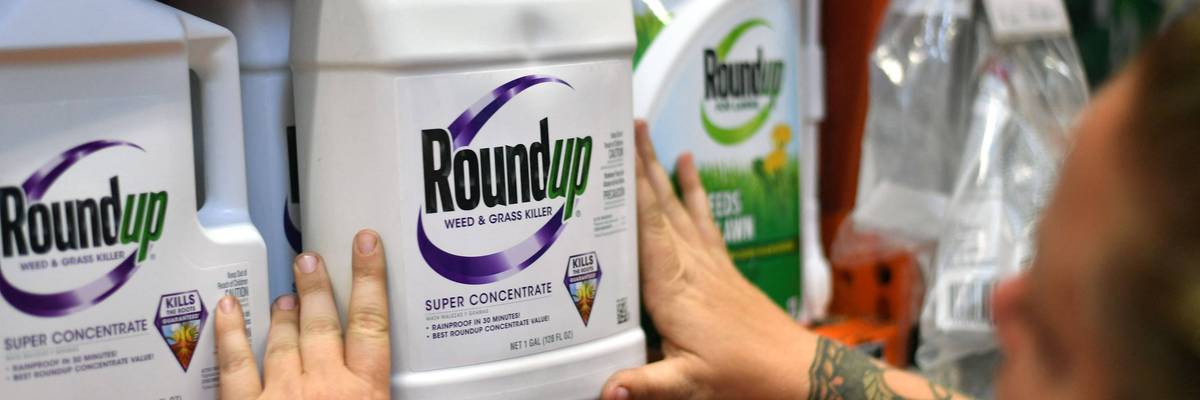
An employee adjusts Roundup products on a shelf at a store in San Rafael, California, on July, 9, 2018.
For decades Roundup has been sold as an effective herbicide, one that was safe for humans and the environment. It isn't.
Mark Twain supposedly once said, "Never let the truth get in the way of a good story," but there is a difference between a good story told in fun and a story (supposedly backed by independent scientific research) that people are led to believe because, well, science is supposed to be true. And so we come to the story of Roundup, the herbicide developed by Monsanto that swept the world because it worked and was the “safe” alternative to widely used weedkillers like Dicamba and 2,4-D,—it was said to be safer than table salt!
Roundup was developed in the 1970s as a non-selective herbicide, meaning it would kill almost any growing plant it touched. It was an effective burn-down herbicide farmers could apply prior to planting, and it assured an almost weed-free field at the beginning of the growing season. Roundup could be used in non-agricultural situations as well, to kill weeds and grass growing in sidewalk and patio cracks, around buildings, etc, but care was needed because, as noted, it was non-target and could kill whatever plant it touched.
For farmers, it worked well, except while it did kill growing weeds, buried weed seeds were not harmed, so a weed-free field at planting time did not ensure a weed-free field throughout the growing season. Weeds would continue to sprout, and more herbicide applications would be needed during the growing season.
Then Monsanto developed their big fix released in 1996, genetically engineered (GE) soybeans resistant to Roundup, followed by GE versions of other commodity crops: corn, cotton, sugar beet, and canola. Over-the-top spraying of these GE crops would kill everything but the crop, and Roundup became one of the most widely used herbicides in the world and GE crops came to dominate world commodity crop production.
Companies like Bayer have to protect their product and their profit even if they have to tell a few lies to do so.
While Monsanto sold Roundup with the slogan, “One spray is all you’ll ever need,” in time, it became clear that some weeds were developing resistance to Roundup and farmers were right back where they started, looking for herbicides that worked consistently. More genetic modifications were made to commodity crops making them resistant to other herbicides, like Dicamba and 2,4-D, the herbicides Roundup was supposed to have replaced. These multiple GE or “stacked” crops could be sprayed with a cocktail of herbicides, hopefully ensuring weed-free fields for the entire growing season.
Farmers are using more herbicide, even on the GE crops, and costs for GE seed have risen much faster than non-GE seed. Of course, the motive was never to reduce the farmer’s production costs or agricultural herbicide use but to increase it—that's where the profit is.
For farmers who didn’t jump on the GE bandwagon, finding non-GE seed is often difficult. Even more onerous, some farmers have found it necessary to plant GE seed as a preventative measure because non-GE crops can be damaged by chemical drift from neighboring GE fields.
So much for effectiveness, what about the safety of Roundup? In 2000 a study was published in the journal Regulatory Toxicology and Pharmacology that deemed the active ingredient in Roundup (glyphosate) was safe and not a human health risk. Since then, that study has been cited consistently as proof of Roundup’s safety. Numerous other studies have shown that glyphosate could cause cancer and that the inert ingredients that are part of the patented Roundup formulation increase the toxicity of glyphosate. Further, the practice of using Roundup as a desiccant on small grain crops (oats, wheat, and barley) prior to harvest puts Roundup directly on grain that enters the human food chain.
Since acquiring Monsanto in 2018, Bayer has paid out about $11 billion to settle almost 100,000 cancer-related lawsuits with approximately 61,000 still pending. In December of 2025 another blow to the claimed safety of Roundup came when the Regulatory Toxicology and Pharmacology journal withdrew the 2000 article that had touted Roundup’s safety. While the study claimed to be independent and peer reviewed, it has come to light that Monsanto's scientists played a significant role in conceiving and writing the article. Oops.
For decades Roundup has been sold as an effective herbicide, one that was safe for humans and the environment, and without which “consequences would be dire.” Companies like Bayer have to protect their product and their profit even if they have to tell a few lies to do so. They claim to produce safe products that help farmers thrive—real independent research refutes that. Bayer and the agribusiness industry may be thriving, but farmers are not and in these times, too few people seem to care that lies are accepted as truth.
Dear Common Dreams reader, It’s been nearly 30 years since I co-founded Common Dreams with my late wife, Lina Newhouser. We had the radical notion that journalism should serve the public good, not corporate profits. It was clear to us from the outset what it would take to build such a project. No paid advertisements. No corporate sponsors. No millionaire publisher telling us what to think or do. Many people said we wouldn't last a year, but we proved those doubters wrong. Together with a tremendous team of journalists and dedicated staff, we built an independent media outlet free from the constraints of profits and corporate control. Our mission has always been simple: To inform. To inspire. To ignite change for the common good. Building Common Dreams was not easy. Our survival was never guaranteed. When you take on the most powerful forces—Wall Street greed, fossil fuel industry destruction, Big Tech lobbyists, and uber-rich oligarchs who have spent billions upon billions rigging the economy and democracy in their favor—the only bulwark you have is supporters who believe in your work. But here’s the urgent message from me today. It's never been this bad out there. And it's never been this hard to keep us going. At the very moment Common Dreams is most needed, the threats we face are intensifying. We need your support now more than ever. We don't accept corporate advertising and never will. We don't have a paywall because we don't think people should be blocked from critical news based on their ability to pay. Everything we do is funded by the donations of readers like you. When everyone does the little they can afford, we are strong. But if that support retreats or dries up, so do we. Will you donate now to make sure Common Dreams not only survives but thrives? —Craig Brown, Co-founder |
Mark Twain supposedly once said, "Never let the truth get in the way of a good story," but there is a difference between a good story told in fun and a story (supposedly backed by independent scientific research) that people are led to believe because, well, science is supposed to be true. And so we come to the story of Roundup, the herbicide developed by Monsanto that swept the world because it worked and was the “safe” alternative to widely used weedkillers like Dicamba and 2,4-D,—it was said to be safer than table salt!
Roundup was developed in the 1970s as a non-selective herbicide, meaning it would kill almost any growing plant it touched. It was an effective burn-down herbicide farmers could apply prior to planting, and it assured an almost weed-free field at the beginning of the growing season. Roundup could be used in non-agricultural situations as well, to kill weeds and grass growing in sidewalk and patio cracks, around buildings, etc, but care was needed because, as noted, it was non-target and could kill whatever plant it touched.
For farmers, it worked well, except while it did kill growing weeds, buried weed seeds were not harmed, so a weed-free field at planting time did not ensure a weed-free field throughout the growing season. Weeds would continue to sprout, and more herbicide applications would be needed during the growing season.
Then Monsanto developed their big fix released in 1996, genetically engineered (GE) soybeans resistant to Roundup, followed by GE versions of other commodity crops: corn, cotton, sugar beet, and canola. Over-the-top spraying of these GE crops would kill everything but the crop, and Roundup became one of the most widely used herbicides in the world and GE crops came to dominate world commodity crop production.
Companies like Bayer have to protect their product and their profit even if they have to tell a few lies to do so.
While Monsanto sold Roundup with the slogan, “One spray is all you’ll ever need,” in time, it became clear that some weeds were developing resistance to Roundup and farmers were right back where they started, looking for herbicides that worked consistently. More genetic modifications were made to commodity crops making them resistant to other herbicides, like Dicamba and 2,4-D, the herbicides Roundup was supposed to have replaced. These multiple GE or “stacked” crops could be sprayed with a cocktail of herbicides, hopefully ensuring weed-free fields for the entire growing season.
Farmers are using more herbicide, even on the GE crops, and costs for GE seed have risen much faster than non-GE seed. Of course, the motive was never to reduce the farmer’s production costs or agricultural herbicide use but to increase it—that's where the profit is.
For farmers who didn’t jump on the GE bandwagon, finding non-GE seed is often difficult. Even more onerous, some farmers have found it necessary to plant GE seed as a preventative measure because non-GE crops can be damaged by chemical drift from neighboring GE fields.
So much for effectiveness, what about the safety of Roundup? In 2000 a study was published in the journal Regulatory Toxicology and Pharmacology that deemed the active ingredient in Roundup (glyphosate) was safe and not a human health risk. Since then, that study has been cited consistently as proof of Roundup’s safety. Numerous other studies have shown that glyphosate could cause cancer and that the inert ingredients that are part of the patented Roundup formulation increase the toxicity of glyphosate. Further, the practice of using Roundup as a desiccant on small grain crops (oats, wheat, and barley) prior to harvest puts Roundup directly on grain that enters the human food chain.
Since acquiring Monsanto in 2018, Bayer has paid out about $11 billion to settle almost 100,000 cancer-related lawsuits with approximately 61,000 still pending. In December of 2025 another blow to the claimed safety of Roundup came when the Regulatory Toxicology and Pharmacology journal withdrew the 2000 article that had touted Roundup’s safety. While the study claimed to be independent and peer reviewed, it has come to light that Monsanto's scientists played a significant role in conceiving and writing the article. Oops.
For decades Roundup has been sold as an effective herbicide, one that was safe for humans and the environment, and without which “consequences would be dire.” Companies like Bayer have to protect their product and their profit even if they have to tell a few lies to do so. They claim to produce safe products that help farmers thrive—real independent research refutes that. Bayer and the agribusiness industry may be thriving, but farmers are not and in these times, too few people seem to care that lies are accepted as truth.
Mark Twain supposedly once said, "Never let the truth get in the way of a good story," but there is a difference between a good story told in fun and a story (supposedly backed by independent scientific research) that people are led to believe because, well, science is supposed to be true. And so we come to the story of Roundup, the herbicide developed by Monsanto that swept the world because it worked and was the “safe” alternative to widely used weedkillers like Dicamba and 2,4-D,—it was said to be safer than table salt!
Roundup was developed in the 1970s as a non-selective herbicide, meaning it would kill almost any growing plant it touched. It was an effective burn-down herbicide farmers could apply prior to planting, and it assured an almost weed-free field at the beginning of the growing season. Roundup could be used in non-agricultural situations as well, to kill weeds and grass growing in sidewalk and patio cracks, around buildings, etc, but care was needed because, as noted, it was non-target and could kill whatever plant it touched.
For farmers, it worked well, except while it did kill growing weeds, buried weed seeds were not harmed, so a weed-free field at planting time did not ensure a weed-free field throughout the growing season. Weeds would continue to sprout, and more herbicide applications would be needed during the growing season.
Then Monsanto developed their big fix released in 1996, genetically engineered (GE) soybeans resistant to Roundup, followed by GE versions of other commodity crops: corn, cotton, sugar beet, and canola. Over-the-top spraying of these GE crops would kill everything but the crop, and Roundup became one of the most widely used herbicides in the world and GE crops came to dominate world commodity crop production.
Companies like Bayer have to protect their product and their profit even if they have to tell a few lies to do so.
While Monsanto sold Roundup with the slogan, “One spray is all you’ll ever need,” in time, it became clear that some weeds were developing resistance to Roundup and farmers were right back where they started, looking for herbicides that worked consistently. More genetic modifications were made to commodity crops making them resistant to other herbicides, like Dicamba and 2,4-D, the herbicides Roundup was supposed to have replaced. These multiple GE or “stacked” crops could be sprayed with a cocktail of herbicides, hopefully ensuring weed-free fields for the entire growing season.
Farmers are using more herbicide, even on the GE crops, and costs for GE seed have risen much faster than non-GE seed. Of course, the motive was never to reduce the farmer’s production costs or agricultural herbicide use but to increase it—that's where the profit is.
For farmers who didn’t jump on the GE bandwagon, finding non-GE seed is often difficult. Even more onerous, some farmers have found it necessary to plant GE seed as a preventative measure because non-GE crops can be damaged by chemical drift from neighboring GE fields.
So much for effectiveness, what about the safety of Roundup? In 2000 a study was published in the journal Regulatory Toxicology and Pharmacology that deemed the active ingredient in Roundup (glyphosate) was safe and not a human health risk. Since then, that study has been cited consistently as proof of Roundup’s safety. Numerous other studies have shown that glyphosate could cause cancer and that the inert ingredients that are part of the patented Roundup formulation increase the toxicity of glyphosate. Further, the practice of using Roundup as a desiccant on small grain crops (oats, wheat, and barley) prior to harvest puts Roundup directly on grain that enters the human food chain.
Since acquiring Monsanto in 2018, Bayer has paid out about $11 billion to settle almost 100,000 cancer-related lawsuits with approximately 61,000 still pending. In December of 2025 another blow to the claimed safety of Roundup came when the Regulatory Toxicology and Pharmacology journal withdrew the 2000 article that had touted Roundup’s safety. While the study claimed to be independent and peer reviewed, it has come to light that Monsanto's scientists played a significant role in conceiving and writing the article. Oops.
For decades Roundup has been sold as an effective herbicide, one that was safe for humans and the environment, and without which “consequences would be dire.” Companies like Bayer have to protect their product and their profit even if they have to tell a few lies to do so. They claim to produce safe products that help farmers thrive—real independent research refutes that. Bayer and the agribusiness industry may be thriving, but farmers are not and in these times, too few people seem to care that lies are accepted as truth.