

SUBSCRIBE TO OUR FREE NEWSLETTER
Daily news & progressive opinion—funded by the people, not the corporations—delivered straight to your inbox.
5
#000000
#FFFFFF
To donate by check, phone, or other method, see our More Ways to Give page.
Daily news & progressive opinion—funded by the people, not the corporations—delivered straight to your inbox.

"Instead of helping, Trump made the largest healthcare cuts in American history and doubled down on his costly tariff taxes," said Rep. Brendon Boyle.
Even as President Donald Trump has declared that the US is in a "golden age" with the "greatest" economy on record, the Wall Street Journal reported on Wednesday that a record number of US workers are dipping into their retirement savings.
The Journal cited recent data from Vanguard Group showing that 6% of the 401(k) plans it administers took a hardship withdrawal in 2025, up from 4.8% that took such a withdrawal in 2024.
The top reasons for such withdrawals last year were avoiding eviction or paying off medical expenses, according to Vanguard.
The Journal noted that the Vanguard data about hardship withdrawals comes as "more Americans are falling behind on debt payments, including on some types of mortgages, putting them at risk of foreclosure," and "the average income of clients seeking help from credit-counseling agencies is rising."
Some Democrats quickly pounced on the Journal report, which they said undercut Trump's rosy assessment of the US economy.
"Record numbers of Americans are raiding their 401(k)s to avoid eviction or pay medical bills," wrote Rep. Mike Levin (D-Calif.). "That's not winning."
Rep. Brendan Boyle (D-Pa.) pointed to the Journal report and accused Trump and the GOP of exacerbating these problems with the cuts to Medicaid contained in the One Big Beautiful Bill Act that the party passed in 2025.
"A record number of Americans are dipping into their retirement savings just to stay afloat," wrote Boyle, the ranking member of the House Budget Committee. "A leading cause: Skyrocketing healthcare costs. Instead of helping, Trump made the largest healthcare cuts in American history and doubled down on his costly tariff taxes."
Senate Minority Leader Chuck Schumer (D-NY) responded to the report by saying, "This is not the golden age Donald Trump promised."
Andrew Bates, former senior deputy press secretary for President Joe Biden, also pointed to the GOP budget law as a key reasons for Americans' deteriorating financial security.
"The GOP in Washington makes the biggest healthcare and energy cuts in history, just to lower taxes for the rich," he wrote. "'Golden Age' for Jeffrey Epstein’s surviving friends, shittiness for everyone else."
Ann Larson, co-founder of Debt Collective, noted that while the data on 401(k) withdrawals is disturbing, it doesn't tell the whole story of the dire overall state of Americans' finances.
"This is bad, but add in the almost half of older Americans who have ZERO retirement savings to pull from," Larson wrote, "and the picture is even more horrifying."
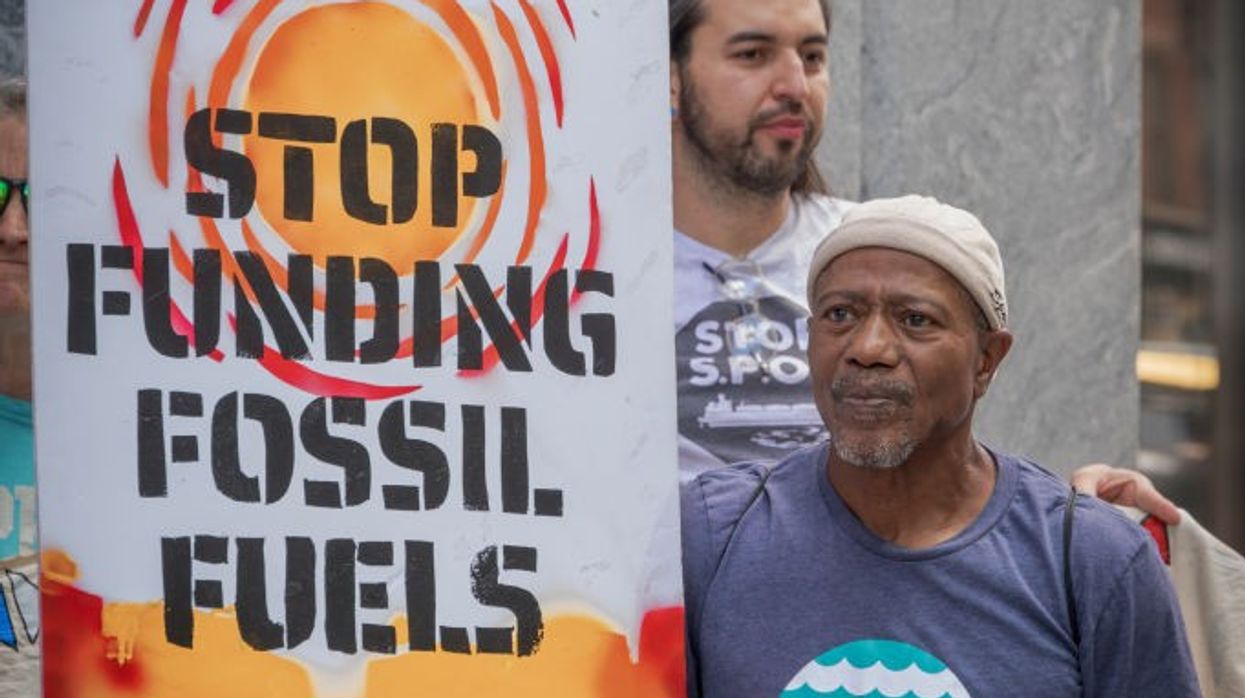
"Investors need to draw a red line on fossil fuel expansion and they need to do it now," said an author of the report, which cites Vanguard and BlackRock as the largest institutional investors in fossil fuel companies.
Institutional investors including the Vanguard Group and BlackRock collectively own $4.3 trillion in the stocks and bonds of fossil fuel companies, according to a report released Tuesday by Urgewald, a nonprofit based in Germany.
Urgewald and partner nonprofits tracked investments into nearly 3,000 companies in the coal, oil, and gas sectors for Investing in Climate Chaos 2024, a report that follows on similar research they published last year.
The $4.3 trillion in financing jeopardizes the quick phaseout of fossil fuels that's necessary to avoid unmanageable climate breakdown, the report says.
"If institutional investors continue backing companies that are still expanding their coal, oil, and gas operations, it will be impossible to phase out fossil fuels in time," Katrin Ganswindt, Urgewald's head of financial research, said in the report. "Investors need to draw a red line on fossil fuel expansion and they need to do it now."
🆕 Investing In Climate Chaos reveals top investors in coal, oil and gas.
👉 Discover who they are & the full report:https://t.co/ix94o84YtT
📢 Calling on all investors to stop all forms of financial support (bonds, loans...) to companies developing new fossil fuel projects. pic.twitter.com/VsRmXD41tl
— Reclaim Finance (@ReclaimFinance) July 9, 2024
Urgewald looked at the holdings of more than 7,500 institutional investors worldwide including "pension funds, insurance companies, asset managers, hedge funds, sovereign wealth funds, endowment funds, and asset management arms of commercial banks" as of May 2024.
The true investment total may be higher than $4.3 trillion, given the lack of transparency in bond markets; the report authors estimated that they only included 20-30% of actual bond holding in fossil fuel companies.
Of the $4.3 trillion, more than half was invested by U.S.-based companies. In fact, $1.1 trillion was held by just four companies: Vanguard, BlackRock, State Street, and Capital Group—dubbed "the filthy four" by Urgewald—each of which had more than $160 billion in fossil fuel investment holdings.
Alec Connon, co-director of Stop the Money Pipeline, said the outsized role of the U.S. was the result of poor governance.
"This mirrors the complete lack of action by U.S. regulators to effectively monitor and address the climate and transition risks of large institutional investors," Connon said in the report. "This inaction lays the ground for the next economic crisis and puts the world on a fast track towards climate chaos."
Nearly $4 trillion of the $4.3 trillion in holdings went to companies that are actively developing new fossil fuel projects, not just tapping existing projects, though the report doesn't specify how much actually went toward new development; many companies do both.
In any case, it's clear that new development abounds: Companies have increased capital expenditure on oil and gas exploration by more than 30% since 2021. ExxonMobil, among the biggest beneficiaries of the institutional investing documented in the report, alone spends $1.4 billion annually searching for new reserves in 37 countries, the publication says.
All of this is in spite of pledges to "transition away" from fossil fuels, as countries agreed to do at the United Nations climate summit in Dubai in December. Environmental campaigners are trying to use those pledges, loophole-ridden as they may be, to pressure institutional investors and regulators to take action.
"The question is, will institutional investors continue snapping up bonds of companies like Saudi Aramco, ExxonMobil, or TotalEnergies whose business model relies on heating up the planet?" the report's authors asked. "Or will pension funds, insurers, and asset managers realize that these investments will produce more heatwaves, more catastrophic floods, more climate disasters?"
Urgewald is one of the NGOs that produces the annual Banking on Climate Chaos report, the latest publication of which found that big banks shoveled nearly $7 trillion into fossil fuel companies in the eight years after the Paris agreement was signed in 2015. That report, released in May, showed that major banks including JPMorgan Chase and Citigroup together financed fossil fuel companies to the tune of $705 billion in 2023, the hottest year on record.
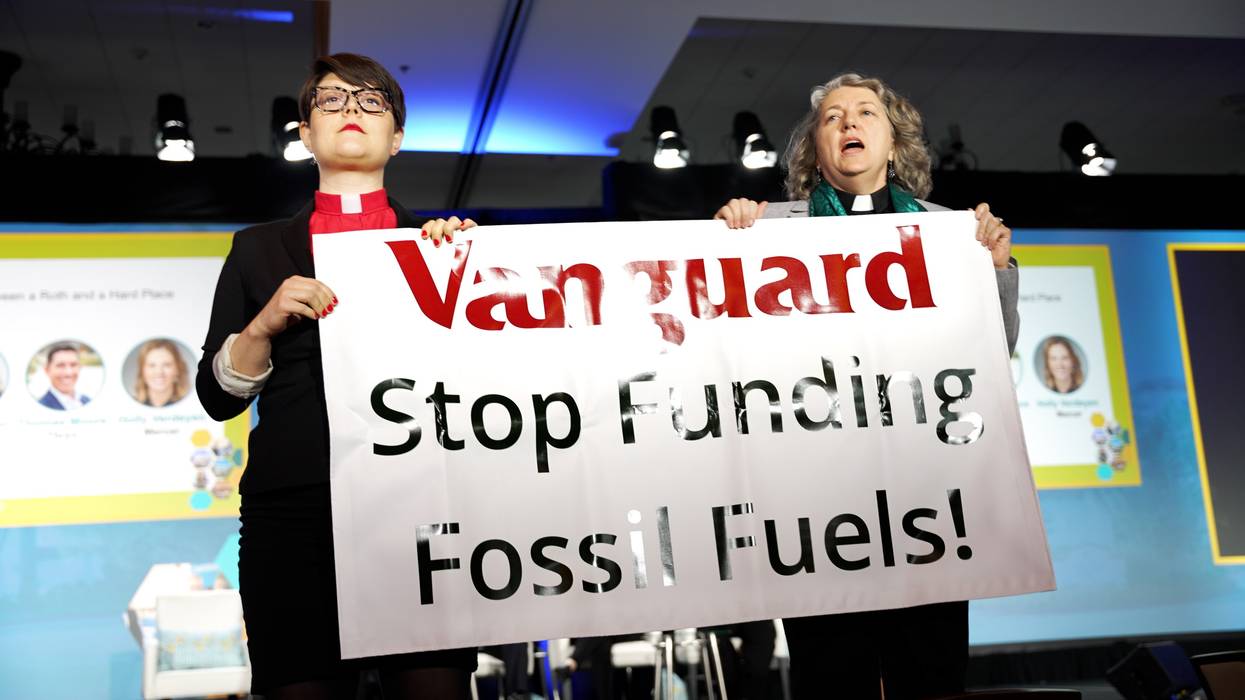
Vanguard must decarbonize, massively scale up sustainable investments, adopt a human rights policy, and use its power to hold the worst climate actors accountable.
“When the fires burn and the seas rise, not in our name, we say, not in our name, we say, not in our name.”
Earlier this week, we found ourselves singing those words as we were led out by security at an investment industry conference attended by over 500 investors and industry leaders. A few minutes earlier, we had stood up to interrupt a speaker on the panel.
“I’m a mother, a minister, and a client,” Amy called out. “I’m desperately worried about my child’s future. Aren’t you worried about yours?”
Then Chelsea spoke. “Vanguard has $300 billion invested in oil, gas, and coal,” she said as security guards approached to force us to leave. “This is reckless and immoral.”
76% of all investors would rather make a dentist visit than invest in an environmentally destructive company.
Vanguard, of course, is the world’s second largest asset manager, after only BlackRock. The company was sponsoring the Pensions & Investments “Defined Contributions West” conference in Southern California, and one of its executives was speaking on the panel.
Vanguard manages over $7 trillion in assets, and its bread and butter is managing retirement accounts. That means that the millions of customers who rely on Vanguard to manage their investments may have no idea that the company is using their money to worsen the climate crisis.
Here’s the thing: 80% of people want to invest responsibly. One study showed that 76% of all investors would rather make a dentist visit than invest in an environmentally destructive company.
Investors don’t want their retirement funds to destroy their children’s or grandchildren’s future. But Vanguard, BlackRock, and other major asset managers have a minuscule amount of their trillions of investments in sustainable funds. Vanguard is ranked worst among all major asset managers for climate commitments. This is not okay.
The science is clear: There can be no further fossil fuel development if we are to keep the global temperature from rising beyond the 1.5°C threshold that scientists agree is the most warming our planet can bear before utter catastrophe.
And beyond the risks to humanity itself, Vanguard is well aware that climate risk is also financial risk. Vanguard’s investments in the fossil fuel industry could ultimately cost its investors in the long run—putting up to $3 trillion in assets at risk if Vanguard does not act to mitigate climate risk.
Disrupting a professional conference in front of hundreds of attendees was not easy. But we have come to believe that the climate crisis is too urgent to wait.
We are people of faith and spirit. Amy’s Unitarian Universalist faith affirms the interdependent web of all creation. Chelsea’s interspiritual background inspires public action that expresses the deepest moral values. Both of our religious backgrounds call us to work for a more just future for all beings.
So, we stood up.
Our spirituality helped us through the process. To prepare, we grounded ourselves in prayer. We remembered all those suffering from climate disasters, both human and non-human. We held close our visions for a world in which all beings and our common home were revered rather than desecrated for profit. We felt clear in heart and spirit that this was the right thing to do. We were together, supported by other colleagues. Without these spiritual practices and community, we couldn’t have done it.
It would be great if we could simply ask Vanguard to do the right thing, and they’d do it. But for years, countless people have called, written letters, asked for meetings, and held protests. Our colleagues at the Earth Quaker Action Team and Vanguard S.O.S. have led campaigns to push Vanguard to improve its practices, to no avail. In fact, Vanguard has moved in the opposite direction, by withdrawing from the Net Zero Asset Managers initiative.
It is irresponsibly naive to think that polite and rational approaches to this threat are sufficient. As people of faith, we need to summon deeper courage and act. For decades, we’ve pointed to Dr. King and Gandhi as our spiritual heroes. The time has come when we need to draw on the same well of inner strength that made them into giants.
The solutions are clear: Vanguard must decarbonize, massively scale up sustainable investments, adopt a human rights policy, and use its power to hold the worst climate actors accountable.
Vanguard can use its power to give us a chance at a liveable future AND investment returns. But it’s not going to happen until Vanguard experiences a wave of grassroots pressure that forces it to change.
We invite you to act in faith and courage with us by sending a fax to Vanguard. To win, it will take all of us doing all we can, and so we also hope you feel called to do more. Please visit www.GreenFaith.org if you’d like to learn more about how you can take faith-filled action to stop the funding of fossil fuels.
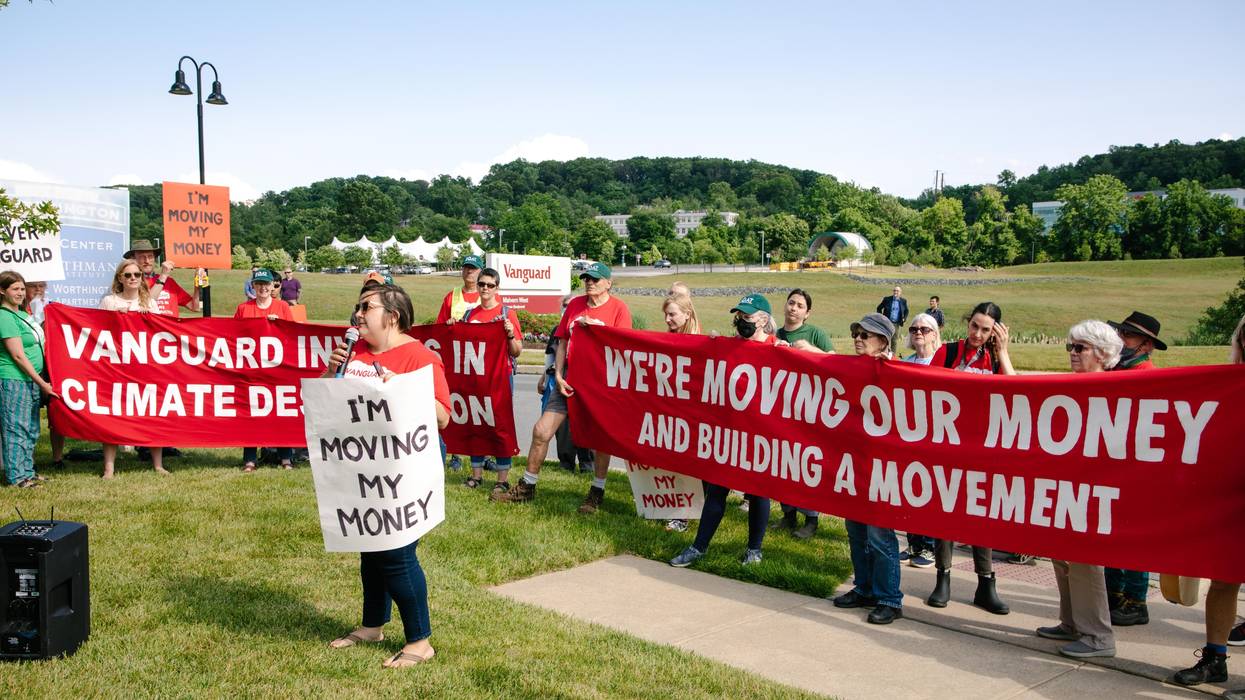
Earth Quaker Action Team has used numerous nonviolent direct actions over the last two years to draw attention to Vanguard’s dangerous investment practices and its failure to incorporate into its business model the existential threat of the climate crisis.
It is easy to feel powerless and overwhelmed by horrifying climate catastrophes seemingly everywhere: Across the U. S. this summer, from Hawaii to Texas and Missouri, intense heat and wildfires are causing injury, illness, and death. Fear and sadness can make us “throw up our hands” and conclude that the problem is too big and that there is nothing we can do to stop the burning of fossil fuels on a scale needed to avert the worst effects of a warming world. However, a group of Quakers in Philadelphia have faith that nonviolent direct action has the potential to interrupt the “business as usual” funding of the fossil fuel industry.
For the last two years, I’ve joined this group of Quakers, Earth Quaker Action Team (EQAT), and an international coalition of activists, in interrupting the pipeline of money that props up the fossil fuel industry. One major source of this money comes from the investment giant, Vanguard Group. Vanguard markets itself as a “leader in low cost investing,” which has helped it become a leader in investment management. People from across the country entrust their savings to Vanguard with the hope of maximizing their return on investment so they can retire or send their children to college. What Vanguard doesn’t advertise is how customers’ money helps drive the fossil fuel industry.
Vanguard is the world’s biggest investor in fossil fuels and has invested $184 billion in fossil fuel infrastructure expansion. (Vanguard is the top investor in Hawaiian Electric, which is currently implicated as a major contributor to the wildfire disaster in Maui.) While Vanguard acknowledges that climate change will have a negative net impact on the global economy, it continues its investment practices, full steam ahead, on a course to climate catastrophe.
We remain hopeful that our message will break through to Vanguard, especially as the reality of climate-related disasters dominates the news, and as more and more investors like many of us refuse to go along with Vanguard’s toxic business practices.
EQAT has used numerous nonviolent direct actions over the last two years to draw attention to Vanguard’s dangerous investment practices and its failure to incorporate into its business model the existential threat of the climate crisis. Luckily, Vanguard’s global headquarters are in EQAT’s “backyard,” Malvern, Pennsylvania, a suburb of Philadelphia, which has allowed us to bring our concerns to their doorstep. Our actions have involved, among other things, distributing fliers to Vanguard employees; co-hosting speakers, including an Indigenous group from Peru asking Vanguard to stop funding oil company Petroperú; and holding a mock news report from the year 2033 in which climate disasters are tied to Vanguard’s failed decision-making in 2023. (We have also prayed at the home of Vanguard CEO, Tim Buckley, in an adjacent suburb.) On the two occasions when we used civil disobedience to get our message across, Vanguard had many of us removed from the campus in handcuffs.
Given the urgency and scope of the crisis, EQAT and its like-minded partners have been urging Vanguard to use the power and influence that it has as a major shareholder in many climate-destroying companies; Vanguard can use its power to insist that fossil fuel companies, and other polluting industries, change their ways. If they refuse, we argue that Vanguard must withdraw its funding from these entities.
We remain hopeful that our message will break through to Vanguard, especially as the reality of climate-related disasters dominates the news, and as more and more investors like many of us refuse to go along with Vanguard’s toxic business practices. In June, a number of EQAT activists who had individual investment accounts with Vanguard decided it was time to remove their funds from “the pipeline.” We came to Vanguard headquarters, in sight of Vanguard employees enjoying their company picnic, and announced that many of us were moving our money elsewhere. Collectively, $17 million has been moved.
While $17 million may not put a big dent in the over $7 trillion that Vanguard manages, it reflects the idea that a caring community can be empowered to take a collective stand against planet-destroying profit taking. Plus, that $17 million is just the beginning. The amount of money being withdrawn from Vanguard is growing as more Quakers and their allies refuse to participate in Vanguard’s reckless way of doing business. One ally Elders Action Network, a national group of thousands, is now joining the effort to move assets out of Vanguard in order to invest with more responsible investment managers.
In addition to removing money from Vanguard, we will continue to challenge Vanguard’s brand. Marketing themselves as a low cost investment manager is misleading as it belies the fact that we all pay a very high price for climate-related disasters. Some of us suffer the health consequences of poor air quality and high heat, while others bear the cost of damaged or destroyed cars and homes in the aftermath of extreme weather and wildfires. As a local television ad targeting Vanguard proclaims, “If it’s bad for the environment, it’s bad for your retirement.”
Remaining hopeful in this work takes discipline and effort. EQAT operates with certain values and practices that help us “stay motivated for the long fights.” One value we embrace is being on our learning edge: We take on tasks and roles that are uncomfortably new, learning as we go. Another value encourages us to create meaningful, supportive connections with our fellow EQAT volunteers. Living these values can be difficult and exhausting, but, for me and others, it offers a much needed alternative to resignation and despair.
“Anti-ESG” efforts all have one things in common—connections to conservative big money donors in the oil and gas industry.
In a recent Gallup poll, the vast majority of Americans surveyed said they were not even “somewhat familiar” with the term “ESG.” But on Capitol Hill, Republicans have developed a fixation on the issue, holding not one but two intensely partisan hearings on the topic.
“Republicans Are Losing Their Minds Over ESG” read one headline.
“Anti-ESG talk leads to partisan fireworks” read another.
Now you may be wondering, what the heck is ESG? What’s anti-ESG? What the heck is “woke” capitalism? And why should I care?
ESG stands for “Environmental, Social, and Governance,” which are categories of metrics that businesses use to assess performance and risk on a range of issues. To reduce risk and create value over the long term, businesses may seek to reduce carbon emissions (Environmental), improve working conditions for workers through racial equity and other measures (Social), or take steps to bring executive compensation closer in line with the company’s median salary (Governance).
Companies’ practices on ESG metrics can have an impact on future performance, so there is tremendous value in understanding long-term risks associated with environmental, social, and governance factors.
The simple concept that businesses should care about their communities and their workers and govern themselves accordingly is not new. In the 1980s, some companies and banks stopped doing business in South Africa to protest racial Apartheid. In the 1990s, a number of institutional investors divested from the tobacco industry as a way to take a stand against the harmful and deceptive practices of companies like Phillip Morris and R.J. Reynolds. And in the 2000s and 2010s, support for environmental shareholder proposals grew substantially in response to the worsening climate crisis.
This leads us to the current backlash. “Anti-ESG” efforts, promulgated by long-time conservative organizations like the Heritage Foundation and American Legislative Exchange Council (ALEC) and newly prominent groups like the Committee to Unleash Prosperity, Consumers’ Research, and the State Financial Officers Foundation all have one things in common—connections to conservative big money donors in the oil and gas industry.
“The anti-‘woke investing’ movement was not created by financial experts,” observed environmental reporter Emily Aktin, “It was created by two of the fossil fuel industry’s most notorious climate disinformers.”
The anti-ESG movement is a well-funded and well-organized campaign led by top conservative political operatives.
Big Oil wants to end ESG investing and ESG business practices because they’re at odds with the continued growth of the fossil fuel industry. Big Oil would rather let our planet burn and increase short-term profits than adjust its business practices to stave off the worst of the climate crisis and invest in long-term profits.
Big Oil also wants you to think that this “anti-ESG” movement is organic, that it emerged from the conservative grassroots, but that could not be further from the truth. The anti-ESG movement is a well-funded and well-organized campaign led by top conservative political operatives. I recently corresponded with Meaghan Winter, author of All Politics Is Local, who explained that:
“Ideological donors and their foundations and think tanks have deliberately chosen to push their agendas through obscure-seeming front groups that work incrementally on the state level because they don’t want to call attention to the profound (and very unpopular) changes they are initiating. This strategy is decades-old, it has worked against unions and abortion and more, and the anti-ESG effort is just one of the latest incarnations.”
One shining example of this is the recent House Oversight Subcommittee hearing on ESG, where the majority witnesses (those called by the GOP, because Republicans control the House of Representatives right now) were Mandy Gunasekara from the Independent Women’s Forum, Jason Isaac from the Texas Public Policy Foundation, and Stephen Moore from the Heritage Foundation. These organizations have a long history of receiving financial support and carrying water for the oil and gas industry, including Koch Industries, ExxonMobil, and Chevron.
Watch Congresswoman Summer Lee lay it out for us, plain and simple.
While the right wing foments a culture war crusade and attempts to make ESG the next critical race theory (“CRT”), the fear mongering campaign has real-world impacts on investors and companies who are scared of being caught in the backlash. For example, some private companies are now backpedaling on their climate commitments.
To be clear, this is what the funders of this movement want.
In December, Vanguard, the world’s second largest asset management firm, pulled out of the Net Zero Asset Managers initiative, which was a voluntary industry-led effort to reach net-zero emission targets by 2050. This was a major setback for anyone who cares about the health and shape of our environment, because Vanguard manages roughly $7 trillion in assets. In order to meet the goals of the Paris Agreement—less than 1.5°C of global warming above pre-industrial levels—global markets must shift capital away from the fossil fuel industry and toward renewable energy systems.
But this goes beyond the climate crisis. In recent years, workers and shareholders have been demanding more corporate accountability on workplace safety, workers’ freedom of association, data privacy, racial equity, and executive compensation, among other issues that fall into the Social and Governance categories of ESG. The right-wing campaign against ESG is a campaign to roll back these victories.
My organization, Take on Wall Street, is organizing with unions, public interest groups, and grassroots groups to fight back against this regressive movement. But it’s not just about playing defense. We also need a forward-looking vision for worker power, climate justice, and racial equity. Watch this space.
An earlier version of this piece was published by Take on Wall Street.

"Asset managers continue to add fuel to the fire by buying the bonds from the worst fossil fuel polluters," said one campaigner.
An analysis released Tuesday by a coalition of environmental organizations shows that 30 of the top asset managers in the United States and Europe collectively hold close to $600 billion in bonds and shares in the world's largest fossil fuel developers, making the investment firms key contributors to the global climate emergency.
Titled Who's Managing Your Future? An Assessment of Asset Managers' Climate Action, the new report from Reclaim Finance, ReCommon, Sierra Club, the Sunrise Project, and Urgewald finds that BlackRock and Vanguard had the largest total bond and equity holdings in fossil fuel developers as of the beginning of 2023, respectively controlling $179.5 billion and $170.3 billion.
But BlackRock and Vanguard are far from alone. The report also shows that JPMorgan Asset Management (AM), UBS AM, Fidelity International, and Credit Suisse AM have substantial bond and stock exposure to major fossil fuel producers.
Such investments, the report notes, make it possible for oil and gas companies to finance fossil fuel expansion projects that are sabotaging hopes of reining in catastrophic planetary warming.
Over just the past 18 months, according to data laid out in the new analysis, leading U.S. and European asset managers invested at least $3.5 billion in new bonds from nearly 40 companies involved in expanding fossil fuel production.
"For fossil fuel expansion to stop and production to start decreasing, the financing behind it must stop," the report states. "And as a significant proportion of this financing comes from bonds, asset managers' role in this financing is clear."
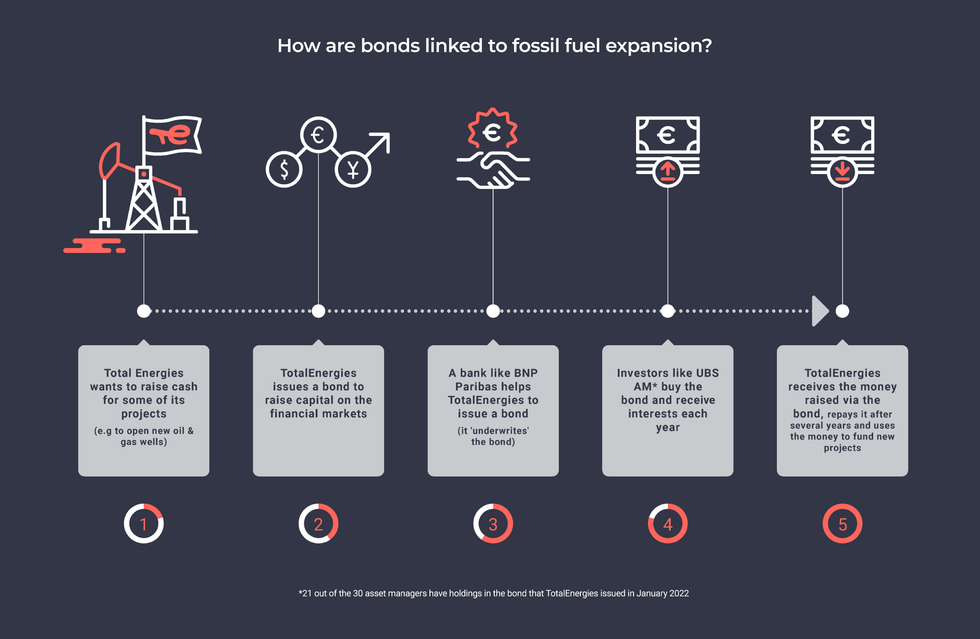
While many of the asset managers examined in the new report have in place policies ostensibly aimed at pressuring companies in their portfolios to curb polluting activities, the analysis finds that "there are major loopholes and weaknesses that still allow most of the asset managers to provide financial services that are essential to the development of new coal, oil, and gas projects."
"Asset managers continue to add fuel to the fire by buying the bonds from the worst fossil fuel polluters," Lara Cuvelier, sustainable investment campaigner at Reclaim Finance, said in a statement. "Their policies are an inadequate response to the climate emergency."
"They should listen to the science and sanction companies that refuse to stop their devastating fossil fuel expansion plans," Cuvelier argued. "It is time for asset managers' clients to challenge them on this issue and ask them to put in place robust policies to stop this scourge."
The report specifically urges top asset managers to:
"This report clearly demonstrates a collective failure from the investment sector to manage climate risk responsibly," said Jessye Waxman of the Sierra Club's Fossil-Free Finance campaign.
"BlackRock and Vanguard are by far the worst offenders, together providing 58% of the recent investments in fossil fuel expansion, while setting very few expectations of fossil fuel companies to pivot away from business as usual," Waxman added. "As the world's largest asset managers, BlackRock and Vanguard have a responsibility to mitigate the growing systemic risk posed by climate change."

"It is business as usual for most banks and investors who continue to support fossil fuel developers without any restrictions, despite their high-profile commitments to carbon neutrality."
Top banks in the United States and around the world have made a show of embracing net-zero emissions pledges, portraying themselves as allies in the fight against the global climate emergency.
But a new analysis published Tuesday by a group of NGOs makes clear that the world's leading financial institutions—including major Wall Street banks such as Citigroup, JPMorgan Chase, and Bank of America—are still pumping money into fossil fuel expansion, bolstering the industry that is primarily responsible for worsening climate chaos.
According to the report, 56 of the largest banks in the Net-Zero Banking Alliance (NZBA)—a coalition convened by the United Nations—have provided nearly $270 billion in the form of loans and underwriting to more than 100 "major fossil fuel expanders," from Saudi Aramco to ExxonMobil to Shell.
Additionally, 58 of the biggest members of the Net-Zero Asset Managers (NZAM) initiative—including the investment behemoths BlackRock and Vanguard—held at least $847 billion worth of stocks and bonds in more than 200 large fossil fuel developers as of September.
Both the NZBA and the NZAM are under the umbrella of the Glasgow Financial Alliance for Net-Zero (GFANZ), a campaign launched in 2021 with the goal of expanding "the number of net zero-committed financial institutions." Climate advocates have long argued that net-zero pledges are fundamentally inadequate to the task of stopping runaway warming.
"The science is very clear: we need to stop developing new coal, oil, and gas projects as soon as possible if we want to meet our climate goals and avoid a worst-case scenario," said Lucie Pinson, the executive director and founder of the watchdog group Reclaim Finance. "Yet, it is business as usual for most banks and investors who continue to support fossil fuel developers without any restrictions, despite their high-profile commitments to carbon neutrality."
"Their greenwashing is all the more damaging as it casts doubt on the sincerity of all net-zero commitments and undermines the efforts of those who are truly acting for the climate," Pinson added.
The groups found that the U.S.-based Wall Street giants Citigroup, JPMorgan Chase, Bank of America, Morgan Stanley, and Wells Fargo provided nearly $90 billion in total financing for fossil fuel expansion between the dates they joined the NZBA and August 2022.
Citigroup, which touts its net-zero commitments on its website, led the pack with $30.5 billion in fossil fuel financing from April 2021 to August 2022.
"The U.S. financial sector cannot be taken seriously on climate change until it stops investing in new fossil fuel projects," said Adele Shraiman, a representative for the Sierra Club's Fossil-Free Finance campaign. "We need an urgent transition to a green economy and the financial sector must help deliver that."
Overall, according to the new report, "229 of the world's largest fossil fuel developers received finance from the 161 GFANZ members covered... which will support them to develop new coal power plants, mines, ports, and other infrastructure, as well as new oil and gas fields and pipelines and LNG terminals."
"These new fossil fuel projects are incompatible with the objective of limiting global warming to 1.5°C, as confirmed in the latest International Energy Agency's World Energy Outlook published in October 2022," the report states. "They will lock in greenhouse gas emissions for decades, despite the adoption of decarbonization targets by some GFANZ members."
Paddy McCully, a senior analyst at Reclaim Finance, said in a statement that "GFANZ members are acting as climate arsonists."
"They've pledged to achieve net-zero but are continuing to pour hundreds of billions of dollars into fossil fuel developers," said McCully. "GFANZ and its member alliances will only be credible once they up their game and insist that their members help bring a rapid end to the era of coal, oil, and fossil gas expansion."

Acting on behalf of both their "fiduciary duty" and the need to protect the planet from climate catastrophe, more than 500 international investor groups managing $39 trillion on Tuesday called on governments to "raise their ambition" at the global climate conference in November, and focus on urgently implementing specific policies to end fossil fuel production.
"We know that more ambitious action on climate is needed, a fact compounded by increasing geopolitical tension and the devastation caused by intensifying extreme weather events."
The pro-climate action coalition the Investor Agenda, which includes major financial institutions from around the world, released its 13th annual "Global Investor Statement to Governments on the Climate Crisis" two months before world leaders are set to meet in Cairo at the 27th United Nations Climate Change Conference (COP27).
Signed by 532 investor groups--but none of the top three U.S. index fund managers, BlackRock, State Street, and Vanguard--the statement reiterates warnings from the Intergovernmental Panel on Climate Change (IPCC) and the International Energy Agency (IEA), both of which have clearly stated that fossil fuel extraction must be rapidly phased out in order to limit global heating to 1.5oC above pre-industrial temperatures.
Last year's climate change summit, COP26, resulted in formal commitments from world policymakers which, if fully implemented, "would reduce the projected level of global warming from 2.7degC to somewhere between 2.1degC and 2.4degC," said the Investor Agenda. "This is a significant acceleration of action, but much more is needed."
The coalition called on governments to enhance and strengthen their emissions targets for 2030 ahead of the conference, implementing domestic policies including:
"Once again, investors are issuing a clear call to governments on the urgent need for public policy to reflect and support investor action," said David Atkin, CEO of Principles for Responsible Investment. "We know that more ambitious action on climate is needed, a fact compounded by increasing geopolitical tension and the devastation caused by intensifying extreme weather events."
Friends of the Earth Action called the statement the financial sector's "most ambitious appeal to officials yet."
The groups, including the Asia Investor Group on Climate Change, CDP, and Ceres, also called on governments to support the Global Methane Pledge to reduce emissions by at least 30% by 2030; to scale up climate finance for adaptation and resilience to meet the needs of the Global South; and to strengthen climate disclosures across the financial system.
The Investor Agenda emphasized that continued global investment in fossil fuel projects not only risks worsening the effects of the human-caused climate emergency, but it also must end to protect investors from financial risks associated with climate risks:
Full implementation of the Paris agreement will create significant investment opportunities in clean technologies, green infrastructure, and other assets, products, and services needed in this new economy. In turn, investors can use capital allocation and stewardship to support sustainable activities that generate jobs and economic growth, make a just transition from carbon-intensive activities, and increase resilience.
Investors are urgently seeking to manage their exposure to climate risks and increase the contribution that their investments make to the Paris agreement goals. Investors are taking action as it is not only permitted by law but is in many cases required to ensure their ability to generate returns in the long-term as a core fiduciary duty and benefit from the opportunities associated with the shift to a net-zero emissions economy.
"Investors from all over the world are asking governments to step up to the urgency of the moment and enact policies the world needs to avert the worst of the climate crisis and that investors need to usher in a new era of economic prosperity built around a just, sustainable, clean energy economy," said Mindy Lubber, CEO of Ceres and a member of the Investor Agenda steering committee.

A significant percentage of shareholders at three of the biggest U.S. banks voted Tuesday to endorse first-of-their-kind resolutions urging the companies to stop supporting new fossil fuel development amid a worsening climate emergency.
"Big banks have a responsibility to address their massive contribution to the climate crisis and protect their shareholders from climate risk."
Shareholders at Citigoup, Bank of America, and Wells Fargo voted 12.8%, 11%, and 11%, respectively, to support climate resolutions filed by the Sierra Club Foundation and other members of the Interfaith Center on Corporate Responsibility. According to the Sierra Club, any resolution that receives at least 5% of the vote can be refiled the following year, and those that get 10% or more are "considered difficult for a company to ignore."
"Big banks have a responsibility to address their massive contribution to the climate crisis and protect their shareholders from climate risk by aligning their policies with their own net-zero commitments and ending support for fossil fuel expansion," Adele Shraiman of the Sierra Club's Fossil-Free Finance campaign said in a statement. "The pressure on them to do so from shareholders and the public is only growing stronger."
The "groundbreaking" resolutions include a call for each bank to "build upon" its net zero commitments by adopting policies "to help ensure that its financing does not contribute to new fossil fuel supplies that would be inconsistent" with the International Energy Agency's "Net-Zero Emissions by 2050" scenario and other climate frameworks.
While shareholders have previously compelled companies to disclose the emissions impact of their operations and investments and set long-term climate targets, this is the first time they have called on banks to implement plans to achieve those objectives, according to Sierra Club.
"The fact that this first-of-its-kind effort gained as much support as it did should send a clear signal that the effort to push Wall Street to deal with its climate problem isn't going anywhere," said Shraiman.
As Danielle Fugere, president of the shareholder advocacy group As You Sow, told Grist: "Investors are saying we can't conduct business in a world that is on fire, that has heatwaves and insufficient water. And I do think companies are beginning to understand that it's in their interest to take action and that shareholders support that action."
Outlining Tuesday's votes, Sierra Club noted:
The resolutions were publicly supported by New York State Common Retirement Fund, the third-largest pension fund in the country, as well as three of New York City's pensions, and Rhode Island's and Seattle's funds.
However, the vote totals suggest that major asset managers like BlackRock, Vanguard, State Street, and Fidelity--which are by far the largest shareholders of the big banks, and are therefore uniquely positioned to make a huge impact on important votes--failed to support them, despite their own net-zero commitment and pledges to use their shareholder power to advance climate action.
"It's deeply disappointing that, once again, asset managers like BlackRock and Vanguard have failed to put their money where their mouth is and use their immense power to hold banks accountable to their climate pledges," Shraiman lamented.
"The rhetoric coming out of these big investors about climate leadership and engaging with their clients on a clean energy transition is worthless if it's not paired with meaningful accountability for clients that are clearly not interested in making that transition a reality," she added.
Paul Rissman, a Sierra Club board member and former executive vice president of an asset management firm, noted that all the largest U.S. banks have pledged to achieve net-zero financed emissions by 2050.
"Big U.S. banks have utterly failed to protect their shareholders' long-term interests."
"Despite their commitments," he wrote, "all of these banks have continued to fund the top 20 companies that are responsible for most fossil fuel development--to the tune of more than $445 billion combined in the six years since the Paris agreement was signed."
"This is recipe for disaster," warned Rissman. "The scientific consensus is clear that in order to achieve global net-zero emissions by 2050 and avert the worst of the climate crisis, the expansion of new fossil fuel development must stop immediately."
"Big U.S. banks have utterly failed to protect their shareholders' long-term interests as they renege on their net-zero commitments and fumble on adequately managing the risks associated with financing new fossil fuel development," he added.
In addition to denouncing companies for their inadequate climate action, critics have also condemned net-zero pledges that some argue are a dangerous form of greenwashing best avoided in favor of near-term commitments to reducing greenhouse gas emissions.

Climate campaigners on Tuesday denounced financial investment giants BlackRock and Vanguard for supporting the planet-killing status quo at Wells Fargo, one of the largest private funders of fossil fuel projects in the world.
BlackRock and Vanguard, which respectively own a 7% and 7.6% stake in the Wall Street financial corporation, are believed to have voted in favor of the bank's chairman, Charles Noski, at the company's annual meeting Tuesday.
"While acknowledgments and commitments may mark a change in thinking within BlackRock and Vanguard, it is action that is needed to curb the climate crisis."
--BlackRock's Big Problem campaign
The two companies have not released public statements regarding their votes, but with Noski winning 94% of the vote, it is "highly improbable for either Vanguard or BlackRock to have voted against him given their share of the vote," said the BlackRock's Big Problem campaign.
Instead of supporting Noski, said campaigners at Sierra Club and other climate action groups, BlackRock and Vanguard should have rejected a chairman under whose leadership Wells Fargo has poured $223 billion into fossil fuel projects just in the last five years. The bank is the top Wall Street investor in fracking infrastructure, and has been a major funder of the Keystone XL and Dakota Access pipelines.
Climate action advocates expressed outrage particularly at BlackRock--the largest asset manager in the world--which has for months claimed it will push the companies it helps control to address the climate crisis in their business plans.
"Wells Fargo has fallen significantly behind the curve when it comes to meeting the moment on climate action, and today it falls even further," said Ben Cushing, a campaign manager at Sierra Club. "Today, BlackRock and Vanguard did not live up to their rhetoric on climate action. We will be monitoring other pivotal shareholder votes closely and hope to see the largest investors step up to hold corporations accountable for their climate failures."
BlackRock acknowledged in its 2021 Stewardship Expectations report that "voting against directors, when we make clear to the company our rationale and expectations, is an effective tool for encouraging positive outcomes," and in January the asset manager said when its companies and directors are "not moving with sufficient speed and urgency" to combat the planetary emergency, it will vote against their re-election.
Under pressure this year, Wells Fargo set a goal of net zero fossil fuel emissions from the projects it finances by 2050. Campaigners said Tuesday it has not done nearly enough to ensure it will stop funding pollution-causing infrastructure.
"Today, BlackRock and Vanguard faced a major test on climate, and they failed," said Jason Opena Disterhoft, senior campaigner at Rainforest Action Network Climate. "They endorsed the management of the world's #3 fossil bank, and #1 fracking bank, with the weakest coal exit policy among its US peers. By giving a thumbs up to Wells Fargo's record on fossil fuels, BlackRock and Vanguard have shown how low a bar they're setting for climate action."
BlackRock, the coalition said, has "huge power and influence in major corporations--including major polluters and their funders. That influence can make or break climate action."
"While acknowledgments and commitments may mark a change in thinking within BlackRock and Vanguard, it is action that is needed to curb the climate crisis," the BlackRock's Big Problem campaign added. "So this shareholder season, as the world looks toward COP26, the United Nations Climate Change Conference in November 2021, their default position must be to vote in favor of pro-climate shareholder resolutions and against corporate boards when a company doesn't have a clear climate transition plan."
Climate activists have held demonstrations this month at BlackRock's international offices, including in London, New York, Zurich, and San Francisco. More demonstrations are planned for the coming weeks.
"The banking, energy, and utility sectors have the greatest potential to shape corporate climate action and protect long-term shareholder value, and there are climate critical shareholder votes happening in each this spring," said the groups.
"We'll be watching," they added.