

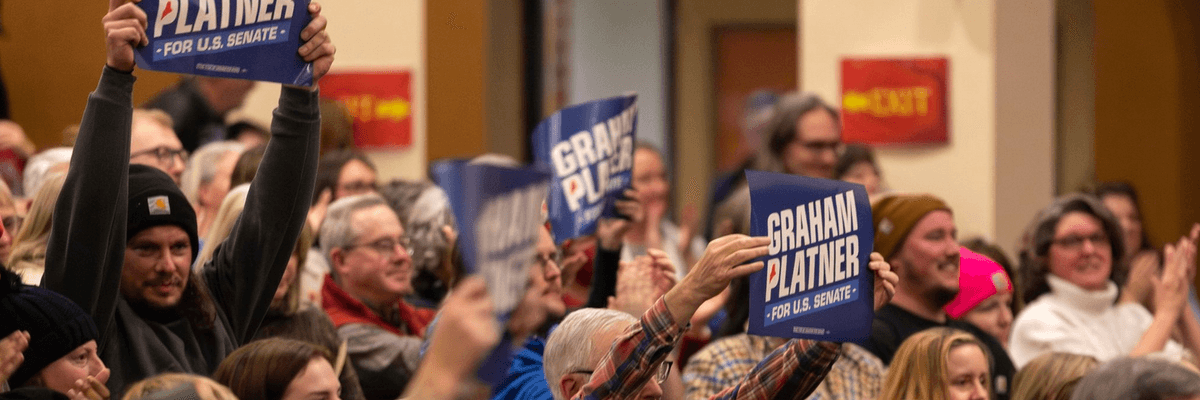
A crowd holds up "Graham Platner for US Senate" signs at a campaign event in Maine on November 22, 2025.
Platner 20 Points Ahead of Mills in Maine Senate Race as Critics Spotlight Her Anti-Worker Veto Record
The new poll, said the progressive candidate, “lays clear what our theory is, which is that we are not going to defeat Susan Collins running the same exact kind of playbook that we’ve run in the past."
It's been more than a month since a media firestorm over old Reddit posts and a tattoo thrust US Senate candidate Graham Platner into the national spotlight, just as Maine Gov. Janet Mills was entering the Democratic primary race in hopes of challenging Republican Sen. Susan Collins—a controversy that did not appear at the time to make a dent in political newcomer Platner's chances in the election.
On Wednesday, the latest polling showed that the progressive combat veteran and oyster farmer has maintained the lead that was reported in a number of surveys just after the national media descended on the New England state to report on his past online comments and a tattoo that some said resembled a Nazi symbol, which he subsequently had covered up.
The Progressive Change Campaign Committee (PCCC), which endorsed Platner on Wednesday, commissioned the new poll, which showed him polling at 58% compared to Mills' 38%.
Nancy Zdunkewicz, a pollster with Z to A Polling, which conducted the survey on behalf of the PCCC, said the poll represented "really impressive early consolidation" for Platner, with the primary election still six months away.
“Platner isn’t just leading in the Democratic primary. He’s leading by a lot, 20 points—58% are supporting him,” Zdunkewicz told Zeteo. “Only 38% are supporting Mills. There are very few undecided voters or weak supporters for Mills to win over at this point in the race."
Platner has consistently spoken to packed rooms across Maine since launching his campaign in August, promoting a platform that is unapologetically focused on delivering affordability and a better quality of life for Mainers.
He supports expanding the popular Medicare program to all Americans; drew raucous applause at an early rally by declaring, “Our taxpayer dollars can build schools and hospitals in America, not bombs to destroy them in Gaza"; and has spoken in support of breaking up tech giants and a federal war crimes investigation into Defense Secretary Pete Hegseth over his deadly boat strikes in the Caribbean.
Mills entered the race after Democratic leaders including Senate Minority Leader Chuck Schumer (D-NY) urged her to. She garnered national attention earlier this year for standing up to President Donald Trump when he threatened federal funding for Maine over the state's policy of allowing students to play on school athletic teams that correspond with their gender.
But the PCCC survey found that when respondents learned details about each candidate, negative critiques of Mills were more damaging to her than Platner's old Reddit posts and tattoo.
Zdunkewicz disclosed Platner's recent controversy to the voters she surveyed, as well as his statements about how his views have shifted in recent years, and found that 21% of voters were more likely to back him after learning about his background. Thirty-nine percent said they were less likely to support him.
The pollster also talked to respondents about the fact that establishment Democrats pushed Mills, who is 77, to enter the race, and about a number of bills she has vetoed as governor, including a tax on the wealthy, a bill to set up a tracking system for rape kits, two bills to reduce prescription drug costs, and several bills promoting workers' rights.
Only 14% of Mainers said they were more likely to vote for Mills after learning those details, while 50% said they were less likely to support her.
At The Lever, Luke Goldstein on Wednesday reported that Mills' vetoes have left many with the "perception that she’s mostly concerned with business interests," as former Democratic Maine state lawmaker Andy O'Brien said. Corporate interests gave more than $200,000 to Mills' two gubernatorial campaigns.
Earlier this year, Mills struck down a labor-backed bill to allow farm workers to discuss their pay with one another without fear of retaliation. Last year, she blocked a bill to set a minimum wage for farm laborers, opposing a provision that would have allowed workers to sue their employers.
She also vetoed a bill banning noncompete agreements and one that would have banned anti-union tactics by corporations.
"In previous years," Goldstein reported, "she blocked efforts to stop employers from punishing employees who took state-guaranteed paid time off, killed a permitting reform bill to streamline offshore wind developments because it included a provision mandating union jobs, and vetoed a modest labor bill that would have required the state government to merely study the issue of paper mill workers being forced to work overtime without adequate compensation."
Speaking to PCCC supporters on Wednesday, Platner suggested the new polling shows that many Mainers agree with the central argument of his campaign: "We need to build power again for working people, both in Maine and nationally.”
The survey, he said, “lays clear what our theory is, which is that we are not going to defeat Susan Collins running the same exact kind of playbook that we’ve run in the past—which is an establishment politician supported by the power structures, supported by Washington, DC, coming up to Maine and trying to run a kind of standard race... We are really trying to build a grassroots movement up here."
We are at a crossroads
This country and this world are at a monumental crossroads. In a few short weeks, US voters will have an opportunity to beat back the forces of fascism and confront the billionaires who are rigging the economy, our media system, and our democracy, making it increasingly impossible for ordinary people to get by. We’re not just talking about the election. We’re talking about what must be done once these fascist elements are vanquished from power. We need a bolder set of solutions than what either major party has so far been willing to offer and a working-class movement ready to fight like hell for it. Trump didn't emerge from nowhere. The conditions that fueled MAGA authoritarianism were created by decades of radical neoliberal economic policies and a corrupt political system dominated by corporate interests. They slashed taxes on the super-rich, promising that the benefits would trickle down. They said giveaways to the corporate titans would make life more affordable for the rest of us. It was all bullshit. And when a bitter, betrayed populace searches for someone to blame, right-wing demagogues have little trouble finding scapegoats. People know when they're being lied to, but you won't hear any of this from the corporate media. Only independent journalism—powered and funded by people who believe in building a better world—can deliver truly trustworthy daily news. Our Fall Campaign is underway, and we need your help. To power our newsroom through the rest of the year, we need to raise $125,000 by midnight on October 31. So if you share our vision, please contribute whatever you can to sustain our work. |
It's been more than a month since a media firestorm over old Reddit posts and a tattoo thrust US Senate candidate Graham Platner into the national spotlight, just as Maine Gov. Janet Mills was entering the Democratic primary race in hopes of challenging Republican Sen. Susan Collins—a controversy that did not appear at the time to make a dent in political newcomer Platner's chances in the election.
On Wednesday, the latest polling showed that the progressive combat veteran and oyster farmer has maintained the lead that was reported in a number of surveys just after the national media descended on the New England state to report on his past online comments and a tattoo that some said resembled a Nazi symbol, which he subsequently had covered up.
The Progressive Change Campaign Committee (PCCC), which endorsed Platner on Wednesday, commissioned the new poll, which showed him polling at 58% compared to Mills' 38%.
Nancy Zdunkewicz, a pollster with Z to A Polling, which conducted the survey on behalf of the PCCC, said the poll represented "really impressive early consolidation" for Platner, with the primary election still six months away.
“Platner isn’t just leading in the Democratic primary. He’s leading by a lot, 20 points—58% are supporting him,” Zdunkewicz told Zeteo. “Only 38% are supporting Mills. There are very few undecided voters or weak supporters for Mills to win over at this point in the race."
Platner has consistently spoken to packed rooms across Maine since launching his campaign in August, promoting a platform that is unapologetically focused on delivering affordability and a better quality of life for Mainers.
He supports expanding the popular Medicare program to all Americans; drew raucous applause at an early rally by declaring, “Our taxpayer dollars can build schools and hospitals in America, not bombs to destroy them in Gaza"; and has spoken in support of breaking up tech giants and a federal war crimes investigation into Defense Secretary Pete Hegseth over his deadly boat strikes in the Caribbean.
Mills entered the race after Democratic leaders including Senate Minority Leader Chuck Schumer (D-NY) urged her to. She garnered national attention earlier this year for standing up to President Donald Trump when he threatened federal funding for Maine over the state's policy of allowing students to play on school athletic teams that correspond with their gender.
But the PCCC survey found that when respondents learned details about each candidate, negative critiques of Mills were more damaging to her than Platner's old Reddit posts and tattoo.
Zdunkewicz disclosed Platner's recent controversy to the voters she surveyed, as well as his statements about how his views have shifted in recent years, and found that 21% of voters were more likely to back him after learning about his background. Thirty-nine percent said they were less likely to support him.
The pollster also talked to respondents about the fact that establishment Democrats pushed Mills, who is 77, to enter the race, and about a number of bills she has vetoed as governor, including a tax on the wealthy, a bill to set up a tracking system for rape kits, two bills to reduce prescription drug costs, and several bills promoting workers' rights.
Only 14% of Mainers said they were more likely to vote for Mills after learning those details, while 50% said they were less likely to support her.
At The Lever, Luke Goldstein on Wednesday reported that Mills' vetoes have left many with the "perception that she’s mostly concerned with business interests," as former Democratic Maine state lawmaker Andy O'Brien said. Corporate interests gave more than $200,000 to Mills' two gubernatorial campaigns.
Earlier this year, Mills struck down a labor-backed bill to allow farm workers to discuss their pay with one another without fear of retaliation. Last year, she blocked a bill to set a minimum wage for farm laborers, opposing a provision that would have allowed workers to sue their employers.
She also vetoed a bill banning noncompete agreements and one that would have banned anti-union tactics by corporations.
"In previous years," Goldstein reported, "she blocked efforts to stop employers from punishing employees who took state-guaranteed paid time off, killed a permitting reform bill to streamline offshore wind developments because it included a provision mandating union jobs, and vetoed a modest labor bill that would have required the state government to merely study the issue of paper mill workers being forced to work overtime without adequate compensation."
Speaking to PCCC supporters on Wednesday, Platner suggested the new polling shows that many Mainers agree with the central argument of his campaign: "We need to build power again for working people, both in Maine and nationally.”
The survey, he said, “lays clear what our theory is, which is that we are not going to defeat Susan Collins running the same exact kind of playbook that we’ve run in the past—which is an establishment politician supported by the power structures, supported by Washington, DC, coming up to Maine and trying to run a kind of standard race... We are really trying to build a grassroots movement up here."
- 'The Establishment Is Spooked': Poll Shows Platner With Big Lead Over Mills in Maine Democratic Primary ›
- Living Wage, Affordability Platforms Like Mamdani and Platner’s Have 'Major Electoral Advantage': Polls ›
- Another Poll Shows Platner's Double-Digit Lead Over Establishment Pick Mills in Maine Senate Race ›
- 'No Blood for Oil': Platner Slams 'Spineless' Susan Collins for Backing Illegal Attack on Venezuela | Common Dreams ›
- After Collins Comments on ICE in Maine, Platner Explains How to Actually Fight 'Authoritarian Overreach' | Common Dreams ›
- New Poll Shows Platner Romping in Dem Primary and Comfortably Ahead of Collins for Maine Senate Seat | Common Dreams ›
- Platner Holds 7-Point Lead Over Mills in Poll That Found Him Behind Just 3 Months Ago | Common Dreams ›
It's been more than a month since a media firestorm over old Reddit posts and a tattoo thrust US Senate candidate Graham Platner into the national spotlight, just as Maine Gov. Janet Mills was entering the Democratic primary race in hopes of challenging Republican Sen. Susan Collins—a controversy that did not appear at the time to make a dent in political newcomer Platner's chances in the election.
On Wednesday, the latest polling showed that the progressive combat veteran and oyster farmer has maintained the lead that was reported in a number of surveys just after the national media descended on the New England state to report on his past online comments and a tattoo that some said resembled a Nazi symbol, which he subsequently had covered up.
The Progressive Change Campaign Committee (PCCC), which endorsed Platner on Wednesday, commissioned the new poll, which showed him polling at 58% compared to Mills' 38%.
Nancy Zdunkewicz, a pollster with Z to A Polling, which conducted the survey on behalf of the PCCC, said the poll represented "really impressive early consolidation" for Platner, with the primary election still six months away.
“Platner isn’t just leading in the Democratic primary. He’s leading by a lot, 20 points—58% are supporting him,” Zdunkewicz told Zeteo. “Only 38% are supporting Mills. There are very few undecided voters or weak supporters for Mills to win over at this point in the race."
Platner has consistently spoken to packed rooms across Maine since launching his campaign in August, promoting a platform that is unapologetically focused on delivering affordability and a better quality of life for Mainers.
He supports expanding the popular Medicare program to all Americans; drew raucous applause at an early rally by declaring, “Our taxpayer dollars can build schools and hospitals in America, not bombs to destroy them in Gaza"; and has spoken in support of breaking up tech giants and a federal war crimes investigation into Defense Secretary Pete Hegseth over his deadly boat strikes in the Caribbean.
Mills entered the race after Democratic leaders including Senate Minority Leader Chuck Schumer (D-NY) urged her to. She garnered national attention earlier this year for standing up to President Donald Trump when he threatened federal funding for Maine over the state's policy of allowing students to play on school athletic teams that correspond with their gender.
But the PCCC survey found that when respondents learned details about each candidate, negative critiques of Mills were more damaging to her than Platner's old Reddit posts and tattoo.
Zdunkewicz disclosed Platner's recent controversy to the voters she surveyed, as well as his statements about how his views have shifted in recent years, and found that 21% of voters were more likely to back him after learning about his background. Thirty-nine percent said they were less likely to support him.
The pollster also talked to respondents about the fact that establishment Democrats pushed Mills, who is 77, to enter the race, and about a number of bills she has vetoed as governor, including a tax on the wealthy, a bill to set up a tracking system for rape kits, two bills to reduce prescription drug costs, and several bills promoting workers' rights.
Only 14% of Mainers said they were more likely to vote for Mills after learning those details, while 50% said they were less likely to support her.
At The Lever, Luke Goldstein on Wednesday reported that Mills' vetoes have left many with the "perception that she’s mostly concerned with business interests," as former Democratic Maine state lawmaker Andy O'Brien said. Corporate interests gave more than $200,000 to Mills' two gubernatorial campaigns.
Earlier this year, Mills struck down a labor-backed bill to allow farm workers to discuss their pay with one another without fear of retaliation. Last year, she blocked a bill to set a minimum wage for farm laborers, opposing a provision that would have allowed workers to sue their employers.
She also vetoed a bill banning noncompete agreements and one that would have banned anti-union tactics by corporations.
"In previous years," Goldstein reported, "she blocked efforts to stop employers from punishing employees who took state-guaranteed paid time off, killed a permitting reform bill to streamline offshore wind developments because it included a provision mandating union jobs, and vetoed a modest labor bill that would have required the state government to merely study the issue of paper mill workers being forced to work overtime without adequate compensation."
Speaking to PCCC supporters on Wednesday, Platner suggested the new polling shows that many Mainers agree with the central argument of his campaign: "We need to build power again for working people, both in Maine and nationally.”
The survey, he said, “lays clear what our theory is, which is that we are not going to defeat Susan Collins running the same exact kind of playbook that we’ve run in the past—which is an establishment politician supported by the power structures, supported by Washington, DC, coming up to Maine and trying to run a kind of standard race... We are really trying to build a grassroots movement up here."
- 'The Establishment Is Spooked': Poll Shows Platner With Big Lead Over Mills in Maine Democratic Primary ›
- Living Wage, Affordability Platforms Like Mamdani and Platner’s Have 'Major Electoral Advantage': Polls ›
- Another Poll Shows Platner's Double-Digit Lead Over Establishment Pick Mills in Maine Senate Race ›
- 'No Blood for Oil': Platner Slams 'Spineless' Susan Collins for Backing Illegal Attack on Venezuela | Common Dreams ›
- After Collins Comments on ICE in Maine, Platner Explains How to Actually Fight 'Authoritarian Overreach' | Common Dreams ›
- New Poll Shows Platner Romping in Dem Primary and Comfortably Ahead of Collins for Maine Senate Seat | Common Dreams ›
- Platner Holds 7-Point Lead Over Mills in Poll That Found Him Behind Just 3 Months Ago | Common Dreams ›