

SUBSCRIBE TO OUR FREE NEWSLETTER
Daily news & progressive opinion—funded by the people, not the corporations—delivered straight to your inbox.
5
#000000
#FFFFFF
To donate by check, phone, or other method, see our More Ways to Give page.
Daily news & progressive opinion—funded by the people, not the corporations—delivered straight to your inbox.

The only answer to Trump’s savage moves is resistance, the kind of resistance that is rising not only throughout the Global South but also in places such as Minnesota.
In the second year of Donald Trump’s second term, beginning with the kidnapping of Venezuelan President Nicolás Maduro on January 2, 2026, followed by the war of choice he has waged against Iran alongside Israeli Prime Minister Benjamin Netanyahu, the US president has continued his demolition of the 80-year-old global order set up by Washington in the aftermath of the Second World War.
That dying regime is a structure of rules, practices, and policies maintaining the hegemony of the United States and the rest of the capitalist West that was promoted with the rhetoric of freedom, free trade, and democracy. In remarkably candid words, the gap between the reality of this so-called multilateral order and the ideology that justified it was captured by the leader of a country, Canada, whose elite benefited from it. In his speech in Davos on January 20, 2026, Prime Minister Mark Carney admitted:
For decades, countries like Canada prospered under what we called the rules-based international order. We joined its institutions, we praised its principles, we benefited from its predictability. And because of that, we could pursue values-based foreign policies under its protection.
We knew the story of the international rules-based order was partially false, that the strongest would exempt themselves when convenient, that trade rules were enforced asymmetrically. And we knew that international law applied with varying rigor depending on the identity of the accused or the victim.
This fiction was useful, and American hegemony, in particular, helped provide public goods, open sea lanes, a stable financial system, collective security, and support for frameworks for resolving disputes.
So, we placed the sign in the window. We participated in the rituals, and we largely avoided calling out the gaps between rhetoric and reality.
The order Carney describes is over, with the hegemon replacing its rules and practices, already unfair to the Global South as they were, with the unilateral exercise of coercion and force, with no rules at all except the rule that might makes right. Perhaps the essence of the new order is best captured by the words of US Defense Secretary Peter Hegseth during the US-Israeli bombing of Teheran: “This was never meant to be a fair fight, and it is not a fair fight. We are punching them while they’re down, which is exactly how it should be.”
In the first three months of 2026, Trump has already succeeded in dismantling the political fictions of the old regime, among them the central principle of the United Nations that expressly prohibits “the threat of the use of force against the territorial integrity or political independence of any state, or in any other manner inconsistent with the Purposes of the United Nations.” The kidnapping of Maduro and the assassination of Iran’s Supreme Leader Ali Khamenei were the hegemon’s announcement to the world that no country is exempt from outright, brazen intervention should Trump see it fit to do so, and there would not even be the fig leaf of constructing a “Coalition of the Willing” to prettify it, as George W. Bush did prior to his invasion of Iraq in 2003. Nor were foreign territories belonging to close allies, such as Greenland, immune from annexation should Trump decide it is in the US national interest to grab them.
Despite denunciations and votes against its aggressive initiatives at the General Assembly, through its veto power at the Security Council and its threat to withhold its financial contributions to the organization’s budget, the United States has neutered the UN.
But before dismantling the political-military fiction of the old regime, Trump assaulted its economic fiction in 2025. More accurately, he resumed the transformation of the multilateral economic order that he began during his first presidency, from 2017 to 2021. During that earlier period, he continued the policy of his predecessor, Barack Obama, of blocking appointments and reappointments to the Appellate Court of the World Trade Organization (WTO), effectively paralyzing the body. But even more brazenly, he declared a unilateral trade war against China, undermining the system of rules and conventions of global trade that the United States led in institutionalizing in 1994, with the founding of the WTO.
In 2025, Trump expanded what he did not hesitate to call his “trade wars” to some 90 other countries. Among them were 50 African countries, some of whom received some of the highest, most punitive tariff increases in the world, like Lesotho (50%), Madagascar (47%), Mauritius (40%), Botswana (37%), and South Africa (30%). There was little rhyme or reason to the rates imposed, though in the case of South Africa, it was partly as punishment for bringing Israel to the International Court of Justice for committing genocide in Gaza.
Trump’s rhetoric is aggressive, brazen, and full of bluster, but let’s not be fooled. His is a defensive imperialism, a fighting retreat.
Foreign aid as an instrument of US policy was a pillar of the old international regime. As Thomas Sankara, one of Africa’s foremost fighters for liberation, pithily observed, “He who feeds you controls you.” To please his far-right base, which did not see foreign aid as important for the maintenance of US hegemony and viewed it as a waste of resources, Trump in one of his first acts—undertaken with Elon Musk, the world’s richest individual—abolished the Agency for International Development (USAID). This move drew divergent responses from progressives and liberals. For some, this was a tragedy since USAID programs were allegedly funding important public health and reproductive health projects in the Global South. For others, it was no loss at all since most of the funds for these initiatives went to pay the US contractors delivering or managing them.
Despite their crowing about doing away with foreign aid, Trump and Musk did not make any move to dismantle or reduce the flow of US funds to the International Monetary Fund, the World Bank, and regional development banks through which the bulk of US money for dominating the Global South via “development assistance“ or “structural adjustment” was funneled. Most likely, the rationale was to hold these so-called multilateral organizations in reserve for the aggressive exercise of American power via Washington’s controlling interest or veto power in these institutions should this become necessary in the future.
In the meantime, these institutions continue to maintain poverty-creating structural adjustment programs, especially in Africa, promote wrong-headed “export-led industrialization” efforts even as the United States imposes massive punitive tariffs on imports from the Global South, and block all efforts to solve the massive indebtedness of developing countries to the tune of over $11.4 trillion, which threatens a rerun of the Third World debt crisis of the early 1980s.
Last November, the Trump administration released National Security Strategy 2025, which announced that the United States would focus its military, political, and economic initiatives to making the Western Hemisphere the primary US sphere of influence. Even before the release of the memorandum, Trump had announced US plans to annex Greenland and the Panama Canal.
Moreover, the “Trump Corollary” to the old Monroe Doctrine made it clear that this would mean aggressively putting an end or countering the activities of non-regional actors such as China in the hemisphere. Shortly after the National Security Strategy went public, the kidnapping of Maduro made it clear that Washington would not hesitate to brazenly intervene in the affairs of any sovereign state in the region, in violation of the central founding principle of the United Nations.
However, with its joint assault with Israel against Iran beginning February 28, Trump appeared to be forcefully telling everyone that the United States was not departing from the old liberal containment paradigm’s perspective that the whole world was Washington’s sphere of influence, as NSS 2025 seemed to have implied. Although Trump’s volatile personality is a factor behind his shifting moves, it is becoming increasingly clear that so long as an operation does not involve sending in ground troops and relies mainly on air power or naval power, Trump is willing to use US military power anywhere in the world, as he has done not only in Iran but also in northern Nigeria, with his bombing of Islamist forces there on December 25, 2025, calculating that with few soldiers returning home in body bags, the US public could be easily pacified into accepting new foreign military engagements.
But also central in accounting for Trump’s moves is the strong influence of Israel, as evidenced not only by the joint US-Israeli assault on Iran but also his full support of Netanyahu’s genocidal campaign against the Palestinian people in Gaza and the West Bank and his sponsorship of a US-led ethnic cleansing operation in Gaza via his deliberately misnamed “Board of Peace.”
A great majority of the people of the United States oppose the war on Iran. Even key figures in the MAGA Movement, such as Steve Bannon, Tucker Carlson, and Marjorie Taylor Greene, have complained that Trump’s recent actions in Venezuela and the Middle East represent his going back on his electoral promise never to get the United States into another “forever war.” Indeed, Carlson has denounced the Iran operation as “Israel’s war,” in which the United States has no business being involved.
Perhaps there is no better explanation for Trump’s subservience to Netanyahu than that provided by a leading figure of the American far right: Curt Mills, executive director of the American Conservative. According to Mills, Trump is
not saying no to Israel because he is fundamentally too agreeable or because he’s fundamentally corrupted. He’s agreeable. He is too close to them politically. And I think, yeah, I think he’s somewhat afraid of them. Why is he afraid of them? I think they’re an intimidating society. And I think people are afraid of Mossad. I think people are afraid of Israeli influence in foreign policy, they are afraid what it can do to people’s careers.
Whatever the cause or causes of his allowing himself to be lured into a war on Iran, it is now clear that this misadventure is a massive miscalculation that might lead to some fractures in his base.
To place things in perspective, though, Israel’s overweening influence began way before Trump. The United States forced the creation of the European settler colony by the United Nations in 1947. Since then, like Frankenstein’s monster, the creature has gradually but surely come to control its creator through the powerful Zionist lobby in Washington, to the point that subservience to its wishes has become a central characteristic of both Democratic and Republican administrations.
Whatever might be his immediate motivations, Trump’s moves are mainly directed at people and countries in the Global South—Palestine, Nigeria, Venezuela, Iran, and Cuba—the last of which he has threatened to assault next or strangle into submission. There is a logic to this strategy since it is mainly the Global South that has shifted the balance of global power and created the crisis of US hegemony. Among the landmarks in this historic process have been the rise of China to becoming the second most powerful economy in the world; the massive defeats of US arms in Iraq, Libya, and Afghanistan over the last 25 years; the rise of Iran as a regional power despite all the efforts of the United States and Israel to contain it; the ability of developing countries to stymie the WTO as an engine of trade liberalization; and the rise of the BRICS as a potential counterweight to the Western alliance.
Also central to the weakening of the hegemon has been the deepening crisis of the global capitalist regime of which Washington has been the global policeman, the key manifestations of which are the deindustrialization of the United State and Europe, the financialization of the leading capitalist economies where speculation rather than production has become the investment of choice, the astounding rise in global income and wealth inequality, and the sharpening contradiction between planetary survival and the ever more intensive drive for profits.
Trump’s regime of unilateralism is a savage world. But there is no going back to the old regime of US hegemony exercised through a multilateral order systematically biased against the Global South behind a façade of liberal democratic rhetoric.
Trump’s rhetoric is aggressive, brazen, and full of bluster, but let’s not be fooled. His is a defensive imperialism, a fighting retreat, a response to the overextension of American economic and political power and the comprehensive failure of capitalism to respond to the needs of humanity and the planet. The only answer to Trump’s savage moves is resistance, the kind of resistance that is rising not only throughout the Global South but also in places such as Minnesota, where people have rallied beyond race and ethnicity to form effective communities of solidarity to stop the brutal assault on migrant families.
The Italian thinker Antonio Gramsci had a saying related to the troubled 1930s that is also apt for our times: “The old world is dying, and the new world struggles to be born. Now is the time of monsters.” Trump’s regime of unilateralism is a savage world. But there is no going back to the old regime of US hegemony exercised through a multilateral order systematically biased against the Global South behind a façade of liberal democratic rhetoric. For the Global South, indeed, for all who are partisans of justice, peace, and planetary survival, there is no choice but to bravely meet the challenge of navigating the turbulent waters of this period of transition to get to the haven of a new global order that will serve the common interest of humanity and the planet, though there is no certainty regarding when or even if that arrival will come.
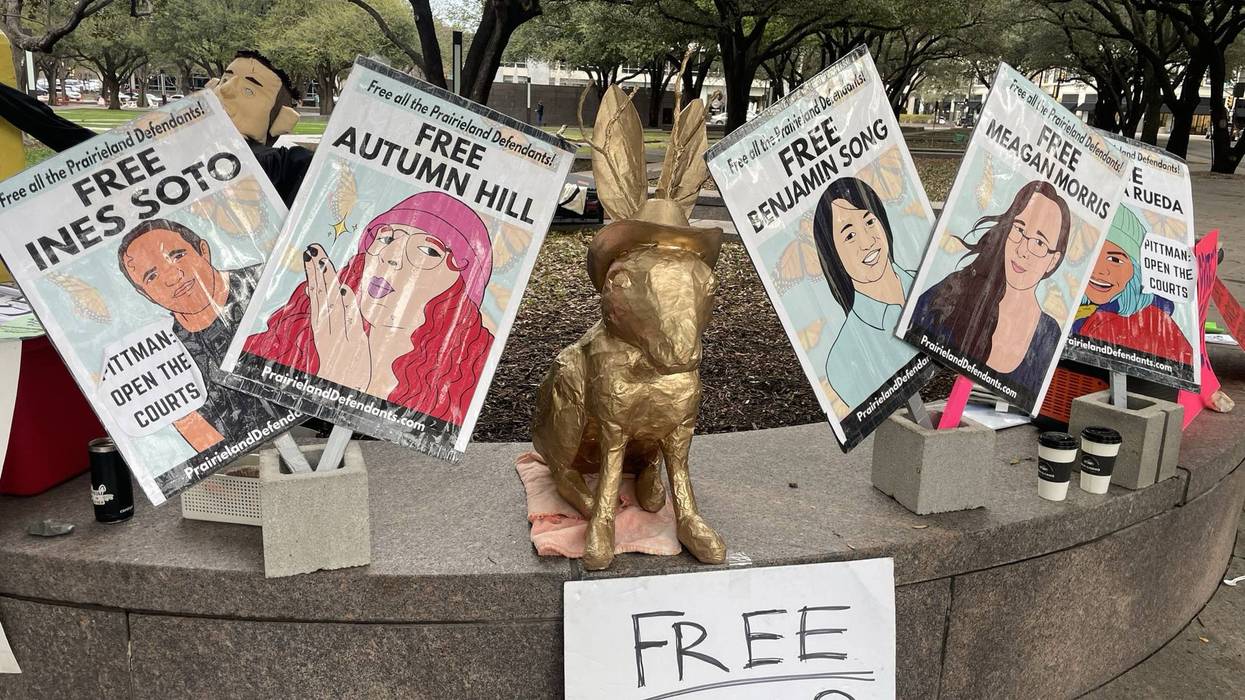
"A case like this helps the government kind of see how far they can go in criminalizing constitutionally protected protest," one legal advocate said.
The government has largely won its first case bringing material-support-for-terrorism charges against protesters alleged to belong to "antifa," which President Donald Trump designated as a domestic terror group in 2025 despite the fact that no such organized group exists and the president has no legal authority to designate organizations as domestic terror groups.
A federal jury in Fort Worth, Texas agreed on Friday to convict eight people of domestic terrorism because they wore all black to a protest outside Immigration and Customs Enforcement's (ICE) Prairieland Detention Facility in Alvarado, Texas on July 4, 2025, at which one of the protesters shot and wounded a police officer. Legal experts say the verdict could bolster attempts by the administration to stifle dissent.
"A case like this helps the government kind of see how far they can go in criminalizing constitutionally protected protests and also helps them kind of intimidate, increase the fear, hoping that folks in other cities then will think twice over protesting,” Suzanne Adely, interim president of the National Lawyers Guild, told The Associated Press.
The administration promised it would be the first such case of many.
"The US lost today with this verdict."
“Antifa is a domestic terrorist organization that has been allowed to flourish in Democrat-led cities—not under President Trump,” Attorney General Pam Bondi said in a statement Friday. “Today’s verdict on terrorism charges will not be the last as the Trump administration systematically dismantles Antifa and finally halts their violence on America’s streets.”
The trial revolved around a nighttime protest at which participants planned to set off fireworks in solidarity with the around 1,000 migrants detained inside the Prarieland ICE facility. Some participants brought guns, which is legal in Texas, as The Intercept reported.
Sam Levine explained in The Guardian what happened next:
Shortly after arriving at the facility, two or three of the protesters broke away from the larger group and began spray painting cars in the parking lot, a guard shack, slashed the tires on a government van, and broke a security camera. Two ICE detention guards came out and told the protesters to stop. A police officer arrived on the scene shortly after and drew his weapon at one of the people allegedly doing vandalism. One of the protesters was standing in the woods with an AR-15 and hit him in the shoulder. The officer would survive.
At first, the federal government charged those arrested after the event with "attempted murder of a police officer," according to NOTUS.
However, that changed after Trump's designation of antifa as a terror group in September and the release of National Security Presidential Memorandum 7 (NSPM-7), which directs federal law enforcement to target left-leaning groups and activities. The next month, the government's case expanded to include terrorism charges.
“This wouldn’t be a terrorism case if it weren’t for that memo,” one defense lawyer told NOTUS on background.
The prosecution argued that the fact that the protesters wore black clothes to the protest was enough to convict them of material support for terrorism.
“Providing your body as camouflage for others to do the enumerated acts is providing support,” Assistant US Attorney Shawn Smith said during closing arguments, as The Intercept reported on Thursday. “It’s impossible to tell who is doing what. That’s the point.”
The defense, meanwhile, warned the jury about the free speech implications of the charge.
“The government is asking you to put protesters in prison as terrorists. You are the only people who can stop that,” Blake Burns, an attorney for defendant Elizabeth Soto, said, according to The Guardian.
"When the villain is a made-up boogeyman then the target becomes 'anyone who disagrees with Trump'—and this is the result."
Ultimately, the jury decided to convict eight defendants of material support for terrorism as well as riot, conspiracy to use and carry an explosive, and use and carry of an explosive. However, they dismissed attempts by the state to argue that the protest constituted a pre-planned ambush and charge four people who had not shot at the police officer with attempted murder and discharging a firearm during a crime. Only Benjamin Song, the alleged shooter, was charged with one count of attempted murder and three counts of discharging a firearm.
The jury also convicted a ninth defendant, Daniel Rolando Sanchez Estrada, of conspiracy to conceal documents. Sanchez Estrada, who was not at the protest, had simply moved a box of zines out of his wife's home after she was arrested for the protest, according to The Intercept.
"The US lost today with this verdict,” Sanchez Estrada’s attorney, Christopher Weinbel, said, as AP reported.
Support the Prarieland Defendants said in a statement, "Everything about this trial from beginning to end has proven what we have said all along: This is a sham trial, built on political persecution and ideological attacks coming from the top."
However, the group commended the solidarity that had sprung up among the defendants and their allies and vowed to continue to support them.
"We have a long journey ahead of us to continue fighting these charges along with the state level charges," they said. "What happens here sets the tone for what’s to come. We are here and we won’t give up."
Outside observers warned about the implication for the right to protest under Trump.
"Remember all the people who dismissed the alarm over NSPM-7 because 'ANTIFA isn't even a real organization'? We told you that didn't matter. When the villain is a made-up boogeyman then the target becomes 'anyone who disagrees with Trump'—and this is the result," said Cory Archibald, the co-founder of Track AIPAC [American Israel Public Affairs Committee].
Content creator Austin MacNamara said: "The Prairieland trial was given almost zero media coverage because of the blatant lies by DHS [Department of Homeland Security] and Police. This verdict now sets a precedent for criminalization of dissent across the board. Noise demos, Black-Bloc, pamphlets/zines/red cards, all of this can be used to imprison you."
Academic Nathan Goodman wrote that convicting people of terrorism based on clothing was a "serious threat to the First Amendment."
The verdict gives new poignancy to what defendant Meagan Morris told NOTUS ahead of the jury's decision: “If we win, I think it shows that Trump’s mandate is not working, that the people understand that you can’t criminalize, you know, First and Second Amendment-protected activities. And I think if we lose, then… a lot of the country is OK with what’s going on. And it will be a much darker time, it’ll just signify a much increased crackdown on political opposition and free speech."

Being a good Cuban American means to support the people, and to fight for what's right and just for them, not for the government; American or Cuban.
What does it mean to be a good Cuban American? If you'd have asked me that question six years ago my answer would have been the standardized one, because it was an answer that had been etched into my mind since I was young.
To be a good Cuban-American I had to:
Those were the three basic pillars for being a good Cuban-American, and they were not optional. They still aren't. At least, that's what the loud Cuban-American voices in Miami and South Florida want you and me to believe.
For me, being a good Cuban American means stopping the embargo. Stop suffocating my people.
I was born in Cuba a few years before their “periodo especial,” which lasted from about 1991 to 2000. Essentially, it was an economic crisis that was highlighted by extreme reductions of already rationed foods and severe energy shortages (apagones). For the duration of my childhood and young adult life, I was taught that these burdens that Cuba felt were the sole fault of Fidel Castro and his government. That it was communism's fault, and that Che Guevara was the main architect of Cuba's torture. As a result, I grew up the way most Cubans who live in the USA do, with a severe mistrust of anything socialist or communist, fully believing that the embargo was choking the Cuban government, and having the lowest possible opinion of Castro and Che.
When I started college, I got involved in activism, and worked very closely with right-wing ideological organizations. Although at the time, I didn’t realize their beliefs were right-wing, I just felt that it was the only way to think and act as a Cuban. I was taught a lot by them, and of course, deep within all of those lessons were the continued lessons on hatred of communism and socialism, Castro and co., and supporting the embargo. This went on for many years, and I eventually became president of a local university-aligned organization. One day, I had a conversation with someone who had also been heavily involved with dissident work. We began discussing trips to Cuba; he'd said it would be his fifth trip over to the island, and I mentioned I hadn't been back since I left back in 1994. He questioned why.
I began listing all of the reasons that had been so eloquently placed into my psyche for the past 20 years: traveling to Cuba was dangerous, it only benefited the Cuban government, my money would never reach the people of Cuba, I would be blacklisted here in the USA because I would be seen as a communist sympathizer, and so forth.
He looked me right in the eyes and said all of the reasons I'd mentioned were American propaganda, and served no other purpose than to instill fear into people who would otherwise see a situation for what it truly was—cruel and unusual. A situation that only hurt the people of Cuba. A situation that was orchestrated by the American government under the guise of hurting the Cuban government, but the real objective was to obtain control of the small sovereign nation.
Over the last five years or so, I have done a lot of unlearning, and while I still feel very strongly about the Cuban government and their crimes toward the Cuban people who oppose them, I do not believe the issue of Cuba is as black and white as the loud voices in South Florida want you and me to believe. The one thing, however, that is very black and white is that the embargo does nothing but hurt the people of Cuba. The embargo does nothing else but cut off an already limited supply of items, medicines, and tools that the Cuban people need to survive.
If you ask me now what it means to be a good Cuban American, my answer is simple, yet in true Cuban fashion also very complex. Being a good Cuban American means to support the people, and to fight for what's right and just for them, not for the government; American or Cuban. Being a good Cuban American means to call for an end to the decades-long embargo that has done nothing but strangle an already struggling country. Being a good Cuban American means recognizing that NO government is without flaw, but understanding that at times when you are pushed into a corner, there are only a handful of ways to stay alive.
For me, being a good Cuban American means stopping the embargo. Stop suffocating my people. Stop oppressing my people, and stop using their suffering as the excuse to blame another government. Not in my name.
End the embargo. Help the Cuban people. If this calls to you, please join Cuban Americans for Cuba. We have poured our hearts into an open letter against the current US policies toward Cuba (CubanAmericansForCuba.Org/Letter), which is a call to our fellow Cubans to stand with us and show the world who we truly are and what we truly stand for.
Our movement is a blend of members across the United States who don't all think alike, but who share one unshakable conviction: that the future of Cuba belongs to the Cuban people, and to them alone, free from American interference and manipulation.
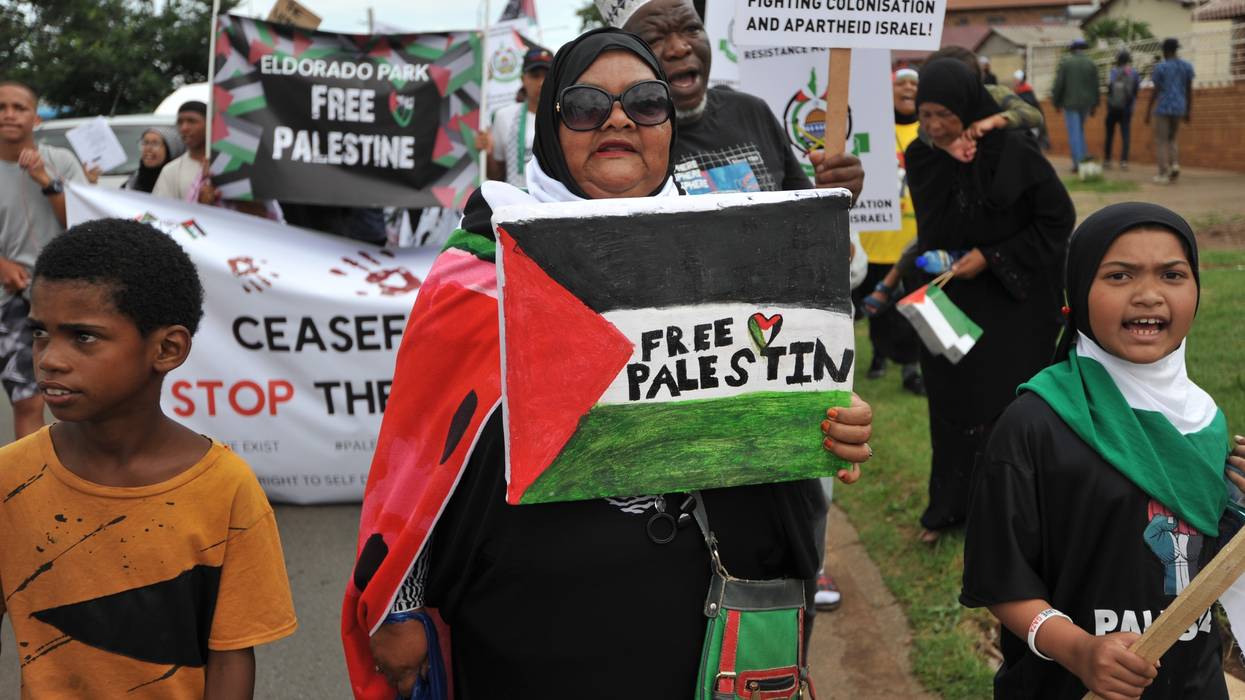
If true justice prevails in Palestine, it will inevitably prevail in Lebanon, in Syria, and beyond. The exhausted branding of the Middle East as a "war-torn region" will finally vanish.
Let us imagine a liberated Palestine. Let us consider how justice for the Palestinian people would reshape not only the region but, indeed, the entire globe.
This is not a conversation about a "political solution" in the narrow, bureaucratic sense. Such solutions require no particular genius: True justice can only occur when the Palestinian people are granted the totality of their rights and the fulfillment of their political aspirations.
Equally true is the reality that no such justice can manifest so long as Israel remains committed to its current Zionist ideology—a framework predicated on racial supremacy and the systematic eradication of the Indigenous Palestinian Arab population. Once the shackles of this ideology are broken, the exact political mechanics become secondary; history suggests that the future would lean toward a shared coexistence rather than a continuation of the current segregation along ethnic lines.
To some, discussing a liberated Palestine now may appear slightly—though not entirely—removed from the current war ravaging the region. It is a war that, if not permanently halted, will continue to devastate the peoples of the Middle East, inviting further militarization, runaway defense spending, and cycles of violence. On the contrary, this is the most critical discussion we can have today.
A just peace will invite more than just the absence of war; it will invite opportunity, reconstruction, a collective regional rise, and—most importantly—the restoration of hope.
In his seminal documentary, the late Australian journalist and filmmaker John Pilger summed up the centrality of Palestine to the Middle East in these prescient words:
A historic injustice has been done to the Palestinian people, and until Israel’s illegal and brutal occupation ends, there will be no peace for anyone—Israelis included.
These are not mere words of posturing; they are an undeniable historical truth. Palestine has remained the beating heart of every Middle Eastern war and every persisting conflict. For Israel, the occupation has served as the linchpin for its military incursions across borders. For Palestine’s neighbors and allies, it remains the unhealed wound of a region historically unified by political, cultural, linguistic, and religious continuity.
Even during periods when Palestine was seemingly relegated to the periphery of regional diplomacy, Israel was keen to remind its neighbors that its designs were never limited to the Palestinians alone. Whether in historic Palestine or the Shatat (Diaspora), the Zionist project has always signaled broader ambitions.
Israeli Prime Minister Benjamin Netanyahu has explicitly confirmed this expansionist intent, recently declaring that he is on a “historic and spiritual mission” to realize the vision of a “Greater Israel.” By openly connecting with a map that swallows Palestinian land and threatens the sovereignty of neighboring Arab states, he has made it clear that the erasure of Palestine is merely the first step in a much larger colonial design.
The current war confirms this centrality. Its origins, the ensuing political discourse, and the clashing visions of a "post-war" reality all pull Palestine back to the center of the global stage. To discuss Palestine as if it were an isolated issue—as some unfortunately do—is a profound historical mistake. Conversely, to discuss the future of the Middle East without centering Palestine is equally delusional.
Therefore, we must insist on the Palestinian discussion now more than ever. Once a just outcome to the Palestinian struggle is achieved, the positive shock waves will transform the region. Only then can we move from a state of perpetual warfare to a future rooted in genuine, collective liberation.
That said, do not expect a list of dry political recipes to follow. We already know, instinctively, what justice for Palestinians looks like. The freedom to live, to be treated with equality, to enjoy sovereignty, and to demand accountability and respect—these do not require exhaustive citations of international legal or humanitarian law. These are natural rights; they flow through us, individually and collectively, as surely as the blood in our veins.
The fact that Israel and its enablers refuse to respect international law, or to adhere to any common humanitarian principle, is no fault of the Palestinians or the other victims of Israeli aggression. The moral and legal burden must be shouldered entirely by those who have abused, disregarded, and dismantled the international legal order for far too long.
Today, the Palestinians—much like the people of Lebanon, Syria, and other nations across the region—are doing exactly what every oppressed nation must do: They are remaining steadfast. This Sumud is the key, now more than ever before. The ultimate outcome of this conflict will not be determined by lopsided death tolls or the sheer scale of structural destruction, but by the unyielding resilience of the people. History is a patient teacher; it tells us that if the rightful owners of the land hold their ground, they will eventually win.
Richard Falk, the former United Nations Special Rapporteur on Palestinian Human Rights and a prominent legal scholar, refers to this phenomenon as winning the "War of Legitimacy." It is a war fought not with fighter jets, but with the moral clarity of those who refuse to disappear.
If true justice prevails in Palestine, it will inevitably prevail in Lebanon, in Syria, and beyond. The exhausted branding of the Middle East as a "war-torn region" will finally vanish. A just peace will invite more than just the absence of war; it will invite opportunity, reconstruction, a collective regional rise, and—most importantly—the restoration of hope.
This is not a desperate wish whispered in a time of darkness. It is the only way out.