

SUBSCRIBE TO OUR FREE NEWSLETTER
Daily news & progressive opinion—funded by the people, not the corporations—delivered straight to your inbox.
5
#000000
#FFFFFF
To donate by check, phone, or other method, see our More Ways to Give page.
Daily news & progressive opinion—funded by the people, not the corporations—delivered straight to your inbox.
"Clearly, the international repression of the Palestinian cause knows no bounds."
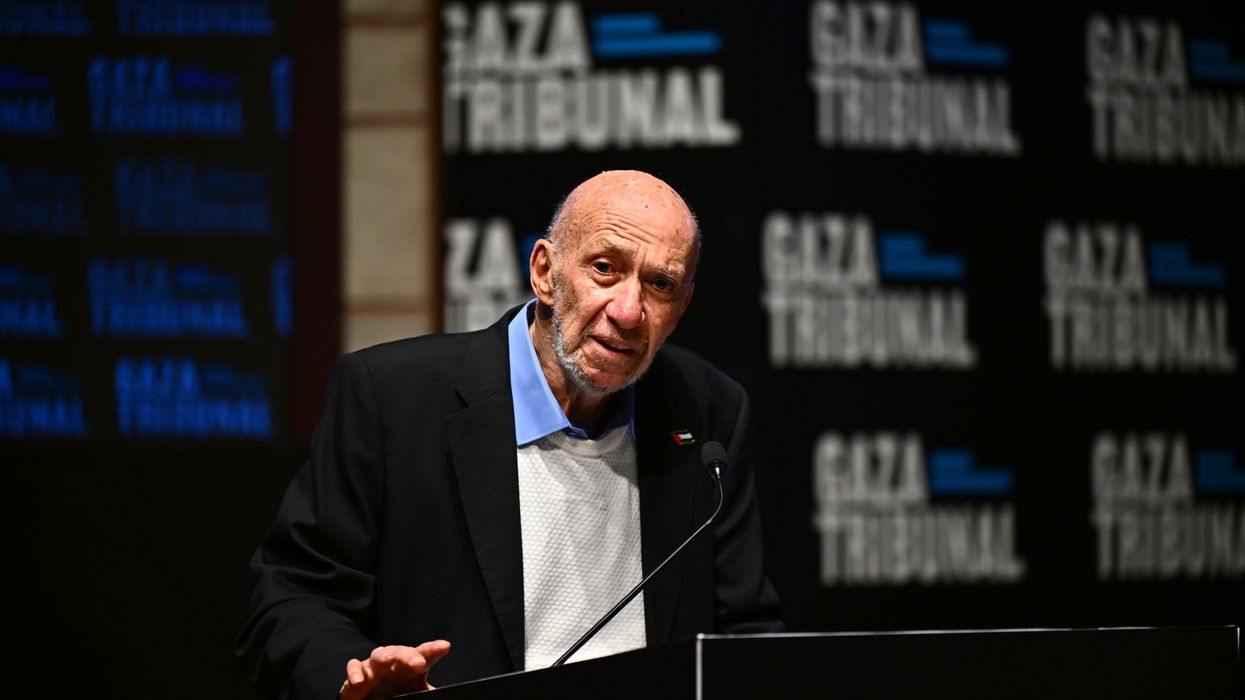
Ninety-five-year-old Richard Falk—world renowned scholar of international law and former UN special rapporteur focused on Palestinian rights—was detained and interrogated for several hours along with his wife, legal scholar Hilal Elver, as the pair entered Canada for a conference focused on that nation's complicity with Israel's genocide in Gaza.
"A security person came and said, ‘We’ve detained you both because we’re concerned that you pose a national security threat to Canada,'” Falk explained to Al-Jazeera in a Saturday interview from Ottawa in the wake of the incident that happened at the international airport in Toronto ahead of the scheduled event.
“It was my first experience of this sort–ever–in my life,” said Falk, professor emeritus of international law at Princeton University, author or editor of more than 20 books, and formerly the UN special rapporteur on the situation of human rights in the Palestinian territories.
Falk, who is American, has been an outspoken critic of the foreign policy of Canada, the United States, and other Western nations on the subject of Israel-Palestine as well as other issues. He told media outlets that he and his wife, also an American, were held for over four hours after their arrival in Toronto. They were in the country to speak and participate at the Palestine Tribunal on Canadian Responsibility, an event scheduled for Friday and Saturday in Ottawa, the nation's capital.
The event, according to the program notes on the website, was designed to "document the multiple ways that Canadian entities – including government bodies, corporations, universities, charities, media, and other cultural institutions–have enabled and continue to enable the settler colonization and genocide of Palestinians, and to articulate what justice and reparations would require."
In his comments to Al-Jazeera, Falk said he believes the interrogation by the Canadian authorities—which he described as "nothing particularly aggressive" but "random" and "disorganized" in its execution—is part of a global effort by powerful nations complicit with human rights abuses and violations of international law to “punish those who endeavour to tell the truth about what is happening” in the world, including in Gaza.
Martin Shaw, a British sociologist and author of The New Age of Genocide, said the treatment of Falk and Elver should be seen as an "extraordinary development" for Canada, and not in a good way. For a nation that likes to think of itself as a "supporter of international justice," said Shaw, "to arrest the veteran scholar and former UN rapporteur Richard Falk while he is attending a Gaza tribunal. Clearly, the international repression of the Palestinian cause knows no bounds."
Canadian Senator Yuen Pau Woo, a supporter of the Palestine Tribunal, told Al-Jazeera he was “appalled” by the interrogation.
“We know they were here to attend the Palestine Tribunal. We know they have been outspoken in documenting and publicizing the horrors inflicted on Gaza by Israel, and advocating for justice,” Woo said. “If those are the factums for their detention, then it suggests that the Canadian government considers these acts of seeking justice for Palestine to be national security threats–and I’d like to know why.”
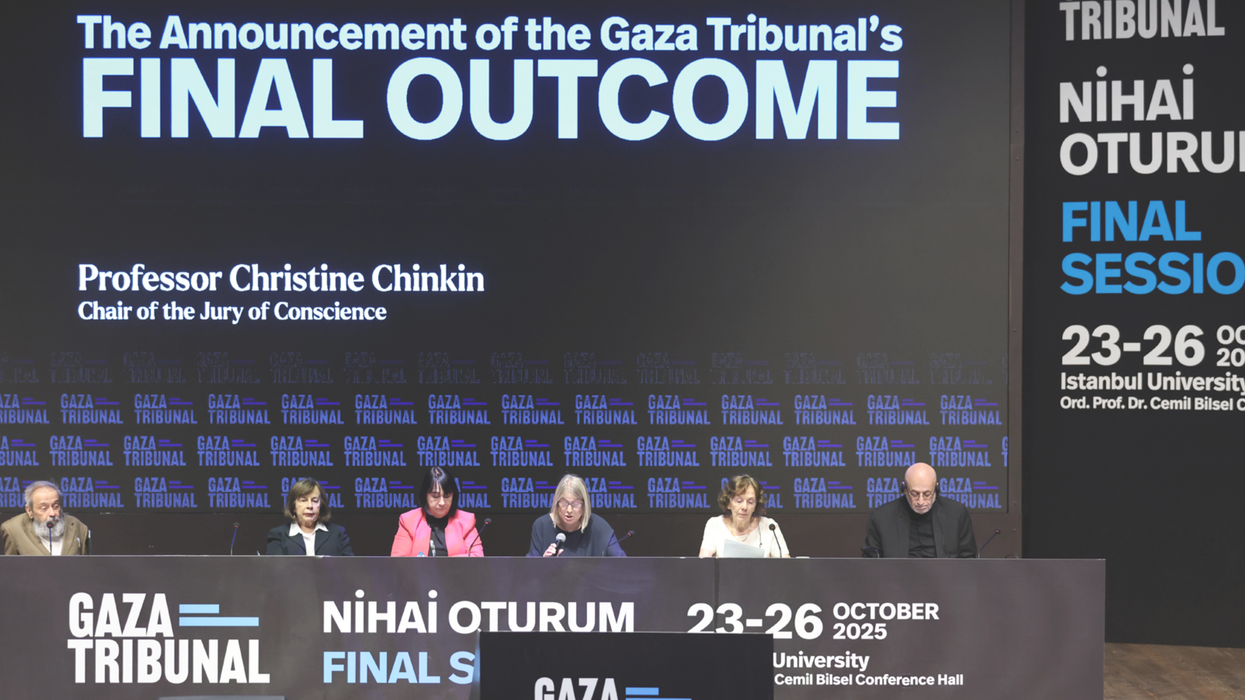
The Gaza Tribunal's final statement calls for legal accountability, suspension of Israel from global groups, and activation of a veto-proof UN mechanism for international intervention to stop the genocide.
A civil society panel assembled in response to Israel's annihilation and starvation of Gaza delivered its final statement Sunday in Istanbul—detailing nine categories of crimes committed, warning that genocide continues, and calling on humanity to take action to hold the perpetrators legally and morally accountable.
Chaired by Richard Falk, a former United Nations special rapporteur on human rights in the occupied Palestinian territories and a professor emeritus at Princeton University in New Jersey, the Gaza Tribunal held four days of public hearings during which international jurists, experts, and witnesses offered evidence and testimonies of what they said are Israel's continuing crimes against the Palestinian people.
Israel "is perpetrating an ongoing genocide against the Palestinian people in Gaza, within—and enabled by—a broader settler-colonial apartheid regime rooted in the supremacist ideology of Zionism," said Christine Chinkin, a University of Michigan law professor who chaired the tribunal's Jury of Conscience.
"The jury, guided by conscience and informed by international law, does not speak with the authority of states, but when law is silenced by power, conscience must become the final tribunal," she continued. "We believe that genocide must be named and documented and that impunity feeds continuing violence throughout the globe."
"Genocide in Gaza is the concern of all humanity," Chinkin added. "When states are silent civil society can and must speak out."
The jury named—and condemned—Israel's crimes in Gaza, including:
Additionally, the jury "finds Western governments, particularly the United States, and others complicit in, in some cases colluding with, Israel’s commission of genocide through provision of diplomatic cover, weapons, weapon parts, intelligence, military assistance and training, and continuing economic relations," Chinkin said.
The panel called for "ending impunity and ensuring accountability" by using legal institutions such as the International Court of Justice—which is currently weighing a genocide case against Israel filed by South Africa—and the International Criminal Court, which last year issued arrest warrants for Israeli Prime Minister Benjamin Netanyahu and former Defense Minister Yoav Gallant for alleged war crimes and crimes against humanity in Gaza including murder and forced starvation.
The jury also urged UN member states to invoke the United for Peace resolution adopted by the UN General Assembly (UNGA) in 1950. The measure is designed to empower action when at least one of the five permanent Security Council members uses a veto to thwart functions mandated under the UN Charter.
The resolution—which has been implemented more than a dozen times—allows the UNGA to take actions ranging from rejecting Israel’s UN credentials to mandating an armed protection force for Gaza, if approved by two-thirds of UN member states.
The jury further recommended "resisting and dismantling oppressive structures" by "building a worldwide movement that weakens, isolates, and dismantles each source through coordinated political, legal, economic, academic, cultural, technological, and social action."
It also called for "comprehensive global confrontation" of Israel "in every sphere—political and diplomatic; legal and human rights; economic and commercial; media, cultural, intellectual, academic, and educational; industrial, technological, and scientific; arts, tourism, and sports."
"Silence is not neutral; silence is complicity," Chinkin concluded, adding that "neutrality is surrender to evil."
"When the Israeli army can do these things and get away with it, it can only then do more of it knowing that it will not meet any punishment," said one analyst.
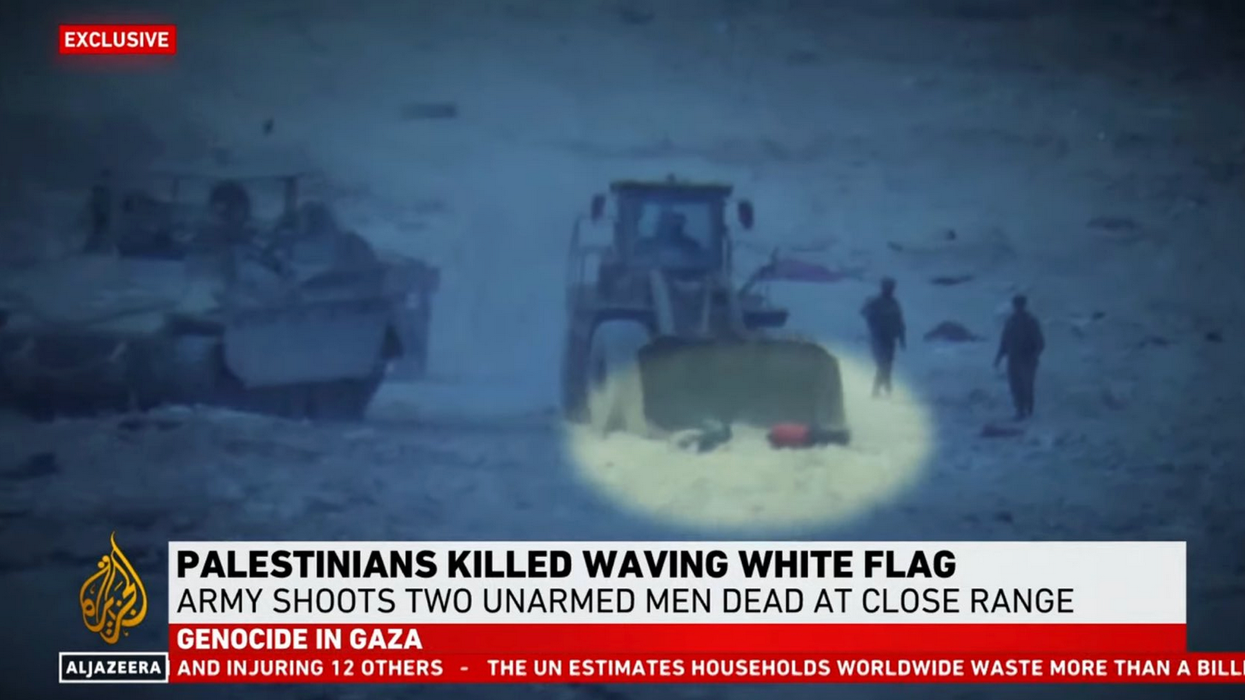
Video footage broadcast Wednesday by Al Jazeera shows Israeli soldiers gunning down two Palestinians on the coast of northern Gaza, even as one of them waves what appears to be a piece of white fabric.
The footage shows one of the men walking in the direction of an Israeli military vehicle with both hands raised. Despite the absence of any clear evidence that the man posed a threat, Israeli forces shot him from a short distance away. Another man is seen on the ground not far behind.
Al Jazeera's Tareq Abu Azzoum said the killings took place near where World Central Kitchen recently dropped off food aid.
The video then shows Israeli soldiers burying the bodies with a bulldozer.
"Probably certain words should be invented for this sort of thing," Marwan Bishara, AI Jazeera's chief political analyst, said in response to the footage. "I am not sure we have the sufficient vocabulary to describe this sort of twilight zone of Israel's fantasy of being the world's most moral army."
"It's a fantasy that meets the reality of a genocide," Bishara added. "An attempt to kill or destroy much of Palestine and Palestinians and hide the evidence and lie about it. When the Israeli army can do these things and get away with it, it can only then do more of it knowing that it will not meet any punishment."
Watch:
مشاهد حصرية للجزيرة لإعدام جنود إسرائيليين مدنيين فلسطينيين أثناء محاولتهم العودة لشمال قطاع غزة#الأخبار #حرب_غزة pic.twitter.com/QER98mv2n6
— قناة الجزيرة (@AJArabic) March 27, 2024
Richard Falk, former United Nations special rapporteur on the human rights situation in the occupied Palestinian territories, told Al Jazeera that the footage provides "vivid confirmation of continuing Israeli atrocities" and spotlights the "unambiguous character of Israeli atrocities that are being carried out on a daily basis."
"The eyes and ears of the world have been assaulted in real-time by this form of genocidal behavior," said Falk. "It is a shocking reality that there has been no adverse reaction from the liberal democracies in the West. It is a shameful moment."
The Euro-Mediterranean Human Rights Monitor, whose board Falk chairs, has documented numerous examples of Israeli soldiers conducting close-range field executions in Gaza since October 7, when Israel launched its latest assault following a Hamas-led attack.
In less than six months, Israeli forces have killed more than 32,500 people in Gaza and sparked one of the worst humanitarian catastrophes in modern history.
The video footage emerged just days after the United Nations Security Council approved a resolution demanding an immediate cease-fire in Gaza. The U.S., Israel's leading arms supplier, abstained from the vote and falsely claimed the measure was "nonbinding."
The Israeli government, for its part, immediately signaled that it would disregard the resolution, just as it has ignored orders from the International Court of Justice.
Sophie McNeill, a human rights campaigner, called the footage released Wednesday "horrifying" and demanded that the International Criminal Court "urgently prioritize investigating and charging all those carrying out war crimes in Gaza."
"There just so happened to be a camera here in this moment. What are we not seeing?" McNeill asked. "This impunity must end."
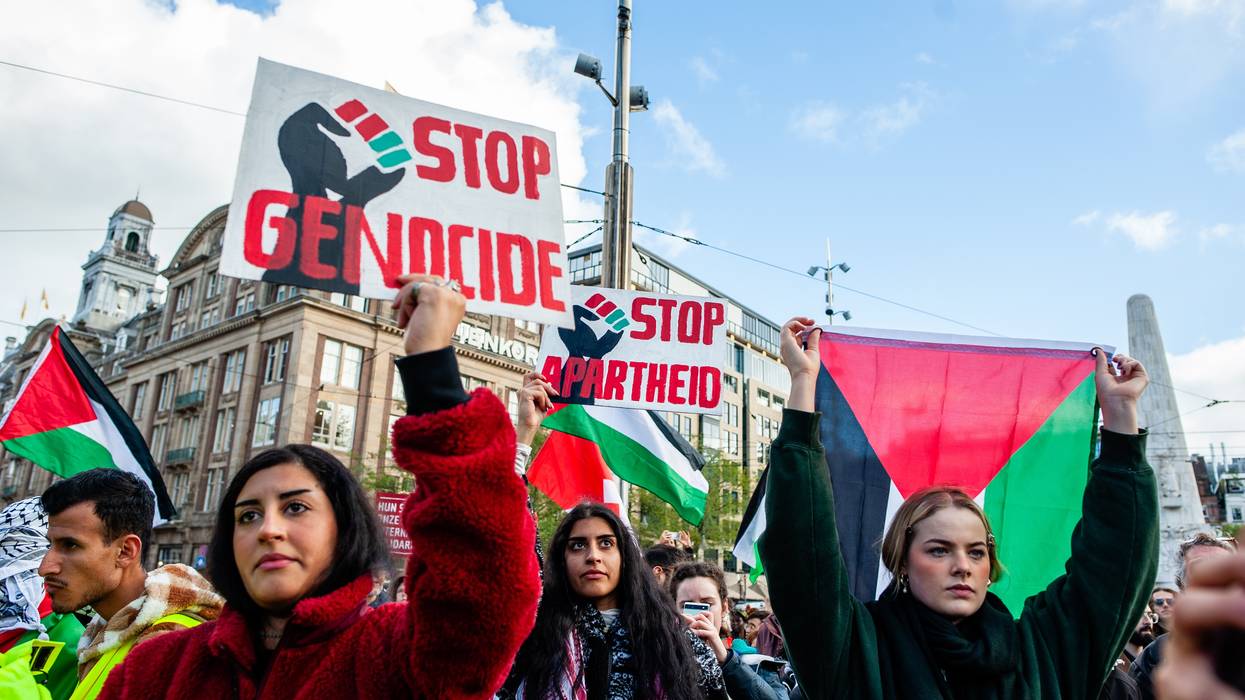
It’s a tool in the campaigns for cease-fire now underway around the world. But will the President of the United States pick it up?
Friday morning’s much-anticipated decision by the International Court of Justice “marks the greatest moment in the history of the [court],” says Richard Falk, a noted international law professor and former United Nations Special Rapporteur on Human Rights in the Occupied Palestinian Territory.
“It strengthens the claims of international law to be respected by all sovereign states — not just some,” Falk says about the ICJ’s ruling that South Africa’s magisterial presentation of evidence “was sufficient to conclude” Israel may be committing, conspiring to commit, or publicly inciting the commission of genocide against Palestinians in Gaza.
The ICJ decision gave new strength to South Africa’s groundbreaking accomplishment — demolishing the taboo against holding Israel accountable for its crimes. As South Africa’s foreign ministry put it, “Today marks a decisive victory for the international rule of law and a significant milestone in the search for justice for the Palestinian people.”
“The decision is a momentous one,” says the foreign ministry, noting how important the determination is for the implementation of the international rule of law. “South Africa thanks the Court for its swift ruling.”
Friday’s decision was a significant victory beyond what most observers hoped for — not only the recognition that Israel’s actions are plausibly genocidal, but because of the imposition of provisional measures based on measures South Africa requested in order to stop Israel’s actions that are continuing to kill and put Palestinians at risk.
The ruling was also particularly important because of the overwhelming majority of judges who supported it, including the sole U.S. judge on the court. When the president of the court, Judge Joan Donoghue, who was a longtime State Department lawyer before being elected to the ICJ, read out the provisional measures, she included the line-up of how judges voted on each one. And she was among the 15 or 16 out of 17 judges who supported every one.
While judges serve as individuals and are not supposed to represent their governments, there is no question that national allegiances and other political considerations often emerge. In this case, only the judge from Uganda opposed all the court’s measures while the temporary Israeli judge opposed four out of six.
It should not have been a surprise that this preliminary finding recognized that Israel’s war against the entire population of Gaza may well constitute genocide. The definition, under the Convention on the Prevention and Punishment of the Crime of Genocide, says that two things are required to fulfill that definition: a specific intent to destroy all or part of a racial, ethnic, religious or other group (in this case the Palestinian population of Gaza), and the commission or attempt to commit any one of five specific acts to realize that intent. South Africa presented evidence that Israel is already committing — and conspiring to commit and inciting commitment — of at least four of those acts: killing, seriously injuring members of the group, creating conditions that make survival of the group impossible, and preventing births within the group. The ICJ decision was not a full determination of the facts and the law — as usual, those issues in international legal venues take years. This kind of initial finding requires a very low bar, only that it is “plausible” that Israel’s military actions, the siege and more could plausibly be found to constitute genocide.
It took the court only two weeks to come to this ruling, though still too long given the numbers of people the Israeli military is killing on a daily basis. But it still represents a hugely important step that will play a major role in strengthening the growing, broadening movement for Palestinian rights that is now playing such an unprecedented role in U.S. and global politics.
And then the ICJ went further, imposing six provisional measures to try and ensure that the rights of Palestinians might be protected from those actions. The measures imposed by the court say Israel “shall take all necessary measures” to prevent the commission of any of the five acts named in the Genocide Convention, that it ensure that its military forces do not commit any of those acts, that it punish any public incitement to those acts, that it take all measures to provide humanitarian assistance, to prevent the destruction of evidence relevant to the charges of genocide, and to report to the court within one month on what Tel Aviv is doing to abide by the court’s ruling.
The first measure was the only one weakened by the court. South Africa had requested the immediate suspension of military operations: a cease-fire. The ICJ language refers only to taking “all necessary measures” to prevent the five genocidal actions, but without demanding an actual end to the military assault. However, the Court’s second measure arguably answers that weaker language by keeping to the South African request that Israel make sure “that the military does not commit” any of the relevant acts — meaning that the IDF should stop killing people and be prevented from doing so. Not just prevented from killing “too many” people, as President Joe Biden’s administration and others have urged, but prevented from killing any people.
In both a national and international context, the Court’s decision poses a huge problem for the Biden administration. White House and State Department officials took the absolute position immediately after South Africa filed their petition to the ICJ that the claim of genocide was “meritless.” But with a close-to-unanimous court ruling that Israel’s assault on Gaza is plausibly genocidal — and with the singular U.S. judge standing with the majority — that dismissive attitude, and related claims that “the UN is biased against Israel” will not get much traction.
Just moments after Judge Donoghue finished reading the court’s ruling, Falk indicated that “this outcome poses the greatest political dilemma for the Biden presidency.”
“I only hope that Biden will, on this occasion,” Falk said, “stand up for justice.”
It is important to remember that while ICJ decisions are binding in international law, there is no appeal, and they are not self-enforcing. The court has no army, not even a police force to send around the world to make sure its orders are being implemented. What it does have, as part of the UN system, is an extraordinary level of credibility. All countries are bound by its decisions.
The Genocide Convention itself, unlike most parts of international law, places specific obligations on every party to the treaty — not only to countries who could be charged with violating its terms. So Friday’s ICJ decision applies to all 153 governments that are party to the Genocide Convention — meaning they have specific obligations to prevent genocide from occurring, to stop it when it does occur, to not be complicit in genocidal actions, and to punish any incitement to genocide that might occur in their own countries.
That means that if this decision goes to the UN Security Council for implementation arrangements, and if, as would be likely, the United States vetoed those efforts, and it then goes to the General Assembly, lots of possibilities arise.
This decision fundamentally, even if preliminary, provides a vital new tool for mobilization and campaigns to force governments to escalate their pressure to stop Israel’s genocide. It’s a tool in the campaigns for cease-fire now underway around the world. In the United States it will likely be a persuasive tool for congresspeople, city councils, universities and other institutions — as well as the Biden administration — to support a cease-fire. Because now it’s not only a question of moral obligation to stop the slaughter of tens of thousands of innocents, it’s also about abiding by the requirements of international law. And for some people, that may make all the difference.
With this new tool in hand, a U.S. shift towards supporting — and demanding — a cease-fire may be possible much sooner.
By failing to advocate for a ceasefire, western states have given a green light to Israel's agenda of collective punishment.
In the avalanche of emotionally fraught commentary on the 7 October attack by Palestinian fighters against Israel and the subsequent Israeli assault on Gaza, media and political leaders appear to have forgotten that from the perspective of international law, Gaza remains an occupied territory subject to the Fourth Geneva Convention (Geneva IV).
Although Israel unilaterally proclaimed its "disengagement" from Gaza in 2005—withdrawing its troops, dismantling 21 settlements and ejecting 8,000 settlers (somewhat offset by giving each unlawful settler family hundreds of thousands of dollars in compensation)—this did not end Israel’s obligations under international law.
The United Nations Human Rights Council has drawn this conclusion on the basis that Israel’s disengagement did not end the existential realities of Israeli control over Gaza, nor did it allow the territory to enjoy the benefits of autonomous political development.
Rather, the process involved an intrusive redeployment of occupying military and police forces on Gaza’s borders, including total control over the entry and exit of Palestinians and goods at border crossings, as well as continuing exclusive dominance over Gaza’s air and sea space.
The question of Gaza’s legal status is extremely relevant to the indiscriminate and disproportionate Israeli retaliation, which has been justified by Israel and its supporters as exacting vengeance while pursuing the goal of destroying Hamas.
This post-2005 structure of occupation was reinforced by frequent Israeli incursions, including targeted assassinations of Hamas political and military officials, frightening sonic booms of overflying Israeli fighter jets, and major military operations in 2008-09, 2012, 2014 and 2021, during which Israel committed many war crimes.
This typical experience of condemning Israel’s policies and practices, but taking no proposed preventive or punitive action in response, has been repeated over and over again, which explains Palestinian disillusionment with the UN and international law.
The question of Gaza’s legal status is extremely relevant to the indiscriminate and disproportionate Israeli retaliation, which has been justified by Israel and its supporters as exacting vengeance while pursuing the goal of destroying Hamas.
The 7 October Palestinian fighters' operation inside Israel, accounting for more than 1,400 Israeli deaths and the capture of around 200 hostages, was itself a distinct war crime.
Neither the Palestinian fighters' attack nor Israel’s response are free from the restraints of law and morality. In the simplest terms, the crimes committed do not give legal impunity to retaliatory Israeli war crimes.
The central point thus far lost in the public discourse is this: just as the Palestinian armed factions had no authority to commit war crimes because they were intensely provoked by decades of Israeli criminal actions, nor does Israel have the authority to act outside the constraints of law when retaliating.
The proper international framing of the relationship between Israel and Hamas—despite being crucial to interpreting the legal, moral and political issues at stake—has been revealingly absent from most media treatments and the policy postures of influential western political leaders.
By failing to advocate for a ceasefire, western states have given a green light to Israel's agenda of collective punishment
Israel has used the most inflammatory and expansive language to vindicate its retaliatory responses. This lawless Israeli extremism has been blandly endorsed by governments in the US, France, Germany, and the UK. Such pronouncements neglect to mention the obligation of the occupying power to administer the territories under its control in ways that give priority to the protection and wellbeing of the occupied civilian population. The occupier does enjoy a reciprocal right to maintain its security in ways that respect and protect non-combatants.
From such a perspective, it is conceptually misleading and normatively unacceptable for Israel to declare war against an occupied territory, as if the indigenous administrative authority was an enemy foreign government—but this is exactly what Israel has done, including claims of self-defense that do not fit the situation of belligerent occupation.
Israel has declared a total war on Gaza, imposing a genocidal siege that has cut off supplies of food, electricity and fuel, making no provision whatsoever to exempt civilians—most of whom have no direct contact with the military activities of Hamas.
Article 55 of Geneva IV sets forth the duty of Israel as occupying power to ensure that the people living in the territory it “occupies” have adequate food, water and medicines. But Israel’s indiscriminate retaliation has included repeated nighttime aerial bombardments of residential areas, alongside the forbidden targeting of hospitals, schools and UN buildings, where many Palestinians have sought shelter under these extraordinary conditions.
Israel has declared a total war on Gaza, imposing a genocidal siege that has cut off supplies of food, electricity and fuel, making no provision whatsoever to exempt civilians—most of whom have no direct contact with the military activities of Hamas.
A 24-hour evacuation order directed at 1.1 million Palestinians living in northern Gaza, without the provision of reasonable time to arrange such a dangerous departure from long-term places of residence, was aggravated by the lack of a safe and habitable place for Palestinians to go, thus intensifying the dangers facing civilians in Gaza - and their suffering. Such a measure amounts to extreme collective punishment, which is prohibited by Article 33 of Geneva IV. It has less to do with security than with driving Palestinians out of Gaza, thereby implementing the end-game visions of Israel’s extremist coalition government.
It is relevant to note that Michael Lynk, the UN’s special rapporteur for Palestine, submitted a detailed report to the agency on why Israel’s authority as occupying power should be terminated, given its failure to comply with applicable international human rights law.
This recommendation was ignored by the UN, but the General Assembly was sufficiently distressed by Israel’s pattern of behaviour in occupied Palestine that it requested an advisory opinion from the International Court of Justice on the continuing legality of Israel’s status as an occupying power within the framework of Geneva IV. The case is currently under consideration by the court.
If the West continues to endorse the double standards on display during the humanitarian catastrophe unfolding in Gaza, it will serve as a reminder that the post-colonial world retains an ethos of Orientalist racism when it comes to addressing issues of peace and justice in the Middle East.
By failing to advocate for a ceasefire, western states have given a green light to Israel’s agenda of collective punishment, which might itself be grotesque cover for the regime’s end goal of massive dispossession and ethnic cleansing of the Palestinian people.

The following open letter, signed by 124 academics from around the globe, is addressed to the Washington Office on Latin America and voices serious concerns over WOLA's support for various components of the Trump administration's policy towards Venezuela.
We write out of concern for the direction that WOLA has taken with regard to a matter of life and death, and possibly war and peace, in Latin America. This letter is an attempt to engage with WOLA about your support for various components of the Trump administration's efforts to topple the government of Venezuela.
We believe that the Trump administration's regime change effort in Venezuela is wrong in every way: morally, legally, and politically. Since war has been openly threatened repeatedly by Trump himself and his top officials, this effort also runs a high risk in terms of the loss of human life and limb, and other unforeseen consequences of war and political violence.
For these reasons and more, WOLA should oppose this regime change effort unequivocally, just as progressives throughout the world opposed the Iraq War of 2003. But it has not done so. Rather, it has endorsed much of it. People may have differing personal opinions regarding the internal politics of Venezuela or how Venezuelans might best resolve their differences. But there is no doubt that the Trump administration's illegal regime change operation is greatly worsening the situation and should be opposed by all who care about human life and international law.
"WOLA should oppose this regime change effort unequivocally, just as progressives throughout the world opposed the Iraq War of 2003."
Most dangerous is WOLA's opposition to the offers of mediation by Pope Francis as well as the neutral governments of Mexico and Uruguay. WOLA has referred to these offers -- which have been called the Montevideo mechanism -- as a "non-starter." Instead, WOLA has chosen the European Contact Group, which is dominated by Washington and governments allied with its illegal sanctions and regime change effort, as the only legitimate place for negotiations to take place.
Since the Trump administration clearly has no desire to negotiate, and has openly stated this, WOLA's choice implies that there will be no real negotiations until the other (European and Latin American) governments in the group are willing to make a clean break with Washington. This is not impossible, but it is unlikely in the foreseeable future. WOLA's choice of a Trump-dominated negotiating group therefore aids Trump and his team of extremists (John Bolton, Marco Rubio, and Elliott Abrams), in their rejection of dialogue or negotiation.
WOLA even rejects the involvement of the UN in negotiations, which the UN Secretary-General Antonio Guterres has proposed, claiming that their role should be limited to overseeing a transition. The UN is the international body that has accumulated the most experience and knowledge in mediating inter- and intra-national crises. This includes successfully mediating the end to even seemingly intractable civil wars, such as in El Salvador in the 1990s. This expertise, alongside the moral authority the UN has as the most representative international body, means that a mediation process overseen by them would carry much more legitimacy than one led by the Trump administration and its political allies.
WOLA has been ambiguous about whether it supports the recognition of Juan Guaido as "interim president," a move that automatically creates a trade embargo on top of the current financial embargo. This is because the source of almost all of the country's foreign exchange is from oil exports, about three-quarters of which goes to countries that have joined the Trump recognition of a parallel government, and therefore will not be expected to pay the current government of Venezuela for its oil.[1]
This will deprive the economy of billions of dollars of foreign exchange, thus accelerating the increase in mortality (including infant and child mortality) from lack of medicines and health care, as well as worsening shortages of food -- an impact that is widely acknowledged. This is profoundly immoral. It also breaches international law, including Article 19 of the OAS Charter, the UN charter, and many other international treaties that the US has signed.
WOLA has also taken an ambivalent position on the August 2017 Trump sanctions, offering some criticisms but also offering suggestions for improvement. These sanctions imposed an illegal (for the same reasons as above) financial embargo that has been devastating, crippling oil production and thereby depriving the economy of billions of dollars for foreign exchange needed for vital imports. It also prevented any debt restructuring, as well as most other measures that would be necessary to exit from the country's depression and hyperinflation.
WOLA defended these sanctions by arguing that "they complicate the Maduro government's finances in such a way that they will not have an immediate impact on the population (although in the longer term, they likely would)." This is false, as anyone familiar with the sanctions and the Venezuelan economy knows. The Venezuelan economy -- not just the government -- depends on oil exports for almost the entirety of its foreign exchange. That is what pays for imports of medicine, food, and other vital necessities -- whether from government or the private sector.
"It is good that WOLA has distinguished itself from these people by opposing US military intervention and the manipulation of humanitarian aid for political purposes. But that is not enough."
These positions are not defensible from a human point of view, and neither is the Trump administration's apparent goal of extra-legal regime change. Why does the Trump team reject negotiation? Because they do not want a compromise solution which is necessary for the opposing political forces in a polarized country to co-exist. They are not concerned with the human costs of a winner-take-all solution; indeed it is possible that for people like Elliott Abrams and John Bolton, violence may be seen as an integral part of their strategy for vanquishing Chavismo and its followers, or gaining the control that both Trump and Bolton have stated that they want to have over the world's largest oil reserves.
It is good that WOLA has distinguished itself from these people by opposing US military intervention and the manipulation of humanitarian aid for political purposes. But that is not enough. It should unequivocally oppose the whole sordid regime change operation, the violations of international law, and the illegal sanctions that are causing so much suffering.
WOLA should not pretend that this external regime change operation led by violence-prone extremists is actually a legitimate effort by the "international community" to help resolve Venezuela's political and economic crisis. And most importantly, WOLA should abandon the implausible assertion that the only viable negotiation process is one that is controlled by the Trump administration and its allies, i.e., the European Contact Group.
[1] The Trump administration subsequently carved out some temporary exceptions for some oil companies.
Signed (affiliations used for identification purposes only):
Greg Grandin, Professor of History, New York University
Noam Chomsky, Emeritus Professor, MIT
Sujatha Fernandes, Professor of Political Economy and Sociology, University of Sydney
Daniel Hellinger, Professor Emeritus of International Relations, Webster University
John Womack Jr., Robert Woods Bliss Professor of Latin American History and Economics, emeritus, Harvard University
Steve Ellner, Associate Managing Editor of Latin American Perspectives
Richard Falk, Professor of International Law Emeritus, Princeton University
Marisol de la Cadena, Professor of Anthropology, University of California-Davis
Julio Yao, Professor of Public International Law, Agent of Panama to the International Court of Justice and Foreign Policy Advisor of General Omar Torrijos during Canal Negotiations
Emir Simao Sader, Professor of Sociology, University of the State of Rio de Janeiro
Gerardo Renique, Associate Professor, Department of History, City College of the City University of New York
Mark Weisbrot, Co-Director, Center for Economic and Policy Research
Sinclair S. Thomson, Associate Professor of History, New York University
Brad Simpson, Associate Professor of History, University of Connecticut
Thomas C. Field Jr., Associate Professor, Embry-Riddle College of Security and Intelligence
Marc Becker, Professor of History, Truman State University
Fred Rosen, Retired editor and director, NACLA
Forrest Hylton, Associate Professor of History, Universidad Nacional de Colombia-Medellin
Rosaura Sanchez, Professor of Literature, UCSD
Suyapa Portillo, Associate Professor, Pitzer College
Jocelyn Olcott, Professor, History, International Comparative Studies, Gender, Sexuality & Feminist Studies, Duke University
John Mill Ackerman, Law Professor, National Autonomous University of Mexico (UNAM)
Paul Ortiz, Associate Professor of History, University of Florida
Bret Gustafson, Associate Professor of Anthropology, Washington University in St Louis
Alexander Avina, PhD, Associate Professor of History, Arizona State University
Julie A. Charlip, Professor of History, Whitman College
Richard Stahler-Sholk, Professor of Political Science, Eastern Michigan University
Alex Dupuy, John E. Andrus Professor of Sociology Emeritus, Wesleyan University
Jose Antonio Lucero, Associate Professor of International Studies, University of Washington
Francine Masiello, Ancker Professor Emerita, UC Berkeley
Elizabeth Monasterios, Professor of Latin American Literatures and Andean Studies and Co-editor, Bolivian Studies Journal, Department of Hispanic Languages and Literatures, University of Pittsburgh
Roxanne Dunbar-Ortiz, Professor Emerita, California State University
Guadalupe Correa-Cabrera, Associate Professor, George Mason University
Christian Parenti, Associate Professor, Economics, John Jay College CUNY
James Krippner, Professor of Latin American History at Haverford College
William I. Robinson, Professor of Sociology and Global and International Studies, University of California-Santa Barbara
James Cohen, University of Paris 3 Sorbonne Nouvelle
Naomi Schiller, Assistant Professor of Anthropology, Brooklyn College, CUNY
Jeb Sprague, University of Virginia
Victor Silverman, Professor, Department of History, Pomona College
Aviva Chomsky, Professor of History and Coordinator of Latin American Studies, Salem State University
Jorge Majfud, Associate Professor of Spanish, Latin American Literature & International Studies, Jacksonville University
Maryclen Stelling, Directora Ejecutiva del Centro de Estudios Latinoamericano, Celarg, Analista politico y de Medios de Comunicacion
Jeffrey L. Gould, Rudy Professor of History, Indiana University
Jules Boykoff, Professor of Political Science, Pacific University
Gavin Fridell, Canada Research Chair in International Development Studies, Saint Mary's University
Margaret Power, Professor of History, Illinois Institute of Technology
Dr. Jerise Fogel, Classics & Humanities Dept, Montclair State University
Clara Irazabal, Professor, University of Missouri-- Kansas City
Heather Williams, Associate Professor of Politics, Pomona College
Kevin A. Young, Assistant Professor of History, University of Massachusetts Amherst
Robert Austin, Honorary Associate, Department of History, School of Philosophical & Historical Inquiry , University of Sydney
Bill Bollinger, Latin American Studies, California State University, Los Angeles
Susan Spronk, Associate Professor, University of Ottawa
Gregory S Kealey, CM, FRSC, Professor Emeritus of History, University of New Brunswick
Rosalind Bresnahan, California State University San Bernardino (retired)
Rich Potter, PhD, Assistant Professor, Chair, Department of Media Arts, The American Jewish University
Silvia M. Arrom, Jane's Professor of Latin American Studies, Emerita, History Dept, Brandeis University
Christopher Helali, Graduate Student, Dartmouth College
Van Gosse, Professor of History, Franklin and Marshall College
Charles Bergquist, Professor Emeritus of History, University of Washington
Bob Buchanan Ph.D., Faculty, Goddard College
Francis Shor, Emeritus Professor, History, Wayne State University
Barbara Weinstein, New York University
Jessica K. Taft, Associate Professor, Latin American and Latino Studies, University of California at Santa Cruz
Renate Bridenthal, emerita Professor of History, Brooklyn College, CUNY
Hannah Gurman, Clinical Associate Professor, Gallatin School, New York University
Pamela S. Murray, Professor, History Department, The University of Alabama at Birmingham
Guillermo Calvo Mahe, Writer and political commentator; former Chair, Political Science, Government and International Relations at the Universidad Autonoma de Manizales
Raymond Craib, Professor of History, Cornell University
Shari Orisich, Ph.D., Assistant Professor, Department of History, Coastal Carolina University
Fernando Leiva, Associate Professor, Department of Latin American and Latino Studies, University of California Santa Cruz
William Smaldone, Professor of History, Willamette University
Robert C. H. Sweeny, Honourary Research Professor, Department of History, Memorial University of Newfoundland
Joan Paluzzi, Ph.D. Medical Anthropologist
Robert Hannigan, Scholar in Residence, History, Suffolk University
Elizabeth Dore, Professor of Latin American Studies, University of Southampton, UK
Sanford Kelson, attorney-at-law and labor arbitrator, past president of Veterans For Peace
Marian Mollin, Ph.D., Associate Professor of History, Virginia Tech
Osamah Khalil, Assoc. Prof., History, Syracuse University, Maxwell School of Citizenship and Public Affairs
Bruce Levine, J.G. Randall Distinguished Professor, Emeritus of History, University of Illinois at Urbana-Champaign
Gabriela F. Arredondo, Associate Professor and Department Chair, Latin American & Latino Studies, University of California at Santa Cruz
Patricia de Santana Pinho, Associate Professor, Department of Latin American & Latino Studies, University of California, Santa Cruz
Lewis Siegelbaum, Jack and Margaret Sweet Professor Emeritus, Department of History, Michigan State University
Sylvanna Falcon, Associate Professor of Latin American & Latino Studies, University of California, Santa Cruz
John Marciano, Professor Emeritus, SUNY Cortland
Shanti Marie Singham, Professor of History and Africana Studies, Williams College
Ronald Grele, Columbia University
Sandi E. Cooper, Professor Emerita, History, City University of New York
Robert Samet, Assistant Professor, Department of Anthropology, Union College
Keith Brooks, UFT, NWU
Enrique Davalos, Chicana/o Studies Professor and Department Chair, San Diego City College
Naoko Shibusawa, Associate Professor of History and American Studies, Brown University
Celia E. Naylor, Associate Professor of Africana Studies and History, Barnard College, Columbia University
Arnold J. Oliver, Ph.D., Emeritus Professor of Political Science, Heidelberg University
Jeff Cooper, Professor of History, Santa Monica College (retired)
John Munro, Associate Professor, St. Mary's University
Tanalis Padilla, Associate Professor of History, Massachusetts Institute of Technology
Karen Breda, Professor, University of Hartford
Pat Lauderdale, Professor and Honors Faculty, Faculty of Justice and Social Inquiry, SST, Arizona State University
Pennee Bender, Acting Director, American Social History Project/Center for Media and Learning, City University of New York--The Graduate Center
Dale L. Johnson, Professor Emeritus, Sociology, Rutgers University
John Beverley, Emeritus Distinguished Professor of Hispanic Languages and Literatures at the University of Pittsburgh, and a founding member of Democratic Socialists of America
Rachel Elfenbein, Ph.D., author, Engendering Revolution: Women, Unpaid Labor, and Maternalism in Bolivarian Venezuela
Judy Ancel, President, The Cross Border Network
Guy Aronoff, Lecturer at Humboldt State University
Jeffrey Erbig, Assistant Professor of Latin American and Latino Studies, University of California, Santa Cruz
Paul Alexander, English Professor, San Diego City College
Liisa L. North, Professor Emeritus, York University, Toronto
Daniel Kovalik, Adjunct Professor of Law, University of Pittsburgh
Frederick B. Mills, Professor of Philosophy, Bowie State University
Brooke Larson, Professor, Department of History, Affiliated Faculty, Center for Latin American and Caribbean Studies and Associated Faculty, Department of Women, Gender, and Sexuality Studies, Stony Brook University
Howard Brick, Louis Evans Professor of History, University of Michigan
Viviana Ramirez, BA (Hons), Dip. Ed., Senior Teacher of Spanish (retired) Queensland Dept. of Education (1994-2016), Australia
Amy Chazkel, Columbia University
Teishan Latner, Assistant Professor Thomas Jefferson University
Richard Grossman, Instructor, Department of History, Northeastern Illinois University
Chris Carlsson, author, co-director, Shaping San Francisco
Tina Braxton, PhD Candidate in History, Georgetown University
Emilie Vardaman, ESL Instructor, Retired
Rupa Shah MD, FACC
Jodie Evans, CODEPINK
Roger Leisner, Radio Free Maine
Frank Brodhead, Peace activist
Miguel Ramirez, Professor of Economics, Trinity College

According to the Palestinian Center for Human Rights in Gaza, during the week beginning December 27, 2018, a disabled Palestinian man was killed by Israeli snipers, and 25 other civilians were wounded, including five children, a journalist and two paramedics. Those 26 Palestinians are among the two million or so, 80 percent of them refugees, still living in the Gaza Strip under military occupation, with insufficient water, food, and medicine amidst destroyed homes and infrastructure.
Many of the conditions they currently face can be traced back to Israel's war on Gaza exactly ten years earlier.
Two days after Christmas 2008, violating a ceasefire that had barely held for more than six months, Israel launched what it called Operation Cast Lead. The 22-day military assault killed more than 1,400 Palestinians in the Gaza Strip, overwhelmingly civilians and including hundreds of children, and injured thousands more. More than 2,000 children were orphaned. Vast swathes of homes, schools, factories, agricultural land, hospitals, mosques, and UN offices across the crowded, impoverished strip of occupied territory were bombed to rubble. Critical infrastructure, including water, sewage treatment and electrical generating capacity, was destroyed.
Just hours into the assault on Gaza, the President of the United Nations General Assembly (UNGA), Fr. Miguel d'Escoto, tried to immediately summon the Assembly in response to the crisis. He faced pushback from those who believed that the Security Council should be allowed to act first, and was unable to convene an official meeting. His speech that night, however, set the stage for a campaign throughout the weeks of Cast Lead to keep the General Assembly at the center of the UN response to Israel's atrocities.
Fr. d'Escoto affirmed that Israel's bombing of Gaza "is simply the commission of wanton aggression by a very powerful state against a territory that it illegally occupies. Time has come to take firm action if the United Nations does not want to be rightly accused of complicity by omission... I remind all member states of the United Nations that the UN continues to be bound to an independent obligation to protect any civilian population facing massive violations of international humanitarian law - regardless of what country may be responsible for those violations. I call on all Member States, as well as officials and every relevant organ of the United Nations system, to move expeditiously not only to condemn Israel's serious violations, but to develop new approaches to providing real protection for the Palestinian people."
By the next day, December 28, the Security Council acted - sort of. The U.S. made clear it would veto any resolution holding Israel responsible for its massive violations, and instead the Council adopted only a press statement, without any enforcement capacity. The statement "expressed serious concern at the escalation of the situation in Gaza and called for an immediate halt to all violence." In other words, the Council did nothing.
But beyond the Security Council there was another crucial organ of the UN system - the General Assembly (GA). By far the most democratic component of the UN, and without a veto mechanism to cripple its decisions, the GA should be the most powerful organ of the United Nations - except that the UN Charter was drafted both in reaction to the perceived failures of the League of Nations, and to make sure the allied victors of World War II, and most especially the U.S., would remain in charge. Therefore, Security Council decisions are considered more powerfully binding than those of the Assembly.
For decades the GA had been hobbled by the view (contested by many) that its decisions are not as important as those of the Security Council. It has had leaders who viewed their one-year terms as President of the General Assembly as little more than glorified photo ops. But just weeks before Israel's Cast Lead assault on Gaza began, a new President of the Assembly had been elected: Fr. Miguel d'Escoto, the former foreign minister of Nicaragua during the Sandinista years, a renowned priest of liberation theology and a committed internationalist. As foreign minister, he led the team working closely with Richard Falk, later the UN's Special Rapporteur on the Situation of Human Rights in the Palestinian Territories Occupied since 1967, as well as others in crafting Managua's successful International Court of Justice challenge to Washington's mining of Nicaragua's harbors during the contra war. Fr. d'Escoto's view of the centrality of the General Assembly went far beyond that of a talking shop or an agency playing second fiddle to the U.S.-dominated Security Council.
Some in the Assembly believed that the Security Council, to which the UN Charter assigns the task of maintaining international peace and security, would have to take the lead, rather than the Assembly. In fact, after its initial press release, it took another ten days before the Security Council managed to cobble together a text that Washington allowed to pass - that is, the Bush administration agreed to abstain on the 14-0 vote, rather than using its veto. On January 8, the Council adopted resolution 1860 calling for an "immediate, durable and fully respected ceasefire leading to the full withdrawal of Israeli forces from Gaza." It also called for efforts "to prevent illicit trafficking in arms and ammunition."
It was clear from the beginning that the Security Council resolution would not work. An "immediate" ceasefire, aimed at stopping the ongoing slaughter of civilians as quickly as possible, was never going to be "durable"; as long as "durability" was the goal, immediacy would never happen. And, by limiting the call on arms trafficking to the prevention of "illicit" trafficking, the resolution allowed Israel to continue relying on its U.S. backers for an unlimited supply of the most advanced weapons, including those prohibited under international law for use against civilians, such as white phosphorous.
To no one's surprise, the Council resolution had no effect; the Israeli assault continued, and the U.S. made sure Israel faced no consequences from the rest of the world.
In the following days Fr. d'Escoto worked with Non-Aligned and other diplomats to convene a meeting of the Assembly to respond. It was a contentious process, as there were disagreements over how much the Assembly resolution should go beyond the limited terms of the text adopted earlier by the Security Council. Convening officially on January 15, the Assembly's discussions went on late into the evening over two days. When it was finally passed, Resolution A/ES-10/18 called for a ceasefire and for implementation of the Security Council resolution; it did not go beyond the Council's demands.
According to the UN's press release, "the text adopted this evening, put forward by Egypt, was the result of a lengthy debate over both content and voting procedure, as it displaced a draft put forward yesterday by General Assembly President Miguel d'Escoto Brockmann. The Assembly President withdrew his sponsorship of that draft, after a vote was requested." The Egyptian text, unlike Fr. Miguel's original proposed language, focused largely on the need for implementation of the Security Council resolution - the same one that had failed to stop the Israeli attack days earlier.
However, in his opening of that Assembly meeting, Fr. d'Escoto issued a powerful challenge to the UN diplomats that spelled out the obligations of the General Assembly, regardless of what the Security Council might do or fail to do, that still has resonance today: "last week an Israeli air strike against one of our schools, a United Nations school, killed at least 43 people. Many of them were children. And all of them were beleaguered and frightened families seeking shelter from bombs and air strikes. They sought shelter from the United Nations when their homes were bombed, when they were warned to flee an approaching bombing raid but had nowhere else to go, when they faced the most desperate decision any parents are ever forced to make - how to keep their children safe. Those families turned to us, to the United Nations, and we failed in our obligation to keep them safe."
He urged his diplomatic counterparts not to let these failures continue. He also pointed out the failures of the Security Council: "The Council called for a ceasefire," he said, "but the demand was undermined by the insistence that it be both 'immediate' and 'durable.' This is double-talk. The obligation for an immediate ceasefire is both unconditional and urgent. Our medium-term goal of a 'durable' and lasting peace cannot be achieved without addressing the root causes of the conflict. The resolution called for unimpeded humanitarian assistance - but it was undermined by the absence of a demand to end the now 19-month closure of Gaza's border crossings by the occupying power in a blockade supported by some of the most powerful members of the Council itself. We all knew such a call, without implementation or enforcement, would be ignored with impunity."
The effort ten years ago to use the democratic and representative strength of the General Assembly to take positions and actions (such as calling on member states to impose an arms trade embargo on Israel, similar to the Assembly's calls during the years of apartheid in South Africa) did not fully succeed. But, ten years later, Fr. d'Escoto's speech reminds us that there is still an institutional memory and possibility at the UN which can sometimes be reclaimed. It won't always work, U.S. domination remains an all-too-consistent reality. But, when global social movements, and some assortment of governments, for whatever reasons of their own, bring enough pressure to make it happen, the UN can still claim its place in global movements against war and oppression. It has done it before, and with enough mobilization of those movements and pressure on those governments, it can do it again.
The refusal of the United Nations, largely because of U.S. pressure, to implement the obligations that Fr. d'Escoto identified during the horrific weeks of Cast Lead a decade ago, created a dangerous precedent of impunity for Israeli violations of international law and human rights. The continuing crisis in the Gaza Strip today, including the two military assaults that followed in 2012 and 2014, the ongoing blockade, and the killing of hundreds of unarmed protesters during the Great March of Return by Israeli forces can be traced back to those fateful weeks at the UN.
Ten years later, those obligations remain unfulfilled, as Fr. d'Escoto closed his remarks: "We, the United Nations, must call for an immediate and unconditional ceasefire and immediate unimpeded humanitarian access. We, the United Nations, must stand with the people around the world who are calling, and acting, to bring an end to this death and destruction."
The complete statement of Fr. Miguel d'Escoto Brockmann is available here.

Circle the wagons!
Apparently what's under assault is war itself, or so the Establishment believes, in the wake of the shocking announcement by the president that he plans to withdraw all 2,000 U.S. troops now deployed in Syria and 7,000, or half, the U.S. troops in Afghanistan.
No, can't do that! Can't do that! This screws everything up. ". . . we must be resolute and unambiguous in our approach to those countries whose strategic interests are increasingly in tension with ours," writes Defense Secretary Jim "Mad Dog" Mattis in his resignation letter to Donald Trump over the issue.
And the New York Times noted that Trump's decision "risks leaving United States' allies in the long-running war weakened while strengthening rivals backed by Iran and Russia.
"American troops entered Syria in 2015 as part of a coalition fighting the Islamic State, which had seized large swaths of territory in Syria and Iraq. In the three years since, the extremist group's self-declared caliphate has crumbled. But the continuing lack of stability in both Syria and Iraq could provide fertile ground for the jihadists to retrench."
War itself -- particularly the wars fomented by, underwritten and armed by the United States over the last two decades -- are the primary cause of global instability and the upsurge of terrorism.
Sounds sensible enough until you factor in the fact that the pursuit of short-term national interests and, indeed, war itself -- particularly the wars fomented by, underwritten and armed by the United States over the last two decades -- are the primary cause of global instability and the upsurge of terrorism. There's never an acknowledgment, by the war establishment, of the consequences of militarism, just an abstract discussion of strategy and "interests."
Since Mad Dog is the face of reasonable opposition to these U.S. troop withdrawals, let me pause for a moment simply to note that, as commanding officer of the two U.S. invasions of Fallujah in the early stages of the Iraq war, in April and November 2004, he's a full-on war criminal.
Dahr Jamail, writing at Truthout, tells us: "While reporting from inside Fallujah during (the April) siege, I personally witnessed women, children, elderly people and ambulances being targeted by U.S. snipers under Mattis' command. Needless to say, all of these are war crimes.
"During the November siege of Fallujah later that same year, which I also covered first-hand, more than 5,000 Iraqi civilians were killed. Most were buried in mass graves in the aftermath of the siege.
"Mosques were deliberately targeted by the U.S. military, hospitals bombed, medical workers detained, ambulances shot at, cease-fires violated, media repressed, and the use of depleted uranium was widespread. All of these are, again, war crimes."
The horror inflicted on Fallujah is, of course, merely the tippy-tip of the military iceberg, but my God, I must ask the New York Times and all the rest of the media that fell in line behind GWB and supported the horrific and pointless invasion of Iraq: Why are the consequences -- and failures -- of our past wars never part of the present discussion? Why is a larger vision, a peace vision, never given serious consideration when it comes to U.S. foreign policy?
"It is common," Richard Falk pointed out in an interview with Daniel Falcone, "for media pundits to question policy choices so long as they do not touch the fundamental guidelines of structure and geopolitical priorities that have shaped the American global role ever since 1945. These fundamentals include . . . the globe-girdling military presence as typified by more than 800 overseas military bases, a sizable naval operation patrolling in every ocean, and a capability to wage hyper war from any point in space."
Beyond the establishment's offense taken, the question remains: What is the value of Trump's decision to start shrinking U.S. involvement in several war-ravaged sectors of the Middle East?
Understandably, peace activists remain wary. He's an America Firster who wants to wall off "USA! USA!" from the global rabble at our southern border. He's a racist and NRA shill who feeds refugee children to his base. He's a corrupt narcissist with fascist inclinations and an ego the size of Mussolini. He's a loose cannon. Has he suddenly become a loose cannon for peace?
Well, maybe.
Trump's plan is a beginning, but only that.
A statement released by the organization World Beyond War, which has been calling for the U.S. withdrawal from Syria since 2015, acknowledges that Trump's plan is a beginning, but only that. In a statement released shortly after Trump's announcement, it notes:
"Removing troops from the ground -- all of them, not just some -- and ceasing base construction, if it happens, will be a start.
"Even more important is ceasing to bomb from above.
"In addition, alternative approaches need to be launched, including unarmed peaceworkers, a weapons ban for the region, a disarmament program, major actual humanitarian aid (and an end to sanctions that harm ordinary people), and diplomacy."
The statement acknowledges that leaving a war is enormously complex and things can get worse before they get better, especially without intelligent preparation and a willingness to invest in social healing. However: "Things have been getting worse for years all over Syria, without that ever being understood as a reason to halt the militarism."
What has to happen next is that building peace becomes the norm. As Falk pointed out in his interview: "Humanity remains trapped in a cage sometimes called 'the war system,' which has the semblance of a permanent lockup."
Without intending to, Trump may have opened the cage door. Now the hard part must begin.

The Middle East is in turmoil now, possibly again on the verge of a major war that could draw in the United States and Russia.
President Donald Trump has pulled the United States out of the six-nation nuclear agreement with Iran, known as the Joint Comprehensive Plan of Action or JCPOA.
Although a few of his advisers counseled against leaving the agreement, he has brought into his cabinet advisers who are known to be hawkish toward the Middle East and prefer regime change in that area to regime reform.
The most notable of these advisers is John Bolton, appointed as director of the National Security Agency. His policies align well with those of the Israeli Prime Minister, Benjamin Netanyahu, who condemned the nuclear accord with Iran from the outset.
On May 14 of this year, Israel celebrated the 70th anniversary of its existence. It has enjoyed extraordinary military successes against its Arab neighbors in 1948, 1956, and 1967, and after suffering a setback at the outset of the 1973 war with Egypt and Syria, the Israeli army crossed the Suez Canal and was in a position to threaten the capitals of Egypt and Syria and their many population centers.
Yet, in spite of its unmatched military capabilities in the Middle East, its strong cultural institutions, its technological capacities, and its high standards of living with respect to the other states in the region, Israel has negotiated peace agreements only with Egypt and Jordan.
The United States government has provided immense financial and military support to Israel as have American citizens and American corporations. The American-Israeli Political Action Committee is one of the strongest pressure groups in the United States on a par with corporate lobbies and the National Rifle Association.
The recent decision of the American government to move its embassy to Jerusalem, done without extracting any concessions from the government of Israel and with no support from its European allies, makes clear the American government's support for the state of Israel.
Equally important and distinctly related, perhaps as severe as the tensions between Iran and Israel, is the presence of Israel's soldiers on the West Bank of the Jordan River, with its heavy Palestinian population.
The Israeli army has been in military occupation of that region for five decades, making it one of the longest military occupations of modern times.
The Israeli state has used its power in that area to deny statehood to the Palestinians, to oppress the Palestinian population, to dispossess Palestinians of houses and land, and has established a substantial settler population, strongly committed to annexing these territories.
American political decision makers, as well as Israeli political leaders, need to rethink their political, military, economic, and cultural policies in the region.
If Israel maintains its army in the West Bank and continues, with Egypt, to isolate Gaza from the outside world, surely Israel will be seen as responsible for the well-being of the Palestinian populations. It will take on apartheid-like policies.
American and Korean political elites have contemplated a denuclearization of the Korean Peninsula. Would not such a policy, namely the denuclearization of the Middle East, be a worthwhile development and a major first step toward resolving the rising tensions in the area?
To this day, the Israelis, possessing, according to some sources, 150 nuclear warheads and refusing to sign the non-nuclear proliferation accord or to allow the International Atomic Energy Agency to conduct inspections of its facilities, claim that Israel will never be the first to introduce nuclear weapons in the region.
Although the Iranians have not claimed that their nuclear program was a response to the presence of nuclear weapons in Israel, surely that must be a factor.
It is time that those of us interested in the Middle East and world peace make our voices heard. We call on others to endorse policies that favor denuclearization of the Middle East and a just and fair resolution of the Arab-Israeli dispute.
This statement originated at Princeton University through conversations involving Arno J. Mayer, Stanley J. Stein, and Robert L. Tignor, all retired faculty from the history department of Princeton University.
Signatories:
Abdel Aziz Ezz el-Arab (American University in Cairo)
Joel Beinin (Stanford University)
Noam Chomsky (MIT)
Richard Falk (Princeton University and the University of California, Santa Barbara)
Khaled Fahmy (University of Cambridge)
James Gelvin (UCLA)
Israel Gershoni (Tel Aviv University)
Molly Greene (Princeton University)
Alain Gresh (former editor of Le Monde diplomatique and general editor of Orient XXI)
Chris Hedges (former Middle East Bureau Chief for the New York Times)
Yoram Meital (Ben Gurion University in the Negev
Ilan Pappe (University of Exeter)
Vijay Prashad (Director of the Tricontinental Institute for Social Research)
Roger Owen (Harvard University)
Cyrus Schayegh (University of Geneva)
Taqadum Al-Khatib (Free University of Berlin), and Michael Wood (Princeton University).
Most of the signers do research and teach courses on the modern Middle East.

Around two dozen right-wing Israeli settler youth were recorded on video taunting relatives of Ali Saad Dawabsheh, the 18-month-old Palestinian toddler murdered along with his parents in a July 2015 arson attack.
The Times of Israel reports the extremists chanted "Ali is burned, where is Ali, Ali is on the grill" as Hussein Dawabsheh, Ali's grandfather, and Nasr Dawabsheh, the slain boy's uncle, left a courthouse in Lod District following a June 19 ruling on the admissibility of confessions made by suspects in the deadly terror attack. Hussein and Nasr have been Ali's legal guardians since the death of his parents. The men were accompanied by Arab Israeli lawmakers Ahmad Tibi and Ayman Odeh, of the Joint List party.
"Where is Ali? Where is Reham? Where is Saad? It's too bad Ahmed didn't burn as well," the youth chanted as they jubilantly danced. Ali's father, 32-year-old Saad Dawabsheh, died four days after masked attackers firebombed his family home in Duma village in the illegally occupied West Bank on July 31, 2015. Ali's mother, Reham Dawabsheh, 26, succumbed to her mortal injuries five weeks after the terror attack. Their son, Ahmed Dawabsha, who was 5 at the time, suffered severe burns and required months of treatment, but survived.
Some 20 police officers reportedly stood by watching the hate chants, without intervening.
"After Ali and Ahmed's uncle told them, 'Ali was just a child, and he is in heaven now,' [the extremists] continued dancing and chanting 'Ali was burned,'" Tibi told YNet News.
The news inside the courthouse wasn't much better for the slain toddler's surviving family, as a three-judge panel tossed out a confession by a teenager accused of involvement in the deadly attack after finding that his confession had been made under duress. Elisha Odess, a 17-year-old American Israeli from Tzofim, an illegal Jews-only settlement in the West Bank, alleges he was tortured by agents from Shin Bet, Israel's internal state security agency. Shin Bet has denied the allegations.
The court also ruled that the confession of the primary suspect in the attack, 23-year-old Amiram Ben-Uliel -- who was indicted in January 2016 on three counts of murder, attempted murder, arson and conspiracy to commit a racially motivated felony -- would stand, since enough time had passed between his alleged torture and his admission.
The ugly scene outside the courthouse was reminiscent of a December 2015 wedding video showing a group of Orthodox Jews dancing frenetically with guns, knives and what appeared to be bombs while stabbing a photo of the murdered baby. That video was widely condemned, even by members of the Israeli far right, and led to the arrest several people who attended what some in the Israeli media dubbed the "hate wedding."
Over the past decade, there have been over 1,000 "price tag" attacks carried out by right-wing Zionist extremists seeking to make innocent Palestinian men, women and children "pay" for any action seen as anti-settlement. This has alarmed even the United States, which has included "price tag" attacks along with Palestinian militant attacks in its annual State Department global terrorism reports.
More than 500,000 Jews currently reside in over 100 exclusive settlements built on Palestinian land seized by Israel during the 1967 Six-Day War. These colonies, which are often connected by roads on which only Jews may drive, are illegal under international law. Critics of Israeli policies and actions, including Palestinian and international human rights groups and prominent activist figures including Nobel peace laureates Jimmy Carter, Desmond Tutu, Mairead Maguire and others, have called Israel's settlement activity and 51-year illegal occupation "apartheid." Others, including former United Nations human rights official Richard Falk, go even further, accusing Israel of ethnic cleansing in Palestine.