

SUBSCRIBE TO OUR FREE NEWSLETTER
Daily news & progressive opinion—funded by the people, not the corporations—delivered straight to your inbox.
5
#000000
#FFFFFF
To donate by check, phone, or other method, see our More Ways to Give page.
Daily news & progressive opinion—funded by the people, not the corporations—delivered straight to your inbox.

Over the last five years the Servant Foundation has become the main identifiable source of funding for Alliance Defending Freedom, described as an anti-LGBTIQ hate group by the Southern Poverty Law Center.
A U.S. nonprofit that aired two ads during Sunday’s Super Bowl attempting to rebrand Jesus for Gen Z is also the main funder of a designated hate group opposing abortion and LGBTIQ rights, openDemocracy can reveal.
The Servant Foundation has plunged millions of dollars into its “He Gets Us” ads, which paint Jesus as an “influencer” who was “cancelled” for standing up for his beliefs. The controversial adverts were shown at the Super Bowl for the second year running and have been plastered across billboards in the United States over the last year.
But analysis of financial accounts by openDemocracy shows over the last five years the Servant Foundation has also grown to become the main identifiable source of funding for Alliance Defending Freedom (ADF), described as an anti-LGBTIQ hate group by the Southern Poverty Law Center (SPLC)—an allegation it denies.
In total Servant gave the group $65.9 million from 2018 to 2021—an average of more than $16 million a year. As a result, ADF’s grant income rose from $55 million in 2017 to $96.8 million in 2021.
Servant’s boom coincides with its split from the National Christian Foundation (NCF), of which it was an affiliate from its launch in 2000 through to 2017. During this time, it would hand out an average $1.3 million a year and receive around $4 million. But after the split with NCF, Servant pocketed more than $1 billion in contributions—a large chunk of which actually came from the NCF.
NCF and Servant Foundation are among 12 DAF operators that from 2017 to 2020 gave $272 million to 36 American groups that work to restrict the rights of women and LGBTIQ people in the U.S. and abroad.
The NCF is considered the biggest U.S. charity for Christian causes and has been accused of channeling millions of dollars to hate groups. Almost immediately after the split with Servant, it gave the group $307 million, followed by another $11 million in 2019. It also received more than $222 million from Servant between 2018 and 2021, showing a mutual flow of money that, according to experts, “adds a layer of secrecy” to donations they make on behalf of clients.
This type of money transfer from one donor-advised fund (DAF) operator to another grew by 409% between 2015 and 2019, and hit $1 billion only in 2019, according to an analysis by the Institute for Policy Studies published in 2021. That study only focused on the biggest commercial DAF operatorsthose nonprofit branches of financial companies, thus excluding DAF operators like Servant and NCF.
“Wealthy people give to intermediaries, such as private foundations and DAF operators, which in 2021 received almost a third of all donations,” Chuck Collins, director for the Program on Inequality and the Common Good at the Institute for Policy Studies, told openDemocracy. “When these donor-controlled intermediaries pass money back and forth, they can add layers of secrecy so the public doesn’t know where the funds are ending up.”
Stephanie Peng, research manager with the National Committee for Responsive Philanthropy (NCRP), which supports marginalized communities, told openDemocracy: “Anonymity is really dangerous, because you don’t know who is really behind all that money; who is controlling massive, massive amounts of money; and necessarily where that funding is going.”
The Servant Foundation was set up in Kansas by evangelical lawyer Bill High. Its partnership with the NCF included the NCF performing “accounting and other back-room tasks” for Servant. High ended the relationship in 2017, reportedly to offer lower fees to clients, and also changed Servant’s public-facing name to The Signatry.
Servant made headlines with its Super Bowl ads, which were part of the $300 million He Gets Us campaign hoping to fuel conservative evangelical goals.
NCF and Servant Foundation are among 12 DAF operators that from 2017 to 2020 gave $272 million to 36 American groups that work to restrict the rights of women and LGBTIQ people in the U.S. and abroad, an openDemocracy investigation revealed earlier this year. Servant donated a fifth of that sum and the NCF almost a half.
By the time Servant split from the NCF, High had forged a crucial relationship with David Green, until then a substantial client of NCF whose retail giant Hobby Lobby plays a prominent role in battles against sexual and reproductive rights.
In 2014, Hobby Lobby won a big case when the Supreme Court ruled that corporations could deny contraception coverage under their workers’ health insurance policies, if doing so would violate their “sincerely held religious beliefs.” The NCF had given millions of dollars to the law groups litigating this case—ADF and the Becket Fund for Religious Liberty, a law firm that has represented the Greens since 2012.
High, who retired as Servant CEO in January, and Green have co-authored several books about Christian charitable giving. Green also appeared in a 2020 promotional video for Servant.
Among other beneficiaries of money channeled through Servant are at least seven U.S. organizations well-known for their attacks against equal rights: ADF, the Fellowship Foundation, Focus on the Family, American Center for Law and Justice, Family Research Council, Heartbeat International, and the Heritage Foundation.
Analysis of donation flows suggests cash from Green that once moved through the NCF could now be getting channeled through Servant. Since 2018, Servant has given big money to two groups focused on international evangelism and distribution of Christian literature that are also listed on the Hobby Lobby donation webpage. They rank second and third in money received from Servant from 2018 to 2021—Every Home for Christ ($181 million) and OneHope ($107 million). Meanwhile, the NCF, which had given $47 million to Every Home for Christ and $25 million to OneHope in 2017, has drastically reduced its contributions to these organizations since then. Green was also reportedly a major donor for the He Gets Us campaign. Both Hobby Lobby and Green did not respond to questions about whether they had stopped donating cash via the NCF and instead donated it via Servant.
The Museum of the Bible, founded by the Green family in 2017 at a cost of $500 million—and marred by scandals for buying looted and smuggled archaeological artifacts and exhibiting “modern forgeries” of Dead Sea Scroll fragments—is another big grantee of the Servant Foundation. It was given more than $3.2 million between 2018 and 2021 and before that had received hundreds of millions from the NCF since 2013.
Among other beneficiaries of money channeled through Servant are at least seven U.S. organizations well-known for their attacks against equal rights: ADF, the Fellowship Foundation, Focus on the Family, American Center for Law and Justice, Family Research Council, Heartbeat International, and the Heritage Foundation.
ADF won a Supreme Court case this year that allows businesses to discriminate against gay couples on free speech grounds, and was one of the groups that masterminded the strategy to overturn the constitutionally protected right to abortion in the U.S. It has defended the sterilization of trans people in Europe and fought the decriminalization of gay sex in Belize. It also launched efforts to ban transgender students’ access to bathrooms and locker rooms consistent with their gender identity.
Also a SPLC-designated hate group, Family Research Council makes false claims about LGBTIQ people, and has been involved in funding and promoting harmful conversion therapies against LGBTIQ people, as well as opposing U.S. local bans to these activities.
The exchange of money between DAF operators as Servant and NCF is a model extending internationally.
In 2021, openDemocracy revealed how Focus on the Family, another organization funded by Servant, had platforms for the provision of conversion therapies in the U.S. and Costa Rica.
openDemocracy requested interviews with all the organizations and individuals named in this investigation. Only the NCF answered through a short written statement signed by its communications vice president, Steve Chapman.
“The NCF does not develop or implement strategies about which charities or causes to support [and] does not rely on third-party designations or labels in our grantmaking process,” Chapman said. “All grants are initiated by the recommendations of our givers.”
In the statement, the DAF operator claimed to serve “over 25,000 givers that use Giving Funds [donor-advised funds] to individually support their favorite causes and charities,” and to have given more than $14 billion since 1982 to more than 70,000 charities that “are providing clean water to the thirsty, rescuing victims of human trafficking, translating the Bible into new languages, and much more.”
The exchange of money between DAF operators as Servant and NCF is a model extending internationally. The NCF, for example, partnered with TrustBridge Global, a charitable giving vehicle that declares itself as the first truly global DAF operator. Registered in 2016 in Florida and Switzerland, its CEO is a former NCF employee. TrustBridge has set up affiliate foundations around the world and claims to have 70,000 nonprofits vetted to receive DAFs. The list includes the ADF branch in the U.K. TrustBridge has also received millions of dollars from Servant.
Servant presents itself as a “global community” that has given $4 billion in “transformational grants for nonprofits around the world,” and supports projects in Africa, Asia, and Latin America. The fund also claims to have given $2 million in 150 grants for emergency relief in Ukraine, and over $1 million “for supporting missionaries around the globe, fueling the spread of the gospel in at least 43 countries,” especially in Africa.
Its website says it gave out over $470 million in grants in 2021, while receiving $899 million in contributions. As a DAF operator, it is able to accept other assets beyond cash, such as property, cryptocurrency, stocks, and mutual funds, as well as life insurance payouts.
“We want donors to be accountable to who they’re giving money to.”
When clients “give” assets other than money to these funds, they can write off the total amount the gifts are worth. This way, donors can bypass capital gains taxes from these gifts, which they would have to pay if they converted them into cash holdings.
Some DAF operators even have estate-planning options to bypass estate taxes and continue charitable giving after a donor dies.
For the NCRP, this is troubling.
“We want donors to be accountable to who they’re giving money to. So if donors are putting all of this money into a DAF, but that money sits there for years and years, and there are no beneficiaries, if the donor made a commitment and that commitment doesn’t make its way down to the recipient organisation, then that’s a problem,” NCRP’s Stephanie Peng said.
Legislative efforts to establish “reasonable timeframes” for paying out assets have so far failed.
High, Servant’s founder, has argued against any effort to make DAFs more accountable. “A hallmark of American charity has always been a right to privacy. We should not take away that privacy right. On the contrary, donor-advised funds have done much to democratize giving, as witnessed by their rapid rise,” he wrote in a Forbes article.
His foundation continues to court new donors. Its website even has a calculator for prospective customers to see how much in taxes they could save by donating.
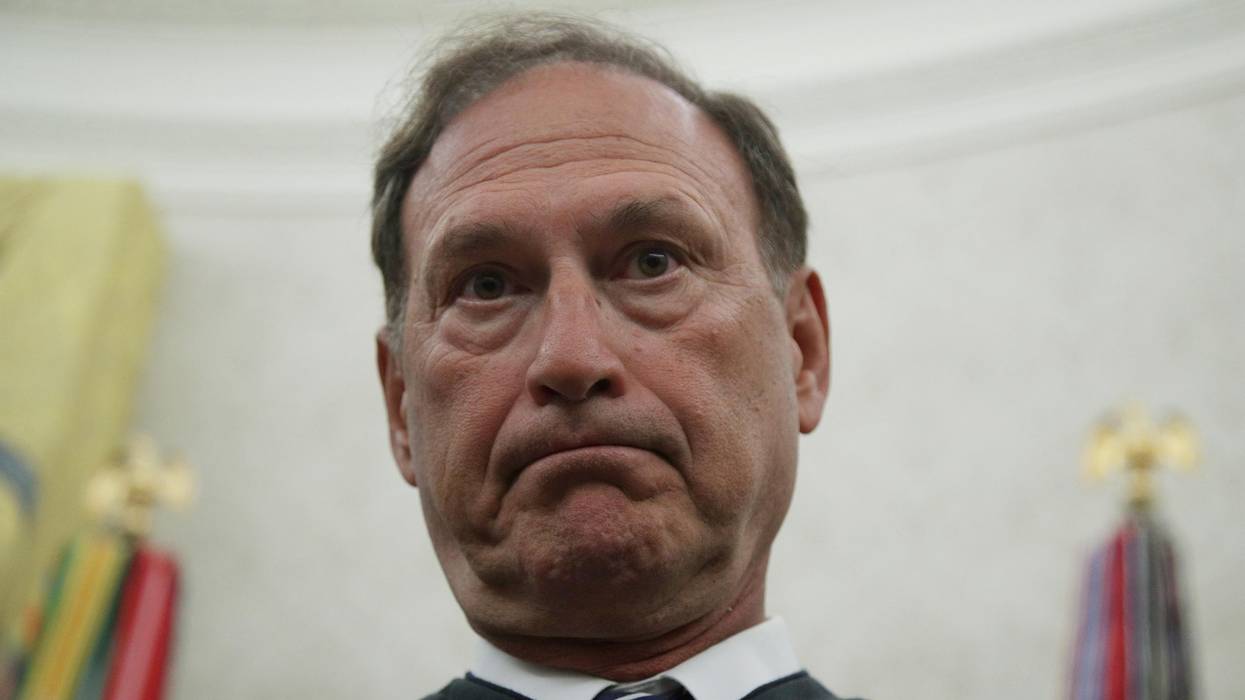
U.S. Supreme Court watchdogs on Thursday applauded the House Judiciary Committee for announcing it will hold a hearing next week regarding allegations that Justice Samuel Alito leaked at least one of the court's rulings to right-wing activists--and called on the Senate to follow suit in the next Congress.
"The people of the country deserve real answers from justices we trust to wield the power of the highest court in the country."
The committee, which is led by Rep. Jerrold Nadler (D-N.Y.) and will be handed over to Republicans after they take control of the House on January 3, is set to open its investigation into the allegations on December 8.
The news of the hearing follows a bombshell New York Times report last month, in which Rev. Rob Schenck, the former head of religious right-wing group Faith & Action, said he had led a lobbying campaign targeting Supreme Court justices.
After Schenck directed his associates to donate to the Supreme Court Historical Society and attend events with the justices, Alito allegedly told two of them that the court would rule in favor of craft retailer Hobby Lobby in Burwell v. Hobby Lobby several weeks before the ruling was officially announced.
"House Judiciary is right to move quickly to investigate, and Senate Democrats should plan to take up the mantle in the new year," Brian Fallon, president of court reform group Demand Justice, told HuffPost Thursday.
After the Times report was published last month, Rep. Hank Johnson (D-Ga.) and Sen. Sheldon Whitehouse (D-R.I.)--who chair the House and Senate Judiciary committees' panels on the courts, respectively--wrote to the Supreme Court's legal counsel asking a number of questions about ethics at the high court, which unlike other federal courts does not abide by a binding ethics code.
The legal counsel denied any wrongdoing by Alito but did not answer the lawmakers' questions, prompting more than 60 progressive groups including Demand Justice to demand congressional hearings, including testimony by Schenck.
Whitehouse and Sen. Dick Durbin (D-Ill.), who chairs the Senate Judiciary Committee and will maintain his position after the new year, have not yet announced their own investigation.
"We will continue to pursue oversight, including oversight into these latest troubling allegations," Whitehouse said on the Senate floor Wednesday. "The people of the country deserve real answers from justices we trust to wield the power of the highest court in the country."
Sarah Lipton-Lubet, executive director of Take Back the Court Action Fund, called the House hearings "a good first step" in demanding accountability from the court.
"We applaud the House Judiciary Committee for holding a hearing on the rampant collusion between the Republican Supreme Court justices and right-wing special interests," said Lipton-Lubet. "It's clear that some of these justices are simply incapable of behaving ethically or putting the law before politics, and the court is unwilling or unable to police itself."

Just as many other universities have been doing, in August, the University of Virginia announced that it was disenrolling 238 students for the autumn semester. They could reenroll provided they showed proof of vaccination against COVID-19 or obtained medical or religious exemptions by a date certain. And therein lies a problem.
The Delta variant of the virus is extremely transmissible - more so than the common cold - and it can occasionally break through and infect a vaccinated person. Thus, even one unvaccinated student in a classroom greatly heightens the risk to an educational institution. Obviously, no blame for not being vaccinated attaches to those who for valid medical reasons cannot be vaccinated. But what about those who claim an exemption for religious reasons?
It is difficult for a layman to find an excuse for such an exception. A majority of Americans professing a faith adhere to Christianity, and is it not an injunction of Jesus in the Gospel according to Matthew to "love thy neighbor as thyself?" In a situation in which communicating a lethal virus to a frail or immune-compromised person might be a death sentence, due regard for one's neighbor ought to the overriding consideration for any believing Christian.
The Catholic Church agrees, and Pope Francis is emphatic:
I believe that morally everyone must take the vaccine. It is the moral choice because it is about your life but also the lives of others.
The other major Christian denominations take the same line. Even Christian Science is unambiguous:
For more than a century, our denomination has counseled respect for public health authorities and conscientious obedience to the laws of the land, including those requiring vaccination.
The other global religions espouse similar views, including Islam. The notorious exception is Islam as perversely interpreted by the Taliban, who incidentally make rather role curious models for American Christians to be emulating.
Still, we see such spectacles as megachurch pastors issuing exemption letters en masse, and a Catholic cleric, Cardinal Raymond Burke, defying his own faith's hierarchy and strongly denouncing vaccine and social distancing. He even criticized fellow Catholics for not believing Jesus would protect them from the virus; it is somewhat inconvenient for his argument that he has been hospitalized with COVID-19.
Clearly, renegade clerics handing out exemptions or publicly advocating against vaccination are not speaking on behalf of the religious doctrine into which they were ordained, so there is no reason to assume their sincerity. Rather, they are taking a partisan political stand on a medical matter while exploiting the near-universal American deference to claims for special treatment based on faith. This conclusion is bolstered by the evidence that adherence to a political party is a better indicator of a person's position on vaccine than religion or any other belief.
The fact that organized religions support vaccination renders the notion that government or business must automatically recognize faith-based exemptions rather shaky to begin with. But there is a more fundamental, constitutional objection to religious exemptions: why is religion privileged above other constitutional rights in a public health emergency that has taken over 640,000 lives? Why should a religious claim allow someone to opt out of an obligation binding on everyone else?
The Constitution recognizes many freedoms, such as freedom of speech, expression, and association, as well as the freedom of religious belief, but also of non-belief. It is the chief business of law and jurisprudence in a free, pluralistic society to balance those competing claims, never letting one presumptive right run roughshod over the others. They must do this while observing the preeminent duty of government: to protect the lives of its citizens.
It should be obvious to even a first-year law student that a government worker cannot claim a conscience-based exemption from a federal government vaccine mandate with the declared reason of his membership in a political party, or belief in UFOs, or because he thinks Bill Gates uses vaccines to implant microchips in people.
Accordingly, the vaccine refusal of someone who, like Cardinal Burke, thinks that Jesus will protect him, begins to sound equally as undeserving of special privilege as our hypothetical examples.
The reason for the differing treatment of constitutional claims is painfully clear, Justice Stephen Breyer's recent high-minded pronouncements about the independence of the courts to the contrary. In recent years, federal courts have increasingly become partisan instruments, and Republican-appointed judges have steadily expanded the controlling authority of religious doctrines over people who may want nothing to do with those doctrines.
The Hobby Lobby case is a notorious example. In that decision, the Supreme Court ruled that an employer may, on religious grounds, deny certain types of health insurance to certain employees, in this case, insurance coverage for contraceptives or abortion services. The court not only decided it was permissible for employers to impose their religious views on employees, but also that a religious claim was sufficiently privileged that it overrode the fact that the decision would have a blatantly disparate and discriminatory impact upon women.
The country already has endured almost a half century of bitter controversy over Roe v. Wade, in which one side of the argument bases its demands on religious claims which, they assert, are so extraordinary that a women's presumptive right of free choice must be prohibited by law to preserve unborn life. Now, ironically, as the culture war extends to vaccines, masks, and social distancing, extraordinary religious claims are brandished to support the dogma that free choice is so paramount that it supersedes the very right to life of innocent third parties.
The U.S. Senate on Wednesday failed to approve a bill that would have restored contraceptive access in the wake of the U.S. Supreme Court's Hobby Lobby ruling last month.
The Protect Women's Health from Corporate Interference Act failed to pass with a 56-43 vote, largely along party lines. Republicans blocked the measure as Democrats failed to reach the minimum requirement of 60 approving votes to move it forward in the legislative process.
Introduced last week by Sen. Patty Murray (D-Washington) and Sen. Mark Udall (D-Colorado), and nicknamed the Not My Bosses' Business Act, the measure stated that the Religious Freedom Restoration Act did not allow employers to refuse to provide specific health care, as required by federal law.
The Supreme Court ruled last month that private businesses could refuse to cover the costs of their employees' birth control if doing so conflicted with their religious beliefs.
Senate Republicans who opposed the measure said it would restrict religious freedom.
"In America, you shouldn't be forced to choose between giving up your business for your faith or giving up your faith for your business," Sen. Roy Blunt (R-Missouri) said before the vote. "The government has no right -- under the Constitution, under the political heritage of the country, under the things that this country was built to stand for -- the government has no right to ask people to make that choice."
Sen. Jeanne Shaheen (D-New Hampshire) argued that women are less likely to obtain certain kinds of health care due to prohibitively high cost.
"When you charge women more for contraception coverage, then you are denying them access to that care," Shaheen said.
ACLU director Laura W. Murphy called the Hobby Lobby decision "an unprecedented move," and said the vote against the bill was political.
"A small number of senators chose politics over women's health today by refusing to allow debate on this bill to move forward," Murphy said. "It's encouraging that a majority of the Senate voted to ensure that all women have access to affordable contraception, and we must build on that momentum as we continue to fight for the rights of all working women."
Debra L. Ness, president of the National Partnership for Women & Families, called the vote "an outrageous and stunning loss not just for women, but for the country."
The Senate's failure to pass the bill "was a painful reminder of how far we have to go before women's health is no longer politicized," Ness said.
Udall tweeted:
If the measure had passed in the Senate, it would almost certainly have failed in a Republican-controlled House of Representatives.
The roll call for the vote follows:
Alphabetical by Senator Name
| Alexander (R-TN), Nay Ayotte (R-NH), Nay Baldwin (D-WI), Yea Barrasso (R-WY), Nay Begich (D-AK), Yea Bennet (D-CO), Yea Blumenthal (D-CT), Yea Blunt (R-MO), Nay Booker (D-NJ), Yea Boozman (R-AR), Nay Boxer (D-CA), Yea Brown (D-OH), Yea Burr (R-NC), Nay Cantwell (D-WA), Yea Cardin (D-MD), Yea Carper (D-DE), Yea Casey (D-PA), Yea Chambliss (R-GA), Nay Coats (R-IN), Nay Coburn (R-OK), Nay Cochran (R-MS), Nay Collins (R-ME), Yea Coons (D-DE), Yea Corker (R-TN), Nay Cornyn (R-TX), Nay Crapo (R-ID), Nay Cruz (R-TX), Nay Donnelly (D-IN), Yea Durbin (D-IL), Yea Enzi (R-WY), Nay Feinstein (D-CA), Yea Fischer (R-NE), Nay Flake (R-AZ), Nay Franken (D-MN), Yea | Gillibrand (D-NY), Yea Graham (R-SC), Nay Grassley (R-IA), Nay Hagan (D-NC), Yea Harkin (D-IA), Yea Hatch (R-UT), Nay Heinrich (D-NM), Yea Heitkamp (D-ND), Yea Heller (R-NV), Nay Hirono (D-HI), Yea Hoeven (R-ND), Nay Inhofe (R-OK), Nay Isakson (R-GA), Nay Johanns (R-NE), Nay Johnson (D-SD), Yea Johnson (R-WI), Nay Kaine (D-VA), Yea King (I-ME), Yea Kirk (R-IL), Yea Klobuchar (D-MN), Yea Landrieu (D-LA), Yea Leahy (D-VT), Yea Lee (R-UT), Nay Levin (D-MI), Yea Manchin (D-WV), Yea Markey (D-MA), Yea McCain (R-AZ), Nay McCaskill (D-MO), Yea McConnell (R-KY), Nay Menendez (D-NJ), Yea Merkley (D-OR), Yea Mikulski (D-MD), Yea Moran (R-KS), Nay Murkowski (R-AK), Yea | Murphy (D-CT), Yea Murray (D-WA), Yea Nelson (D-FL), Yea Paul (R-KY), Nay Portman (R-OH), Nay Pryor (D-AR), Yea Reed (D-RI), Yea Reid (D-NV), Nay Risch (R-ID), Nay Roberts (R-KS), Nay Rockefeller (D-WV), Yea Rubio (R-FL), Nay Sanders (I-VT), Yea Schatz (D-HI), Not Voting Schumer (D-NY), Yea Scott (R-SC), Nay Sessions (R-AL), Nay Shaheen (D-NH), Yea Shelby (R-AL), Nay Stabenow (D-MI), Yea Tester (D-MT), Yea Thune (R-SD), Nay Toomey (R-PA), Nay Udall (D-CO), Yea Udall (D-NM), Yea Vitter (R-LA), Nay Walsh (D-MT), Yea Warner (D-VA), Yea Warren (D-MA), Yea Whitehouse (D-RI), Yea Wicker (R-MS), Nay Wyden (D-OR), Yea |
_____________________
Human rights groups and the LGBT community are bracing for the precedent set by the U.S. Supreme Court's June 30 Hobby Lobby ruling, which declared that religiously affiliated companies are exempt from laws that run counter to their beliefs.
Citing the Burwell v. Hobby Lobby decision, on Tuesday the American Civil Liberties Union and a group of other rights groups announced that they are pulling their support from a bill that bars workplace discrimination--the Employment Non-Discrimination Act, or ENDA--because a provision in the bill would allow religiously affiliated employers to continue to discriminate based on sexual orientation and gender identity.
"Because opponents of LGBT equality are already misreading [the Hobby Lobby] decision as having broadly endorsed rights to discriminate against others," the joint statement (pdf) reads, "we cannot accept a bill that sanctions discrimination and declares that discrimination against LGBT people is more acceptable than other kinds of discrimination."
The discriminatory provision grants religiously affiliated organizations "a blank check to engage in workplace discrimination against LGBT people," adds the group, which includes the Gay & Lesbian Advocates & Defenders (GLAD), Lambda Legal, National Center for Lesbian Rights, and Transgender Law Center.
In her dissenting opinion, Justice Ruth Bader Ginsburg warned that with that ruling she feared the court had "ventured into a minefield." As if to illustrate her point, religious groups are already lining up to claim religious right to what many call government-sanctioned discrimination.
In what was seen as the first sign that the "floodgates" were open, the day after the Burwell v. Hobby Lobby ruling was handed down, a group of religious leaders including pastor Rick Warren sent a letter to President Obama asking him to include a religious exemption in his long-promised executive order barring federal contractors from workplace discrimination.
Because ENDA has long been stalled in a House subcommittee, last month Obama announced that he would soon issue an executive order in its place.
To counter their call, on Tuesday 100 liberal faith leaders sent an opposing letter (pdf) to the President asking that he deliver the executive order with no exemption.
"An exemption would set a terrible precedent by denying true equality for LGBT people," the group writes, "while simultaneously opening a Pandora's Box inviting other forms of discrimination."
The signatories include Rev. Peter Morales, president, of the Unitarian Universalist Association, Rev. Barry Lynn, executive director of Americans United for Separation of Church and State and Episcopal Bishop Gene Robinson--who was the first openly gay priest to be consecrated a bishop in a major Christian denomination.
_____________________
The US Supreme Court late Thursday handed religiously affiliated nonprofit groups a big victory in the ongoing battle between 'religious freedom' and women's rights.
The unsigned, provisional ruling exempts Wheaton College in Illinois from the Obamacare contraceptive coverage requirement if the Christian school tells the Obama administration that it objects to providing birth control to its employees and students for religious reasons.
The court's order drew an unusually angry reaction from the 3 female Justices: Ruth Bader Ginsburg, Elena Kagan and Sonia Sotomayor. The three women issued a scathing 16-page dissent (.pdf) that sharply criticized the court majority for backtracking on its Hobby Lobby decision last Monday.
The court's 5-4 decision in Burwell v Hobby Lobby provided for-profit corporations with a similar exemption.
"Those who are bound by our decisions usually believe they can take us at our word," Justice Sotomayor wrote. "Not so today."
The court's action, she added, even "undermines confidence in this institution."
"After expressly relying on the availability of the religious-nonprofit accommodation to hold that the contraceptive coverage requirement violates [the Religious Freedom Restoration Act] as applied to closely held for-profit corporations, the Court now, as the dissent in Hobby Lobby feared it might, retreats from that position."
"I do not doubt that Wheaton genuinely believes that signing the self-certification form is contrary to its religious beliefs," wrote Sotomayor. "But thinking one's religious beliefs are substantially burdened - no matter how sincere or genuine that belief may be - does not make it so."
"The issuance of an injunction in this case will presumably entitle hundreds or thousands of other objectors to the same remedy," she said.
"The ability of women to participate equally in the economic and social life of the Nation has been facilitated by their ability to control their reproductive lives."
-Justice Sandra Day O'Connor, Planned Parenthood v. Casey
"The ability of women to participate equally in the economic and social life of the Nation has been facilitated by their ability to control their reproductive lives."
-Justice Sandra Day O'Connor, Planned Parenthood v. Casey
In the Burwell vs. Hobby Lobby Stores, Inc. decision on Monday, conservative Supreme Court justices ruled that only some women are entitled to control over their health. This decision represents the latest chapter in an ongoing conservative effort to weaken the reproductive rights of some of the most vulnerable women in the country.
Since no female justice joined the opinion, five men determined that Hobby Lobby and other "closely-held" corporations cannot be compelled to provide insurance coverage for contraception for their employees if they disagree on religious grounds. The owners of Hobby Lobby objected to covering two forms of emergency contraception and two types of intrauterine devices (IUDs) because they feel that using them results in abortion. Although this decision was predicated on objections to four types of birth control, the Supreme Court decision likely affects all twenty contraception methods covered by Affordable Care Act (ACA) regulations. This decision could potentially affect millions of women since "closely-held" corporations employ over 52% of American workers.
The majority bowed to ideology at the expense of science and common sense. There is no medical evidence that emergency contraception, IUDs, or any other form of contraception covered by ACA regulations, cause abortion. In contrast, contraception is designed to prevent unwanted pregnancies that do sometimes lead to an abortion. In an ironic twist, Hobby Lobby objected to providing insurance coverage for IUDs, which are twenty times more effective at preventing unwanted pregnancy than contraception methods lucky enough to receive the Hobby Lobby stamp of approval.
The Hobby Lobby decision furthers the separation of women into distinct economic classes--those who can afford the contraception they want and those who cannot. It undermines the right of millions of women to access vital preventative care regardless of their ability to pay. As Justice Ginsburg noted in her dissent, the cost of obtaining an IUD without insurance is practically equal to the monthly salary of a low-wage worker. Emergency contraception is also expensive--a single dose can cost more than $60. Hobby Lobby places low-income women who cannot pay out of pocket at the mercy of their employers.
The ruling is also intensely harmful to the one in three women who are currently experiencing or will experience domestic violence. An astonishing 99% of survivors report that abusers restrict access to economic resources in some way. Even though some survivors may appear wealthy, they are in fact low-income due to this economic abuse. When employers refuse to cover contraception, the vast majority of survivors cannot afford it. Making matters worse, conservatives also support huge cuts in funding for the Title X clinics that survivors and other low-income women might be able to turn to for access to low-cost contraception in the event that their employer opts out of coverage. Between the actions of a conservative court and Congress, survivors and low-income women simply can't win.
By decreasing women's access to contraception, Hobby Lobby empowers abusers. Forcing survivors to have unwanted pregnancies is a common tactic used by abusers to make survivors more dependent on the relationship. The mechanism? Interfering with or failing to use contraception. Twenty-five percent of adolescent survivors report that abusive partners tried to force them to become pregnant by interfering with contraception. Abusers may destroy or hide oral contraceptives; purposely rip holes in condoms or remove them during sex; fail to withdraw as a method of birth control; or forcibly remove other forms of contraception such as patches, vaginal rings, or IUDs.
The American College of Obstetricians and Gynecologists recommends several strategies to combat this kind of reproductive coercion. They encourage health care providers to package oral contraceptives in ways that an abuser may not detect, such as in an unmarked envelope. They also promote the practice of inserting IUDs that have the strings removed so that abusers cannot detect their presence. An IUD needs to be inserted every twelve years, as opposed to a shot that needs to be administered every three months, or an oral contraceptive that must be taken daily. As a result, IUDs are arguably the best way to provide unobtrusive, effective contraception to survivors. Thanks to five male Supreme Court Justices, however, IUDs likely just became much harder to access, and the lives of many low-income women and survivors became much harder too.
Thank you, Mr. Supreme Court.
Here is the clearest, and scariest, implication of the Supreme Court's Monday ruling in Burwell v. Hobby Lobby, Inc.: The Patient Protection and Affordable Care Act - "Obamacare" - is fatally flawed. It is clear we now need a public, single-payer health care system - because the Supreme Court can no longer protect us.
Here is the clearest, and scariest, implication of the Supreme Court's Monday ruling in Burwell v. Hobby Lobby, Inc.: The Patient Protection and Affordable Care Act - "Obamacare" - is fatally flawed. It is clear we now need a public, single-payer health care system - because the Supreme Court can no longer protect us.
The fact that Hobby Lobby Inc. actually had a legal standing to bring this case to court in order to contest providing comprehensive health care to their 18,000 employees should prove that a key feature of the Affordable Care Act is unsound: It relies too heavily on private entities to deliver a public good - health care.
The Hobby Lobby case was decided not under the constitutional rights guaranteed by the First Amendment, but under those dictated in the Religious Freedom Restoration Act of 1993, drafted to prevent laws that substantially burden a person's free exercise of religion. Under that act, the government must prove that a law that hinders religious expression serves a "compelling state interest" and does so in the "least restrictive" way possible.
Justice Samuel Alito's majority opinion concedes that the government has a "compelling state interest" in providing contraception, but claims the Affordable Care Act does not do so with the "least restrictive means" to achieve this end. Unacknowledged, however, is that there is almost no way to provide comprehensive birth control coverage in a minimally restrictive way to businesses without widening government jurisdiction over health care. If businesses will not pay for health insurance that covers contraception, then the government must.
This exposes the primary and unavoidable weakness of the ACA. Because it still requires that private companies enforce what should be considered public policy - health care - the ACA will always face potential legal contention with the personally held religious beliefs of employers.
Moreover, Hobby Lobby Inc., Conestoga Wood and Mardel were able to preserve legal standing before the court while completely ignoring science and reality. The Religious Freedom Restoration Act protects their religious liberty so thoroughly that all the Greens and the Hahns had to do was believe that the forms of birth control in question, including emergency contraceptives, caused abortions. But, they very obviously do not. The American College of Obstetrics and Gynecologists has maintained for years that "emergency contraception is not effective after implantation; therefore, it is not an abortifacient."
Public policy needs to be based on empirical fact, not disproved or unproven beliefs. But we cannot do this until the American health care policy eliminates the role of private companies in administering public goods.
Intentionally or not, Justice Alito makes the case for an expansion of government control of health care. He maintains throughout his 49-page decision that the best way to ensure comprehensive birth control access under insurance plans "would be for the Government to assume the cost of providing the four contraceptives at issue to any women who are unable to obtain them under their health-insurance policies due to their employers' religious objections."
Ironically, this represents a potential increase in the scope of the federal government that most conservatives would protest - and did protest when the ACA and the public option (in which the government would offer a publicly funded insurance plan as an alternative to private insurance) were up for debate four years ago.
Justice Alito's offered solution to the newly formed coverage gap is the expansion of an ACA "accommodation" currently in place for religious nonprofits. Via an exemption to the ACA crafted by the Department of Health and Human Services, employees of these nonprofits are still eligible for contraceptive coverage through their existing insurance companies directly, and not through their religiously affiliated employer. Justice Alito maintains that "HHS has provided no reason why the same system cannot be made available when the owners of for-profit corporations have similar religious objections [to contraception coverage]."
Interestingly, interest groups on both side of this debate rejected Alito's alternative, albeit for completely different reasons.
Lori Windham, Senior Counsel for the Becket Fund for Religious Liberty and counsel for Hobby Lobby, maintains that the accommodation "fails to solve the moral problem created by the mandate for many religious organizations."
Judy Waxman, Vice President for Health and Reproductive Rights at the National Women's Law Center, said that expanding the existing accommodation would separate birth control from other health care drugs and services. "Birth control is a basic health service that almost all women in this country use for health care. And it is important that it be covered like every other service," Waxman said.
President Obama seems to have taken note. When White House Press Secretary Josh Earnest was asked Monday afternoon if the administration was looking to expand the current ACA accommodation in place for religious nonprofits, Earnest simply said "no." Instead, he affirmed that the ruling made clear "that there is an opportunity for Congress to take the kinds of steps that would mitigate this problem."
Unfortunately for American women, congressional action is very unlikely to happen, even though there is plenty of fervor over the issue among Democrats. Senate Majority Leader Harry Reid (D-Nev.) took to the Senate floor Monday morning to declare "If the Supreme Court will not protect women's access to health care, then Democrats will."
There are various legislative solutions to the contraceptive coverage gap left by the decision, including giving the federal government the power and the funds to cover contraception specifically and amending the Religious Freedom Restoration Act. But none of these are considered viable options amidst the current congressional dissonance.
But something must be done. A single-payer public health care option should be reexamined to detach employer whims from public needs. We must minimize the influence of bosses and businesses in the implementation of health care. No one elected them.
On Monday the Supreme Court struck down a key part of the Affordable Care Act, ruling that privately-owned corporations don't have to offer their employees contraceptive coverage that conflicts with the corporate owners' religious beliefs.
On Monday the Supreme Court struck down a key part of the Affordable Care Act, ruling that privately-owned corporations don't have to offer their employees contraceptive coverage that conflicts with the corporate owners' religious beliefs.
The owners of Hobby Lobby, the plaintiffs in the case, were always free to practice their religion. The Court bestowed religious freedom on their corporation as well - a leap of logic as absurd as giving corporations freedom of speech. Corporations aren't people.
The deeper problem is the Court's obliviousness to the growing imbalance of economic power between corporations and real people. By giving companies the right not offer employees contraceptive services otherwise mandated by law, the Court ignored the rights of employees to receive those services.
(Justice Alito's suggestion that those services could be provided directly by the federal government is as politically likely as is asingle-payer federal health-insurance plan - which presumably would be necessary to supply such contraceptives or any other Obamacare service corporations refuse to offer on religious grounds.)
The same imbalance of power rendered the Court's decision in "Citizens United," granting corporations freedom of speech, so perverse. In reality, corporate free speech drowns out the free speech of ordinary people who can't flood the halls of Congress with campaign contributions.
Freedom is the one value conservatives place above all others, yet time and again their ideal of freedom ignores the growing imbalance of power in our society that's eroding the freedoms of most people.
This isn't new. In the early 1930s, the Court trumped New Deal legislation with "freedom of contract" - the presumed right of people to make whatever deals they want unencumbered by federal regulations. Eventually (perhaps influenced by FDR's threat to expand the Court and pack it with his own appointees) the Court relented.
But the conservative mind has never incorporated economic power into its understanding of freedom. Conservatives still champion "free enterprise" and equate the so-called "free market" with liberty. To them, government "intrusions" on the market threaten freedom.
Yet the "free market" doesn't exist in nature. There, only the fittest and strongest survive. The "free market" is the product of laws and rules continuously emanating from legislatures, executive departments, and courts. Government doesn't "intrude" on the free market. It defines and organizes (and often reorganizes) it.
Here's where the reality of power comes in. It's one thing if these laws and rules are shaped democratically, reflecting the values and preferences of most people.
But anyone with half a brain can see the growing concentration of income and wealth at the top of America has concentrated political power there as well -- generating laws and rules that tilt the playing field ever further in the direction of corporations and the wealthy.
Antitrust laws designed to constrain monopolies have been eviscerated. Competition among Internet service providers, for example, is rapidly disappearing - resulting in higher prices than in any other rich country. Companies are being allowed to prolong patents and trademarks, keeping drug prices higher here than in Canada or Europe.
Tax laws favor capital over labor, giving capital gains a lower rate than ordinary income. The rich get humongous mortgage interest deductions while renters get no deduction at all.
The value of real property (the major asset of the middle class) is taxed annually, but not the value of stocks and bonds (where the rich park most of their wealth).
Bankruptcy laws allow companies to smoothly reorganize, but not college graduates burdened by student loans.
The minimum wage is steadily losing value, while CEO pay is in the stratosphere. Under U.S. law, shareholders have only an "advisory" role in determining what CEOs rake in.
Public goods paid for with tax revenues (public schools, affordable public universities, parks, roads, bridges) are deteriorating, while private goods paid for individually (private schools and colleges, health clubs, security guards, gated community amenities) are burgeoning.
I could go on, but you get the point. The so-called "free market" is not expanding options and opportunities for most people. It's extending them for the few who are wealthy enough to influence how the market is organized.
Most of us remain "free" in limited sense of not being coerced into purchasing, say, the medications or Internet services that are unnecessarily expensive, or contraceptives they can no longer get under their employer's insurance plan. We can just go without.
We're likewise free not to be burdened with years of student debt payments; no one is required to attend college. And we're free not to rent a place in a neighborhood with lousy schools and pot-holed roads; if we can't afford better, we're free to work harder so we can.
But this is a very parched view of freedom.
Conservatives who claim to be on the side of freedom while ignoring the growing imbalance of economic and political power in America are not in fact on the side of freedom. They are on the side of those with the power.
The Supreme Court decision in the Hobby Lobby case might not have been surprising, but there's at least one aspect of the media coverage of the company that fails in a big way: Few outlets note that the company was providing the very type of health coverage it finds impossible to reconcile with its religious beliefs before the Affordable Care Act existed.
As people following the case might know, the Green family that runs the company sued over the Affordable Care Act, arguing that the law's requirement that health plans provide contraceptive coverage violated their conservative Christian religious beliefs. Hobby Lobby and another small company were attempting to make this claim under the Religious Freedom Restoration Act, in an attempt-which proved successful-to get the Court to extend individual freedom of religion rights to corporations.
In advance of the ruling, Time (6/26/14) ran a very flattering profile of the Green family, heavy on quotes from family friends and associates, pointing out the family's generosity ("The Greens share that prosperity like people who truly believe that the money is God's, not theirs") and portraying them as living in a somewhat hostile culture. Of the family meeting to discuss whether or not to sue, Time explains:
According to a friend, Steve Green--David's younger son and the company president--spoke last, using the Bible's Book of Daniel to review the possible repercussions of litigation. Like the Greens, Daniel was a privileged participant in a culture indifferent to his faith.
After they made their decision to sue, the Green family released this statement: "Our family is now being forced to choose between following the laws of the land that we love or maintaining the religious beliefs that have made our business successful and have supported our family and thousands of our employees and their families. We simply cannot abandon our religious beliefs to comply with this mandate."
Under the headline "Hobby Lobby Made Fight a Matter of Christian Principle," the New York Times report (6/30/14) portrayed the legal battle the same way:
For the family behind Hobby Lobby, fighting the Affordable Care Act's contraceptives mandate all the way to the Supreme Court was a calling, not a choice.
But it was most certainly a choice. The idea to bring the case was not Hobby Lobby's, but the work of the conservative Becket Fund for Religious Liberty. This is critical, because reporters ought to note that Hobby Lobby, according to its own court filing, was providing employees with contraceptive coverage it apparently concluded violated its religious beliefs. As Stephanie Mencimer of Mother Jones (3/21/14) pointed out, Hobby Lobby says it has a problem with "the emergency contraceptive pills Plan B and Ella and intrauterine devices (IUDs), which they (erroneously) believe are abortifacients."
But, Mencimer noted:
The company admits in its complaint that until it considered filing the suit in 2012, its generous health insurance plan actually covered Plan B and Ella (though not IUDs). The burden of this coverage was apparently so insignificant that God, and Hobby Lobby executives, never noticed it until the mandate became a political issue.
Mencimer wrote that the case "is a mess of bad facts, political opportunism and questionable legal theories." Coverage should point this out-especially the opportunism of a corporation that is being portrayed as waging a serious battle on behalf of its deeply held religious convictions.
