

SUBSCRIBE TO OUR FREE NEWSLETTER
Daily news & progressive opinion—funded by the people, not the corporations—delivered straight to your inbox.
5
#000000
#FFFFFF
To donate by check, phone, or other method, see our More Ways to Give page.


Daily news & progressive opinion—funded by the people, not the corporations—delivered straight to your inbox.
"We urge the commission to continue to focus on its vital work preserving market integrity and protecting the public, uphold the letter and spirit of the Dodd-Frank Act, and withdraw the proposed rule."
A trio of Democratic U.S. senators on Monday wrote to Commodity Futures Trading Commission Chair Rostin Behnam expressing their "serious reservations" with the agency's proposed rule on seeded funds and money market funds, a policy the lawmakers warned would "undermine the goals of Dodd-Frank" by rolling back the already weakened financial oversight law.
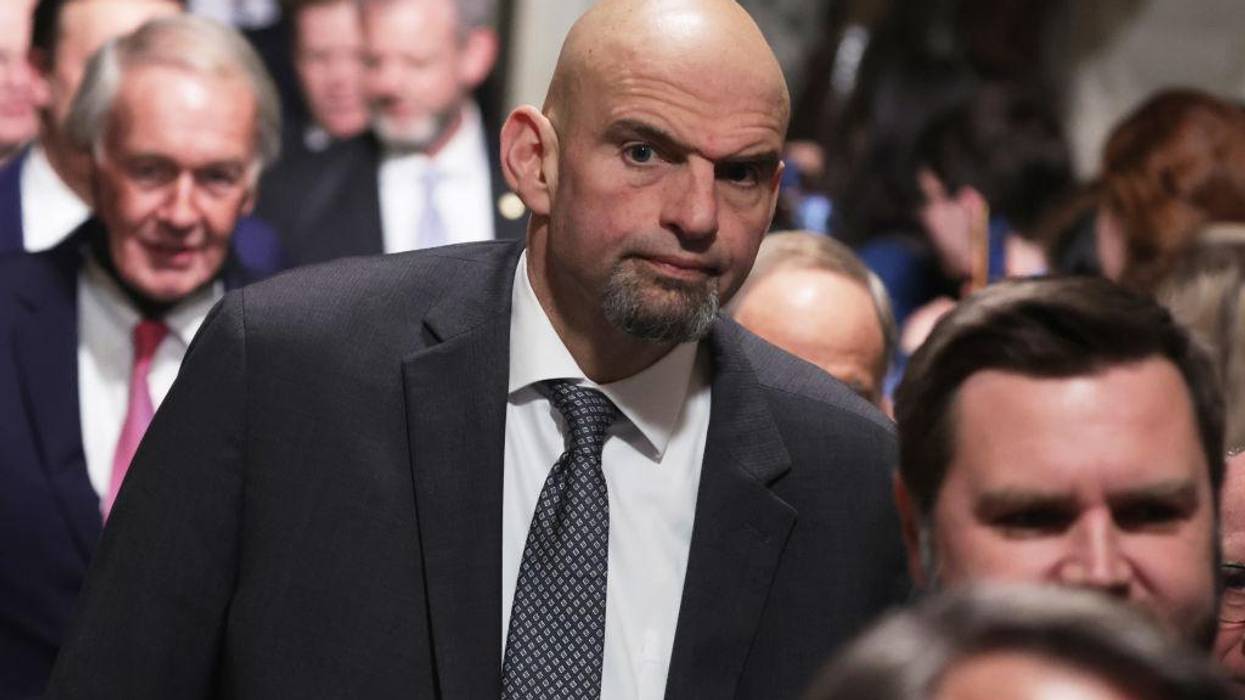
Passed in the wake of the 2008 global financial meltdown, the Dodd-Frank Wall Street Reform and Consumer Protection Act—which was partially rolled back during the Trump administration—overhauled federal financial regulation. In a letter to Behnam, Sens. John Fetterman (Pa.), Sherrod Brown (Ohio), and Tina Smith (Minn.) assert that the CFTC's proposed rule is a "step in the wrong direction" that would increase market instability by decreasing collateral requirements for certain transactions.
The Global Markets Advisory Committee, largely made up of finance industry insiders, recommended the proposed rule in 2020 during the Trump administration.
As the letter explains:
The proposed rule would reduce or eliminate initial margin requirements for up to three years for a subset of swap market participants. "Initial margin" is the collateral that participants must set aside when entering swap agreements. Initial margin requirements, along with "variation margin" and other capital requirements, protect counterparties to a swap in the event of a default. Dodd-Frank set up comprehensive rules for swap agreements after they significantly contributed to the 2008 financial crisis and the federal government was forced to bail out Wall Street.
"The 2008 financial crisis showed the dangers that swaps can pose to economic stability, and Dodd-Frank directed regulators, including the CFTC, to require initial margin for uncleared swaps specifically to reduce those risks," the senators wrote. "It is vital for the CFTC to continue upholding its Dodd-Frank mandate and to maintain high standards and safeguards for this important market."
"We urge the commission to continue to focus on its vital work preserving market integrity and protecting the public, uphold the letter and spirit of the Dodd-Frank Act, and withdraw the proposed rule," the lawmakers added.
The collapse earlier this year of Silicon Valley Bank and Signature Bank—both of which benefited from regulatory relief thanks to the 2018 rollback—brought renewed scrutiny on Dodd-Frank's Republican-engineered shortcomings. Sen. Mike Crapo (R-Idaho), who wrote the 2018 banking deregulation law, insisted in March that "there is no need for regulatory reform" in the wake of the banks' failures.
Robert Weissman, president of the consumer advocacy group Public Citizen, responded to Crapo's assertion by writing that "you have to be hard-core committed to mindless free-market fundamentalism—or truly in thrall to your donors—to insist there's no need for new regulations after Silicon Valley Bank."
Last month, Sen. Elizabeth Warren (D-Mass.) also wrote a letter to Behman sharing her concerns about the proposed rule. Noting the policy's 2020 introduction, Warren said in her October 10 letter that "it is unclear why the commission is choosing to propose these rules now, three years later, without conducting its own additional analyses of whether the changes are necessary or will strengthen the stability of the domestic financial system."
"I strongly urge the commission not to loosen the existing rules and not to roll back important Dodd-Frank Act reforms," Warren added.
Four years ago, student loan debt in America topped $1 trillion. Today, that number has swelled even further, with some 43 million Americans feeling the enduring gravity of $1.3 trillion in student loan debt.
While student debt may not intuitively register as something that plagues the poor, student debt delinquency and defaults are concentrated in low-income areas, even though lower-income borrowers also tend to have much smaller debts. Defaults and delinquencies among low-income Americans escalated following the Great Recession of 2008, a period when many states disinvested from public colleges and universities. The result was higher costs of college, which has led to larger loans.
Low-income students are often left at a dramatic academic disadvantage in the first place. For example, students who work full-time on top of college classes can't cover the cost of tuition or living expenses, and working while in school can actually shrink the chance of graduating altogether. Moreover, these students are less likely to have access to career counseling or outside financial resources to help them pay for school, making the payoff negligible at best.
The inequity is so crushing that an alarming number of these students--predominantly students of color--are dropping out of school altogether. One-third of low-income student borrowers at public four-year schools drop out, a rate 10 percent higher than the rest of student borrowers overall.
When it comes to for-profit colleges, the story gets even worse. These institutions often target prospective students who are low-income while falsely assuring positive job and economic prospects upon graduating. Many students do end up dropping out, and even those who do graduate do not always receive a quality education that leaves them prepared for success--or with an income that matches up with their monthly loan payments. Their degrees too often cannot compete in the job market, leaving many of these students jobless.
A dream of a higher education shouldn't be a sentence to years--or an entire lifetime--of poverty.
This confluence of factors explains why borrowers who owe the least tend to be lower-income and are the most likely to fall behind or default on their monthly payments. As the Mapping Student Debt project has found, people with more debt are less likely to default on their loan payments because they have the most access to wealth, whether through family money or financial assets or educational degrees. And it's not hard to connect the dots. The biggest borrowers tend to be the biggest earners, so those who take out large loans to pay for graduate or professional school are less likely to default or fall behind because they're in high-earning jobs. The Department of Education estimated that 7 percent of graduate borrowers default versus 22 percent of those who only borrow for undergraduate studies. The default can actually lead to an increase in student loan debt because of late fees and interest, as well as a major decline in credit, ineligibility for additional student aid, and even wage garnishment at the request of the federal government.
Fortunately, there are solutions already in place that can help borrowers get out of default and back on their feet. For borrowers with federal loans, the Department of Education has a number of income-driven repayment programs (IDR) that cap a borrower's monthly payment to as low as 10 percent of their discretionary income. Rather than being saddled with debt and an income that doesn't realistically allow for repayment, borrowers can take advantage of programs such as PAYE, REPAYE, and Income-Based-Repayment to make their monthly loan payments proportional to their income. And some low-income borrowers might even qualify to pay nothing at all if they fall beneath certain income levels.
These plans won't just help borrowers with high debt balances. IDR is especially helpful for borrowers with smaller balances because it reduces the monthly burden while keeping more money in their pockets to cover expenses for food, housing, and other basic needs that borrowers must choose between in the face of overwhelming monthly payments.
Yet woefully few borrowers are aware of these plans, which have the potential to ensure low-income borrowers aren't paying more than they can afford. Fully 51 percent of student loan borrowers nationwide are eligible for these programs, but only 15 percent are enrolled.
A dream of a higher education shouldn't be a sentence to years—or an entire lifetime—of poverty. With federal IDR programs, paying back any amount of student debt can be much less draining of an obligation, especially for our most vulnerable citizens. It's on all of us to ensure those who can benefit the most from IDR are aware of it.
One of the more telling combinations of news stories from the past week found education policy insiders in Washington, DC, rejoicing over the passage of a new law rewriting federal education policy while, at the same time, a new report revealed how political leadership is continuing to fail America's public schools.
This is not to say that revising federal education policy wasn't a worthwhile goal. For sure, the new law, dubbed the Every Student Succeeds Act, has corrected some harmful aspects of federal education policy. Many good commentaries have pointed out significant problems with the new law too. But such is the nature of legislating. You don't always get everything you want.
However, despite all the celebration surrounding ESSA, the issue that remains mostly unaddressed in education policy is the massive under-funding that most states continue to inflict on public schools. The ugly truth about how political leaders continue to underfund local schools was exposed in a new report from the Center for Budget and Policy Priorities.
Schools Aren't Getting The Money They Need
The new CBPP report finds, "Most states provide less support per student for elementary and secondary schools - in some cases, much less - than before the Great Recession." This is an issue that should be front-and-center in education discussion, not something burbling in the background while education policy leaders congratulate each other over a job well done.
As the commentary from CBPP on its report explains, state funding is a key factor in any assessment of the health and well being of the nation's public schools. K-12 schools generally rely on their respective state government to supply about 46 percent of their funding. Local governments provide another 45 percent, and the federal government chips in only 9 percent on average.
The significance of funding sources varies considerably from state to state, given state funding formulas and the demographics of specific districts (schools with large populations of low-income, nonwhite students receive extra federal funds through a provision called Title I). But "because schools rely so heavily on state aid," CBPP explains, "cuts to state funding (especially formula funding) generally force local school districts to scale back educational services, raise more revenue to cover the gap, or both."
Also, the severity of these funding cuts varies considerably from state to state. CBPP reports that while at least 31 states are guilty of underfunding schools, some are worse than others. In 15 states, the cuts exceeded 10 percent, and 12 states have imposed new cuts, even as the national economy continues to improve.
Alternative sources of education funding have not come forward to address the downturn of the states. Although CBPP found that in most states, local funding for education has risen somewhat to counterbalance state cuts, total local funding nationally "declined between 2008 and 2014, adding to the damage from state funding cuts."
Federal funds for K-12 schools are also down, from their high of 11 percent average of school budgets in 2010 to the current level of 9 percent.
Money Matters
Importantly, as the CBPP commentary states, "money matters for educational outcomes," especially for low-income children, whose best interest, many have said, is the main intention of federal education policy. The CBPP commentary points to two recent studies showing the positive impact of increased school funding on students.
The most recent of the two studies found "a 20 percent increase in per-pupil spending each year for all 12 years of public school for children from poor families leads to about 0.9 more completed years of education, 25 percent higher earnings, and a 20 percentage-point reduction in the annual incidence of adult poverty ... The magnitudes of these effects are sufficiently large to eliminate between two-thirds and all of the gaps in these adult outcomes between those raised in poor families and those raised in non-poor families."
Deep funding cuts also hamper schools' ability to implement many of "reforms" federal education policy makers say they are so keen on, including higher salaries, costly data systems, and increased spending on education technology and STEM (science, technology, engineering, and math) education.
What Spending Cuts Mean To Students
The impact of funding cuts revealed by CBPP at a 30,000-foot view is most apparent when viewed closer to ground level.
In Virginia - where education funding is still over 11 percent below 2008 levels, according to CBPP - the Washington Post reports schools have cut 11,200 staff members statewide while student enrollment increased more than 42,000 students during the same time period.
Many of the additional students pose greater challenges to more time-strapped teachers -- 39 percent more are economically disadvantaged, 33 percent more don't speak English as their first language, and the number of homeless students is up 73 percent.
In Pennsylvania, an ongoing funding crisis has driven many schools to borrow in order to make payroll. Some schools that are closing for the upcoming Winter break may not have the money to open up when the students return in January.
In Washington state, where a court order fines the state $100,000 a day for inadequate school funding, parents have organized to raise money for staffing levels in schools their children don't attend.
In North Carolina - where education funding is still nearly 14 percent bellow 2008 levels, according to CBPP - the impact of funding cuts are especially glaring.
Education correspondent Lindsay Wagner reports from the Tarheel State that since 2008, "the economy has recovered significantly, but state spending on education has not. And that is reflected in the disappearance of teacher assistants and in schools left scrambling for supplies, textbooks, and professional development for their educators."
Wagner's ground-level reporting from districts across the state reveals schools where lack of funding has bloated class sizes to out-of-hand levels and eliminated one-to-one assistance for struggling students. In many of these schools, lack of money means textbooks and teaching supplies are scarce, vital art, music, and other elective programs are a memory, and classes that help low-performing students no longer exist.
"There's no turnaround in sight," Wagner reports. "For fiscal 2015, state lawmakers cut funding for at-risk student services programs by more than $9 million."
At the same time the funding cuts continue, education "reforms" continue to roll out from state lawmakers, including new requirements for schools to "do better at remediating students who don't read proficiently" and "a new A-F school grading scheme that punishes schools whose students don't perform well on standardized tests."
Wagner observes, "Without the funds and resources necessary to accomplish these end goals, the desired results appear to be very difficult to achieve.'
A Real 'Reform' Agenda, If We Want One
The problems caused by inadequate funding are no doubt most acute in schools that need money the most - where populations of non-white students go to get educated.
As a recent report amplified by The Atlantic revealed, "schools with a lot of minority students are chronically underfunded," especially, it appears, because those schools are populated with mostly non-white students. According to the study, the article reported, "No matter how rich or poor the district in question, funding gaps existed solely based on the racial composition of the school."
One wonders why organizations promoting "education reform" make standardized testing and certain mandated "performance outcomes" the focal points of their advocacy rather funding issues.
It's not that the research basis to argue for increased school funding isn't there. As Ben Spielberg argues on his personal blog, that research base "is at least as strong as, if not stronger than, that behind practically any other education policy proposal" currently in consideration in the "reform" agenda.
There's evidence the political will to support increased funding for schools is there too, at least among voters. Even in red states such as Arizona, - which leads the nation in cutting school funding by more than 23 percent, according to CBPP, surveys show significant willingness among voters to raise taxes in order to more adequately fund schools.
"Increased funding, to be useful, must of course be spent in smart ways," Spielberg contends. "Money by itself isn't a panacea. But it's important to get the facts right: Money matters, and it matters quite a bit."
Yet despite the facts of the matter, he concludes, "We've yet to target and sustain increased funding in schools that serve our neediest students. Especially in low-income areas, America definitely can - and should - invest more in K-12 public education."
That would be a real "reform" agenda education policy leaders should be working on, if they want one.
In a stunning turn of events, President Obama announced last weekend that "unnecessary testing" is "consuming too much instructional time" and creating "undue stress for educators and students." Rarely has a president so thoroughly repudiated such a defining aspect of his public education policy. In a three-minute video announcing this reversal, Obama cracks jokes about how silly it is to over-test students and recalls that the teachers who had the most influence on his life did not prepare him best for his standardized tests. Perhaps Obama hopes we will forget it was his own Education Secretary, Arne Duncan, who radically reorganized America's education system around the almighty test score.
Obama's statement comes in the wake of another study revealing the overwhelming number of standardized tests children are forced to take: The average student today is subjected to 112 standardized tests between preschool and high school graduation. Because it's what we have rewarded and required, America's education system has completely fixated on how well students perform on tests. Further, the highest concentration of these tests is in schools serving low-income students and students of color.
To be sure, Obama isn't the only president who has menaced the education system with high-stakes exams. This thoroughly bi-partisan project was enabled by George W. Bush's No Child Left Behind Act. NCLB became law in 2002 with overwhelming support from Republicans and Democrats alike.
Instead of erasing the wrong answer choice of NCLB's test-and-punish policy, Obama decided to press ahead. Like a student filling in her entire Scantron sheet with answer choice, "D," Duncan's erroneous Race to the Top initiative was the incorrect solution for students. However, it made four corporations rich by assigning their tests as the law of the land. Desperate school districts, ravaged by the Great Recession, eagerly sought Race to the Top points by promulgating more and more tests.
The cry of the parents, students, educators and other stewards of education was loud and sorrowful as Obama moved to reduce the intellectual and emotional process of teaching and learning to a single score--one that would be used to close schools, fire teachers and deny students promotion or graduation. Take, for instance, this essay penned by Diane Ravitch in 2010. She countered Obama's claim that Race to the Top was his most important accomplishment:
[RttT] will make the current standardized tests of basic skills more important than ever, and even more time and resources will be devoted to raising scores on these tests. The curriculum will be narrowed even more than under George W. Bush's No Child Left Behind, because of the link between wages and scores. There will be even less time available for the arts, science, history, civics, foreign language, even physical education. Teachers will teach to the test.
What Ravitch warned us about has come to pass, and Obama has now admitted as much without fully admitting to his direct role in promoting the tests. Duncan and Obama, with funding from the Gates Foundation, coupled Race to the Top with Common Core State Standards and the high-stakes tests that came shrink-wrapped with them. Together, these policies have orchestrated a radical seizure of power by what I call the "technocracy"--The multibillion-dollar testing corporations, the billionaire philanthropists who promote their policies, and the politicians who write their policies into law.
These policies in turn have produced the largest uprising against high-stakes testing in U.S. history. To give you just a few highlights of the size and scope of this unprecedented struggle, students have staged walkouts of the tests in Portland, Chicago, Colorado, New Mexico, and beyond. Teachers from Seattle to Toledo to New York City have refused to administer the tests. And the parent movement to opt children out of tests has exploded into a mass social movement, including some 60,000 families in Washington State and more than 200,000 families in New York State. One of the sparks that helped ignite this uprising occurred at Garfield High School, where I teach when the entire faculty voted unanimously to refuse to administer the Measures of Academic Progress (MAP) test. The boycott spread to several other schools in Seattle, and then the superintendent threatened my colleagues with a ten-day suspension without pay. Because of the unanimous vote of the student government and the PTA in support of the boycott--and the solidarity we received from around the country--the superintendent backed off his threat and canceled the MAP test altogether at the high school level. Can you imagine the vindication that my colleagues feel today--after having risked their jobs to reduce testing--from hearing the president acknowledge there is too much testing in the schools? And it should be clear that this national uprising, this Education Spring, has forced the testocracy to retreat and is the reason that the Obama administration has come to its current understanding on testing in schools.
However, the testocracy, having amassed so much power and wealth, won't slink quietly into the night. A Facebook video from Obama isn't going to convince the Pearson corporation to give up its $9 billion in corporate profits from testing and textbooks. The tangle of tests promulgated by the federal government is now embedded at state and district levels.
More importantly, the President exposed how halfhearted his change of heart was by declaring he would not reduce the federal requirement to annually test all students in grades 3 through 8 in math and reading, with high school students still tested at least once. A reauthorization of NCLB is in the works, and all versions preserve these harmful testing mandates. Also, Obama's call to reduce testing to 2% of the school year still requires students to take standardized tests for an outlandish twenty-four hours. And it isn't even all the time directly spent taking the tests that's the biggest problem. The real shame, which Obama never addressed, is that as long as there are high stakes attached to standardized tests, test prep activities will continue to dominate instructional time. As long as the testocracy continues to demand that these tests determine students' graduation and teachers' evaluation or pay, test prep will continue to crowd out all the things that educators know are vital to teaching the whole child--critical thinking, imagination, the arts, recess, collaboration, problem-based learning, and more.
Obama's main accomplice in proliferating costly testing, Arne Duncan, said, "It's important that we're all honest with ourselves. At the federal, state, and local level, we have all supported policies that have contributed to the problem in implementation."
Yes, let's all be honest with ourselves. Honesty would require acknowledgment that standardized test scores primarily demonstrate a student's family income level, not how well a teacher has coached how to fill in bubbles. Honesty would dictate that we recognize that the biggest obstacle to the success of our students is that politicians are not being held accountable for the fact that nearly half of the children in public schools now live in poverty. As Congress debates the new iteration of federal education policy, they should focus on supporting programs to uplift disadvantaged children and leave the assessment policy to local educators. They have proven they don't understand how to assess our students best, and now they have admitted as much. It's time to listen to those of us who have advocated for an end to endlessly ranking and sorting our youth with high-stakes tests. It's time Congress repeal the requirement of standardized tests at every grade level. It's time to end the reign of the testocracy and allow parents, students, and educators to implement authentic assessments designed to help support student learning and nurture the whole child.