

SUBSCRIBE TO OUR FREE NEWSLETTER
Daily news & progressive opinion—funded by the people, not the corporations—delivered straight to your inbox.
5
#000000
#FFFFFF
To donate by check, phone, or other method, see our More Ways to Give page.
Daily news & progressive opinion—funded by the people, not the corporations—delivered straight to your inbox.
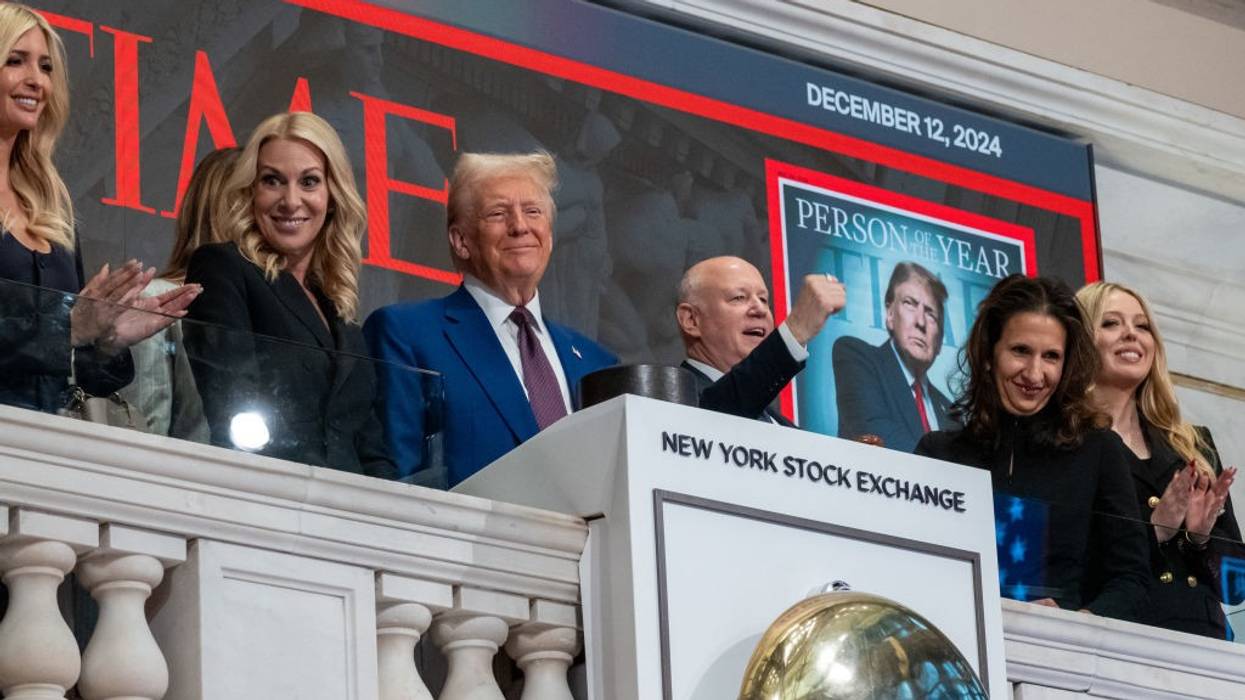
The president-elect's advisers are reportedly discussing plans to shrink or eliminate key bank watchdogs, including the Federal Deposit Insurance Corporation.
President-elect Donald Trump and his advisers are reportedly considering plans to weaken—or abolish altogether—top bank regulators, including the Federal Deposit Insurance Corporation and Office of the Comptroller of the Currency.
The Wall Street Journal reported Thursday that members of Trump's transition team and the new Elon Musk-led Department of Government Efficiency have asked nominees under consideration to head the FDIC and OCC if the bank watchdogs could be eliminated and have their functions absorbed by the Treasury Department, which is set to be run by a billionaire hedge fund manager and crypto enthusiast.
"Bank executives are optimistic President-elect Donald Trump will ease a host of regulations on capital cushions and consumer protections, as well as scrutiny of consolidation in the industry," the Journal reported. "But FDIC deposit insurance is considered near sacred. Any move that threatened to undermine even the perception of deposit insurance could quickly ripple through banks and in a crisis might compound customer fears."
The Trump team's internal and fluid discussions about the fate of the key bank regulators broadly aligns with Project 2025's proposal to "merge the Office of the Comptroller of the Currency, the Federal Deposit Insurance Corporation, the National Credit Union Administration, and the Federal Reserve's non-monetary supervisory and regulatory functions."
The FDIC, which is primarily funded by bank insurance premiums, was established during the Great Depression to restore public trust in the nation's banking system, and the agency played a central role in navigating the 2023 bank failures that threatened a systemic crisis.
Observers warned that gutting the FDIC and OCC could catalyze another economic meltdown.
"The next recession starts here," tech journalist Jacob Silverman warned in response to the Journal's reporting.
Eric Rauchway, a historian of the New Deal, wrote that "even Milton Friedman appreciated the FDIC," underscoring the extreme nature of the incoming Trump administration's deregulatory ambitions.
Musk, the world's wealthiest man, is also pushing for the elimination of the Consumer Financial Protection Bureau, an agency established in the wake of the 2008 financial crisis.
The Journal noted Thursday that "Rep. Andy Barr, a Republican from Kentucky and Trump ally on the House Financial Services Committee, has backed the plan to eliminate or drastically alter the CFPB and said he wants to get rid of what he calls 'one-size-fits-all' regulation for banks."
Barr has received millions of dollars in campaign donations from the financial sector and "introduced many pieces of pro-industry legislation, including significant rollbacks of protections stemming from the 2008 financial crisis," according to the watchdog group Accountable.US.
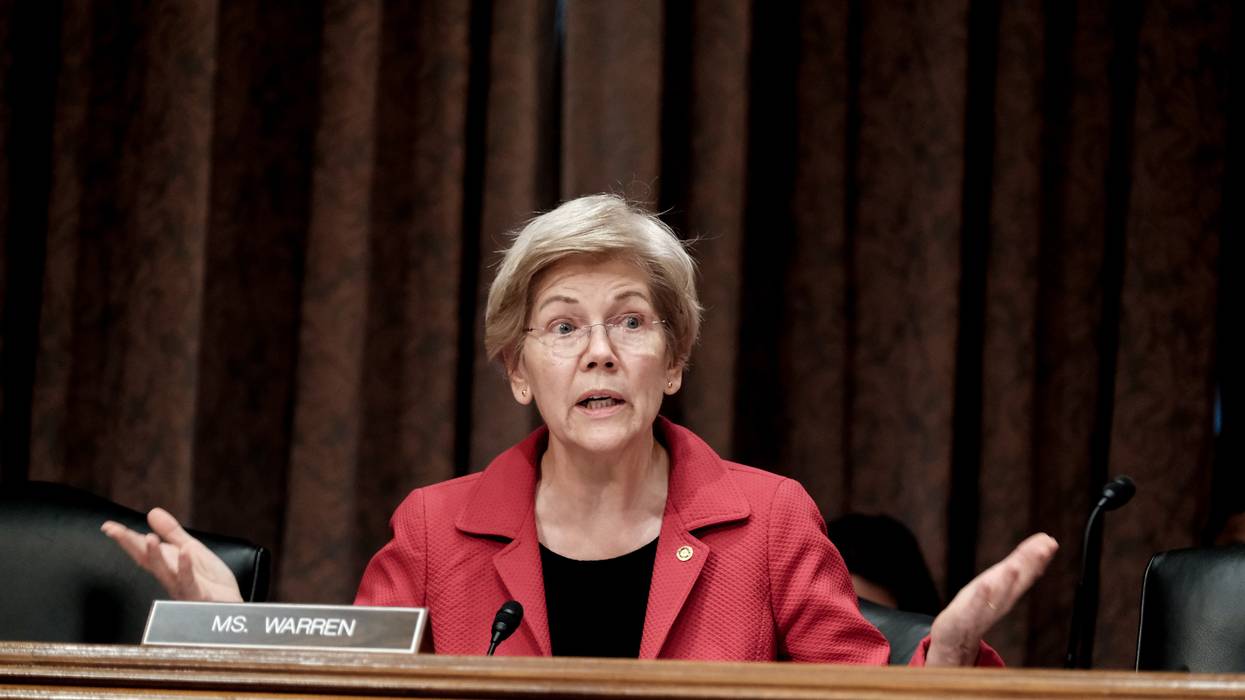
"The recent bank crisis underscores the urgency of strengthening the merger review process and reversing the dangerous trend of bank consolidation."
In the wake of three recent bank failures, U.S. Sen. Elizabeth Warren on Tuesday urged financial regulators to promote competition rather than further consolidation in the industry and improve merger guidelines.
The Massachusetts Democrat's call for action came in a letter to Assistant Attorney General Jonathan Kanter, Federal Deposit Investment Corporation (FDIC) Chairman Gruenberg, Acting Comptroller of the Currency Michael Hsu, Federal Reserve Vice Chair for Supervision Michael Barr, and Treasury Secretary Janet Yellen.
"Earlier this year, a series of fatal errors—poor risk management by bank executives, corporate greed, deregulation, and the lack of sufficient federal supervision—led to the implosion of Silicon Valley Bank, which was shortly followed by the collapses of Signature Bank, and First Republic," she wrote. "Unfortunately, Secretary Yellen and Acting Comptroller Hsu have recently indicated that they appear to be taking the wrong lessons from these bank failures, suggesting that they would like to see more bank consolidation."
"The number of commercial banks in the U.S. has fallen by 70% over the past two decades, and the trend is accelerating."
The letter references reporting from Politico's "Morning Money" (MM) earlier this month. As the outlet detailed:
A top lobbyist for big U.S. banks is hearing more openness from government officials on the topic of mergers for midsize lenders in the wake of banking stress earlier this year. But the industry wants more than just talk.
"There's been something of a sea change in Washington over the last two months," Bank Policy Institute CEO Greg Baer told MM in an interview this week. "I do think, at the highest level, and at the highest levels, there is a recognition that midsize banks need to be allowed to merge and be acquired potentially by larger banks."
"The problem, though, is that's easy to say," he added. "But you have to convince banks that in fact, you mean what you say."
Warren argued to Yellen and the letter's other recipients that "while your agencies are working to update the guidelines under which you evaluate bank mergers, which were last published in 1995, the recent bank crisis underscores the urgency of strengthening the merger review process and reversing the dangerous trend of bank consolidation."
"I have long been concerned with bank concentration and your agencies' failures to curb the proliferation of banks that are 'too big to fail,'" the senator acknowledged, noting that none of the federal banking agencies have formally denied a bank merger application in over 15 years, and the U.S. Department of Justice has not challenged one in more than 35 years.
"Meanwhile, the number of commercial banks in the U.S. has fallen by 70% over the past two decades, and the trend is accelerating with $77 billion in bank mergers and acquisitions in 2021 alone—the 'highest yearly deal volume since the 2008 financial crisis,'" she continued. Such consolidation not only harms consumers and small businesses but also heightens "systemic risk in the financial system, reducing the number of smaller banks and creating even more too-big-to-fail banks."
After highlighting President Joe Biden's 2021 executive order directing financial regulators and the attorney general to review and strengthen bank merger oversight, the senator asserted that allowing additional industry consolidation "would be a dereliction of your responsibilities" as well as a betrayal of the White House's "commitment to promoting competition in the economy."
"Shoring up our banking system will require stronger regulation and more vigorous oversight of big banks to keep them from failing in the first place," Warren contended, "and stronger merger guidelines and rules that significantly check consolidation and limit the size and number of too-big-to-fail banks that put taxpayers at risk."
One of the senator's proposed solutions is the Bank Merger Review Modernization Act, which would limit consolidation in the sector with various policies, including a requirement that mergers are in the public interest.
Her new letter concludes with a series of questions about ongoing work to update bank merger review guidelines—including when those guidelines will be released. She requested responses by July 10.
Warren has recently pressed financial regulators not only via letters but also at congressional hearings—including in May, when she grilled Hsu about the sale of First Republic to JPMorgan Chase, which made the nation's biggest bank even bigger. During that event, the senator declared that "the single biggest threat to the U.S. banking system is concentration."
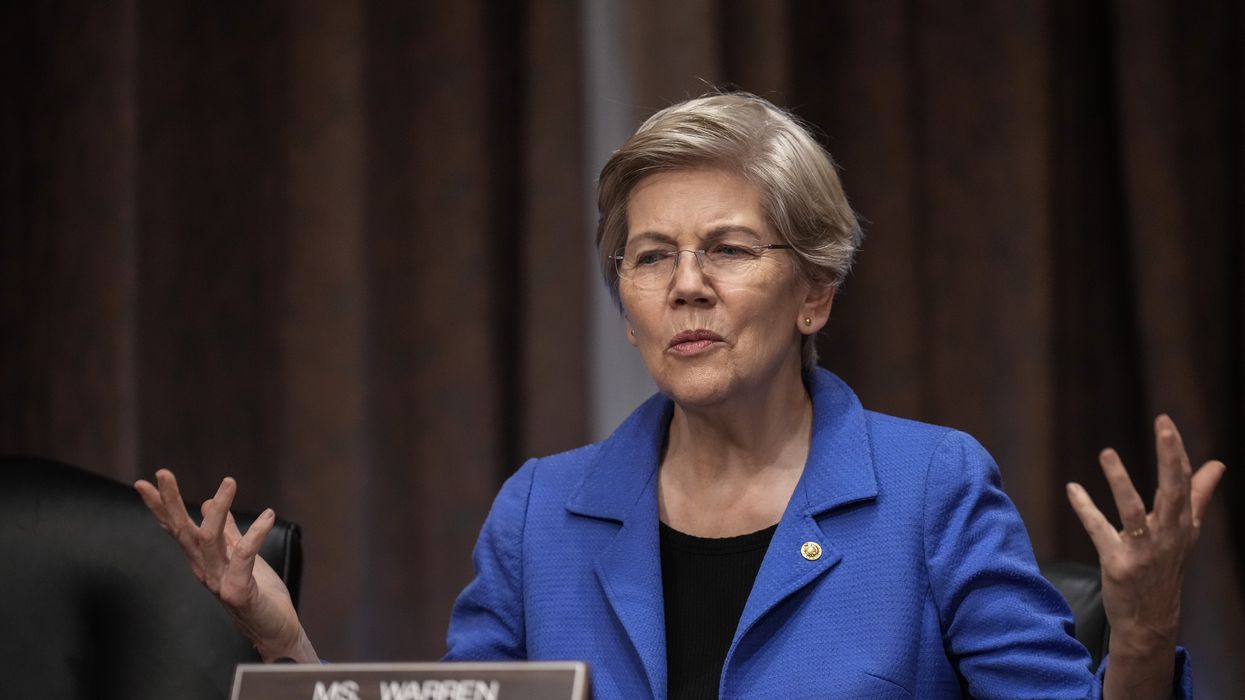
"The single biggest threat to the U.S. banking system is more concentration," said the Massachusetts Democrat. "A bank as big as JPMorgan shouldn't be allowed to get even bigger."
U.S. Sen. Elizabeth Warren raised alarm about the recent sale of First Republic Bank to JPMorgan Chase—which followed a government takeover of the former—in a letter to financial regulators and a series of questions during a Thursday hearing.
"The failure of First Republic Bank shows how deregulation has made the too-big-to-fail problem even worse," the Massachusetts Democrat said after the controversial sale earlier this month. "Congress needs to make major reforms to fix a broken banking system."
Ahead of the Senate Committee on Banking, Housing, and Urban Affairs hearing, Warren wrote to two officials who appeared before the panel Thursday morning: Martin Gruenberg, chair of the Federal Deposit Insurance Corporation (FDIC), and Michael Hsu, acting head of the Office of the Comptroller of the Currency (OCC).
"The executives at First Republic—who took excessive risks and did not appropriately manage them as interest rates increased throughout 2022 and 2023—bear primary responsibility for this failure," Warren wrote in the letter, dated Wednesday. "I am continuing to seek answers from the bank's executives, and attempting to pass bipartisan legislation that would claw back their excessive compensation."
"But the outcome of this seizure and sale were deeply troubling: It resulted in a $13 billion cost to the Federal Deposit Insurance Fund—which will ultimately be passed on to ordinary bank consumers across the country—and made JPMorgan, the nation's biggest bank, even bigger," she added. "JPMorgan will also record a $2.6 billion gain from the deal."
Warren asked Gruenberg and Hsu to prepare to address the topic at the committee's hearing and also requested written responses to a series of questions by the end of the month.
"One set of questions involves the $13 billion loss to the Federal Deposit Insurance Fund, and why the fund was allowed to take this loss while the FDIC deal made nearly $50 billion worth of uninsured deposits at First Republic—including $30 billion in uninsured deposits from big banks—whole," she noted. "My second set of concerns involves the decision to choose JPMorgan—which was already the nation's largest bank—to acquire First Republic and become even bigger."
During the hearing, Warren explained that "when the FDIC sells a failed bank, the law requires that you choose the highest bidder that will result in the lowest cost to the Deposit Insurance Fund—but the law also requires signoff from the OCC, and the OCC's job, by law, is to consider whether the merger would pose 'risk to the stability of the United States banking or financial system.'"
The senator questioned Hsu about the decision to sell to JPMorgan versus PNC or Citizens Bank, given that selling to either of the latter would have posed less of a risk, based on one metric used by financial regulators that is notably influenced by bank size.
"Comptroller Hsu, your job, by law, is to determine risk to the system from making big banks even bigger, and you have a clear metric for doing that," Warren said. "So how do you explain approving a sale to a banking giant that increases the risk to the banking system by somewhere between nearly 800% and 1,400% more than selling to other bidders? Did you just ignore the fact that a failure at JPMorgan would blow a hole in our banking system... and let them grow by $200 billion?"
After insisting that "for every merger application we follow the law, we follow our guidelines, we follow our policies and procedures," Hsu said focusing only on the metric Warren cited would not have been "wise," and if that approach had been taken, "I fear that there would have been greater financial instability that weekend."
As her time expired, Warren—who was visibly frustrated by Hsu's lack of a broader explanation for choosing JPMorgan Chase—declared that "the single biggest threat to the U.S. banking system is concentration."
"We're all pushing harder for merger guidelines so that we don't get more concentration in the banking system," she told Hsu. "You are the one person who was supposed to use judgment on the question... 'Between multiple sales, which one was the right one to go with, and which one presented more risk to the banking system?'"
"According to your own metric, you chose the one that gives us more concentration in the system," the senator stressed. "I am very troubled by that decision."
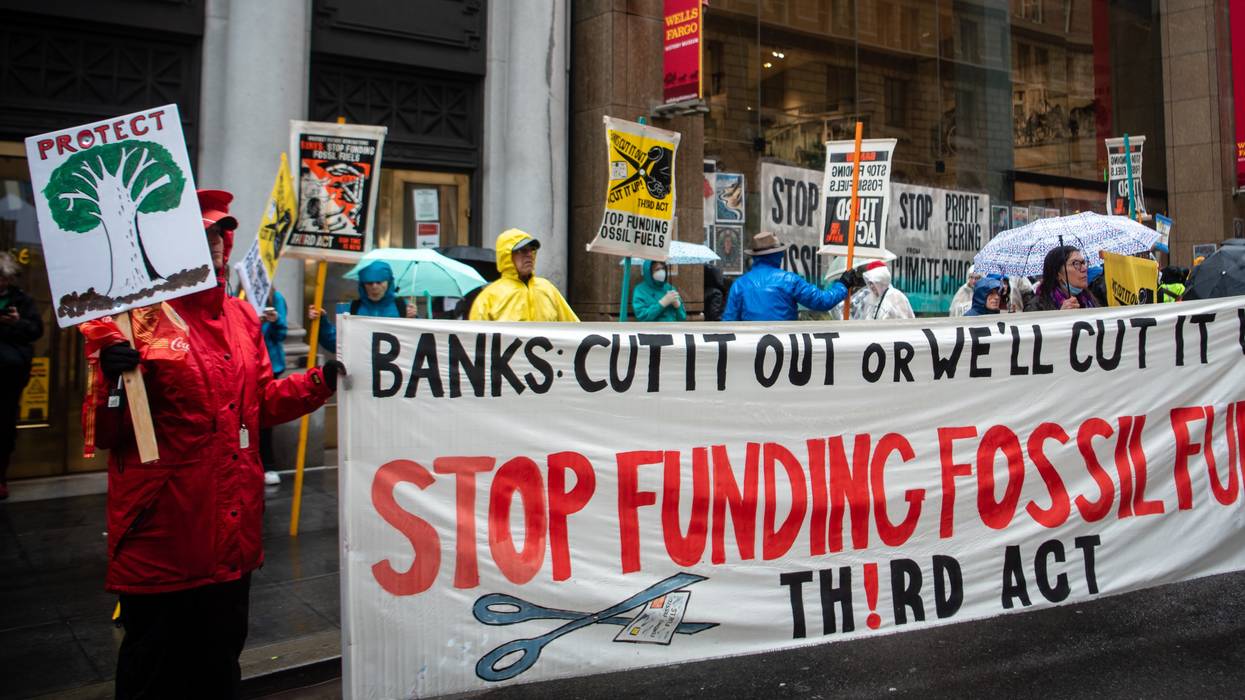
"If management at a wide swath of banks failed to properly address a well-understood risk, they cannot be trusted to independently address other complex emerging risks," argued 50 green groups.
In the wake of recent bank collapses and protests across the United States demanding financial institutions end fossil fuel financing, 50 climate, environmental justice, and Indigenous rights groups on Tuesday advocated for new regulations.
"We the undersigned strongly urge financial regulators and Congress to learn from the collapse and bailout of Silicon Valley Bank (SVB) and rapidly implement new regulations to mitigate against climate-related financial risk," the coalition wrote.
"Climate-related risks are moving us toward a financial crisis. But regulators have not taken adequate steps to actually mitigate those risks."
The groups' letter was sent to key leaders at the U.S. Treasury Department, Federal Reserve, Federal Deposit Insurance Corporation (FDIC), National Economic Council, and relevant U.S. House and Senate committees.
After explaining how the SVB collapse is partly the result of poor management enabled by regulatory rollbacks under the Trump administration, the letter states that "this is only the latest example of a bank being wholly unprepared for a large and obvious financial risk."
The letter continues:
It is a stark reminder of the chaos that can unfold when a financial institution has high exposure to a risky industry, and of the fact that the leaders of major financial institutions are frequently far more concerned with their short-term gains than with robust risk management measures that ensure their safety and the safety and soundness of the financial system. As a reminder of the latter, senior managers at SVB paid themselves millions in bonuses hours before their bank failed and the federal government financially backstopped it. Here again, stronger rules—including the Dodd-Frank executive compensation rules that remain unfinished—could have incentivized greater bank attention to risks.
To prevent any potential for a cascade of bank runs after SVB's collapse, federal regulators have now effectively set a precedent of guaranteeing all bank deposits in all banking institutions nationwide, to be backstopped by the Federal Deposit Insurance Fund and then taxpayer dollars. Moreover, the Federal Reserve has begun lending at extraordinarily generous terms to any other banks with assets whose real value has been curbed by interest rate hikes—in effect, the Fed is offering a first-of-its-kind, get-out-of-bank-failure-free card to any firms that made the same foreseeable mistake as SVB. Regulators justified this extraordinary shift in the structures of American finance by relying on emergency rules in place to prevent systemic risk to the financial system. In effect, regulators argued that SVB's inability to mitigate one of the most obvious forms of financial risk—the potential for rising interest rates amid high inflation—constituted a grave risk to the whole financial system, and, thereby, the whole economy.
"If management at a wide swath of banks failed to properly address a well-understood risk, they cannot be trusted to independently address other complex emerging risks," the groups argued. "Regulators must intervene to protect the financial system from risks associated with climate change and the ongoing transition to a green economy."
The letter notes recent remarks from Treasury Secretary Janet Yellen about the economic and financial impact of the climate emergency as well as how, as it worsens, "banks of all sizes holding mortgage-backed bonds will see their assets drop in value" while "banks invested in the fossil fuel industry will eventually be saddled with stranded assets."
"Climate-related risks are moving us toward a financial crisis. But regulators have not taken adequate steps to actually mitigate those risks," the coalition warned, calling on U.S. policymakers to:
"Banks cannot be trusted to independently evaluate and protect against the systemic risks of the climate crisis in real-time. They also cannot be trusted to avoid creating risks for other institutions and the financial system through their support for fossil assets and greenhouse gas emissions," the letter says. "This process requires regulators to set clear rules and ensure banks and financial institutions do not engage in unsafe behavior and do not create undue risks and costs for the financial system and the economy."
Signatories include Greenpeace USA, Lakota People's Law Project, Sierra Club, and Third Act—who came together earlier this month for a "Stop Dirty Banks" national day of action, the first elderly-led mass climate demonstration in U.S. history.
"Today is a major drive to take the cash out of carbon," declared Third Act's Bill McKibben. "We want JPMorgan Chase, Citi, Wells Fargo, and Bank of America to hear the voices of the older generation which has the money and structural power to face down their empty, weasel words on climate. We will not go to our graves quietly knowing that the financial institutions in our own communities continue to fund the climate crisis."
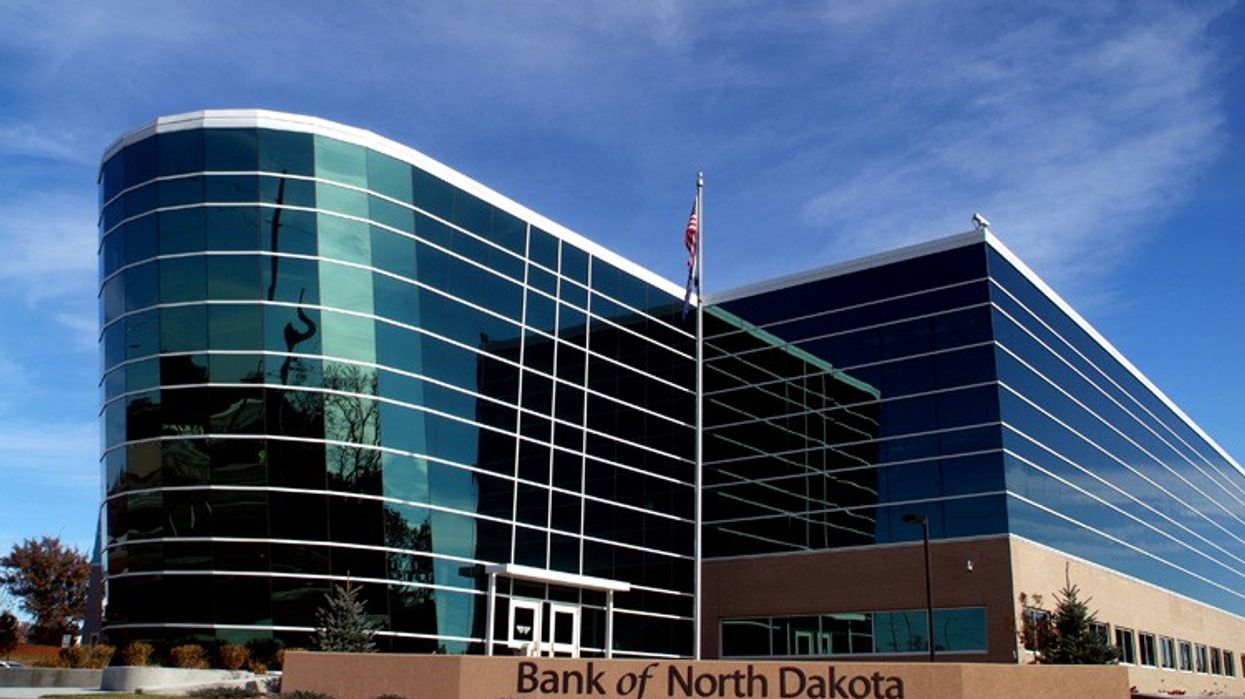
A state-owned bank on the model of the Bank of North Dakota can provide low-interest loans, liquidity, and financial sovereignty.
On CNN March 14, Roger Altman, a former deputy Treasury secretary in the Clinton administration, said that American banks were on the verge of being nationalized:
What the authorities did over the weekend was absolutely profound. They guaranteed the deposits, all of them, at Silicon Valley Bank. What that really means… is that they have guaranteed the entire deposit base of the U.S. financial system. The entire deposit base. Why? Because you can't guarantee all the deposits in Silicon Valley Bank and then the next day say to the depositors, say, at First Republic, sorry, yours aren't guaranteed. Of course they are.
…So this is a breathtaking step which effectively nationalizes or federalizes the deposit base of the U.S. financial system.
The deposit base of the financial system has not actually been nationalized, but Congress is considering modifications to the Federal Deposit Insurance Corporation (FDIC) insurance limit. Meanwhile, one state that does not face those problems is North Dakota, where its state-owned bank acts as a "mini-Fed" for the state. But first, a closer look at the issues.
Bail In, Bail Out, or "Socialism for the Rich"?
On Friday, March 10, Silicon Valley Bank (SVB) was put into receivership by the FDIC. The FDIC announced that deposits over the $250,000 insurance limit would get an advance dividend within the next week, and would receive a receivership certificate for the rest of the funds. Most of the depositors were venture-backed startups that needed to keep large deposits in the bank to meet payroll and pay suppliers, and over 95% of the deposits were uninsured and at risk of being lost. It was basically a "bail in" of the uninsured deposits, which would be recoverable only if funds were available after the bank's assets had been sold.
But that arrangement lasted only two days. On March 12, Signature Bank was put into receivership; and the FDIC, Treasury, and Federal Reserve jointly announced that all of the deposits at the two banks, not just those under the insurance limit, would be available for withdrawal on demand.
At a Senate Finance Committee hearing on March 16, Treasury Secretary Janet Yellen said that the guarantee would not apply to all deposits at all banks. Rather, the determination would be made on a case-by-case basis.
In a Bloomberg News interview on March 16, former FDIC Chair Sheila Bair criticized that decision. She observed that the two banks getting special treatment were not "systemically important," and that the cost of the expanded guarantee was to be covered by a special assessment against all insured banks, including the small community banks that provide essential credit to local businesses. She argued that if guarantees were going to be given over the $250,000 limit, they should apply to deposits everywhere.
Meanwhile, on March 12, the Federal Reserve announced that it had set up a special purpose vehicle of the sort arranged for Covid relief in March 2020, called the Bank Term Funding Program (BTFP). Like the Covid special purpose vehicles, it would be backstopped with $25 billion from the Exchange Stabilization Fund (ESF), a fund set up in 1934 to stabilize the exchange value of the dollar. The BTFP was to be available to any bank needing it, and many banks obviously did. Over $300 billion in short-term loans were withdrawn from the Fed's various facilities just in the week after SVB's collapse.
This money is not, however, the sort of "free lunch" provided to troubled banks in the last financial crisis. The money is to be advanced as a loan for up to a year, at a hefty interest rate as of March 22 of 4.88%. According to a Federal Reserve press release, advances will be made to "eligible depository institutions pledging U.S. Treasuries, agency debt and mortgage-backed securities, and other qualifying assets as collateral. These assets will be valued at par. The BTFP will be an additional source of liquidity against high-quality securities, eliminating an institution's need to quickly sell those securities in times of stress."
"Valued at par" means that banks can hold their long-term federal securities to maturity while acquiring ready cash against them to meet withdrawals, without having to "mark to market" and sell at a loss.
The Systemic Flaw
So what caused this crisis, and what can be done to remedy it?
In the midst of the 2008 economic crisis, former Fed Chair Alan Greenspan conceded that there was a flaw in his perception of the financial operating system. For 40 years, he had believed that banks could "self-regulate" responsibly, a presumption that had proven to be flawed.
In the case of SVB, however, the bank was not engaged in the sort of risky lending seen in the subprime crisis, and increased "stress testing" wouldn't have saved it. It had put its deposits largely in federal securities, purported to be the safest assets available—so safe that they carry a "zero risk weighting" requiring no extra capital buffer. What went wrong was that they were long-term bonds at low interest. When rates shot up, the market value of the bonds dropped, since buyers prefer newer bonds paying higher interest. Bonds that could be sold were sold at a loss, and some marked "hold to maturity" could not be sold at all. As a result, SVB lacked the liquidity to meet the sudden unexpected demand for withdrawals.
The flaw to which SVB and many other "troubled" banks have fallen victim is the age-old systemic problem of "borrowing short to lend long." For centuries, banks have borrowed the money of depositors who expect to have it available on demand, and have invested it in long-term assets that cannot be immediately liquidated. The system works well so long as the depositors don't panic and rush to pull their money out all at once. But when they do, if the problem is systemic, not just single banks but the whole banking system can collapse.
We used to see this flaw dramatized every December, when TV networks ran the 1946 Christmas classic "It's a Wonderful Life." When the Bailey Brothers Building and Loan suffered a bank run, George Bailey (Jimmy Stewart) had to explain to the panicked depositors that their money had been lent to their neighbors. He was on the verge of suicide, when a guardian angel showed him how critical he and his bank had been to the community; and the neighbors pitched in and rescued the bank.
Even closer to the situation today was the crisis of the savings and loan associations (S&Ls) of the 1980s, after the Federal Reserve raised interest rates dramatically to kill inflation. Most of the assets of the S&Ls were long-term fixed-rate mortgages. As rates rose, they had to pay more to attract deposits; but the amount they earned on their fixed-rate mortgages didn't change. Losses mounted, but the S&L insurance fund, the FSLIC, lacked sufficient money to reimburse all the depositors at failed S&Ls so the regulators turned a blind eye and allowed them to keep operating as "zombies." The matter was finally resolved with legislation in 1989 that placed S&L insurance under the FDIC and established the Resolution Trust Corporation to resolve the remaining troubled S&Ls. The ultimate cost to the taxpayers was estimated to be as high as $124 billion.
As with George Bailey's savings and loan, the flaw was not "fractional reserve" lending. The S&Ls pooled the money of their customers and lent only what they had. The systemic flaw was and still is that to make long-term loans, banks must borrow "other people's money," which is expected to be available on demand. Today the banks' liquidity options include not just their own depositors but other banks' depositors in the fed funds market, and pension funds and other institutional creditors lending in the repo market. But they all expect their money to be available on demand; and if the bank has lent it out in long-term loans, the bank can be caught short shuffling reserves around trying to meet that demand.
The Failed Banks Were Not Nationalized, But Maybe They Should Have Been
One option that was debated in the 2008-09 crisis was actual nationalization. As professor Michael Hudson wrote in February 2009:
Real nationalization occurs when governments act in the public interest to take over private property… Nationalizing the banks along these lines would mean that the government would supply the nation's credit needs. The Treasury would become the source of new money, replacing commercial bank credit. Presumably this credit would be lent out for economically and socially productive purposes, not merely to inflate asset prices while loading down households and business with debt as has occurred under today's commercial bank lending policies.
Gar Alperovitz, professor emeritus at the University of Maryland, also weighed in on the issue. In a 2012 New York Times article titled "Wall Street Is Too Big to Regulate," he noted that the five biggest banks—JPMorgan Chase, Bank of America, Citigroup, Wells Fargo, and Goldman Sachs—had amassed assets amounting to more than half the nation's GDP. He wrote:
With high-paid lobbyists contesting every proposed regulation, it is increasingly clear that big banks can never be effectively controlled as private businesses. If an enterprise (or five of them) is so large and so concentrated that competition and regulation are impossible, the most market-friendly step is to nationalize its functions…
Nationalization isn't as difficult as it sounds. We tend to forget that we… essentially nationalized the American International Group, one of the largest insurance companies in the world, and the government still owns roughly 60 percent of its stock.
Another example was Continental Illinois, the largest bank bankruptcy and the seventh-largest bank in the country when it failed in 1984. The FDIC wiped out existing shareholders, infused capital, took over bad assets, replaced senior management, and owned the bank for about a decade, running it as a commercial enterprise, selling it in 1994.
What constituted a radical departure from capitalist principles in the last financial crisis was not "nationalization" but an unprecedented wave of bank bailouts, sometimes called "welfare for the rich." The taxpayers bore the losses while the culpable management not only escaped civil and criminal penalties but made off with record bonuses. Banks backed by an army of lobbyists succeeded in getting laws changed so that what was formerly criminal behavior became legal. Instead of nationalization, we got TARP, the Troubled Asset Relief Program, in which toxic assets were purchased from financial institutions by the Treasury. Faced with the inequity of that solution, many economists recommended nationalization instead. Willem Buiter, chief economist of Citigroup and formerly a member of the Bank of England's Monetary Policy Committee, wrote in the Financial Times in September 2009:
Is the reality of the modern, transactions-oriented model of financial capitalism indeed that large private firms make enormous private profits when the going is good and get bailed out and taken into temporary public ownership when the going gets bad, with the taxpayer taking the risk and the losses?
If so, then why not keep these activities in permanent public ownership? There is a long-standing argument that there is no real case for private ownership of deposit-taking banking institutions, because these cannot exist safely without a deposit guarantee and/or lender of last resort facilities that are ultimately underwritten by the taxpayer. ...Once the state underwrites the deposits or makes alternative funding available as lender of last resort, deposit-based banking is a license to print money. [Emphasis added.]
Those are all good arguments, but Congress is not likely to nationalize the whole banking system any time soon.
What About Nationalizing the Liquidity Pool?
Without going to those lengths, what could be made a public utility is the banks' liquidity pool. Banks could borrow directly from the deep pocket of the central bank, the "lender of last resort" (or from the Treasury if it were reengineered so that it could issue money as credit without taxing or going into debt). Banks would still need to make "prudent" loans—loans to borrowers who had demonstrated an ability to pay the money back—since if they suffered substantial defaults, they would not be able to balance their books and could be put into bankruptcy. They would still charge interest to cover their costs, and they would still compete for borrowers by keeping their interest rates low, maintaining the principles of "market capitalism" operating now. Customer deposits could be sequestered separately from loans, e.g. at government-backed postal banks. In fact, sequestering customer funds is what brokerages (such as Schwab and Fidelity) do now. Rather than the bank gambling with your money, you gamble with it yourself. But that, of course, can be risky too!
In any case sequestering deposits is not likely to happen either. What is being sought is what Roger Altman predicted—FDIC insurance coverage of the entire deposit base. In a March 17 letter first reported by Bloomberg News, the Midsize Bank Coalition of America called on regulators "immediately... to reinstate full deposit insurance coverage for depositors," for two years. That was done in 2008, the letter noted, "and was one of the most effective tools used in the great financial crisis and it needs to be brought back immediately. Importantly, as happened previously, this increase in insurance should be paid for directly by the banks themselves by simply increasing the deposit insurance assessment on banks who choose to participate in this increased insurance coverage."
The concern for midsize banks is that depositors have been fleeing to giant "too big to fail" banks, perceiving them to be safer. But as Cornell professor Robert Hockett observes, midsize banks lend to the midsize businesses that are the backbone of the productive economy. He has drafted legislation to provide for universal deposit insurance, discussed in Forbes. However, it's an uphill battle. Even Sheila Bair, who is clearly sympathetic to the plight of local banks, has reservations on full coverage. As reported on MSN.com:
FDIC Chairwoman Sheila Bair said Tuesday that Congress should consider temporarily providing guarantees for deposits in transaction accounts used by employers to pay their workers—a move that some Democrats are considering.
But Bair said it would be an "overreaction" to insure all bank deposits.
"Unlimited insurance would be very expensive to do. It would be assessed on the banking system, backstopped by taxpayers, and would primarily help very, very wealthy people," Bair said on Washington Post Live.
Small community banks—defined as banks with $10 billion or less in assets—have spoken out against paying more to cover the failure of larger banks such as SVB.
The Public Bank Option
Meanwhile, one midsize bank that has escaped this furor is the Bank of North Dakota. With assets in 2021 of $10.3 billion and a return on investment of 15%, the BND is owned by the state, which self-insures it. There is no fear of bank runs, because the state's revenues compose the vast majority of its deposits, and they must be deposited in the BND by law.
The state's local banks are also protected by the BND, which is forbidden to compete with them. Instead, it partners with them, helping with liquidity and capitalization. The BND has been called a "mini-Fed" for the state and its banks. That helps explain why North Dakota has more local banks per capita than any other state, at a time when other states have been losing banks to big bank mergers, causing the number of U.S. banks to shrink radically.
U.K. professor Richard Werner recently published a briefing memo supporting the case for a public bank. It was prepared for the state of Tennessee, which is considering a sovereign state bank on the North Dakota model, but the arguments apply to all states. Benefits discussed include dividends, higher state-level tax revenues, greater job creation, greater local autonomy and resilience to shocks, more options for funding public sector borrowing and state pension funds, and protection of financial transaction freedom and privacy.
Small and local is good, but even small regional banks need to pool their resources for maximum efficiency and security. A state-owned bank on the model of the Bank of North Dakota can provide low-interest loans, liquidity, and financial sovereignty, keeping financial resources in the state directed to public purposes, all while turning a profit for the state.

The senator also demanded a federal investigation into potential insider trading by executives.
U.S. Sen. Elizabeth Warren on Monday weighed in on the collapse of Silicon Valley Bank, taking to The New York Times' opinion section to offer her view on how the financial institution failed, while also looking ahead and detailing "what Washington must do—quickly—to prevent the next crisis."
Namely, the Massachusetts Democrat wrote, the federal government must ensure the bank's risky behavior isn't rewarded with bonuses and generous compensation for executives, and must determine whether insider trading tipped off Silicon Valley Bank (SVB) executives regarding their firm's impending failure last Friday.
Joining other progressives including Sen. Bernie Sanders (I-Vt.) and former Labor Secretary Robert Reich in noting that Republican lawmakers' push to roll back oversight and liquidity requirements allowed SVB to "load up on risk" and made it more vulnerable to failure, Warren pointed to the conduct of bank executives just before the Federal Deposit Insurance Corporation (FDIC) was forced to save the institution.
Just hours before the California-based firm collapsed on Friday, Warren wrote, "SVB executives were busy paying out congratulatory bonuses," estimated to be as high as $140,000 for managing directors, according to CNBC.
"If we are to deter this kind of risky behavior from happening again, it's critical that those responsible not be rewarded."
The bonuses were for work performed in 2022, when SVB was largely serving a small, wealthy subset of the U.S. population—"a concentrated group of tech companies with big deposits, driving an abnormally large ratio of uninsured deposits," Warren wrote.
Securities and Exchange Commission (SEC) filings also show that SVB CEO Greg Becker sold $2.27 million in bank stocks in late February and $1.1 million in stocks in January.
The bank took a risk by heavily concentrating its assets in a single industry, and then by investing a large share of the funds into long-term Treasury bonds "that promised good returns when interest rates were low," wrote Reich at Substack on Monday. When interest rates rose, the value of the bonds fell and "the gusher of venture capital funding to startup and tech companies slowed, because venture funds had to pay more to borrow money."
"As a result, these startup and tech companies had to withdraw more of their money from the bank to meet their payrolls and other expenses," Reich continued. "But the bank didn't have enough money on hand."
The business model used by SVB executives including Becker "was great for SVB's short-term profits, which shot up by nearly 40% over the last three years," wrote Warren. But with regulators forced to take over SVB and then on Sunday to dissolve Signature Bank—a New York-based institution also heavily tied to tech—to mitigate the damage done, she added, "now we know its cost."
As SVB executives were celebrating their bonuses Friday, "businesses and nonprofits with accounts at the bank [were left] alarmed that they wouldn't be able to pay their bills and employees," the senator wrote.
"SVB and Signature shareholders will be wiped out, but their executives must also be held accountable," she added. "Mr. Becker of SVB took home $9.9 million in compensation last year, including a $1.5 million bonus for boosting bank profitability—and its riskiness. Joseph DePaolo of Signature got $8.6 million. We should claw all of that back, along with bonuses for other executives at these banks. Where needed, Congress should empower regulators to recover pay and bonuses."
Morris Pearl, former BlackRock managing director and chair of the economic justice group Patriotic Millionaires, added that Becker and other executives should not be rewarded for failing "to foresee the consequences of the current market and the Federal Reserve interest rate hikes" as they "put tens of billions of dollars of risk on the shoulders of businesses and workers."
"SVB's incompetence in running their financial institution has led to a crisis impacting regular Americans," said Pearl. "Bankers always say that regulators get in the way of doing their jobs and making profits, but this is what happens when Congress takes them at their word and loosens regulations. Bank managers have an inherent conflict of interest regarding government oversight; they get the credit if things go well, and the FDIC takes the hit if things go south."
In addition to clawing back bonuses and exorbitant executive pay to ensure there are material consequences for SVB's mismanagement, Warren wrote at the Times, prosecutors should also "investigate whether any executives engaged in insider trading or broke other civil or criminal laws."
Rep. Ruben Gallego (D-Ariz.), who is running for Sen. Kyrsten Sinema's (I-Ariz.) Senate seat, echoed Warren's call.
"If we are to deter this kind of risky behavior from happening again," said Warren, "it's critical that those responsible not be rewarded."

"We cannot continue down the road of more socialism for the rich and rugged individualism for everyone else," said the U.S. Senator from Vermont.
Sen. Bernie Sanders on Sunday night called for a full repeal of the 2018 banking deregulations signed into law by former President Donald Trump and declared that "now is not the time for taxpayers bail out Silicon Valley Bank"—the California bank that collapsed Friday.
On Sunday evening, the U.S. Treasury Department, Federal Reserve, and Federal Deposit Insurance Corporation (FDIC) issued a joint statement outlining a plan to make all deposits for Silicon Valley Bank as well as Signature Bank, which was shuttered by New York regulators earlier in the day, available to costumers Monday morning.
In his statement, Sanders said, "If there is a bailout of Silicon Valley Bank, it must be 100 percent financed by Wall Street and large financial institutions. We cannot continue down the road of more socialism for the rich and rugged individualism for everyone else. Let us have the courage to stand up to Wall Street, repeal the disastrous 2018 bank deregulation law, break up too big to fail banks and address the needs of working families, not the risky bets of vulture capitalists."
The statement the Fed, Treasury, and FDIC noted that "no losses" associated with the rescue plan "will be borne by the taxpayer," though the extraordinary intervention—the largest of its kind since the 2008 financial collapse—is still seen by many economists and financial experts, even if bank investors and debt holders are not protected, as a "bailout" for the financial industry only made possible by taxpayers.
"Let us have the courage to stand up to Wall Street, repeal the disastrous 2018 bank deregulation law, break up too big to fail banks and address the needs of working families, not the risky bets of vulture capitalists."
Warren Gunnels, longtime staffer and top advisor to Sanders, made the connection between venture capitalists clamoring for a speedy government intervention to save the banking sector from a wider shock and the same kind of people who have adamantly opposed financial relief for the struggling middle- and working-class Americans:
As the Washington Post reports, "The decision by Treasury to backstop all deposits at SVB and Signature — not just those up to $250,000 that are insured under federal law — rested on a judgment that it was necessary to avoid a wider 'systemic' meltdown. The move will likely ignite a political firestorm over the decision to protect the assets of tech firms, venture capitalists, and other rich people in California."
In 2018, as Sen. Mike Crapo's (R-Idaho) Economic Growth, Regulatory Relief, and Consumer Protection Act was making its way through Congress, Sanders took to the floor of the U.S. Senate to oppose the bill, warning of exactly this kind of economic disaster if the deregulation was approved:
"Let's be clear," Sanders said Sunday night in his statement. "The failure of Silicon Valley Bank is a direct result of an absurd 2018 bank deregulation bill signed by Donald Trump that I strongly opposed. Five years ago, the Republican Director of the Congressional Budget Office released a report finding that this legislation would 'increase the likelihood that a large financial firm with assets of between $100 billion and $250 billion would fail.'"
"Unfortunately," he added, "that is precisely what happened."
On Monday, Lindsey Owens, executive directive of the progressive economic watchdog Groundwork Collaborative, focused on the additional lending facility made available to the bank customers and said the latest actions expose a deep "rot" within the Federal Reserve—especially as the central bank squeezes workers with increasingly higher interest rates, hikes that played at least a part in the banks' failures.
"This weekend, the Federal Reserve moved mountains to protect wealthy venture capitalists from the fallout of its aggressive interest rate hikes," said Owens. " Today, the Fed will return to its core work of pushing hardworking Americans out on the street to meet its inflation goals."
Such a set of policies, said Owens, shows the Fed "is irreparably broken and can no longer be trusted to go it alone on monetary policy. As Congress works to re-regulate mid-size banks after the misguided 2018 rollbacks that set this weekend's crisis in motion, they should also address the rot at the Fed."
In a statement on Sunday ahead of the government's rescue plan announcement, Matt Stoller, research director for the American Economic Liberties Project, made the case against any taxpayer bailout for SVB.
"Silicon Valley Bank was a badly managed and corrupt institution that entangled itself with powerful actors in the technology industry," Stoller argued. "The operative question government regulators are now facing is whether to use taxpayer funds to bail out the depositors from the failures of SVB's management."
But a full bailout, Stoller warned, "will only encourage other large regional banks to take similar risks in the future, just as Silicon Valley Bank did."
While bank investors and executives will not be included in the emergency actions announced on Sunday, Rep. Ro Khanna, the California Democrat who represents Silicon Valley, applauded the actions taken by Treasury to keep depositors whole.
Among his constituents impacted by the bank's collapse, he said, were "non-profit leaders, small business owners, start-up founders, and impacted employees of small businesses."
While expressly arguing that government intervention "should not and need not ... cost taxpayers a dime" during a news interview Sunday morning, Khanna later applauded the government plan while echoing Sanders' call for a reversal of the deregulation that led to the current crisis.
"I am glad that the Department of Treasury listened and moved to protect workers, the innovation pipeline, and the economy at large," Khanna said. "But the work doesn't end here. We've known since 2008 that stronger regulations are needed to prevent exactly this type of crisis. Congress must come together to reverse the deregulation policies that were put in place under Trump to avert future instability.”