SUBSCRIBE TO OUR FREE NEWSLETTER
Daily news & progressive opinion—funded by the people, not the corporations—delivered straight to your inbox.
5
#000000
#FFFFFF
To donate by check, phone, or other method, see our More Ways to Give page.
Daily news & progressive opinion—funded by the people, not the corporations—delivered straight to your inbox.
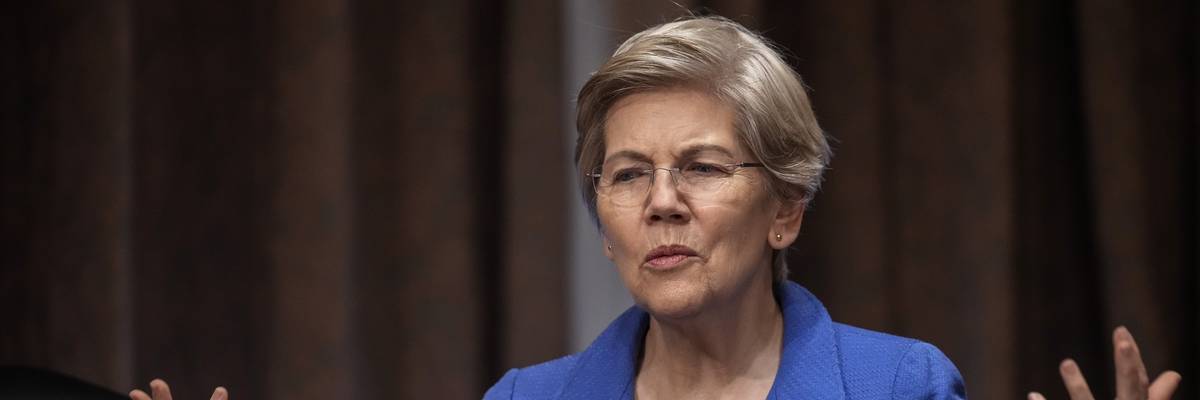
U.S. Sen. Elizabeth Warren (D-Mass.) attends a Senate Banking Committee hearing on April 27, 2023 in Washington, D.C.
"The single biggest threat to the U.S. banking system is more concentration," said the Massachusetts Democrat. "A bank as big as JPMorgan shouldn't be allowed to get even bigger."
U.S. Sen. Elizabeth Warren raised alarm about the recent sale of First Republic Bank to JPMorgan Chase—which followed a government takeover of the former—in a letter to financial regulators and a series of questions during a Thursday hearing.
"The failure of First Republic Bank shows how deregulation has made the too-big-to-fail problem even worse," the Massachusetts Democrat said after the controversial sale earlier this month. "Congress needs to make major reforms to fix a broken banking system."
Ahead of the Senate Committee on Banking, Housing, and Urban Affairs hearing, Warren wrote to two officials who appeared before the panel Thursday morning: Martin Gruenberg, chair of the Federal Deposit Insurance Corporation (FDIC), and Michael Hsu, acting head of the Office of the Comptroller of the Currency (OCC).
"The executives at First Republic—who took excessive risks and did not appropriately manage them as interest rates increased throughout 2022 and 2023—bear primary responsibility for this failure," Warren wrote in the letter, dated Wednesday. "I am continuing to seek answers from the bank's executives, and attempting to pass bipartisan legislation that would claw back their excessive compensation."
"But the outcome of this seizure and sale were deeply troubling: It resulted in a $13 billion cost to the Federal Deposit Insurance Fund—which will ultimately be passed on to ordinary bank consumers across the country—and made JPMorgan, the nation's biggest bank, even bigger," she added. "JPMorgan will also record a $2.6 billion gain from the deal."
Warren asked Gruenberg and Hsu to prepare to address the topic at the committee's hearing and also requested written responses to a series of questions by the end of the month.
"One set of questions involves the $13 billion loss to the Federal Deposit Insurance Fund, and why the fund was allowed to take this loss while the FDIC deal made nearly $50 billion worth of uninsured deposits at First Republic—including $30 billion in uninsured deposits from big banks—whole," she noted. "My second set of concerns involves the decision to choose JPMorgan—which was already the nation's largest bank—to acquire First Republic and become even bigger."
During the hearing, Warren explained that "when the FDIC sells a failed bank, the law requires that you choose the highest bidder that will result in the lowest cost to the Deposit Insurance Fund—but the law also requires signoff from the OCC, and the OCC's job, by law, is to consider whether the merger would pose 'risk to the stability of the United States banking or financial system.'"
The senator questioned Hsu about the decision to sell to JPMorgan versus PNC or Citizens Bank, given that selling to either of the latter would have posed less of a risk, based on one metric used by financial regulators that is notably influenced by bank size.
"Comptroller Hsu, your job, by law, is to determine risk to the system from making big banks even bigger, and you have a clear metric for doing that," Warren said. "So how do you explain approving a sale to a banking giant that increases the risk to the banking system by somewhere between nearly 800% and 1,400% more than selling to other bidders? Did you just ignore the fact that a failure at JPMorgan would blow a hole in our banking system... and let them grow by $200 billion?"
After insisting that "for every merger application we follow the law, we follow our guidelines, we follow our policies and procedures," Hsu said focusing only on the metric Warren cited would not have been "wise," and if that approach had been taken, "I fear that there would have been greater financial instability that weekend."
As her time expired, Warren—who was visibly frustrated by Hsu's lack of a broader explanation for choosing JPMorgan Chase—declared that "the single biggest threat to the U.S. banking system is concentration."
"We're all pushing harder for merger guidelines so that we don't get more concentration in the banking system," she told Hsu. "You are the one person who was supposed to use judgment on the question... 'Between multiple sales, which one was the right one to go with, and which one presented more risk to the banking system?'"
"According to your own metric, you chose the one that gives us more concentration in the system," the senator stressed. "I am very troubled by that decision."
Dear Common Dreams reader, It’s been nearly 30 years since I co-founded Common Dreams with my late wife, Lina Newhouser. We had the radical notion that journalism should serve the public good, not corporate profits. It was clear to us from the outset what it would take to build such a project. No paid advertisements. No corporate sponsors. No millionaire publisher telling us what to think or do. Many people said we wouldn't last a year, but we proved those doubters wrong. Together with a tremendous team of journalists and dedicated staff, we built an independent media outlet free from the constraints of profits and corporate control. Our mission has always been simple: To inform. To inspire. To ignite change for the common good. Building Common Dreams was not easy. Our survival was never guaranteed. When you take on the most powerful forces—Wall Street greed, fossil fuel industry destruction, Big Tech lobbyists, and uber-rich oligarchs who have spent billions upon billions rigging the economy and democracy in their favor—the only bulwark you have is supporters who believe in your work. But here’s the urgent message from me today. It's never been this bad out there. And it's never been this hard to keep us going. At the very moment Common Dreams is most needed, the threats we face are intensifying. We need your support now more than ever. We don't accept corporate advertising and never will. We don't have a paywall because we don't think people should be blocked from critical news based on their ability to pay. Everything we do is funded by the donations of readers like you. When everyone does the little they can afford, we are strong. But if that support retreats or dries up, so do we. Will you donate now to make sure Common Dreams not only survives but thrives? —Craig Brown, Co-founder |
U.S. Sen. Elizabeth Warren raised alarm about the recent sale of First Republic Bank to JPMorgan Chase—which followed a government takeover of the former—in a letter to financial regulators and a series of questions during a Thursday hearing.
"The failure of First Republic Bank shows how deregulation has made the too-big-to-fail problem even worse," the Massachusetts Democrat said after the controversial sale earlier this month. "Congress needs to make major reforms to fix a broken banking system."
Ahead of the Senate Committee on Banking, Housing, and Urban Affairs hearing, Warren wrote to two officials who appeared before the panel Thursday morning: Martin Gruenberg, chair of the Federal Deposit Insurance Corporation (FDIC), and Michael Hsu, acting head of the Office of the Comptroller of the Currency (OCC).
"The executives at First Republic—who took excessive risks and did not appropriately manage them as interest rates increased throughout 2022 and 2023—bear primary responsibility for this failure," Warren wrote in the letter, dated Wednesday. "I am continuing to seek answers from the bank's executives, and attempting to pass bipartisan legislation that would claw back their excessive compensation."
"But the outcome of this seizure and sale were deeply troubling: It resulted in a $13 billion cost to the Federal Deposit Insurance Fund—which will ultimately be passed on to ordinary bank consumers across the country—and made JPMorgan, the nation's biggest bank, even bigger," she added. "JPMorgan will also record a $2.6 billion gain from the deal."
Warren asked Gruenberg and Hsu to prepare to address the topic at the committee's hearing and also requested written responses to a series of questions by the end of the month.
"One set of questions involves the $13 billion loss to the Federal Deposit Insurance Fund, and why the fund was allowed to take this loss while the FDIC deal made nearly $50 billion worth of uninsured deposits at First Republic—including $30 billion in uninsured deposits from big banks—whole," she noted. "My second set of concerns involves the decision to choose JPMorgan—which was already the nation's largest bank—to acquire First Republic and become even bigger."
During the hearing, Warren explained that "when the FDIC sells a failed bank, the law requires that you choose the highest bidder that will result in the lowest cost to the Deposit Insurance Fund—but the law also requires signoff from the OCC, and the OCC's job, by law, is to consider whether the merger would pose 'risk to the stability of the United States banking or financial system.'"
The senator questioned Hsu about the decision to sell to JPMorgan versus PNC or Citizens Bank, given that selling to either of the latter would have posed less of a risk, based on one metric used by financial regulators that is notably influenced by bank size.
"Comptroller Hsu, your job, by law, is to determine risk to the system from making big banks even bigger, and you have a clear metric for doing that," Warren said. "So how do you explain approving a sale to a banking giant that increases the risk to the banking system by somewhere between nearly 800% and 1,400% more than selling to other bidders? Did you just ignore the fact that a failure at JPMorgan would blow a hole in our banking system... and let them grow by $200 billion?"
After insisting that "for every merger application we follow the law, we follow our guidelines, we follow our policies and procedures," Hsu said focusing only on the metric Warren cited would not have been "wise," and if that approach had been taken, "I fear that there would have been greater financial instability that weekend."
As her time expired, Warren—who was visibly frustrated by Hsu's lack of a broader explanation for choosing JPMorgan Chase—declared that "the single biggest threat to the U.S. banking system is concentration."
"We're all pushing harder for merger guidelines so that we don't get more concentration in the banking system," she told Hsu. "You are the one person who was supposed to use judgment on the question... 'Between multiple sales, which one was the right one to go with, and which one presented more risk to the banking system?'"
"According to your own metric, you chose the one that gives us more concentration in the system," the senator stressed. "I am very troubled by that decision."
U.S. Sen. Elizabeth Warren raised alarm about the recent sale of First Republic Bank to JPMorgan Chase—which followed a government takeover of the former—in a letter to financial regulators and a series of questions during a Thursday hearing.
"The failure of First Republic Bank shows how deregulation has made the too-big-to-fail problem even worse," the Massachusetts Democrat said after the controversial sale earlier this month. "Congress needs to make major reforms to fix a broken banking system."
Ahead of the Senate Committee on Banking, Housing, and Urban Affairs hearing, Warren wrote to two officials who appeared before the panel Thursday morning: Martin Gruenberg, chair of the Federal Deposit Insurance Corporation (FDIC), and Michael Hsu, acting head of the Office of the Comptroller of the Currency (OCC).
"The executives at First Republic—who took excessive risks and did not appropriately manage them as interest rates increased throughout 2022 and 2023—bear primary responsibility for this failure," Warren wrote in the letter, dated Wednesday. "I am continuing to seek answers from the bank's executives, and attempting to pass bipartisan legislation that would claw back their excessive compensation."
"But the outcome of this seizure and sale were deeply troubling: It resulted in a $13 billion cost to the Federal Deposit Insurance Fund—which will ultimately be passed on to ordinary bank consumers across the country—and made JPMorgan, the nation's biggest bank, even bigger," she added. "JPMorgan will also record a $2.6 billion gain from the deal."
Warren asked Gruenberg and Hsu to prepare to address the topic at the committee's hearing and also requested written responses to a series of questions by the end of the month.
"One set of questions involves the $13 billion loss to the Federal Deposit Insurance Fund, and why the fund was allowed to take this loss while the FDIC deal made nearly $50 billion worth of uninsured deposits at First Republic—including $30 billion in uninsured deposits from big banks—whole," she noted. "My second set of concerns involves the decision to choose JPMorgan—which was already the nation's largest bank—to acquire First Republic and become even bigger."
During the hearing, Warren explained that "when the FDIC sells a failed bank, the law requires that you choose the highest bidder that will result in the lowest cost to the Deposit Insurance Fund—but the law also requires signoff from the OCC, and the OCC's job, by law, is to consider whether the merger would pose 'risk to the stability of the United States banking or financial system.'"
The senator questioned Hsu about the decision to sell to JPMorgan versus PNC or Citizens Bank, given that selling to either of the latter would have posed less of a risk, based on one metric used by financial regulators that is notably influenced by bank size.
"Comptroller Hsu, your job, by law, is to determine risk to the system from making big banks even bigger, and you have a clear metric for doing that," Warren said. "So how do you explain approving a sale to a banking giant that increases the risk to the banking system by somewhere between nearly 800% and 1,400% more than selling to other bidders? Did you just ignore the fact that a failure at JPMorgan would blow a hole in our banking system... and let them grow by $200 billion?"
After insisting that "for every merger application we follow the law, we follow our guidelines, we follow our policies and procedures," Hsu said focusing only on the metric Warren cited would not have been "wise," and if that approach had been taken, "I fear that there would have been greater financial instability that weekend."
As her time expired, Warren—who was visibly frustrated by Hsu's lack of a broader explanation for choosing JPMorgan Chase—declared that "the single biggest threat to the U.S. banking system is concentration."
"We're all pushing harder for merger guidelines so that we don't get more concentration in the banking system," she told Hsu. "You are the one person who was supposed to use judgment on the question... 'Between multiple sales, which one was the right one to go with, and which one presented more risk to the banking system?'"
"According to your own metric, you chose the one that gives us more concentration in the system," the senator stressed. "I am very troubled by that decision."