
SUBSCRIBE TO OUR FREE NEWSLETTER
Daily news & progressive opinion—funded by the people, not the corporations—delivered straight to your inbox.
5
#000000
#FFFFFF
To donate by check, phone, or other method, see our More Ways to Give page.


Daily news & progressive opinion—funded by the people, not the corporations—delivered straight to your inbox.
The transformation of the Democratic Party from a working class party to one of prosperous elites can’t be ignored or wished away. It is one reason why this election is so close and why an extremist may capture the electoral college. But it doesn't have to be this way.
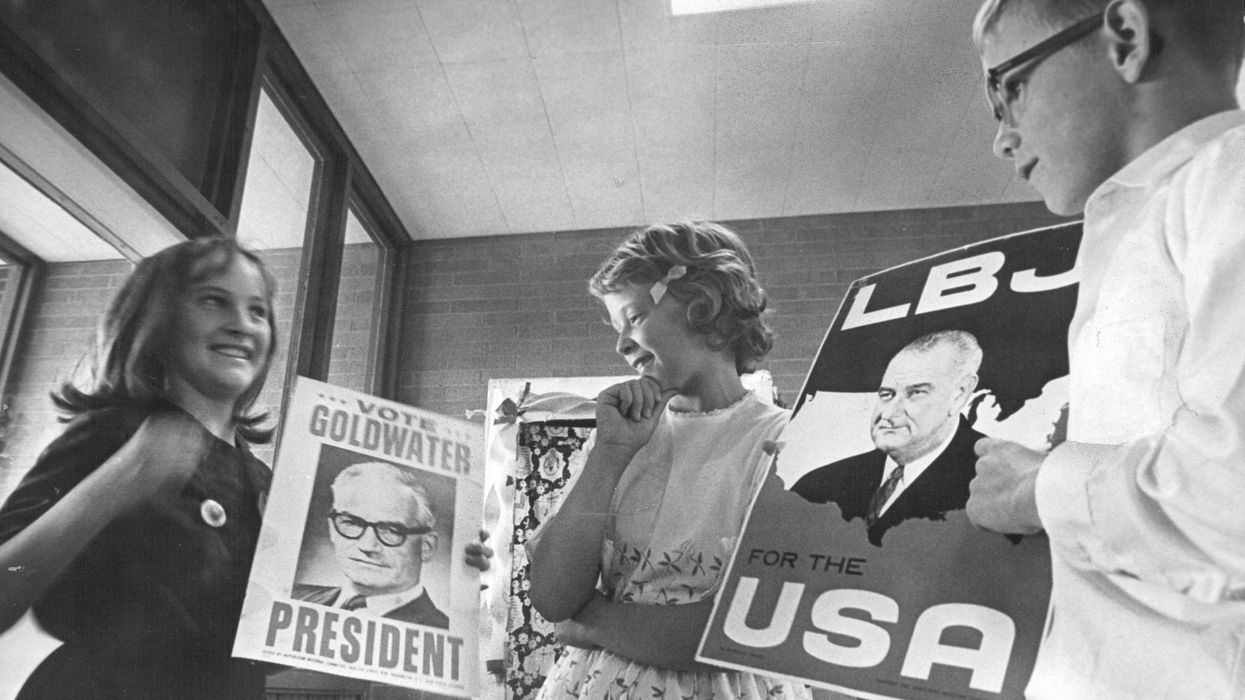
In 1964, Senator Barry Goldwater, the Republican from Arizona, captured his party's presidential nomination and unabashedly conducted an extremist, right-wing campaign. He opposed civil rights legislation and New Deal social welfare programs. He implied a willingness to use nuclear weapons, saying he would give U.S. field commanders and the NATO Supreme Commander the freedom to launch them without presidential approval.
As Goldwater famously said in his acceptance speech at the Republican convention, “Extremism in the defense of liberty is no vice! Moderation in the pursuit of justice is no virtue.”
The Johnson campaign exploited Goldwater’s extremism with what may be the most effective and chilling TV ad of all time.
If you watch the famous campaign ad, you’ll see a very young girl standing in a field, pulling petals off a daisy while counting them out one by one. Then, we hear the voice of a military commander (with a strong southern accent) doing a similar countdown that ends in a nuclear explosion which takes over the screen. The ad finishes with a voice-over, Lyndon Johnson offering a few pious words about love and peace. Johnson is never seen. Goldwater is never mentioned.
Lyndon Johnson crushed Goldwater 61.1 percent to 38.5, winning 486 electoral votes to 52.
This year’s election also features a self-declared extremist. Yet today, the presidential race is a toss-up. Trump’s extremism promotes lies about immigrants eating pets and the poisoning of our blood. Trump calls Democrats the enemy within and he praises those who stormed the capital on January 6th. And in total violation of the history of American electioneering, he continues to argue that the 2020 election was stolen from him. A vast majority of Republicans agree with him. Goldwater and his party of 1964 look like centrists in comparison.
Given Trump’s blatant extremism, how can the election be so close? Why isn’t Harris 20 points ahead? What is so different between now and 1964?
Hillary Clinton, in 2016, provided an explanation, shared by many, that about half of all Trump voters are bigots:
You know, to just be grossly generalistic, you could put half of Trump's supporters into what I call the basket of deplorables. (Laughter/applause) Right? (Laughter/applause) They're racist, sexist, homophobic, xenophobic, Islamophobic – you name it.
Voters are willing to elect Trump, the ultra-extremist, because he voices their fears about the rise of women, people of color, and the LGBTQ+ communities. More than anything, they and Trump want to make America white again!
If that theory is correct, we’d expect white working-class voters to be very illiberal on those issues and to have become even more so over the last several decades. We tested that theory in my book, Wall Street’s War on Workers, tracking 23 divisive social issues questions found in long-term voter surveys. It turns out that in 13 of the questions, the responses shifted in a more liberal direction over the years, and none of the 23 became more illiberal. Here are two stunning examples:
“Should gay or lesbian couples be legally permitted to adopt children?”
Said Yes in 2000: 38.2%
Said Yes in 2020: 76.0%
“Should legal status be granted to all illegal immigrants who have held jobs and paid taxes for at least 3 years and have not been convicted of any felony crimes?”
Said Yes in 2010: 32.1%
Said Yes in 2020: 61.8%
If the deplorable argument is wanting, as our research suggests, what is a better explanation for the enormous support Trump is receiving?
A disclaimer is in order. It’s impossible to address all the factors in one short article. But this question shouldn’t be ignored, so here goes.
Let’s start with trust in government. In 1964, an amazing 77 percent of Americans agreed that “they trust the government to do what is right just about always/most of the time.” In 2024 it was 22 percent.
That means the incumbent President in 1964, Lyndon Johnson, was viewed as the leader of a government that protected it’s people. Kamala Harris, as the current incumbent Vice-President, is mostly viewed as a leader of a government that is not protecting the average person. Harris is perceived as part of the establishment, the elites who have benefited during the years of runaway inequality, while Trump is perceived as its wrecking ball.
But that displeasure with government today suggests another set of explanations, including the collapse of unionization and the rise of job insecurity facing working people over the past four decades. More than 29 percent of the total U.S. workforce were union members in 1964. Add in their families and at last half of all Americans had close union connections. Today, 94 percent of all private sector workers are not in unions.
As a result, nearly all workers have had little or no protection against the mass layoffs that have regularly afflicted the country since the 1970s, even when the economy is prospering. During the Johnson years, the union ecosystem was so dense that Democratic politicians had no choice but to appeal to the interests of working people. They had to be the party of workers whether they liked it or not.
But starting with Bill Clinton, unions became small enough to ignore. Appealing to and appeasing Wall Street and corporate interests became central to the Democratic Party’s path to power. They wrongly believed that workers had no place else to turn.
And white workers, in particular, fled the Democrats. The research for my book strongly suggests that the main culprit was mass layoffs and the failure of the Democrats to address them.
Take Mingo County, West Virginia, with a population 25,000. It had 3,300 coal mining jobs in 1996. In that year Bill Clinton received 69.7 percent of the vote. By 2020, Mingo County had lost 3,000 of those coal mining jobs, and Joe Biden received only 13.9 percent.
Is this cherry-picking one country to make a point? No. For Wall Street’s War on Workers, we tested all the counties in the Blue Wall states of Michigan, Pennsylvania, and Wisconsin.
Our findings showed that as the county mass layoff rate went up, the Democratic vote declined. In short, the Democrats are being blamed for failing to protect working-class people from the destruction of their jobs. While working people may not know all the details about stock buybacks and leveraged buyouts, they know that Wall Street has been walking all over them and the Democrats have done little to stop them.
In discussing with my colleagues why this election is so different than 1964, one noted that the problem may be that Harris didn’t have enough time to mount a full campaign. But another jumped in and said, maybe she had too much time. Say what?
“She’s a corporate Democrat,” my colleague responded, meaning that the more Harris campaigns the more she sends that corporate-friendly signal to working-class voters. When they say she isn’t specific enough about her plans, they’re also saying she isn’t speaking directly enough to them about their issues.
The transformation of the Democratic Party from the party of the working class to the party of prosperous elites can’t be ignored or wished away. It is one reason why this election is so close and why an extremist may capture the electoral college. If Trump wins, he will surely wield his axe against government, and that is certain to negatively impact the most vulnerable among us.
It doesn’t have to be this way. My research and that of the Center for Working Class Politics show that a strong progressive populist message is very attractive to working people, especially in the Blue Wall states. It’s a damn shame that so many Democratic politicians can’t see the writing on the wall.When Harris delivered her acceptance speech in Chicago, it did not include the words “atomic” or “nuclear” at all.

One evening in early September 1964, a frightening commercial jolted 50 million Americans who were partway through watching “Monday Night at the Movies” on NBC. The ad began with an adorable three-year-old girl counting petals as she pulled them from a daisy. Then came a man’s somber voiceover, counting down from ten to zero. Then an ominous roar and a mushroom cloud from a nuclear bomb explosion.
The one-minute TV spot reached its climax with audio from President Lyndon Johnson, concluding that “we must love each other, or we must die.” The ad did not mention his opponent in the upcoming election, Sen. Barry Goldwater, but it didn’t need to. By then, his cavalier attitude toward nuclear weapons was well established.
Goldwater’s bestseller The Conscience of a Conservative, published at the start of the decade, was unnervingly open to the idea of launching a nuclear war, while the book exuded disdain for leaders who “would rather crawl on knees to Moscow than die under an Atom bomb.” Closing in on the Republican nomination for president, the Arizona senator suggested that “low-yield” nuclear bombs could be useful to defoliate forests in Vietnam.
His own words gave plenty of fodder to others seeking the GOP nomination. Pennsylvania Gov. William Scranton called Goldwater “a trigger-happy dreamer” and said that he “too often casually prescribed nuclear war as a solution to a troubled world.” New York Gov. Nelson Rockefeller unloaded with a rhetorical question: “How can there be sanity when he wants to give area commanders the authority to make decisions on the use of nuclear weapons?”
- YouTubeyoutu.be
So, the stage was set for the “daisy ad,” which packed an emotional wallop -- and provoked a fierce backlash. Critics cried foul, deploring an attempt to use the specter of nuclear annihilation for political gain. Having accomplished the goal of putting the Goldwater camp on the defensive, the commercial never aired again as a paid ad. But national newscasts showed it while reporting on the controversy.
Today, a campaign ad akin to the daisy spot is hard to imagine from the Democratic or Republican nominee to be commander in chief, who seem content to bypass the subject of nuclear-war dangers. Yet those dangers are actually much higher now than they were 60 years ago. In 1964, the Doomsday Clock maintained by experts at the Bulletin of the Atomic Scientists was set at 12 minutes to apocalyptic midnight. The ominous hands are now just 90 seconds away.
Yet, in their convention speeches this summer, both Donald Trump and Kamala Harris were silent on the need to engage in genuine diplomacy for nuclear arms control, let alone take steps toward disarmament.
Trump offered standard warnings about Russian and Chinese arsenals and Iran’s nuclear program, and boasted of his rapport with North Korean dictator Kim Jong Un. Left unmentioned was Trump’s presidential statement in 2017 that if North Korea made “any more threats to the United States,” that country “will be met with fire and fury like the world has never seen.” Nor did he refer to his highly irresponsible tweet that Kim should be informed “I too have a Nuclear Button, but it is a much bigger & more powerful one than his, and my Button works!”
When Harris delivered her acceptance speech, it did not include the words “atomic” or “nuclear” at all.
Now in high gear, the 2024 presidential campaign is completely lacking in the kind of wisdom about nuclear weapons and relations between the nuclear superpowers that Lyndon Johnson and, eventually, Ronald Reagan attained during their presidencies.
Johnson privately acknowledged that the daisy commercial scared voters about Goldwater, which “we goddamned set out to do.” But the president was engaged in more than an electoral tactic. At the same time that he methodically deceived the American people while escalating the horrific war on Vietnam, Johnson pursued efforts to defuse the nuclear time bomb.
“We have made further progress in an effort to improve our understanding of each other’s thinking on a number of questions,” Johnson said at the conclusion of his extensive summit meeting with Soviet Premier Alexei Kosygin in Glassboro, New Jersey, on June 25, 1967. But fifty-seven years later, there is scant evidence that the current or next president of the United States is genuinely interested in improving such understanding between leaders of the biggest nuclear states.
Two decades after the summit that defrosted the Cold War and gave rise to what was dubbed “the spirit of Glassboro,” President Reagan stood next to Soviet leader Mikhail Gorbachev and said: “We decided to talk to each other instead of about each other.” But such an attitude would be heresy in the 2024 presidential campaign.
“These are the stakes,” Johnson said in the daisy ad as a mushroom cloud rose on screen, “to make a world in which all God’s children can live, or to go into the dark.”
Those are still the stakes. But you wouldn’t know it now from either of the candidates vying to be the next president of the United States.
A new Gallup poll released on Friday provided more evidence that the nation's electorate doesn't like this year's leading presidential candidates.
Presumptive Republican nominee Donald Trump has the dubious distinction of being the most unfavorably viewed of any candidate over the past seven decades--displacing 1964 Republican candidate Barry Goldwater from the bottom spot.
The poll offers no smug moment for Clinton: her scores put her among the bottom four presidential candidates, with scores barely better than Goldwater's.
The scores are based on telephone interviews with a random sample of 1,025 adults living in all 50 U.S. states and the District of Columbia. Respondents were asked to give a number between +1 and +5 to express a favorable view of a candidate, with +5 being the most favorable. They were also asked to give a number between -1 and -5 to express an unfavorable view of the candidate, with -5 being unfavorable.
With that data, Gallup indicated who has the highest unfavorable and favorable ratings, as well as overall favorable and unfavorable ratings.
Trump's highly favorable rating is just 16 percent, and his highly unfavorable rating is 42. Goldwater's highly favorable rating was 17, for comparison, and his highly unfavorable rating was just 26 percent.
Clinton, for her part, has a highly favorable rating of 22 percent and a highly unfavorable rating of 33 percent.
Democrat George McGovern also had a bad image during his 1972 presidential bid. His scores are sandwiched between those of Goldwater and Clinton, having a 21 percent highly favorable rating and 20 percent highly unfavorable score.
Looking at total favorable versus total unfavorable ratings, Clinton edges out Trump, having 51 percent favorable to 50 percent unfavorable. The real estate mogul, meanwhile, has 42 percent favorable versus 59 percent negative.
Gallup states: "The wild card in this year's ratings is that more Americans view Clinton and Trump highly unfavorably than highly favorably, and to an unprecedented degree."
Looking at the other end of the list, Dwight D. Eisenhower (in '56) leads the total favorable score with 84 percent, followed by Lyndon B. Johnson and Jimmy Carter (in '76) with 81.
The new Gallup poll is not the first survey showing voters' distaste for both leading candidates.
A Reuters/Ipsos poll released in May showed voters choosing to vote against Trump or Clinton rather than for one of the candidates.
An NBC News/Survey Monkey poll also released in May showed that 60 percent of respondents said they "dislike" or "hate" Clinton, and 63 percent felt that way about Trump.
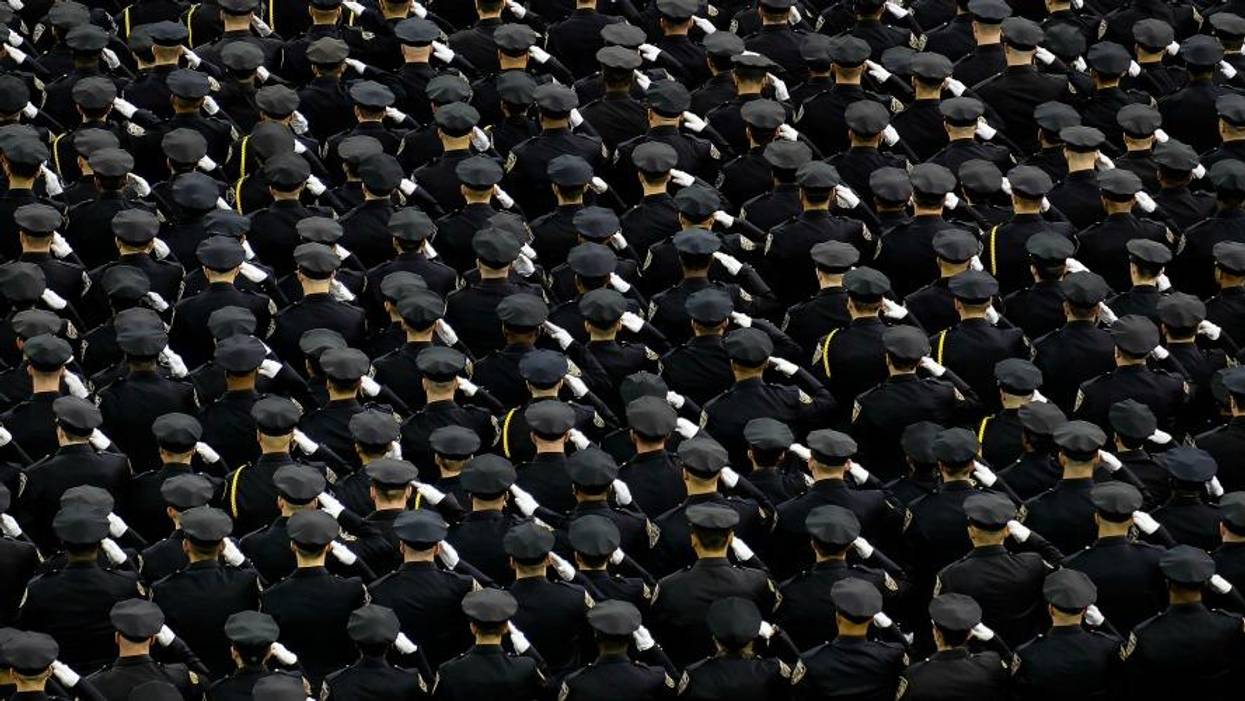
The New York Post, the notorious right-wing tabloid owned by Rupert Murdoch, inspired a media stampede of stories highlighting increases in New York City's crime statistics.
The New York Post, the notorious right-wing tabloid owned by Rupert Murdoch, inspired a media stampede of stories highlighting increases in New York City's crime statistics. The hysterical headline "You're 45% More Likely to Be Murdered in de Blasio's Manhattan" (5/26/15) served as a springboard for other local media outlets to question if the city was suddenly a crime-ridden hellhole under Mayor Bill de Blasio-presented by the Post as a liberal on policing.
The Post's story reported that there had been 16 murders so far this year in Manhattan, one of New York City's five boroughs, versus 11 during the same time period in 2014 (when, the Post failed to note, de Blasio was also mayor--he took office on January 1, 2014). An increase of 45 percent naturally sounds much more alarming than the flat numerical increase: five more.
These homicide figures are actually so low historically in the city that you'd have to go back to the 1960s for comparable numbers. For a city that once had upwards of 1,000 and sometime 2,000 murders a year, a time from the 1970s into the '90s often referred to as "the bad old days," 16 in Manhattan in five months is remarkably low.
If instead of comparing de Blasio's second year in office to his first year, the Post had compared the rate of killing so far this year to the 102 Manhattan homicides (not counting 9/11) in 2001-the last full year of the mayoralty of Rudy Giuliani, celebrated by the Post for his crime-fighting triumphs-the headline would have had to read, "You're 63% Less Likely to Be Murdered in de Blasio's Manhattan Than in Giuliani's"-but that's a framing that you're never going to see in the New York Post.
Instead, the short but effective story, quoting unnamed police sources (of course) clamoring for more cops and more "stop & frisks"-arbitrary police searches, mainly of young men of color-was followed a few days later by a front-page story (5/31/15). The cover featured a shooting victim's uncle with the caption "Bring Back Stop & Frisk," rehashing a debate over a policing tactic found to be mostly unconstitutional by a federal judge in 2013. The decrease in the documented use of stop & frisk, which began to be dramatically scaled back in the last year of then-Mayor Michael Bloomberg, is now attributed by the Post to de Blasio and blamed for the supposed spike in crime.
The Daily News, smelling blood in the water, jumped on the opportunity to flesh out the developing mayor-soft-on-crime theme with a story (6/5/15) reporting an increase in subway assaults. Citing some of the mayor's supposedly crime-inducing police "reforms," like "the decriminalization of low-level marijuana possession" (which was actually decriminalized in 1977), the story piled onto de Blasio-who, like other Democrats, is actually much more a supporter than reformer of police. ("When police give instruction, you follow the instruction," he remarked in response to complaints about cops' brutal response to protests against police violence-New York Observer, 4/30/15.)
Of course, the media-driven conversation on policing and public safety begins with the simplistic premise that the amount and aggressiveness of policing solely determines the crime rate. A Wall Street Journal story in May demonstrated that the only proof reporters need to confirm the notion that de Blasio is dangerously soft on crime are opinion polls showing New Yorkers are worried about crime (FAIR Blog, 5/15/15). But opinion polling shows that public perceptions of crime have little to do with actual crime rates, as a majority of respondents nearly always tell Gallup that crime is rising, even as crime rates have fallen dramatically over the past 20 years. Commenting on this phenomenon, Lauren-Brooke Eisen and Oliver Roeder of the Brennan Center (Huffington Post, 3/16/15) suggest that "sensationalist coverage of isolated crimes has contributed to the public misperception that crime is increasing."
The media's never-ending push for ever-lower crime stats, continually raising expectations, is likely politically driven. Somehow exempt from the criticism of de Blasio's supposed soft-on-crime sins is NYPD Commissioner Bill Bratton, the man actually in charge of policing in New York City--a favorite of conservatives who is regarded as an international champion of aggressive policing.
In a fawning column in the Post (6/6/15), Michael Goodwin heaps praise on Bratton and complains that de Blasio (described as some sort of flaming communist) won't "let Bratton be Bratton"--finally declaring, "It's time to turn Bill Bratton loose." This Frankenstein-like description of Bratton is perhaps appropriate, but suggests spikes in crime simply require more unchecked policing in urban neighborhoods.

The Washington Post's Fix blog plotted New York City's plummeting use of "stop & frisk" against its steadily declining crime rate.
Again, the underlying truth that media take for granted is that more police = less crime. But is that true? As even Bratton himself has been forced to admit, all sorts of serious crime was much higher when stop & frisk was at its peak in 2011 (at nearly 700,000 stops) than this year (which probably won't crack 50,000 recorded stops). The tactic's correlation with crime would suggest, if anything, an inverse relationship--the opposite of what the front page of the Post would have its readers believe.
The same is true for the number of uniformed police officers. As the size of the NYPD has dropped from an all-time high of about 41,000 cops in 2001 to just under 35,000 today, crime has also dropped--dramatically. Again, if the popular notion is that more cops make us safer, then the reality, it seems, is counterintuitive.
Bernard Harcourt, who wrote influential books and authored studies debunking the famous Broken Windows theory of policing (the debated idea that focusing on low-level "urban disorder" will curtail serious crime), recently pointed out ( Guardian, 6/6/15) that the "crime wave" politics being carried by right-wing and corporate centrist media outlets are a classic response to a political movement that takes on racist policing in America:
The point of the "Ferguson effect," though, is not to be accurate. It is instead to distract us from the growing evidence about the magnitude and extent of police use of lethal violence in the United States--as powerfully documented just this week by the Guardian and the Washington Post--and to besmirch the #BlackLivesMatter movement.
It's a strategy that Republican presidential candidate Barry Goldwater inaugurated in his campaign in 1964, almost single-handedly turning crime into a political weapon against the civil rights movement.
Harcourt was debunking a Wall Street Journal op-ed (5/29/15) by Heather MacDonald, a senior fellow at the right-wing Manhattan Institute, which has promoted Broken Windows policing for years. MacDonald had made the claim that the "crime wave" is a national trend made possible by protests.
If that sounds familiar, it's because it's essentially the same logic New York City police union boss Pat Lynch used to pin the shootings of two NYPD officers last December on both demonstrators and Mayor de Blasio (Huffington Post, 12/21/14). As law-and-order pundits often do, MacDonald argues that the "Ferguson Effect" isn't only leading to more crime, but that the urban poor will pay the bloody price if the police aren't allowed to continue their usual shenanigans.
While Bratton and de Blasio may be forced to rebuff some of the media's hysteria, they both stand behind the Broken Windows theory that was popularized in the '90s under New York Mayor Rudy Giuliani and a younger Bratton. The theory, a target of protesters from Ferguson to New York, is a fundamental cornerstone of policing in America. Its success is self-evident, as politicians and media pundits tell it.
But as Harcourt and others have pointed out, its supposed causal relationship with diminishing crime simply isn't supported by research. Other social factors (economic shifts, the end of the crack era, etc.) that seem to explain an international phenomenon of declining crime that began in the '90s, and occurred in cities whether or not they subscribed to the Broken Windows theory, are seldom mentioned when media tackles the issue of crime.
That more complicated picture, of course, will likely never make for a good front page.