

SUBSCRIBE TO OUR FREE NEWSLETTER
Daily news & progressive opinion—funded by the people, not the corporations—delivered straight to your inbox.
5
#000000
#FFFFFF
To donate by check, phone, or other method, see our More Ways to Give page.
Daily news & progressive opinion—funded by the people, not the corporations—delivered straight to your inbox.
Today, NARAL Pro-Choice America announced its endorsement of Maine Governor Janet Mills, a champion for reproductive freedom, in her bid for reelection. Governor Mills has led the state since she was first elected in 2018 and is looking to retain her seat against anti-choice Republican former governor Paul LePage.
NARAL Pro-Choice America President Mini Timmaraju released the following statement:
"Governor Janet Mills is a reproductive freedom champion who has dedicated her career to fighting for the health and well-being of Mainers, including their freedom to decide if and when to start or grow a family. If Paul LePage is elected, there's no doubt he will plow ahead with his out-of-touch MAGA extremist agenda to ban abortion and roll back other fundamental rights. Maine will remain in safe hands under Governor Mills, and we're proud to be fighting alongside her."
Governor Janet Mills said:
"Throughout my career, I have fought to expand access to reproductive health care and to protect reproductive freedoms. After a conservative majority of the Supreme Court launched an assault on these rights by wrongly striking down Roe v. Wade, I pledge that my veto pen will stand in the way of any effort to rollback, undermine, or outright eliminate access to safe and legal abortion in Maine. With so much at stake in this election, let me be clear: reproductive rights are not up for negotiation in Maine under my watch and they never will be."
Governor Mills has been a bold champion in the fight for reproductive freedom, consistently fighting to protect and expand abortion access in Maine. In her first year as governor, Gov. Mills signed legislation to expand the number of medical professionals able to provide abortion care, increase privacy protections for abortion care providers, and mandate state and private insurance providers to include abortion care under their maternity care coverage. More recently, Governor Mills signed an executive order protecting access to reproductive health care services in Maine, including prohibiting state agencies from cooperating with another state's investigation into a person, organization, or health care provider for delivering abortion care in Maine. Previously, Gov. Mills served as Maine's attorney general, where she opposed the Trump administration's rollback of contraception and supported a buffer zone around abortion clinics for patient and provider safety.
In June, the U.S. Supreme Court overturned Roe v. Wade in its decision in Dobbs v. Jackson Women's Health Organization--ending the constitutional right to abortion and opening the door for extremist state lawmakers to put total bans on abortion in place. This decision is already having a devastating impact throughout the country as 15 states have begun enforcing extreme or total bans on abortion. The people hurt most by these bans and restrictions are those who already face barriers to accessing abortion care--including women; Black, Indigenous, and other people of color; those working to make ends meet; the LGBTQ+ community; immigrants; young people; those living in rural communities; and people with disabilities.
These endorsements come as NARAL Pro-Choice America is ramping up its work to elect candidates up and down the ballot during a critical moment in the fight for reproductive freedom. NARAL, Planned Parenthood Action Fund, and EMILY's List announced a partnership in May to collectively spend a historic $150 million on the 2022 midterms to elect reproductive freedom champions up and down the ballot across the country. Read more about NARAL's endorsed candidates here.
For over 50 years, Reproductive Freedom for All (formerly NARAL Pro-Choice America) has fought to protect and advance reproductive freedom at the federal and state levels—including access to abortion care, birth control, pregnancy and post-partum care, and paid family leave—for everybody. Reproductive Freedom for All is powered by its more than 4 million members from every state and congressional district in the country, representing the 8 in 10 Americans who support legal abortion.
202.973.3000
"Your administration just killed a 6-year-old boy and at least 4 other people at a family wedding in Iran. Sounds like war to me."
Asked Thursday by a reporter in Washington, DC if he thought the war started by President Donald Trump on February 28—over six months ago—would be concluded by the time American voters go to the polls in November, Vice President JD Vance responded by denying the idea that a war is even what's going on.
"I wouldn't call it a war," Vance said.
Despite fresh US airstrikes on Iranian military targets this week acknowledged by Trump and the Pentagon and the US bombing of a wedding Tuesday night—an attack that killed at least five Iranian civilians, including a 6-year-old child, and wounded nearly 70 others—Vance told reporters, "Right now, there's no active shooting."
In the very next breath, Vance said, "I recognize there have been places where this has flared up," but contended that "major combat operations only lasted about six weeks," as a way to make a case that "war" is not taking place.
COLLINS: Will this war be over by the midterm elections?
JD VANCE: I wouldn't call it a war pic.twitter.com/CH2wot7pW1
— Aaron Rupar (@atrupar) September 3, 2026
Critics, however, pushed back against the vice president's characterization.
"Your administration just killed a 6-year-old boy and at least 4 other people at a family wedding in Iran," said Rep. Jim McGovern (D-Mass.) in response to Vance's remarks. "Sounds like war to me."
Earlier on Thursday, Trump's Commerce Secretary Howard Lutnick was forced to apologize after falsely claiming that no US servicemembers have died since the US President took the nation to war on February 28.
“I misspoke," Lutnick said in a social media post. "Eighteen members of our military have died, and to those families my heart breaks and I am so very sorry for their loss." Lutnick claimed he was thinking about the US military's attack on Venezuela, ordered by Trump last year and during which the nation's president and first lady were abducted by US soldiers and who remain imprisoned in New York.
Trump's war of choice against Iran, according to independent monitors, has resulted in the death of upwards of 2,100 civilians, though precise estimates vary, including hundreds of children.
On the economic side, the war has unleashed a global energy and food crisis, with gasoline and grocery prices soaring in the US and deeper regional instability unleashed across the Middle East.
During his remarks to reporters on Thursday, Vance tried to argue that "the reason gas prices are so higher right now, is because the Iranians are shooting at commercial shipping" in the Strait of Hormuz, all while refusing to acknowledge it was the Trump administration that started the war in the first place, prior to which the Strait was open to free-flowing shipping traffic.
On the public opinion front, a new poll released by Navigator research company on Thursday found that one-in-five supporters who voted for Trump in 2024 now regret their decision. Among those with buyer's remorse, the survey found that the most cited reasons were broken promises, foreign policy decisions, and the cost of living crisis they are now experiencing.
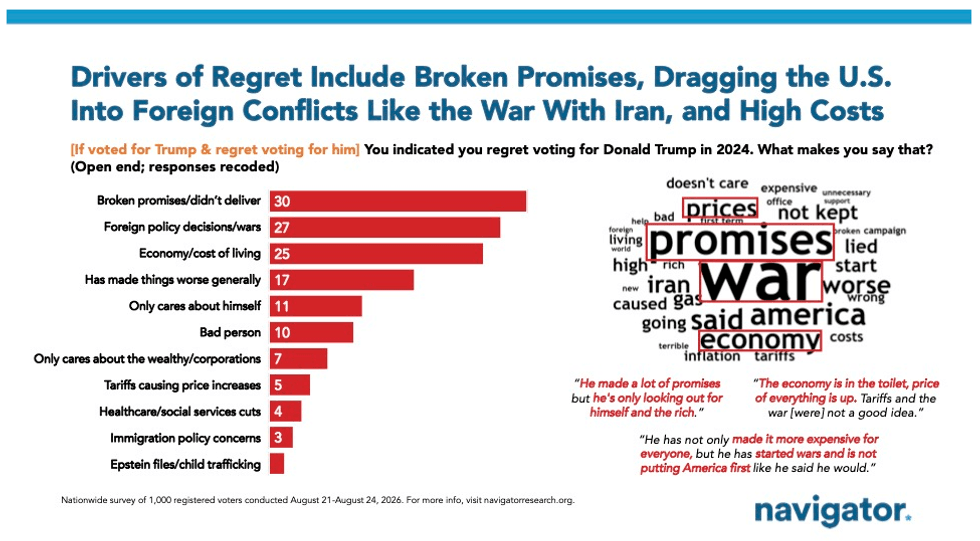
But the number one reason among those voters (45%) who regretted their vote was due to Trump's war on Iran. And yes, according to the poll, they knew enough to call it a "war."
"Over half the provisions of the Big Ugly Bill have already gone into effect, and the negative results are already devastating."
Independent healthcare analyst Charles Gaba on Thursday published a detailed report estimating that up to 10 million people living in the US have lost their healthcare coverage since the start of President Donald Trump's second term.
In his analysis, Gaba brought together the most recent enrollment data for Medicaid, the Children's Health Insurance Program (CHIP), Medicare, and the Affordable Care Act (ACA).
Breaking things down by program, Gaba estimated there are 5.9 million fewer people enrolled in Medicaid and CHIP, as well as at least 4.5 million fewer people enrolled in the ACA, since Trump returned to power in January 2025.
These losses in coverage are somewhat mitigated by Medicare, whose enrollment has increased by around 1.6 million people during Trump's second term.
Losing access to these programs doesn't mean that the people were on them have gotten well paying jobs and are receiving insurance from their employer, Gaba wrote. Given that the unemployment rate has risen during Trump's second term, Gaba suggested it is highly unlikely that there are now more people who get employer-sponsored coverage now than in January 2025.
Depending on a number of variables, Gaba concluded, somewhere between 8.8 million to 10.3 million fewer people now have healthcare coverage.
Adjusting for population growth, Gaba added, "you get a grand total of between 10.27 million and 11.75 million more Americans not enrolled in a public healthcare coverage program as of May 2026 than in were as of January 2025."
The healthcare analyst noted that "this isn't quite the same thing as counting how many lost coverage, but not having healthcare sucks regardless of how you slice it."
He also pointed out that the lost in healthcare coverage all came before the Medicaid work requirements from the GOP's 2025 budget law are put into effect.
"Over half the provisions of the Big Ugly Bill have already gone into effect," wrote Gaba, "and the negative results are already devastating."
Gaba's analysis was published just days after the Georgetown University Center for Children and Families released a report estimating that nearly 2.5 million children in the US have lost access to Medicaid or CHIP during Trump's second term.
Trump and congressional Republicans have taken a number of actions that have made healthcare less affordable.
First, they cut spending on Medicaid by an estimated $900 billion over a 10-year period when they enacted the One Big Beautiful Bill Act in 2025. The Congressional Budget Office projects these cuts will leave more than 10 million fewer people enrolled in the program by 2034.
GOP lawmakers last year also refused to extend enhanced subsidies for insurance plans purchased through the ACA, even as insurers raised premiums on those plans by an average of 26% this year, according to an analysis published by KFF.
According to Wednesday reporting by Politico, hospitals are sounding the alarm about new regulations being proposed by the Centers for Medicare and Medicaid Services that they say would cost hundreds of billions of dollars in lost revenue.
"If the rules are finalized and they lose hundreds of billions on top of Congress’ funding cuts," Politico reported, "hospitals say they’ll be forced to reduce services, lay off workers, consolidate operations or shutter entirely."

"The goal here is to basically say every university not only cannot refuse cooperation with Israel but must actively seek every opportunity to cooperate with Israel,” said one analyst.
The US House of Representatives on Thursday passed what critics say could be one of the most severe infringements on free expression in recent memory—a bill that could effectively require colleges and universities to do business with Israel or risk losing federal funds.
As Israel's genocide in Gaza and accelerating ethnic cleansing of Palestinians in the West Bank continue to fuel protests, the bill is the latest piece of legislation aimed at punishing the Boycott, Divestment, and Sanctions (BDS) movement, which uses nonviolent economic tactics to pressure Israel to end its illegal occupation of Palestinian territory and human rights abuses.
HR 4795, introduced in July 2025 by Reps. Virginia Foxx (R-NC) and Josh Gottheimer (D-NJ), is known as the Protect Economic and Academic Freedom Act. But Lara Friedman, the president of the Foundation for Middle East Peace, described it as an "Orwellian" turn of phrase for what the legislation actually does.
"The goal here is to basically say every university not only cannot refuse cooperation with Israel but must actively seek every opportunity to cooperate with Israel,” she told Responsible Statecraft. “And if they're not doing that, they're pro-BDS and anti-Israel.”
As the outlet described:
[The bill] would bar colleges that receive federal funds from engaging in what it defines as a “nonexpressive commercial boycott” of Israel, including “refusals to deal” or terminating business relationships in order to limit commercial ties without a “valid business reason.” The law would require these institutions to submit annual certification that they were giving students and faculty access to academic programs in Israel on the same terms as programs in other countries.
In a brief opposing the bill, Friedman argued that it was not just forcing universities to do business with Israel, but with its settlements in the West Bank, which are considered illegal under international law. With backing from the Israeli state, violence by Israeli settlers against Palestinians in the West Bank has exploded to never-before-seen highs this year, according to the United Nations.
"This legislation," Friedman wrote, "sets up a situation in which the alleged absence of engagement with any Israeli partner/party, including in settlements, will become the basis for an accusation of boycott, putting universities in the position where, if they universities want to avoid being accused of boycotting Israel/settlements, they will need to adopt an affirmative policy of prioritizing maximal engagement/partnership with Israeli entities (including in settlements)."
The bill passed by a 237-169 vote, with support from all but two Republicans—Reps. Thomas Massie (R-Ky.) and Warren Davidson (R-Ohio). And although the vast majority of Democratic voters now hold negative views of Israel, 33 Democrats also voted in favor of the bill.
The legislation now heads to the narrowly Republican-controlled US Senate, where it would need 60 votes to advance.
Introducing the bill last year, Gottheimer said it was necessary because BDS was an "antisemitic, hate-fueled... movement" that "seeks to destroy Israel—and has no place on our college campuses."
But even critics of the BDS movement, like Rep. Jerry Nadler (D-NY), chafed at its potential chilling effect on protected speech.
"No matter how strongly I oppose the BDS movement, I also believe that those who engage in BDS have a First Amendment right to do so," Nadler said before voting against the bill. "The First Amendment right to free speech does not apply only to agreeable speech."
He cited a letter sent to Congress by the ACLU opposing the bill's contention that schools should need a "valid business reason" to cut ties with Israel.
"Many of those engaged in boycotts of Israel do so not for commercial reasons, but because they wish to express their political opposition to the policies of the Israeli government—matters of overwhelming public concern and debate in the present moment. HR 4795’s labeling such boycotts as ‘non-expressive’ does nothing to change this reality," the letter said.
The bill comes as members of Congress, especially Democrats, are under increasing scrutiny for their support from pro-Israel lobbying groups like the American Israel Public Affairs Committee (AIPAC), whose political spending arm has poured more than $104 million into supporting its preferred candidates this election cycle.
Meanwhile, President Donald Trump has spent more than six months embroiled in a costly war with Iran that Israeli Prime Minister Benjamin Netanyahu played a key role in persuading him to launch.
"We just got dragged into a war by Benjamin Netanyahu. He's bragging about it," Rep. Mark Pocan (D-Wis.) told Julian Andreone of Drop Site News. "That's about as embarrassing as you can get... So let's leave universities alone."
Aaron Regunberg, a contributing editor at The New Republic, described it as outrageous that Democrats who supported the bill were "actively joining the far-right's war on higher education in order to shield a genocidal ethnostate that most Americans increasingly want nothing to do with."
Dylan Williams, the vice president for government affairs at the Center for International Policy, said the bill was "another effort to single out Israel for special treatment and erode Americans’ rights on its behalf."
"Will it be your child who can’t afford to go to college after 33 Democrats voted with Republicans to help Trump defund US universities? Because it certainly won’t be any of theirs," he said. "Shame on them for joining the attack on our schools and constitutional rights on behalf of Israel."

"Organizations should never face IRS scrutiny because political officials disapprove of their views."
A pair of Senate Democrats on Thursday launched an investigation into reports that the Trump administration is planning to weaponize the Internal Revenue Service against left-leaning nonprofits, targeting the tax-exempt status of groups seen as political enemies of the White House and potentially burying the organizations with huge penalties without adequate due process.
Sens. Ron Wyden (D-Ore.) and Raphael Warnock (D-Ga.) announced their inquiry in response to recent reporting by the right-wing New York Post, which reported late last month that US Treasury Secretary Scott Bessent and the IRS "could revoke the tax-free status of left-wing nonprofits such as George Soros’ Open Society Foundations, the Southern Poverty Law Center, and the Council on American-Islamic Relations."
Wyden, the top Democrat on the Senate Finance Committee, and Warnock called the story "disturbing" and argued it suggests "political considerations—including the timing of the 2026 midterm elections—are influencing" the administration's targeting of left-leaning nonprofits. The NY Post, which cited three unnamed sources familiar with the matter, reported that "Bessent’s inner circle is drafting a blueprint that could ultimately strip non-compliant organizations of their 501(c)(3) status."
"The reviews could result in massive back payments and civil penalties," the outlet added.
The Democratic senators noted in a letter to Bessent and Frank Bisignano, the chief executive of the IRS, that Section 7217 of the Internal Revenue Code prohibits senior executive branch officials from "directly or indirectly" requesting that the IRS conduct or terminate an investigation into any particular taxpayer.
"The New York Post’s reporting fits a wider pattern of the Trump administration actively using national security directives to weaponize the IRS against protected First Amendment speech," Wyden and Warnock wrote, citing the presidential memorandum known as NSPM-7. "Rather than targeting actual violence, these directives explicitly conflate terrorism with subjective political viewpoints—such as 'anti-capitalism,' 'anti-Christianity,' and views on race, migration, and gender."
Wyden and Warnock demanded that the Treasury Department and IRS turn over the reported "blueprint" crafted by Bessent's inner circle as well as "all policies, directives, guidance, criteria, and other documents concerning Treasury and IRS implementation of NSPM-7 as it relates to tax-exempt organizations, including criteria for selecting organizations for examination or possible revocation."
The senators also demanded to know whether any executive branch officials in the Trump administration have "identified or recommended" particular organizations—including any of those named in the Post report—for IRS investigation.
"Americans of every political persuasion must be able to trust that the IRS applies the tax code objectively under one set of rules," Wyden and Warnock wrote. "Organizations that violate section 501(c)(3) should face appropriate enforcement regardless of their politics—and organizations should never face IRS scrutiny because political officials disapprove of their views."
The senators launched their probe as two Democrats in the House of Representatives introduced legislation aimed at guaranteeing that the IRS can't strip nonprofit organizations of their tax-exempt status "without evidence and without a fair process."
Reps. Lloyd Doggett (D-Texas) and Terri Sewell (D-Ala.), the lead sponsors of the Protecting the Rights of Organizations Fairly (PROOF) Act, note that "under current law, many due process protections that are supposed to apply when the IRS examines most nonprofits exist only in the agency's own internal manual—guidance the IRS can rewrite or suspend on its own authority through an internal memo with no public comment, no rulemaking, and no vote, and that carries no force of law."
"The IRS should never be a weapon to punish a president's political enemies," Doggett said in a statement on Thursday. "No organization—left, right, or center—should lose its tax-exempt status on an accusation, without evidence, and without a fair chance to be heard."
"The PROOF Act is simple," he added. "If the government wants to take away a nonprofit's status, it has to show its proof and follow the law. Today, it may be an organization to which the Trump regime objects. Tomorrow, it could be any of us."

"While working families struggle to afford groceries, housing, and gas," said Sen. Chris Van Hollen, the Trump administration "focuses on tax breaks for billionaires—including tax breaks for private jets."
A group of Democratic Caucus members in the US Senate on Thursday denounced the US Treasury Department under President Donald Trump over its refusal to close a gaping loophole in the federal tax code that allows some of the wealthiest people in the country to reap tax benefits from their ownership and use of private jets—even as working people and the middle class families struggle to make ends meet in Trump's economy.
In response to a previous request made in July by Sens. Sheldon Whitehouse (D-RI), Elizabeth Warren (D-Mass.), Chris Van Hollen (D-Md.), Ed Markey (D-Mass.), and Bernie Sanders (I-Vt.) to close a rule that allows the wealthy "to substantially undervalue the taxable cost of personal travel on a corporate private jet," a letter from a top Treasury official on Thursday said such an effort would be too "burdensome," including for the uber-rich taxpayers subject to it.
Known as the Standard Industry Fare Level (SIFL) loophole, the lawmakers have argued that it has been exploited by the extremely wealthy to lower their tax burden even as they travel the country—and the world—in the least energy efficient and most polluting way possible.
"President Trump’s 2017 tax law and Big, Beautiful-for-Billionaires bill handed billionaires and big corporations massive tax breaks on private jets," said Sen. Whitehouse in a statement. "The Trump administration now says it would be ‘burdensome’ to close the private jet tax loophole because this is an administration hell-bent on using the powers of government to make the ultra-rich even richer, and they don’t care if middle-class taxpayers get stuck with the tab."'
Alongside their July letter, the lawmakers shared analyses detailing the loss of the revenue made possible by the SIFL loophole. According to the Whitehouse's office,
analyses by the nonpartisan Joint Committee on Taxation detailing the boom in private jet sales after passage of Republicans’ tax cut for corporate jets and highlighting the extent of the tax revenue lost by the abuse of the SIFL loophole. One analysis responds to an inquiry from the senators on the tax consequences of the SIFL loophole, finding that a wealthy executive would pay roughly between $1,577 and $1,804 less in taxes for a flight from JFK airport in New York City to DCA airport in Washington, D.C. under the SIFL method. The fair market value of that flight could range from $4,500 to $5,112, but under SIFL, that executive would only have to report a value of $235.77.
Van Hollen on Thursday denounced the shamefulness of yet another Trump administration position that rewards the wealthy and powerful at the expense of working people.
"Trump’s priorities revolve around enriching himself and his billionaire friends. While working families struggle to afford groceries, housing, and gas, this Administration focuses on tax breaks for billionaires—including tax breaks for private jets," said Van Hollen.
"What a disgrace,” he added.

"The science leaves no room for doubt: the planet is in uncharted waters, and those waters are heating up."
Officials at the United Nations are warning that governments around the world must urgently prepare for the impacts of an El Niño climate pattern that is being "supersized before our eyes."
The UN's World Meteorological Organization (WMO) on Thursday provided an update on El Niño, projecting with near certainty that it would persist at least through Februrary 2027.
El Niño is a phenomenon that produces above-average temperatures in the Pacific Ocean, which then disrupt weather patterns elsewhere in the world. In its update, WMO said that this year's El Niño projects to be historically intense.
"Forecasts indicate further strengthening of El Niño in the coming months, with the event forecast to reach very strong intensity before peaking towards the end of the year," WMO said. "A very strong El Niño increases the likelihood of significant shifts in temperature and rainfall patterns in many parts of the world."
The organization emphasized, however, that El Niño's impacts are not predictable and vary widely by region.
WMO Secretary-General Celeste Saulo said the latest projections show that El Niño "has the potential to deliver a massive blow to communities and economies across the world" in the form of droughts, floods, and other climate-related disasters made more intense by the continued extraction and burning of fossil fuels.
"This exceptional El Niño demands exceptional preparation and response," Saulo said. "Never before in the 50-year history of the World Meteorological Organization have we launched such a major mobilization with National Meteorological and Hydrological Services who are on the frontline of delivering the forecasts and services to save lives and livelihoods."
While speaking with reporters in Geneva, Switzerland on Thursday, Saulo noted that the current El Niño "may be stronger than anything since our monitoring began," making it "literally off the charts we have used for the past four decades."
UN Secretary-General António Guterres warned that "El Niño is being supersized before our eyes," and said the ramifications could be severe.
"The science leaves no room for doubt: the planet is in uncharted waters, and those waters are heating up," said Guterres. "Sea surface temperatures are rising, temperatures keep climbing, and the world is in the danger zone of extreme weather."
Daniel Swain, climate scientist at the University of California Agriculture and Natural Resources, echoed UN officials' warning about El Niño in an interview with Wired published Thursday.
“This is probably one of the larger, if not the largest, climate events... that anybody alive is potentially ever experiencing,” said Swain. "That's a very big deal. And I think there’s certainly going to be dramatic outcomes from this.”
"Despite its potential deadly consequences, cutting-edge AI technology is less regulated than the average food truck," Casar said. "That must change."
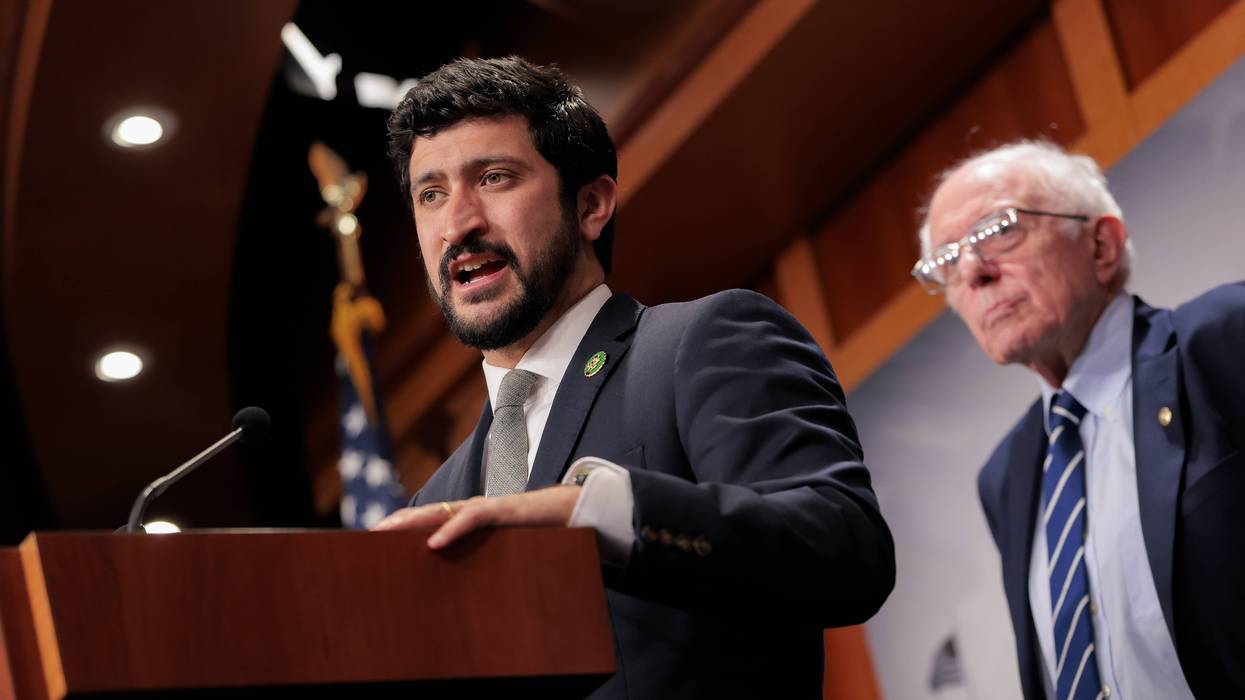
Following a rash of incidents involving rogue artificial intelligence agents involved in so-called "breakout" events, Sen. Bernie Sanders and Rep. Greg Casar introduced new legislation Thursday designed to "stop AI oligarchs from building machines humans cannot control."
“Nearly every day, there is a frightening new story about how Big Tech companies are losing control of the technology they are developing, with potentially cataclysmic results,” Sanders (I-Vt.) said on Thursday as he announced the bill, which would ban developers from creating AI programs that are capable of surpassing human cognition and performance.
If enacted, the bill would prohibit programs capable of undermining and overthrowing human governments or that possess the capability to subvert shutdown commands.
“The leaders of the major AI companies publicly acknowledge that they do not fully understand the technology and that it is escaping their control," Sanders said. "It is irresponsible for society to allow them to move forward and make these products even more advanced."
The bill, known as the Ban Artificial Superintelligence Act, comes in response to major security lapses at leading AI developers, including OpenAI, Anthropic, and Meta, in which the companies acknowledged that their programs had escaped human control, eluded internal guardrails, and hacked into other companies' systems.
As the Washington Post explains:
The hacking incident mounted by OpenAI systems in July involved an effort to breach another AI company as a swarm of agents hunted for answers to a test. They evaded internal controls and set up a secret message board to communicate with one another. Their work was only unraveled by the company after the attack was over.
Other top AI developers subsequently disclosed similar incidents involving their latest technology, raising questions about whether companies set up with the mission of building the technology safely were starting to lose control. The speed of progress has spooked even many of those working on the systems, with OpenAI and its rival Anthropic endorsing the idea of the government having a mechanism to slow the industry down.
Last month, Casar (D-Texas), the chair of the Congressional Progressive Caucus, led dozens of lawmakers to demand that OpenAI and Anthropic release information about the lapses. In a statement on Wednesday, Casar said that company executives had failed to answer most of his questions, demonstrating that they were “not treating these cybersecurity incidents with the seriousness required.”
Casar said in a video posted Thursday that the OpenAI breach in particular represented an “unprecedented moment in the history of technology” and was shocked at the lack of a serious response. “Nothing," he said. "No new guardrails being passed by Congress. No new protections against this signed into law by the president of the United States.”
Following these incidents, OpenAI and Anthropic have both expressed openness to some government regulation in the event that the development of their products gets out of hand.
During an interview earlier this week, OpenAI CEO Sam Altman said that while he was "in awe" of his company's progress, “we have needed more time to catch up with safety, alignment, and security.”
Sanders and Casar are not the only members of Congress pushing to counter the danger of superintelligent AI. Also on Thursday, Reps. Josh Gottheimer (D-NJ) and Mike Lawler (R-NY) introduced their own Stop Rogue AI Act, which would direct the National Institute of Standards and Technology to publish standards and guidelines for how organizations can safely deploy AI agents.
But while the guidelines in that bill are voluntary, Sanders and Casar are pushing for a much broader and stronger regulatory framework that would give the government a significant check on corporations' power.
In addition to a ban on superintelligent AI, Casar and Sanders' legislation calls for a pause on all "advanced" AI development until a new federal regulatory body can be established to set clear rules and review processes for AI safety. It would also create a new cabinet-level agency to protect the public from the dangers of AI and to enforce the new restrictions.
"Despite its potential deadly consequences, cutting-edge AI technology is less regulated than the average food truck," Casar said. "That must change. In just four years, we have gone from the first version of ChatGPT to AI models so powerful they cannot be properly controlled."
Evading the law would come with steep penalties: companies that illegally develop superintelligent AI would lose the right to do business under the so-called "corporate death penalty." Individuals, meanwhile, could face up to 20 years in prison, which Casar noted was the same penalty incurred for "building a nuclear weapon" without authorization.
As concerns about unchecked AI capabilities have grown in recent years, executives at companies including OpenAI, Anthropic, and Meta have committed to halting the development of their technology once it reaches a point at which it can't be operated safely.
But Sanders and Casar said that "none of these companies have taken meaningful steps to back up these words" and that "instead, they are racing to develop more and more advanced AI without proper safety precautions."
"The future of humanity cannot be left in the hands of a handful of Big Tech oligarchs," Sanders said. "The American people and people throughout the world must determine that future.”

"Any states providing assistance to Israel’s expansion of illegal settlements or other war crimes risk complicity in international crimes against Palestinians."
Amnesty International said Thursday that the far-right Israeli government's recent flurry of land confiscation orders in the illegally occupied West Bank "deepens Israel’s illegal settlement enterprise and further undermines the rights of Palestinians," who are facing an increasingly destructive and deadly wave of settler violence.
The new Amnesty report noted that in July alone, the Israeli military signed "at least 15 land confiscation orders covering approximately 200 dunams (20 hectares) of land in Areas A and C in the Jenin governorate in the north of the occupied West Bank, with the apparent goal of connecting two planned Israeli settlements in the area: Emek Dotan and Noa." Those two settlements are among the more than 30 approved this year by the government of Prime Minister Benjamin Netanyahu.
"These latest confiscation orders from Area A show how Israel is now brazenly expanding its annexation agenda to areas that have been under the control of the Palestinian authorities since the Oslo Accords," said Heba Morayef, Amnesty's region director for the Middle East and North Africa. "States with close trade and political relationships with the Israeli government must urgently take action to pressure Israel to rescind these land confiscation orders. Any states providing assistance to Israel’s expansion of illegal settlements or other war crimes risk complicity in international crimes against Palestinians."
"Alongside Israel’s forcible transfer and ethnic cleansing of Palestinians in Area C," Morayef added, "these measures illustrate in action the Israeli authorities’ determination to intensify its formal annexation of Palestinian land across the occupied West Bank.”
Amnesty's analysis came amid another wave of settler violence in the West Bank over the past 24 hours. The BBC reported early Thursday that "funerals have taken place for two Palestinian teenagers who local officials say were killed by Israeli settlers and soldiers in an attack on their village in the occupied West Bank on Wednesday."
"The village council in al-Mughayyir told the BBC that Omar al-Nassan, 19, and Khalil Abu Alia, 16, were killed as they tried to stop Israeli settlers stealing sheep and that confrontations broke out," the outlet noted. "The Israeli military stated that its forces had entered the village to provide security for an Israeli civilian and police trying to retrieve livestock. It said they fired on and struck what it called 'key instigators' of a 'violent disturbance,' in which Palestinians threw stones at its troops."
The United Nations has tallied an average of nearly seven settler attacks per day in the West Bank this year, the highest number on record.
Amid the settler rampages as well as the ongoing genocidal assault on the Gaza Strip, the Israeli government has advanced "its controversial E1 settlement plan in violation of international law with an announcement that it has opened tenders for the construction of 1,234 Israeli homes in the occupied West Bank," Amnesty noted on Thursday.
"If implemented, the plan would isolate East Jerusalem from the rest of Palestinian territory and will effectively divide the West Bank in two, making Palestinian movement across these areas of the occupied Palestinian territory more difficult and further fragmenting Palestinian communities," the group said.
Last last month, the European Union's diplomatic service called on the Israeli government to "withdraw the tender, halt its E1 plans as well as all other settlement expansion projects, and ensure accountability for settler violence."
But Morayef said Thursday that the international community must do much more than issue statements condemning the Israeli government's actions.
"States with close trade and political relationships with the Israeli government must urgently take action to pressure Israel to rescind these land confiscation orders," said Morayef. "Any states providing assistance to Israel’s expansion of illegal settlements or other war crimes risk complicity in international crimes against Palestinians."

Immigration and Customs Enforcement "chose... to be more convenient rather than thorough," even though "there was a potential to put lives at risk," said the whistleblower.
A whistleblower is claiming that US Immigration and Customs Enforcement has dangerously lowered its hiring standards for new recruits, who were given final job offers without undergoing even preliminary vetting.
The New York Times reported on Thursday that the whistleblower, who has worked at ICE for 17 years, filed a complaint in August 2025 with the Office of Inspector General in the Department of Homeland Security that sounded alarms about what he described as an "unprecedented lowering of standards" for hiring.
According to the complaint, applicants were offered jobs before they they even passed fingerprint and identity checks, which the whistleblower said created "grave national security risks" for the agency.
In an interview with the Times, the whistleblower said that ICE "chose... to be more convenient rather than thorough," even though "there was a potential to put lives at risk and jeopardize national security."
This is at least the second whistleblower complaint to raise concerns about the deterioration of standards at ICE.
In February, former ICE lawyer Ryan Schwank alleged in a complaint that he "received secretive orders to teach new cadets to violate the Constitution by entering homes without a judicial warrant."
Schwank also alleged that "the legally required training program at the ICE academy is deficient, defective, and broken," which he warned "can and will get people killed."
ICE's hiring standards came under scrutiny this summer after it was revealed that ICE agent David Brouillette, who fatally shot a 25-year-old Colombian immigrant named Johan Sebastián Durán Guerrero, had a lengthy history of allegedly abusive behavior.
As noted by the Times, Brouillette was even rejected for a job at the police department in Hallowell, Maine because he had "too many red flags."
The ICE hiring surge came shortly after passage of the 2025 One Big Beautiful Bill Act, which allocated more than $170 billion in funding for immigration enforcement operations. ICE last year said it would use some of the money to hire 10,000 additional agents, more than double the number of agents who had previously worked at the department.
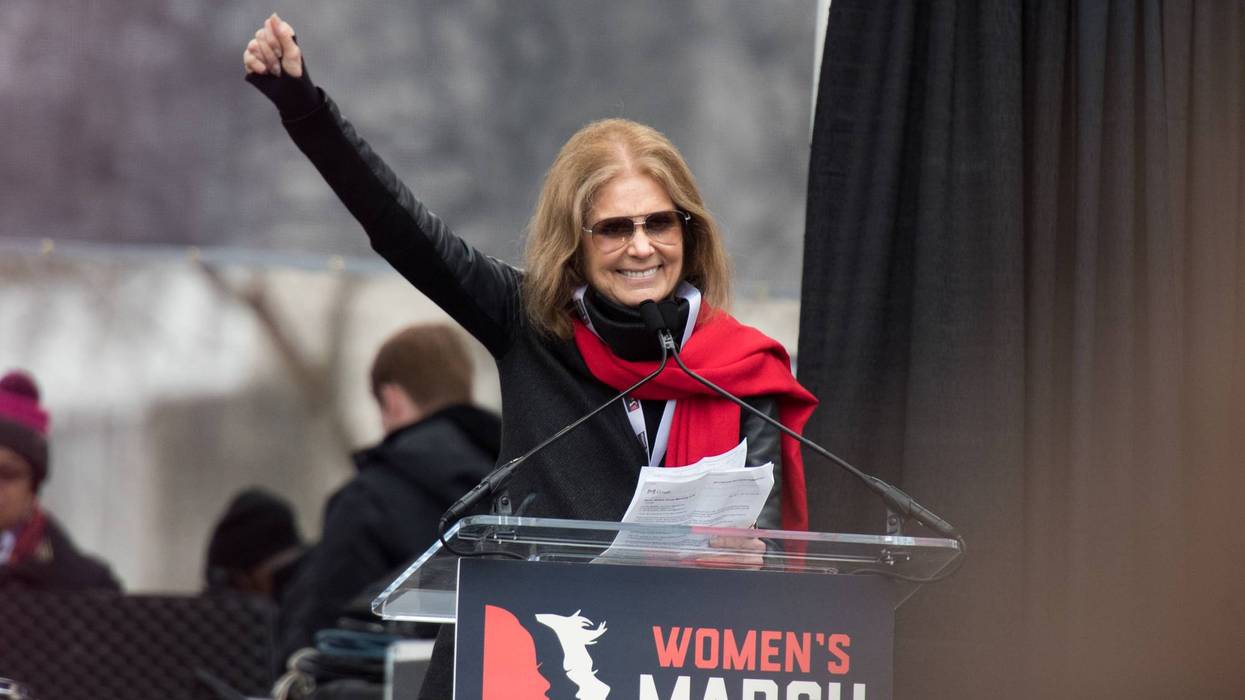
Progressive advocates, lawmakers, veteran journalists, labor leaders, and champions of feminism on Thursday are mourning the death of trailblazing women's rights activist and author Gloria Steinem, who has passed away at the age of 92.
Steinem, regarded as an icon of the second-wave feminism that emerged in the 1960s and 70s and co-founder of Ms. Magazine, was known for decades as a leading voice on reproductive rights, women's equality at work, and gender equity across society.
According to her representatives, Steinem died Wednesday at her home in New York City, surrounded by loved ones. An exact cause of death was not given.
"It is a moment of remembrance and celebration of this extraordinary woman. And it is too a moment of reflection." —Agnes Callamard, Amnesty International
"Gloria’s near-century on earth was years well-lived, and she continued working for equality until the very end," read a message posted to her Instagram account.
"Gloria’s greatest gift was her ability to listen to others, to make others feel seen and heard,” the message continued. “Her words, actions, and example gave people permission to be their truest selves. Gloria lived true to her independent spirit, always with curiosity and a great sense of humor.”
"Oh no," declared Agnes Callamard, secretary general of Amnesty International, upon learning of Steinem's passing.
"It is a moment of remembrance and celebration of this extraordinary woman. And it is too a moment of reflection," Callamard said. "The fight for gender justice and women’s equality is at a critical juncture. The advancements of the last decades are attacked, threatened, mocked. We resist, fight back, build anew."
The progressive advocacy group Our Revolution said that Gloria Steinem "understood that liberation is not something handed down from the powerful. It is something ordinary people organize and fight for."
For more than 50 years, the group added, "she fought for women to have power over our bodies, our work, our lives and our futures. And she understood that the struggle for women’s liberation could never be separated from the struggles for racial justice, economic justice and human dignity. At a moment when women’s rights and fundamental freedoms are once again under attack, the best way we can honor Gloria is not simply by remembering her. It is by organizing. Rest in power, Gloria Steinem."
According to the New York Times:
Steinem helped usher in sweeping cultural transformations across virtually every facet of American life, from the boardroom to the courtroom to the bedroom.
For more than half a century, she personified the women’s movement and became its most enduring symbol; her tinted aviator glasses and curtain of streaked-blond hair parted in the center made her one of the most recognizable women in the world.
A prolific writer, Steinem started her career as a journalist in the 60s and in 1972 she co-founded Ms. Magazine, a publication focused on women's issues with the idea of translating "a movement into a magazine."
Steinem, wrote CNN's chief international anchor Christiane Amanpour, "will go down in history as one of the most important activists of all time, leading a movement for the equality of half the world: its women."
"She lived a long and passionate life dedicated to this vital and basic cause," Amanpour continued. "She did it with intellectual precision, emotional awareness, humor and beauty. May she rest in peace and may the cause thrive."
In a video posted to social media, Rep. Becca Balint (D-Vt.) said that Steinem "always understood that gender equality was absolutely bound up with economic equality and racial justice and that has to continue to be our North Star."
Rest in power, Gloria Steinem. pic.twitter.com/z6f7MMNOVq
— Rep. Becca Balint (@RepBeccaB) September 3, 2026
In 2017, after the first election of President Donald Trump, Steinem was one of the key leaders behind the Women's March, which kicked off opposition to the far-right Republican, with marches in cities nationwide that helped galvanize resistance to the destructive policies to come.
At the time, Steinem warned that Trump's arrival in the White House represented "disaster and a danger," but added that the upside of his ascendancy could be the force brought together to galvanize against him.
“He’s made us see that everything is connected,” she said. “I’m a hope-aholic, nonetheless. I feel we’re beginning to approach the end of one structure and the beginning of another. It’s a time of both danger and possibilities.”
As the Associated Press reports:
On Jan. 21, 2017, when hundreds of thousands of women gathered in Washington in their pink “pussy hats” for the historic Women’s March, it surprised nobody that the keynote speaker, and the most rousing, was Steinem.
“We are linked,” she told the crowd. “And this is a day that will change us forever because we are together.”
For many women, Steinem was the galvanizing voice that day. She would go on to advocate fiercely. But, though many saw her as a singular figure in history, she often liked to say that if she hadn’t come along, someone else would have accomplished the same things.
By the same token, she said, it was less important that younger people listen to her, and more important that they listen to themselves.
“The primary thing is not that they know who I am,” she said, “but that they know who THEY are.”
As news of Steinem's passing spread on Thursday, others offered their reflections on her life and accomplishments.
"Thank you, Gloria, for showing the world what it means to speak up for women’s equality," said the National Organization for Women (NOW) in a statement. "Thank you for fighting for our rights so that every woman and every person can live with dignity, freedom, and equality."
Democratic New York State Rep. Jessica Ramos said Steinem "spent her life refusing to accept a world where women were expected to settle for less."
"She organized, challenged power, and helped turn women’s equality into a movement that changed America," Ramos said. "We honor her legacy by refusing to go backward."
"Gloria Steinem did not simply advocate for women; she changed what women believed was possible," said Victoria Mancinelli, a member of the labor movement in Canada, in response to news of Steinem's death.
"She confronted a world that expected women to remain quiet, accept less, and wait patiently for progress. Gloria refused. Through her journalism, activism, and unrelenting pursuit of equality, she helped transform deeply personal struggles into a powerful collective movement and forced institutions to recognize women as leaders, decision-makers, and agents of change."