SUBSCRIBE TO OUR FREE NEWSLETTER
Daily news & progressive opinion—funded by the people, not the corporations—delivered straight to your inbox.
5
#000000
#FFFFFF
To donate by check, phone, or other method, see our More Ways to Give page.
Daily news & progressive opinion—funded by the people, not the corporations—delivered straight to your inbox.
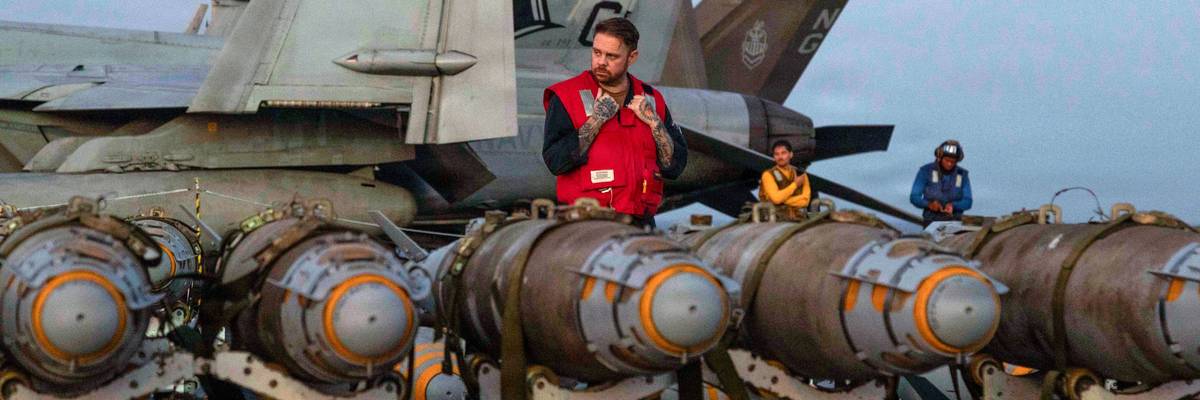
US sailors transfer ordnance on the flight deck of the Nimitz-class aircraft carrier USS Abraham Lincoln on February 27, 2026 in the Arabian Sea.
"Medicare for All, or endless foreign wars?" asked Democratic US Senate candidate Graham Platner. "Anyone in the House or Senate giving the wrong answer should lose their seat."
The daily price tag of US President Donald Trump's illegal war on Iran would be enough to cover the daily costs of federal nutrition assistance for more than 40 million Americans, as well as daily Medicaid costs for the roughly 16 million people expected to lose health coverage due to the Republican budget package that Trump signed into law last year.
That's according to an analysis published Thursday by the National Priorities Project (NPP), which noted that—on an annual basis—the estimated $1 billion-per-day cost of the US war on Iran is "higher than the appropriated budget of any federal agency except the Pentagon itself."
"That money could cover the things we need here at home," wrote NPP's Alliyah Lusuegro and Lindsay Koshgarian. "The tradeoff is clear: the Trump administration—backed by several members of Congress—is cutting healthcare and food assistance for millions of families while spending $1 billion a day on this emerging war."
"The question isn’t whether the money exists—it's what we choose to spend it on," they wrote.
In a social media post on Friday, Democratic US Senate candidate Graham Platner—a veteran of the Iraq and Afghanistan wars—posed what he characterized as a "simple question" to members of Congress: "Medicare for All, or endless foreign wars?"
"Anyone in the House or Senate giving the wrong answer," Platner added, "should lose their seat."
"The cost of the war in Iraq ended up being almost $3 trillion. This could be astronomical, easily.”
The Pentagon's early estimate of the Iran war's cost was first reported by Atlantic journalist Nancy Youssef, who cited an unnamed congressional official.
In a separate analysis released earlier this week, the Center for Strategic and International Studies put the cost of the first 100 hours of the Iran war at $3.7 billion, or $891.4 million per day. The Pentagon is reportedly planning to ask Congress to approve at least $50 billion in supplemental funding for the war, a historically unpopular assault that lawmakers did not authorize.
“Without support from the American people, Donald Trump led the country into a reckless war with Iran that has taken the lives of six service members and injured several others," said Kendall Witmer, rapid response director for the Democratic National Committee. "Now, the White House is scrambling to come up with a plan as the cost of Trump’s war skyrockets. Working families are already struggling with soaring prices and a hollowed-out job market—they can't afford Trump’s war of choice."
On Thursday, Rep. Brendan Boyle (D-Pa.) asked the nonpartisan Congressional Budget Office to conduct a thorough analysis of the financial costs of the Iran war, including scenarios in which the assault drags on for more than five weeks and the US launches a ground invasion.
“Taxpayers deserve a nonpartisan estimate of the financial and economic impact of President Trump’s reckless war in Iran that has already led to the tragic deaths of American servicemembers," said Boyle. "American families don’t want billions of dollars wasted on an unnecessary war—they want lower costs and affordable healthcare.”
Koshgarian of NPP told CNN that the costs of war are "highly unpredictable, and so we won’t know the cost of it until it’s over."
"The cost of the war in Iraq ended up being almost $3 trillion,” Koshgarian said. “This could be astronomical, easily.”
Dear Common Dreams reader, It’s been nearly 30 years since I co-founded Common Dreams with my late wife, Lina Newhouser. We had the radical notion that journalism should serve the public good, not corporate profits. It was clear to us from the outset what it would take to build such a project. No paid advertisements. No corporate sponsors. No millionaire publisher telling us what to think or do. Many people said we wouldn't last a year, but we proved those doubters wrong. Together with a tremendous team of journalists and dedicated staff, we built an independent media outlet free from the constraints of profits and corporate control. Our mission has always been simple: To inform. To inspire. To ignite change for the common good. Building Common Dreams was not easy. Our survival was never guaranteed. When you take on the most powerful forces—Wall Street greed, fossil fuel industry destruction, Big Tech lobbyists, and uber-rich oligarchs who have spent billions upon billions rigging the economy and democracy in their favor—the only bulwark you have is supporters who believe in your work. But here’s the urgent message from me today. It's never been this bad out there. And it's never been this hard to keep us going. At the very moment Common Dreams is most needed, the threats we face are intensifying. We need your support now more than ever. We don't accept corporate advertising and never will. We don't have a paywall because we don't think people should be blocked from critical news based on their ability to pay. Everything we do is funded by the donations of readers like you. When everyone does the little they can afford, we are strong. But if that support retreats or dries up, so do we. Will you donate now to make sure Common Dreams not only survives but thrives? —Craig Brown, Co-founder |
The daily price tag of US President Donald Trump's illegal war on Iran would be enough to cover the daily costs of federal nutrition assistance for more than 40 million Americans, as well as daily Medicaid costs for the roughly 16 million people expected to lose health coverage due to the Republican budget package that Trump signed into law last year.
That's according to an analysis published Thursday by the National Priorities Project (NPP), which noted that—on an annual basis—the estimated $1 billion-per-day cost of the US war on Iran is "higher than the appropriated budget of any federal agency except the Pentagon itself."
"That money could cover the things we need here at home," wrote NPP's Alliyah Lusuegro and Lindsay Koshgarian. "The tradeoff is clear: the Trump administration—backed by several members of Congress—is cutting healthcare and food assistance for millions of families while spending $1 billion a day on this emerging war."
"The question isn’t whether the money exists—it's what we choose to spend it on," they wrote.
In a social media post on Friday, Democratic US Senate candidate Graham Platner—a veteran of the Iraq and Afghanistan wars—posed what he characterized as a "simple question" to members of Congress: "Medicare for All, or endless foreign wars?"
"Anyone in the House or Senate giving the wrong answer," Platner added, "should lose their seat."
"The cost of the war in Iraq ended up being almost $3 trillion. This could be astronomical, easily.”
The Pentagon's early estimate of the Iran war's cost was first reported by Atlantic journalist Nancy Youssef, who cited an unnamed congressional official.
In a separate analysis released earlier this week, the Center for Strategic and International Studies put the cost of the first 100 hours of the Iran war at $3.7 billion, or $891.4 million per day. The Pentagon is reportedly planning to ask Congress to approve at least $50 billion in supplemental funding for the war, a historically unpopular assault that lawmakers did not authorize.
“Without support from the American people, Donald Trump led the country into a reckless war with Iran that has taken the lives of six service members and injured several others," said Kendall Witmer, rapid response director for the Democratic National Committee. "Now, the White House is scrambling to come up with a plan as the cost of Trump’s war skyrockets. Working families are already struggling with soaring prices and a hollowed-out job market—they can't afford Trump’s war of choice."
On Thursday, Rep. Brendan Boyle (D-Pa.) asked the nonpartisan Congressional Budget Office to conduct a thorough analysis of the financial costs of the Iran war, including scenarios in which the assault drags on for more than five weeks and the US launches a ground invasion.
“Taxpayers deserve a nonpartisan estimate of the financial and economic impact of President Trump’s reckless war in Iran that has already led to the tragic deaths of American servicemembers," said Boyle. "American families don’t want billions of dollars wasted on an unnecessary war—they want lower costs and affordable healthcare.”
Koshgarian of NPP told CNN that the costs of war are "highly unpredictable, and so we won’t know the cost of it until it’s over."
"The cost of the war in Iraq ended up being almost $3 trillion,” Koshgarian said. “This could be astronomical, easily.”
The daily price tag of US President Donald Trump's illegal war on Iran would be enough to cover the daily costs of federal nutrition assistance for more than 40 million Americans, as well as daily Medicaid costs for the roughly 16 million people expected to lose health coverage due to the Republican budget package that Trump signed into law last year.
That's according to an analysis published Thursday by the National Priorities Project (NPP), which noted that—on an annual basis—the estimated $1 billion-per-day cost of the US war on Iran is "higher than the appropriated budget of any federal agency except the Pentagon itself."
"That money could cover the things we need here at home," wrote NPP's Alliyah Lusuegro and Lindsay Koshgarian. "The tradeoff is clear: the Trump administration—backed by several members of Congress—is cutting healthcare and food assistance for millions of families while spending $1 billion a day on this emerging war."
"The question isn’t whether the money exists—it's what we choose to spend it on," they wrote.
In a social media post on Friday, Democratic US Senate candidate Graham Platner—a veteran of the Iraq and Afghanistan wars—posed what he characterized as a "simple question" to members of Congress: "Medicare for All, or endless foreign wars?"
"Anyone in the House or Senate giving the wrong answer," Platner added, "should lose their seat."
"The cost of the war in Iraq ended up being almost $3 trillion. This could be astronomical, easily.”
The Pentagon's early estimate of the Iran war's cost was first reported by Atlantic journalist Nancy Youssef, who cited an unnamed congressional official.
In a separate analysis released earlier this week, the Center for Strategic and International Studies put the cost of the first 100 hours of the Iran war at $3.7 billion, or $891.4 million per day. The Pentagon is reportedly planning to ask Congress to approve at least $50 billion in supplemental funding for the war, a historically unpopular assault that lawmakers did not authorize.
“Without support from the American people, Donald Trump led the country into a reckless war with Iran that has taken the lives of six service members and injured several others," said Kendall Witmer, rapid response director for the Democratic National Committee. "Now, the White House is scrambling to come up with a plan as the cost of Trump’s war skyrockets. Working families are already struggling with soaring prices and a hollowed-out job market—they can't afford Trump’s war of choice."
On Thursday, Rep. Brendan Boyle (D-Pa.) asked the nonpartisan Congressional Budget Office to conduct a thorough analysis of the financial costs of the Iran war, including scenarios in which the assault drags on for more than five weeks and the US launches a ground invasion.
“Taxpayers deserve a nonpartisan estimate of the financial and economic impact of President Trump’s reckless war in Iran that has already led to the tragic deaths of American servicemembers," said Boyle. "American families don’t want billions of dollars wasted on an unnecessary war—they want lower costs and affordable healthcare.”
Koshgarian of NPP told CNN that the costs of war are "highly unpredictable, and so we won’t know the cost of it until it’s over."
"The cost of the war in Iraq ended up being almost $3 trillion,” Koshgarian said. “This could be astronomical, easily.”