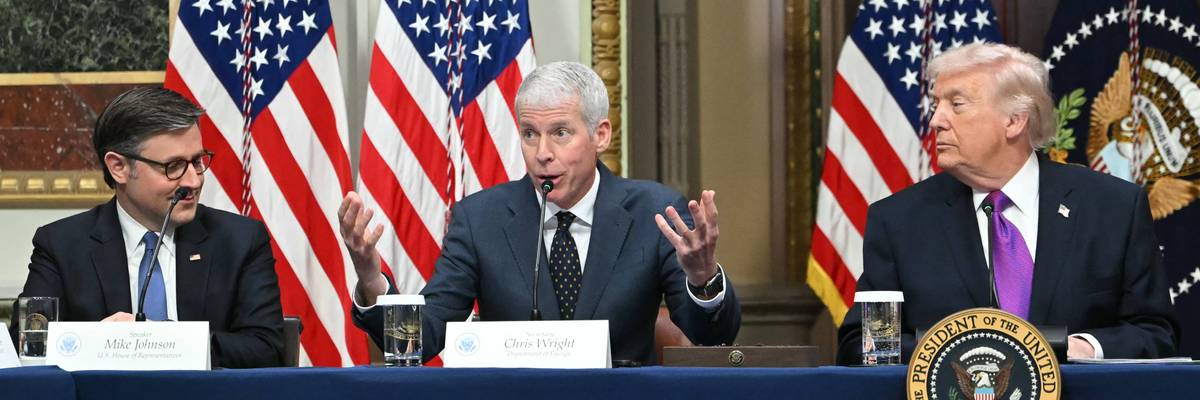
US Speaker of the House Mike Johnson and President Donald Trump listen to Energy Secretary Chris Wright during an event on March 4, 2026.
Trump Energy Chief Accused of Manipulating Oil Markets With Deleted Post About Strait of Hormuz
"The fusion of war-making and market manipulation by top Trump officials isn't entirely without precedent," said one observer, "but the speed and brazenness does seem new."
US Energy Secretary Chris Wright, a former fracking executive, was accused on Tuesday of manipulating global markets after he posted a striking claim on social media: The American Navy, he wrote, had "successfully escorted an oil tanker through the Strait of Hormuz to ensure oil remains flowing."
The post on X was deleted minutes later, after "oil prices slid at their steepest pace in years," according to the Wall Street Journal. The White House press secretary later acknowledged publicly that Wright's claim was false, and the Energy Department—which has been scrambling to quell mounting fears of a sustained increase in oil prices and broader supply chain chaos stemming from the US-Israeli assault on Iran—threw unnamed staff under the bus, saying they "incorrectly captioned" the post.
"So who just made $100 million dollars shorting oil for the 3 minutes that Chris Wright had that post up?" asked hedge fund manager Spencer Hakimian.
Anti-monopoly researcher Matt Stoller wrote in response to the post and its deletion that "the fusion of war-making and market manipulation by top Trump officials isn't entirely without precedent, but the speed and brazenness does seem new."
The debacle also notably drew a reaction from the Iranian foreign minister, Abbas Araghchi, who wrote on X that "US officials are posting fake news to manipulate markets."
"It won't protect them from inflationary tsunami they've imposed on Americans," wrote Araghchi. "Markets are facing the biggest shortfall in HISTORY: bigger than the Arab Oil Embargo, Iran's Islamic Revolution, and the Kuwait invasion COMBINED."
The Strait of Hormuz has become a critical flashpoint of the US-Israeli war on Iran, whose military has threatened to attack vessels that attempt to pass through the route in retaliation for the deadly missile onslaught. An estimated 13 million barrels per day passed through the strait in 2025—roughly 31% of all seaborne crude flows.
“At the beginning of the war we announced, and we announce again, no vessel associated with aggressors against Iran has the right to pass through the Strait of Hormuz,” said the Islamic Revolutionary Guards Corps. “If you have doubts, come closer and find out.”
Reuters reported Tuesday that, contrary to Wright's deleted post, the US Navy has "refused near-daily requests from the shipping industry for military escorts through the Strait of Hormuz since the start of the war on Iran, saying the risk of attacks is too high for now."
The United Kingdom Maritime Trade Operations center said early Wednesday that a cargo vessel in the strait was "hit by an unknown projectile," causing a fire onboard and forcing crew members to evacuate.
The report came hours after the US military said it "eliminated multiple Iranian naval vessels," including "16 minelayers near the Strait of Hormuz." The announcement followed, by less than two hours, a social media post from President Donald Trump declaring that "we have no reports" of Iran laying mines in the strait.
"If for any reason mines were placed, and they are not removed forthwith, the Military consequences to Iran will be at a level never seen before," Trump wrote. "If, on the other hand, they remove what may have been placed, it will be a giant step in the right direction!"
After attending a classified briefing on Tuesday, US Sen. Chris Murphy (D-Conn.) wrote that it was obvious the administration "had no plan" regarding the Strait of Hormuz prior to launching its assault on Iran.
"They don't know how to get it safely back open," Murphy wrote. "Which is unforgivable, because this part of the disaster was 100% foreseeable."
We are at a crossroads
This country and this world are at a monumental crossroads. In a few short weeks, US voters will have an opportunity to beat back the forces of fascism and confront the billionaires who are rigging the economy, our media system, and our democracy, making it increasingly impossible for ordinary people to get by. We’re not just talking about the election. We’re talking about what must be done once these fascist elements are vanquished from power. We need a bolder set of solutions than what either major party has so far been willing to offer and a working-class movement ready to fight like hell for it. Trump didn't emerge from nowhere. The conditions that fueled MAGA authoritarianism were created by decades of radical neoliberal economic policies and a corrupt political system dominated by corporate interests. They slashed taxes on the super-rich, promising that the benefits would trickle down. They said giveaways to the corporate titans would make life more affordable for the rest of us. It was all bullshit. And when a bitter, betrayed populace searches for someone to blame, right-wing demagogues have little trouble finding scapegoats. People know when they're being lied to, but you won't hear any of this from the corporate media. Only independent journalism—powered and funded by people who believe in building a better world—can deliver truly trustworthy daily news. Our Fall Campaign is underway, and we need your help. To power our newsroom through the rest of the year, we need to raise $125,000 by midnight on October 31. So if you share our vision, please contribute whatever you can to sustain our work. |
US Energy Secretary Chris Wright, a former fracking executive, was accused on Tuesday of manipulating global markets after he posted a striking claim on social media: The American Navy, he wrote, had "successfully escorted an oil tanker through the Strait of Hormuz to ensure oil remains flowing."
The post on X was deleted minutes later, after "oil prices slid at their steepest pace in years," according to the Wall Street Journal. The White House press secretary later acknowledged publicly that Wright's claim was false, and the Energy Department—which has been scrambling to quell mounting fears of a sustained increase in oil prices and broader supply chain chaos stemming from the US-Israeli assault on Iran—threw unnamed staff under the bus, saying they "incorrectly captioned" the post.
"So who just made $100 million dollars shorting oil for the 3 minutes that Chris Wright had that post up?" asked hedge fund manager Spencer Hakimian.
Anti-monopoly researcher Matt Stoller wrote in response to the post and its deletion that "the fusion of war-making and market manipulation by top Trump officials isn't entirely without precedent, but the speed and brazenness does seem new."
The debacle also notably drew a reaction from the Iranian foreign minister, Abbas Araghchi, who wrote on X that "US officials are posting fake news to manipulate markets."
"It won't protect them from inflationary tsunami they've imposed on Americans," wrote Araghchi. "Markets are facing the biggest shortfall in HISTORY: bigger than the Arab Oil Embargo, Iran's Islamic Revolution, and the Kuwait invasion COMBINED."
The Strait of Hormuz has become a critical flashpoint of the US-Israeli war on Iran, whose military has threatened to attack vessels that attempt to pass through the route in retaliation for the deadly missile onslaught. An estimated 13 million barrels per day passed through the strait in 2025—roughly 31% of all seaborne crude flows.
“At the beginning of the war we announced, and we announce again, no vessel associated with aggressors against Iran has the right to pass through the Strait of Hormuz,” said the Islamic Revolutionary Guards Corps. “If you have doubts, come closer and find out.”
Reuters reported Tuesday that, contrary to Wright's deleted post, the US Navy has "refused near-daily requests from the shipping industry for military escorts through the Strait of Hormuz since the start of the war on Iran, saying the risk of attacks is too high for now."
The United Kingdom Maritime Trade Operations center said early Wednesday that a cargo vessel in the strait was "hit by an unknown projectile," causing a fire onboard and forcing crew members to evacuate.
The report came hours after the US military said it "eliminated multiple Iranian naval vessels," including "16 minelayers near the Strait of Hormuz." The announcement followed, by less than two hours, a social media post from President Donald Trump declaring that "we have no reports" of Iran laying mines in the strait.
"If for any reason mines were placed, and they are not removed forthwith, the Military consequences to Iran will be at a level never seen before," Trump wrote. "If, on the other hand, they remove what may have been placed, it will be a giant step in the right direction!"
After attending a classified briefing on Tuesday, US Sen. Chris Murphy (D-Conn.) wrote that it was obvious the administration "had no plan" regarding the Strait of Hormuz prior to launching its assault on Iran.
"They don't know how to get it safely back open," Murphy wrote. "Which is unforgivable, because this part of the disaster was 100% foreseeable."
US Energy Secretary Chris Wright, a former fracking executive, was accused on Tuesday of manipulating global markets after he posted a striking claim on social media: The American Navy, he wrote, had "successfully escorted an oil tanker through the Strait of Hormuz to ensure oil remains flowing."
The post on X was deleted minutes later, after "oil prices slid at their steepest pace in years," according to the Wall Street Journal. The White House press secretary later acknowledged publicly that Wright's claim was false, and the Energy Department—which has been scrambling to quell mounting fears of a sustained increase in oil prices and broader supply chain chaos stemming from the US-Israeli assault on Iran—threw unnamed staff under the bus, saying they "incorrectly captioned" the post.
"So who just made $100 million dollars shorting oil for the 3 minutes that Chris Wright had that post up?" asked hedge fund manager Spencer Hakimian.
Anti-monopoly researcher Matt Stoller wrote in response to the post and its deletion that "the fusion of war-making and market manipulation by top Trump officials isn't entirely without precedent, but the speed and brazenness does seem new."
The debacle also notably drew a reaction from the Iranian foreign minister, Abbas Araghchi, who wrote on X that "US officials are posting fake news to manipulate markets."
"It won't protect them from inflationary tsunami they've imposed on Americans," wrote Araghchi. "Markets are facing the biggest shortfall in HISTORY: bigger than the Arab Oil Embargo, Iran's Islamic Revolution, and the Kuwait invasion COMBINED."
The Strait of Hormuz has become a critical flashpoint of the US-Israeli war on Iran, whose military has threatened to attack vessels that attempt to pass through the route in retaliation for the deadly missile onslaught. An estimated 13 million barrels per day passed through the strait in 2025—roughly 31% of all seaborne crude flows.
“At the beginning of the war we announced, and we announce again, no vessel associated with aggressors against Iran has the right to pass through the Strait of Hormuz,” said the Islamic Revolutionary Guards Corps. “If you have doubts, come closer and find out.”
Reuters reported Tuesday that, contrary to Wright's deleted post, the US Navy has "refused near-daily requests from the shipping industry for military escorts through the Strait of Hormuz since the start of the war on Iran, saying the risk of attacks is too high for now."
The United Kingdom Maritime Trade Operations center said early Wednesday that a cargo vessel in the strait was "hit by an unknown projectile," causing a fire onboard and forcing crew members to evacuate.
The report came hours after the US military said it "eliminated multiple Iranian naval vessels," including "16 minelayers near the Strait of Hormuz." The announcement followed, by less than two hours, a social media post from President Donald Trump declaring that "we have no reports" of Iran laying mines in the strait.
"If for any reason mines were placed, and they are not removed forthwith, the Military consequences to Iran will be at a level never seen before," Trump wrote. "If, on the other hand, they remove what may have been placed, it will be a giant step in the right direction!"
After attending a classified briefing on Tuesday, US Sen. Chris Murphy (D-Conn.) wrote that it was obvious the administration "had no plan" regarding the Strait of Hormuz prior to launching its assault on Iran.
"They don't know how to get it safely back open," Murphy wrote. "Which is unforgivable, because this part of the disaster was 100% foreseeable."