

SUBSCRIBE TO OUR FREE NEWSLETTER
Daily news & progressive opinion—funded by the people, not the corporations—delivered straight to your inbox.
5
#000000
#FFFFFF
To donate by check, phone, or other method, see our More Ways to Give page.
Daily news & progressive opinion—funded by the people, not the corporations—delivered straight to your inbox.

A further 15 Greenpeace International activists and a Russian freelance photojournalist were today charged with piracy in Murmansk. This means that all 28 activists from the Greenpeace ship Arctic Sunrise, as well as two freelancers, now face the charge. If convicted, the offence carries a maximum 15 year jail term.
Those charged today are:
American Peter Willcox (Captain, Arctic Sunrise); Argentinian Miguel Hernan Perez Orzi; Australian Colin Russell; Britons Frank Hewetson and Iain Rogers; Canadians Alexandre Paul and Paul D Ruzycki; Danish citizen Anne Mie Roer Jensen; French citizen Francesco Pisanu; Italian Cristian D'Alessandro; New Zealanders Jonathan Beauchamp and David Haussmann; Russian Andrey Allakhverdov; Swiss Marco Weber; Turkish citizen Gizhem Akhan and Russian freelance photojournalist Denis Sinyakov.
Lawyers acting on behalf of Greenpeace International have now lodged formal appeals in the Murmansk Lenin district court against the continued detention of the Arctic 30.
Greenpeace International Executive Director Kumi Naidoo said:
"Our activists have been charged with a crime that did not happen, they are accused of an imaginary offence. There can be no doubt about why the charge of piracy has been brought and the legal hammer wielded. An effort is underway to intimidate us, but our peaceful passionate campaign against Gazprom and all other Arctic drillers will not be silenced.
"A profound injustice is right now being perpetrated against our friends, our brothers and sisters, our sons and daughters who sit in jail. I call on people across the world to stand with us against Gazprom and all oil companies who want to drill in the Arctic, join us in this fight against bullies of the very worst kind."
Greenpeace International is taking its efforts to highlight the case, free the activists and protect the Arctic to a global level. On Tuesday night Greenpeace climbers hung a huge banner from the roof of FC Basel's St. Jakob-Park stadium in Switzerland as the team faced Schalke in the UEFA Champions League - a tournament sponsored by Gazprom. On Wednesday all of Gazprom's filling stations in Germany were hit by protests.
On Saturday (5th October) tens of thousands of people will take part in an emergency global day of solidarity. Peaceful events are planned in more than 80 cities in 45 countries across the world. In Hong Kong hundreds will gather at the main harbour to form a human banner. In South Africa people will come together at former Apartheid detention centres. In Canada large audio and visual displays will light up at an all-night event. In Madrid supporters will gather in Puerto del Sol with a replica of the Arctic Sunrise ship. And in Senegal fishermen who last year welcomed the Arctic Sunrise on its voyage to preserve their fishing grounds will take to their boats again in an act of solidarity.
Today Mikhail Fedotov, the head of the Russian presidential Human Rights Council, said he sees no reason to prosecute the crew of the Arctic Sunrise for piracy (1). The council is an advisory panel established to assist President Putin in fulfilling his constitutional responsibilities to guarantee and protect human rights. Groups such as Amnesty International, Human Rights Watch and Reporters Without Borders have called for the release of the activists, while media outlets are increasingly highlighting their plight.
Today EU regulators announced they are preparing an anti-trust case against Gazprom, in a move that could cost the oil giant $15 billion. (2)
Greenpeace has also released a letter written by Faiza Oulahsen, 26, a Dutch environmentalist being detained in Murmansk. In the letter, penned shortly before she was charged yesterday, she says: "I have no idea how this is going to end, or how long it's going to take." She describes the experience of sitting through hearings in a cage and living in a prison cell that is "ice cold" and where the lights are never turned off. "I started to lose the calmness and self-control I had been using the past couple of days, slowly but surely. Two months in a cell is one thing, but what comes after that? A sentence of a few months or a few years in a case based on lies?"
The 28 activists, a freelance photographer and the freelance videographer, were involved in a protest against the Gazprom Arctic drilling platform Prirazlomnaya on September 18th. Two activists tried to climb the side of the platform and hang a banner.
Greenpeace is a global, independent campaigning organization that uses peaceful protest and creative communication to expose global environmental problems and promote solutions that are essential to a green and peaceful future.
+31 20 718 2000
"The fact that 40 of 47 Democratic senators voted to withhold military hardware from Israel is a new high water mark in holding Israel accountable," said one observer, who called the final vote "still troubling."
US senators on Wednesday voted down a pair of resolutions aimed at blocking US bomb and bulldozer sales to Israel as it continues its genocidal war on Gaza and devastating bombardment and mass displacement in Lebanon.
Upper chamber lawmakers voted 59-40 against advancing SJ Res. 32, a joint resolution introduced by Sen. Bernie Sanders (I-Vt.) "providing for congressional disapproval of the proposed foreign military sale to the government of Israel of certain defense articles and services."
At issue are $295 million worth of Caterpillar D9 series bulldozers, spare parts, and related services. Israel often uses the bulldozers to destroy homes and other civilian structures in Gaza, the illegally occupied West Bank, including East Jerusalem, and Lebanon.
Absolutely historic vote today where 40 US Senators voted to block the sale of Caterpillar D-9 bulldozers to Israel, citing civilian harm Gaza, the West Bank, and Lebanon.Though the measure was defeated (as expected), the tide is turning. Just last year, this number was 27.
[image or embed]
— Mai El-Sadany (@maitelsadany.bsky.social) April 15, 2026 at 4:21 PM
In 2003, American human rights activist Rachel Corrie was crushed to death by a Caterpillar D9 while attempting to stop the demolition of a home in Rafah, Gaza.
Entire villages and hamlets have been razed using the dozers as Israel ethnically cleanses the occupied territories to make way for Jewish-only settler colonies.
The SJ Res. 32 roll call was followed by a 63-36 vote against advancing SJ Res. 138, which was introduced by Sanders and Sens. Chris Van Hollen (D-Md.), Jeff Merkley (D-Ore.), and Peter Welch (D-Vt.). The measure rejects the proposed sale of 12,000 BLU–110A/B general purpose, 1,000-pound bomb bodies and associated items and services.
Experts point to Israel's use of 1,000- and 2,000-pound bombs in densely populated Gaza—and the Israeli military's loosened rules of engagement effectively allowing unlimited civilian casualties in strikes targeting a single Hamas militant of any rank—as a major reason why so many Gazans are being killed and injured.
Sanders said on social media after the votes, "Today, more than 80% of the Democratic caucus stood with the American people and voted to block US military aid to [Israeli Prime Minister Benjamin] Netanyahu and his horrific, illegal wars."
"We are making progress," the senator continued. "When we started this effort there were just 11 votes, now there are 40."
Today, more than 80% of the Democratic caucus stood with the American people and voted to block U.S. military aid to Netanyahu and his horrific, illegal wars.
[image or embed]
— Senator Bernie Sanders (@sanders.senate.gov) April 15, 2026 at 5:05 PM
Sen. Ed Markey (D-Mass.) said following Wednesday's votes:
A vote to approve arms sales to Israel at this time would be seen as a message of approval for [President Donald] Trump and Netanyahu’s disastrous war against Iran. I will not send that message.
Why would we send American military weapons that could prolong, escalate, or worsen this horrible situation in the Middle East? I say no more. The Senate should express its opposition to Trump and Netanyahu’s needless war in Iran and seek to stop it in any way it can.
There is no military solution to this crisis. We must solve this at the negotiating table. We must stop these arms sales and end this war now.
Matt Duss, executive vice president at the Center for International Policy (CIP) and a former adviser to Sanders, slammed Democrats like Senate Minority Leader Chuck Schumer (D-NY) and Sen. Chris Coons (D-Del.) who voted to block the resolutions, for their "cowardly bullshit."
Duss noted that just last September, Coons said that "if there is no change in direction from the Israeli administration, for the first time I would seriously consider" voting to block arms transfers to Israel.
"Israeli behavior has only gotten worse since then," Duss said.
Wednesday's votes followed numerous previous failed attempts to limit US arms transfers to Israel since it launched its genocidal retaliation for the Hamas-led attack of October 7, 2023, which has left more than 250,000 Palestinians dead, wounded, or missing.
Dylan Williams, vice president for government affairs at CIP, said on X that "the fact that 40 of 47 Democratic senators voted to withhold military hardware from Israel is a new high water mark in holding Israel accountable for violating US and international law."
"It is still troubling that a few Democrats and all Republicans voted to supply the arms," he added.
The Biden and Trump administrations have lavished Israel with more than $21 billion in armed aid since October 2023, despite the International Criminal Court's issuance of arrest warrants for Netanyahu and former Defense Minister Yoav Gallant for alleged crimes against humanity and war crimes in Gaza.
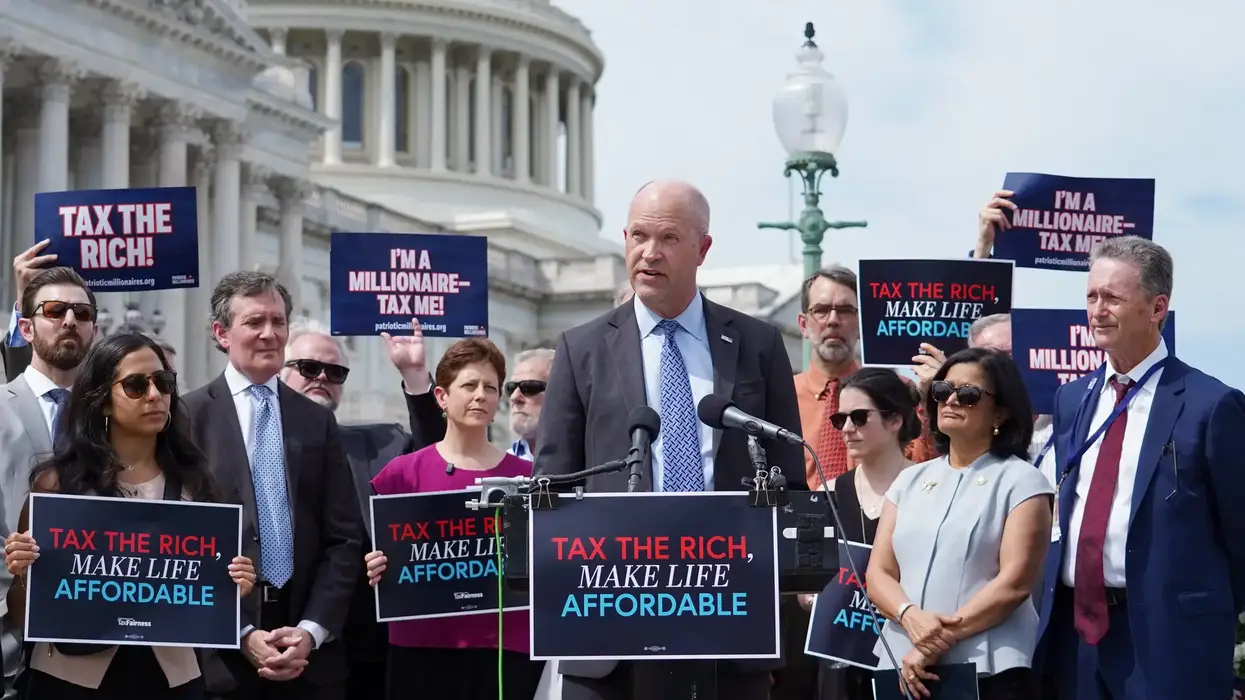
"We cannot hand over the keys to our democracy to people who are unwilling to address the economic injustices that exist today," said Scott Ellis of the Patriotic Millionaires.
"Millionaires like me who want a rich, stable, free country demand an economy that ensures it. That begins with commonsense revenue raisers and tax reforms that stop the accumulation of oligarchic concentrations of wealth."
That's what Scott Ellis of the Patriotic Millionaire said Wednesday—Tax Day in the United States—as he gathered with members of various organizations, plus Sens. Chris Van Hollen (D-Md.) and Ed Markey (D-Mass.), as well as Reps. Don Beyer (D-Va,), Chris Deluzio (D-Pa.), and Pramila Jayapal (D-Wash.), for a "tax the rich" rally on Capitol Hill.
"While I've seen examples of the good that wealth can do, I have also seen all the ways it can lead to irreparable harm to our personal, political, moral, and societal well-being," said Ellis. "There is a level of wealth beyond which it threatens the health and even the existence of our democracy and our economy. We cannot hand over the keys to our democracy to people who are unwilling to address the economic injustices that exist today."
We’re taking our message across Washington, DC.Our mobile billboard will be circling Capitol Hill, the National Mall, and beyond—calling out billionaire tax avoidance and demanding higher taxes on the richest Americans.Because working people pay what they owe. It’s time the ultra-rich do too.
[image or embed]
— Patriotic Millionaires (@patrioticmillionaires.org) April 15, 2026 at 11:49 AM
Ellis said that he joined the lawmakers and others gathered "to urge our government leaders to deal with the money problem in our country head-on with solutions like those found in the Patriotic Millionaires' MONEY Agenda platform. Every time inequality reaches extraordinary levels, we create a vulnerability to authoritarianism where money becomes power. If we want to unrig our economy, we need a bold, surprisingly simple economic vision."
So far, two bills tied to the MONEY Agenda have been introduced in Congress: the Equal Tax Act, sponsored by Markey and Rep. Delia Ramirez (D-Ill.), and the Working Americans' Tax Cut Act, spearheaded by Van Hollen and Beyer.
"Teachers, nurses, and millions [of] working people are paying more while getting less because our tax code is rigged to reward wealth over work," Markey said in a statement. "The Equal Tax Act brings fairness to our tax code by requiring millionaires and billionaires to pay taxes on investment income the same way working people pay taxes. On Tax Day, I'm proud to work with Congresswoman Ramirez to fight for legislation that has the wealthy pay their fair share, and rewards work every bit as much as wealth."
Van Hollen, meanwhile, said Wednesday that "my Working Americans' Tax Cut Act creates a fairer system that ensures those who are stretching to make ends meet can keep more of what they earn, while asking the well-off to pitch in more. It's long past time that we rebalanced our tax code to put working people first—and promote greater opportunity and shared prosperity for all."
This country’s tax system is built to favor those at the top and squeeze every last dime out of those at the bottom. It’s time for a change to this rigged system.
[image or embed]
— Congresswoman Pramila Jayapal (@jayapal.house.gov) April 15, 2026 at 6:58 PM
Deluzio used the "Tax the Rich, Make Life Affordable" rally to call out the agenda of elected Republicans—who control the White House and both chambers of Congress—and promote another bill led by Jayapal, Rep. Brendan Boyle (D-Pa.), and Sen. Elizabeth Warren (D-Mass.).
"Our government has a fiscal recklessness problem, and it looks like this: the richest people in the history of Earth facing lower tax rates than Americans who earn a paycheck," said Deluzio. "Yet that is the Republican plan—jack up the national debt and slash healthcare and more for the American people to pay for these huge tax giveaways to corporations and the ultrarich. We need a vastly different approach, like passing the Ultra-Millionaires Tax to get some sanity back into our tax system."
To illustrate just how broken the current system is, EJ Juárez, executive director of State Innovation Exchange, noted that "in 2025 alone, billionaire wealth grew 22%—from $6.7 trillion to $8.2 trillion—while working families see the cost of living go up, and wages too low. That is why SiX is working alongside state legislators across the country to lead the way."
"Across all 50 states, lawmakers are advancing bold solutions to make the ultrawealthy pay what they owe, close corporate loopholes, and build tax systems that actually lower costs and empower working families," Juárez said, nodding to initiatives in places such as California and Washington state. "Together, states are proving a better future is possible."
Beyond Washington, DC, New York City Mayor Zohran Mamdani partnered with Nobel laureate in economics Joseph Stiglitz and Paris School of Economics professor Gabriel Zucman for a Tax Day op-ed calling out the "rigged" US tax code.
"The idea that billionaires should pay higher tax rates than working people is not radical," the trio wrote for The Guardian. "What is radical is allowing a system where extreme wealth exists alongside widespread hardship—and where those billionaires can in effect opt out of contributing to the society that made their success possible."

"We won't stop fighting for a self-evident truth: The government should not be able to bypass the courts to surveil Americans," said one privacy campaigner.
A controversial federal spying power is set to expire next week, but Republican leadership in the US House of Representatives again delayed a reauthorization vote on Wednesday amid persistent demands for reforms from across the political spectrum.
President Donald Trump is pushing for a "clean" 18-month extension of Section 702 of the Foreign Intelligence Surveillance Act (FISA), which allows for warrantless spying on the electronic communications of noncitizens located outside the United States.
House Speaker Mike Johnson (R-La.) "canceled a vote scheduled for Wednesday evening... amid a hard-liner rebellion, making it more likely the program could expire in five days—but said the House would try again Thursday," Politico reported.
As for whether there would be the necessary votes on Thursday to adopt a rule to proceed to consideration of the bill, Johnson said: "I think we will... We're working through some final details."
Although GOP leaders are plowing ahead with their reauthorization effort, Demand Progress senior policy adviser Hajar Hammado still welcomed the delay, declaring that "this time, fearmongering was not enough to overcome a bipartisan movement fighting for the privacy rights of all Americans."
"We rarely ever see the full force of the White House and the intelligence agencies fail to browbeat Congress into giving them what they want," Hammado noted. "That this happened today is a testament to the tireless work of our movement, which has been successfully bringing Republicans, Democrats, and Independents together for a common cause."
"Of course, this fight is nowhere near over," she added. "Speaker Johnson can still force a vote any time with extremely short notice, but our coalition feels the wind at our backs, and we won't stop fighting for a self-evident truth: The government should not be able to bypass the courts to surveil Americans."
Hammado's group has been a leader in the growing coalition calling for reforms—including for lawmakers to close the "data broker loophole" that intelligence and law enforcement agencies use to buy their way around the Fourth Amendment to the US Constitution, which is supposed to protect Americans against unreasonable searches and seizures.
It's not just congressional Republicans under pressure. Demand Progress Action and Fight for the Future took aim at House Intelligence Committee Ranking Member Jim Himes (D-Conn.)—who has signaled that he will support renewal and vote against adding privacy protections—with a Sunday print advertisement in the Connecticut Post.
We teamed up with @demandprogress.bsky.social to call out @jahimes.bsky.social for supporting Trump's mass surveillance efforts by trying to push through Section 702 without reform.
[image or embed]
— Fight for the Future (@fightforthefuture.org) April 14, 2026 at 8:38 PM
On Tuesday, Congressional Asian Pacific American Caucus Chair Grace Meng (D-NY), Congressional Hispanic Caucus Chair Adriano Espaillat (D-NY), and Congressional Progressive Caucus Chair Greg Casar (D-Texas) spearheaded a letter to Democratic and Republican leaders in both chambers arguing that "this authority ought to include meaningful Fourth Amendment protections for Americans in its renewal package."
"The Trump administration has demonstrated an unparalleled appetite for collecting and exploiting Americans' personal data," the caucus leaders and members wrote. "The administration has built profiles on American citizens, demanded that artificial intelligence (AI) companies assist in mass domestic surveillance, and paid hundreds of millions of dollars to build a megadatabase of Americans' personal data. Without independent guardrails on Section 702, this administration has
repeatedly shown that it cannot be trusted to police its own use of this sweeping surveillance authority."
Over 30 civil society organizations—including Demand Progress, Fight for the Future, Indivisible, Project On Government Oversight, RootsAction, and more—endorsed the congressional letter. POGO policy counsel Donald Bell commended the leadership of the caucuses "in seeking real guardrails and accountability that protect our constitutional rights," while Hammado urged "all members of Congress to follow the lead" of the three groups.
Meanwhile, The American Prospect reported Monday that "the Congressional Black Caucus will quietly support an effort to reauthorize surveillance powers that were used to spy on Black Lives Matter activists in 2020," which "comes after Rep. Gregory Meeks (D-NY), the powerful ranking member of the House Committee on Foreign Affairs, successfully lobbied CBC leadership to stand down on reforming the vast intelligence authority."
After publication, Meeks told the outlet that "I support FISA reauthorization, but the only vote I've been whipping is my war powers resolution to end the war in Iran. Whip operations are traditionally conducted by the ranking member of the committee that has jurisdiction over the legislation being considered. Any claim that I'm whipping the CBC on FISA is false."
In response to that reporting,Re Access Now, Fight for the Future, and STOP Spying NYC said in a joint statement that "if the heat of the glares aimed at Rep. Meeks right now could melt him, he'd be dripping like a snowman on the pavement in July. No one in Queens wants everybody in the federal government to have total access to the intimate details of their lives with the tap of a mouse."
Highlighting the danger of continuing the spying power sans privacy protections as Trump's Immigration and Customs Enforcement officers roam US streets, the groups said that "it is a total betrayal of the Fourth Amendment and the dignity of everyday people in this country to treat us all as if we are guilty until Big Brother Trump proves us innocent by watching our every move. And worse—it's impossible to predict how these troves of records may be weaponized in the future against racial justice activists, trans and queer families, abortion patients and providers, anti-war activists, or anyone who acts out of step with MAGA."
"It's supposed to be the Foreign Intelligence Surveillance Act, not the Forever Indiscriminate Surveillance Act. Rep. Meeks' colleagues are proposing real safeguards to protect people against this indiscriminate government surveillance," the trio added. "He is not only failing his constituency, he is disrespecting them and putting them in danger. It's not too late for Rep. Meeks to get on the right side of history."