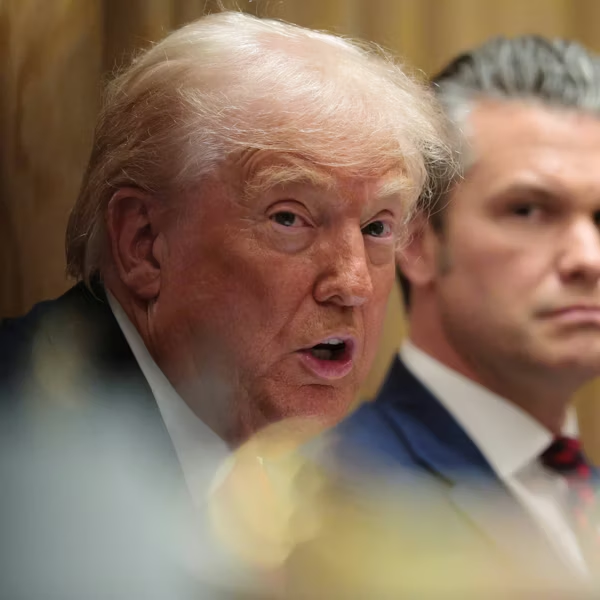
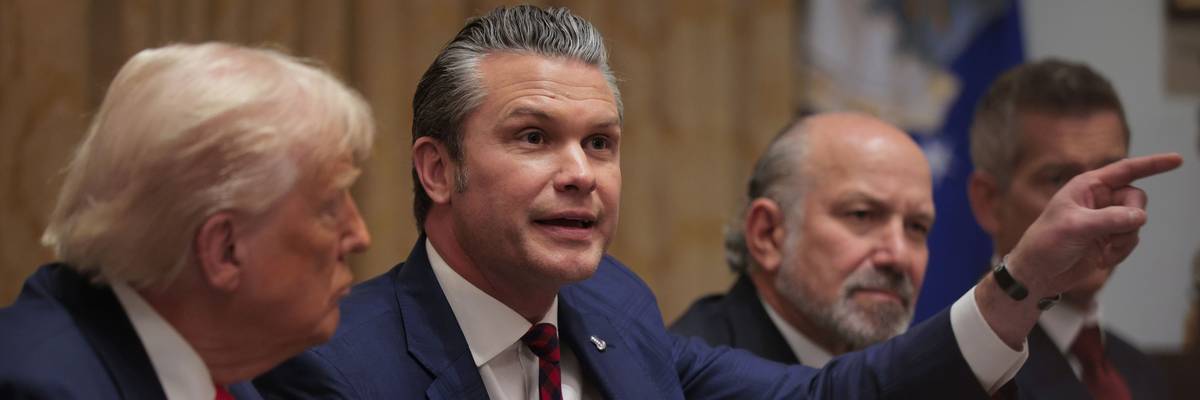
US Defense Secretary Pete Hegseth speaks during a Cabinet meeting at the White House on December 2, 2025 in Washington, DC.
Hegseth Defends Boat Bombings as New Details Further Undermine Administration's Justifications
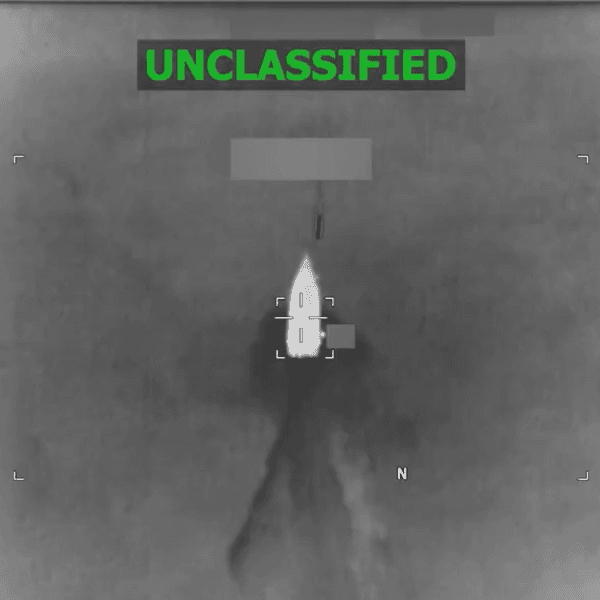
The boat targeted in the infamous September 2 "double-tap" strike was not even headed for the US, Adm. Frank Bradley revealed to lawmakers.
US Defense Secretary Pete Hegseth on Saturday defended the Trump administration's policy of bombing suspected drug-trafficking vessels even as new details further undermined the administration's stated justifications for the policy.
According to the Guardian, Hegseth told a gathering at the Ronald Reagan presidential library that the boat bombings, which so far have killed at least 87 people, are necessary to protect Americans from illegal drugs being shipped to the US.
"If you’re working for a designated terrorist organization and you bring drugs to this country in a boat, we will find you and we will sink you," Hegseth said. "Let there be no doubt about it."
However, leaked details about a classified briefing delivered to lawmakers last week by Adm. Frank Bradley about a September 2 boat strike cast new doubts on Hegseth's justifications.
CNN reported on Friday that Bradley told lawmakers that the boat taken out by the September 2 attack was not even headed toward the US, but was going "to link up with another, larger vessel that was bound for Suriname," a small nation in the northeast of South America.
While Bradley acknowledged that the boat was not heading toward the US, he told lawmakers that the strike on it was justified because the drugs it was carrying could have theoretically wound up in the US at some point.
Additionally, NBC News reported on Saturday that Bradley told lawmakers that Hegseth had ordered all 11 men who were on the boat targeted by the September 2 strike to be killed because "they were on an internal list of narco-terrorists who US intelligence and military officials determined could be lethally targeted."
This is relevant because the US military launched a second strike during the September 2 operation to kill two men who had survived the initial strike on their vessel, which many legal experts consider to be either a war crime or an act of murder under domestic law.
Rep. Jim Himes (D-Conn.), the ranking member of the House Permanent Select Committee on Intelligence, watched video of the September 2 double-tap attack last week, and he described the footage as “one of the most troubling things I’ve seen in my time in public service.”
“Any American who sees the video that I saw will see its military attacking shipwrecked sailors,” Himes explained. “Now, there’s a whole set of contextual items that the admiral explained. Yes, they were carrying drugs. They were not in position to continue their mission in any way... People will someday see this video and they will see that that video shows, if you don’t have the broader context, an attack on shipwrecked sailors.”
While there has been much discussion about the legality of the September 2 double-tap strike in recent days, some critics have warned that fixating on this particular aspect of the administration's policy risks taking the focus off the illegality of the boat-bombing campaign as a whole.
Daphne Eviatar, director for security and human rights for Amnesty International USA, said on Friday that the entire boat-bombing campaign has been "illegal under both domestic and international law."
"All of them constitute murder because none of the victims, whether or not they were smuggling illegal narcotics, posed an imminent threat to life," she said. "Congress must take action now to stop the US military from murdering more people in the Caribbean and Eastern Pacific."
We are at a crossroads
This country and this world are at a monumental crossroads. In a few short weeks, US voters will have an opportunity to beat back the forces of fascism and confront the billionaires who are rigging the economy, our media system, and our democracy, making it increasingly impossible for ordinary people to get by. We’re not just talking about the election. We’re talking about what must be done once these fascist elements are vanquished from power. We need a bolder set of solutions than what either major party has so far been willing to offer and a working-class movement ready to fight like hell for it. Trump didn't emerge from nowhere. The conditions that fueled MAGA authoritarianism were created by decades of radical neoliberal economic policies and a corrupt political system dominated by corporate interests. They slashed taxes on the super-rich, promising that the benefits would trickle down. They said giveaways to the corporate titans would make life more affordable for the rest of us. It was all bullshit. And when a bitter, betrayed populace searches for someone to blame, right-wing demagogues have little trouble finding scapegoats. People know when they're being lied to, but you won't hear any of this from the corporate media. Only independent journalism—powered and funded by people who believe in building a better world—can deliver truly trustworthy daily news. Our Fall Campaign is underway, and we need your help. To power our newsroom through the rest of the year, we need to raise $125,000 by midnight on October 31. So if you share our vision, please contribute whatever you can to sustain our work. |
US Defense Secretary Pete Hegseth on Saturday defended the Trump administration's policy of bombing suspected drug-trafficking vessels even as new details further undermined the administration's stated justifications for the policy.
According to the Guardian, Hegseth told a gathering at the Ronald Reagan presidential library that the boat bombings, which so far have killed at least 87 people, are necessary to protect Americans from illegal drugs being shipped to the US.
"If you’re working for a designated terrorist organization and you bring drugs to this country in a boat, we will find you and we will sink you," Hegseth said. "Let there be no doubt about it."
However, leaked details about a classified briefing delivered to lawmakers last week by Adm. Frank Bradley about a September 2 boat strike cast new doubts on Hegseth's justifications.
CNN reported on Friday that Bradley told lawmakers that the boat taken out by the September 2 attack was not even headed toward the US, but was going "to link up with another, larger vessel that was bound for Suriname," a small nation in the northeast of South America.
While Bradley acknowledged that the boat was not heading toward the US, he told lawmakers that the strike on it was justified because the drugs it was carrying could have theoretically wound up in the US at some point.
Additionally, NBC News reported on Saturday that Bradley told lawmakers that Hegseth had ordered all 11 men who were on the boat targeted by the September 2 strike to be killed because "they were on an internal list of narco-terrorists who US intelligence and military officials determined could be lethally targeted."
This is relevant because the US military launched a second strike during the September 2 operation to kill two men who had survived the initial strike on their vessel, which many legal experts consider to be either a war crime or an act of murder under domestic law.
Rep. Jim Himes (D-Conn.), the ranking member of the House Permanent Select Committee on Intelligence, watched video of the September 2 double-tap attack last week, and he described the footage as “one of the most troubling things I’ve seen in my time in public service.”
“Any American who sees the video that I saw will see its military attacking shipwrecked sailors,” Himes explained. “Now, there’s a whole set of contextual items that the admiral explained. Yes, they were carrying drugs. They were not in position to continue their mission in any way... People will someday see this video and they will see that that video shows, if you don’t have the broader context, an attack on shipwrecked sailors.”
While there has been much discussion about the legality of the September 2 double-tap strike in recent days, some critics have warned that fixating on this particular aspect of the administration's policy risks taking the focus off the illegality of the boat-bombing campaign as a whole.
Daphne Eviatar, director for security and human rights for Amnesty International USA, said on Friday that the entire boat-bombing campaign has been "illegal under both domestic and international law."
"All of them constitute murder because none of the victims, whether or not they were smuggling illegal narcotics, posed an imminent threat to life," she said. "Congress must take action now to stop the US military from murdering more people in the Caribbean and Eastern Pacific."
- UN Experts Say Those Ordering and Carrying Out US Boat Strikes Should Be 'Prosecuted for Homicide' ›
- 'These Are Murders': Trump Condemned After Bombing Yet Another Boat Off Venezuelan Coast ›
- Legal Experts Accuse Hegseth of 'War Crimes, Murder, or Both' After New Reporting on Boat Strike Order ›
- As Hegseth Refuses to Release Video of Boat Murder, AOC Calls Briefing a 'Joke' | Common Dreams ›
US Defense Secretary Pete Hegseth on Saturday defended the Trump administration's policy of bombing suspected drug-trafficking vessels even as new details further undermined the administration's stated justifications for the policy.
According to the Guardian, Hegseth told a gathering at the Ronald Reagan presidential library that the boat bombings, which so far have killed at least 87 people, are necessary to protect Americans from illegal drugs being shipped to the US.
"If you’re working for a designated terrorist organization and you bring drugs to this country in a boat, we will find you and we will sink you," Hegseth said. "Let there be no doubt about it."
However, leaked details about a classified briefing delivered to lawmakers last week by Adm. Frank Bradley about a September 2 boat strike cast new doubts on Hegseth's justifications.
CNN reported on Friday that Bradley told lawmakers that the boat taken out by the September 2 attack was not even headed toward the US, but was going "to link up with another, larger vessel that was bound for Suriname," a small nation in the northeast of South America.
While Bradley acknowledged that the boat was not heading toward the US, he told lawmakers that the strike on it was justified because the drugs it was carrying could have theoretically wound up in the US at some point.
Additionally, NBC News reported on Saturday that Bradley told lawmakers that Hegseth had ordered all 11 men who were on the boat targeted by the September 2 strike to be killed because "they were on an internal list of narco-terrorists who US intelligence and military officials determined could be lethally targeted."
This is relevant because the US military launched a second strike during the September 2 operation to kill two men who had survived the initial strike on their vessel, which many legal experts consider to be either a war crime or an act of murder under domestic law.
Rep. Jim Himes (D-Conn.), the ranking member of the House Permanent Select Committee on Intelligence, watched video of the September 2 double-tap attack last week, and he described the footage as “one of the most troubling things I’ve seen in my time in public service.”
“Any American who sees the video that I saw will see its military attacking shipwrecked sailors,” Himes explained. “Now, there’s a whole set of contextual items that the admiral explained. Yes, they were carrying drugs. They were not in position to continue their mission in any way... People will someday see this video and they will see that that video shows, if you don’t have the broader context, an attack on shipwrecked sailors.”
While there has been much discussion about the legality of the September 2 double-tap strike in recent days, some critics have warned that fixating on this particular aspect of the administration's policy risks taking the focus off the illegality of the boat-bombing campaign as a whole.
Daphne Eviatar, director for security and human rights for Amnesty International USA, said on Friday that the entire boat-bombing campaign has been "illegal under both domestic and international law."
"All of them constitute murder because none of the victims, whether or not they were smuggling illegal narcotics, posed an imminent threat to life," she said. "Congress must take action now to stop the US military from murdering more people in the Caribbean and Eastern Pacific."
- UN Experts Say Those Ordering and Carrying Out US Boat Strikes Should Be 'Prosecuted for Homicide' ›
- 'These Are Murders': Trump Condemned After Bombing Yet Another Boat Off Venezuelan Coast ›
- Legal Experts Accuse Hegseth of 'War Crimes, Murder, or Both' After New Reporting on Boat Strike Order ›
- As Hegseth Refuses to Release Video of Boat Murder, AOC Calls Briefing a 'Joke' | Common Dreams ›