
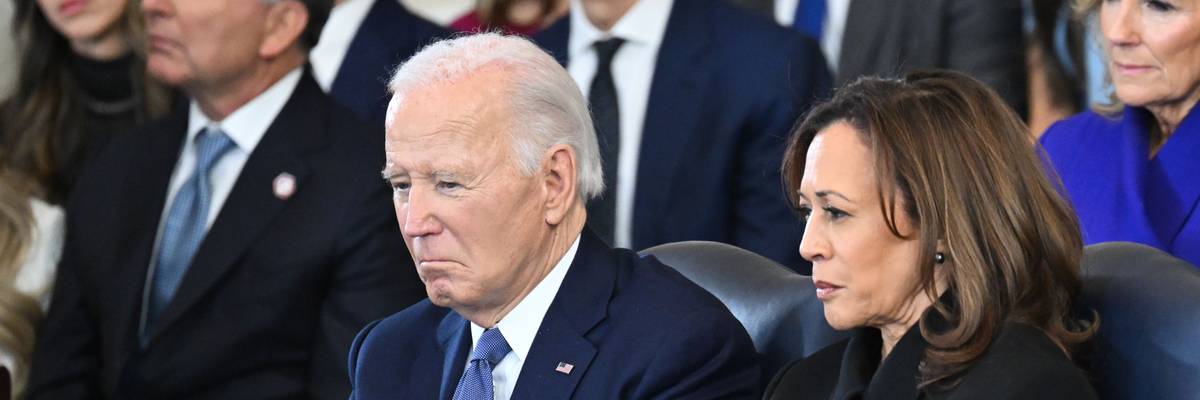
Joe Biden and Kamala Harris attended the inauguration ceremony of President Donald Trump on January 20, 2025.
Autopsy Says Corporate Capture, Support for Genocide Were Key Factors in Democrats' 2024 Disaster
"Harris and the Democratic Party leadership prioritized the agendas of corporate donors and gambled on a centrist path, while largely abandoning working-class, young, and progressive voters."
As the Democratic establishment slow-walks its own assessment of what went wrong in last year's elections, an outside autopsy released Thursday argues the party's failure to sufficiently appeal to and mobilize working-class voters as well as its complicity in Israel's genocide in Gaza were key factors behind the failure to prevent President Donald Trump from securing a second White House term.
The report, authored by journalist Christopher D. Cook and published by the progressive advocacy group RootsAction, argues there were five primary reasons for former Vice President Kamala Harris' loss to Trump:
- Harris' loss of nearly 7 million voters who backed Joe Biden in 2020;
- Biden's refusal to exit the top of the ticket until just months before the election;
- The Democratic Party's decision to prioritize courting so-called moderate Republicans and corporate donors over organizing working-class voters;
- Support for Israel's genocidal assault on Gaza; and
- The loss of young-voter support.
Cook acknowledges that certain "external factors" impacted the 2024 contest beyond the Democratic Party or the Harris campaign's control, including "immense special-interest spending to manipulate voters’ information and perceptions on social media platforms" such as Elon Musk's X and racism and sexism, which "certainly disadvantaged" the former vice president.
But ultimately, Harris' campaign and the leadership of the Democratic Party "bear responsibility for Trump’s return to the White House," the report says.
"This was a preventable disaster, but Harris and the Democratic Party leadership prioritized the agendas of corporate donors and gambled on a centrist path, while largely abandoning working-class, young, and progressive voters," Cook said in a statement.
The report places significant emphasis on the Harris campaign's fateful decision to openly appeal to Republican voters in the hope that some would abandon Trump—a strategy that Hillary Clinton pursued during her 2016 presidential bid, to disastrous effect.
Cook points to the Harris campaign's embrace of former Rep. Liz Cheney (R-Wyo.) as the most galling example of this strategy.
"Harris and Cheney—a Republican who had become a pariah in her own party—campaigned for several days together," the report observes. "On the campaign trail, they repeatedly hit high-minded themes about the threat that Donald Trump posed to American democracy, while scarcely speaking to voters’ more urgent concerns about the state of the economy."
The campaign's gamble that it could appeal to potential GOP swing voters while keeping the Democratic base intact "proved to be a huge mistake," the report says, arguing the approach muddied "Democrats’ message about economic inequality" while "consuming valuable campaign resources that should have been spent on a more robust base turnout operation."
The report cites a "glaring instance" in the critical battleground state of Pennsylvania, which Trump ended up winning by fewer than two percentage points:
As the New York Times reported, Harris campaign staffers in Pennsylvania were so concerned about poor outreach to Black and Latino voters in crucial areas of Philadelphia, they met secretly at a donut shop and formed a “rogue” voter turnout operation to reach these core Democratic constituents. In this clandestine operation, hastily conceived in the waning days of the campaign, members of Harris’s team set out to knock on the doors of as many Black and Latino voters as possible in a desperate dash to shore up Harris’ numbers among what should have been core constituencies.
The Harris campaign also received guidance and support from corporate interests and prominent billionaires, which Cook names as a "likely factor for why more working-class voters walked away from the Democrats."
"Due to these corporate influences, including from billionaire Mark Cuban and others, the Harris campaign avoided any bold policy proposals confronting corporate power, instead adopting 'marginal pro-business tweaks to the status quo that both her corporate and progressive allies agreed never coalesced into a clear economic argument,'" Cook wrote, citing the Times.
On Gaza, the postmortem notes that Harris "offered no substantive changes from Biden’s unpopular policies backing Israel," fueling a sharp drop-off in support among Arab Americans and young voters.
"Extensive polling suggests that Biden, and later Harris, could have inspired and mobilized these voters by campaigning on policies such as cancelling student debt, expanding healthcare access, curbing support for Israel’s siege of Gaza, and boldly promoting economic populist policies," the report says, pointing to the success of progressive ballot measures even in red states where Harris struggled.
In coming elections, the report concludes, Democrats must learn from their recent failures and embrace highly popular "economic populist policies"—from Medicare for All to higher corporate taxes to a long-overdue federal minimum wage hike—to build a lasting working-class coalition.
"The Democratic Party must show voters that it has a spine and can stand up to corporate and big-money interests," the report says.
We are at a crossroads
This country and this world are at a monumental crossroads. In a few short weeks, US voters will have an opportunity to beat back the forces of fascism and confront the billionaires who are rigging the economy, our media system, and our democracy, making it increasingly impossible for ordinary people to get by. We’re not just talking about the election. We’re talking about what must be done once these fascist elements are vanquished from power. We need a bolder set of solutions than what either major party has so far been willing to offer and a working-class movement ready to fight like hell for it. Trump didn't emerge from nowhere. The conditions that fueled MAGA authoritarianism were created by decades of radical neoliberal economic policies and a corrupt political system dominated by corporate interests. They slashed taxes on the super-rich, promising that the benefits would trickle down. They said giveaways to the corporate titans would make life more affordable for the rest of us. It was all bullshit. And when a bitter, betrayed populace searches for someone to blame, right-wing demagogues have little trouble finding scapegoats. People know when they're being lied to, but you won't hear any of this from the corporate media. Only independent journalism—powered and funded by people who believe in building a better world—can deliver truly trustworthy daily news. Our Fall Campaign is underway, and we need your help. To power our newsroom through the rest of the year, we need to raise $125,000 by midnight on October 31. So if you share our vision, please contribute whatever you can to sustain our work. |
As the Democratic establishment slow-walks its own assessment of what went wrong in last year's elections, an outside autopsy released Thursday argues the party's failure to sufficiently appeal to and mobilize working-class voters as well as its complicity in Israel's genocide in Gaza were key factors behind the failure to prevent President Donald Trump from securing a second White House term.
The report, authored by journalist Christopher D. Cook and published by the progressive advocacy group RootsAction, argues there were five primary reasons for former Vice President Kamala Harris' loss to Trump:
- Harris' loss of nearly 7 million voters who backed Joe Biden in 2020;
- Biden's refusal to exit the top of the ticket until just months before the election;
- The Democratic Party's decision to prioritize courting so-called moderate Republicans and corporate donors over organizing working-class voters;
- Support for Israel's genocidal assault on Gaza; and
- The loss of young-voter support.
Cook acknowledges that certain "external factors" impacted the 2024 contest beyond the Democratic Party or the Harris campaign's control, including "immense special-interest spending to manipulate voters’ information and perceptions on social media platforms" such as Elon Musk's X and racism and sexism, which "certainly disadvantaged" the former vice president.
But ultimately, Harris' campaign and the leadership of the Democratic Party "bear responsibility for Trump’s return to the White House," the report says.
"This was a preventable disaster, but Harris and the Democratic Party leadership prioritized the agendas of corporate donors and gambled on a centrist path, while largely abandoning working-class, young, and progressive voters," Cook said in a statement.
The report places significant emphasis on the Harris campaign's fateful decision to openly appeal to Republican voters in the hope that some would abandon Trump—a strategy that Hillary Clinton pursued during her 2016 presidential bid, to disastrous effect.
Cook points to the Harris campaign's embrace of former Rep. Liz Cheney (R-Wyo.) as the most galling example of this strategy.
"Harris and Cheney—a Republican who had become a pariah in her own party—campaigned for several days together," the report observes. "On the campaign trail, they repeatedly hit high-minded themes about the threat that Donald Trump posed to American democracy, while scarcely speaking to voters’ more urgent concerns about the state of the economy."
The campaign's gamble that it could appeal to potential GOP swing voters while keeping the Democratic base intact "proved to be a huge mistake," the report says, arguing the approach muddied "Democrats’ message about economic inequality" while "consuming valuable campaign resources that should have been spent on a more robust base turnout operation."
The report cites a "glaring instance" in the critical battleground state of Pennsylvania, which Trump ended up winning by fewer than two percentage points:
As the New York Times reported, Harris campaign staffers in Pennsylvania were so concerned about poor outreach to Black and Latino voters in crucial areas of Philadelphia, they met secretly at a donut shop and formed a “rogue” voter turnout operation to reach these core Democratic constituents. In this clandestine operation, hastily conceived in the waning days of the campaign, members of Harris’s team set out to knock on the doors of as many Black and Latino voters as possible in a desperate dash to shore up Harris’ numbers among what should have been core constituencies.
The Harris campaign also received guidance and support from corporate interests and prominent billionaires, which Cook names as a "likely factor for why more working-class voters walked away from the Democrats."
"Due to these corporate influences, including from billionaire Mark Cuban and others, the Harris campaign avoided any bold policy proposals confronting corporate power, instead adopting 'marginal pro-business tweaks to the status quo that both her corporate and progressive allies agreed never coalesced into a clear economic argument,'" Cook wrote, citing the Times.
On Gaza, the postmortem notes that Harris "offered no substantive changes from Biden’s unpopular policies backing Israel," fueling a sharp drop-off in support among Arab Americans and young voters.
"Extensive polling suggests that Biden, and later Harris, could have inspired and mobilized these voters by campaigning on policies such as cancelling student debt, expanding healthcare access, curbing support for Israel’s siege of Gaza, and boldly promoting economic populist policies," the report says, pointing to the success of progressive ballot measures even in red states where Harris struggled.
In coming elections, the report concludes, Democrats must learn from their recent failures and embrace highly popular "economic populist policies"—from Medicare for All to higher corporate taxes to a long-overdue federal minimum wage hike—to build a lasting working-class coalition.
"The Democratic Party must show voters that it has a spine and can stand up to corporate and big-money interests," the report says.
- 'The Truth Is Better Than Continuing to Lose': Petition Demands DNC Release Autopsy of 2024 Defeat | Common Dreams ›
- 'Why Wouldn't You Just Release It?': DNC Chair Confronted Over Buried 2024 Election Autopsy | Common Dreams ›
- Opinion | Establishment Democrats Still Don't Get Why They Lost in 2024 | Common Dreams ›
- Read It: The 192-Page Autopsy of the 2024 Election the DNC Didn't Want You To See | Common Dreams ›
- Opinion | Why the DNC 2024 Autopsy Is a Giant Turd | Common Dreams ›
- Author of DNC Autopsy Found Gaza Policy Hurt Harris in 2024—But Never Submitted Finding to Party Leadership | Common Dreams ›
As the Democratic establishment slow-walks its own assessment of what went wrong in last year's elections, an outside autopsy released Thursday argues the party's failure to sufficiently appeal to and mobilize working-class voters as well as its complicity in Israel's genocide in Gaza were key factors behind the failure to prevent President Donald Trump from securing a second White House term.
The report, authored by journalist Christopher D. Cook and published by the progressive advocacy group RootsAction, argues there were five primary reasons for former Vice President Kamala Harris' loss to Trump:
- Harris' loss of nearly 7 million voters who backed Joe Biden in 2020;
- Biden's refusal to exit the top of the ticket until just months before the election;
- The Democratic Party's decision to prioritize courting so-called moderate Republicans and corporate donors over organizing working-class voters;
- Support for Israel's genocidal assault on Gaza; and
- The loss of young-voter support.
Cook acknowledges that certain "external factors" impacted the 2024 contest beyond the Democratic Party or the Harris campaign's control, including "immense special-interest spending to manipulate voters’ information and perceptions on social media platforms" such as Elon Musk's X and racism and sexism, which "certainly disadvantaged" the former vice president.
But ultimately, Harris' campaign and the leadership of the Democratic Party "bear responsibility for Trump’s return to the White House," the report says.
"This was a preventable disaster, but Harris and the Democratic Party leadership prioritized the agendas of corporate donors and gambled on a centrist path, while largely abandoning working-class, young, and progressive voters," Cook said in a statement.
The report places significant emphasis on the Harris campaign's fateful decision to openly appeal to Republican voters in the hope that some would abandon Trump—a strategy that Hillary Clinton pursued during her 2016 presidential bid, to disastrous effect.
Cook points to the Harris campaign's embrace of former Rep. Liz Cheney (R-Wyo.) as the most galling example of this strategy.
"Harris and Cheney—a Republican who had become a pariah in her own party—campaigned for several days together," the report observes. "On the campaign trail, they repeatedly hit high-minded themes about the threat that Donald Trump posed to American democracy, while scarcely speaking to voters’ more urgent concerns about the state of the economy."
The campaign's gamble that it could appeal to potential GOP swing voters while keeping the Democratic base intact "proved to be a huge mistake," the report says, arguing the approach muddied "Democrats’ message about economic inequality" while "consuming valuable campaign resources that should have been spent on a more robust base turnout operation."
The report cites a "glaring instance" in the critical battleground state of Pennsylvania, which Trump ended up winning by fewer than two percentage points:
As the New York Times reported, Harris campaign staffers in Pennsylvania were so concerned about poor outreach to Black and Latino voters in crucial areas of Philadelphia, they met secretly at a donut shop and formed a “rogue” voter turnout operation to reach these core Democratic constituents. In this clandestine operation, hastily conceived in the waning days of the campaign, members of Harris’s team set out to knock on the doors of as many Black and Latino voters as possible in a desperate dash to shore up Harris’ numbers among what should have been core constituencies.
The Harris campaign also received guidance and support from corporate interests and prominent billionaires, which Cook names as a "likely factor for why more working-class voters walked away from the Democrats."
"Due to these corporate influences, including from billionaire Mark Cuban and others, the Harris campaign avoided any bold policy proposals confronting corporate power, instead adopting 'marginal pro-business tweaks to the status quo that both her corporate and progressive allies agreed never coalesced into a clear economic argument,'" Cook wrote, citing the Times.
On Gaza, the postmortem notes that Harris "offered no substantive changes from Biden’s unpopular policies backing Israel," fueling a sharp drop-off in support among Arab Americans and young voters.
"Extensive polling suggests that Biden, and later Harris, could have inspired and mobilized these voters by campaigning on policies such as cancelling student debt, expanding healthcare access, curbing support for Israel’s siege of Gaza, and boldly promoting economic populist policies," the report says, pointing to the success of progressive ballot measures even in red states where Harris struggled.
In coming elections, the report concludes, Democrats must learn from their recent failures and embrace highly popular "economic populist policies"—from Medicare for All to higher corporate taxes to a long-overdue federal minimum wage hike—to build a lasting working-class coalition.
"The Democratic Party must show voters that it has a spine and can stand up to corporate and big-money interests," the report says.
- 'The Truth Is Better Than Continuing to Lose': Petition Demands DNC Release Autopsy of 2024 Defeat | Common Dreams ›
- 'Why Wouldn't You Just Release It?': DNC Chair Confronted Over Buried 2024 Election Autopsy | Common Dreams ›
- Opinion | Establishment Democrats Still Don't Get Why They Lost in 2024 | Common Dreams ›
- Read It: The 192-Page Autopsy of the 2024 Election the DNC Didn't Want You To See | Common Dreams ›
- Opinion | Why the DNC 2024 Autopsy Is a Giant Turd | Common Dreams ›
- Author of DNC Autopsy Found Gaza Policy Hurt Harris in 2024—But Never Submitted Finding to Party Leadership | Common Dreams ›