SUBSCRIBE TO OUR FREE NEWSLETTER
Daily news & progressive opinion—funded by the people, not the corporations—delivered straight to your inbox.
5
#000000
#FFFFFF
To donate by check, phone, or other method, see our More Ways to Give page.
Daily news & progressive opinion—funded by the people, not the corporations—delivered straight to your inbox.
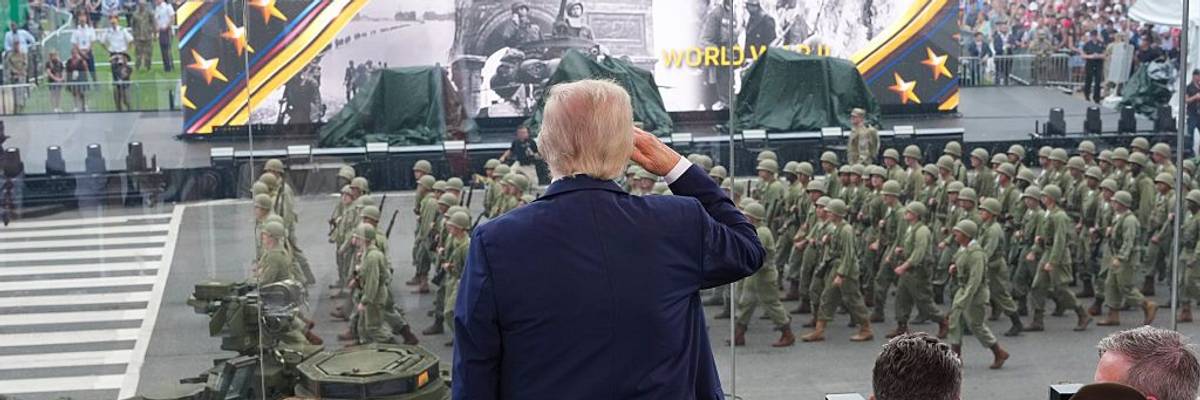
President Donald Trump stands and salutes troops during the celebration of the Army's 250th birthday on the National Mall on June 14, 2025 in Washington, DC.
Historian Greg Grandin argued that Trump's foreign policy will likely result in "more confrontation, more brinkmanship, more war."
Yale historian Greg Grandin believes that President Donald Trump's foreign policy is putting the US on a dangerous course that could lead to a new world war.
Writing in The New York Times on Monday, Grandin argued that the Trump administration seems determined to throw out the US-led international order that has been in place since World War II.
In its place, Grandin said, is "a vision of the world carved up into garrisoned spheres of competing influence," in which the US has undisputed control over the Western Hemisphere.
As evidence, he pointed to the Trump White House's recently published National Security Strategy that called for reviving the so-called Monroe Doctrine that in the past was used to justify US imperial aggression throughout Latin America, and that the Trump administration is using to justify its own military adventures in the region.
Among other things, Grandin said that the Trump administration has been carrying out military strikes against purported drug smuggling boats in the Caribbean and the Pacific Ocean, and has also been "meddling in the internal politics of Brazil, Argentina, and Honduras, issuing scattershot threats against Colombia and Mexico, menacing Cuba and Nicaragua, increasing its influence over the Panama Canal, and seizing an oil tanker off the coast of Venezuela."
Most ominously, Grandin said, is how the US Department of Defense has been "carrying out a military buildup in the Caribbean that is all but unprecedented in its scale and concentration of firepower, seemingly aimed at effecting regime change in Venezuela."
A large problem with dividing the globe into spheres controlled by major powers, Grandin continued, is that these powers inevitably come into violent conflict with one another.
Citing past statements and actions by the British Empire, Imperial Japan, and Nazi Germany, Grandin argued that "as the world marched into a second global war, many of its belligerents did so citing the Monroe Doctrine."
This dynamic is particularly dangerous in the case of Trump, who, according to Grandin, sees Latin America "as a theater of global rivalry, a place to extract resources, secure commodity chains, establish bulwarks of national security, fight the drug war, limit Chinese influence, and end migration."
The result of this policy shift, Grandin concluded, "will most likely be more confrontation, more brinkmanship, more war."
Dear Common Dreams reader, It’s been nearly 30 years since I co-founded Common Dreams with my late wife, Lina Newhouser. We had the radical notion that journalism should serve the public good, not corporate profits. It was clear to us from the outset what it would take to build such a project. No paid advertisements. No corporate sponsors. No millionaire publisher telling us what to think or do. Many people said we wouldn't last a year, but we proved those doubters wrong. Together with a tremendous team of journalists and dedicated staff, we built an independent media outlet free from the constraints of profits and corporate control. Our mission has always been simple: To inform. To inspire. To ignite change for the common good. Building Common Dreams was not easy. Our survival was never guaranteed. When you take on the most powerful forces—Wall Street greed, fossil fuel industry destruction, Big Tech lobbyists, and uber-rich oligarchs who have spent billions upon billions rigging the economy and democracy in their favor—the only bulwark you have is supporters who believe in your work. But here’s the urgent message from me today. It's never been this bad out there. And it's never been this hard to keep us going. At the very moment Common Dreams is most needed, the threats we face are intensifying. We need your support now more than ever. We don't accept corporate advertising and never will. We don't have a paywall because we don't think people should be blocked from critical news based on their ability to pay. Everything we do is funded by the donations of readers like you. When everyone does the little they can afford, we are strong. But if that support retreats or dries up, so do we. Will you donate now to make sure Common Dreams not only survives but thrives? —Craig Brown, Co-founder |
Yale historian Greg Grandin believes that President Donald Trump's foreign policy is putting the US on a dangerous course that could lead to a new world war.
Writing in The New York Times on Monday, Grandin argued that the Trump administration seems determined to throw out the US-led international order that has been in place since World War II.
In its place, Grandin said, is "a vision of the world carved up into garrisoned spheres of competing influence," in which the US has undisputed control over the Western Hemisphere.
As evidence, he pointed to the Trump White House's recently published National Security Strategy that called for reviving the so-called Monroe Doctrine that in the past was used to justify US imperial aggression throughout Latin America, and that the Trump administration is using to justify its own military adventures in the region.
Among other things, Grandin said that the Trump administration has been carrying out military strikes against purported drug smuggling boats in the Caribbean and the Pacific Ocean, and has also been "meddling in the internal politics of Brazil, Argentina, and Honduras, issuing scattershot threats against Colombia and Mexico, menacing Cuba and Nicaragua, increasing its influence over the Panama Canal, and seizing an oil tanker off the coast of Venezuela."
Most ominously, Grandin said, is how the US Department of Defense has been "carrying out a military buildup in the Caribbean that is all but unprecedented in its scale and concentration of firepower, seemingly aimed at effecting regime change in Venezuela."
A large problem with dividing the globe into spheres controlled by major powers, Grandin continued, is that these powers inevitably come into violent conflict with one another.
Citing past statements and actions by the British Empire, Imperial Japan, and Nazi Germany, Grandin argued that "as the world marched into a second global war, many of its belligerents did so citing the Monroe Doctrine."
This dynamic is particularly dangerous in the case of Trump, who, according to Grandin, sees Latin America "as a theater of global rivalry, a place to extract resources, secure commodity chains, establish bulwarks of national security, fight the drug war, limit Chinese influence, and end migration."
The result of this policy shift, Grandin concluded, "will most likely be more confrontation, more brinkmanship, more war."
Yale historian Greg Grandin believes that President Donald Trump's foreign policy is putting the US on a dangerous course that could lead to a new world war.
Writing in The New York Times on Monday, Grandin argued that the Trump administration seems determined to throw out the US-led international order that has been in place since World War II.
In its place, Grandin said, is "a vision of the world carved up into garrisoned spheres of competing influence," in which the US has undisputed control over the Western Hemisphere.
As evidence, he pointed to the Trump White House's recently published National Security Strategy that called for reviving the so-called Monroe Doctrine that in the past was used to justify US imperial aggression throughout Latin America, and that the Trump administration is using to justify its own military adventures in the region.
Among other things, Grandin said that the Trump administration has been carrying out military strikes against purported drug smuggling boats in the Caribbean and the Pacific Ocean, and has also been "meddling in the internal politics of Brazil, Argentina, and Honduras, issuing scattershot threats against Colombia and Mexico, menacing Cuba and Nicaragua, increasing its influence over the Panama Canal, and seizing an oil tanker off the coast of Venezuela."
Most ominously, Grandin said, is how the US Department of Defense has been "carrying out a military buildup in the Caribbean that is all but unprecedented in its scale and concentration of firepower, seemingly aimed at effecting regime change in Venezuela."
A large problem with dividing the globe into spheres controlled by major powers, Grandin continued, is that these powers inevitably come into violent conflict with one another.
Citing past statements and actions by the British Empire, Imperial Japan, and Nazi Germany, Grandin argued that "as the world marched into a second global war, many of its belligerents did so citing the Monroe Doctrine."
This dynamic is particularly dangerous in the case of Trump, who, according to Grandin, sees Latin America "as a theater of global rivalry, a place to extract resources, secure commodity chains, establish bulwarks of national security, fight the drug war, limit Chinese influence, and end migration."
The result of this policy shift, Grandin concluded, "will most likely be more confrontation, more brinkmanship, more war."