

SUBSCRIBE TO OUR FREE NEWSLETTER
Daily news & progressive opinion—funded by the people, not the corporations—delivered straight to your inbox.
5
#000000
#FFFFFF
To donate by check, phone, or other method, see our More Ways to Give page.
Daily news & progressive opinion—funded by the people, not the corporations—delivered straight to your inbox.
The bomb blasts that killed at least 76 people in Kampala on July 11, 2010, were a heinous attack on civilians and an assault on the basic tenet of the right to life, Human Rights Watch said today. Uganda and other regional governments should ensure that Somali refugee and Muslim communities are protected from potential reprisals or arbitrary targeting by law enforcement.
The two simultaneous bomb blasts hit an Ethiopian restaurant and a rugby club, where people had gathered to watch the World Cup final. Ali Mohamed Raghe, the spokesperson for the Somali Islamist armed group al-Shabaab, claimed responsibility for the bombings and threatened further attacks if Uganda and Burundi continue to supply troops to AMISOM, the African Union military force in Somalia that is backed by the United States, the United Nations, and the European Union.
"These bombings are an indefensible assault on the right to life" said Rona Peligal, Africa director at Human Rights Watch. "There is never any justification for such abhorrent attacks on civilians, and al-Shabaab should immediately stop targeting civilians in Somalia and the region."
Human Rights Watch has previously documented patterns of al-Shabaab attacks on civilians in Somalia, where the group is fighting the Transitional Federal Government. The Kampala bombings are the first time the insurgent group has claimed responsibility for an attack on civilians outside Somalia, although individuals aligned with al-Shabaab who are believed to have links to al Qaeda have been accused of deadly attacks on the US embassies in Kenya and Tanzania in 1998.
Concerns that al-Shabaab could strike outside of Somalia have increased over the past few months, and the attacks in Kampala may create further instability in an already-volatile region. Al-Shabaab has previously threatened attacks in Kenya, which borders Somalia and is host to more than 300,000 Somali refugees. It has also threatened attacks in another neighbor, Ethiopia, which intervened militarily in Somalia in 2006 to support the weak Somali transitional government.
Responses in the wake of the Kampala bombing, however, raise concerns that regional counterterrorism operations may adversely affect Somali refugees and Muslim communities already vulnerable to abuses from private citizens or host government security forces.
Human Rights Watch received credible reports that at least one person of Eritrean descent in Kampala was allegedly beaten by unknown assailants since the July 11 bombing and required medical treatment. Others from the Horn of Africa, including Somalis and Eritreans, have faced threats since the bombings. Recognizing the potential for reprisals, on July 14 President Yoweri Museveni made a welcome statement cautioning Ugandans not to collectively blame Somalis for the bombing.
Human Rights Watch urges the Ugandan government and other regional governments to ensure that all law enforcement operations are conducted in full accordance with international human rights standards.
"Understandably, police in Uganda and the region will be under immense pressure to bring those responsible for these horrific attacks to justice," Peligal said. "But authorities in the region also need to make sure that vulnerable refugee and Muslim communities are protected from reprisals - whether from private citizens or security forces - and that they strongly condemn such acts."
Human Rights Watch has documented serious abuses, including torture and extrajudicial executions, by Uganda's lead counterterrorism operatives, the Joint Anti-Terrorism Task Force. The task force, which draws members from the military, the police, and the intelligence organizations, routinely detains suspects for long periods of time without charge.
Most victims of these abuses are allegedly affiliates or members of a Ugandan Muslim rebel group, the Allied Democratic Forces, currently based in Congo. Ugandan police have claimed that the Allied Democratic Forces were possibly involved in the July 11 bombing, but the evidence for this allegation is unclear.
Background
Harakat al-Shabaab al-Mujahideen, also known simply as al-Shabaab ("the youth" in Arabic), is a Somali Islamist group that began as the military offshoot of the Islamic Courts Union, a coalition that controlled large parts of southern Somalia in late 2006. In December 2006, Ethiopian troops intervened in Somalia to support the Transitional Federal Government but the conflict intensified, with all parties committing serious violations of the laws of war, including indiscriminate attacks on civilians. Ethiopian forces withdrew from Mogadishu in January 2009.
Some of al-Shabaab's leaders and affiliates are allegedly linked to al-Qaeda. The United States, the EU, and governments in the region have expressed alarm about the group's expanding influence in Somalia. It is the most powerful single armed faction in Somalia, controlling more territory in south-central Somalia than any other group.
Human Rights Watch is one of the world's leading independent organizations dedicated to defending and protecting human rights. By focusing international attention where human rights are violated, we give voice to the oppressed and hold oppressors accountable for their crimes. Our rigorous, objective investigations and strategic, targeted advocacy build intense pressure for action and raise the cost of human rights abuse. For 30 years, Human Rights Watch has worked tenaciously to lay the legal and moral groundwork for deep-rooted change and has fought to bring greater justice and security to people around the world.

“There’s a new kind of brazenness in declaring an intent to commit unlawful attacks,” said a researcher for Human Rights Watch. “It appears impunity has emboldened the Israeli military."
Doctors in Lebanon are warning that the Israeli military appears to be waging a campaign of deliberate destruction on their country's healthcare system.
In an interview with The Associated Press published Monday, Sidon-based surgeon Dr. Mohammed Ziara, who previously worked in Gaza City, said that he believes Israel is trying to inflict the same kind of damage on the Lebanese healthcare system that it inflicted in Gaza, when it regularly bombed hospitals and other healthcare facilities.
“I’ve lived this before,” Ziara told the AP, referring to Israel's attack on Gaza that has killed more than 70,000 Palestinians. "I cannot go back to Gaza now. But I can be here, in Lebanon."
The AP noted that Israel is justifying bombings of Lebanese hospitals by claiming that Hezbollah is using them as headquarters for storing weapons and plotting attacks. Israel made the same claims about Hamas militants being stationed in Gaza hospitals.
"Israel has increasingly targeted Lebanese first responders and medical centers, forcing several hospitals to evacuate," the AP reported.
Human Rights Watch researcher Ramzi Kaiss told the AP that, while Israel has launched attacks on Lebanon before, the country now seems even more willing to attack civilian infrastructure than in the past.
“There’s a new kind of brazenness in declaring an intent to commit unlawful attacks,” Kaiss explained. “It appears impunity has emboldened the Israeli military."
Human rights activists for the last several weeks have been trying to draw attention to Israel's attacks on Lebanese healthcare.
Kristine Beckerle, deputy regional director for the Middle East and North Africa at Amnesty International, said in March that Israel is using "the same deadly playbook it used in 2024 in Lebanon to kill dozens of health workers and devastate healthcare services."
Beckerle also slammed Israel's justifications for bombing healthcare infrastructure.
"Throwing out accusations claiming that healthcare facilities and ambulances are being used for military purposes without providing any evidence," Beckerle said, "does not justify treating hospitals, medical facilities or medical transport as battlefields or treating doctors and paramedics as targets. Under international humanitarian law parties to a conflict must ensure to distinguish between military objectives and civilian objects."
Kenneth Roth, former executive director of Human Rights Watch, recently flagged reports from Lebanese healthcare workers who "say Israeli bombing has deliberately targeted medical workers and facilities in southern Lebanon" in "a systematic effort to make the area unlivable."

"We stand firmly against war crimes, deliberate starvation, ethnic cleansing, genocide, and ecocide," said one Greenpeace campaigner.
Greenpeace International said Monday that the MY Arctic Sunrise—one of its largest and most storied vessels—will be taking part in the upcoming Global Sumud Flotilla relaunch in order "to directly challenge Israel’s ongoing blockade of aid to Gaza."
The green group said the Arctic Sunrise, an icebreaker that's been part of Greenpeace's fleet since 1995, will be "sailing alongside more than 70 vessels and over 1,000 participants" in the second Global Sumud Flotilla, which is scheduled to set sail from Barcelona on April 12, with subsequent stops in Syracuse, Italy, and Lerapetra, Greece en route to Gaza.
Greenpeace said the Arctic Sunrise "is providing operational and technical support" for the flotilla.
“The devastation inflicted on Gaza has become a dangerous doctrine of impunity, now spreading to Lebanon through relentless destruction and deepening human suffering," Greenpeace Middle East and North Africa executive director Ghiwa Nakat said in a statement. "The Greenpeace ship is joining this people-led mission to demand safe, unhindered humanitarian access to Gaza and to challenge the illegal blockade that continues to devastate civilian life."
"We stand firmly against war crimes, deliberate starvation, ethnic cleansing, genocide, and ecocide," Nakat added. "This flotilla is a call to governments around the world to end their silence, protect humanitarian action, and act with urgency and principle to uphold international law, human dignity, and justice.”
Global Sumud Flotilla organizers said the spring 2026 mission will focus on specialized medical care, with more than 1,000 healthcare professionals aiming to deliver lifesaving medicines and equipment to Gaza, where 29 months of Israeli war and siege have left the Palestinian exclave's medical infrastructure in utter ruins.
Last year, dozens of boats carrying hundreds of activists from over 40 nations took part in the last Global Sumud Flotilla—sumud means “perseverance” in Arabic—as it attempted to break Israel’s naval blockade and deliver desperately needed humanitarian aid including food, medicines, and baby formula to starving Gazans amid a growing famine.
Israeli forces intercepted and seized the flotilla vessels in international waters in early October, arresting all aboard the boats and temporarily jailing them in Israel, where some including Swedish climate campaigner Greta Thunberg said they were physically and psychologically abused by their captors.
The Freedom Flotilla Coalition has made numerous attempts to break Israel’s blockade by sea, all of which ended in more or less the same way. In 2010, Israeli forces raided one of the first convoys carrying humanitarian aid to Gaza by sea. The Israeli attackers killed nine volunteers aboard the MV Mavi Marmara, including Turkish-American teenager Furkan Doğan.
Numerous experts and the entire United Nations Security Council except the United States have called the starvation of Gaza deliberately created by Israel, whose prime minister, Benjamin Netanyahu, and former defense minister, Yoav Gallant, are wanted by the International Criminal Court for alleged crimes against humanity and war crimes, including murder and forced starvation.
Israel—whose assault and siege of Gaza have left more than 250,000 Palestinians dead or wounded—is also facing a genocide case in the International Court of Justice filed by South Africa and formally supported by nearly 20 countries, including Spain, the mission's country of departure.
“At this time of escalating war, triggered by US and Israeli militaries and cascading into a cycle of destruction and pain across the Middle East, we are honored to answer the call to join the Sumud Flotilla," Greenpeace Spain executive director Eva Saldaña said Monday. "While world governments have lacked the courage and conviction to uphold international law and their obligation to prevent genocide in Gaza, the Sumud Flotilla has been a shining light of humanitarian solidarity and a symbol of hope in action.”
Global Sumud Flotilla leaders applauded Greenpeace's decision to participate in its spring mission.
“Greenpeace’s history of defending the seas, confronting injustice, and taking action in defense of life makes them a powerful addition to our 2026 spring mission," Global Sumud Flotilla Steering Committee member Susan Abdullah said Monday. "We sail together in the same direction, with a shared determination to help break Israel’s illegal siege of Gaza.”
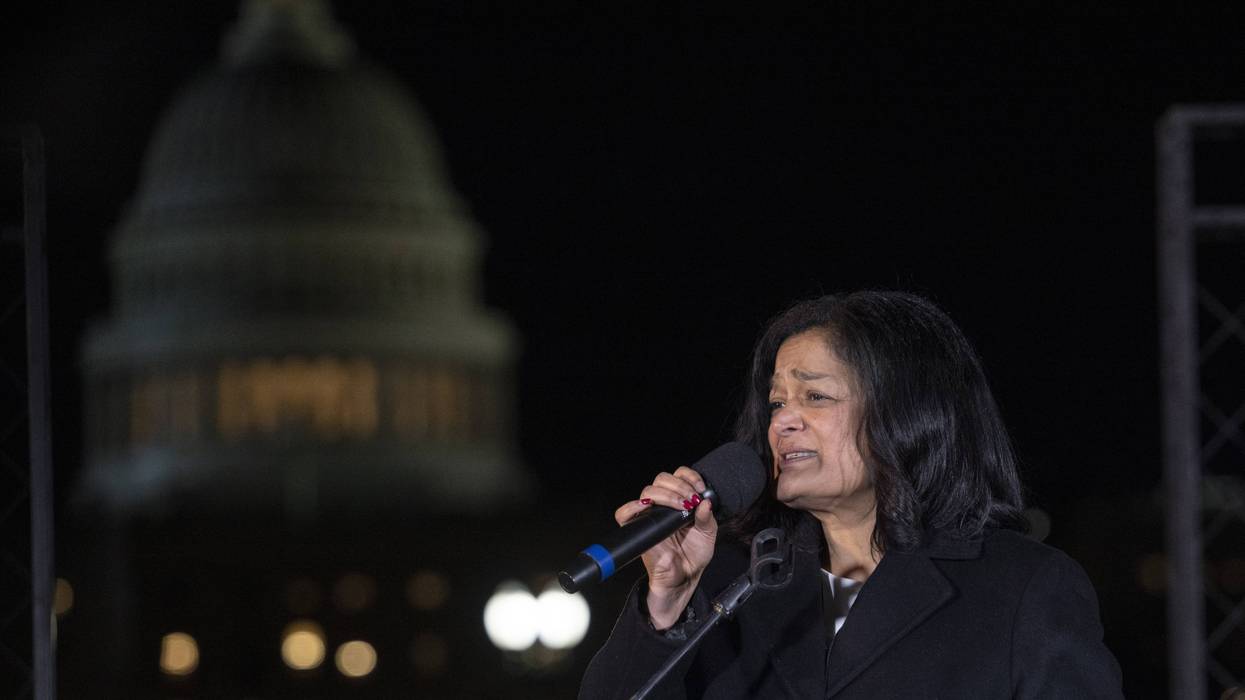
Reps. Pramila Jayapal and Jonathan Jackson described Trump's blockade of the island as "effectively an economic bombing of the infrastructure of the country that has produced permanent damage."
After returning from a delegation trip to Cuba, US Reps. Pramila Jayapal and Jonathan Jackson on Sunday renewed calls for President Donald Trump to end his illegal fuel blockade of the island, which they described as "cruel collective punishment."
The pair of progressive lawmakers were the first to visit the island since Trump imposed the blockade in January in a bid to cripple the island's economy as part of an effort to overthrow its government, or, in the president's words, "take" the island.
Almost no oil has been allowed to enter for more than three months, which Jayapal (D-Wash.) and Jackson (D-Ill.) described as "effectively an economic bombing of the infrastructure of the country—that has produced permanent damage."
"We witnessed firsthand premature babies in incubators, weighing just two pounds, who are at tremendous risk because their ventilators and incubators cannot function without electricity," they said. "Children cannot attend school because there is no fuel for them or their teachers to travel. Cancer patients cannot receive lifesaving treatments because of a lack of medications."
"There is a water shortage because there is little electricity to pump water," they continued. "Businesses have closed. Families cannot keep food refrigerated, and food production on the island has dropped to just 10% of the people’s needs."
The oil blockade is an escalation of more than 60 years of punitive economic warfare by the US against Cuba, imposed through an embargo that has limited Cuba's ability to trade with the rest of the world and hampered its economic development to the tune of trillions of dollars.
Jayapal had previously visited Cuba in February 2024 on a trip with other members of the Congressional Progressive Caucus. Since her last time in Havana, she said, "There's such a big difference."
"So many of the streets of this beautiful city were deserted. People were already lining up for food," she said in an interview with the Cuban outlet Belly of the Beast. "I don't think that any American wants to create this kind of devastation for the Cuban children, for the babies, for the moms, for the people."
She said the phrase "collective punishment," while accurate, almost felt "too technocratic" to describe what she witnessed.
"We are strangling the Cuban people," Jayapal said.
The United Nations General Assembly has voted 33 times to call for the end of the embargo since 1993.
In February, a group of UN experts condemned Trump's fuel blockade as "a serious violation of international law and a grave threat to a democratic and equitable international order" and an "extreme form of unilateral economic coercion."
Cuban President Miguel Diaz-Canel has acknowledged having talks with Trump in recent weeks in order to negotiate an end to the embargo and threats of further aggression.
The Cuban government has taken actions that the lawmakers described as "signs that Cuba is changing." It has released more than 2,000 prisoners, announced economic reforms to allow more involvement of American businesses, and allowed the FBI to investigate Cuban troops' lethal shooting of five armed Cuban exiles as they approached in a speedboat in February.
While hardly softening his threats to Cuba, which he continued to insist was “finished,” Trump last week allowed a Russian oil tanker to dock on the island without incident and deliver around 700,000 barrels of much-needed oil.
But the lawmakers said it's not enough. Jackson, noting the "generosity" of Cuba as a provider of medical treatment around the world, said the US must allow food and fuel to be allowed to return to the island "so that the Cuban people can continue to rise."
Jayapal said that when they spoke with Diaz-Canel, he expressed "a real desire for a real negotiation" with the US, but that he also expressed "sadness" and "frustration" at what was being done to his country.
"These kinds of sanctions, embargoes, they don't get to the government. They hurt the people," Jayapal said. "Perhaps the American people don't understand the violence of an economic sanction versus the violence of dropping a bomb."
Jackson—whose father, the late Rev. Jesse Jackson, took many trips to Cuba during his life—described America's treatment of the nation’s people as a “crucifixion.”
"Americans would not want to see what I saw in that hospital," Jackson said, describing a malnourished baby named Alejandro, whom he said was "fighting for life."
Due to the intermittent power surges caused by the lack of fuel, he said, "We didn't know when the incubator was going to start working."
"That's an act of war," he said. "We have to put an end to that."
He added that Secretary of State Marco Rubio, himself a Cuban-American who has long sought to bring about regime change, "should come before the Congress and explain his policy."
In late March, Jayapal introduced legislation that would block Trump from conducting military action against Cuba without congressional authorization. She said she'd continue to push for bills to block Trump from launching a war and to push for sanctions relief.
The Trump administration has portrayed its economic warfare as part of an effort to "liberate" the Cuban people from an oppressive government.
But the lawmakers, who met with wide swaths of Cuban society—including business and religious leaders, humanitarian groups, and civil society organizations—said that "Cubans across the political spectrum," including anti-government dissidents, expressed similar feelings.
"Across all sectors, there is agreement," they said. "This illegal blockade must end immediately."