SUBSCRIBE TO OUR FREE NEWSLETTER
Daily news & progressive opinion—funded by the people, not the corporations—delivered straight to your inbox.
5
#000000
#FFFFFF
To donate by check, phone, or other method, see our More Ways to Give page.
Daily news & progressive opinion—funded by the people, not the corporations—delivered straight to your inbox.
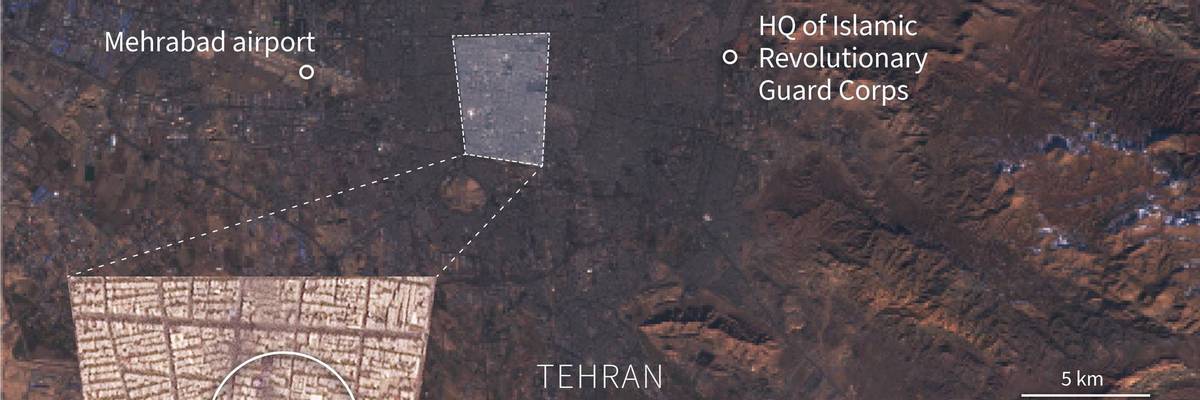
An infographic shows a map of Tehran, zooming in on the compound of Iranian Supreme Leader Ayatollah Ali Khamenei, who was killed in a US-Israeli operation on February 28, 2026.
The decision "will make it much more difficult to monitor US-Israeli bombing there, which seems to be the point," said one human rights campaigner.
The satellite firm Planet Labs told customers, including major news outlets, that it was acting on the Trump administration's request as it announced it was implementing "an indefinite withhold of imagery" in Iran and across the Middle Eastern countries where the widening conflict started by the US and Israel is unfolding.
The Saturday announcement, said UK rights campaigner Sarah Wilkinson, was a sign that images of the war will be censored "to hide the truth."
Planet Labs sent an email to journalists who have regularly used the company's satellite images to report on the US-Israeli bombing of Iran and Iran's retaliatory actions on Saturday, saying that after receiving a request from the US government, it was "moving to a managed access model... and releasing imagery on a case-by-case basis and for urgent, mission-critical requirements or in the public interest."
Washington Post reporter Evan Hill suggested the announcement would limit reporters' access to information from "one of the most important US-based commercial satellite imagery providers on whom most media outlets rely."
The announcement comes as Iran's military capabilities have reportedly exceeded US expectations, with US intelligence reporting Iran has retained many of its missile and mobile launchers and casting doubt on the Pentagon's claims that the US is severely diminishing Iran's missile stockpile.
The White House's request for a suspension of satellite imagery was the latest sign that "Trump’s war is going swimmingly," said podcast host Mark Ames sardonically.
It also coincided with multiple threats over the weekend from President Donald Trump, who said this coming Tuesday would be "Power Plant Day, and Bridge Day, all wrapped up in one"—with increased attacks on Iran's civilian infrastructure unless Iran agrees to a deal on Monday.
A major bridge was destroyed by the US on Saturday, while Israeli forces bombed a significant petrochemical complex, reportedly sending pollution into the surrounding city. At least 13 people were killed in the two attacks combined. A projectile that struck the vicinity of the Bushehr Nuclear Power Plant also killed at least one person and raised concerns about a larger attack, which "could trigger a nuclear accident, with health impacts that would devastate generations," as World Health Organization Director-General Tedros Adhanom Ghebreyesus said.
Kenneth Roth, former executive director of Human Rights Watch, said the Trump administration's demand for satellite images to be withheld "will make it much more difficult to monitor US-Israeli bombing there, which seems to be the point."
Data and imagery collected starting on March 9 will be withheld by Planet Labs. The company previously instituted a 14-day delay on the release of satellite images to ensure they would not be "leveraged" by "adversarial actors."
Also on Saturday, Al Jazeera reported that Israeli soldiers had "destroyed all of the CCTV cameras" around the United Nations Interim Force in Lebanon, a mission in the southern part of the country where three peacekeepers were wounded in a blast on Friday and several others have been killed since early March, including some by Israeli fire.
Dear Common Dreams reader, It’s been nearly 30 years since I co-founded Common Dreams with my late wife, Lina Newhouser. We had the radical notion that journalism should serve the public good, not corporate profits. It was clear to us from the outset what it would take to build such a project. No paid advertisements. No corporate sponsors. No millionaire publisher telling us what to think or do. Many people said we wouldn't last a year, but we proved those doubters wrong. Together with a tremendous team of journalists and dedicated staff, we built an independent media outlet free from the constraints of profits and corporate control. Our mission has always been simple: To inform. To inspire. To ignite change for the common good. Building Common Dreams was not easy. Our survival was never guaranteed. When you take on the most powerful forces—Wall Street greed, fossil fuel industry destruction, Big Tech lobbyists, and uber-rich oligarchs who have spent billions upon billions rigging the economy and democracy in their favor—the only bulwark you have is supporters who believe in your work. But here’s the urgent message from me today. It's never been this bad out there. And it's never been this hard to keep us going. At the very moment Common Dreams is most needed, the threats we face are intensifying. We need your support now more than ever. We don't accept corporate advertising and never will. We don't have a paywall because we don't think people should be blocked from critical news based on their ability to pay. Everything we do is funded by the donations of readers like you. When everyone does the little they can afford, we are strong. But if that support retreats or dries up, so do we. Will you donate now to make sure Common Dreams not only survives but thrives? —Craig Brown, Co-founder |
The satellite firm Planet Labs told customers, including major news outlets, that it was acting on the Trump administration's request as it announced it was implementing "an indefinite withhold of imagery" in Iran and across the Middle Eastern countries where the widening conflict started by the US and Israel is unfolding.
The Saturday announcement, said UK rights campaigner Sarah Wilkinson, was a sign that images of the war will be censored "to hide the truth."
Planet Labs sent an email to journalists who have regularly used the company's satellite images to report on the US-Israeli bombing of Iran and Iran's retaliatory actions on Saturday, saying that after receiving a request from the US government, it was "moving to a managed access model... and releasing imagery on a case-by-case basis and for urgent, mission-critical requirements or in the public interest."
Washington Post reporter Evan Hill suggested the announcement would limit reporters' access to information from "one of the most important US-based commercial satellite imagery providers on whom most media outlets rely."
The announcement comes as Iran's military capabilities have reportedly exceeded US expectations, with US intelligence reporting Iran has retained many of its missile and mobile launchers and casting doubt on the Pentagon's claims that the US is severely diminishing Iran's missile stockpile.
The White House's request for a suspension of satellite imagery was the latest sign that "Trump’s war is going swimmingly," said podcast host Mark Ames sardonically.
It also coincided with multiple threats over the weekend from President Donald Trump, who said this coming Tuesday would be "Power Plant Day, and Bridge Day, all wrapped up in one"—with increased attacks on Iran's civilian infrastructure unless Iran agrees to a deal on Monday.
A major bridge was destroyed by the US on Saturday, while Israeli forces bombed a significant petrochemical complex, reportedly sending pollution into the surrounding city. At least 13 people were killed in the two attacks combined. A projectile that struck the vicinity of the Bushehr Nuclear Power Plant also killed at least one person and raised concerns about a larger attack, which "could trigger a nuclear accident, with health impacts that would devastate generations," as World Health Organization Director-General Tedros Adhanom Ghebreyesus said.
Kenneth Roth, former executive director of Human Rights Watch, said the Trump administration's demand for satellite images to be withheld "will make it much more difficult to monitor US-Israeli bombing there, which seems to be the point."
Data and imagery collected starting on March 9 will be withheld by Planet Labs. The company previously instituted a 14-day delay on the release of satellite images to ensure they would not be "leveraged" by "adversarial actors."
Also on Saturday, Al Jazeera reported that Israeli soldiers had "destroyed all of the CCTV cameras" around the United Nations Interim Force in Lebanon, a mission in the southern part of the country where three peacekeepers were wounded in a blast on Friday and several others have been killed since early March, including some by Israeli fire.
The satellite firm Planet Labs told customers, including major news outlets, that it was acting on the Trump administration's request as it announced it was implementing "an indefinite withhold of imagery" in Iran and across the Middle Eastern countries where the widening conflict started by the US and Israel is unfolding.
The Saturday announcement, said UK rights campaigner Sarah Wilkinson, was a sign that images of the war will be censored "to hide the truth."
Planet Labs sent an email to journalists who have regularly used the company's satellite images to report on the US-Israeli bombing of Iran and Iran's retaliatory actions on Saturday, saying that after receiving a request from the US government, it was "moving to a managed access model... and releasing imagery on a case-by-case basis and for urgent, mission-critical requirements or in the public interest."
Washington Post reporter Evan Hill suggested the announcement would limit reporters' access to information from "one of the most important US-based commercial satellite imagery providers on whom most media outlets rely."
The announcement comes as Iran's military capabilities have reportedly exceeded US expectations, with US intelligence reporting Iran has retained many of its missile and mobile launchers and casting doubt on the Pentagon's claims that the US is severely diminishing Iran's missile stockpile.
The White House's request for a suspension of satellite imagery was the latest sign that "Trump’s war is going swimmingly," said podcast host Mark Ames sardonically.
It also coincided with multiple threats over the weekend from President Donald Trump, who said this coming Tuesday would be "Power Plant Day, and Bridge Day, all wrapped up in one"—with increased attacks on Iran's civilian infrastructure unless Iran agrees to a deal on Monday.
A major bridge was destroyed by the US on Saturday, while Israeli forces bombed a significant petrochemical complex, reportedly sending pollution into the surrounding city. At least 13 people were killed in the two attacks combined. A projectile that struck the vicinity of the Bushehr Nuclear Power Plant also killed at least one person and raised concerns about a larger attack, which "could trigger a nuclear accident, with health impacts that would devastate generations," as World Health Organization Director-General Tedros Adhanom Ghebreyesus said.
Kenneth Roth, former executive director of Human Rights Watch, said the Trump administration's demand for satellite images to be withheld "will make it much more difficult to monitor US-Israeli bombing there, which seems to be the point."
Data and imagery collected starting on March 9 will be withheld by Planet Labs. The company previously instituted a 14-day delay on the release of satellite images to ensure they would not be "leveraged" by "adversarial actors."
Also on Saturday, Al Jazeera reported that Israeli soldiers had "destroyed all of the CCTV cameras" around the United Nations Interim Force in Lebanon, a mission in the southern part of the country where three peacekeepers were wounded in a blast on Friday and several others have been killed since early March, including some by Israeli fire.