

SUBSCRIBE TO OUR FREE NEWSLETTER
Daily news & progressive opinion—funded by the people, not the corporations—delivered straight to your inbox.
5
#000000
#FFFFFF
To donate by check, phone, or other method, see our More Ways to Give page.
Daily news & progressive opinion—funded by the people, not the corporations—delivered straight to your inbox.

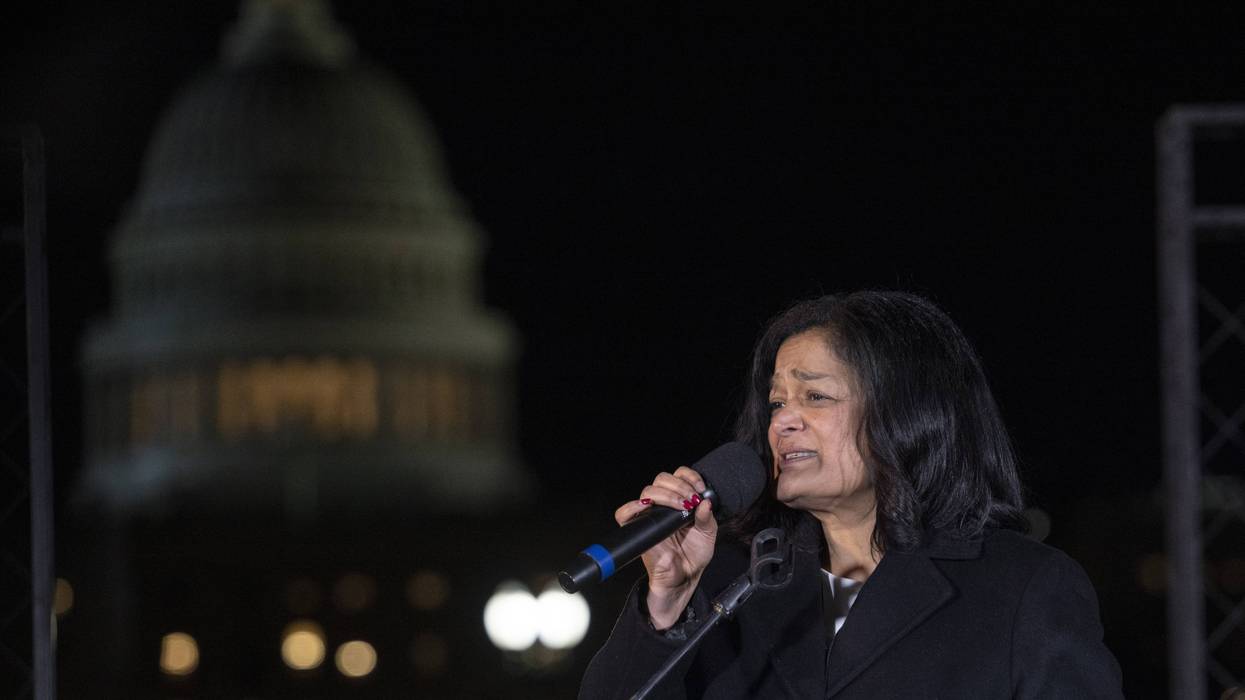
“May we not remain silent at a time of injustice and what feels like a quiet genocide on the Cuban people. We will end this blockade. It’s the responsibility of Congress to do its darn job to end it,” said Rep. Delia Ramirez. It is also the responsibility of all people of conscience
On September 2, 2026, Democratic Congresswomen Delia Ramírez of Illinois and Ilhan Omar of Minnesota hosted a shadow hearing in Congress on “Breaking the Blockade: Reassessing the Moral and Legal Failures of US-Cuba Policy.” A shadow hearing, called by the minority party, has all the formalities of an official hearing of Congress. Four distinguished witnesses gave testimony about the current state of life in Cuba under the oil blockade imposed by the Trump administration in January, and additional coercive measures that have been steadily imposed since then.
Dr. Tania Zakrison of the University of Chicago Medical Center described a “humanitarian catastrophe” due to cumbersome licensing and state overcompliance with sanctions, which mean that supplies are not available to prevent loss of limbs in diabetes patients, for example, and that children and cancer patients are dying due to lack of medicines. The lack of oil to fuel the electrical grid and pump water has caused a severe water shortage. “One-third of the population now has no water at all and are digging into the ground to drink muddy, untreated water,” said Dr. Zakrison. This, coupled with a lack of supplies such as IV fluid bags, is contributing to the recent doubling of infant mortality; research clearly attributes the causality of thousands of excess child deaths to the blockade. Food production is down 60% since January. Doctors “are bearing witness to the preventable deaths that we in the US are causing.”
Rev. Dr. Robert Turner of Empowerment Temple in Baltimore, Maryland visited Cuba in July: “What I found was not a hostile, defeated, nor broken people. I found peaceful, loving, resilient, ingenious people surviving decades of a US embargo and now a blockade that has turned survival itself into a daily act of will.” Our government “has decided that disagreement over the political and economic system justifies collective punishment. That is more than reprehensible,” said Rev. Turner. “It is sinfully wicked and an abuse of the power God has allowed America to possess… What I saw was a constructed crisis, suffering manufactured by policy—our policy.”
Attorney Suzanne Adely, president of the National Lawyer’s Guild, listed several ways in which the US blockade of Cuba violates international law and is repeatedly condemned by the international community. Yet it escalates and is now accompanied by threats of illegal US military aggression. She stated: “The US justification—that Cuba poses an ‘extraordinary threat’ to national security—is legally untenable. A small island subjected to six decades of economic warfare cannot credibly threaten the United States. Likewise, Cuba’s designation as a 'State Sponsor of Terrorism' is arbitrary and politically motivated. It contradicts objective counter-terrorism criteria and ignores documented violations by other states, undermining the credibility of the list itself.”
“We have to talk about Cuba every single day until it becomes part of our algorithm."
Ms. Adely indicated that while Cuba is under siege and being denied the right to sovereignty, the US is arguably committing crimes against humanity and possibly even genocide.
Felix Sharpe Caballero, a Cuban-American living in Detroit who frequently visits family on the island, said: “I testify at great peril. There is a lot of patent hostility in the Cuban-American community. But to be silent, would be a betrayal.”
Caballero continued: “The injustices perpetrated on the Cuban people today have reached the point, quite frankly, of genocide. We are using hunger, lack of medicine, electricity to cook and draw water, food, and basic hygiene products… on the Cuban people to achieve the economic overthrow of the Cuban government. There are 7,000 containers sitting across the world that are not being delivered to Cuba because of State Department activity. The United States of America has been fighting a proxy war on behalf of the Cuban American aristocracy in South Florida.”
Mr. Caballero has learned from his physician cousin in Havana what happens to babies in the NICU when the power goes out. As his voice cracked, he indicated that “some of those babies are not going to recover when the power comes back on.”
With six other members of her Progressive Caucus in attendance, including Reps. Pramila Jayapal (D-Wash.), Maxine Dexter (D-Ore.), Jonathan Jackson (D-Ore.), Chuy Garcia (D-Ill.), Rashida Tlaib (D-Mich.), and Omar, Congresswoman Ramírez concluded the session by saying, “This shadow hearing is just the beginning.” She urged the American people to raise the profile of this issue. “We have to talk about Cuba every single day until it becomes part of our algorithm.” Ramírez vowed to keep pressuring her colleagues to pass three key pieces of legislation:
Congresswoman Ramírez’s concluding words were: “May we not remain silent at a time of injustice and what feels like a quiet genocide on the Cuban people. We will end this blockade. It’s the responsibility of Congress to do its darn job to end it.”
It is also the responsibility of all people of conscience to make sure that happens.
A video recording of the shadow hearing can be found here.
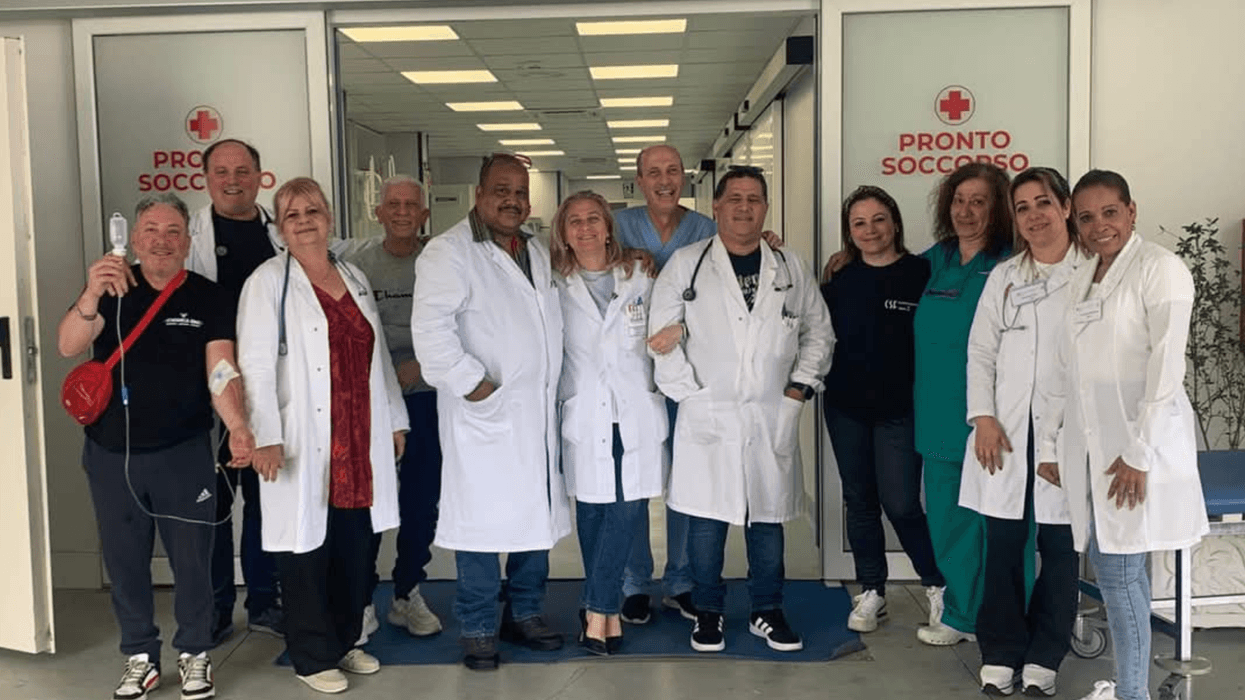
"Italy is indebted to Cuba," the letter states. "Every day of silence has a cost in human lives."
As of Wednesday, more than 8,000 Italian medical and scientific professionals have signed an open letter acknowledging their indebtedness to Cuban doctors and condemning the tightening of the 65-year US embargo on Cuba by President Donald Trump as he threatens "take" the island.
"Over the decades, Cuba has built a health system that was considered an international model, capable of guaranteeing universal access to care even in limited resource conditions. Since 1963, more than 600,000 Cuban health workers have served in more than 160 countries, including Italy," states the letter addressed to Italian Prime Minister Giorgia Meloni and Health Minister Orazio Schillaci.
"That system is currently in a state of collapse," the letter continues. "Survival in childhood cancers has fallen from 80% to 65% due to the lack of first-line drugs."
The publication notes that "96,000 people—almost 1% of the population—including 11,000 children are on the waiting list for surgery. If the situation does not change, the list could affect 160,000 patients by the end of 2026. Over 300 pediatric surgeries per week are compromised by shortages of drugs, oxygen, anesthetics, and consumables."
"The crisis has its roots in a combination of factors that have progressively worsened," the letter continues. "The tightening of the economic embargo during the first Trump administration, Covid-19, and, since January 2026, the near-total blockade of energy supplies following the Venezuelan crisis have deprived the island of fuel, electricity, and access to international drug and medical device markets."
A report published in April by researchers at the Center for Economic Policy and Research confirmed an “unprecedented increase” in Cuba’s infant mortality rate, which soared 148% between 2018 and 2025.
Report co-author Joe Sammut said that “the blockade has had a particularly dire effect on Cuba’s healthcare infrastructure, with frequent power outages" exacerbated by the US oil blockade "interrupting the use of critical equipment for the treatment of patients, including incubators for premature babies, and ventilators to help sick newborns breathe."
The United Nations General Assembly has overwhelmingly condemned the broader US embargo—which Cuba’s government says has cost the island's economy more than $1 trillion over seven decades—33 times.
"The collapse of a health system is not just a local tragedy: It is a violation of fundamental human rights that requires a response from the global community, beyond any political assessment of the Cuban regime," the Italian letter argues.
"Italy cannot remain indifferent or silent, also because it is indebted to Cuba for the help received during the Covid-19 pandemic and for the current work of Cuban doctors in the Calabria Region to guarantee the functioning of the local health service," the publication adds.
The Trump administration has been pressuring Italy to curb its use of Cuban doctors, who are essential to Calabria's healthcare system.
"It is the duty of the global health community—doctors, researchers, institutions, scientific journals—but also of the civil community to act without ambiguity, in compliance with the fundamental principles of humanitarian law," the letter concludes. "Every day of silence has a cost in human lives."
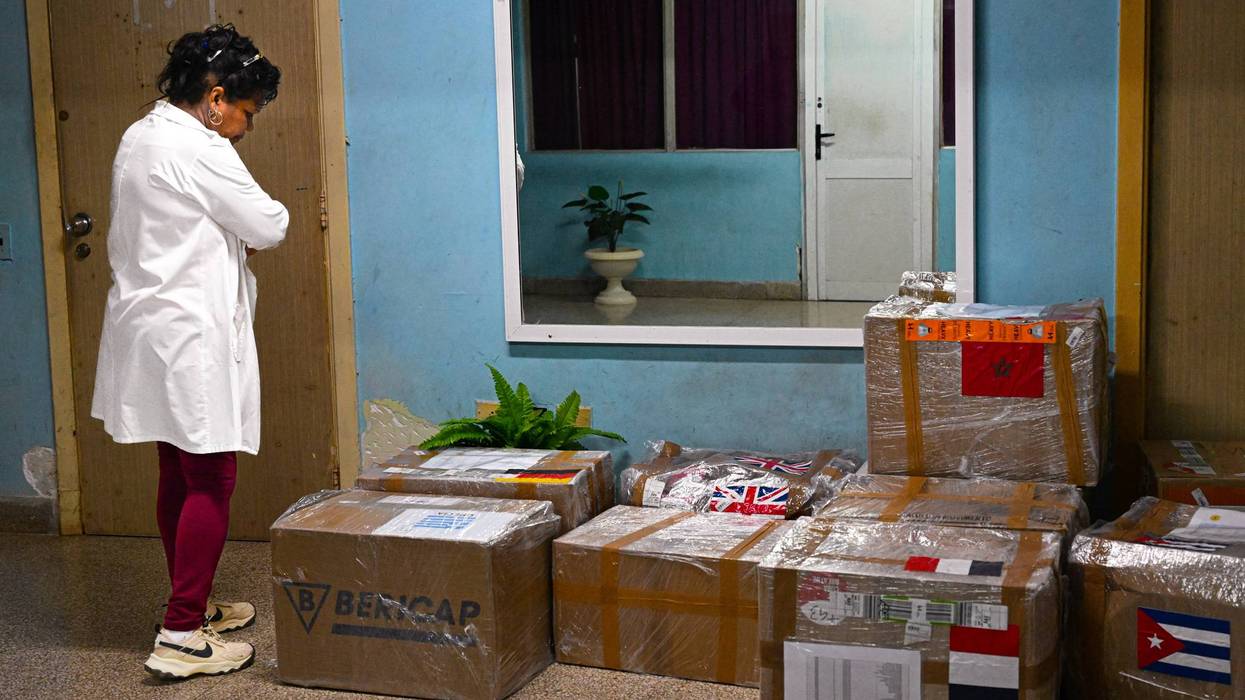
"The fuel restrictions imposed since early 2026 and recent tightening of extraterritorial sanctions, taken together, are directly harming Cubans, especially the most vulnerable," said Volker Türk.
The United Nations' top human rights official on Monday implored the Trump administration to immediately lift its oil embargo and economic sanctions on Cuba as the island faces a rapidly deteriorating humanitarian emergency, with dire fuel shortages causing rolling blackouts, disrupting food supplies, and buckling hospitals.
“The fuel restrictions imposed since early 2026 and recent tightening of extraterritorial sanctions, taken together, are directly harming Cubans, especially the most vulnerable," UN High Commissioner for Human Rights Volker Türk said in a statement. "Children are dying because doctors lack access to essential medical supplies and medicines. This is unacceptable. These sanctions must be lifted immediately."
Türk noted that key medical services on the island—including oncology and maternal health—have been severely damaged by US economic warfare this year and over the past decade, causing infant mortality to surge and childhood cancer survival rates to fall, among other impacts. The UN rights chief's office noted that "essential medicines are in critical short supply, with supply levels down to about 30%."
Cuban President Miguel Díaz-Canel acknowledged the shortages in an interview released Monday, saying that "we have very effective programs to care for children with cancer; today, these programs are limited by a shortage of medications and supplies, and as a result, the survival rates of these children with cancer are declining."
In his Monday statement, Türk also pointed to the sanctions' impact on the island's food supply, much of which is imported. Fuel shortages caused by US President Donald Trump's embargo—imposed in late January following his administration's abduction of Venezuela's president—have led to "a reported 60% decrease in food production and spikes in the costs of basic food items," according to the UN.
"Such severe sanctions packages that target entire sectors of an economy and produce broad, indiscriminate, and harsh effects on populations are incompatible with basic principles of international human rights law,” said Türk. "Cuba faces increasing isolation. Companies are leaving. Fewer airlines fly to the country. It is almost disconnected from international payment systems. Rising summer temperatures risk increasing the spread of vector-borne and waterborne diseases. The hurricane season further increases exposure."
"This creates a perfect storm for social and economic deterioration and suffering for the Cuban people," he warned.
The UN official's statement came amid fears that the Trump administration is preparing for a military assault on Cuba, which the US president has repeatedly threatened in the months following the illegal bombing and invasion of Venezuela.
"Cuba is next, by the way," Trump said in late March.
Politico reported in late May that the Pentagon is putting "building blocks in place" for an invasion of Cuba, "positioning the troops and weapons needed for the US to launch a military attack."
"All it needs is a final go-ahead from Donald Trump," the outlet reported.
The US military buildup and escalating economic warfare have led Democratic lawmakers to call for swift passage of a war powers resolution to prevent Trump from launching yet another military operation without congressional approval.
"Trump's belligerent foreign policy is creating new wars and conflicts across the world. As our country is already embroiled in a new war with Iran, the president has now set his sights on regime change in Cuba,” Rep. Nydia Velázquez (D-NY), a lead sponsor of the resolution, said last month. "This administration is rushing toward another disastrous war, putting countless American and foreign lives at risk."

The oil embargo has also devastated Cuba's tourism industry, with multiple international hotel chains abandoning the country.
The US military for the last four months has been blockading oil shipments from entering Cuba, and residents living on the island are saying the situation is growing increasingly dire.
In a Monday report from The Guardian, several Cubans described how their lives have been thrown into turmoil by the Trump administration's oil blockade, which began shortly after the US military invaded Venezuela and abducted President Nicolás Maduro earlier this year.
As noted by The Guardian, Cuba's gas stations have now been empty for months because of the blockade, and the state's power company struggles to keep electricity on for even a few hours every day.
One unnamed doctor in Havana who spoke to The Guardian said that "we’ve been four days without light" in his apartment building, and warned that the fuel shortages would cause even more severe crises on the island the longer they persist.
"Without electricity, water is also a problem," the doctor said. "And there are mosquitoes everywhere."
Havana resident Martha Pérez told The Guardian that she has had to buy gas from "an online supermarket," but added that "the price is US$29 a bottle when it used to be just a few cents when I bought it from the state."
As reported by The Associated Press on Monday, Cubans have been buying fuel on the black market at exorbitant prices that most people cannot afford.
Rather than pay such high sums for gas, many Cubans have simply given up driving all together.
Auto body shop owner Diriel Valdez told the AP that his business has been severely hurt by the oil embargo because Cubans aren't bothering to have their cars maintained or repaired amidst the fuel shortages.
“People don’t want to do major repairs anymore,” Valdez said. “A lot of them have their cars parked. They don’t have much hope that they’ll be circulating the way they used to."
Adding to the economic misery, The Wall Street Journal reported on Saturday that many international businesses that have operated in Cuba for years are now pulling out due to the cost of maintaining operations.
The oil embargo has been particularly harsh on Cuba's tourism industry, and the Journal reported that "Spanish hotel giants Iberostar and Meliá have said they are giving up management of at least a dozen Cuban hotels each," while "Royalton Hotels & Resorts, a Canadian operator, ceased operations after grappling with a collapse in tourism."
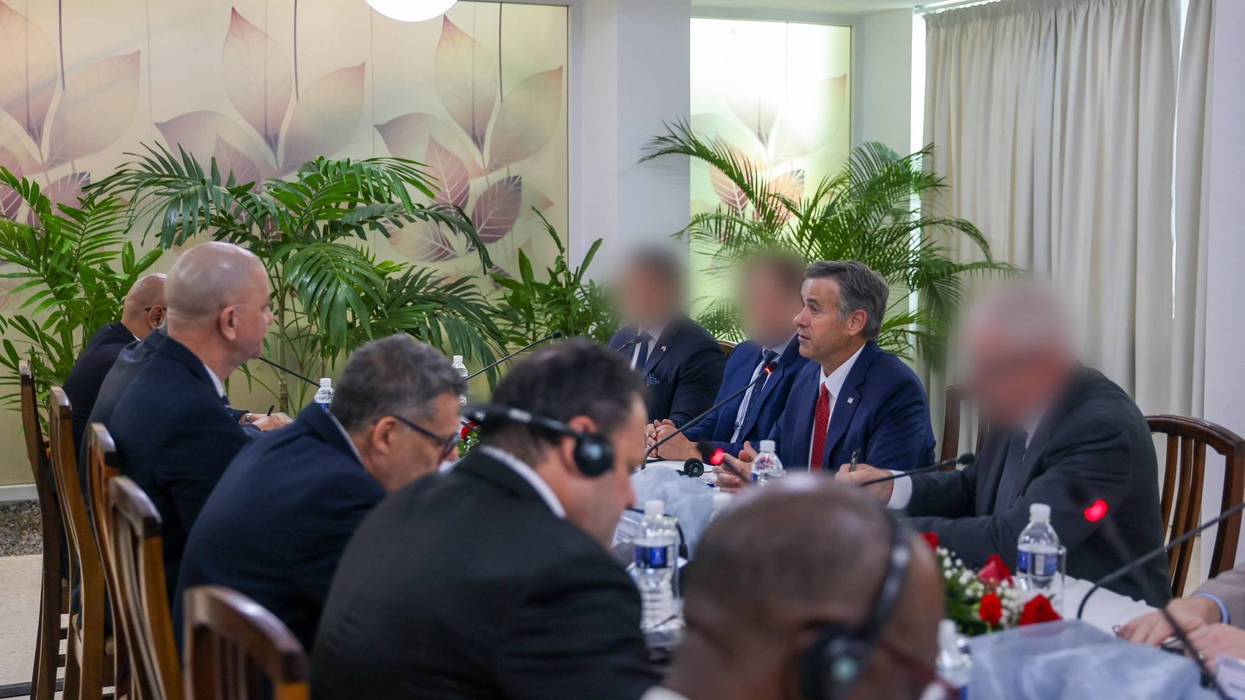
Democratic Rep. Pramila Jayapal called for an immediate end to the US blockade, warning that "we are contributing to immense suffering in Cuba and a worsening humanitarian crisis."
The director of the US Central Intelligence Agency met with Cuban officials in Havana on Thursday after the island nation's government said it had completely run out of fuel due to the Trump administration's oil blockade.
The CIA's X account posted photos of some of Director John Ratcliffe's meetings, blurring the faces of US intelligence officials who accompanied the agency chief. In a statement, the CIA said it met with Raúl Rodríguez Castro, the grandson of former Cuban President Raúl Castro; Interior Minister Lázaro Álvarez Casas; and the head of Cuba's intelligence services.
Havana, Cuba pic.twitter.com/7S7TtJPyf5
— CIA (@CIA) May 14, 2026
"This is one of the most sinister and ominous social media posts I've ever seen," legal scholar Maryam Jamshidi wrote in response to the CIA photos.
Ratcliffe, the highest-ranking Trump administration official to visit Cuba, decided to visit "to personally deliver President Donald Trump's message that the United States is prepared to seriously engage on economic and security issues, but only if Cuba makes fundamental changes," the CIA said.
A CIA official told NewsNation that "while the director emphasized that President Trump prefers dialogue, the Cubans should have no illusions that the President will not enforce red lines."
Trump has repeatedly threatened to seize Cuba by force, describing the island country as his next military target after Venezuela and Iran. Fears of an imminent military attack have grown in recent weeks amid Trump's belligerent rhetoric and surging US surveillance flights off Cuba's coast.
"I think I can do anything I want with [Cuba], if you want to know the truth," Trump told reporters in the Oval Office in March. "A very weakened nation."
"This failed policy needs to end immediately. Every day, we are contributing to immense suffering in Cuba and a worsening humanitarian crisis."
The spy chief's trip came a day after Cuba's energy minister announced that months after Trump imposed an oil blockade on the island, "we have absolutely no fuel oil, absolutely no diesel."
The same day, the US State Department dangled "$100 million in direct humanitarian assistance to the Cuban people." Cuban Foreign Minister Bruno Rodríguez Parrilla said Cuba's leadership is "willing to hear the details of the offer and the manner in which it would be implemented."
"We hope it is free of political maneuvers and attempts to exploit the shortages and suffering of a people under siege," he added. "The best aid that the US government could provide to the noble Cuban people at this or any time is to de-escalate the measures of the energy, economic, commercial, and financial blockade, intensified as never before in recent months, which severely affects all sectors of the Cuban economy and society."
Cuban President Miguel Díaz-Canel echoed that sentiment, writing in a Thursday social media post that "the damage could be alleviated in a much easier and more expeditious way by lifting or easing the blockade, as it is well known that the humanitarian situation is coldly calculated and induced."
Progressive lawmakers in the US are imploring the Trump administration to end US economic warfare against Cuba, engage diplomatically with the country, and drop any plans for a military assault.
Rep. Pramila Jayapal (D-Wash.), who has come under attack from Republican lawmakers for visiting Cuba in April, said Thursday that "Cuba has run out of diesel and fuel oil and is enduring some of the worst blackouts in decades because of the US’ cruel oil blockade."
"This failed policy needs to end immediately," said Jayapal. "Every day, we are contributing to immense suffering in Cuba and a worsening humanitarian crisis."

Dozens of House Democrats wrote that the US "must not respond to a crisis it is creating with policies that deepen suffering."
A group of more than 30 Democratic lawmakers in the US House is imploring the Trump administration to abandon any plans for a military assault on Cuba and end the decades-old blockade that has deprived the island nation of fuel and sparked a grave humanitarian crisis.
In a letter dated May 12 and addressed to top Trump administration officials, Rep. Delia Ramirez (D-Ill.) and other House Democrats wrote that the US "must not respond to a crisis it is creating with policies that deepen suffering, undermine the rule of law, and repeat the gravest failures of its past."
The members of Congress demanded that the Trump administration immediately end its use of the notorious Guantanamo Bay military prison for migrant detention, lift all "coercive economic measures" currently strangling Cuba, and "abandon reported plans for US military action against Cuba."
"Such action," the lawmakers warned, "would be unlawful, deeply destabilizing, and catastrophic for the Cuban population, while further increasing displacement, exacerbating mass suffering, and undermining US interests in the region."
"It must be unequivocally rejected," they added.
Through sanctions and unlawful threats of military action, the Trump administration is deepening the humanitarian crisis in Cuba. At the same time, they are once again threatening to use the Guantanamo Base, a prison with a history of dehumanizing and abusing people, to detain… pic.twitter.com/cXbCFfds4W
— Congresswoman Delia C. Ramirez (@repdeliaramirez) May 13, 2026
The House Democrats' letter was released shortly before Cuba's energy minister said the country has "absolutely no fuel" and "absolutely no diesel," blaming the oil blockade that the Trump administration imposed earlier this year after kidnapping the president of Venezuela—previously Cuba's primary supplier of oil.
"This dramatic worsening has a single cause: the genocidal energy blockade to which the United States subjects our country, threatening irrational tariffs against any nation that supplies us with fuel," Cuban President Miguel Díaz-Canel wrote Wednesday on social media. "What the spokespeople of the U.S. regime try to portray to the world as the direct consequence of poor management by the Cuban government is, in reality, the result of a perverse plan aimed at driving the people’s shortages and hardships to extreme levels."
US President Donald Trump has said publicly that his next military target is Cuba, which he has threatened to "take" by force.
Bruno Rodríguez Parrilla, Cuba's foreign affairs minister, posted the House Democrats' letter to social media on Thursday, writing that "the government that claims to defend democracy should listen to the majority voices that oppose the current escalation of threats, aggressions, tightening of the blockade, and energy siege against our country."
Last month, nearly every Republican senator and one Democrat—Sen. John Fetterman of Pennsylvania—voted down a legislative effort to prevent Trump from launching an attack on Cuba without congressional authorization.

Instead of instruments of war, flotillas have become symbols of peace—acts of humanitarian direct action, civil resistance, and cross-border solidarity.
Flotillas have historically been fleets of military vessels—tools of empire designed for swift offensive or defensive operations at sea. The images they evoke are ones of imperial power and looming violence. Just look at the massive US naval buildup that surrounded Iran as part of the recent US attacks.
But peace activists have also developed a new kind of flotilla.
Instead of instruments of war, flotillas have become symbols of peace—acts of humanitarian direct action, civil resistance, and cross-border solidarity. Take the flotillas that have tried to reach Gaza, like the Global Sumud Flotilla. Even though they have been illegally intercepted by the Israeli military, they have educated millions of people worldwide about Israel’s atrocities, activated entire cities to shut down, and offered a beacon of hope to the beleaguered people of Gaza.
As US policy continues to sanction and blockade Cuba—causing immense hardship for the Cuban people—I, along with many others, felt compelled to escalate our own tactics of solidarity by joining the recent flotilla to Cuba as part of the Nuestra América Convoy. Our boat carried 15 tons of aid, part of the more than 40 tons delivered by the convoy.
The US empire is indeed dying, and it is up to us to not just reimagine the better world we need and want, but to actually put that world into practice.
The United States is currently imposing some of the harshest sanctions on Cuba in recent history, compounding a 67-year blockade that has restricted access to medicine, fuel, and food. But in recent months, the US added another dimension: a naval blockade to severely limit fuel imports, leading to a humanitarian crisis.
In an ideal world, we wouldn’t need fossil fuels—we would already have made a just transition to renewable energy. And while Cuba is working at lightning speed to expand solar power, the current reality is stark: People still need fuel to cook, to transport food, to operate ambulances, to power hospitals, and to keep ventilators running.
The international community has responded to this escalation in US economic warfare with intensified solidarity. Hundreds of thousands of people around the world have been mobilizing to send aid and condemn the US blockade. In March, Progressive International, CODEPINK, and The People’s Forum launched the Nuestra América Convoy, bringing together over 600 people from 33 countries. We came with millions of dollars’ worth of aid—from urgently needed medical supplies to longer-term solutions like solar panels.
While many of my friends boarded planes to Havana, packing every inch of their luggage with medicine, hygiene products, vitamins, and art supplies, I traveled to Mexico to meet the flotilla crew. We spent four days at sea together—activists, journalists, organizers. Some had helped organize the Gaza Sumud Flotilla; others had taken part in mass protests in solidarity with Palestine.
Our goal was to deliver much-needed aid to the people of Cuba. But just as important was challenging the dominant narrative—that Cuba’s suffering is the result of its own government, rather than decades of cruel US policy.
Even though the boat was full of journalists documenting the trip, their cameras could not fully capture the sense of community among strangers united by a shared mission. I remember being nervous about the cold and the possibility of seasickness, but within minutes, people were offering ginger chews, acupressure bracelets, and rain gear.
Our departure was delayed due to weather, boat repairs, and the logistics of loading the aid. In the meantime, we stayed with supporters in Mexico who couldn’t join the voyage but found other ways to contribute. We shared a send-off dinner at an Egyptian restaurant whose owner had followed the Gaza flotillas. He told us how proud he was to see a flotilla to Cuba leaving from his small town.
On the boat, we shared cooking, dishwashing, and night watch shifts—standard practice in occupations, encampments, and direct actions where resources are limited but creativity and collaboration are abundant. At sea, a simple breakfast of rice, beans, eggs, guacamole, and toast tastes like a feast. We slept under galaxies of stars, woke to sunrises on the horizon, and at sunset made music with whatever we had—a guitar, a bucket drum, water bottles filled with dry beans.
Meanwhile, I stayed connected to those traveling by plane, watching group chats fill with photos of carefully packed bags and urgent questions: Who can fit more supplies? How many solar batteries can we carry on? The coordination was constant, collective, and inspiring.
The blockade severely limits what goods can reach Cuba. While US citizens can still travel there under certain categories, they face restrictions and often risk questioning upon return. But solidarity is not tourism. It is not about swooping in, taking photos, and leaving. It is about building relationships, listening, and committing to ongoing struggle from our home countries.
We had a beautiful reception from the Cuban people when we landed, and then had the opportunity to speak directly with community groups about current conditions.I learned how they overcome so much by placing value in community over the individual.
The US empire is indeed dying, and it is up to us to not just reimagine the better world we need and want, but to actually put that world into practice. Reflecting on my experience, I started thinking—if we can turn flotillas from a force of evil into vessels of hope and solidarity, then what else can we change? What if we built schools around the world instead of sending bombs? What if, like the Cubans, we funded healthcare over warfare and sent doctors to cure people instead of soldiers to kill them?
You don’t have to board a boat with humanitarian supplies to show solidarity. Flotillas are one tactic, but we need a variety and diversity of tactics right now, and always. You can move forward by showing solidarity to your neighbors at home, as well as to our neighbors 90 miles off our shores. Because what we build together, in community—whether through a peace flotilla or local mutual aid—is stronger than anything built through force.
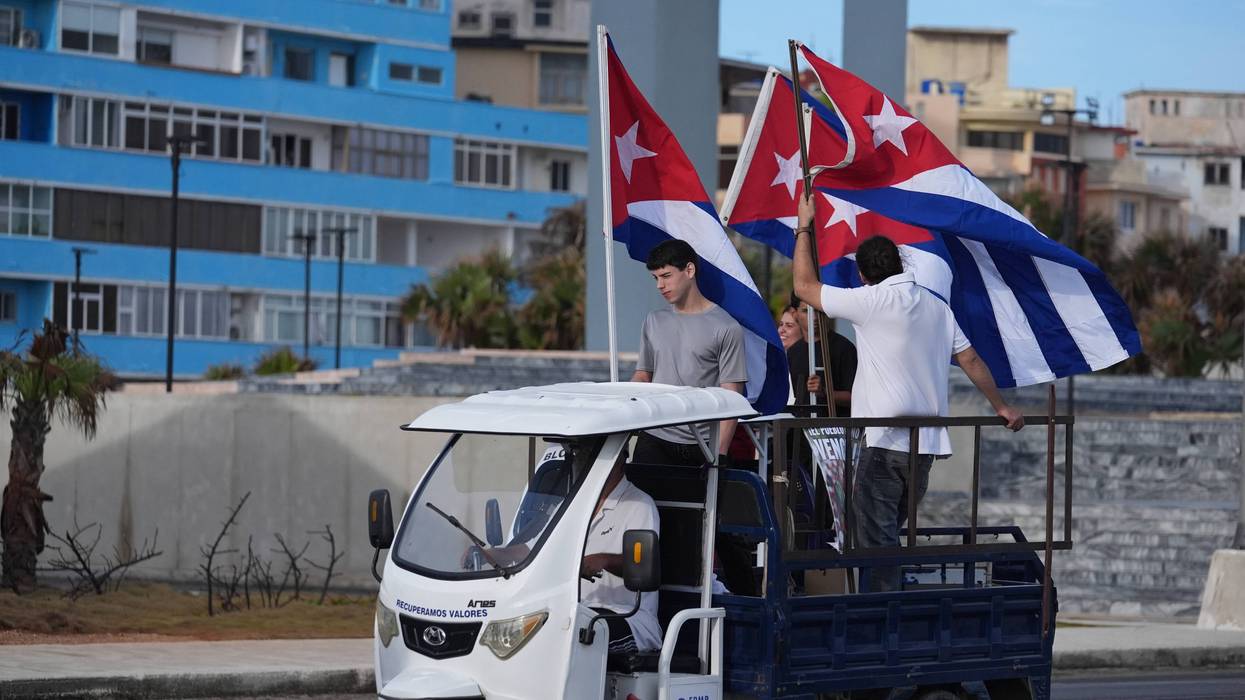
“The continued use of Guantánamo Bay, which has an extensive history of abuse and torture, is horrific and unconscionable."
Dozens of human rights organizations sent a letter to Congress on Friday, decrying threats by US military officials to detain Cubans who flee to the US to escape President Donald Trump's crushing economic blockade at Guantánamo Bay.
The 86 groups, which include the Center for Constitutional Rights, the Center for Victims of Torture, the International Refugee Assistance Project, and Refugees International, zeroed in on remarks made by US Marine Corps Gen. Francis Donovan, the commander of the US Southern Command (SOUTHCOM), during a Senate Armed Services Committee hearing last month about how the military would respond to the mass influx of Cuban refugees to the United States.
The risks of a refugee exodus from Cuba were sparked in January after Trump tightened the already brutal regime of economic sanctions by threatening to slap harsh tariffs on any nation that provided oil to Cuba. The result has been a crippling fuel shortage that has caused routine blackouts and disrupted every facet of daily life, from hospital care to food cultivation.
Trump enacted the fuel blockade in what he has described as an effort to coerce the government to step down from power and make way for one more amenable to the interests of American companies. With Cuba in a weakened state, he has threatened to "take" the island outright using American military force.
The United Nations has warned that if the blockade is prolonged, it could bring about a total "humanitarian collapse.”
Asked by Sen. Tom Cotton (R-Ark.) about what would be done if this caused a mass influx of Cuban refugees to the US, Donovan said they had an executive order that would involve coordinating with the Department of Homeland Security to handle a "mass migration event."
Donovan said it would include using the US military base at Guantánamo Bay, “where we would set up a camp to deal with those migrants or any overflow from any situation in Cuba itself.”
“Given the well-documented history of abusive and unlawful detention at Guantánamo, any proposal to use the base for additional detention is deeply troubling and unacceptable," the organizations wrote on Friday,
They note the prison’s history as a site used for extrajudicial torture during the global War on Terror and as a holding facility for other migrant groups, including Haitian refugees and asylum seekers who fled a military coup in the 1990s, many of whom were subjected to substandard living conditions.
"Time and again, we have seen the US government try to use Guantánamo as a legal black hole to mistreat migrants, subjecting them to inhumane conditions and interfering with both their right to seek protection in the United States and their right to counsel," said Pedro Sepulveda, a litigation fellow for the International Refugee Assistance Project.
Despite pledges from multiple presidents to close the camp for good, it remains open more than two decades after former President George W. Bush began using it to detain hundreds of terrorism suspects without trial.
Trump has expanded its use during his second term, using it to temporarily hold more than 700 migrants since February 2025—including dozens of Cubans rounded up by immigration agents.
Trump’s use of the camp marks the first time it has been used to hold people detained in the continental United States. A Washington Post investigation from February found that those in the facility were subject to weeks-long periods of isolation, invasive strip searches, and denied contact with lawyers.
The human rights groups called on Congress to block any funding that could be used to detain Cubans fleeing Trump's blockade and to shut down Guantánamo Bay for good.
"The president has held Guantánamo detention as a threat over the heads of migrants in the United States and now threatens the same over Cubans who may be forced to flee their homes as a result of his own actions," said Yumna Rizvi, a senior policy analyst for the Center for Victims of Torture.
Michael Galant, the senior research and outreach associate at the Center for Economic and Policy Research, said, “If the Trump administration is worried about Cuban migration, the solution is simple: Stop intentionally impoverishing the Cuban people through an embargo and fuel blockade.”
Reps. Pramila Jayapal and Jonathan Jackson described Trump's blockade of the island as "effectively an economic bombing of the infrastructure of the country that has produced permanent damage."
After returning from a delegation trip to Cuba, US Reps. Pramila Jayapal and Jonathan Jackson on Sunday renewed calls for President Donald Trump to end his illegal fuel blockade of the island, which they described as "cruel collective punishment."
The pair of progressive lawmakers were the first to visit the island since Trump imposed the blockade in January in a bid to cripple the island's economy as part of an effort to overthrow its government, or, in the president's words, "take" the island.
Almost no oil has been allowed to enter for more than three months, which Jayapal (D-Wash.) and Jackson (D-Ill.) described as "effectively an economic bombing of the infrastructure of the country—that has produced permanent damage."
"We witnessed firsthand premature babies in incubators, weighing just two pounds, who are at tremendous risk because their ventilators and incubators cannot function without electricity," they said. "Children cannot attend school because there is no fuel for them or their teachers to travel. Cancer patients cannot receive lifesaving treatments because of a lack of medications."
"There is a water shortage because there is little electricity to pump water," they continued. "Businesses have closed. Families cannot keep food refrigerated, and food production on the island has dropped to just 10% of the people’s needs."
The oil blockade is an escalation of more than 60 years of punitive economic warfare by the US against Cuba, imposed through an embargo that has limited Cuba's ability to trade with the rest of the world and hampered its economic development to the tune of trillions of dollars.
Jayapal had previously visited Cuba in February 2024 on a trip with other members of the Congressional Progressive Caucus. Since her last time in Havana, she said, "There's such a big difference."
"So many of the streets of this beautiful city were deserted. People were already lining up for food," she said in an interview with the Cuban outlet Belly of the Beast. "I don't think that any American wants to create this kind of devastation for the Cuban children, for the babies, for the moms, for the people."
She said the phrase "collective punishment," while accurate, almost felt "too technocratic" to describe what she witnessed.
"We are strangling the Cuban people," Jayapal said.
The United Nations General Assembly has voted 33 times to call for the end of the embargo since 1993.
In February, a group of UN experts condemned Trump's fuel blockade as "a serious violation of international law and a grave threat to a democratic and equitable international order" and an "extreme form of unilateral economic coercion."
Cuban President Miguel Diaz-Canel has acknowledged having talks with Trump in recent weeks in order to negotiate an end to the embargo and threats of further aggression.
The Cuban government has taken actions that the lawmakers described as "signs that Cuba is changing." It has released more than 2,000 prisoners, announced economic reforms to allow more involvement of American businesses, and allowed the FBI to investigate Cuban troops' lethal shooting of five armed Cuban exiles as they approached in a speedboat in February.
While hardly softening his threats to Cuba, which he continued to insist was “finished,” Trump last week allowed a Russian oil tanker to dock on the island without incident and deliver around 700,000 barrels of much-needed oil.
But the lawmakers said it's not enough. Jackson, noting the "generosity" of Cuba as a provider of medical treatment around the world, said the US must allow food and fuel to be allowed to return to the island "so that the Cuban people can continue to rise."
Jayapal said that when they spoke with Diaz-Canel, he expressed "a real desire for a real negotiation" with the US, but that he also expressed "sadness" and "frustration" at what was being done to his country.
"These kinds of sanctions, embargoes, they don't get to the government. They hurt the people," Jayapal said. "Perhaps the American people don't understand the violence of an economic sanction versus the violence of dropping a bomb."
Jackson—whose father, the late Rev. Jesse Jackson, took many trips to Cuba during his life—described America's treatment of the nation’s people as a “crucifixion.”
"Americans would not want to see what I saw in that hospital," Jackson said, describing a malnourished baby named Alejandro, whom he said was "fighting for life."
Due to the intermittent power surges caused by the lack of fuel, he said, "We didn't know when the incubator was going to start working."
"That's an act of war," he said. "We have to put an end to that."
He added that Secretary of State Marco Rubio, himself a Cuban-American who has long sought to bring about regime change, "should come before the Congress and explain his policy."
In late March, Jayapal introduced legislation that would block Trump from conducting military action against Cuba without congressional authorization. She said she'd continue to push for bills to block Trump from launching a war and to push for sanctions relief.
The Trump administration has portrayed its economic warfare as part of an effort to "liberate" the Cuban people from an oppressive government.
But the lawmakers, who met with wide swaths of Cuban society—including business and religious leaders, humanitarian groups, and civil society organizations—said that "Cubans across the political spectrum," including anti-government dissidents, expressed similar feelings.
"Across all sectors, there is agreement," they said. "This illegal blockade must end immediately."

Cuba's Deputy Foreign Minister Carlos Fernandez de Cossio said he hoped the people of the United States would ask, "Why does our government treat the whole population of Cuba this way?"
More than 96,000 Cubans, including 11,000 children, are "waiting for surgery" due to a fuel shortage caused by the American blockade, the country's deputy foreign minister, Carlos Fernandez de Cossio, said on Sunday.
The numbers cited by the minister on NBC's "Meet the Press" on Sunday were first reported earlier this month by Cuban Minister of Public Health José Ángel Portal Miranda, who explained that President Donald Trump's policy of “energy asphyxiation," using tariffs to threaten countries out of importing fuel to Cuba, has devastated its National Health Service.
The policy has left Cuba unable to import oil from abroad for more than three months, reducing its fuel supply by about 90% and leading to periodic blackouts and strict energy rationing.
Using the severely limited electricity at its disposal, Cuba's health system has been forced to prioritize continuing cancer treatments and other lifesaving procedures, putting those awaiting non-urgent surgeries on the sidelines.
Last month, a specialist at a hospital in Holguín told Diario de Cuba that the surgeries canceled included "uncomplicated hernias, cataract surgeries, some non-urgent gynecological procedures, and scheduled orthopedic surgeries."
Other healthcare professionals said that nobody was being admitted to the hospital for tests and that it was running low on basic supplies like syringes, IV tubing, and antibiotics, which could not be delivered due to fuel shortages. Most of those that have been used had to be donated by family members or purchased for exorbitant prices on the black market.
Jorge Barrera, a reporter for CBC News, spoke with patients and employees at Havana’s National Institute of Cardiology and Cardiovascular Surgery this weekend and found it to be at about half capacity, and that nonessential care has been virtually all suspended.
"Even though the health system is a point of pride for Cuba... something that they export to the rest of the world," Barrera explained, "because of this crisis, because of the impact it's had on the skyrocketing prices, it's just not enough for them to make ends meet. So people are quitting... to find other ways to make money to feed their families."
Experts with the United Nations have condemned the blockade of Cuba as "a serious violation of international law." Condemnations have grown louder over the past week as Trump said he believed he'd have "the honor of taking Cuba" after it collapsed.
De Cossio said he hoped the people of the United States would ask "Why does our government treat the whole population of Cuba this way?" and that they'd "understand that it's not correct to treat another nation the way the US is doing simply to try to achieve political goals."
The US blockade of Cuba is largely unpopular with the American public. A poll published last week by YouGov found that just 28% of adult US citizens said they approved of the US blocking oil shipments to the country, while 46% said they opposed it.
Asked by anchor Kristen Welker about suggestions from Trump that Cuba would collapse "on its own" without the need for the US to intervene militarily, De Cossio retorted, "What does 'on its own' mean when it’s being forced by the United States?"
Prior to Trump's further measures to isolate Cuba in January, the US had placed Cuba under an economic embargo for more than 60 years, which severely hampered the country's economic development and has cost Cuba trillions of dollars since it began, according to the UN.
"It’s a very bizarre statement, and it’s claimed by most US politicians repeatedly that Cuba will collapse on its own," De Cossio said. "Then why does the US government need to employ so many resources, so much political capital, so many human resources to try to destroy the economy of another country? Evidently, it implies that the country does not have the characteristics to collapse on its own."