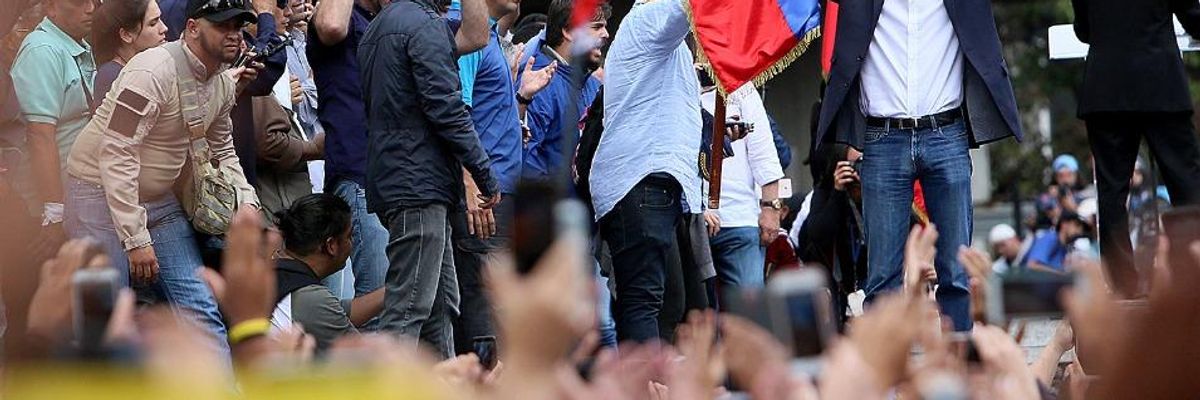
Venezuelan opposition leader and head of the National Assembly Juan Guaido declares self interim president as thousands of people protest against Nicolas Maduro on January 23, 2019 in Caracas, Venezuela. Many countries including the US, Canada and Chile have recognized officially recognized Guaido as the legitimate president of Venezuela. (Photo: Edilzon Gamez/Getty Images)
Fears of US-Backed 'Coup' in Motion as Trump Recognizes Venezuela Opposition Lawmaker as 'Interim President'
In response to Trump declaration, President Nicolas Maduro gives diplomats from 'imperialist' U.S. 72 hours to leave the country
President Nicolas Maduro of Venezuela officially cut off dipomatic ties with the U.S. government on Wednesday--and gave American diplomats 72 hours to leave the country--in response to President Donald Trump declaring formal recognition of an opposition lawmaker as the "Interim President" of Venezuela, despite not being elected by the nation's people for that position.
"They intend to govern Venezuela from Washington. Do you want a puppet government controlled by Washington?"
--Venezuela President Nicolas Maduro"Before the people and nations of the world, and as constitutional president," declared Maduro to a crowd of red-shirted supporters gathered outside the presidential residence in Caracas, "I've decided to break diplomatic and political relations with the imperialist U.S. government."
According to the Associated Press:
Maduro said in his speech the U.S. was making a "grave mistake" by trying to impose a president on Venezuela and rattled off a long list of countries -- Guatemala, Brazil, Chile and Argentina--that saw leftist governments toppled or come under military rule during the Cold War with U.S. support.
In a prepared White House statement earlier in the day, Trump declared he was "officially recognizing the President of the Venezuelan National Assembly, Juan Guaido, as the Interim President of Venezuela."
In addition to vowing to "use the full weight of United States economic and diplomatic power" to restore what he called "democracy" in the country, Trump also encouraged "other Western Hemisphere governments" to recognize Guaido. Shortly later, CBC News reported that Canada, led by Prime Minister Justin Trudeau, was making plans to follow Trump's lead.
In his remarks from Caracas, Maduro told his supporters "the very existence of our Bolivarian republic" was under threat and urged them to resist "at all costs" what he explicitly described as a "coup" attempt by the "interventionist gringo empire" and the "fascist right" within his own country.
"They intend to govern Venezuela from Washington," Maduro declared. "Do you want a puppet government controlled by Washington?"
Critics of U.S. imperialism and its long history of anti-democratic manuevers in Latin American expressed immediate alarm on Wednesday after Trump's announcement. And what Trump identified as "democracy," critics of the move instead used Maduro's description: "coup."
Mark Weisbrot, co-director of the Center for Economic and Policy Research (CEPR), called the latest moves by the Trump administration a "disgrace."
"It's acceleration of the Trump administration's efforts at regime change in Venezuela," said Weisbrot. "We all know how well that strategy has worked out in Iraq, Afghanistan, Libya, and Syria--not to mention that hundreds of thousands of people in Latin American have been killed by U.S.-sponsored regime change in Latin America since the 1970s."
The announcement by the U.S. and Canada--one also backed by the newly-elected far-right Brazilian President Jair-Balsonaro--arrived on the same day that massive street protests in Caracas and elsewhere across Venezuela were held by opposition parties and those upset with Maduro's leadership and just two days after the latest failed coup attempt by rogue military officials.
Following a call for progressive U.S. lawmakers to respond, Rep. Ro Khanna (D-Calif.) tweeted:
Considering the U.S. political class has spent the last two years up in arms over the idea that the Russian government had the audacity to interfere in the 2016 elections, it stands to reason that the U.S. government simply deciding to "recognize" an un-elected opposition lawmaker as president of a foreign nation--regardless of affinity for the actual elected president--might be viewed as problematic:
While members of the U.S. foreign policy establishment, including Richard Haass of the Council on Foreign Relations, embraced Trump's move, more progressive-minded critics pushed back:
On Tuesday, U.S. Vice President Mike Pence stirred outrage of his own by issuing a statement in support of the anti-government protest movement--a gesture critics similarly viewed as an explicit effort to undermine Maduro by fomenting the nation's right-wing to stage a coup against the socialist government.
In Facebook post on Wednesday, Dr. Francisco Dominguez, secretary of the Venezuela Solidarity Campaign, a U.K.-based campaign that backs the Bolivarian revolution and Venezuela's right to self-determination, voiced loud objection to the U.S. vice president's call.
"This is an outrageous violation of international law and an unacceptable interference into the affairs of a sovereign nation plus a grotesque aggression by openly calling on Venezuelans to rise up to oust the democratically elected [Maduro] government," Dominguez said. "The U.S. has tried to oust the democratically elected government of Venezuela since 1998 and the brief April 2002 coup against Hugo Chavez had Washington fingerprints all over."
Pointing to the history of U.S. imperialism in Latin America, including the 1973 CIA-backed coup in Chile, Dominguez said the people of the region know all too well the "horrendous results" of anti-democratic interventions by the Americans.
Naming Pence, President Donald Trump, national security advisor John Bolton, and Sen. Marco Rubio (R-Fla.) as leaders of hawkish tendencies within the U.S. government, Dominguez characterized the recent history of U.S. aggression towards Venezuela--"20 years of golpismo, economic warfare, destabilization, violence, [and] financial blockade"--as a strategy that would allow U.S.-backed interests to get their hands on the country's "oil, gold, coltan, thorium and many other lucrative raw materials."
In a tweet on Tuesday, Rubio warned the Maduro government it was "about to cross a line & trigger a response that believe me you are not prepared to face," a reference to violence predicted at Wednesday planned opposition protests.
According to CEPR's Weisbrot, the economic sanction imposed on Venezuela by the U.S. and other nations are designed to destabilize the country and have helped fuel the economic anxieties that, in part, drive the street protests and social upheaval. "The Trump sanctions on Venezuela are illegal under U.S. and international law, and they have killed many people in that country," he explained.
Weisbrot rejected the idea that members of the administration or others pushing for regime change in Venezuela are doing so on behalf of the Venezuelan people. "Of course it goes without saying," he concluded, "that all of these crimes and threats of violence from Pence, Trump, Rubio, etc. have nothing to do with 'democracy.'"
An Urgent Message From Our Co-Founder
Dear Common Dreams reader, It’s been nearly 30 years since I co-founded Common Dreams with my late wife, Lina Newhouser. We had the radical notion that journalism should serve the public good, not corporate profits. It was clear to us from the outset what it would take to build such a project. No paid advertisements. No corporate sponsors. No millionaire publisher telling us what to think or do. Many people said we wouldn't last a year, but we proved those doubters wrong. Together with a tremendous team of journalists and dedicated staff, we built an independent media outlet free from the constraints of profits and corporate control. Our mission has always been simple: To inform. To inspire. To ignite change for the common good. Building Common Dreams was not easy. Our survival was never guaranteed. When you take on the most powerful forces—Wall Street greed, fossil fuel industry destruction, Big Tech lobbyists, and uber-rich oligarchs who have spent billions upon billions rigging the economy and democracy in their favor—the only bulwark you have is supporters who believe in your work. But here’s the urgent message from me today. It's never been this bad out there. And it's never been this hard to keep us going. At the very moment Common Dreams is most needed, the threats we face are intensifying. We need your support now more than ever. We don't accept corporate advertising and never will. We don't have a paywall because we don't think people should be blocked from critical news based on their ability to pay. Everything we do is funded by the donations of readers like you. When everyone does the little they can afford, we are strong. But if that support retreats or dries up, so do we. Will you donate now to make sure Common Dreams not only survives but thrives? —Craig Brown, Co-founder |
President Nicolas Maduro of Venezuela officially cut off dipomatic ties with the U.S. government on Wednesday--and gave American diplomats 72 hours to leave the country--in response to President Donald Trump declaring formal recognition of an opposition lawmaker as the "Interim President" of Venezuela, despite not being elected by the nation's people for that position.
"They intend to govern Venezuela from Washington. Do you want a puppet government controlled by Washington?"
--Venezuela President Nicolas Maduro"Before the people and nations of the world, and as constitutional president," declared Maduro to a crowd of red-shirted supporters gathered outside the presidential residence in Caracas, "I've decided to break diplomatic and political relations with the imperialist U.S. government."
According to the Associated Press:
Maduro said in his speech the U.S. was making a "grave mistake" by trying to impose a president on Venezuela and rattled off a long list of countries -- Guatemala, Brazil, Chile and Argentina--that saw leftist governments toppled or come under military rule during the Cold War with U.S. support.
In a prepared White House statement earlier in the day, Trump declared he was "officially recognizing the President of the Venezuelan National Assembly, Juan Guaido, as the Interim President of Venezuela."
In addition to vowing to "use the full weight of United States economic and diplomatic power" to restore what he called "democracy" in the country, Trump also encouraged "other Western Hemisphere governments" to recognize Guaido. Shortly later, CBC News reported that Canada, led by Prime Minister Justin Trudeau, was making plans to follow Trump's lead.
In his remarks from Caracas, Maduro told his supporters "the very existence of our Bolivarian republic" was under threat and urged them to resist "at all costs" what he explicitly described as a "coup" attempt by the "interventionist gringo empire" and the "fascist right" within his own country.
"They intend to govern Venezuela from Washington," Maduro declared. "Do you want a puppet government controlled by Washington?"
Critics of U.S. imperialism and its long history of anti-democratic manuevers in Latin American expressed immediate alarm on Wednesday after Trump's announcement. And what Trump identified as "democracy," critics of the move instead used Maduro's description: "coup."
Mark Weisbrot, co-director of the Center for Economic and Policy Research (CEPR), called the latest moves by the Trump administration a "disgrace."
"It's acceleration of the Trump administration's efforts at regime change in Venezuela," said Weisbrot. "We all know how well that strategy has worked out in Iraq, Afghanistan, Libya, and Syria--not to mention that hundreds of thousands of people in Latin American have been killed by U.S.-sponsored regime change in Latin America since the 1970s."
The announcement by the U.S. and Canada--one also backed by the newly-elected far-right Brazilian President Jair-Balsonaro--arrived on the same day that massive street protests in Caracas and elsewhere across Venezuela were held by opposition parties and those upset with Maduro's leadership and just two days after the latest failed coup attempt by rogue military officials.
Following a call for progressive U.S. lawmakers to respond, Rep. Ro Khanna (D-Calif.) tweeted:
Considering the U.S. political class has spent the last two years up in arms over the idea that the Russian government had the audacity to interfere in the 2016 elections, it stands to reason that the U.S. government simply deciding to "recognize" an un-elected opposition lawmaker as president of a foreign nation--regardless of affinity for the actual elected president--might be viewed as problematic:
While members of the U.S. foreign policy establishment, including Richard Haass of the Council on Foreign Relations, embraced Trump's move, more progressive-minded critics pushed back:
On Tuesday, U.S. Vice President Mike Pence stirred outrage of his own by issuing a statement in support of the anti-government protest movement--a gesture critics similarly viewed as an explicit effort to undermine Maduro by fomenting the nation's right-wing to stage a coup against the socialist government.
In Facebook post on Wednesday, Dr. Francisco Dominguez, secretary of the Venezuela Solidarity Campaign, a U.K.-based campaign that backs the Bolivarian revolution and Venezuela's right to self-determination, voiced loud objection to the U.S. vice president's call.
"This is an outrageous violation of international law and an unacceptable interference into the affairs of a sovereign nation plus a grotesque aggression by openly calling on Venezuelans to rise up to oust the democratically elected [Maduro] government," Dominguez said. "The U.S. has tried to oust the democratically elected government of Venezuela since 1998 and the brief April 2002 coup against Hugo Chavez had Washington fingerprints all over."
Pointing to the history of U.S. imperialism in Latin America, including the 1973 CIA-backed coup in Chile, Dominguez said the people of the region know all too well the "horrendous results" of anti-democratic interventions by the Americans.
Naming Pence, President Donald Trump, national security advisor John Bolton, and Sen. Marco Rubio (R-Fla.) as leaders of hawkish tendencies within the U.S. government, Dominguez characterized the recent history of U.S. aggression towards Venezuela--"20 years of golpismo, economic warfare, destabilization, violence, [and] financial blockade"--as a strategy that would allow U.S.-backed interests to get their hands on the country's "oil, gold, coltan, thorium and many other lucrative raw materials."
In a tweet on Tuesday, Rubio warned the Maduro government it was "about to cross a line & trigger a response that believe me you are not prepared to face," a reference to violence predicted at Wednesday planned opposition protests.
According to CEPR's Weisbrot, the economic sanction imposed on Venezuela by the U.S. and other nations are designed to destabilize the country and have helped fuel the economic anxieties that, in part, drive the street protests and social upheaval. "The Trump sanctions on Venezuela are illegal under U.S. and international law, and they have killed many people in that country," he explained.
Weisbrot rejected the idea that members of the administration or others pushing for regime change in Venezuela are doing so on behalf of the Venezuelan people. "Of course it goes without saying," he concluded, "that all of these crimes and threats of violence from Pence, Trump, Rubio, etc. have nothing to do with 'democracy.'"
- Opinion | Western Media Continue to Defend Washington’s Deadly Venezuela Agenda | Common Dreams ›
- Opinion | Trump Brought the Coups Home | Common Dreams ›
- Opinion | The True Meaning of the Panama Canal Drought | Common Dreams ›
- Maduro Slams Attempted 'Coup Against Venezuela' as Far-Right Cries Fraud | Common Dreams ›
- Opinion | The Return of the Kirkpatrick Doctrine | Common Dreams ›
President Nicolas Maduro of Venezuela officially cut off dipomatic ties with the U.S. government on Wednesday--and gave American diplomats 72 hours to leave the country--in response to President Donald Trump declaring formal recognition of an opposition lawmaker as the "Interim President" of Venezuela, despite not being elected by the nation's people for that position.
"They intend to govern Venezuela from Washington. Do you want a puppet government controlled by Washington?"
--Venezuela President Nicolas Maduro"Before the people and nations of the world, and as constitutional president," declared Maduro to a crowd of red-shirted supporters gathered outside the presidential residence in Caracas, "I've decided to break diplomatic and political relations with the imperialist U.S. government."
According to the Associated Press:
Maduro said in his speech the U.S. was making a "grave mistake" by trying to impose a president on Venezuela and rattled off a long list of countries -- Guatemala, Brazil, Chile and Argentina--that saw leftist governments toppled or come under military rule during the Cold War with U.S. support.
In a prepared White House statement earlier in the day, Trump declared he was "officially recognizing the President of the Venezuelan National Assembly, Juan Guaido, as the Interim President of Venezuela."
In addition to vowing to "use the full weight of United States economic and diplomatic power" to restore what he called "democracy" in the country, Trump also encouraged "other Western Hemisphere governments" to recognize Guaido. Shortly later, CBC News reported that Canada, led by Prime Minister Justin Trudeau, was making plans to follow Trump's lead.
In his remarks from Caracas, Maduro told his supporters "the very existence of our Bolivarian republic" was under threat and urged them to resist "at all costs" what he explicitly described as a "coup" attempt by the "interventionist gringo empire" and the "fascist right" within his own country.
"They intend to govern Venezuela from Washington," Maduro declared. "Do you want a puppet government controlled by Washington?"
Critics of U.S. imperialism and its long history of anti-democratic manuevers in Latin American expressed immediate alarm on Wednesday after Trump's announcement. And what Trump identified as "democracy," critics of the move instead used Maduro's description: "coup."
Mark Weisbrot, co-director of the Center for Economic and Policy Research (CEPR), called the latest moves by the Trump administration a "disgrace."
"It's acceleration of the Trump administration's efforts at regime change in Venezuela," said Weisbrot. "We all know how well that strategy has worked out in Iraq, Afghanistan, Libya, and Syria--not to mention that hundreds of thousands of people in Latin American have been killed by U.S.-sponsored regime change in Latin America since the 1970s."
The announcement by the U.S. and Canada--one also backed by the newly-elected far-right Brazilian President Jair-Balsonaro--arrived on the same day that massive street protests in Caracas and elsewhere across Venezuela were held by opposition parties and those upset with Maduro's leadership and just two days after the latest failed coup attempt by rogue military officials.
Following a call for progressive U.S. lawmakers to respond, Rep. Ro Khanna (D-Calif.) tweeted:
Considering the U.S. political class has spent the last two years up in arms over the idea that the Russian government had the audacity to interfere in the 2016 elections, it stands to reason that the U.S. government simply deciding to "recognize" an un-elected opposition lawmaker as president of a foreign nation--regardless of affinity for the actual elected president--might be viewed as problematic:
While members of the U.S. foreign policy establishment, including Richard Haass of the Council on Foreign Relations, embraced Trump's move, more progressive-minded critics pushed back:
On Tuesday, U.S. Vice President Mike Pence stirred outrage of his own by issuing a statement in support of the anti-government protest movement--a gesture critics similarly viewed as an explicit effort to undermine Maduro by fomenting the nation's right-wing to stage a coup against the socialist government.
In Facebook post on Wednesday, Dr. Francisco Dominguez, secretary of the Venezuela Solidarity Campaign, a U.K.-based campaign that backs the Bolivarian revolution and Venezuela's right to self-determination, voiced loud objection to the U.S. vice president's call.
"This is an outrageous violation of international law and an unacceptable interference into the affairs of a sovereign nation plus a grotesque aggression by openly calling on Venezuelans to rise up to oust the democratically elected [Maduro] government," Dominguez said. "The U.S. has tried to oust the democratically elected government of Venezuela since 1998 and the brief April 2002 coup against Hugo Chavez had Washington fingerprints all over."
Pointing to the history of U.S. imperialism in Latin America, including the 1973 CIA-backed coup in Chile, Dominguez said the people of the region know all too well the "horrendous results" of anti-democratic interventions by the Americans.
Naming Pence, President Donald Trump, national security advisor John Bolton, and Sen. Marco Rubio (R-Fla.) as leaders of hawkish tendencies within the U.S. government, Dominguez characterized the recent history of U.S. aggression towards Venezuela--"20 years of golpismo, economic warfare, destabilization, violence, [and] financial blockade"--as a strategy that would allow U.S.-backed interests to get their hands on the country's "oil, gold, coltan, thorium and many other lucrative raw materials."
In a tweet on Tuesday, Rubio warned the Maduro government it was "about to cross a line & trigger a response that believe me you are not prepared to face," a reference to violence predicted at Wednesday planned opposition protests.
According to CEPR's Weisbrot, the economic sanction imposed on Venezuela by the U.S. and other nations are designed to destabilize the country and have helped fuel the economic anxieties that, in part, drive the street protests and social upheaval. "The Trump sanctions on Venezuela are illegal under U.S. and international law, and they have killed many people in that country," he explained.
Weisbrot rejected the idea that members of the administration or others pushing for regime change in Venezuela are doing so on behalf of the Venezuelan people. "Of course it goes without saying," he concluded, "that all of these crimes and threats of violence from Pence, Trump, Rubio, etc. have nothing to do with 'democracy.'"
- Opinion | Western Media Continue to Defend Washington’s Deadly Venezuela Agenda | Common Dreams ›
- Opinion | Trump Brought the Coups Home | Common Dreams ›
- Opinion | The True Meaning of the Panama Canal Drought | Common Dreams ›
- Maduro Slams Attempted 'Coup Against Venezuela' as Far-Right Cries Fraud | Common Dreams ›
- Opinion | The Return of the Kirkpatrick Doctrine | Common Dreams ›