SUBSCRIBE TO OUR FREE NEWSLETTER
Daily news & progressive opinion—funded by the people, not the corporations—delivered straight to your inbox.
5
#000000
#FFFFFF
To donate by check, phone, or other method, see our More Ways to Give page.
Daily news & progressive opinion—funded by the people, not the corporations—delivered straight to your inbox.
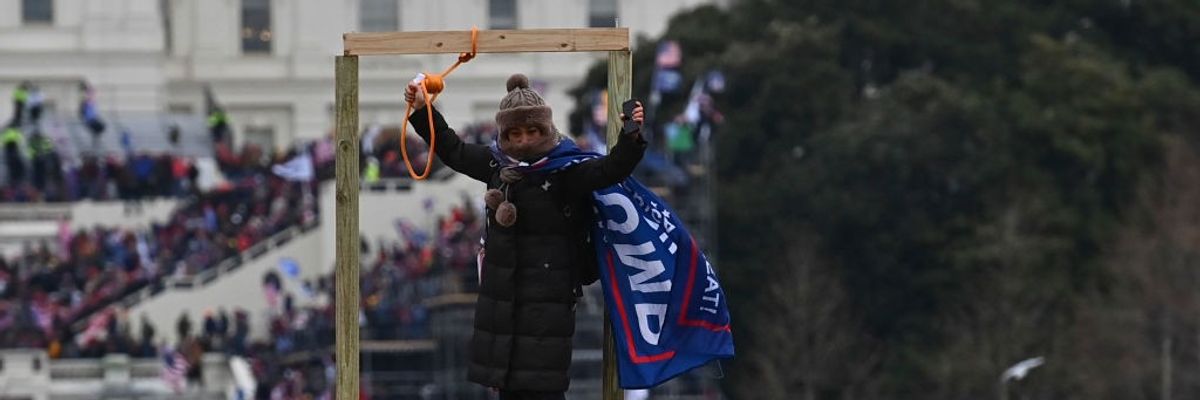
A woman poses for a picture with a noose during a protest calling for legislators to overturn the election results in President Donald Trump’s favor at the U.S. Capitol on January 6, 2021, in Washington, D.C.
The violence on January 6, 2021, was just a shadow of the bloodshed that accompanied countless U.S.-sponsored interventions around the globe.
August 19 marked the 70th anniversary of the overthrow of Mohammad Mosaddegh, the first democratically-elected prime minister of Iran. It was the first coup d’état in the modern era orchestrated by the United States, launching decades of coups, assassinations and “regime change.”
While Iran’s grim anniversary generated scant attention in the U.S., one attempted coup was in the news, as defendants in the Fulton County, Georgia, election interference case against former president Donald Trump and his 18 coconspirators began surrendering for arrest. This is the second indictment served on Trump for his attempted coup against the United States following his 2020 election defeat. The Trump-summoned mob that stormed the U.S. Capitol almost stopped the peaceful transfer of power. The violence on January 6, 2021, though, was just a shadow of the bloodshed that accompanied countless U.S.-sponsored interventions around the globe.
President Dwight Eisenhower’s administration was directly involved in Mossadegh’s overthrow. But it had help. The CIA was just six years old in 1953. Britain’s spy agency, MI6, by comparison, had been around for decades, had two world wars behind it, and had fomented uprisings and intrigue the world over as Britain struggled to maintain its waning empire. By the 1950s, the British empire’s lifeblood was petroleum, pumped from Iran’s oil fields by the British-controlled Anglo-Iranian Oil Company. In 1951, tired of being plundered, the Iranian parliament nationalized its oil industry. The movement was led by Mohammad Mosaddegh, who not long after was elected prime minister. He would remain in office for just over a year, as the U.S. and the U.K. plotted to retake control of Iran’s oil.
Hopefully, confronting a homegrown attempted coup, with the multiple prosecutions of Donald Trump and his codefendants, will hasten a reckoning with our nation’s violent history plotting coups abroad.
The extent to which MI6 partnered with the CIA in Mossadegh’s ouster was revealed when a remarkable documentary, Coup 53, premiered in 2019. The film, directed by Taghi Amirani, an Iranian-born physicist turned filmmaker, uncovered the coup’s long-concealed direction by an MI6 operative named Norman Darbyshire.
“We all grew up with the story of the CIA coup run by Kermit Roosevelt,” Amirani said on the Democracy Now! news hour. He was describing Kermit Roosevelt, recruited by CIA Director Allen Dulles and his brother, Secretary of State John Foster Dulles, to be the CIA’s point person on the Iran coup. He was the grandson of President Theodore Roosevelt. Kermit Roosevelt gave numerous interviews, practically bragging that he brought $1 million into Iran for the coup, but only spent $60,000 of it.
“Kermit… was more of a bagman and an adventurist,” Amirani said, going on to describe MI6’s principal Iran operative: “Darbyshire was in Iran from the age of 19 as a soldier. He spoke probably better Persian than me. He knew the Iranian street. He really understood the psyche of the Iranian mob, as he says in the interview in our film. He knows how to turn them, what buttons to press.”
Amirani’s research for Coup 53 uncovered troves of forgotten material. He found a transcript of an interview with Darbyshire. When the initial CIA-led coup attempt failed, a mercenary mob hired by Darbyshire swept through Tehran, surrounded Mossadegh’s house, and, with the help of rebellious army officers, attacked the residence and arrested Mossadegh.
The U.S. and Britain installed a puppet, Mohammad Reza Pahlavi, as the Shah of Iran. He ruled for a quarter century, guided by the CIA in the creation of SAVAK, a brutal state security apparatus that terrorized and killed Iranians who dared speak out. In 1979, the Shah was overthrown during the Iranian Revolution, ushering in strict theocratic rule that persists to this day.
Amirani’s research brought him to the nonprofit National Security Archives in Washington, D.C., which pries classified documents from the U.S. government for public access. One key CIA document obtained by the archive in 2013 reads, “The military coup that overthrew Mossadeq and his National Front cabinet was carried out under CIA direction as an act of U.S. foreign policy, conceived and approved at the highest levels of government.”
In one chilling interstitial in Coup 53, document boxes that line the wall of the archive’s reading room scroll by, listing successive U.S.-sponsored coups, attempted coups, and military interventions that followed the overthrow of Mossadegh:
Arbenz (Guatemala, 1954); Lumumba (Congo, 1961); Trujillo (Dominican Republic, 1961); Diem (Vietnam, 1963); Goulart (Brazil, 1964); Sukarno (Indonesia, 1965); Salvador Allende (Chile, 1973); and others from the invasion of Grenada in 1983 to the wars in Nicaragua and El Salvador in the 1980s; the ongoing attempts to overthrow the governments of Cuba and Venezuela, to the invasion and occupation of Iraq.
Hopefully, confronting a homegrown attempted coup, with the multiple prosecutions of Donald Trump and his codefendants, will hasten a reckoning with our nation’s violent history plotting coups abroad. On the 70th anniversary of the coup in Iran, such self-reflection is long overdue.
Dear Common Dreams reader, It’s been nearly 30 years since I co-founded Common Dreams with my late wife, Lina Newhouser. We had the radical notion that journalism should serve the public good, not corporate profits. It was clear to us from the outset what it would take to build such a project. No paid advertisements. No corporate sponsors. No millionaire publisher telling us what to think or do. Many people said we wouldn't last a year, but we proved those doubters wrong. Together with a tremendous team of journalists and dedicated staff, we built an independent media outlet free from the constraints of profits and corporate control. Our mission has always been simple: To inform. To inspire. To ignite change for the common good. Building Common Dreams was not easy. Our survival was never guaranteed. When you take on the most powerful forces—Wall Street greed, fossil fuel industry destruction, Big Tech lobbyists, and uber-rich oligarchs who have spent billions upon billions rigging the economy and democracy in their favor—the only bulwark you have is supporters who believe in your work. But here’s the urgent message from me today. It's never been this bad out there. And it's never been this hard to keep us going. At the very moment Common Dreams is most needed, the threats we face are intensifying. We need your support now more than ever. We don't accept corporate advertising and never will. We don't have a paywall because we don't think people should be blocked from critical news based on their ability to pay. Everything we do is funded by the donations of readers like you. When everyone does the little they can afford, we are strong. But if that support retreats or dries up, so do we. Will you donate now to make sure Common Dreams not only survives but thrives? —Craig Brown, Co-founder |
August 19 marked the 70th anniversary of the overthrow of Mohammad Mosaddegh, the first democratically-elected prime minister of Iran. It was the first coup d’état in the modern era orchestrated by the United States, launching decades of coups, assassinations and “regime change.”
While Iran’s grim anniversary generated scant attention in the U.S., one attempted coup was in the news, as defendants in the Fulton County, Georgia, election interference case against former president Donald Trump and his 18 coconspirators began surrendering for arrest. This is the second indictment served on Trump for his attempted coup against the United States following his 2020 election defeat. The Trump-summoned mob that stormed the U.S. Capitol almost stopped the peaceful transfer of power. The violence on January 6, 2021, though, was just a shadow of the bloodshed that accompanied countless U.S.-sponsored interventions around the globe.
President Dwight Eisenhower’s administration was directly involved in Mossadegh’s overthrow. But it had help. The CIA was just six years old in 1953. Britain’s spy agency, MI6, by comparison, had been around for decades, had two world wars behind it, and had fomented uprisings and intrigue the world over as Britain struggled to maintain its waning empire. By the 1950s, the British empire’s lifeblood was petroleum, pumped from Iran’s oil fields by the British-controlled Anglo-Iranian Oil Company. In 1951, tired of being plundered, the Iranian parliament nationalized its oil industry. The movement was led by Mohammad Mosaddegh, who not long after was elected prime minister. He would remain in office for just over a year, as the U.S. and the U.K. plotted to retake control of Iran’s oil.
Hopefully, confronting a homegrown attempted coup, with the multiple prosecutions of Donald Trump and his codefendants, will hasten a reckoning with our nation’s violent history plotting coups abroad.
The extent to which MI6 partnered with the CIA in Mossadegh’s ouster was revealed when a remarkable documentary, Coup 53, premiered in 2019. The film, directed by Taghi Amirani, an Iranian-born physicist turned filmmaker, uncovered the coup’s long-concealed direction by an MI6 operative named Norman Darbyshire.
“We all grew up with the story of the CIA coup run by Kermit Roosevelt,” Amirani said on the Democracy Now! news hour. He was describing Kermit Roosevelt, recruited by CIA Director Allen Dulles and his brother, Secretary of State John Foster Dulles, to be the CIA’s point person on the Iran coup. He was the grandson of President Theodore Roosevelt. Kermit Roosevelt gave numerous interviews, practically bragging that he brought $1 million into Iran for the coup, but only spent $60,000 of it.
“Kermit… was more of a bagman and an adventurist,” Amirani said, going on to describe MI6’s principal Iran operative: “Darbyshire was in Iran from the age of 19 as a soldier. He spoke probably better Persian than me. He knew the Iranian street. He really understood the psyche of the Iranian mob, as he says in the interview in our film. He knows how to turn them, what buttons to press.”
Amirani’s research for Coup 53 uncovered troves of forgotten material. He found a transcript of an interview with Darbyshire. When the initial CIA-led coup attempt failed, a mercenary mob hired by Darbyshire swept through Tehran, surrounded Mossadegh’s house, and, with the help of rebellious army officers, attacked the residence and arrested Mossadegh.
The U.S. and Britain installed a puppet, Mohammad Reza Pahlavi, as the Shah of Iran. He ruled for a quarter century, guided by the CIA in the creation of SAVAK, a brutal state security apparatus that terrorized and killed Iranians who dared speak out. In 1979, the Shah was overthrown during the Iranian Revolution, ushering in strict theocratic rule that persists to this day.
Amirani’s research brought him to the nonprofit National Security Archives in Washington, D.C., which pries classified documents from the U.S. government for public access. One key CIA document obtained by the archive in 2013 reads, “The military coup that overthrew Mossadeq and his National Front cabinet was carried out under CIA direction as an act of U.S. foreign policy, conceived and approved at the highest levels of government.”
In one chilling interstitial in Coup 53, document boxes that line the wall of the archive’s reading room scroll by, listing successive U.S.-sponsored coups, attempted coups, and military interventions that followed the overthrow of Mossadegh:
Arbenz (Guatemala, 1954); Lumumba (Congo, 1961); Trujillo (Dominican Republic, 1961); Diem (Vietnam, 1963); Goulart (Brazil, 1964); Sukarno (Indonesia, 1965); Salvador Allende (Chile, 1973); and others from the invasion of Grenada in 1983 to the wars in Nicaragua and El Salvador in the 1980s; the ongoing attempts to overthrow the governments of Cuba and Venezuela, to the invasion and occupation of Iraq.
Hopefully, confronting a homegrown attempted coup, with the multiple prosecutions of Donald Trump and his codefendants, will hasten a reckoning with our nation’s violent history plotting coups abroad. On the 70th anniversary of the coup in Iran, such self-reflection is long overdue.
August 19 marked the 70th anniversary of the overthrow of Mohammad Mosaddegh, the first democratically-elected prime minister of Iran. It was the first coup d’état in the modern era orchestrated by the United States, launching decades of coups, assassinations and “regime change.”
While Iran’s grim anniversary generated scant attention in the U.S., one attempted coup was in the news, as defendants in the Fulton County, Georgia, election interference case against former president Donald Trump and his 18 coconspirators began surrendering for arrest. This is the second indictment served on Trump for his attempted coup against the United States following his 2020 election defeat. The Trump-summoned mob that stormed the U.S. Capitol almost stopped the peaceful transfer of power. The violence on January 6, 2021, though, was just a shadow of the bloodshed that accompanied countless U.S.-sponsored interventions around the globe.
President Dwight Eisenhower’s administration was directly involved in Mossadegh’s overthrow. But it had help. The CIA was just six years old in 1953. Britain’s spy agency, MI6, by comparison, had been around for decades, had two world wars behind it, and had fomented uprisings and intrigue the world over as Britain struggled to maintain its waning empire. By the 1950s, the British empire’s lifeblood was petroleum, pumped from Iran’s oil fields by the British-controlled Anglo-Iranian Oil Company. In 1951, tired of being plundered, the Iranian parliament nationalized its oil industry. The movement was led by Mohammad Mosaddegh, who not long after was elected prime minister. He would remain in office for just over a year, as the U.S. and the U.K. plotted to retake control of Iran’s oil.
Hopefully, confronting a homegrown attempted coup, with the multiple prosecutions of Donald Trump and his codefendants, will hasten a reckoning with our nation’s violent history plotting coups abroad.
The extent to which MI6 partnered with the CIA in Mossadegh’s ouster was revealed when a remarkable documentary, Coup 53, premiered in 2019. The film, directed by Taghi Amirani, an Iranian-born physicist turned filmmaker, uncovered the coup’s long-concealed direction by an MI6 operative named Norman Darbyshire.
“We all grew up with the story of the CIA coup run by Kermit Roosevelt,” Amirani said on the Democracy Now! news hour. He was describing Kermit Roosevelt, recruited by CIA Director Allen Dulles and his brother, Secretary of State John Foster Dulles, to be the CIA’s point person on the Iran coup. He was the grandson of President Theodore Roosevelt. Kermit Roosevelt gave numerous interviews, practically bragging that he brought $1 million into Iran for the coup, but only spent $60,000 of it.
“Kermit… was more of a bagman and an adventurist,” Amirani said, going on to describe MI6’s principal Iran operative: “Darbyshire was in Iran from the age of 19 as a soldier. He spoke probably better Persian than me. He knew the Iranian street. He really understood the psyche of the Iranian mob, as he says in the interview in our film. He knows how to turn them, what buttons to press.”
Amirani’s research for Coup 53 uncovered troves of forgotten material. He found a transcript of an interview with Darbyshire. When the initial CIA-led coup attempt failed, a mercenary mob hired by Darbyshire swept through Tehran, surrounded Mossadegh’s house, and, with the help of rebellious army officers, attacked the residence and arrested Mossadegh.
The U.S. and Britain installed a puppet, Mohammad Reza Pahlavi, as the Shah of Iran. He ruled for a quarter century, guided by the CIA in the creation of SAVAK, a brutal state security apparatus that terrorized and killed Iranians who dared speak out. In 1979, the Shah was overthrown during the Iranian Revolution, ushering in strict theocratic rule that persists to this day.
Amirani’s research brought him to the nonprofit National Security Archives in Washington, D.C., which pries classified documents from the U.S. government for public access. One key CIA document obtained by the archive in 2013 reads, “The military coup that overthrew Mossadeq and his National Front cabinet was carried out under CIA direction as an act of U.S. foreign policy, conceived and approved at the highest levels of government.”
In one chilling interstitial in Coup 53, document boxes that line the wall of the archive’s reading room scroll by, listing successive U.S.-sponsored coups, attempted coups, and military interventions that followed the overthrow of Mossadegh:
Arbenz (Guatemala, 1954); Lumumba (Congo, 1961); Trujillo (Dominican Republic, 1961); Diem (Vietnam, 1963); Goulart (Brazil, 1964); Sukarno (Indonesia, 1965); Salvador Allende (Chile, 1973); and others from the invasion of Grenada in 1983 to the wars in Nicaragua and El Salvador in the 1980s; the ongoing attempts to overthrow the governments of Cuba and Venezuela, to the invasion and occupation of Iraq.
Hopefully, confronting a homegrown attempted coup, with the multiple prosecutions of Donald Trump and his codefendants, will hasten a reckoning with our nation’s violent history plotting coups abroad. On the 70th anniversary of the coup in Iran, such self-reflection is long overdue.