SUBSCRIBE TO OUR FREE NEWSLETTER
Daily news & progressive opinion—funded by the people, not the corporations—delivered straight to your inbox.
5
#000000
#FFFFFF
To donate by check, phone, or other method, see our More Ways to Give page.
Daily news & progressive opinion—funded by the people, not the corporations—delivered straight to your inbox.
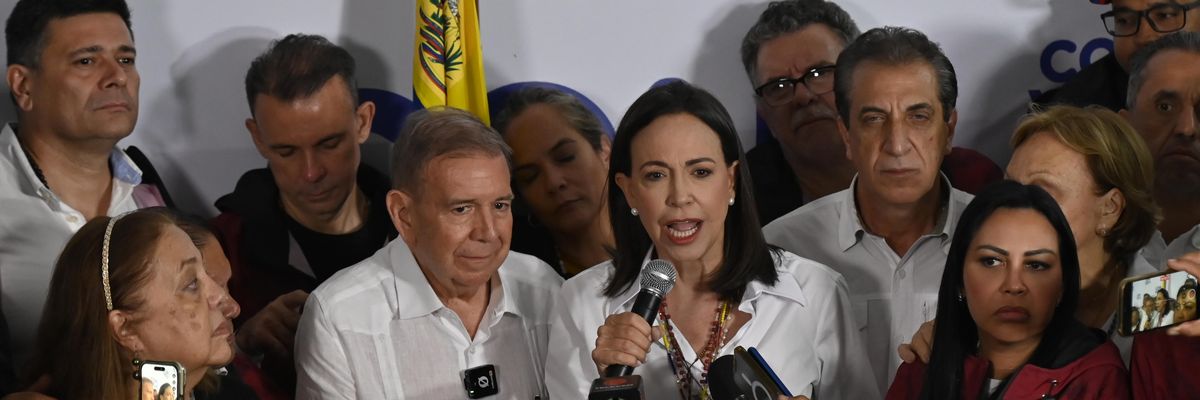
Opposition leader María Corina Machado speaks at a press conference on July 28, 2024 in Caracas, Venezuela.
One political scientist argued that "doubts about Venezuela's elections appear less as concerns that the people's voice will not be heard, than that it will."
Venezuela's far-right opposition is doubling down on its refusal to accept defeat in the country's presidential election amid simmering unrest and violence in the streets of Caracas, sparking warnings of another coup attempt in a nation that has long faced interference from the United States and other Western powers.
Led by María Corina Machado, who was disqualified from running in Sunday's election, Venezuela's opposition claimed that its candidate—ex-diplomat Edmundo González—defeated President Nicolás Maduro with over 70% of the vote, contradicting the official results announced by the Consejo Nacional Electoral (CNE).
Machado, who once urged Israeli Prime Minister Benjamin Netanyahu to back an effort to topple Maduro's elected government, pointed Venezuelans to a website the opposition is using to assemble its own vote counts.
"So far, she hasn't presented any evidence [of fraud]," Caracas-based reporter Andreína Chávez Alava said in an appearance on Democracy Now! Tuesday morning. "In past elections they have also said they have evidence that they won and they never actually showed any proof."
Protests have erupted in Venezuela after President Nicolás Maduro was declared the winner of Sunday’s election, with the opposition accusing the government of vote fraud. Caracas-based reporter @AChavezAlava of @venanalysis describes the tense situation on the ground. pic.twitter.com/V1xrXuJ8q3
— Democracy Now! (@democracynow) July 30, 2024
According to CNE, Maduro won with just over 51% of the vote in a contest that one group of independent election observers described as "fair and transparent." Experts, election watchers, and the leaders of other Latin American nations—including the left-wing presidents of Brazil and Chile—have called on CNE to release detailed election results to dispel any doubts about the contest's legitimacy.
Right-wing leaders in Latin America, meanwhile, have backed the Venezuelan opposition's unsubstantiated claims of election theft. Javier Milei, Argentina's far-right president, declared on social media that "Argentina is not going to recognize another fraud, and hopes that the armed forces this time will defend democracy and the popular will"—openly hinting at the possibility of a military coup.
Milei's comments, as well as those of other right-wing political leaders in the region, prompted Venezuela to announce the withdrawal of diplomatic personnel from Argentina and several other nations.
The United States, which has a long history of meddling in Venezuelan politics and has supported past efforts to oust Maduro's government, has also questioned the CNE tally and floated the possibility of additional sanctions, which have had devastating impacts on Venezuela's economy.
"We have serious concerns that this result does not reflect the will and the votes of the Venezuelan people," Vedant Patel, a spokesperson for the U.S. State Department, told reporters during a briefing on Monday.
Addressing Venezuelans on Monday, Maduro condemned what he described as an attempted "coup against Venezuela" by "the world's extreme right." Maduro also denounced those who toppled a statue of the late former Venezuelan President Hugo Chávez.
"All acts of criminal violence will be judged in accordance with Venezuelan laws and the full and absolute weight of the law will be applied to them," said Maduro.
Venezuelanalysis reported that on early Monday afternoon, "a group of protesters attempted to advance to Miraflores Presidential Palace through the central Urdaneta Avenue before being stopped by a police cordon."
Later in the day, the outlet continued, a "group of masked activists clashed with the National Guard in El Silencio, close to another access to the presidential palace."
Political scientist Jodi Dean wrote in the wake of Sunday's elections that "from here in Caracas, I can attest that U.S. doubts" about the legitimacy of Sunday's election "are unwarranted."
"Venezuela has one of the most advanced voting systems in the world," Dean wrote in a blog post published by Progressive International on Tuesday. "U.S. doubts about Venezuela's elections appear less as concerns that the people's voice will not be heard, than that it will."
" Neoliberalism is crumbling and a battle is underway for what will replace it: war and oppression or peace and solidarity?" Dean continued. "The refusal of the opposition to accept the results of the election, and, indeed, their willingness to double down by claiming to have won over 70% of the vote and incite violence across the country demonstrates that the battle won't be an easy one."
Dear Common Dreams reader, It’s been nearly 30 years since I co-founded Common Dreams with my late wife, Lina Newhouser. We had the radical notion that journalism should serve the public good, not corporate profits. It was clear to us from the outset what it would take to build such a project. No paid advertisements. No corporate sponsors. No millionaire publisher telling us what to think or do. Many people said we wouldn't last a year, but we proved those doubters wrong. Together with a tremendous team of journalists and dedicated staff, we built an independent media outlet free from the constraints of profits and corporate control. Our mission has always been simple: To inform. To inspire. To ignite change for the common good. Building Common Dreams was not easy. Our survival was never guaranteed. When you take on the most powerful forces—Wall Street greed, fossil fuel industry destruction, Big Tech lobbyists, and uber-rich oligarchs who have spent billions upon billions rigging the economy and democracy in their favor—the only bulwark you have is supporters who believe in your work. But here’s the urgent message from me today. It's never been this bad out there. And it's never been this hard to keep us going. At the very moment Common Dreams is most needed, the threats we face are intensifying. We need your support now more than ever. We don't accept corporate advertising and never will. We don't have a paywall because we don't think people should be blocked from critical news based on their ability to pay. Everything we do is funded by the donations of readers like you. When everyone does the little they can afford, we are strong. But if that support retreats or dries up, so do we. Will you donate now to make sure Common Dreams not only survives but thrives? —Craig Brown, Co-founder |
Venezuela's far-right opposition is doubling down on its refusal to accept defeat in the country's presidential election amid simmering unrest and violence in the streets of Caracas, sparking warnings of another coup attempt in a nation that has long faced interference from the United States and other Western powers.
Led by María Corina Machado, who was disqualified from running in Sunday's election, Venezuela's opposition claimed that its candidate—ex-diplomat Edmundo González—defeated President Nicolás Maduro with over 70% of the vote, contradicting the official results announced by the Consejo Nacional Electoral (CNE).
Machado, who once urged Israeli Prime Minister Benjamin Netanyahu to back an effort to topple Maduro's elected government, pointed Venezuelans to a website the opposition is using to assemble its own vote counts.
"So far, she hasn't presented any evidence [of fraud]," Caracas-based reporter Andreína Chávez Alava said in an appearance on Democracy Now! Tuesday morning. "In past elections they have also said they have evidence that they won and they never actually showed any proof."
Protests have erupted in Venezuela after President Nicolás Maduro was declared the winner of Sunday’s election, with the opposition accusing the government of vote fraud. Caracas-based reporter @AChavezAlava of @venanalysis describes the tense situation on the ground. pic.twitter.com/V1xrXuJ8q3
— Democracy Now! (@democracynow) July 30, 2024
According to CNE, Maduro won with just over 51% of the vote in a contest that one group of independent election observers described as "fair and transparent." Experts, election watchers, and the leaders of other Latin American nations—including the left-wing presidents of Brazil and Chile—have called on CNE to release detailed election results to dispel any doubts about the contest's legitimacy.
Right-wing leaders in Latin America, meanwhile, have backed the Venezuelan opposition's unsubstantiated claims of election theft. Javier Milei, Argentina's far-right president, declared on social media that "Argentina is not going to recognize another fraud, and hopes that the armed forces this time will defend democracy and the popular will"—openly hinting at the possibility of a military coup.
Milei's comments, as well as those of other right-wing political leaders in the region, prompted Venezuela to announce the withdrawal of diplomatic personnel from Argentina and several other nations.
The United States, which has a long history of meddling in Venezuelan politics and has supported past efforts to oust Maduro's government, has also questioned the CNE tally and floated the possibility of additional sanctions, which have had devastating impacts on Venezuela's economy.
"We have serious concerns that this result does not reflect the will and the votes of the Venezuelan people," Vedant Patel, a spokesperson for the U.S. State Department, told reporters during a briefing on Monday.
Addressing Venezuelans on Monday, Maduro condemned what he described as an attempted "coup against Venezuela" by "the world's extreme right." Maduro also denounced those who toppled a statue of the late former Venezuelan President Hugo Chávez.
"All acts of criminal violence will be judged in accordance with Venezuelan laws and the full and absolute weight of the law will be applied to them," said Maduro.
Venezuelanalysis reported that on early Monday afternoon, "a group of protesters attempted to advance to Miraflores Presidential Palace through the central Urdaneta Avenue before being stopped by a police cordon."
Later in the day, the outlet continued, a "group of masked activists clashed with the National Guard in El Silencio, close to another access to the presidential palace."
Political scientist Jodi Dean wrote in the wake of Sunday's elections that "from here in Caracas, I can attest that U.S. doubts" about the legitimacy of Sunday's election "are unwarranted."
"Venezuela has one of the most advanced voting systems in the world," Dean wrote in a blog post published by Progressive International on Tuesday. "U.S. doubts about Venezuela's elections appear less as concerns that the people's voice will not be heard, than that it will."
" Neoliberalism is crumbling and a battle is underway for what will replace it: war and oppression or peace and solidarity?" Dean continued. "The refusal of the opposition to accept the results of the election, and, indeed, their willingness to double down by claiming to have won over 70% of the vote and incite violence across the country demonstrates that the battle won't be an easy one."
Venezuela's far-right opposition is doubling down on its refusal to accept defeat in the country's presidential election amid simmering unrest and violence in the streets of Caracas, sparking warnings of another coup attempt in a nation that has long faced interference from the United States and other Western powers.
Led by María Corina Machado, who was disqualified from running in Sunday's election, Venezuela's opposition claimed that its candidate—ex-diplomat Edmundo González—defeated President Nicolás Maduro with over 70% of the vote, contradicting the official results announced by the Consejo Nacional Electoral (CNE).
Machado, who once urged Israeli Prime Minister Benjamin Netanyahu to back an effort to topple Maduro's elected government, pointed Venezuelans to a website the opposition is using to assemble its own vote counts.
"So far, she hasn't presented any evidence [of fraud]," Caracas-based reporter Andreína Chávez Alava said in an appearance on Democracy Now! Tuesday morning. "In past elections they have also said they have evidence that they won and they never actually showed any proof."
Protests have erupted in Venezuela after President Nicolás Maduro was declared the winner of Sunday’s election, with the opposition accusing the government of vote fraud. Caracas-based reporter @AChavezAlava of @venanalysis describes the tense situation on the ground. pic.twitter.com/V1xrXuJ8q3
— Democracy Now! (@democracynow) July 30, 2024
According to CNE, Maduro won with just over 51% of the vote in a contest that one group of independent election observers described as "fair and transparent." Experts, election watchers, and the leaders of other Latin American nations—including the left-wing presidents of Brazil and Chile—have called on CNE to release detailed election results to dispel any doubts about the contest's legitimacy.
Right-wing leaders in Latin America, meanwhile, have backed the Venezuelan opposition's unsubstantiated claims of election theft. Javier Milei, Argentina's far-right president, declared on social media that "Argentina is not going to recognize another fraud, and hopes that the armed forces this time will defend democracy and the popular will"—openly hinting at the possibility of a military coup.
Milei's comments, as well as those of other right-wing political leaders in the region, prompted Venezuela to announce the withdrawal of diplomatic personnel from Argentina and several other nations.
The United States, which has a long history of meddling in Venezuelan politics and has supported past efforts to oust Maduro's government, has also questioned the CNE tally and floated the possibility of additional sanctions, which have had devastating impacts on Venezuela's economy.
"We have serious concerns that this result does not reflect the will and the votes of the Venezuelan people," Vedant Patel, a spokesperson for the U.S. State Department, told reporters during a briefing on Monday.
Addressing Venezuelans on Monday, Maduro condemned what he described as an attempted "coup against Venezuela" by "the world's extreme right." Maduro also denounced those who toppled a statue of the late former Venezuelan President Hugo Chávez.
"All acts of criminal violence will be judged in accordance with Venezuelan laws and the full and absolute weight of the law will be applied to them," said Maduro.
Venezuelanalysis reported that on early Monday afternoon, "a group of protesters attempted to advance to Miraflores Presidential Palace through the central Urdaneta Avenue before being stopped by a police cordon."
Later in the day, the outlet continued, a "group of masked activists clashed with the National Guard in El Silencio, close to another access to the presidential palace."
Political scientist Jodi Dean wrote in the wake of Sunday's elections that "from here in Caracas, I can attest that U.S. doubts" about the legitimacy of Sunday's election "are unwarranted."
"Venezuela has one of the most advanced voting systems in the world," Dean wrote in a blog post published by Progressive International on Tuesday. "U.S. doubts about Venezuela's elections appear less as concerns that the people's voice will not be heard, than that it will."
" Neoliberalism is crumbling and a battle is underway for what will replace it: war and oppression or peace and solidarity?" Dean continued. "The refusal of the opposition to accept the results of the election, and, indeed, their willingness to double down by claiming to have won over 70% of the vote and incite violence across the country demonstrates that the battle won't be an easy one."