SUBSCRIBE TO OUR FREE NEWSLETTER
Daily news & progressive opinion—funded by the people, not the corporations—delivered straight to your inbox.
5
#000000
#FFFFFF
To donate by check, phone, or other method, see our More Ways to Give page.
Daily news & progressive opinion—funded by the people, not the corporations—delivered straight to your inbox.
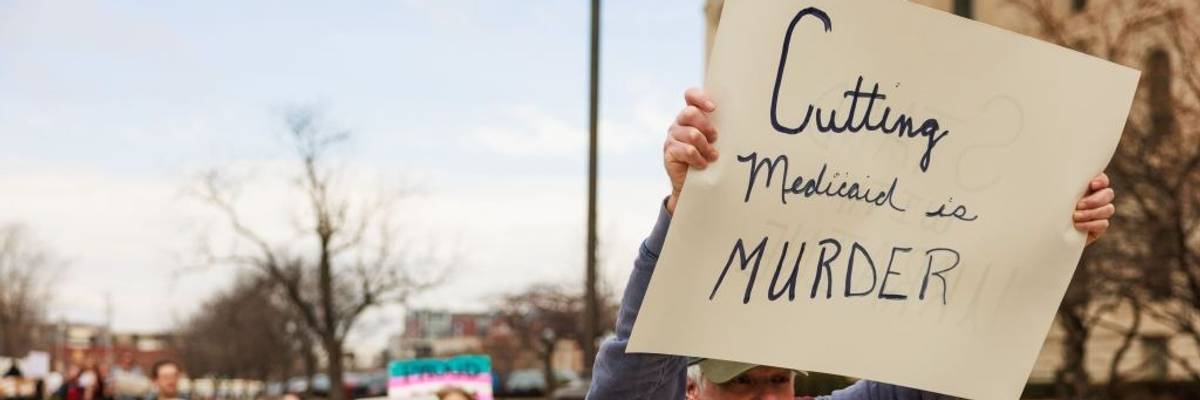
A protester holds a sign opposing Medicaid cuts during a demonstration against President Donald Trump in Indianapolis on March 4, 2025.
"If your 'red line' is taking away healthcare from millions of people, then you don't have a red line."
A key House Republican said Tuesday that he would be unwilling to accept more than $500 billion in Medicaid cuts in the GOP's emerging reconciliation package, a "red line" that drew swift mockery and condemnation from healthcare campaigners.
Rep. Don Bacon (R-Neb.), who is seen as a critical swing vote in the narrowly controlled Republican House, told Politico that his ceiling for Medicaid cuts over the next decade is a half-trillion dollars—a message he has privately delivered to President Donald Trump's White House.
Anthony Wright, executive director of Families USA, said in a statement Tuesday that a $500 billion cut to Medicaid "is not at all moderate, but massive—the biggest cut in the history of Medicaid, one that would force millions of Americans to lose coverage."
"Slashing Medicaid by hundreds of billions of dollars would force states like Nebraska to make the unholy choice to drop people from coverage, cut benefits, and/or cut payments to the providers we all rely on, or otherwise raise taxes," said Wright. "Medicaid cuts would be another wrecking ball to the health system and to the economy."
The Century Foundation has estimated that cutting federal Medicaid funding by $500 billion over a 10-year period would strip health coverage from more than 18 million children and more than 2 million adults with disabilities.
"If your 'red line' is taking away healthcare from millions of people, then you don't have a red line," said Kobie Christian, a spokesperson for the advocacy coalition Unrig Our Economy.
"Not one dollar should be cut from Medicaid to pay for one dollar of tax breaks for the rich."
Bacon also made clear Tuesday that he would support draconian changes to Medicaid that have been tried with disastrous results at the state level.
"They should be seeking the skill sets for better jobs," Bacon said in support of adding work requirements to Medicaid, despite an abundance of evidence showing that such mandates succeed only at booting people from the program, not increasing employment. (Most Medicaid recipients who are able to work already do.)
Brad Woodhouse, president of Protect Our Care, said in a statement that "as the GOP drafts their devastating budget, one thing remains true: Republicans in Congress want to make the largest Medicaid cuts in history to fund tax breaks for the wealthiest Americans."
"Whether it's a trillion dollars, half a trillion, or hundreds of billions in Medicaid cuts, no member of Congress can justify ripping healthcare away from some of the most vulnerable Americans to give tax breaks to the wealthy," said Woodhouse. "Not one dollar should be cut from Medicaid to pay for one dollar of tax breaks for the rich."
The "moderate" $500 billion Medicaid cut being pitched here would finance a $500 billion tax cut for millionaire business owners and the heirs of estates worth over $28 million per couple. There is nothing moderate about cutting low-income Americans' health care to pay for tax cuts for the rich.
[image or embed]
— Brendan Duke (@brendanvduke.bsky.social) April 29, 2025 at 4:14 PM
Congressional Republicans have previously backed budget plans that would allow $880 billion in Medicaid cuts over the next decade, as well as massive reductions in spending on federal nutrition assistance.
But the GOP push for Medicaid cuts to pay for another round of tax breaks that would largely benefit the wealthy has sparked outrage nationwide, and it appears some Republicans are feeling the pressure from constituents.
Rep. David Valadao (R-Calif.), whose district has the highest percentage of Medicaid recipients in the House GOP conference, raised concerns about deep Medicaid cuts in an interview with Politico on Tuesday.
But like Bacon, Valadao said he was open to proposals that experts say would bring disastrous consequences for Medicaid recipients. Politico noted that the California Republican "is leaving the door open to capping the overall funding for certain beneficiaries in the 41 states that have expanded Medicaid under the Affordable Care Act."
Edwin Park, a research professor at the Georgetown University McCourt School of Public Policy's Center for Children and Families, warned earlier this week that the per-capita funding cap Republicans are considering should "be viewed as just another proposal to sharply shift expansion costs to states by lowering the effective expansion matching rates, with the intent of undermining and eventually repealing the Medicaid expansion."
"That, in turn, would take away coverage from nearly 21 million low-income parents, people with disabilities, near-elderly adults, and others," Park wrote. "It would also have significant adverse effects on the children of expansion adults: Research shows that the Medicaid expansion increases enrollment among eligible children and therefore reduces the number of uninsured children."
"And, of course, it would also deter the 10 remaining non-expansion states from taking up the expansion in the future," he added.
Dear Common Dreams reader, It’s been nearly 30 years since I co-founded Common Dreams with my late wife, Lina Newhouser. We had the radical notion that journalism should serve the public good, not corporate profits. It was clear to us from the outset what it would take to build such a project. No paid advertisements. No corporate sponsors. No millionaire publisher telling us what to think or do. Many people said we wouldn't last a year, but we proved those doubters wrong. Together with a tremendous team of journalists and dedicated staff, we built an independent media outlet free from the constraints of profits and corporate control. Our mission has always been simple: To inform. To inspire. To ignite change for the common good. Building Common Dreams was not easy. Our survival was never guaranteed. When you take on the most powerful forces—Wall Street greed, fossil fuel industry destruction, Big Tech lobbyists, and uber-rich oligarchs who have spent billions upon billions rigging the economy and democracy in their favor—the only bulwark you have is supporters who believe in your work. But here’s the urgent message from me today. It's never been this bad out there. And it's never been this hard to keep us going. At the very moment Common Dreams is most needed, the threats we face are intensifying. We need your support now more than ever. We don't accept corporate advertising and never will. We don't have a paywall because we don't think people should be blocked from critical news based on their ability to pay. Everything we do is funded by the donations of readers like you. When everyone does the little they can afford, we are strong. But if that support retreats or dries up, so do we. Will you donate now to make sure Common Dreams not only survives but thrives? —Craig Brown, Co-founder |
A key House Republican said Tuesday that he would be unwilling to accept more than $500 billion in Medicaid cuts in the GOP's emerging reconciliation package, a "red line" that drew swift mockery and condemnation from healthcare campaigners.
Rep. Don Bacon (R-Neb.), who is seen as a critical swing vote in the narrowly controlled Republican House, told Politico that his ceiling for Medicaid cuts over the next decade is a half-trillion dollars—a message he has privately delivered to President Donald Trump's White House.
Anthony Wright, executive director of Families USA, said in a statement Tuesday that a $500 billion cut to Medicaid "is not at all moderate, but massive—the biggest cut in the history of Medicaid, one that would force millions of Americans to lose coverage."
"Slashing Medicaid by hundreds of billions of dollars would force states like Nebraska to make the unholy choice to drop people from coverage, cut benefits, and/or cut payments to the providers we all rely on, or otherwise raise taxes," said Wright. "Medicaid cuts would be another wrecking ball to the health system and to the economy."
The Century Foundation has estimated that cutting federal Medicaid funding by $500 billion over a 10-year period would strip health coverage from more than 18 million children and more than 2 million adults with disabilities.
"If your 'red line' is taking away healthcare from millions of people, then you don't have a red line," said Kobie Christian, a spokesperson for the advocacy coalition Unrig Our Economy.
"Not one dollar should be cut from Medicaid to pay for one dollar of tax breaks for the rich."
Bacon also made clear Tuesday that he would support draconian changes to Medicaid that have been tried with disastrous results at the state level.
"They should be seeking the skill sets for better jobs," Bacon said in support of adding work requirements to Medicaid, despite an abundance of evidence showing that such mandates succeed only at booting people from the program, not increasing employment. (Most Medicaid recipients who are able to work already do.)
Brad Woodhouse, president of Protect Our Care, said in a statement that "as the GOP drafts their devastating budget, one thing remains true: Republicans in Congress want to make the largest Medicaid cuts in history to fund tax breaks for the wealthiest Americans."
"Whether it's a trillion dollars, half a trillion, or hundreds of billions in Medicaid cuts, no member of Congress can justify ripping healthcare away from some of the most vulnerable Americans to give tax breaks to the wealthy," said Woodhouse. "Not one dollar should be cut from Medicaid to pay for one dollar of tax breaks for the rich."
The "moderate" $500 billion Medicaid cut being pitched here would finance a $500 billion tax cut for millionaire business owners and the heirs of estates worth over $28 million per couple. There is nothing moderate about cutting low-income Americans' health care to pay for tax cuts for the rich.
[image or embed]
— Brendan Duke (@brendanvduke.bsky.social) April 29, 2025 at 4:14 PM
Congressional Republicans have previously backed budget plans that would allow $880 billion in Medicaid cuts over the next decade, as well as massive reductions in spending on federal nutrition assistance.
But the GOP push for Medicaid cuts to pay for another round of tax breaks that would largely benefit the wealthy has sparked outrage nationwide, and it appears some Republicans are feeling the pressure from constituents.
Rep. David Valadao (R-Calif.), whose district has the highest percentage of Medicaid recipients in the House GOP conference, raised concerns about deep Medicaid cuts in an interview with Politico on Tuesday.
But like Bacon, Valadao said he was open to proposals that experts say would bring disastrous consequences for Medicaid recipients. Politico noted that the California Republican "is leaving the door open to capping the overall funding for certain beneficiaries in the 41 states that have expanded Medicaid under the Affordable Care Act."
Edwin Park, a research professor at the Georgetown University McCourt School of Public Policy's Center for Children and Families, warned earlier this week that the per-capita funding cap Republicans are considering should "be viewed as just another proposal to sharply shift expansion costs to states by lowering the effective expansion matching rates, with the intent of undermining and eventually repealing the Medicaid expansion."
"That, in turn, would take away coverage from nearly 21 million low-income parents, people with disabilities, near-elderly adults, and others," Park wrote. "It would also have significant adverse effects on the children of expansion adults: Research shows that the Medicaid expansion increases enrollment among eligible children and therefore reduces the number of uninsured children."
"And, of course, it would also deter the 10 remaining non-expansion states from taking up the expansion in the future," he added.
A key House Republican said Tuesday that he would be unwilling to accept more than $500 billion in Medicaid cuts in the GOP's emerging reconciliation package, a "red line" that drew swift mockery and condemnation from healthcare campaigners.
Rep. Don Bacon (R-Neb.), who is seen as a critical swing vote in the narrowly controlled Republican House, told Politico that his ceiling for Medicaid cuts over the next decade is a half-trillion dollars—a message he has privately delivered to President Donald Trump's White House.
Anthony Wright, executive director of Families USA, said in a statement Tuesday that a $500 billion cut to Medicaid "is not at all moderate, but massive—the biggest cut in the history of Medicaid, one that would force millions of Americans to lose coverage."
"Slashing Medicaid by hundreds of billions of dollars would force states like Nebraska to make the unholy choice to drop people from coverage, cut benefits, and/or cut payments to the providers we all rely on, or otherwise raise taxes," said Wright. "Medicaid cuts would be another wrecking ball to the health system and to the economy."
The Century Foundation has estimated that cutting federal Medicaid funding by $500 billion over a 10-year period would strip health coverage from more than 18 million children and more than 2 million adults with disabilities.
"If your 'red line' is taking away healthcare from millions of people, then you don't have a red line," said Kobie Christian, a spokesperson for the advocacy coalition Unrig Our Economy.
"Not one dollar should be cut from Medicaid to pay for one dollar of tax breaks for the rich."
Bacon also made clear Tuesday that he would support draconian changes to Medicaid that have been tried with disastrous results at the state level.
"They should be seeking the skill sets for better jobs," Bacon said in support of adding work requirements to Medicaid, despite an abundance of evidence showing that such mandates succeed only at booting people from the program, not increasing employment. (Most Medicaid recipients who are able to work already do.)
Brad Woodhouse, president of Protect Our Care, said in a statement that "as the GOP drafts their devastating budget, one thing remains true: Republicans in Congress want to make the largest Medicaid cuts in history to fund tax breaks for the wealthiest Americans."
"Whether it's a trillion dollars, half a trillion, or hundreds of billions in Medicaid cuts, no member of Congress can justify ripping healthcare away from some of the most vulnerable Americans to give tax breaks to the wealthy," said Woodhouse. "Not one dollar should be cut from Medicaid to pay for one dollar of tax breaks for the rich."
The "moderate" $500 billion Medicaid cut being pitched here would finance a $500 billion tax cut for millionaire business owners and the heirs of estates worth over $28 million per couple. There is nothing moderate about cutting low-income Americans' health care to pay for tax cuts for the rich.
[image or embed]
— Brendan Duke (@brendanvduke.bsky.social) April 29, 2025 at 4:14 PM
Congressional Republicans have previously backed budget plans that would allow $880 billion in Medicaid cuts over the next decade, as well as massive reductions in spending on federal nutrition assistance.
But the GOP push for Medicaid cuts to pay for another round of tax breaks that would largely benefit the wealthy has sparked outrage nationwide, and it appears some Republicans are feeling the pressure from constituents.
Rep. David Valadao (R-Calif.), whose district has the highest percentage of Medicaid recipients in the House GOP conference, raised concerns about deep Medicaid cuts in an interview with Politico on Tuesday.
But like Bacon, Valadao said he was open to proposals that experts say would bring disastrous consequences for Medicaid recipients. Politico noted that the California Republican "is leaving the door open to capping the overall funding for certain beneficiaries in the 41 states that have expanded Medicaid under the Affordable Care Act."
Edwin Park, a research professor at the Georgetown University McCourt School of Public Policy's Center for Children and Families, warned earlier this week that the per-capita funding cap Republicans are considering should "be viewed as just another proposal to sharply shift expansion costs to states by lowering the effective expansion matching rates, with the intent of undermining and eventually repealing the Medicaid expansion."
"That, in turn, would take away coverage from nearly 21 million low-income parents, people with disabilities, near-elderly adults, and others," Park wrote. "It would also have significant adverse effects on the children of expansion adults: Research shows that the Medicaid expansion increases enrollment among eligible children and therefore reduces the number of uninsured children."
"And, of course, it would also deter the 10 remaining non-expansion states from taking up the expansion in the future," he added.