May, 18 2015, 10:15am EDT
#YouShellNotPass Blockades Shut Down Terminal 5
Where: Harbor Island Fishing Dock (Spokane Street over the East Channel of the Duwamish River)
When: Monday, May 18, 7am
More Information: https://www.facebook.com/events/882064961859930/
Hundreds of people plan to blockade the gates to Terminal 5 at the Port of Seattle, stopping work on Shell's Arctic Drilling rig Polar Pioneer. Some have chained themselves together or locked themselves to heavy objects while hundreds will hold a mass sit-in.
SEATTLE, WA
Where: Harbor Island Fishing Dock (Spokane Street over the East Channel of the Duwamish River)
When: Monday, May 18, 7am
More Information: https://www.facebook.com/events/882064961859930/
Hundreds of people plan to blockade the gates to Terminal 5 at the Port of Seattle, stopping work on Shell's Arctic Drilling rig Polar Pioneer. Some have chained themselves together or locked themselves to heavy objects while hundreds will hold a mass sit-in.
"Everyone is out here today, we have scientists, teachers and city councilmembers risking arrest because they understand the severity of this moment," said Sarra Tekola a student with Divest University of Washington who recently won a vote to divest their school's endowment from Coal. "Climate change isn't a polar bear issue it's a human rights issue, climate change displaces people from their countries, 40 years ago desertification kicked my father out of his country in Ethiopia and it's going to get worse. This is our lunch counter to sit on, this is our history to be made, we hold the world in our hands."
A loose network of several dozen groups calling themselves the sHell No! Action Council (SNAC) organized today's action. SNAC has focused their opposition to Arctic Drilling on the impacts of Global Warming on the impacts on peoples in the Global South and indigenous communities.
"For the past few years, the Philippines has ranked highly as a country most vulnerable to climate change. My heart fills with dread every time I hear another news report on an extreme weather event in the Philippines, where my family still lives" says Bayan PNW Coordinator Katrina Pestano. "As the U.S. consumes 20% of the world's energy resources, we Filipino Americans believe it is our duty to organize for more renewable energy sources and against activities that would extract fossil fuels from the earth," added Katrina. "Islands like the Philippines continue to disproportionately face the brunt of disaster brought on by global climate change."
City Councilmember Kshama Sawant joined hundreds of Seattlites prepared to risk arrest in today's action. While the majority of participants were local, some travelled from as far as the east coast and the gulf south.
"Just last week I was at a rally in front of a polluting Shell asphalt refinery in Saint Rose, Louisiana. Neighbors there are sick from Shell's pollution. Shell cannot safely operate the facilities it already has. There's no way this company should be allowed to drill in the Arctic," said Anne Rolfes, a New Orleans resident participating in today's action.
Others traveled from Alaska to show their opposition to Shell's plans, including a number of Alaskan Native activists.
"I'm here as an Inupiaq person to support and stand with the activists and kayaktivists in the effort to keep the Arctic Ocean free of drilling for oil. Quyanaqpak for helping protect our way of life," said Allison Warden, who travelled to Seattle from the Arctic for this weekend's events.
Part of the group locked down are the Seattle Raging Grannies. "My generation is responsible for the way things are and we owe it to our children and grandchildren to stand up to make a change and protect their future" said Annette Clapstein.
Zarna Joshi dressed in a sari and holding a sign that says Vande Mataram, I bow to my mother, said. "I will not allow the future of our planet, my mother, to be destroyed by this greedy, short sighted, capitalist system that is utterly failing the people." She says she wants to invite her Indian brothers and sisters to join in this fight for our future.
Organizers with the sHell No! Action Council say the process they used to organize their protests was just as important as the outcomes. The council called mass meetings and used a spokescouncil modeled off the planning for the 1999 WTO protests. Over 200 people participated in democratic planning for today's actions.
"Today we're not just shutting down Shell, we're challenging corporate capitalism, imperialism and colonialism with a vision of people power and true mass democracy," said Ahmed Gaya an organizer with Rising Tide Seattle, one of the groups participating in the sHell No! Action Council.
###
Spokespeople
Katrina Pestano, Bayan PNW Coordinator - 206-403-0349
Joaquin Uy, Bayan PNW - 206-427-2999
Anne Rolfes, Louisiana Bucket Brigade - 504-452-4909
Jill Mangaliman, Got Green Executive Director - jill@gotgreen.org
JM Wong, Parisol - dameimee247854@gmail.com
Ahmed Gaya - Rising Tide Seattle, 773-960-2587
Emily Johnston - 350 Seattle, 206-407-5003
LATEST NEWS
After Mills Exit, Platner Vows to Defeat Collins With 'Movement of Working Mainers'
Graham Platner, now the presumptive Democratic nominee in Maine's US Senate race, said that "we are now taking back our power.”
Apr 30, 2026
Graham Platner, now the presumptive Democratic nominee for the US Senate in Maine, delivered a preview of his general election pitch to voters on Thursday hours after his top primary rival, Maine Gov. Janet Mills, suspended her campaign.
Speaking to supporters in Augusta, Platner characterized his Senate bid as part of a broader effort to restore power to working-class Americans who for decades have been beaten down by big money interests.
"The race has never really been about me or any one person," said Platner. "It's about a movement of working Mainers who are fed up with being robbed by billionaires and the politicians who own them. We are now taking back our power."
Platner vowed to defeat incumbent Sen. Susan Collins (R-Maine), but he said the ultimate goal is to "start tearing down the system that, for too long, has forgotten and written off the people who make Maine and this country what it is."
Platner was joined by several Maine Democrats who were on hand to endorse his Senate bid.
Maine state Sen. Mike Tipping (D-08) said Platner must be elected to the US Senate because Collins "betrayed the people she was elected to serve."
Tipping warned that defeating Collins won't be easy because "we're about to see an ungodly amount of money spent in Maine, hundreds of millions of dollars more than ever before, and we're going to be flooded with ads."
Rather than being intimidated by the flood of corporate cash in the race, Tipping said that "we should get angrier every time we see, during the nightly news, or during a baseball game, or in the middle of a YouTube video, one of those ads, because we should remember that they were paid for by selling out Maine people."
Maine state Rep. Nina Milliken (D-16) said that Platner is "the type of leader that we don't see often enough," in part because "he understands that the path forward isn't about dropping to our knees for powerful people."
"At a moment when our democracy is under considerable strain," continued Milliken, "we need leaders who are willing to be clear about what's at stake. The answer to rising authoritarianism is not moderate half-measures or Band-Aids on severed limbs. It's building a movement that actually delivers for the people, one that's grounded in fairness, dignity, and economic justice."
While powerful national Democrats had backed Mills' candidacy in the primary, Senate Minority Leader Chuck Schumer (D-NY) and Democratic Senatorial Campaign Committee Chair Kirsten Gillibrand (D-NY) endorsed Platner shortly after the Maine governor suspended her campaign.
“After years of allowing Trump’s abuses of power, Senator Collins has never been more vulnerable,” they said, “and we will work with the presumptive Democratic nominee Graham Platner to defeat her.”
Keep ReadingShow Less
'This Is Piracy': Israel Condemned for Seizure of Gaza-Bound Flotilla Near Greece
"How on Earth," asked the UN's top Palestine expert, "is possible that Israel is allowed to assault and seize vessels in international waters just off Greece/Europe?"
Apr 30, 2026
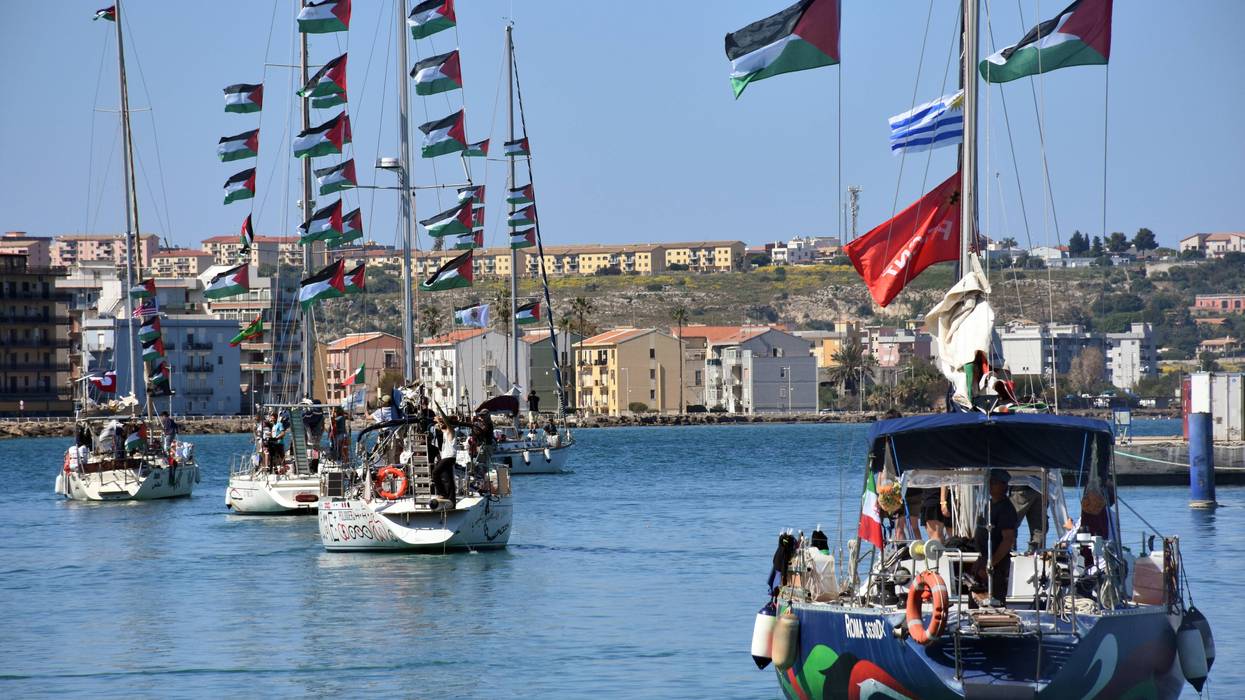
Palestine defenders on Thursday condemned Israeli forces' raidb of the latest Global Sumud Flotilla—which was sailing off the Greek coast while attempting to deliver humanitarian aid to Gaza—and the arrest of more than 200 of its participants, with some prominent critics calling the seizure an act of piracy.
Greenpeace International—whose MY Arctic Sunrise is the flotilla's most prominent ship—said that the maritime convoy's 58 vessels were "boarded and harassed by Israeli forces in international waters 45 nautical miles west of the Greek island Kythira and 600 nautical miles from Gaza."
Flotilla organizers said on X: “Our boats were approached by military speedboats, self-identified as ‘Israel’, pointing lasers and semi-automatic weapons ordering participants to the front of the boats and to get on their hands and knees. The boat communications are being jammed and an SOS was issued."
The organizers said 211 flotilla participants were seized by Israeli forces. Flotilla activist Yasmine Scola said members were "kidnapped."
Global Sumud France spokesperson Helene Coron said that 10 French nationals, including communist Paris City Council Member Raphaelle Primet, were seized.
"We don't have the information for the other nationalities, but the boats were mixed in terms of nationality, so there were crew members from all 48 delegations," Coron added.
Israel's Foreign Ministry said that "approximately 175 activists from more than 20 boats... are now making their way peacefully to Israel."
Responding to Israel's interception, former Greek Finance Minister Yanis Varoufakis said on social media that his country's government "is either complicit or incapable of defending our seas from Israel."
"So much for freedom of navigation and international law," he added.
Independent British Member of Parliament Jeremy Corbyn said of the flotilla members: "They were not intercepted. They were abducted in international waters. This is piracy—and is a flagrant violation of international law."
Another British lawmaker, Labour MP Bell Ribeiro-Addy, wrote on X that "last night, Israel's navy committed an act of armed piracy in international waters, threatening unarmed civilians aboard."
"Our government must condemn this attack, extend diplomatic protection to British participants, and work to ensure safe passage," she added.
The migrant search and rescue group SOS Mediterranee France said on X that "attacking or threatening" Global Sumud Flotilla vessels "in international waters constitutes a violation of maritime law."
"Furthermore, the Geneva Conventions are clear: Any person engaged in a humanitarian mission must be protected. Solidarity is not a crime, Preventing aid, however, is," the group added.
In the United States, Council on American-Islamic Relations executive director Nihad Awad said in a statement that “Congress must demand that the Israeli apartheid government immediately release the American citizens and other humanitarian activists it kidnapped in international waters in a blatant violation of international law."
"Our nation would not tolerate, much less fund, the kidnapping of American citizens in international waters off the coast of Greece by any other state," Awad added. "It is long past time for the out-of-control Netanyahu regime to face consequences of its crimes, including American citizens.”
The United States supports Israel with tens of billions of dollars in armed aid, and diplomatic cover including repeated vetoes of United Nations Security Council cease-fire resolutions for Gaza.
Last year, dozens of boats carrying hundreds of activists from over 40 nations took part in the last Global Sumud Flotilla—sumud means “perseverance” in Arabic—as it attempted to break Israel’s naval blockade and deliver desperately needed humanitarian aid including food, medicines, and baby formula to starving Gazans amid a growing famine.
Israeli forces intercepted and seized the flotilla vessels in international waters in early October, arresting all aboard the boats and temporarily jailing them in Israel.
In 2010, Israeli forces raided one of the first convoys carrying humanitarian aid to Gaza by sea. The attackers killed nine volunteers aboard the MV Mavi Marmara, including Turkish-American teenager Furkan Doğan.
Members of past Gaza flotillas have reported abuse at the hands of their Israeli captors, although they have urged the world to focus not on them, but rather the people of Gaza, who have endured nearly 31 months of genocidal war and siege.
More than 250,000 Palestinians have been killed or wounded by Israeli forces since the Hamas-led attack of October 7, 2023, including thousands who are still missing and presumed dead and buried beneath rubble. Most victims are civilians. Around 2 million other Gazans have been forcibly displaced, starved, or sickened.
Israel—whose prime minister, Benjamin Netanyahu, is wanted by the International Criminal Court for alleged crimes against humanity and war crimes in Gaza—is facing an ongoing genocide case at the International Court of Justice in The Hague.
The Israeli government continues to blockade Gaza by land and sea, strictly limiting the entry of humanitarian aid into the besieged coastal strip.
“We renew our call on world leaders to take concrete and immediate action in the face of the genocide being inflicted by Israel on the people of Gaza," Pujarini Sen, project lead aboard the Arctic Sunrise, said Thursday. "The international community’s ongoing failure to enforce international law leaves it culpable for Israel’s actions."
Keep ReadingShow Less

'Only the Beginning': Santa Marta Summit Heralded as New Dawn in Fight to End Fossil Fuel Era
“Amid a tense geopolitical context and worsening climate extremes, Santa Marta helped spark a feeling of renewed energy, but delegates must now follow through to deliver action, not just words," said a senior climate adviser at Greenpeace.
Apr 30, 2026
Environmental activists are hopeful after a six-day climate summit in Colombia resulted in a coalition of more than 50 countries agreeing to start developing plans to move away from planet-heating fossil fuels. But they say action must now follow talk.
In marked contrast to the annual United Nations climate summits, which have been routinely overrun by oil and gas industry lobbyists and concluded with agreements that largely ignore the imperative to divest from fossil fuels, Shiva Gounden, the head of Greenpeace's delegation this week in Santa Marta, said the conference that concluded Wednesday "was a breath of fresh air, a real sign that the wind is finally shifting."
The 59 nations that attended the First Conference on Transitioning Away from Fossil Fuels did not ultimately end with a binding agreement to transition away from fossil fuels within a specific timeframe, which activists say is urgently necessary as global heating rapidly approaches 1.5°C above preindustrial levels.
Many of the world's biggest polluters—including the United States, China, and India, as well as petrostates like Saudi Arabia, Qatar, and the United Arab Emirates—were also absent.
However, the summit did end with attendees, nearly half of whom are fossil fuel producers and who represent more than half of global gross domestic product, agreeing to form tangible "frameworks" for how they plan to transition away from a fossil-fueled model of capitalism that Colombian President Gustavo Petro decried as "suicidal."
Perhaps the single biggest breakthrough at the conference was France's unveiling of a national roadmap to phase out fossil fuels in the coming decades. It became the first developed nation to lay out such a plan, with the goals of removing coal from its national grid by 2027, phasing out oil by 2045, and fossil gas by 2050.
The French climate envoy, Benoit Faraco, described it not only as an obligation but an opportunity: “This process has made us realise we want to be an electro-superpower,” he said, according to The Guardian. “We want to be the electricity Saudi Arabia of Europe, selling green electrons to the UK, Ireland, Germany, and other countries.”
Many attendees also agreed that any collective movement away from fossil fuels would require addressing the debt crisis in the Global South, which many countries—especially those in Africa, where national debts have doubled in the past five years—have found themselves cranking up fossil fuel production to cope with.
While the conference concluded without any binding plan for debt forgiveness, which many delegates from developing countries had proposed, the participants agreed that poorer countries would need support to move out of debt and finance a green transition.
"Fossil fuel dependency deepens economic instability, fuels conflict, and traps countries in cycles of debt," said Bronwen Tucker, public finance lead for Oil Change International. "As long as Global South countries remain locked in this system, while Global North governments write the financial rules, public resources will continue to flow away from people and toward the systems driving crisis."
Laura Caicedo, the campaigns coordinator at Greenpeace Colombia, described the conference as "an important space to put the just energy transition on the agenda ahead of the Climate COP," which will take place in Turkey this coming November.
"There is willingness and a sense of fresh momentum that is worth celebrating," she said. "But this is only the beginning: more time is needed for this process to mature into a true platform for dialogue that can inform decision-making in this and other cooperation spaces on key energy issues."
The next conference on Transitioning Away From Fossil Fuels is set to occur early next year in Tuvalu, a low-lying Pacific island nation that is at risk of becoming uninhabitable within decades due to sea-level rise.
While climate activists were heartened by the progress made in Santa Marta, Gounden said countries need to come to Tuvalu with concrete plans.
“When we get to Tuvalu, the conversation has to change," she said. "We can’t just bring more ambition; we have to bring proof of implementation."
This week's conference took place against the backdrop of the US and Israel's war in Iran, where US President Donald Trump has suggested a key goal is to "take the oil" controlled by Iran. The obstruction of oil shipments has become a critical piece of strategic and economic leverage and simultaneously inflicted chaos upon the global economy, disrupting humanitarian aid for some of the world's poorest and most vulnerable people.
"Amid a tense geopolitical context and worsening climate extremes," said Rodrigo Estrada, Greenpeace International's senior climate adviser, "Santa Marta helped spark a feeling of renewed energy, but delegates must now follow through to deliver action, not just words."
While the war has sent energy companies' profits soaring, the climate advocacy group 350.org estimated this week that the continued blockade of the Strait of Hormuz could cost households and businesses an additional $600 billion to $1 trillion.
"It’s never been clearer that fossil fuel phase-out is imperative for stability and peace," Tucker said. "Every step away from fossil fuels weakens the outsized power and wealth that allows the US to wage illegal wars in the name of energy dominance."
At the next conference, she added, "The richest polluting countries must show they are serious. Canada, Norway, the UK, and the EU must make real plans to accelerate their fossil fuel phaseout at home and come to the table with real economic collaboration."
Mariana Paoli, the climate policy lead for Oxfam, said the lack of action by rich countries was "disappointing" and needed to change.
"Wealthy governments have still not stepped up to provide sufficient climate financing for poorer countries, which face the brunt of the impacts of the climate crisis," she said. "Rich countries hold the historical responsibility for the climate crisis, therefore they must not only move first and faster but also provide finance at scale for others to follow them."
"A just transition," she said, "must make rich polluters pay for the crisis they have caused."
Keep ReadingShow Less
Most Popular