SUBSCRIBE TO OUR FREE NEWSLETTER
Daily news & progressive opinion—funded by the people, not the corporations—delivered straight to your inbox.
5
#000000
#FFFFFF
To donate by check, phone, or other method, see our More Ways to Give page.
Daily news & progressive opinion—funded by the people, not the corporations—delivered straight to your inbox.
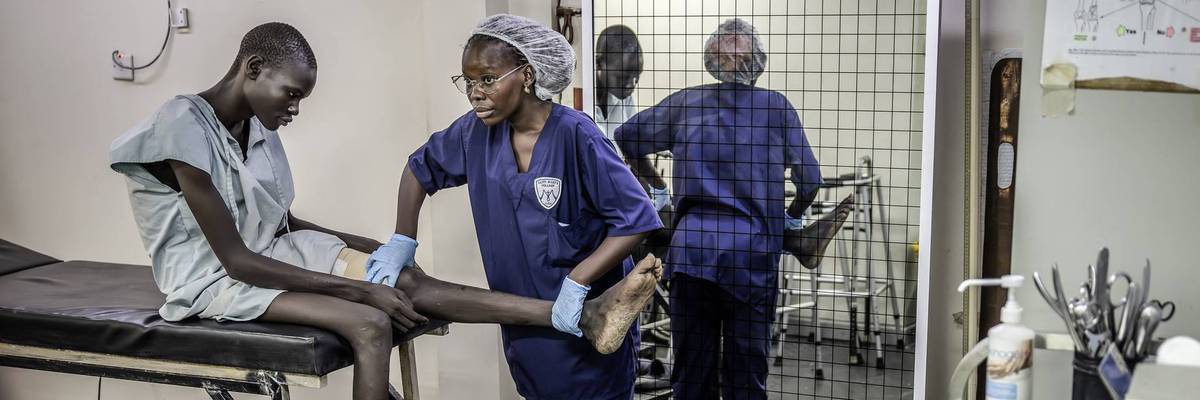
A rehabilitation nurse guides a patient through exercises at the International Committee of the Red Cross-supported rehabilitation ward in Juba Military Hospital in Juba, South Sudan on February 19, 2026.
“With global humanitarian needs already at record levels, further escalation of the conflict in the Middle East and wider region will have grave ramifications for crises across the world,” said one advocate.
The US-Israeli war against Iran has unleashed a "triple emergency" that is draining the global humanitarian aid system of resources and putting millions of the world's most vulnerable people at even greater risk, according to a dire warning issued Friday by the International Rescue Committee.
The war has already resulted in the deaths of thousands and the displacement of millions of people in Iran and Lebanon. But the IRC says that the ripple effects of the war are beginning to spread to conflict zones across the world.
The conflict has caused many nations in the region to partially or fully close their airspace, leaving critical cargo stranded.
Meanwhile, Iran’s closure of the Strait of Hormuz in retaliation for US and Israeli attacks has disrupted the flow of more than 20% of the world’s oil exports, sharply raising transport costs and straining budgets that could go toward lifesaving aid.
“Medical aid is highly dependent on international transport,” said Willem Zuidema, Save the Children’s global supply chain director. “The blockage in the Strait of Hormuz, combined with spiking cost for insurance and fuel, is directly impacting patients in our health facilities, at the worst time possible.”
IRC said $130,000 worth of pharmaceutical aid intended for its humanitarian response to the conflict in Sudan has been left stranded in Dubai due to the strait's closure.
According to Save the Children, this delay has put 90 primary healthcare facilities across Sudan at risk of running low on supplies.
More than 400,000 children, the group estimated, could be affected by the inability to receive antibiotics, antimalarial drugs, pain and fever medications, and other treatments.
The group said it has been forced to deliver the aid using the much more costly method of transporting it across Jeddah, where it will be carried by sea freight to Sudan, which the group said could add as much as $1,000-2,000 per container.
The same is true of humanitarian zones in Afghanistan and Yemen, where treatments for thousands of children must now be delivered by air or by land, dramatically raising the costs.
The closure of the strait has also forced many vessels carrying aid to find alternative routes. IRC said its shipping partners have been forced to reroute their operations to instead travel around Africa's Cape of Good Hope, adding up to a month for ocean freight deliveries to war zones on the continent.
"What we are seeing is the war in Iran unleashing a triple emergency," said David Milliband, the president and CEO of IRC.
"First, a surge in humanitarian need, with Lebanon now the most visible humanitarian scar and one of the fastest-growing displacement crises in the world, with over one million people forced from their homes in weeks," he said.
"Second, a global economic shock, as disruptions to food, fuel, and fertilizer markets, putting up to 30% of fertilizer trade at risk, threatens more than 300 million people already facing acute food insecurity," said Milliband, and "third, a system under strain, with more than 60 conflicts stretching diplomatic attention and funding to a breaking point, pushing crises like Sudan and Gaza further down the list of priorities."
Milliband marveled at the priorities of the powers prosecuting the war. He pointed to a recent estimate from the Pentagon that the first six days of the war alone cost $11.3 billion, noting that "just $4 billion is enough to pay for treatment for every acutely malnourished child in the world."
Zuidema said that the "grave ripple effects" caused by the war are exacerbated by the fact that "governments are cutting vital foreign aid budgets."
He called on all parties to the war to cease hostilities and to adhere to their obligations under international law, including allowing the free flow of humanitarian aid.
“There should be no barriers to lifesaving supplies: Exemptions should be put in place to allow humanitarian supplies, fertilizer, and food to be able to move through the Strait of Hormuz,” Zuidema said. “With global humanitarian needs already at record levels, further escalation of the conflict in the Middle East and wider region will have grave ramifications for crises across the world.”
Dear Common Dreams reader, It’s been nearly 30 years since I co-founded Common Dreams with my late wife, Lina Newhouser. We had the radical notion that journalism should serve the public good, not corporate profits. It was clear to us from the outset what it would take to build such a project. No paid advertisements. No corporate sponsors. No millionaire publisher telling us what to think or do. Many people said we wouldn't last a year, but we proved those doubters wrong. Together with a tremendous team of journalists and dedicated staff, we built an independent media outlet free from the constraints of profits and corporate control. Our mission has always been simple: To inform. To inspire. To ignite change for the common good. Building Common Dreams was not easy. Our survival was never guaranteed. When you take on the most powerful forces—Wall Street greed, fossil fuel industry destruction, Big Tech lobbyists, and uber-rich oligarchs who have spent billions upon billions rigging the economy and democracy in their favor—the only bulwark you have is supporters who believe in your work. But here’s the urgent message from me today. It's never been this bad out there. And it's never been this hard to keep us going. At the very moment Common Dreams is most needed, the threats we face are intensifying. We need your support now more than ever. We don't accept corporate advertising and never will. We don't have a paywall because we don't think people should be blocked from critical news based on their ability to pay. Everything we do is funded by the donations of readers like you. When everyone does the little they can afford, we are strong. But if that support retreats or dries up, so do we. Will you donate now to make sure Common Dreams not only survives but thrives? —Craig Brown, Co-founder |
The US-Israeli war against Iran has unleashed a "triple emergency" that is draining the global humanitarian aid system of resources and putting millions of the world's most vulnerable people at even greater risk, according to a dire warning issued Friday by the International Rescue Committee.
The war has already resulted in the deaths of thousands and the displacement of millions of people in Iran and Lebanon. But the IRC says that the ripple effects of the war are beginning to spread to conflict zones across the world.
The conflict has caused many nations in the region to partially or fully close their airspace, leaving critical cargo stranded.
Meanwhile, Iran’s closure of the Strait of Hormuz in retaliation for US and Israeli attacks has disrupted the flow of more than 20% of the world’s oil exports, sharply raising transport costs and straining budgets that could go toward lifesaving aid.
“Medical aid is highly dependent on international transport,” said Willem Zuidema, Save the Children’s global supply chain director. “The blockage in the Strait of Hormuz, combined with spiking cost for insurance and fuel, is directly impacting patients in our health facilities, at the worst time possible.”
IRC said $130,000 worth of pharmaceutical aid intended for its humanitarian response to the conflict in Sudan has been left stranded in Dubai due to the strait's closure.
According to Save the Children, this delay has put 90 primary healthcare facilities across Sudan at risk of running low on supplies.
More than 400,000 children, the group estimated, could be affected by the inability to receive antibiotics, antimalarial drugs, pain and fever medications, and other treatments.
The group said it has been forced to deliver the aid using the much more costly method of transporting it across Jeddah, where it will be carried by sea freight to Sudan, which the group said could add as much as $1,000-2,000 per container.
The same is true of humanitarian zones in Afghanistan and Yemen, where treatments for thousands of children must now be delivered by air or by land, dramatically raising the costs.
The closure of the strait has also forced many vessels carrying aid to find alternative routes. IRC said its shipping partners have been forced to reroute their operations to instead travel around Africa's Cape of Good Hope, adding up to a month for ocean freight deliveries to war zones on the continent.
"What we are seeing is the war in Iran unleashing a triple emergency," said David Milliband, the president and CEO of IRC.
"First, a surge in humanitarian need, with Lebanon now the most visible humanitarian scar and one of the fastest-growing displacement crises in the world, with over one million people forced from their homes in weeks," he said.
"Second, a global economic shock, as disruptions to food, fuel, and fertilizer markets, putting up to 30% of fertilizer trade at risk, threatens more than 300 million people already facing acute food insecurity," said Milliband, and "third, a system under strain, with more than 60 conflicts stretching diplomatic attention and funding to a breaking point, pushing crises like Sudan and Gaza further down the list of priorities."
Milliband marveled at the priorities of the powers prosecuting the war. He pointed to a recent estimate from the Pentagon that the first six days of the war alone cost $11.3 billion, noting that "just $4 billion is enough to pay for treatment for every acutely malnourished child in the world."
Zuidema said that the "grave ripple effects" caused by the war are exacerbated by the fact that "governments are cutting vital foreign aid budgets."
He called on all parties to the war to cease hostilities and to adhere to their obligations under international law, including allowing the free flow of humanitarian aid.
“There should be no barriers to lifesaving supplies: Exemptions should be put in place to allow humanitarian supplies, fertilizer, and food to be able to move through the Strait of Hormuz,” Zuidema said. “With global humanitarian needs already at record levels, further escalation of the conflict in the Middle East and wider region will have grave ramifications for crises across the world.”
The US-Israeli war against Iran has unleashed a "triple emergency" that is draining the global humanitarian aid system of resources and putting millions of the world's most vulnerable people at even greater risk, according to a dire warning issued Friday by the International Rescue Committee.
The war has already resulted in the deaths of thousands and the displacement of millions of people in Iran and Lebanon. But the IRC says that the ripple effects of the war are beginning to spread to conflict zones across the world.
The conflict has caused many nations in the region to partially or fully close their airspace, leaving critical cargo stranded.
Meanwhile, Iran’s closure of the Strait of Hormuz in retaliation for US and Israeli attacks has disrupted the flow of more than 20% of the world’s oil exports, sharply raising transport costs and straining budgets that could go toward lifesaving aid.
“Medical aid is highly dependent on international transport,” said Willem Zuidema, Save the Children’s global supply chain director. “The blockage in the Strait of Hormuz, combined with spiking cost for insurance and fuel, is directly impacting patients in our health facilities, at the worst time possible.”
IRC said $130,000 worth of pharmaceutical aid intended for its humanitarian response to the conflict in Sudan has been left stranded in Dubai due to the strait's closure.
According to Save the Children, this delay has put 90 primary healthcare facilities across Sudan at risk of running low on supplies.
More than 400,000 children, the group estimated, could be affected by the inability to receive antibiotics, antimalarial drugs, pain and fever medications, and other treatments.
The group said it has been forced to deliver the aid using the much more costly method of transporting it across Jeddah, where it will be carried by sea freight to Sudan, which the group said could add as much as $1,000-2,000 per container.
The same is true of humanitarian zones in Afghanistan and Yemen, where treatments for thousands of children must now be delivered by air or by land, dramatically raising the costs.
The closure of the strait has also forced many vessels carrying aid to find alternative routes. IRC said its shipping partners have been forced to reroute their operations to instead travel around Africa's Cape of Good Hope, adding up to a month for ocean freight deliveries to war zones on the continent.
"What we are seeing is the war in Iran unleashing a triple emergency," said David Milliband, the president and CEO of IRC.
"First, a surge in humanitarian need, with Lebanon now the most visible humanitarian scar and one of the fastest-growing displacement crises in the world, with over one million people forced from their homes in weeks," he said.
"Second, a global economic shock, as disruptions to food, fuel, and fertilizer markets, putting up to 30% of fertilizer trade at risk, threatens more than 300 million people already facing acute food insecurity," said Milliband, and "third, a system under strain, with more than 60 conflicts stretching diplomatic attention and funding to a breaking point, pushing crises like Sudan and Gaza further down the list of priorities."
Milliband marveled at the priorities of the powers prosecuting the war. He pointed to a recent estimate from the Pentagon that the first six days of the war alone cost $11.3 billion, noting that "just $4 billion is enough to pay for treatment for every acutely malnourished child in the world."
Zuidema said that the "grave ripple effects" caused by the war are exacerbated by the fact that "governments are cutting vital foreign aid budgets."
He called on all parties to the war to cease hostilities and to adhere to their obligations under international law, including allowing the free flow of humanitarian aid.
“There should be no barriers to lifesaving supplies: Exemptions should be put in place to allow humanitarian supplies, fertilizer, and food to be able to move through the Strait of Hormuz,” Zuidema said. “With global humanitarian needs already at record levels, further escalation of the conflict in the Middle East and wider region will have grave ramifications for crises across the world.”