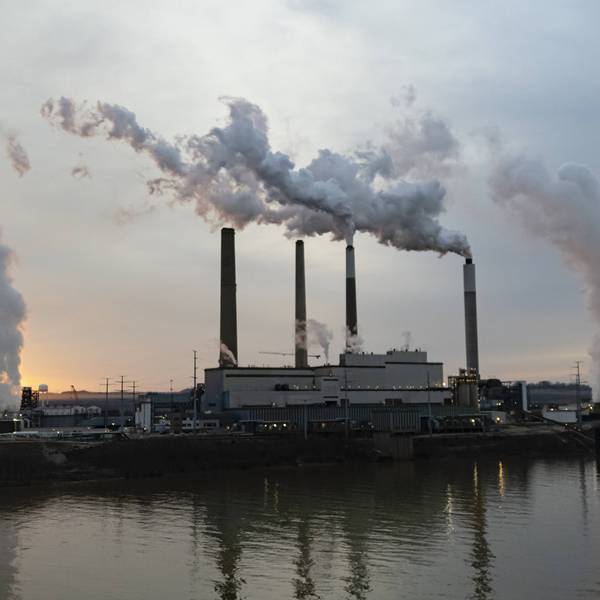

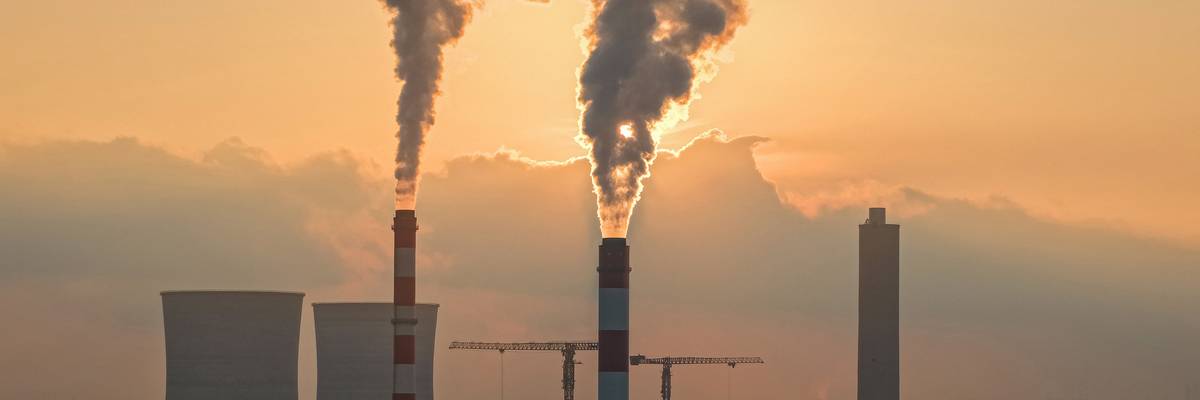
The photo taken on May 16, 2025 shows smoke rising from chimneys at a power plant during sunset in Taicang, in eastern China's Jiangsu province.
Ahead of COP30, UN Report Shows 1.5°C Will Be Breached as Countries Pledge Just 10% Emissions Cut
“The truth is that we have failed to avoid an overshooting above 1.5°C in the next few years," said UN chief António Guterres. "We don’t want to see the Amazon as a savannah. But that is a real risk if we don’t change course."
Ahead of the United Nations' global summit on the climate emergency in Belém, Brazil, a report on countries' climate plans released Tuesday served as both "a progress update and a warning siren," one campaigner said.
According to the Nationally Determined Contribution (NDC) Synthesis Report, governments have submitted plans to the UN that would reduce fossil fuel emissions by just 10% by 2035 compared to 2019 levels, a fraction of what is needed to keep the planet from warming more than 1.5°C above preindustrial temperatures.
The report includes climate action plans from fewer than a third of the nations that signed the Paris Agreement, the legally binding treaty demanding countries take action to limit planetary heating to 1.5°C, a decade ago.
China and the European Union have not yet submitted their NDCs ahead of the UN Climate Change Conference (COP30), and in the United States, President Donald Trump ordered the country's withdrawal from the Paris Agreement for a second time earlier this year and has been pushing for more fossil fuel extraction while dismantling renewable energy projects.
The report's projection includes a plan that was submitted by the US in the last weeks of the Biden administration, which Trump has said he has no plans to fulfill.
Without officially submitting an NDC, China has pledged to cut its carbon emissions by 7-10% of their peak by 2035, and the EU has been debating a reduction of 62-72.5%.
Judging from the commitments that have been made so far, UN Secretary-General António Guterres told The Guardian and Amazon-based news outlet Sumaúma that the 1.5°C goal will be breached, at least temporarily,
"Overshooting is now inevitable," he said, noting that an international goal should now be to reverse course on emissions in time to return to the 1.5°C mark by the end of the century.
“Let’s recognize our failure,” he told the outlets. “The truth is that we have failed to avoid an overshooting above 1.5°C in the next few years. And that going above 1.5°C has devastating consequences. Some of these devastating consequences are tipping points, be it in the Amazon, be it in Greenland, or western Antarctica or the coral reefs."
Guterres said it is "absolutely indispensable to change course in order to make sure that the overshoot is as short as possible and as low in intensity as possible to avoid tipping points like the Amazon. We don’t want to see the Amazon as a savannah. But that is a real risk if we don’t change course and if we don’t make a dramatic decrease of emissions as soon as possible.”
"The success of COP30 now hinges less on the maths of new targets and more on the politics closing the ambition gap and accelerating a fair and fast transition from fossil fuels to renewables.”
The report was released a week after Brazil's government announced it was opening up the Amazon rainforest to oil drilling even as the country is set to host COP30, where campaigners hope to focus on implementing climate action plans. Earlier this month, researchers in the United Kingdom found that the world's coral reefs have been driven to a tipping point by surging global temperatures.
“Ten years on from Paris, governments are still allowing fossil fuel companies to call the shots," said Illan Zugman, managing director for Latin America at 350.org. "We see progress in words, but not yet in the numbers. Every new oil field or gas terminal wipes out the gains made in these NDCs. Just kilometers from where COP30 will take place, new licenses are being given out. Real climate leadership means drawing the line on fossil fuels now."
Steffen Menzel, program lead for climate diplomacy and geopolitics at the think tank E3G, noted that "while some developed and developing countries are providing clear examples to follow, delays and lackluster pledges from major emitters such as the EU and China have undermined the effectiveness of the Paris Agreement.”
Despite their power and resources, said World Wildlife Fund global NDC enhancement coordinator Shirley Matheson, "major G20 economies still haven’t submitted their targets with less than a fortnight to go before COP30 begins."
“While countries are making genuine progress, the gap between words and action remains dangerously wide," said Matheson. “At COP30, the G20 must stop hesitating and start delivering. It’s time to turn the slow jog into a sprint by supercharging a clean and fair energy transition. This means increasing the share of renewable energy while phasing out fossil fuels, mobilizing climate finance, and ending deforestation and the wider destruction of nature. The world can’t afford delay disguised as diplomacy.”
Andreas Sieber, associate director of policy and campaigns at 350.org, emphasized that renewables in many countries "are booming and meet all new electricity demand this year and fossil fuels are finally showing signs of peaking."
"Yet, all progress is still far too slow," said Sieber. "The success of COP30 now hinges less on the maths of new targets and more on the politics closing the ambition gap and accelerating a fair and fast transition from fossil fuels to renewables.”
Zugman stressed that many governments around the world "have the technology, the money, and the public support for a clean energy transition."
"What’s missing is political courage," said Zugman. "Until we stop funding fossil fuels and start taxing their billions, we will keep losing precious time.”
We are at a crossroads
This country and this world are at a monumental crossroads. In a few short weeks, US voters will have an opportunity to beat back the forces of fascism and confront the billionaires who are rigging the economy, our media system, and our democracy, making it increasingly impossible for ordinary people to get by. We’re not just talking about the election. We’re talking about what must be done once these fascist elements are vanquished from power. We need a bolder set of solutions than what either major party has so far been willing to offer and a working-class movement ready to fight like hell for it. Trump didn't emerge from nowhere. The conditions that fueled MAGA authoritarianism were created by decades of radical neoliberal economic policies and a corrupt political system dominated by corporate interests. They slashed taxes on the super-rich, promising that the benefits would trickle down. They said giveaways to the corporate titans would make life more affordable for the rest of us. It was all bullshit. And when a bitter, betrayed populace searches for someone to blame, right-wing demagogues have little trouble finding scapegoats. People know when they're being lied to, but you won't hear any of this from the corporate media. Only independent journalism—powered and funded by people who believe in building a better world—can deliver truly trustworthy daily news. Our Fall Campaign is underway, and we need your help. To power our newsroom through the rest of the year, we need to raise $125,000 by midnight on October 31. So if you share our vision, please contribute whatever you can to sustain our work. |
Ahead of the United Nations' global summit on the climate emergency in Belém, Brazil, a report on countries' climate plans released Tuesday served as both "a progress update and a warning siren," one campaigner said.
According to the Nationally Determined Contribution (NDC) Synthesis Report, governments have submitted plans to the UN that would reduce fossil fuel emissions by just 10% by 2035 compared to 2019 levels, a fraction of what is needed to keep the planet from warming more than 1.5°C above preindustrial temperatures.
The report includes climate action plans from fewer than a third of the nations that signed the Paris Agreement, the legally binding treaty demanding countries take action to limit planetary heating to 1.5°C, a decade ago.
China and the European Union have not yet submitted their NDCs ahead of the UN Climate Change Conference (COP30), and in the United States, President Donald Trump ordered the country's withdrawal from the Paris Agreement for a second time earlier this year and has been pushing for more fossil fuel extraction while dismantling renewable energy projects.
The report's projection includes a plan that was submitted by the US in the last weeks of the Biden administration, which Trump has said he has no plans to fulfill.
Without officially submitting an NDC, China has pledged to cut its carbon emissions by 7-10% of their peak by 2035, and the EU has been debating a reduction of 62-72.5%.
Judging from the commitments that have been made so far, UN Secretary-General António Guterres told The Guardian and Amazon-based news outlet Sumaúma that the 1.5°C goal will be breached, at least temporarily,
"Overshooting is now inevitable," he said, noting that an international goal should now be to reverse course on emissions in time to return to the 1.5°C mark by the end of the century.
“Let’s recognize our failure,” he told the outlets. “The truth is that we have failed to avoid an overshooting above 1.5°C in the next few years. And that going above 1.5°C has devastating consequences. Some of these devastating consequences are tipping points, be it in the Amazon, be it in Greenland, or western Antarctica or the coral reefs."
Guterres said it is "absolutely indispensable to change course in order to make sure that the overshoot is as short as possible and as low in intensity as possible to avoid tipping points like the Amazon. We don’t want to see the Amazon as a savannah. But that is a real risk if we don’t change course and if we don’t make a dramatic decrease of emissions as soon as possible.”
"The success of COP30 now hinges less on the maths of new targets and more on the politics closing the ambition gap and accelerating a fair and fast transition from fossil fuels to renewables.”
The report was released a week after Brazil's government announced it was opening up the Amazon rainforest to oil drilling even as the country is set to host COP30, where campaigners hope to focus on implementing climate action plans. Earlier this month, researchers in the United Kingdom found that the world's coral reefs have been driven to a tipping point by surging global temperatures.
“Ten years on from Paris, governments are still allowing fossil fuel companies to call the shots," said Illan Zugman, managing director for Latin America at 350.org. "We see progress in words, but not yet in the numbers. Every new oil field or gas terminal wipes out the gains made in these NDCs. Just kilometers from where COP30 will take place, new licenses are being given out. Real climate leadership means drawing the line on fossil fuels now."
Steffen Menzel, program lead for climate diplomacy and geopolitics at the think tank E3G, noted that "while some developed and developing countries are providing clear examples to follow, delays and lackluster pledges from major emitters such as the EU and China have undermined the effectiveness of the Paris Agreement.”
Despite their power and resources, said World Wildlife Fund global NDC enhancement coordinator Shirley Matheson, "major G20 economies still haven’t submitted their targets with less than a fortnight to go before COP30 begins."
“While countries are making genuine progress, the gap between words and action remains dangerously wide," said Matheson. “At COP30, the G20 must stop hesitating and start delivering. It’s time to turn the slow jog into a sprint by supercharging a clean and fair energy transition. This means increasing the share of renewable energy while phasing out fossil fuels, mobilizing climate finance, and ending deforestation and the wider destruction of nature. The world can’t afford delay disguised as diplomacy.”
Andreas Sieber, associate director of policy and campaigns at 350.org, emphasized that renewables in many countries "are booming and meet all new electricity demand this year and fossil fuels are finally showing signs of peaking."
"Yet, all progress is still far too slow," said Sieber. "The success of COP30 now hinges less on the maths of new targets and more on the politics closing the ambition gap and accelerating a fair and fast transition from fossil fuels to renewables.”
Zugman stressed that many governments around the world "have the technology, the money, and the public support for a clean energy transition."
"What’s missing is political courage," said Zugman. "Until we stop funding fossil fuels and start taxing their billions, we will keep losing precious time.”
- 'Our New Reality': Planet Reaches First Climate Tipping Point With Coral Reef Dieback ›
- 'Historic Mistake': Brazil Opens Up Amazon to New Oil Drilling Ahead of Global Climate Summit ›
- Fridays for Future Plans Global Climate Strike During COP30 in Brazil ›
- Opinion | We're on the Verge of Exceeding 1.5°C of Warming, But It's Not Too Late for Action | Common Dreams ›
- Calling Climate Change a 'Public Health Crisis,' Open Letter Urges Action at COP30 | Common Dreams ›
- Nations' Climate Plans Could Cause 2.5°C of Warming, Imperiling 'Livable Future' | Common Dreams ›
- Amnesty Urges COP30 Attendees to 'Resist Aligning With' Trump Climate Crisis Denial | Common Dreams ›
- Opinion | COP30: 'A Real Opening for Quicker Progress' | Common Dreams ›
- Campaigners Urge Countries to Seize 'Momentum' at COP30 and Deliver Roadmap for Green Transition | Common Dreams ›
- Groups Condemn 'Exceptionally Weak' Language on Fossil Fuel Phaseout in COP30 Draft Text | Common Dreams ›
- UN Report Estimates Bold Climate Action Would Deliver $100 Trillion in Benefits by 2100 | Common Dreams ›
- 'Every Key Climate Indicator Is Flashing Red' in New UN Report | Common Dreams ›
Ahead of the United Nations' global summit on the climate emergency in Belém, Brazil, a report on countries' climate plans released Tuesday served as both "a progress update and a warning siren," one campaigner said.
According to the Nationally Determined Contribution (NDC) Synthesis Report, governments have submitted plans to the UN that would reduce fossil fuel emissions by just 10% by 2035 compared to 2019 levels, a fraction of what is needed to keep the planet from warming more than 1.5°C above preindustrial temperatures.
The report includes climate action plans from fewer than a third of the nations that signed the Paris Agreement, the legally binding treaty demanding countries take action to limit planetary heating to 1.5°C, a decade ago.
China and the European Union have not yet submitted their NDCs ahead of the UN Climate Change Conference (COP30), and in the United States, President Donald Trump ordered the country's withdrawal from the Paris Agreement for a second time earlier this year and has been pushing for more fossil fuel extraction while dismantling renewable energy projects.
The report's projection includes a plan that was submitted by the US in the last weeks of the Biden administration, which Trump has said he has no plans to fulfill.
Without officially submitting an NDC, China has pledged to cut its carbon emissions by 7-10% of their peak by 2035, and the EU has been debating a reduction of 62-72.5%.
Judging from the commitments that have been made so far, UN Secretary-General António Guterres told The Guardian and Amazon-based news outlet Sumaúma that the 1.5°C goal will be breached, at least temporarily,
"Overshooting is now inevitable," he said, noting that an international goal should now be to reverse course on emissions in time to return to the 1.5°C mark by the end of the century.
“Let’s recognize our failure,” he told the outlets. “The truth is that we have failed to avoid an overshooting above 1.5°C in the next few years. And that going above 1.5°C has devastating consequences. Some of these devastating consequences are tipping points, be it in the Amazon, be it in Greenland, or western Antarctica or the coral reefs."
Guterres said it is "absolutely indispensable to change course in order to make sure that the overshoot is as short as possible and as low in intensity as possible to avoid tipping points like the Amazon. We don’t want to see the Amazon as a savannah. But that is a real risk if we don’t change course and if we don’t make a dramatic decrease of emissions as soon as possible.”
"The success of COP30 now hinges less on the maths of new targets and more on the politics closing the ambition gap and accelerating a fair and fast transition from fossil fuels to renewables.”
The report was released a week after Brazil's government announced it was opening up the Amazon rainforest to oil drilling even as the country is set to host COP30, where campaigners hope to focus on implementing climate action plans. Earlier this month, researchers in the United Kingdom found that the world's coral reefs have been driven to a tipping point by surging global temperatures.
“Ten years on from Paris, governments are still allowing fossil fuel companies to call the shots," said Illan Zugman, managing director for Latin America at 350.org. "We see progress in words, but not yet in the numbers. Every new oil field or gas terminal wipes out the gains made in these NDCs. Just kilometers from where COP30 will take place, new licenses are being given out. Real climate leadership means drawing the line on fossil fuels now."
Steffen Menzel, program lead for climate diplomacy and geopolitics at the think tank E3G, noted that "while some developed and developing countries are providing clear examples to follow, delays and lackluster pledges from major emitters such as the EU and China have undermined the effectiveness of the Paris Agreement.”
Despite their power and resources, said World Wildlife Fund global NDC enhancement coordinator Shirley Matheson, "major G20 economies still haven’t submitted their targets with less than a fortnight to go before COP30 begins."
“While countries are making genuine progress, the gap between words and action remains dangerously wide," said Matheson. “At COP30, the G20 must stop hesitating and start delivering. It’s time to turn the slow jog into a sprint by supercharging a clean and fair energy transition. This means increasing the share of renewable energy while phasing out fossil fuels, mobilizing climate finance, and ending deforestation and the wider destruction of nature. The world can’t afford delay disguised as diplomacy.”
Andreas Sieber, associate director of policy and campaigns at 350.org, emphasized that renewables in many countries "are booming and meet all new electricity demand this year and fossil fuels are finally showing signs of peaking."
"Yet, all progress is still far too slow," said Sieber. "The success of COP30 now hinges less on the maths of new targets and more on the politics closing the ambition gap and accelerating a fair and fast transition from fossil fuels to renewables.”
Zugman stressed that many governments around the world "have the technology, the money, and the public support for a clean energy transition."
"What’s missing is political courage," said Zugman. "Until we stop funding fossil fuels and start taxing their billions, we will keep losing precious time.”
- 'Our New Reality': Planet Reaches First Climate Tipping Point With Coral Reef Dieback ›
- 'Historic Mistake': Brazil Opens Up Amazon to New Oil Drilling Ahead of Global Climate Summit ›
- Fridays for Future Plans Global Climate Strike During COP30 in Brazil ›
- Opinion | We're on the Verge of Exceeding 1.5°C of Warming, But It's Not Too Late for Action | Common Dreams ›
- Calling Climate Change a 'Public Health Crisis,' Open Letter Urges Action at COP30 | Common Dreams ›
- Nations' Climate Plans Could Cause 2.5°C of Warming, Imperiling 'Livable Future' | Common Dreams ›
- Amnesty Urges COP30 Attendees to 'Resist Aligning With' Trump Climate Crisis Denial | Common Dreams ›
- Opinion | COP30: 'A Real Opening for Quicker Progress' | Common Dreams ›
- Campaigners Urge Countries to Seize 'Momentum' at COP30 and Deliver Roadmap for Green Transition | Common Dreams ›
- Groups Condemn 'Exceptionally Weak' Language on Fossil Fuel Phaseout in COP30 Draft Text | Common Dreams ›
- UN Report Estimates Bold Climate Action Would Deliver $100 Trillion in Benefits by 2100 | Common Dreams ›
- 'Every Key Climate Indicator Is Flashing Red' in New UN Report | Common Dreams ›