SUBSCRIBE TO OUR FREE NEWSLETTER
Daily news & progressive opinion—funded by the people, not the corporations—delivered straight to your inbox.
5
#000000
#FFFFFF
To donate by check, phone, or other method, see our More Ways to Give page.
Daily news & progressive opinion—funded by the people, not the corporations—delivered straight to your inbox.
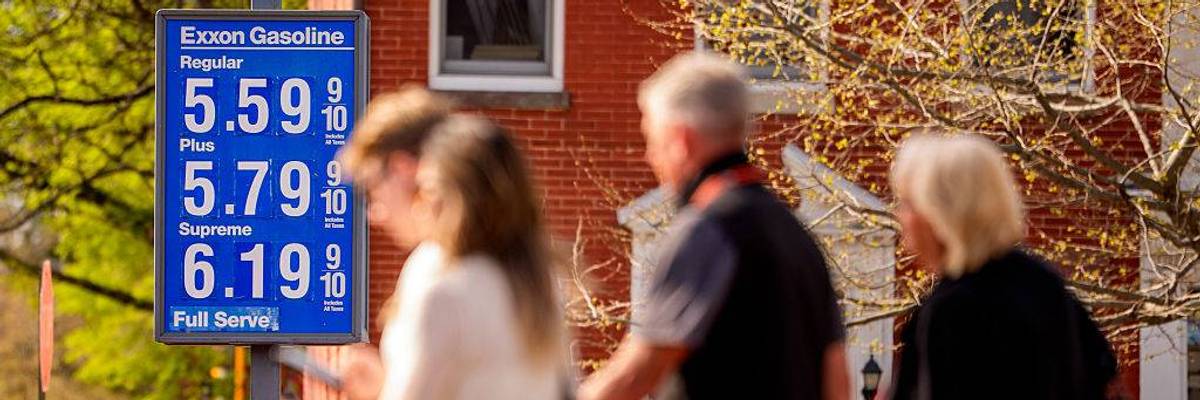
Gas prices over five dollars a gallon are displayed at an Exxon gas station near the U.S. Capitol Building on March 31, 2026 in Washington, DC.
“Moments of global crisis continue to translate into bumper profits for oil majors while ordinary people pay the price."
US President Donald Trump's unprovoked war of choice in Iran has been a goldmine for the fossil fuels industry, which is earning massive windfall profits thanks to the rise in the price of petroleum.
An analysis published by The Guardian on Wednesday estimated that the 100 biggest oil and gas companies have collectively raked in an extra $30 million per hour since Trump launched his war with Iran without any congressional authorization in late February.
In just the first month of the conflict, The Guardian reported, Big Oil made $23 billion in windfall profits, and the industry is projected to haul in an additional $234 billion in windfall profits by the end of the year if the price of oil stays in the $100 range.
The top beneficiaries of the Iran conflict are Saudi Aramco, which is projected to earn $25.5 billion in windfall profits by the end of the year; Kuwait Petroleum Corp., which is projected to earn $12.1 billion; and ExxonMobil, which is projected to earn $11 billion.
"The excess profits come from the pockets of ordinary people as they pay high prices to fill up their vehicles and power their homes, as well as from businesses incurring higher energy bills," The Guardian noted. "Dozens of countries have cut fuel taxes to help struggling consumers, meaning those nations, including Australia, South Africa, Italy, Brazil and Zambia, are raising less money for public services."
The Guardian's analysis was conducted by climate watchdog Global Witness, using data from intelligence provider Rystad Energy.
Patrick Galey, head of news investigations at Global Witness, told The Guardian that Big Oil's windfall profits should be a wakeup call to the world about the dangers of relying on fossil fuels.
"Moments of global crisis continue to translate into bumper profits for oil majors while ordinary people pay the price," Galey said. "Until governments kick their fossil fuel addiction, all of our spending power will be held hostage to the whims of strongmen."
Climate advocates have for months been calling for a windfall profits tax on Big Oil during the Iran War as a way to retrieve some of the money consumers have lost during the conflict.
Earlier this month, the climate advocacy organization 350.org renewed its previous call to slap fossil fuel companies with a windfall profits tax, and then invest the revenue into renewable energy sources to provide real long-term relief to global consumers.
Beth Walker, an energy policy expert at climate change think tank E3G, also recommended a windfall profits tax with the aim of ending reliance on dirty energy sources.
"Governments should use taxes on windfall profits to accelerate the transition to green energy," said Walker, "rather than deepen dependence on fossil fuels.”
Dear Common Dreams reader, It’s been nearly 30 years since I co-founded Common Dreams with my late wife, Lina Newhouser. We had the radical notion that journalism should serve the public good, not corporate profits. It was clear to us from the outset what it would take to build such a project. No paid advertisements. No corporate sponsors. No millionaire publisher telling us what to think or do. Many people said we wouldn't last a year, but we proved those doubters wrong. Together with a tremendous team of journalists and dedicated staff, we built an independent media outlet free from the constraints of profits and corporate control. Our mission has always been simple: To inform. To inspire. To ignite change for the common good. Building Common Dreams was not easy. Our survival was never guaranteed. When you take on the most powerful forces—Wall Street greed, fossil fuel industry destruction, Big Tech lobbyists, and uber-rich oligarchs who have spent billions upon billions rigging the economy and democracy in their favor—the only bulwark you have is supporters who believe in your work. But here’s the urgent message from me today. It's never been this bad out there. And it's never been this hard to keep us going. At the very moment Common Dreams is most needed, the threats we face are intensifying. We need your support now more than ever. We don't accept corporate advertising and never will. We don't have a paywall because we don't think people should be blocked from critical news based on their ability to pay. Everything we do is funded by the donations of readers like you. When everyone does the little they can afford, we are strong. But if that support retreats or dries up, so do we. Will you donate now to make sure Common Dreams not only survives but thrives? —Craig Brown, Co-founder |
US President Donald Trump's unprovoked war of choice in Iran has been a goldmine for the fossil fuels industry, which is earning massive windfall profits thanks to the rise in the price of petroleum.
An analysis published by The Guardian on Wednesday estimated that the 100 biggest oil and gas companies have collectively raked in an extra $30 million per hour since Trump launched his war with Iran without any congressional authorization in late February.
In just the first month of the conflict, The Guardian reported, Big Oil made $23 billion in windfall profits, and the industry is projected to haul in an additional $234 billion in windfall profits by the end of the year if the price of oil stays in the $100 range.
The top beneficiaries of the Iran conflict are Saudi Aramco, which is projected to earn $25.5 billion in windfall profits by the end of the year; Kuwait Petroleum Corp., which is projected to earn $12.1 billion; and ExxonMobil, which is projected to earn $11 billion.
"The excess profits come from the pockets of ordinary people as they pay high prices to fill up their vehicles and power their homes, as well as from businesses incurring higher energy bills," The Guardian noted. "Dozens of countries have cut fuel taxes to help struggling consumers, meaning those nations, including Australia, South Africa, Italy, Brazil and Zambia, are raising less money for public services."
The Guardian's analysis was conducted by climate watchdog Global Witness, using data from intelligence provider Rystad Energy.
Patrick Galey, head of news investigations at Global Witness, told The Guardian that Big Oil's windfall profits should be a wakeup call to the world about the dangers of relying on fossil fuels.
"Moments of global crisis continue to translate into bumper profits for oil majors while ordinary people pay the price," Galey said. "Until governments kick their fossil fuel addiction, all of our spending power will be held hostage to the whims of strongmen."
Climate advocates have for months been calling for a windfall profits tax on Big Oil during the Iran War as a way to retrieve some of the money consumers have lost during the conflict.
Earlier this month, the climate advocacy organization 350.org renewed its previous call to slap fossil fuel companies with a windfall profits tax, and then invest the revenue into renewable energy sources to provide real long-term relief to global consumers.
Beth Walker, an energy policy expert at climate change think tank E3G, also recommended a windfall profits tax with the aim of ending reliance on dirty energy sources.
"Governments should use taxes on windfall profits to accelerate the transition to green energy," said Walker, "rather than deepen dependence on fossil fuels.”
US President Donald Trump's unprovoked war of choice in Iran has been a goldmine for the fossil fuels industry, which is earning massive windfall profits thanks to the rise in the price of petroleum.
An analysis published by The Guardian on Wednesday estimated that the 100 biggest oil and gas companies have collectively raked in an extra $30 million per hour since Trump launched his war with Iran without any congressional authorization in late February.
In just the first month of the conflict, The Guardian reported, Big Oil made $23 billion in windfall profits, and the industry is projected to haul in an additional $234 billion in windfall profits by the end of the year if the price of oil stays in the $100 range.
The top beneficiaries of the Iran conflict are Saudi Aramco, which is projected to earn $25.5 billion in windfall profits by the end of the year; Kuwait Petroleum Corp., which is projected to earn $12.1 billion; and ExxonMobil, which is projected to earn $11 billion.
"The excess profits come from the pockets of ordinary people as they pay high prices to fill up their vehicles and power their homes, as well as from businesses incurring higher energy bills," The Guardian noted. "Dozens of countries have cut fuel taxes to help struggling consumers, meaning those nations, including Australia, South Africa, Italy, Brazil and Zambia, are raising less money for public services."
The Guardian's analysis was conducted by climate watchdog Global Witness, using data from intelligence provider Rystad Energy.
Patrick Galey, head of news investigations at Global Witness, told The Guardian that Big Oil's windfall profits should be a wakeup call to the world about the dangers of relying on fossil fuels.
"Moments of global crisis continue to translate into bumper profits for oil majors while ordinary people pay the price," Galey said. "Until governments kick their fossil fuel addiction, all of our spending power will be held hostage to the whims of strongmen."
Climate advocates have for months been calling for a windfall profits tax on Big Oil during the Iran War as a way to retrieve some of the money consumers have lost during the conflict.
Earlier this month, the climate advocacy organization 350.org renewed its previous call to slap fossil fuel companies with a windfall profits tax, and then invest the revenue into renewable energy sources to provide real long-term relief to global consumers.
Beth Walker, an energy policy expert at climate change think tank E3G, also recommended a windfall profits tax with the aim of ending reliance on dirty energy sources.
"Governments should use taxes on windfall profits to accelerate the transition to green energy," said Walker, "rather than deepen dependence on fossil fuels.”