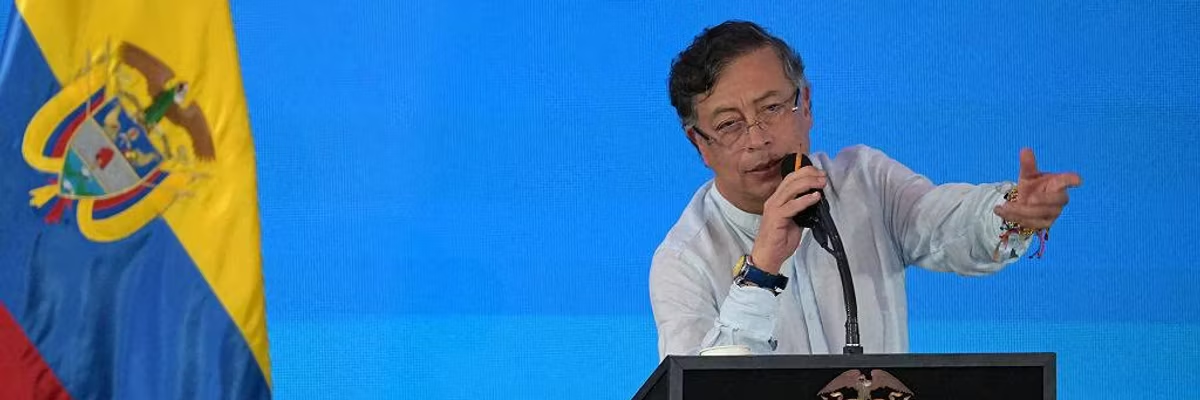
Colombia's President Gustavo Petro speaks during the International Conference on the Just Transition Away from Fossil Fuels in Santa Marta, Colombia, on April 28, 2026.
Colombian President Warns ‘Suicidal’ Fossil-Fueled Capitalism Is Leading World to ‘Barbarism’
“There is inertia in the power and the economy of this archaic form of energy—fossil fuels—that lead to death."
Colombian President Gustavo Petro warned on Tuesday that the current model of fossil fuel-driven capitalism was leading the world into "barbarism" and "fascism."
According to a Wednesday report from The Guardian, Petro told attendees of the First Conference on Transitioning Away from Fossil Fuels being held in Santa Marta, Colombia that capitalism's insistence on continued fossil fuel dependence was "suicidal" and driving the world toward more conflict.
"There is inertia in the power and the economy of this archaic form of energy—fossil fuels—that lead to death," said Petro. "Undoubtedly, that form of capital can commit suicide, taking with it humanity and [other] life... The question that needs to be asked is whether capitalism can truly adapt to a non-fossil energy model.”
Petro also warned that the consequences of sticking with a model of capitalism that centers fossil fuel energy won't be merely economic but also political.
"We are heading towards barbarism," he said. "And barbarism is the prelude to, or the very essence of, fascism."
As reported by Common Dreams last week, the conference in Colombia, which wraps up Wednesday, has featured more than 50 nations discussing strategies to phase out energy based on coal, oil, and gas.
Ralph Regenvanu, minister for climate change of the island nation of Vanuatu, told NPR on Wednesday that his country has been seeing the impacts of the climate crisis up close in the form of rising sea levels and spiraling energy costs.
Because of this, Regenvanu said his government has accelerated plans to begin solar energy and electric vehicle projects, telling NPR that "the decision on EVs was directly stimulated by the crisis."
France was also a major presence at the conference, reported The Guardian, as French climate envoy Benoit Faraco outlined an ambitious plan to make his country a major renewable energy producer.
"This process has made us realize we want to be an electro-superpower," said Faraco. "We want to be the electricity Saudi Arabia of Europe, selling green electrons to the UK, Ireland, Germany, and other countries."
But Tzeporah Berman, founder and chair of the Fossil Fuel Treaty Initiative, told The Guardian that the ability to transition away from fossil fuels will be much harder for many developing nations, even though these nations are the ones most adversely impacted by the climate emergency.
"There are many fossil-fuel producing countries in the Global South that are being pushed into expanding fossil fuel production just to feed their debt," Berman explained. "There is an expanding debt crisis in the Global South. It is impossible for countries to even imagine a fossil fuel transition with such limited fiscal space."
Advocates warned that the conference did not appear set to produce new commitments to fund climate action in the Global South, but discussions were taking place about tackling massive subsidies that have been granted annually to fossil fuel giants.
"It is a space where conversations can take place about, for instance, subsidy reform," Leo Roberts of the think tank E3G told The Guardian, "to take the $1.5 trillion in [annual] fossil fuel subsidies and repurpose them to somewhere else.”
We are at a crossroads
This country and this world are at a monumental crossroads. In a few short weeks, US voters will have an opportunity to beat back the forces of fascism and confront the billionaires who are rigging the economy, our media system, and our democracy, making it increasingly impossible for ordinary people to get by. We’re not just talking about the election. We’re talking about what must be done once these fascist elements are vanquished from power. We need a bolder set of solutions than what either major party has so far been willing to offer and a working-class movement ready to fight like hell for it. Trump didn't emerge from nowhere. The conditions that fueled MAGA authoritarianism were created by decades of radical neoliberal economic policies and a corrupt political system dominated by corporate interests. They slashed taxes on the super-rich, promising that the benefits would trickle down. They said giveaways to the corporate titans would make life more affordable for the rest of us. It was all bullshit. And when a bitter, betrayed populace searches for someone to blame, right-wing demagogues have little trouble finding scapegoats. People know when they're being lied to, but you won't hear any of this from the corporate media. Only independent journalism—powered and funded by people who believe in building a better world—can deliver truly trustworthy daily news. Our Fall Campaign is underway, and we need your help. To power our newsroom through the rest of the year, we need to raise $125,000 by midnight on October 31. So if you share our vision, please contribute whatever you can to sustain our work. |
Colombian President Gustavo Petro warned on Tuesday that the current model of fossil fuel-driven capitalism was leading the world into "barbarism" and "fascism."
According to a Wednesday report from The Guardian, Petro told attendees of the First Conference on Transitioning Away from Fossil Fuels being held in Santa Marta, Colombia that capitalism's insistence on continued fossil fuel dependence was "suicidal" and driving the world toward more conflict.
"There is inertia in the power and the economy of this archaic form of energy—fossil fuels—that lead to death," said Petro. "Undoubtedly, that form of capital can commit suicide, taking with it humanity and [other] life... The question that needs to be asked is whether capitalism can truly adapt to a non-fossil energy model.”
Petro also warned that the consequences of sticking with a model of capitalism that centers fossil fuel energy won't be merely economic but also political.
"We are heading towards barbarism," he said. "And barbarism is the prelude to, or the very essence of, fascism."
As reported by Common Dreams last week, the conference in Colombia, which wraps up Wednesday, has featured more than 50 nations discussing strategies to phase out energy based on coal, oil, and gas.
Ralph Regenvanu, minister for climate change of the island nation of Vanuatu, told NPR on Wednesday that his country has been seeing the impacts of the climate crisis up close in the form of rising sea levels and spiraling energy costs.
Because of this, Regenvanu said his government has accelerated plans to begin solar energy and electric vehicle projects, telling NPR that "the decision on EVs was directly stimulated by the crisis."
France was also a major presence at the conference, reported The Guardian, as French climate envoy Benoit Faraco outlined an ambitious plan to make his country a major renewable energy producer.
"This process has made us realize we want to be an electro-superpower," said Faraco. "We want to be the electricity Saudi Arabia of Europe, selling green electrons to the UK, Ireland, Germany, and other countries."
But Tzeporah Berman, founder and chair of the Fossil Fuel Treaty Initiative, told The Guardian that the ability to transition away from fossil fuels will be much harder for many developing nations, even though these nations are the ones most adversely impacted by the climate emergency.
"There are many fossil-fuel producing countries in the Global South that are being pushed into expanding fossil fuel production just to feed their debt," Berman explained. "There is an expanding debt crisis in the Global South. It is impossible for countries to even imagine a fossil fuel transition with such limited fiscal space."
Advocates warned that the conference did not appear set to produce new commitments to fund climate action in the Global South, but discussions were taking place about tackling massive subsidies that have been granted annually to fossil fuel giants.
"It is a space where conversations can take place about, for instance, subsidy reform," Leo Roberts of the think tank E3G told The Guardian, "to take the $1.5 trillion in [annual] fossil fuel subsidies and repurpose them to somewhere else.”
- Amazon Nations Reject Colombia's Call to End Oil Extraction, Fail to Agree on Deforestation Goal ›
- 'Enough Words': Colombia's Petro Urges Armed UN Force to End Gaza Genocide ›
- To Lead on Climate, Colombia's Petro Must Oppose Trade Framework That Impedes Action ›
Colombian President Gustavo Petro warned on Tuesday that the current model of fossil fuel-driven capitalism was leading the world into "barbarism" and "fascism."
According to a Wednesday report from The Guardian, Petro told attendees of the First Conference on Transitioning Away from Fossil Fuels being held in Santa Marta, Colombia that capitalism's insistence on continued fossil fuel dependence was "suicidal" and driving the world toward more conflict.
"There is inertia in the power and the economy of this archaic form of energy—fossil fuels—that lead to death," said Petro. "Undoubtedly, that form of capital can commit suicide, taking with it humanity and [other] life... The question that needs to be asked is whether capitalism can truly adapt to a non-fossil energy model.”
Petro also warned that the consequences of sticking with a model of capitalism that centers fossil fuel energy won't be merely economic but also political.
"We are heading towards barbarism," he said. "And barbarism is the prelude to, or the very essence of, fascism."
As reported by Common Dreams last week, the conference in Colombia, which wraps up Wednesday, has featured more than 50 nations discussing strategies to phase out energy based on coal, oil, and gas.
Ralph Regenvanu, minister for climate change of the island nation of Vanuatu, told NPR on Wednesday that his country has been seeing the impacts of the climate crisis up close in the form of rising sea levels and spiraling energy costs.
Because of this, Regenvanu said his government has accelerated plans to begin solar energy and electric vehicle projects, telling NPR that "the decision on EVs was directly stimulated by the crisis."
France was also a major presence at the conference, reported The Guardian, as French climate envoy Benoit Faraco outlined an ambitious plan to make his country a major renewable energy producer.
"This process has made us realize we want to be an electro-superpower," said Faraco. "We want to be the electricity Saudi Arabia of Europe, selling green electrons to the UK, Ireland, Germany, and other countries."
But Tzeporah Berman, founder and chair of the Fossil Fuel Treaty Initiative, told The Guardian that the ability to transition away from fossil fuels will be much harder for many developing nations, even though these nations are the ones most adversely impacted by the climate emergency.
"There are many fossil-fuel producing countries in the Global South that are being pushed into expanding fossil fuel production just to feed their debt," Berman explained. "There is an expanding debt crisis in the Global South. It is impossible for countries to even imagine a fossil fuel transition with such limited fiscal space."
Advocates warned that the conference did not appear set to produce new commitments to fund climate action in the Global South, but discussions were taking place about tackling massive subsidies that have been granted annually to fossil fuel giants.
"It is a space where conversations can take place about, for instance, subsidy reform," Leo Roberts of the think tank E3G told The Guardian, "to take the $1.5 trillion in [annual] fossil fuel subsidies and repurpose them to somewhere else.”
- Amazon Nations Reject Colombia's Call to End Oil Extraction, Fail to Agree on Deforestation Goal ›
- 'Enough Words': Colombia's Petro Urges Armed UN Force to End Gaza Genocide ›
- To Lead on Climate, Colombia's Petro Must Oppose Trade Framework That Impedes Action ›