SUBSCRIBE TO OUR FREE NEWSLETTER
Daily news & progressive opinion—funded by the people, not the corporations—delivered straight to your inbox.
5
#000000
#FFFFFF
To donate by check, phone, or other method, see our More Ways to Give page.
Daily news & progressive opinion—funded by the people, not the corporations—delivered straight to your inbox.
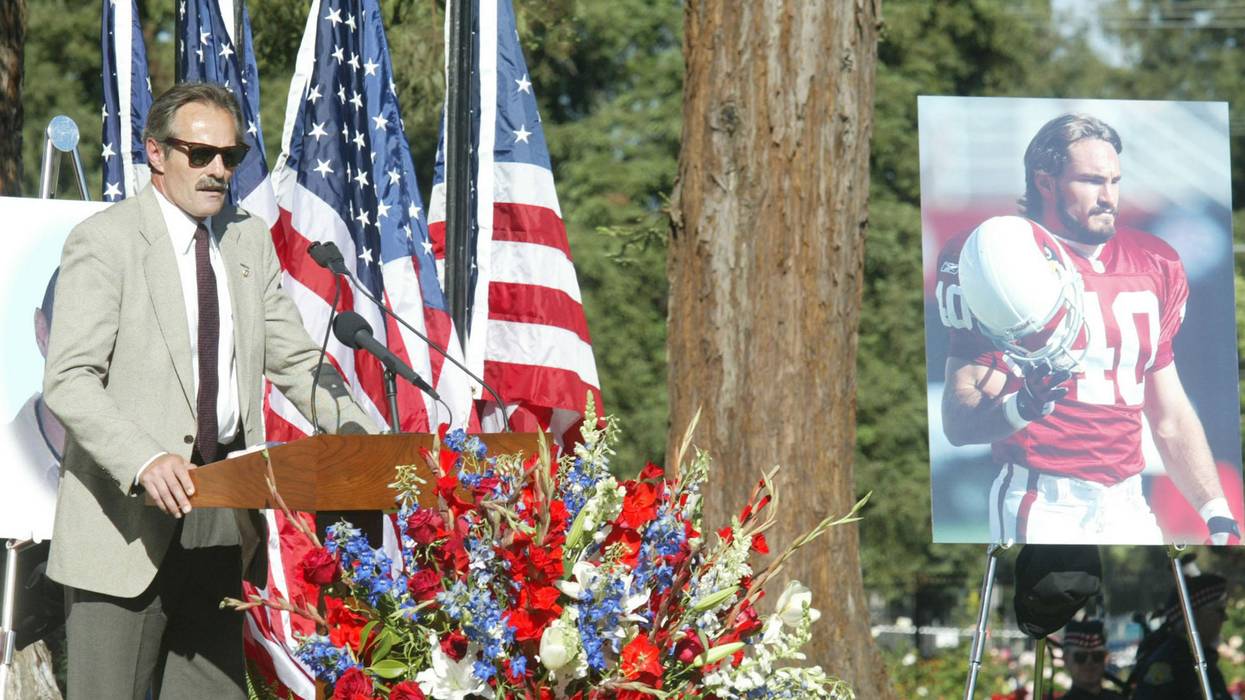
One journalist reminded readers that the NFL star and Army Ranger "called the Iraq invasion and occupation 'fucking illegal' and was killed by friendly fire in an incident the military covered up and tried to hide from his family."
Advocates of peace, truth, and basic human decency on Sunday excoriated the National Football League's "whitewashing" of former Arizona Cardinal and Army Ranger Pat Tillman's death in Afghanistan by so-called "friendly fire" and the military's subsequent cover-up—critical details omitted from a glowingly patriotic Super Bowl salute.
As a group of four Pat Tillman Foundation scholars chosen as honorary coin-toss captains at Super Bowl LVII in Glendale, Arizona were introduced via a video segment narrated by actor Kevin Costner, viewers were told how Tillman "gave up his NFL career to join the Army Rangers and ultimately lost his life in the line of duty."
The video did not say how Tillman died, what he thought about the Iraq war, or how the military lied to his family and the nation about his death. This outraged many viewers.
"Obviously the army killing Pat Tillman and covering it up afterwards is the worst thing the U.S. military did to him, but the years they've spent rolling out his portrait backed by some inspirational music as a recruiting tool is a surprisingly close second," tweeted progressive writer Jay Willis.
"Pat Tillman called the Iraq invasion and occupation 'fucking illegal' and was killed by friendly fire in an incident the military covered up and tried to hide from his family," tweeted Washington Post investigative reporter Evan Hill.
"I'm writing a book for FIRST GRADERS on Pat Tillman that contains more truth about his life and death than the NFL just provided at the Super Bowl," wrote author Andrew Maraniss.
"Another year of hijacking the Pat Tillman story and not telling that he hated the Iraq War and was killed by the military," said one Twitter user.
"Tell the real story of Pat Tillman or get off the screen," fumed yet another.
Tillman, 25 years old at the time, turned down a $3.6 million contract with the Cardinals to enlist in the U.S. Army in May 2002 after the 9/11 attacks on the United States. He expected to be deployed to Afghanistan. Instead, he was sent to invade Iraq—a country that had no ties to 9/11. Tillman quickly came to deplore the "fucking illegal" war, and even made "loose plans" to meet with anti-war intellectual Noam Chomsky, according to The Intercept's Ryan Devereaux.
As Tillman's brother Kevin sardonically wrote:
Somehow we were sent to invade a nation because it was a direct threat to the American people, or to the world, or harbored terrorists, or was involved in the September 11 attacks, or received weapons-grade uranium from Niger, or had mobile weapons labs, or WMD, or had a need to be liberated, or we needed to establish a democracy, or stop an insurgency, or stop a civil war we created that can't be called a civil war even though it is. Something like that.
Pat and Kevin were sent to Afghanistan on April 8, 2004. Stationed at a forward operating base in Khost province, Pat was killed on April 22, 2004 by what the army said was "enemy fire" during a firefight.
However, the army knew in the days immediately following Tillman's death that he had been shot three times in the head from less than 30 feet away by so-called "friendly fire," and that U.S. troops had burned his uniform and body armor in a bid to conceal their fatal error.
"The deception surrounding this case was an insult to the family, but more importantly, its primary purpose was to deceive a whole nation," Kevin Tillman testified before Congress in 2007. "We say these things with disappointment and sadness for our country. Once again, we have been used as props in a Pentagon public relations exercise."
Hearing on Tillman, Lynch Incidents: Kevin Tillman's Openingwww.youtube.com
Tillman's father, Patrick Tillman Sr., told the Washington Post in 2005 that after his son was killed, "all the people in positions of authority went out of their way to script this. They purposely interfered with the investigation, they covered it up."
"I think they thought they could control it, and they realized that their recruiting efforts were going to go to hell in a handbasket if the truth about his death got out," he contended. "They blew up their poster boy."
The following year, Tillman's mother Mary was interviewed by Sports Illustrated and blamed U.S. military and George W. Bush administration officials all the way up to then-Defense Secretary Donald Rumsfeld for covering up her son's killing.
"They attached themselves to his virtue and then threw him under the bus," she said. "They had no regard for him as a person. He'd hate to be used for a lie. I don't care if they put a bullet through my head in the middle of the night. I'm not stopping."

The troops live under
The cannon's thunder
From Sind to Cooch Behar
Moving from place to place
When they come face to face
With a different breed of fellow
Whose skins are black or yellow
They quick as winking chop him into
Beefsteak tartar
--"The Cannon Song" from "The Threepenny Opera"
The soldier's tale is as old as war. It is told and then forgotten. There are always young men and women ardent for glory, seduced by the power to inflict violence and naive enough to die for the merchants of death. The soldier's tale is the same, war after war, generation after generation. It is Spenser Rapone's turn now. The second lieutenant was given an "other than honorable" discharge June 18 after an Army investigation determined that he "went online to promote a socialist revolution and disparage high-ranking officers" and thereby had engaged in "conduct unbecoming an officer." Rapone laid bare the lie, although the lie often seems unassailable. We must honor those like him who have the moral courage to speak the truth about war, even if the tidal waves of patriotic propaganda that flood the culture overwhelm the voices of the just.
Rapone enlisted in the Army in 2010. He attended basic training at Fort Benning, Ga. He graduated from airborne school in February 2011 and became an Army Ranger. He watched as those around him swiftly fetishized their weapons.
"The rifle is the reification of what it means to be infantrymen," he said when I reached him by phone in Watertown, N.Y. "You're taught that the rifle is an extension of you. It is your life. You have to carry it at all times. The rifle made us warriors dedicated to destroying the enemy in close personal combat. At first, it was almost gleeful. We were a bunch of 18-year-olds, 19-year-olds. We had this instrument of death in our hands. We had power. We could do what 99 percent of our countrymen could not. The weapon changes you. You want to prove yourself. You want to be tested in combat. You want to deliver death. It draws you in, as much as life in the Army sucks. You start executing tactical maneuvers and battle drills. You get a certain high. It's seductive. The military beats empathy out of you. It makes you callous."
He was disturbed by what was happening around him and to him.
"When you get to RASP [the Ranger Assessment and Selection Program], you're told you not only have to understand Ranger culture and history, you have to adopt what's called an airborne Ranger in the sky," he said. "They make you go online and look at Rangers who were killed in action. You have to learn about this person and print out a copy of their obituary. It's really unsettling, the whole process. This was a class leader acting on behalf of the cadre, he said something to the effect of 'I'll give you a hint, don't pick Pat Tillman.' "
Rapone began to read about Pat Tillman, the professional football player who joined the Rangers and was killed in 2004 in Afghanistan by friendly fire, a fact that senior military officials, including Gen. Stanley A. McChrystal, who at the time was the U.S. commander in Afghanistan, covered up and replaced with a fictitious Hollywood version of death in combat with the enemy. Rapone watched the 2010 documentary "The Tillman Story" and would later read the 2006 Truthdig essay "After Pat's Birthday," written by Pat's brother Kevin, who was in the Rangers with Pat. Pat Tillman, who had been in contact with Noam Chomsky, had become a critic of the war. In addition to lying to the Tillman family about Pat's death, the Army did not return, and probably destroyed, Pat's papers and diary.
"Pat Tillman showed me I could resist the indoctrination," he said. "I did not have to let the military dehumanize me and turn me into something monstrous. When I learned how his death was covered up to sell the war, it was shocking. The military wasn't interested in preserving freedom or democracy. It was only interested in protecting the profits of those in power and expanding the U.S. hegemony. I was not a Hollywood freedom fighter. I was a cog in the imperialist machine. I preyed on the poorest, most exploited people on the planet."
"We were told to 'shoot, move, and communicate,' " he said of his Ranger training. "This became our entire existence. We did not need to understand why or the larger implications. These things did not concern us."
By July 2011 he was in Khost province in Afghanistan. He was 19 years old. He was an assistant machine gunner on an Mk-48, an 18-pound weapon that is mounted on a tripod and has a fire rate of 500 to 625 rounds per minute. He carried the spare barrel, along with the ammunition, which he fed into the gun. When his fellow Rangers cleared dwellings at night he set up a blocking position. He watched as the Rangers separated terrified men, women and children, treating them "as if they were animals." The Rangers spoke of the Afghans as subhumans, dismissing them as "hajjis" and "ragheads."
"A lot of the guys would say, 'I want to go out every night and kill people,' " he told me. "The Rangers are about hyper-masculinity, misogyny, racism, and a hatred of other cultures."
His platoon sergeant had the hammer of Thor, a popular symbol among white supremacists, tattooed on his arm. The sergeant told new Rangers that if they saw something that upset them and wanted to speak out about it they were "in the wrong fucking place."
Rapone left the Rangers to attend West Point in 2012. Maybe, as an officer, he could make a difference, infuse some humanity into his squads of killers. But he had his doubts.
"When I started West Point in July 2012 I encountered a lot of similar themes I noticed in the Ranger regiment," he said. "Officers and NCOs relished the idea of being able to kill people with impunity. It's Rudyard Kipling. It's the young British soldier mentality we've seen for hundreds of years. Its hyper-masculine. Even female cadets have to assimilate themselves. Any display of femininity is considered weakness. This is combined with the structural racism. They still honor [Confederate Gen.] Robert E. Lee at West Point. There's a barracks named after him. There's a portrait of him in the library in his Confederate uniform. In the bottom right of the portrait, in the background, is a slave."
Rapone watched with growing anger as black cadets were kicked out for infractions that did not lead to the expulsion of white cadets.
He majored in history. But he read outside of the curriculum, including authors such as Howard Zinn and Stan Goff, a former Special Forces master sergeant who had been in Vietnam, Haiti, Panama, Colombia and Somalia and who wrote "Hideous Dream: A Soldier's Memoir of the U.S. Invasion of Haiti."
"I realized we are the muscle for those with wealth and status," Rapone said. "I also realized I was a socialist. It was jarring."
His outspokenness and criticism saw him reprimanded.
"I almost got kicked out my senior year at West Point," he said. "At that point, I was a socialist. When you study political economy, when you study critical theory, it informs your analysis and your work. It started off as an academic position. But I thought there has to be more to this. There has to be some kind of an action to back up my theories."
He was derided as the "communist cadet." He sought out those at the military academy who suffered from discrimination there, including people of color, women and Muslims. He joined the Muslim Cadet Association, although he is not Muslim.
"I wanted to help Muslim cadets find a platform," he said. "I wanted them to know they were not forgotten. At West Point, there weren't too many people who understood or appreciated Islam or how the U.S. has ripped Islamic countries to shreds."
He helped organize an effort to provide Muslims at the academy with a proper prayer space, something that led him into heated arguments with senior administrative officials.
One professor confronted him: "I've been watching you for the past three, four years--you think you can do whatever you want." "Yes, sir," Rapone answered, a response that resulted in his being written up for speaking back to an officer.
The professor examined his social media accounts and found Rapone was posting articles from socialist publications and criticizing U.S. policy on Syrian refugees. The teacher sent a file on Rapone to the Criminal Investigations Division and G2, or military intelligence. Rapone was interrogated by senior officers. He was issued a "punishment tour" lasting 100 hours. He was forced to walk back and forth in the central square at West Point in his full dress uniform each week until the required hours were fulfilled. "It looked like something out of a Monty Python sketch," he said.
He was stripped of his privileges for 60 days. His spring break was canceled. He spent spring break doing landscaping and other menial tasks to "pay off" his punishment debt. He was required to train cadets who had not passed a required event.
"At West Point, they'll maintain that hazing doesn't exist," he said, "at least the kind that was around in the '50s or '60s. But it's still hazing. You're considered a plebe when you first get to West Point. You take out upper classmen's trash every night. You're not allowed to talk when you're outside as a plebe. You have to keep your hands balled up and walk in position of attention. If you're caught talking to a classmate, you'll get in trouble. The worst part is that those who move on from their plebe year enforce the same dehumanizing behavior, which they despised, on the new plebes."
He had experienced hazing in the Rangers, too. New Rangers were forced to fight each other and do numerous push-ups or were hogtied and their stomachs were smacked repeatedly.
"The hazing weeds out people who won't embrace it," he said. "To resist total assimilation, a lot of people create an ironic detachment. But this ironic detachment is really another form of assimilation. It runs pretty deep. There was a guy in a leadership position who tried to kill himself when I was overseas. There were cadets who committed suicide when I was at West Point and others who tried to commit suicide. I spent eight years in the Army. Suicide was a very tangible reality. A lot of suicides were the result of the combination of hazing and military culture, which in a sense is a form of hazing. Your drill instructor can't beat the shit out of you the way he used to, but the military still has methods to torture you emotionally."
When he graduated from West Point he was sent back to Fort Benning, where he had been a young recruit six years earlier.
"Every other Friday a basic training class graduates," he said. "I would see these buzzed-cut teenaged boys, who had barely progressed out of puberty, being sent into the meat grinder. It was unsettling. I was being trained to lead these guys, to tell them the mission we were doing was just and right. I could not in good conscience do that. I searched for an opening. I looked for ways to leave or speak out. When the whole national anthem thing was starting up with Colin Kaepernick, putting his skin in the game, risking himself to fight against systemic racism, I thought I could at least do my part."
He posted a picture of himself in uniform with the hashtag #VeteransForKaepernick.
"Everything snowballed from there," he said. "Colin Kaepernick, for me, was linked to Pat Tillman. He too was willing to risk himself and his status to speak truth to power."
His public support of Kaepernick--along with his social media posts of photos of himself at his 2016 graduation at West Point wearing a Che Guevara T-shirt under his uniform and holding up his fist as he showed the words "Communism will win" on the inside of his cap--led to an investigation. Afterward, the Army's 10th Mountain Division accept his resignation.
"The United States is almost religious about its patriotism," he said. "Military personnel are seen as infallible. You have someone like [Secretary of Defense] James Mattis, who is a bona fide war criminal. He dropped bombs on a wedding ceremony in Iraq. He's responsible for overseeing many different massacres in Iraq. Or [general and former national security adviser] H.R. McMaster. These people can't do any wrong because they've served. This reverence for the military is priming the population to accept military rule and a form of fascism or protofascism. That's why I felt even more compelled to get out."
"The public doesn't understand how regressive and toxic military culture is," he went on. "The military's inherent function is the abuse and degradation of other people. It is designed to be a vehicle of destruction. It's fundamental to the system. Without that, it would collapse. You can't convert the military into a humanitarian force even when you use the military in humanitarian ways, such as in New Orleans during Hurricane Katrina. The military trains soldiers to see other human beings, particularly brown and black human beings, as an imminent threat."
"Of course, the military prides itself on being apolitical, which is oxymoronic," he said. "The military is the political muscle of the state. There are few things more dangerous than a soldier who thinks he or she doesn't have a political function."
"I want to implore other soldiers and military personnel, there's more to being a soldier than knowing how to fire a weapon," Rapone said. "You can take a lot of what you've learned into society and actually help. At West Point, they say they teach you to be a leader of character. They talk to you about moral fortitude. But what do we see in the military? I was blindly following orders. I was inflicting violence on the poorest people on earth. How is there any morality in that?"
Twenty-four hours after reading the news that five U.S. soldiers were killed in yet another friendly fire incident in Afghanistan, I fear this response is already old news.
And it is old news, Pat Tillman was killed by friendly fire 10 years ago last April. It has been 12-years since the first friendly fire incident occurred in Afghanistan, when an American fighter pilot dropped a 225-kilogram laser-guided bomb on four Canadian soldiers in what is known as the "Tarnak Farm incident."
It has been said countless times that friendly fire is an inevitable fact of war. Time called the friendly fire incident that happened on Monday in Afghanistan, "a curse of the technologically advanced." A curse is something that is out of the control of the alleged cursed. The US is in complete control of its actions in Afghanistan. What we need to start saying and hearing is, 'friendly fire is an unnecessary fact during unnecessary wars.'
There have been 25 officially reported friendly fire incidents since 2001 in Afghanistan. However, after the cover up of Pat Tillman's death we can only assume there have been more. This officially reported number does not include the unspecified number of innocent Afghans who have been killed or captured and sent to Guantanamo indefinitely as a result of bad U.S. intelligence, outright negligence, or war crimes. Anand Gopal reports extensively on this largely unacknowledged number in his latest book No Good Men Among the Living. The capture and detention of innocent Afghans is something I can attest to firsthand.
US taxpayers have spent $557 billion between 2001 and 2011 on the war in Afghanistan, as Gopal reports in his book. Most of this money was spent after the Taliban had surrendered, and al-Qaeda had fled to Pakistan following the initial US invasion in 2001. In light of these facts polls now show that only 14% of Americans have a favorable view of the war in Afghanistan.
Declaring a war unnecessary and thus unjust does not diminish the sacrifices of the young soldiers who died in them. Most soldiers do the best with the information they are given by their chain of command and the media they are exposed to. However, 12 years into this war there is little justification for any US soldier to be fighting in Afghanistan. Thus there is no excuse or inevitability in these ongoing friendly fire incidents.
If we don't label something by its real name then it will happen again. What is happening in Afghanistan is imperialism not self-defense. Those who continue to die in friendly fire incidents in Afghanistan do so unnecessarily.
Of the many lies George W. Bush told us about the wars in Iraq and Afghanistan, some were larger but none worse than that told about the death of Pat Tillman.
In 2004 - just after Bush's invasion of Iraq, ostensibly in search of those non-existent weapons of mass destruction - Tillman became a military-and media-manufactured symbol of duty, sacrifice, patriotism and heroism. But the truth about Tillman's life is much more complex, and his death ultimately far more heroic, than the convenient, self-serving lie served up by the military and then sent out by our ever-gullible media.
Tillman, a truly remarkable young man who walked away from a multi-million dollar contract as a professional football player to enlist as in the Army Rangers after the 9/11 attacks, is the subject of The Tillman Story, a moving documentary directed by Amir Bar-Lev that opens in theatres in New York and Los Angeles this week. Although the film rightly tells the story of Pat Tillman's remarkable life, it also focuses on a parallel "Tillman story," that of the struggle his family went through to learn the truth about Tillman's death from "friendly fire" and the ongoing cover-up of how and why our military and political leaders lied in order to exploit his heroism for propaganda purposes.
Tillman was on his second tour of duty when he was killed in Afghanistan - a victim of "fratricide," inadvertently killed by his own troops during an ill-fated expedition. Our leaders should have told the truth - namely, that Corporal Tillman's death was a senseless accident coupled with incompetence. Instead they lied - to all of us, but most despicably to his family - rewrote the details of his death, awarding Tillman a posthumous Silver Star, America's third-highest military decoration, and turned the tragedy into an opportunity to promote their endless and unpopular wars.
Why did they lie? No doubt it began because at the time of Tillman's death, in April 2004, the Bush war machine was roiled by a number of negative images that threatened to adversely affect public perception of the war in Iraq. Remember those haunting photographs and videos of the bodies of American contractors strung up in Fallujah? Can you ever forget the searing images depicting abuse by U.S. soldiers working as guards in the Abu Ghraib prison? Adding the news that American soldiers had gunned down a celebrated NFL star certainly wouldn't help the war effort... So Pat Tillman was recast, in death, as a war hero and lesson to us all.
The Tillman Story excels in teaching us other lessons, however - not only about Corporal Pat Tillman, but also about his remarkable family, led by his indefatigable mother Dannie. It shows the arduous journey his family undertook to find the truth about what happened and to have someone held accountable not only for their son's death but also for the added insult of its use as a propaganda tool. Handed a massive, confusing box of intelligence records - thousands of pages of documents about her son's death - Dannie Tillman patiently dug through the voluminous material to uncover the roots of a carefully coordinated cover-up. Her efforts, along with that of Tillman's father and other family members and friends, eventually forced a Congressional hearing into the matter. As the film dramatically demonstrates in its stunning climax, however, the ultimate fix was in... and although the many obvious lies and cover-ups can be tracked up to and even well beyond such military brass as the recently fired general Stanley McChrystal, in the end no one among the higher-ups was ever found blameworthy or even responsible for lying to the Tillman family and the nation.
In lieu of presenting a hagiography, Director Bar-Lev does an excellent job of humanizing Tillman and offering a multi-dimensional look at his actual character. Scenes with Tillman's family as they lovingly describe his character and his close, funny and frequently profane relationship with two brothers (the film is unfortunately and unfairly burdened with an "R" rating as a result) along with testimony from family friends and fellow soldiers paint a clear portrait of who Tillman really was - warts and all. As Bar-Lev points out, Pat Tillman was no "paragon of moral certitude; he was curious and tried to see things from every possible point of view." That impulse is what the director attempts to give back to his subject, after he had been dehumanized and exploited for political gain by America's leaders, aided and abetted as usual by the complicit cheerleaders of the national news media.
"I hope the story of Tillman tells us that heroism and humanity are not contradictory and heroism is complex," Bar-Lev told Documentary magazine. "'Hero' is a problematic word that says a lot more about the people using it than the person they're speaking about....
"I knew there were myths around his death," Bar-Lev added, "but what began to intrigue me was when we found out there were equally as many myths about his life."
"Ultimately, what I would want to have happen is just the truth," Pat's youngest brother Richard told ESPN.com. "At the end of the day, Pat deserves the truth. This isn't about our family. This isn't about the Tillmans. This is about Pat Tillman. And he deserves the truth, period. He sacrificed so much for his country, and then the government turns around and uses him for propaganda. That is totally unacceptable."
I urge you to go see The Tillman Story, an insightful, powerful and truthful film that not only calls to task the entire chain of command but also questions our very notion of heroism itself - another topic in need of of some determined truth-telling!
Late last month, five U.S. troops died within 24 hours in southern Afghanistan. Taliban militants have killed more Americans and other troops deployed by NATO this year than in any of the previous years since President Bush ordered the invasion in 2001.
Will President Obama supplement the 21,000 soldiers sent to Afghanistan during the summer? If he heeds the experience of the Vietnam War, he'll find a gracious way to leave the place and save his presidency.
But Gen. Stanley McChrystal, commander of U.S. and NATO forces, whose career should have ended when he admitted participating in the cover-up of the "friendly fire" killing of football star Pat Tillman, has reportedly asked Obama for up to 45,000 new troops. That would bring the total number of U.S. troops to 100,000, equaling the number of Soviet troops in Afghanistan at the height of their failed occupation. "I think that in some areas that the breadth of the violence, the geographic spread of violence, is a little more than I would have gathered," the general admitted on 60 Minutes. How can that be? Didn't he read Pentagon reports on U.S. casualties?
In Washington, Congress is debating sending more troops to back a government that engaged in election fraud in the August and has earned the reputation of extreme corruption.
That sure sounds familiar. In 1968, Gen. William Westmoreland assured President Lyndon Johnson that 200,000-plus troops would stabilize a corrupt puppet South Vietnamese government, provide security for the local population, and win hearts and minds. We all know how well that worked out.
This should provoke obvious questions in the White House: Does the enemy have a deeper source of recruits throughout the Muslim world than the United States and NATO? If so, how are we to reach our goals of nation-building and destroying terrorist bases? How long can the United States stay in Afghanistan? How long can the Taliban remain there? They disappeared when U.S. forces arrived Oct. 7, 2001; they reappeared in larger numbers when U.S. troops got "distracted" by Iraq.
McChrystal plans to stay in Afghanistan for years. A New York Times/CBS News poll released last month indicated that approximately half of the country opposes increasing troop levels in Afghanistan. Only 29 percent of respondents thought Obama should increase troop levels.
McChrystal told Obama that U.S. military strategy should focus less on protecting our troops and more on securing Afghan communities. He admitted such a plan "could expose military personnel and civilians to greater risk in the near term." However, the general concluded, successful linking of U.S. troops with the Afghan people would transcend the losses. "Accepting some risk in the short term will ultimately save lives in the long run," he wrote in his report sent to the Defense Department in August. It was leaked to The Washington Post in late September.
The report contains echoes of Westmoreland. Mr. Bush claimed he needed to invade Afghanistan to get bin Laden and the al-Qaeda training camp there. Yet, the 9/11 attackers planned and prepared in Germany and the United States with Saudi (not Afghan) money and backing. Eight frustrating years later, Pakistan seems to have imported the terror war--not war against terror. The real goal, getting al-Qaeda and bin Laden, has been replaced with securing the population and backing the government. This is also known as nation-building.
McChrystal's plan involves NATO committing to long-term military counter-insurgency, ending corruption in the Afghan government and having NATO soldiers eschew body armor and secure bases and instead secure remote Afghan villages. NATO's mission, wrote McChrystal, "cannot succeed if it is unwilling to share risk, at least equally, with the people."
Vintage Mao Zedong and Che Guevara! But in 2006, when Canadian Air Force Capt. Trevor Greene removed his helmet "to parley with the locals...an Afghan brained him with an axe," wrote Thomas Walkom in the Toronto Star. Capt. Greene shared the risk, but the military obviously neglected to educate the axe wielder--and the hundreds of thousands like him.
Mary Tillman has a message for the National Football League: Help me find out what happened to my son.
Inspired to serve his country after 9/11, Pat Tillman gave up a lucrative career with the Arizona Cardinals to join the Army in May 2002. As a Ranger, he participated in Operation Iraqi Freedom, then fought in Afghanistan, where he was killed in April 2004.
Tillman's death was mourned coast to coast, and the public and his family were told by the Pentagon that he died a "warrior's death" charging up a hill, urging on his fellow Rangers. His funeral was nationally televised, and Arizona Sen. John McCain, now the presumptive Republican presidential nominee, was among those delivering eulogies.
President Bush took time from his 2004 reelection campaign to address Cardinal fans on a Jumbotron during an emotional halftime ceremony in which the Arizona franchise retired Tillman's jersey number.
Yet the circumstances of his death turned out to be an obscene hoax. Tillman was, in fact, killed by friendly fire.
Now, after six investigations and two congressional hearings, there remain many unanswered questions about Tillman's death and the Army's initial investigation of it. His family has challenged the Bush administration, the Pentagon and the media to uncover the truth.
To keep the public pressure on, Mary Tillman has written a book, "Boots on the Ground at Dusk: My Tribute to Pat Tillman." In a recent interview with me, she was highly critical of the actions of the NFL because she believes it continues to bathe in the glory of her son's patriotic sacrifice while doing little to help the Tillman family find out how Pat died.
"I think the [NFL] has not gone out of its way to help," she told me. The league has "exploited Pat, just like the military. ... [It has] a beautiful statue to him at the Cardinals' stadium. I don't know if that's more for us or the [NFL]. I feel like it's more for the league."
War and patriotism, of course, have long been associated with the culture of football. Quarterbacks are routinely referred to as "field generals" who throw "bullets" and "bombs." Some coaches walk the sidelines with the gravity of a Gen. George Patton. Military airplanes overfly many stadiums before games begin. Military recruiters often set up booths at football facilities.
The NFL has seized on Pat Tillman as another way to connect with the red, white and blue sports fan. Earlier this year, former Commissioner Paul Tagliabue brought together the NFL and the United Service Organizations to build the Pat Tillman USO Center at Bagram Air Base in Afghanistan. And the league just opened an exhibit dedicated to Tillman at its Pro Football Hall of Fame in Canton, Ohio.
Now the Tillmans want the NFL to help them speed up the latest congressional hearing into Pat Tillman's death.
The league certainly seems to have the clout to get things moving. Owners of professional football teams are some of the wealthiest and best-connected people in the United States. In the 2004 election cycle, NFL and other sports teams owners gave $14.6 million to Democrats and Republicans, as well as to independent political committees. San Diego Chargers owner Alex Spanos gave a $4-million donation to the Progress for America Voter Fund, which backed Bush.
As Kent Cooper of PoliticalMoneyLine, a nonpartisan research group, told USA Today, "I don't think the public is generally aware that [pro team owners] give these big donations."
Last year, the House Committee on Oversight and Government Reform, which is overseeing the inquiry, asked the administration for all documents related to Tillman's death and cover-up. The administration gave the committee what it described as "mostly press clippings" because of "executive branch confidentiality interests." The committee's chairman, Rep. Henry A. Waxman (D-Beverly Hills), and its ranking minority member, Rep. Thomas M. Davis III (R-Va.), protested that the documents shed virtually "no light on these matters."
Meanwhile, 20 veterans who saw combat in Iraq and Afghanistan took the extraordinary step last August of writing a letter to NFL Commissioner Roger Goodell, asking his help in securing the release of the requested documents.
Unfortunately, the league has not responded to Mary Tillman or the veterans.
"If this [a death of family member or friend under unclear circumstances] had happened to any one of us," said Mary Tillman, "Pat would have gone through a wall to find out the truth. So, it's the least I can do and the least any one of us can do [to find out how he died.]"
And that should include the National Football League and Goodell.
What does it mean to be a nation at war? Is it possible to exercise democratic control over a wartime government that dismisses honest criticism as unpatriotic? What should citizens do when members of their military not only commit crimes -- as happens during every war -- but also rely on propaganda to hide mistakes and to embellish or even create victories, as happened in the cases of Army Ranger Pat Tillman and Private Jessica Lynch?
Those are big questions, but a few things are clear. One is that the secrecy, deception and constraints sought by wartime administrations are anathemas to the transparency, accountability and freedom necessary to democracy. As James Madison warned, "Of all the enemies of public liberty, war is perhaps the most to be dreaded, because it comprises and develops the germ of every other."
Another truism is that citizens retain the right to receive information and provide guidance to their government during wartime. The last is that, while security concerns may legitimately restrict what information can be shared when, maintaining civilian oversight of war operations helps ensure that human rights standards are upheld.
Perhaps the most important effort to provide oversight of ongoing U.S. wars was the April 24 Congressional hearing on battlefield misinformation. The hearing focused on the wounding, capture and rescue of Jessica Lynch in Iraq in March 2003, and on the death of Pat Tillman in Afghanistan in April 2004. For more than four hours, the U.S. House Committee on Oversight and Government Reform heard a remarkable amount of information. There were often emotional first-hand accounts; analyses by a medical doctor, dedicated family members and military inspectors; and many questions from members of Congress.
Ideally, news media would have covered the hearing in depth and hosted wide-ranging discussions and debates of the issues raised. Instead, the overwhelming majority of news outlets only showed, quoted or described the opening remarks of the hearing's first witness panel, and then moved on to their next story.
What went unreported were shocking truths about the Lynch and Tillman incidents and the many remaining questions, as well as new insights into military misinformation. The exchanges highlighted below, drawn from testimony given throughout the hearing, fill in these blanks. (For an analysis that places the hearing in the context of news coverage at the time of the incidents, see Robin Andersen's article, "'Mission Accomplished,' Four Years Later.")
Other Soldiers, Other Questions
Perhaps the most under-reported aspect of the hearing was the list of U.S. soldiers whose injuries or deaths remain mired in secrecy. Pat Tillman's brother and fellow Army Ranger Kevin Tillman advocated strongly for other families still waiting for answers. Kevin told the stories of the following soldiers, all of whom were killed in Iraq:
Members of Congress named other soldiers whose families have received misleading information:
Creating the Narrative
Most of the Congressional hearing focused on Private Jessica Lynch and Corporal Pat Tillman. In addition to uncovering new information and raising unanswered questions, the Lynch and Tillman testimony showed how well -- and, at times, how irresponsibly -- the U.S. military manages the media.
Shortly after the U.S. invasion of Iraq, Lynch became renowned as a plucky young soldier who bravely resisted an enemy ambush, but was seriously wounded and captured. After U.S. soldiers rescued her in a nighttime raid, Lynch's story became an allegory for the courageousness and righteousness of U.S. troops in Iraq.
Except that it didn't quite happen like that. British reporters quickly debunked Lynch's rescue as a staged media event, and, once she was well enough to realize and respond to the narrative, Lynch herself disavowed the rest. During the hearing, Rep. Waxman added another wrinkle -- evidence that the "rescue" operation had been delayed, for publicity purposes:
Rep. Henry Waxman: The military had an opportunity to rescue you, when you were captive for ten days. But there was a whole day, before they captured you, when they were preparing not just to rescue you, but to videotape the rescue. Were you aware of that, or aware of it now?
Private Jessica Lynch: Not at the time, I wasn't aware that they were videotaping me, no. But after the fact, yeah I knew about it and now, you know, I kind of understand why they did it.
Waxman: Well, maybe you understand it. ... I come from Hollywood. I expect show business in Hollywood, not from the military and not to support a story that was a fabrication. ... Our staff interviewed Jim Wilkinson, the director of strategic communications at CENTCOM (U.S. Central Command). He informed us of the plans of your rescue operation. He informed the press operation a full day before it happened.
Waxman later questioned Lt. Col. John Robinson, who was a CENTCOM spokesperson during the Lynch incident:
Rep. Henry Waxman: Lt. Col. Robinson, you were interviewed about this rescue video by the Washington Post. ... Your statement, according to the Post, was -- quote -- 'We let them know, if possible we wanted to get it. We'd like to have' the video. 'We were hoping we would have good visuals. We knew it would be the hottest thing of the day. There was not an intent to talk it down or embellish it because we didn't need to. It was an awesome story.' You say you let them know that you wanted to tape the rescue. Who is the 'them' you were referring to -- the rescue team, the operations folks? ... Do you recall the quote?
Lt. Col. John Robinson: No, sir, I don't remember speaking to them about Jessica Lynch, but I can tell you where the visuals would have come from. The visuals would have come from an officer who was assigned to the SOP [Special Operations] unit, who had an additional duty of providing visuals back to the press center. These were not the only visuals that we received from this unit. And we got visuals all day, every day, throughout that particular operation. And so, these visuals that we received would have been visuals that we would have requested as soon as we found out that there was a potential rescue.
Much like the dramatic rescue footage was essential to the Lynch story, the televised memorial service and posthumous award given Corporal Pat Tillman cemented and promoted the false narrative around his death.
That football hero turned soldier Pat Tillman had been killed by his fellow troops in Afghanistan was known immediately, and rapidly reported up the chain of command. However, for more than a month, Tillman's family and the U.S. public were told that Pat had been killed by the enemy, while bravely protecting other U.S. soldiers.
During the House hearing, Rep. Bruce Braley asked Specialist Bryan O'Neal and the Acting Inspector General of the Defense Department, Thomas Gimble, about the statements used in Tillman's Silver Star Award:
Rep. Bruce Braley: In addition to being an eyewitness to Corporal Tillman's death and reporting this incident up the chain of command, you were also involved in writing a statement that was used to award Corporal Tillman the Silver Star. Do you remember that?
Specialist Bryan O'Neal: Yes, sir.
Braley: ... Was this a situation where they gave you a sheet of paper and told you to write down, in your own words, your best recollection of the events that had happened, or did someone prepare a statement for you to review and sign?
O'Neal: What happened, sir, was I got sat behind a computer and I was told to type up my recollection of what happened. And as soon as I was done typing, I was relieved to go back to my platoon, sir. And that was the last I heard of it.
Braley: So when you finished typing your statement, it was in a digital format that had not been printed out. Is that correct?
O'Neal: Roger that, sir.
Braley: ... Did you ever sign, in your handwriting, a statement that you had reviewed and verified the authenticity of?
O'Neal: Negative, sir.
Braley: Now I want to ask you about the statement that was ultimately used in the Silver Star commendation. ... This version of the statement also says you -- quote -- 'engaged the enemy very successfully' -- end quote. That the enemy moved most of their attention to your position which -- quote -- 'drew a lot of fire from them.' Did you write these sentences, claiming that you were engaged with the enemy?
O'Neal: No, sir.
Braley: Do you know who made the changes to your statement, to make it appear as if you were receiving fire from the enemy, rather than from your own platoon?
O'Neal: No, sir.
Braley: Mr. Gimble, the Inspector General's office investigated these alterations to the witnesses' statements and flagged these differences as well. But in the course of your investigation, did you ever discover who specifically changed this language and why that language was changed?
Hon. Thomas Gimble: ... The citations that we got were part of the package that we got of the General Jones investigation [into Tillman's death]. And they were not signed, it just had stamped as 'original, signed.' And my investigators went back to Specialist O'Neal and the sergeant and said, 'Did you write these?' And they said no, that they did not. ... We were unable to determine who in the chain of command actually did the alterations.
Senior Chief Petty Officer Stephen White was a friend of Pat Tillman's and the only active-duty military member to speak at the televised memorial service. During the hearing, White explained that he based his memorial service speech on the altered Silver Star documents:
Rep. William Clay: You were not with Corporal Tillman in Afghanistan when he was killed. Is that correct?
Senior Chief Petty Officer Stephen White: That's correct, sir.
Clay: Then how did you become aware of the details surrounding his death?
White: The initial, sporadic stuff that I got was from Kevin [Tillman, Pat's brother] himself. The morning of the memorial, I don't recall exactly how I got word but, I knew that they wanted me to ... let the family know, that he was going to be presented with the Silver Star. In order to do that in the presentation, I wanted to, basically, to surmise what had happened on the target site. I called an enlisted person whose name I cannot recall. I believe he was with the 75th Ranger Battalion. The morning of, he read the citation to me, over the phone. I summarized in my own words, asked him if that was an accurate summarization. He said it was, and that's what I went with in my speech.
Hiding the Truth
For false narratives to gain currency, the truth must be suppressed. In Private Jessica Lynch's case, her injuries kept her from correcting the public record for some time. But her doctor was another matter.
Dr. Gene Bolles, a neurosurgeon and military contractor at Landstuhl Regional Medical Center in Germany, was one of the first people to examine Lynch following her "rescue." During the Congressional hearing, he said it was clear that Lynch had no bullet wounds -- contrary to already widely-reported stories of her combat heroism -- and that her wounds were consistent with a serious vehicle accident. Then Rep. John Yarmuth asked Bolles whether he had been restricted in his public remarks at the time:
Rep. John Yarmuth: Did you have to sign any kind of nondisclosure agreement?
Dr. Gene Bolles: Yes, I did.
Yarmuth: ... Were you asked to sign this specifically for the Lynch case?
Bolles: ... Before she left, the day before or the day of, I was asked to sign something to say that this would not be discussed, also.
Yarmuth: And you had never been asked to sign anything like that, involving any other patient of yours?
Bolles: No, sir.
Yarmuth: ... Did you think it was peculiar, that you were asked to sign a nondisclosure agreement for one patient?
Bolles: At the time, no. I'm not sure I do now. ...
Yarmuth: Looking back at it now, are you suspicious? ... What do you think was behind their action?
Bolles: I really don't think I have an opinion on that, sir. It may have been standard procedure for a highly visible situation such as Private Lynch was. I don't know.
With regard to Corporal Pat Tillman's death, eyewitness accounts and reports quickly relayed up the chain of command blatantly contradicted the U.S. military's preferred narrative. During the House hearing, Rep. Elijah Cummings described what is known about these high-level communications:
Rep. Elijah Cummings: We have an email that was written on April 28, 2004, six days after Pat Tillman's death. ... It describes how the White House was asking for information about Corporal Tillman, for the President to use in a speech at the White House Correspondents' Dinner. ... The next day, April 29, 2004, an urgent communication was sent to the highest levels of the Army command structure, alerting them that friendly fire was the suspected cause of death. This communication is called a Personal Four, that is P-4, memo. ... It [the P-4 memo] goes on to express concern that the President or Defense Secretary might suffer -- quote -- 'public embarrassment, if the circumstances of Corporal Tillman's death become public' -- end of quote. ... When the President spoke at the Correspondents' Dinner, he was careful in his wording. He praised Pat Tillman's courage, but carefully avoided describing how he was killed.
During the hearing, several members of Congress and witnesses asked: Which military and government officials were rapidly informed that Tillman had been killed by "friendly fire," but kept that truth from his family and from the public for more than a month?
Reps. Cummings and Waxman wondered if President Bush's cautious words at the White House Correspondents' Dinner indicate that he, or someone in his office, knew. Based on then-CENTCOM chief John Abizaid's trip to Afghanistan shortly after Tillman's death, the number of high-ranking military officers who definitely knew, and then-Defense Secretary Donald Rumsfeld's previous correspondence with Tillman, Pat's mother Mary Tillman said she believes that Rumsfeld knew the real cause of Pat's death.
The hearing also brought to light a chilling account of the "friendly fire" incident, which Mary Tillman paraphrased from an investigation by Brigadier General Gary Jones:
Mary Tillman: At this particular moment, they [the soldiers who shot and killed Pat] got excited. They were not afraid. When they were asked about this particular engagement, not once did they say they were afraid. Not once did they say they were being fired upon. They said they were excited. Or one said, I wanted to be in a firefight. General Jones asked, 'Did you PID [positively identify] your target?' 'No, I wanted to be in a firefight.' When they asked, 'Did you see waving hands?' 'Yes, we saw waving hands.' 'What did it look like,' General Jones asked. 'It looked like they were trying to say, hey, it's us.' And yet, they fired at them.
Strangely, the Army's criminal investigation found that the soldiers who killed Tillman had not broken the rules of engagement.
Civilians Are People, Too
Following the hearing, Oversight Committee Chair Waxman sent letters to Defense Secretary Robert Gates and White House Counsel Fred Fielding, asking for documents clarifying "how and when" high-ranking Defense Department and White House officials "learned of the circumstances surrounding Corporal Tillman's death."
Of course, battlefield misinformation doesn't just surround U.S. soldiers. Many more Afghan and Iraqi civilians have died under questionable circumstances. The New York Times recently reported new information about U.S. military assaults on civilians in Haditha, Iraq and in Jalalabad, Afghanistan.
The Haditha revelations eerily echo the circumstances surrounding Pat Tillman's death. Immediately following the November 2005 U.S. assault, the Iraqi civilian deaths were reported up the chain of command. However, that information was suppressed, because the Haditha killings represented, in the words of the Times report, "a potential public relations problem that could fuel insurgent propaganda against the American military."
U.S. soldiers also attempted to deny the truth about the March 2007 Jalalabad killings, destroying photos and video that journalists had taken at the scene. A military official explained that "untrained people" might "capture visual details that are not as they originally were." Two months later, the U.S. military apologized and paid $2,000 to the surviving family members of the 19 civilians killed.
What happened in Jalalabad and Haditha, to Pat Tillman, Jessica Lynch and LaVena Johnson, and to many other soldiers and civilians caught up in U.S. wars isn't due to malicious intent. Tragedies and lies happen whenever human beings are put into a war zone. This doesn't excuse them. It does mean that U.S. citizens should accept a share of the responsibility, and insist upon truth and accountability, lest our democracy become wartime "collateral damage."
"It is time for the truth, the whole truth, versus misinformation and hype." Those were Jessica Lynch's words as she testified before Congress April 24-- along with the brother and mother of the late Army Ranger Specialist Pat Tillman -- to set the record straight on her service in Iraq.
On April 2, 2003, Army Private Lynch was carried from an Iraqi hospital and whisked away on a Black Hawk helicopter. It was a great PR opportunity for the Bush administration, and with the help of too many in the mainstream media, they spun it for all that it was worth.
Lynch's testimony last week was timely, coming just one day before the premiere of Bill Moyers Journal on PBS, a 90-minute report entitled Buying the War. "Four years after shock and awe," Moyers observed, "the press has yet to come to terms with its role in enabling the Bush administration to go to war on false pretenses."
"I am still confused as to why they chose to lie and tried to make me a legend...." Lynch said.
As Daphne Eviatar reported in The Nation in 2003, media outlets across the country ran with Brig. Gen. Vincent Brooks' initial account of a daring rescue of Lynch by Special Ops forces, complete with firefights upon entering and exiting the "location of danger." The story snowballed into a "daring raid in hostile territory," and anonymous US officials told reporters of Lynch fighting "fiercely" and shooting "several enemy soldiers." She had been shot and stabbed, according to these accounts.
"The whole Rambo story, that I went down fighting. It just wasn't the truth. I didn't even get a shot off. My weapon had jammed. And I didn't even get to fire," Lynch told Newsweek.
Eviatar observed that the "Saving Private Lynch" story arrived at the perfect moment for an administration obsessed with controlling the press coverage. It had been less than two weeks since the invasion and correspondents were delivering a stream of grim news: then-Defense Secretary Donald Rumsfeld was receiving harsh criticism for deploying too few ground troops to contain the violence; there was "unexpectedly fierce fighting in the south"; a van full of Iraqi women and children were mistakenly killed by US forces; and four Marines died in a helicopter crash. The Lynch story offered a tale of heroism to replace the horrors of this war on the front pages and the airwaves.
"The bottom line is the American people are capable of determining their own ideals for heroes and they don't need to be told elaborate tales," Lynch said.
In his documentary, Moyers said of the lead up to the invasion, "This gets us right to the heart of the debate that's going on now in our craft. We lean heavily in reporting on what [government officials] say.... We really give heavy weight to what public officials say."
This reliance on government accounts continued as the war began and Jessica Lynch was injured. "As with many stories, we were left with our sourcing being other government agencies," Paul Slavin, senior vice president of ABC News, admitted to Eviatar.
"There was a real sense that you don't get that critical of a government that's leading us in war time," Walter Isaacson, former Chairman and CEO of CNN, told Moyers.
By mid-April, the government and media tale was debunked. Lynch hadn't fired her weapon, nor had she been shot or stabbed (an examination did reveal that she had been sexually assaulted, however). And, according to hospital staff, the Iraqi fighters had already abandoned the hospital before she was "rescued," casting doubt on any gunfights and characterizations of daring.
"The nurses at the hospital tried to soothe me and tried unsuccessfully at one point to return me to American troops," Lynch testified.
The lies about the service of Lynch and the death of Tillman demonstrate the lengths to which this administration will go to protect its interests--and the necessity that the media ask tough questions to preserve our democracy. As Naomi Wolf notes in Fascist America, in 10 Easy Steps: "In a fascist system, it's not the lies that count but the muddying. When citizens can't tell real news from fake, they give up their demands for accountability bit by bit."
"They could have handled situations a lot better and made sure that the truth was more accurate," Lynch said.
They could have indeed.