

SUBSCRIBE TO OUR FREE NEWSLETTER
Daily news & progressive opinion—funded by the people, not the corporations—delivered straight to your inbox.
5
#000000
#FFFFFF
To donate by check, phone, or other method, see our More Ways to Give page.
Daily news & progressive opinion—funded by the people, not the corporations—delivered straight to your inbox.
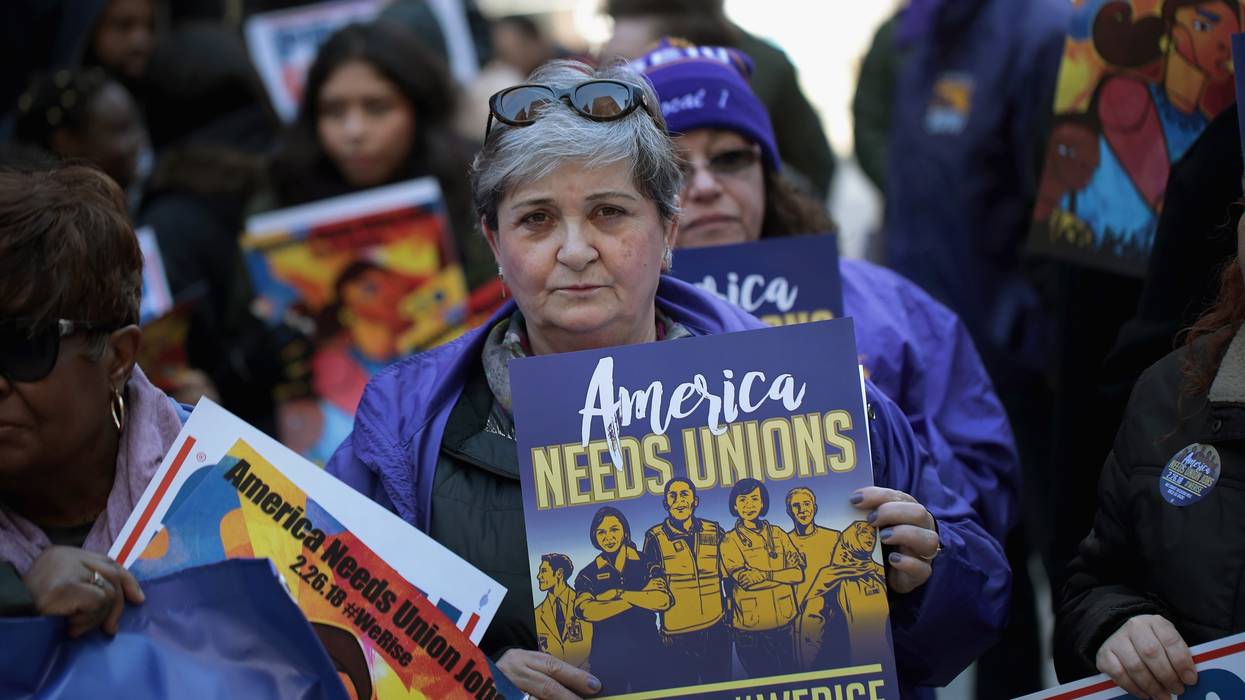
Tripling union membership would raise the pay of the median worker by more than $7,700 a year, or nearly $270,000 over a 35-year career. That’s enough to more than cover the cost of sending two children to a four-year public university.
This Labor Day, workers across the country are sending a clear message: They want a greater voice on the job. A near-record 71% of Americans approve of unions, and surveys show over 50 million nonunion workers would join a union if they could.
At a time when many are struggling to afford basic necessities, it’s easy to understand why. Through unions and collective bargaining, workers have more power to win higher wages, better benefits, safer working conditions, and a fairer share of the wealth they create. Unions help build a strong middle class, reduce inequality, narrow racial economic disparities, and boost participation in our democracy.
Yet only 1 in 10 US workers are in a union today—a sharp decline from the more than 1 in 3 workers who belonged to a union in the 1950s. That drop did not happen because workers stopped wanting or needing unions. It happened due to relentless attacks on unions and collective bargaining, and lawmakers’ failure to fix the broken labor laws that have allowed those attacks to succeed.
The consequences have been enormous. As union power has declined, workers have seen less of the gains from the economic growth they have helped create. Since 1979, productivity (how much average value workers produce in an hour of work) has grown 2.8 times as much as pay for typical workers.
This Labor Day, let’s recommit to putting more power in the hands of working people.
New Economic Policy Institute research makes clear just how much working people stand to gain by rebuilding union power to 1950s’ levels.
Tripling union membership would raise the pay of the median worker by more than $7,700 a year, or nearly $270,000 over a 35-year career. That’s enough to more than cover the cost of sending two children to a four-year public university, for example. Crucially, both union and nonunion workers would see these gains because stronger unions raise standards across the labor market.
Scaled across the workforce, tripling union membership would shift an estimated $1.2 trillion to the pockets of working people every year. This is enough to reverse roughly one-third of the increase in inequality since 1979.
Stronger unions are also good for businesses and the broader economy. When workers earn more, they have more money to spend in their communities, strengthening consumer demand. Businesses would benefit from lower worker turnover, higher productivity, and workers who have a greater stake in the success of their workplaces.
Tripling union membership won’t be easy, but it’s far from a nostalgic pipe dream. It will take continued nationwide organizing and decisive policy action that makes it easier for workers to unionize. Federal lawmakers can start by passing legislation that expands collective bargaining rights, closes loopholes in existing law that allows employers to suppress worker organizing, and holds employers accountable when they violate workers’ labor rights. Further, state lawmakers should provide all public-sector workers with collective bargaining rights and repeal so-called right-to-work laws that weaken workers’ ability to organize and bargain collectively.
This Labor Day, let’s recommit to putting more power in the hands of working people. That means giving more workers the freedom to organize. And it means setting an ambitious goal worthy of the moment: tripling union membership and building an economy that works for working people.

Matt Witt’s new book Make Holidays Your Own encourages creative rethinking of family gatherings and community practices on major holidays.
It’s a good thing that labor journalist and author Matt Witt was not running for governor of Wisconsin this year like Democratic Socialists of America candidate Francesca Hong.
Democratic primary rivals and Republican opposition researchers would have badly distorted the message of Witt’s new book Make Holidays Your Own (Common Ground Press). It encourages creative rethinking of family gatherings and community practices on major holidays.
In their effort to discredit Hong, her foes in both parties created what The New York Times called a “social media kerfuffle” over old posts dissing Thanksgiving, Christmas, Valentine’s Day, and Halloween.
The outspoken state legislator and former restaurant owner from Madison lost her August 11 primary despite polling very strongly beforehand. Given the annual sense of foreboding that overtakes millions of Americans when tense family reunions draw near in late November, Hong’s past call for Thanksgiving to be “canceled”—because of its connection to “colonialism”—probably had its local fans.
Sometimes the development of alternative celebrations—such as the reclaiming of May Day by the modern day, more immigrant-influenced US labor movement--can lead to two opportunities to picnic, protest, and march, rather than just one!
Under fire on the campaign trail, Hong did concede that bringing people together around a table can be “a good thing.” But, according to the Times, she also courted controversy by “questioning the value of Valentine’s Day and Christmas trees.” So not only Wisconsin turkey farmers, but gift card sellers and Christmas tree growers—if sufficiently miffed—might have voted instead for the moderate Democrat from Milwaukee, David Crowley, who won the primary.
And even if Hong had prevailed, according to the Times, she faced the challenge of winning over voters like John Wilson, a 61-year old pharmacist from Platteville, Wisconsin, who usually “leans Democratic.” However, when asked whether he favored Hong or US Rep. Tom Tiffany, the Republican running for governor, Wilson chose the latter because “you have to take people at their word” about serious matters like Thanksgiving.
Tiffany has strong views on holidays too; in 2021, he was one of 14 House members who voted against making Juneteenth Day a federal holiday, which won’t be popular with African-American voters statewide.
In the future, left-leaning candidates can avoid even momentarily distracting flaps like this by reading Matt Witt’s book—hopefully, before pulling the trigger on Twitter, in a moment of pique. The few paid days off that most Americans get to enjoy should not be cancel culture targets, when, as the author argues, they can be celebrated in ways “more historically accurate, meaningful, inclusive, and fun,”
In Make Holidays Your Own, Witt offers much creative advice about dealing with Turkey Day, Mother’s Day, Memorial Day, Veterans Day, the Fourth of July, and eight others; his focus is on countering their crass commercialization, historical baggage, stultifying traditionalism, or exploitation by the right.
See, for example, the garish 250th birthday party staged on July 4 of this year in Washington, DC by the White House and its corporate funders. While no doubt critical of that, Abdul El-Sayed, the successful Democratic Senate primary winner in Michigan is definitely tip-toeing around the issue of fireworks on the Fourth.
As the Times notes, “He has deleted a number of videos and posts where he floated the idea of abandoning fireworks on Independence Day.” El-Sayed’s press spokesperson is now reminding voters that he “is the former captain of his high school football team, loves Michigan football on Saturdays, and celebrates the Fourth of July with fireworks like the next Michigander.”
In other words, he’s an all-American guy! As Witt explains: “In every culture, holidays matter. They come with a message and symbols—with a story that reinforces a certain way of looking at society and passes on certain values to the next generation.” According to the author, what’s good about remaking holidays, in ways that send a different message, “is that you don’t have to convince everyone in your community who doesn’t agree. They can celebrate however they want and so can you.”
And sometimes the development of alternative celebrations—such as the reclaiming of May Day by the modern day, more immigrant-influenced US labor movement--can lead to two opportunities to picnic, protest, and march, rather than just one!
As a former communications director for the United Mine Workers, Teamsters, and Service Employees International Union, the author delves, most informatively, into the political agenda behind the creation of Labor Day, as a counter to nascent working-class internationalism in the late 19th century.
Readers will learn that it was a corporate Democrat president—rather than any anti-union Republican—who first tried to erase the memory of May 1, as an international workers holiday born in the USA, and replace it with an end of summer day off out of step with the rest of the world.
To add insult to injury, May 1 then got officially rebranded, during the McCarthy era, as Law Day—although nobody, even corporate lawyers, get time off for that. Yet, thanks to multiple MAGA threats to the “rule of law” since President Donald Trump got reelected, more than 1,000 California bar members used their lunch hour to stage a first-time ever May Day-style protest in downtown San Francisco.)
As Witt recounts, massive demonstrations seeking shorter working hours occurred in Chicago and other US cities on May 1, 1886; when repeated on May Day four years later, workers in “dozens of countries in Europe and Latin America also held rallies and marches to support the eight-hour day demand.”
Thereafter, much to the alarm of “robber barons” here and abroad, May 1 protests became “an annual event for workers all around the world” and an expression of cross-border solidarity between labor radicals of varying stripes.
By 1896, however, a business-backed resident of the White House named Grover Cleveland needed a “sop to unions.” He had, after all, just called out federal troops to crush the Pullman strike organized by the American Railway Union, a pioneering alternative to craft unionism led by future Socialist Party presidential candidate Eugene Victor Debs (who was jailed for his role in the strike).
At Cleveland’s request, Congress declared that workers should be given a day off, every year, on the first Monday in September so, as Witt notes, “Actions taken by US unions would not be coordinated with their counterparts in the rest of the world.”
“Today, Labor Day is a paid holiday for about 3 in 4 workers in the US. Ironically, the lowest paid workers are the least likely to have the day off with pay. That includes non-union workers in food service, retail, hotels, agriculture, delivery, and janitorial services, as well as part-time workers, or those whose companies claim are ‘independent contractors’ rather than employees.”
On the holiday counterprogramming front, the good news is that May Day (as noted above) has made a major comeback over the last two decades. There is also “the shining example of the transformation of Columbus Day to Indigenous Peoples Day as now observed in many cities and states.”
Thanks to the efforts of progressive veterans’ groups like Veterans for Peace and Common Defense, at least some commemorative events on Memorial Day and Veterans Day now focus on peace and justice issues, rather than uncritical celebration of past wars.
In his chapter on Martin Luther King Day, the author suggests a range of activities that “can be about the movement and not just the man.” (This is advice that venerators of Cesar Chavez are taking, but only belatedly, after recent revelations about his history of sexual abuse while president of the United Farm Workers.)
Witt reports that all proceeds from his book are going to Rethinking Schools, a “national nonprofit organization that supports social, economic, and environmental justice teaching at a time when the very idea of public education is under attack. Rethinking Schools’ materials have been used by tens of thousands of educators and have reached millions of students.”
Let’s hope that Make Holidays Your Own also gets into the hands of many educators who have to come up with fresh ideas for in-school celebrations of holidays, that cannot be cancelled even in blue states. But, of course, don’t want their personal creativity in the classroom (or pet peeves) unleashing a conservative backlash of the sort that did not help Hong.
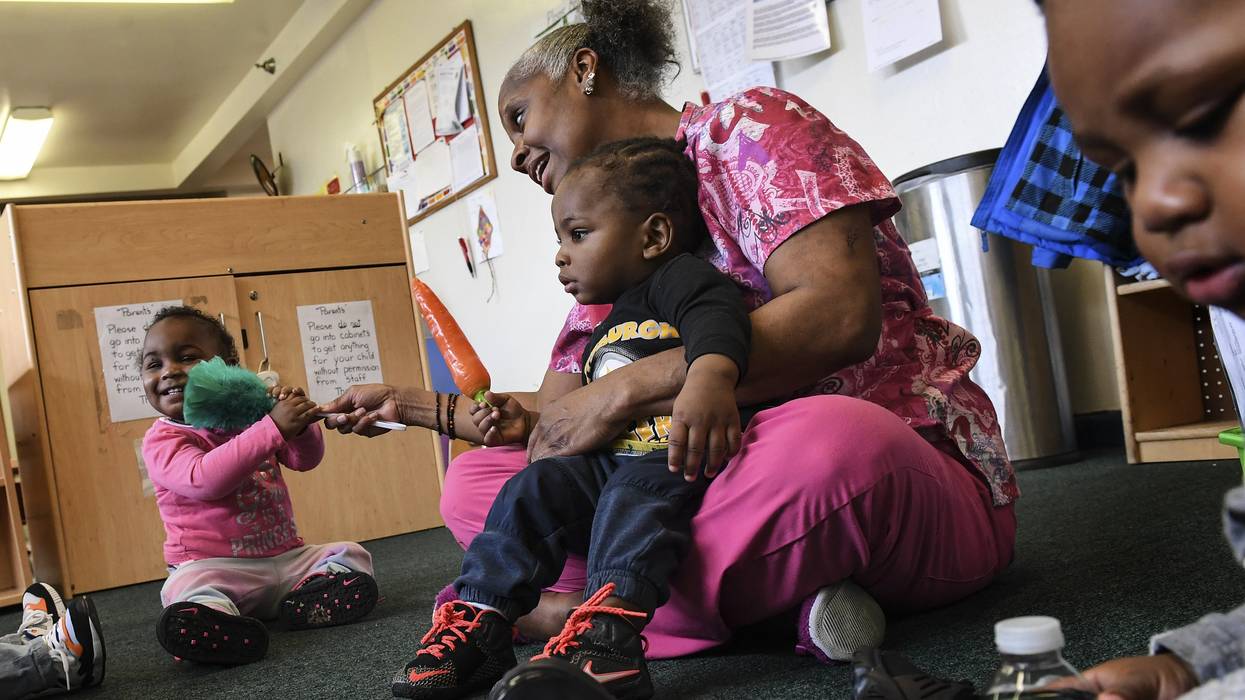
The work that our families run on often happens where no one can see it. This Labor Day, as midterms near, I'm thinking about what it will take for the people who do that work—and the people who depend on it—to finally be counted.
What does it say about this country when you can work for more than 40 years and still can’t afford to stop?
I am 66 years old and have spent over 30 years caring for children across the South. When 2024 drew to a close, I tried to retire. I thought I had put in enough time to set myself free from the labor of surviving this economy.
But, as I worried, I couldn't afford it. The price of everything was increasing, including bread, and I realized I had no choice but to return to work within six months of my retirement.
You can tell workers like me that we should have saved more, planned better, chosen a better path toward our retirement. But here’s the problem many domestic and care workers encounter: You cannot save money you never had. When wages barely cover housing, groceries, medicine, and everything else life throws at you, retirement is less like a plan and more like a luxury. In 2025 (the year I was supposed to be retired), early educators had a median wage of $34,980. Other domestic workers, like house cleaners make an estimated median wage of $34,650, and home care workers in 2025 had a median annual income of $22,429. These wages reflect the reality that domestic workers overall are three times as likely to live in poverty as other workers.
With seven children and 18 grandchildren, I do not want another generation of women in my family to inherit a country’s economy where caring for others means giving up their own security.
I come from a legacy of domestic workers. My grandmother, Big Momma, was a Certified Nursing Assistant. My mother was a housekeeper. I became a childcare worker. Three generations of Black women in my family have cared for other people.
We are part of a much longer history, and that is why this work has never paid what it should.
In 1881, 20 Black laundresses organized a movement that grew to nearly 3,000 members and won better wages after striking. Nearly a century later, Dorothy Bolden organized domestic workers across this same city and founded the National Domestic Workers Union of America. Bolden understood that better working conditions and civic power went hand in hand and even made voter registration part of the strategy to organize domestic workers.
When this country finally wrote basic protections into law, such as the right to organize, a minimum wage, and a path to retirement, domestic workers and farmworkers were left out of these protections. That was intentional. Much of that work was done by Black women in the South; leaving it unprotected was no accident. A multigenerational legacy later, we are still living with the consequences these gaps created.
It’s why a person can care for children for over 32 years and still not be able to afford to retire. We didn’t fail to plan; our work was just kept out of sight and out of the protections other workers won.
For most of my career as a childcare worker, children knew me as Miss Cathy. If one of them came to me crying because they were being bullied or something was wrong, I would tell them, "Miss Cathy is going to get to the bottom of it." And trust that Miss Cathy always did.
I adore my work and the children I care for. But loving your work should not require sacrificing your own security.
Or your health.
I have Graves’ disease—a disease that is twice as likely to impact Black women—and often, we face delayed diagnoses and advanced symptoms because of healthcare disparities. For years, I managed it by going to quick clinics when I could afford them and, most of the time, went without care when I couldn't. It was ironic: I was spending my days making sure other people's children were cared for while struggling to afford consistent care for myself. It was not until I turned 65 and qualified for Medicare that I finally had access to health coverage. And even that coverage is at risk.
But this essay is not meant to share all of the challenges I face in care work. No, I am writing this to emphasize that I am no longer the exception. We, as working-class people, have become the rule.
Across the United States, retirement is slipping out of reach for working people of every kind. Wages have not kept up with the cost of the roof over our heads, a simple doctor's visit, a full grocery cart, or care of any kind. More and more people are working into their late 60s, 70s, even 80s, not because they want to, but because stopping simply is not an option. For me, I work until God tells me to stop. The insecurity I’ve referenced has always shadowed domestic workers, and now it’s reaching the rest of the working class. My story reflects the lives of so many working people.
But domestic workers are building a constituency around care: domestic workers, family caregivers, parents, and everyone who understands that care is not some niche issue. It is part of whether a family can afford to live and whether the people who provide that care can afford to grow old, in my case, preferably with a crisp beverage on a beautiful beach.
The economy and affordability are on people's minds. It’s the only thing that’s on my mind. My bank account tells me that things are expensive.
For Black women like me, the right to be heard was never simple. Our grandmothers cleaned other people's homes and were told their voice did not matter in their own country. My father, who raised my siblings and me in 1960s Memphis, taught us that sitting out of the civic process was not optional; he refused to be invisible, and engaging with elected officials was a way to ensure that.
And it is not only domestic workers who have a stake in this. Every family with childcare needs, every person with an aging parent or disabled loved one at home, all of us who will need care someday—we all deeply depend on this work. When we make that care visible, when we insist that it be counted and prioritized, we are looking out for one another.
I want the people in elected office to hear that childcare lets parents go to work, that home care lets people live with dignity, and that we, the people who do that work, should be able to retire from it one day.
Domestic workers are more than our labor. We are neighbors, parents, and grandparents.
With seven children and 18 grandchildren, I do not want another generation of women in my family to inherit a country’s economy where caring for others means giving up their own security.
My grandmother cared for people. My mother cared for people. I spent 32 years caring for children. We have done our part.
This Labor Day, I want the people who represent us—and the country we have spent our lives caring for—to show us they will do theirs.
And if they don't, Miss Cathy is going to get to the bottom of it.
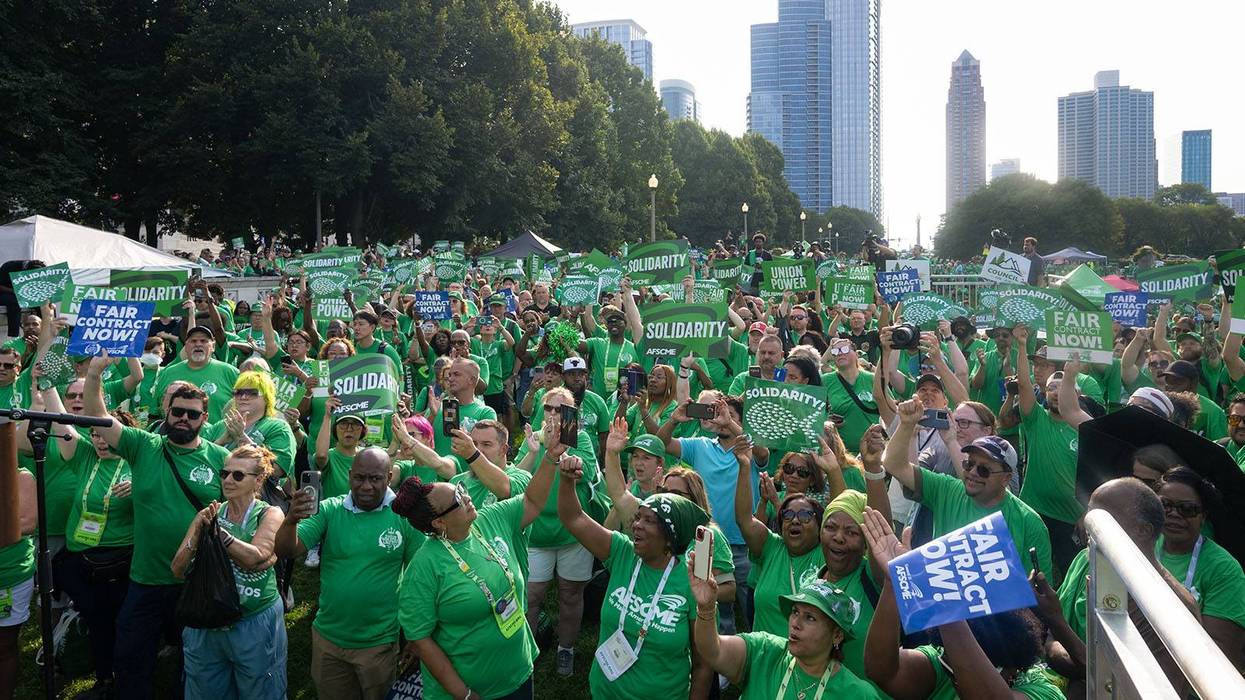
Standing together is how we take on billionaires and anti-worker politicians. It is how we protect our jobs, our freedoms, and the spirit of Labor Day itself.
Working people are fed up. Job uncertainty is the new normal. Chaos and corruption are constantly spilling out of Washington. But for the people grinding out a living every day, the crisis hits much closer to home. Burnout is rampant among essential workers, especially among caregivers, first responders, and social workers. And even as working people put in longer hours, their paychecks cover less and less as prices on seemingly everything continue to rise month after month. This Labor Day, that anger needs somewhere to go.
In 2026, even a simple backyard barbecue with friends and family can feel out of reach. These days, you are paying more for the burgers and crossing your fingers, hoping the lettuce will not make you sick.
The essential workers clocking in this Labor Day to keep our communities safe, healthy, and running should be able to count on one job paying enough to live on. Instead, too many worry about how they will make ends meet—or are picking up a second or even a third job. On a day meant to celebrate working people, that is a damn shame.
And it is not just groceries stretching family budgets. It’s healthcare and prescription drugs. Gas and electric bills. Rent and childcare. Nearly every necessity costs more, and every paycheck has to stretch further.
This November, working people must vote like our jobs, our freedoms, and our families’ futures depend on it, because they do.
This affordability crisis is not an accident. It is the result of choices. It is what happens when politicians pick a side. Whenever the Trump administration had a chance to lighten the burden on working families, it chose to make that burden heavier. Its so-called “Big Beautiful Bill” gutted the Supplemental Nutrition Assistance Program, putting groceries further out of reach for millions of families. It slashed Medicaid, threatening coverage and shifting more healthcare costs onto working people.
The administration has made its choice clear: It is on the side of billionaires. Their wealth has surged by trillions since last Labor Day. The president’s own wealth has grown by $2.2 billion—all while working people and retirees struggle to afford the basics.
AFSCME has made its choice clear, too. Our union stands with working people—with the 1.4 million public service workers and retirees who make our communities stronger every day.
We side with Chearice Vaughn, a US Department of Agriculture worker and president of AFSCME Local 3870, whose team connects rural schools, hospitals, and families to high-speed internet. Despite her 32 years of dedicated public service, the administration tried to fire her.
We stand with Sabrina Bishop, a San Diego homecare provider and a member of UDW/AFSCME Local 3930, who cares for veterans, people with disabilities, and older Americans. The administration has gone after overtime protections that ensure caregivers like Sabrina are paid for every hour they work.
And we stand with Everett Johnson, a preventive maintenance technician for Baltimore City Public Schools and a member of AFSCME Council 3. Everett keeps school buildings safe, but a lack of resources forced him to buy his own tools to do the job.
These workers are not powerless. They have a union.
AFSCME went to court and stopped the administration from forcing Chearice out. Sabrina and her union siblings mobilized at the California State Capitol and won protections for overtime pay. Everett has a seat at the table to negotiate for better pay, better equipment, and the resources to do his job.
That is what union power looks like. When working people come under attack, we organize. We fight back. And we win.
More working people are recognizing that power every day. That is why public support for unions is at an historic high and why AFSCME continues to grow despite the constant attacks.
Standing together is how we take on billionaires and anti-worker politicians. It is how we protect our jobs, our freedoms, and the spirit of Labor Day itself.
But our power does not stop at the workplace. It extends to the ballot box.
This November, working people must vote like our jobs, our freedoms, and our families’ futures depend on it, because they do. We must elect candidates who will lower costs, protect public services, and stand up for working people, not billionaires.
This Labor Day, ask yourself: Whose side are you on?
And this November, vote for the people who are on your side.

As spying becomes big business, more people are mobilizing to resist mass surveillance.
For many, Labor Day signifies a time of transition, the end of summer and the return to business as usual, whether it be school or work. But the holiday weekend was born out of a more radical past, and at a place charged with a history of protest and free expression.
On September 5, 1882, more than 10,000 workers sacrificed a day’s pay to march on Union Square and demand an eight-hour workday and an end to child labor. The success of their protest paved the way for Labor Day to become a federal holiday in 1894.
Initially a gated garden enclave for New York’s wealthiest, architects Frederick Law Olmsted and Calvert Vaux redesigned Union Square in 1872 as an open plaza for public assembly and patriotic demonstration.
By the beginning of the 20th century, Union Square became the epicenter of radical American politics, a setting for protests by anarchists and socialists. Noted activist Emma Goldman frequently used the public plaza to challenge government censorship and advocate for women’s reproductive rights and free speech.
Today, however, Union Square has been fenced in by a barricade of a different sort. Ringing the plaza is a spiky array of cameras, installed on streetlights by a New York Police Department seeking to surveil New Yorkers and anyone else who happens by the square.
The cameras include automatic license-plate recognition technology, which captures data on every car that passes the square down Broadway or across busy 14th Street.
Whether you’re driving to the grocery store for a quart of milk or attending a local No Kings protest, odds are that law enforcement has recorded, processed, and archived your activities for future reference.
Such setups are so ubiquitous to cities and major intersections that they’re easy to dismiss as normal features of a busy streetscape. But that’s changing.
The company that produces many of these surveillance cameras—Flock Group Inc.—has become a focus of concern among activists, advocates, and people of every political stripe who don’t want law enforcement documenting and archiving their every activity.
But Flock is not alone. Surveilling everyday Americans is now a multibillion-dollar business that’s growing fast.
Flock has struck license-plate reading camera contracts with 7,000 law-enforcement agencies, accounting for 40% of all such departments nationwide. There are more than 130,000 of these cameras deployed across 49 states, likely at a busy intersection or gathering point near you.
Whether you’re driving to the grocery store for a quart of milk or attending a local No Kings protest, odds are that law enforcement has recorded, processed, and archived your activities for future reference.
The philosophy behind such mass surveillance is that authorities need to capture data on everyone’s movements to identify those few who step out of line. It’s as though you need to know the habits of every blade of grass in the haystack to cull out the one wayward needle.
If that’s not disturbing enough, there have also been extensive reports of abuse, including local police officers deploying department surveillance technology to stalk romantic interests—including strangers—while innocent people have been thrown in jail based on a misread license plate or an inaccurate biometric scan.
“The constant and ongoing surveillance of people in public places raises serious First and Fourth Amendment concerns,” says Jenna Ruddock, Free Press’ advocacy director. “Even decisions about where to install these cameras map onto well-established practices of racist policing, aside from the fact that facial-detection technology has an alarming track record when attempting to identify people of color.”
Still, more major tech companies are getting in on the expanding surveillance business. Powerful artificial intelligence companies are marketing AI-enabled video analytics with facial-recognition capacities for real-time threat detection (think Minority Report).
And while Meta doesn’t directly market its Ray-Ban smart glasses to law enforcement, local police departments and immigration agencies have been buying them in bulk via Amazon.
For its part, Amazon is chasing multimillion-dollar contracts to provide law enforcement with cloud infrastructure for data storage, analytics, and biometric systems, including more than $250 million from the Department of Homeland Security to host many of the databases and systems used to track, monitor, and deport immigrants.
Though he once promised that he wouldn’t allow anyone to use company technology to harm people, Google CEO Sundar Pichai is now seeking to profit from mass surveillance. The company is already doing business with Immigration and Customs Enforcement while vying with Amazon and other tech giants for government cloud-computing contracts. Google is also under contract to provide the tech at the center of federal projects to upgrade the “virtual wall” that surveils US borders.
As more cameras sprout up in more locations, the movement to oppose such government spying is spreading. Dozens of cities across the country have cut ties with Flock over their residents’ data-privacy concerns. People have flocked to public hearings and city council meetings to pressure local elected officials to turn the cameras off. Some have taken matters into their own hands, covering nearby Flock and other surveillance cameras with trash bags—or even cutting down camera-attached light poles with electric saws.
DeFlock, an anti-surveillance activist group, has been mapping locations of Flock and other cameras nationwide. (This author used this tool to identify the many non-Flock surveillance cameras surrounding Union Square).
In August, privacy advocates organized the DeFlock National Week of Action, which featured a series of protests, town halls, and informational events to oppose automated license-plate readers and other mass surveillance technology.
The pushback against local surveillance cameras is occurring alongside the fast-spreading movement to stop the unchecked construction of data centers. There’s a common culprit in both popular uprisings: the unholy alliances struck between Big Tech and government. Others are rightfully suspicious of the billionaire class pushing the rapid, reckless development of advanced AI and surveillance tools without first seeking the consent of surrounding communities.
In Union Square on a recent Monday, I asked local busker Lawrence Kidwell whether he knew what all of the nearby police cameras were about. “The NYPD just wants to listen to my music,” he said.
Perhaps. But the cameras are also in place to discourage other forms of expression and muzzle voices of dissent. Something that Union Square has long welcomed may become lost to the new deprivations of the surveillance state.
This piece was originally published at Pressing Issues.
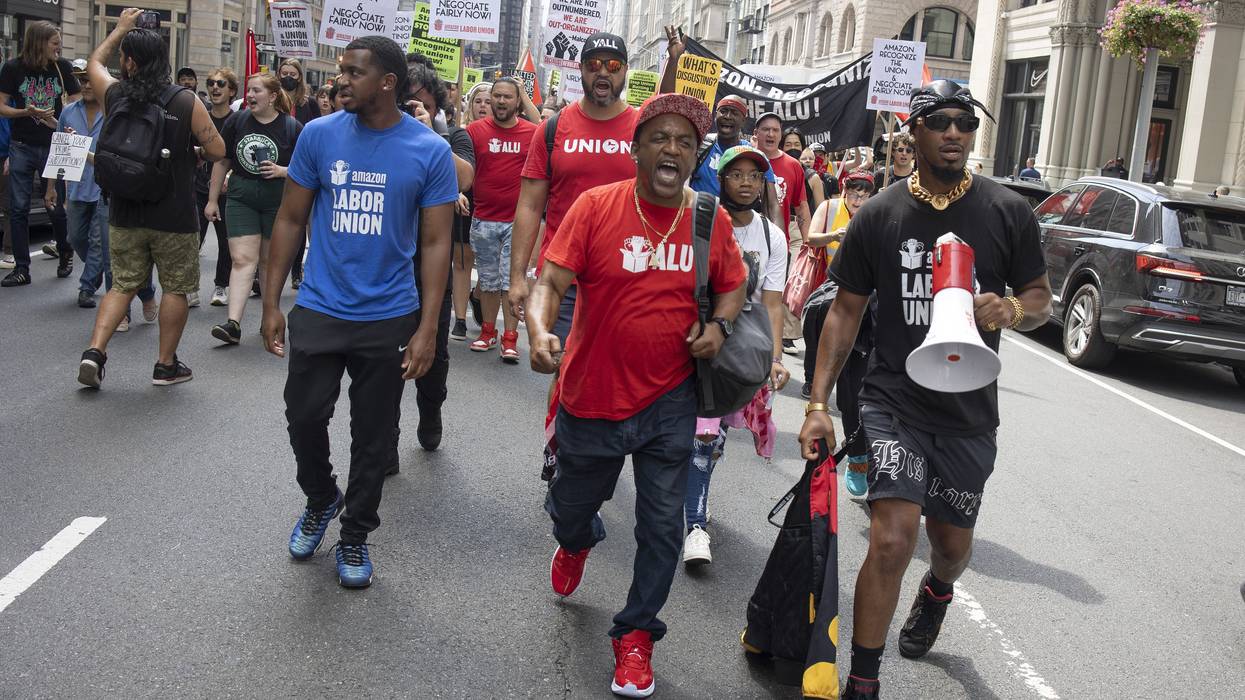
Labor Day can be converted from just a symbolic holiday into a day of mass action, democratic deliberation, and binding commitments.
Unfortunately, Labor Day has become a long weekend for mattress sales and political platitudes when it should be the annual day when working people present the case for taking control of our country back from the corporatists who shape our political economy. The first Monday in September is a massive, unused civic asset, a legally recognized national holiday that could function as a recurring general assembly of America’s workers—if we choose to reclaim it.
Instead of being about the power of labor over capital, Labor Day has been domesticated into barbecues and ballgames while giant corporations tighten their grip on our economy, our governments, and the daily lives of all Americans, regardless of political labels.
Tens of millions of workers are still paid wages that cannot support a decent life, forced into permanent economic insecurity by part‑time jobs, gig “contracts,” and union‑busting consultants. Workplace democracy doesn’t exist: You are more likely to be punished for organizing a union than to be protected for exercising your basic rights. Corporate crime—tax evasions, wage theft, unsafe conditions, and violations of environmental and consumer protections—goes largely unprosecuted. At most, corporations are punished with wrist‑slap fines that CEOs quietly treat as a cost of doing business. In the richest country on Earth, we still lack universal healthcare, universal childcare, paid family leave, and a fair progressive tax system to provide needed revenues. Worker productivity rises, and the wealth of the top 1% reaches obscene levels. It is time for unions to take on the corporate predators who are wrecking our economy and democracy.
Meanwhile, politicians of both major parties take to Labor Day podiums, praise “the hardworking men and women of this country,” and then return to Washington and state capitols to do the bidding of campaign donors. They vote for trade deals that outsource jobs, deregulation that strips away workplace protections, and budgets that starve labor law enforcement. Public‑sector workers are vilified as “special interests” for wanting a decent pension.
Reclaiming Labor Day requires workers, unions, and allied organizations to decide that enough is enough and that this one annual holiday is theirs, with the media taking notice.
It does not have to be this way. Labor Day can be converted from just a symbolic holiday into a day of mass action, democratic deliberation, and binding commitments. Imagine Labor Day not as a backdrop for store sales, but as a day when a pro-worker agenda is presented. In cities and towns across the country, Labor Day could be an occasion for workers to convene meetings—at union halls, school auditoriums, public parks, and town squares—to deliver their demands to elected officials and the public.
At the center of this reclaimed Labor Day should be a Worker Compact for America—a concise, concrete program of rights, protections, and public investments that elected officials pledge, in writing, to support (see my column: "Long-Overdue Domestic Compact for America"). The Compact could include a living wage pegged to the real cost of housing, food, and healthcare; card‑check recognition and real penalties for employers who retaliate against organizing; universal healthcare as a right; paid family and medical leave; universal, publicly supported childcare; and serious criminal and civil sanctions for corporate abuses such as wage and pension theft and workplace safety violations.
Labor Day should also be the moment when workers formally summon their representatives to account. Every senator, every representative, every governor, every mayor, and every state legislator whose constituents work for a living should receive a written summons well in advance of Labor Day: “You are Summoned and morally obligated to engage with a workers’ assembly in your district on this date, at this time, to answer questions and respond to demands of the Worker Compact.” Those who appear would be questioned, on the record, about their votes and their pledges to support the Worker Compact.
Those who refuse to appear would be named from the podium and in the local media as having chosen their corporate patrons over the workers who elect them.
Unions must be at the forefront of this transformation, but they cannot do it alone. The AFL‑CIO and national unions should provide muscle, resources, and experienced organizers. Local unions, especially those that have led recent organizing drives, should be the anchors in their communities. But civic groups, faith communities, student organizations, tenant unions, consumer advocates, and environmental justice campaigns—all of them have a direct stake in a stronger labor movement and should be invited to help expose the carnage caused by unchecked Corporate Power (see the AFL-CIO’s Worker Foundation of Trump’s Second-Term Agenda).
Much of the infrastructure already exists; it is the public reshaping of Labor Day that needs to change. Parades, where they still occur, should shift from generic celebration to worker agenda‑driven demonstrations. Floats should not just carry politicians waving; they should carry workers demanding specific changes: warehouse workers calling for safe staffing, nurses calling for safe patient ratios, and transit workers calling for investment in public transportation. Marching bands can be joined by marching delegations of workers—each with their banners and demands. Voter registration tables, ballot measure petitions, and sign‑up sheets for organizing committees should line the parade routes.
Because of the election calendar, Labor Day signals the final stretch of every general election. Candidate forums convened by workers on Labor Day should not end at sundown; they should kick off sustained, workplace-based, and neighborhood‑based organizing that runs through Election Day and beyond. Every candidate who signs the Worker Compact on Labor Day should be evaluated: Did they co‑sponsor the bills they promised to support, vote the way they pledged, and stand with workers in strikes and organizing drives? The next Labor Day, those records should again be publicized.
Reclaiming Labor Day requires workers, unions, and allied organizations to decide that enough is enough and that this one annual holiday is theirs, with the media taking notice.
The question posed every first Monday in September is the old union question: Which side are you on? If we are on the side of workers, then we must act like it—organizing, summoning, demanding, and voting for candidates who stand with the workers, not the vastly under-taxed corporate predators and plutocrats.
If you are interested in organizing events in your community, contact us at LaborDay@nader.org
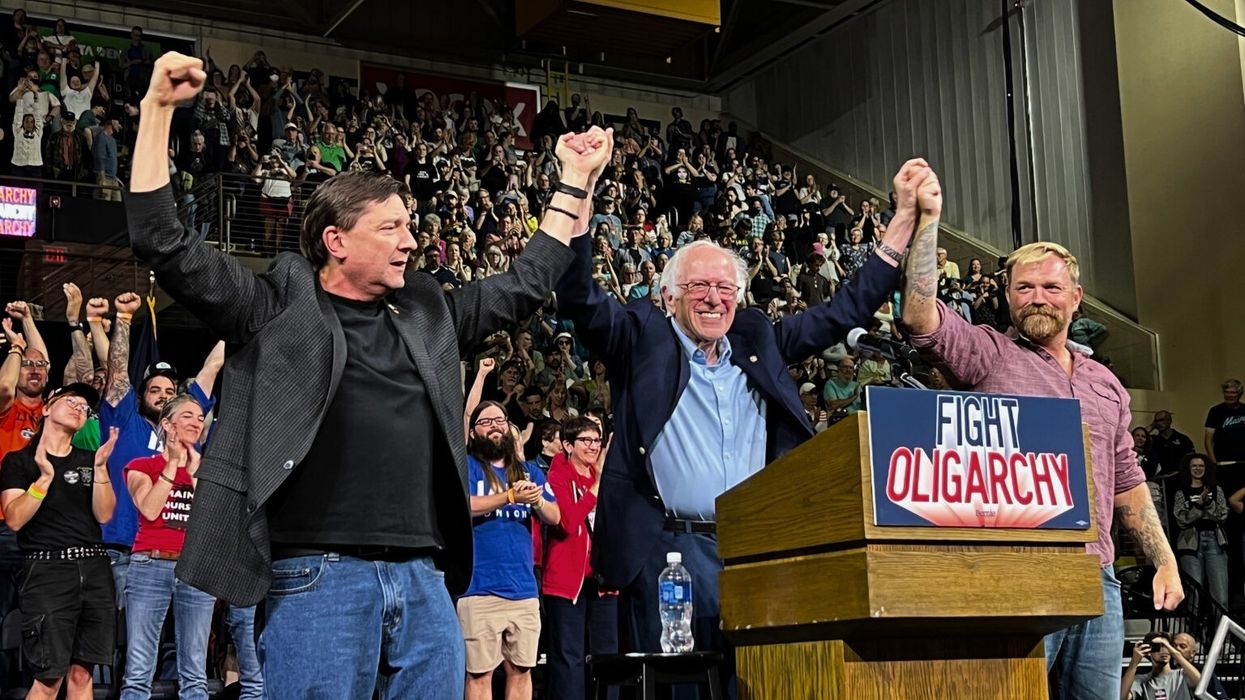
"We do not live in a system that is broken. We live in a system that is functioning exactly as it is intended," said Graham Platner, running for US Senate. "We live in a system that has been built by the political class to enrich and support billionaires on the backs of working people."
Sen. Bernie Sanders headlined a Labor Day rally in downtown Portland, Maine on Monday as part of his ongoing "Fighting Oligarchy" tour, where he joined hands in solidarity with the two candidates—Troy Jackson and Graham Platner—both of whom embrace the Vermont independent's democratic socialist message and a critique that argues concentrated wealth and power have corrupted both major political parties at the expense of working people.
Platner, an oysterman from the small coastal town of Sullivan seeking to win the Democratic primary in order to challenge Republican Sen. Susan Collins in 2026, launched his campaign last month by stating flatly that "the oligarchy is the enemy."
During his remarks Monday at the Cross Insurance Arena, Platner brought the crowd of over 6,500 people to their feet multiple times by blasting the ruling class and lamenting the struggle of too many Maine families.
"Politicians have made a series of decisions over the last 40 years that have resulted in the world that we see today. Their choices have left many of us with very little while, very few accrue vast amounts of wealth," he declared. "In 1990, there were less than 100 billionaires in the United States—today there are over 800. I ask you: when you look around, do you see a community and a state that is eight times wealthier than it was in 1990?"
Sanders rally with Graham Platner and Troy Jackson
"Much of the world that we have today is the specific result of policy choices made by establishment politicians. And the shameful truth of all of this is the blame cannot simply be left at the feet of one political party," said Platner. "We have two parties that want the votes of working people, but neither has done anything lately to earn it. No one is owed allegiance. Support must be earned and that will never happen as long as Democrats are part of the same corporate apparatus that the Republicans are."
Platner's bid against Collins, who has held the seat in the US Senate since 1997, is seen by some political observers as a long shot, but Platner was emphatic that voters in Maine are no longer fooled by what he described as her political "charade" in which she postures as a moderate while backing President Donald Trump's far-right, pro-corporate agenda.
"No one cares that you pretend to be remorseful as you sell out to lobbyists," Planter said of Collins. "No one cares while you sell out to corporations and no one cares while you sell out to a president who are all engineering the greatest redistribution of wealth,—from the working class to the ruling class—in American history."
"Symbolic opposition does not reopen hospitals," he continued, referencing the destruction repercussions of Collins' support for the GOP megabill earlier this year that will strip hundreds of billions from Medicaid. "Weak condemnations do not bring back Roe v. Wade. Sellling out the same working class voters who've delivered mandate for change after mandate for change is not forgivable. A performative politics that enables the destruction of our way of life is disqualifying for the role of United States Senator."
Platner drove home his message that the ruling class, both in Maine and nationwide, is at the heart of the struggles and challenged the idea that voters don't understand the term "oligarchy"—something that segments of the Democratic Party establishment have argued as Sanders toured the country this summer with his message.
"I keep getting told that voters don't know what that word means," said Platner. "But from the standing ovation, I assume everybody knows what it means because we know what's happening when we're getting robbed blind. But let's be clear, we do not live in a system that is broken. We live in a system that is functioning exactly as it is intended. We live in a system that has been built by the political class to enrich and support billionaires on the backs of working people."
The state of Maine, he declared amid a standing ovation, "deserves better than Susan Collins and Maine deserves an alternative who is not at risk of being mistaken as being beholden to the same status quo that she is. I am running because it is time for change."
Planter vowed to "beat back fascism," called for defense of democracy, and said people must embrace a notion of freedom that goes beyond a "romantic freedom"—one that recognizes the affordability crisis that makes life so difficult for working people.
What people need, he said, is a "freedom to not be condemned to scraps and to struggle, but to live with the dignity and fulfillment that gives us the society we deserve. Where instead of dreaming of a life where we can get by, we can afford a life that allows us to dream."
Following Platner, Troy Jackson, a seventh-generation logger from northern Maine who turned to politics on a working-class platform and rose to become president of the State Senate, is among those seeking to become the next governor of Maine when Gov. Janet Mills, also a Democrat, leaves office next year.
"I'm running because it's time to put power back in the hands of the people," said Jackson, after recounting his days in the woods, struggling to provide for his family while the wealthy owners of the logging companies grew ever richer and ever greedier.
"I'm running for governor because the American dream of putting down roots and owning a home and being able to provide for your family with a good-paying job is moving way out of reach," said Jackson. "I am running for the people who worked their entire lives and still can't afford to retire because the economic system in this country is rigged against them. And I'm running for all the workers who've been told to do or go home who've been told that they're replaceable and that their lives are disposable."
Like Platner, Jackson railed against the "status quo" and while he credited Democrats in the state for doing many important things over recent years, also admitted the party had fallen "woefully short" on many issues.
During his speech to conclude the rally, Sanders said this year's Labor Day comes at a perilous time in US history, with Trump's authoritarianism coinciding—and not coincidentally—with obscene levels of economic and political inequality.
Sanders said that the hundreds of thousands of people he has now spoken to as part of the "Fighting Oligarchy" tour have made it clear to him that there is a shared set of beliefs that can overturn the assault on democracy and working people that Trump is now leading.
"We have been to 15 states—and now I can say from Maine to California and a lot of states in between. And we've talked to over 300,000 people," said Sanders. "And what I can tell you without any fear of contradiction is the American people do not want an oligarchic form of government."
"They do not want to live under a kleptocracy where a president gets rich by being president and they sure as hell a sick and tired of the ongoing war of the rich against the working class of this country," he continued. "This is an unprecedented and, in fact, dangerous moment in American history and we have got to respond in an unprecedented way. And the way we respond is to build the kind of strong, progressive grassroots movement, the likes of which this country has never seen."
Echoing Platner, Sanders said that simply denouncing and confronting the Republicans will not be enough to turn the tide.
"What we need to do—which the Democratic Party, the leadership does not do—is have a vision of where we want this country to be," said Sanders.
"What I am begging of you is don't think small, think big," he continued, championing Medicare for All, robust support for public education, an end to disastrous US foreign policy—including support for the Israeli assault on Gaza, an expansion of Social Security, and serious efforts to curb rising food costs and the housing crisis that is crushing working people from coast to coast.
"Brothers and sisters, we got to be thinking outside the box in this state. We got to elect Graham and we got to elect Troy and other good people, but they can't do it alone," said Sanders.
The trick of the ruling class, he told the crowd, is "they basically try to say that ordinary people are powerless."
"What they're saying is they have all the money, they have all of the power, you got nothing. And they can do anything they want and you can't stop them," Sanders continued. "Well, I think we've got some news for them. Not only can we stop them, not only will we stop them, but for the future of this country and in fact the world, we must, must stop them today."
"On Labor Day—when we thank the unions for all they have done for the working class of this country—we understand and remember what a union is," he concluded. "A union is the understanding that one person cannot do it alone. That we all have got to come together to fight with and for each other. And what the union movement is about is solidarity forever."
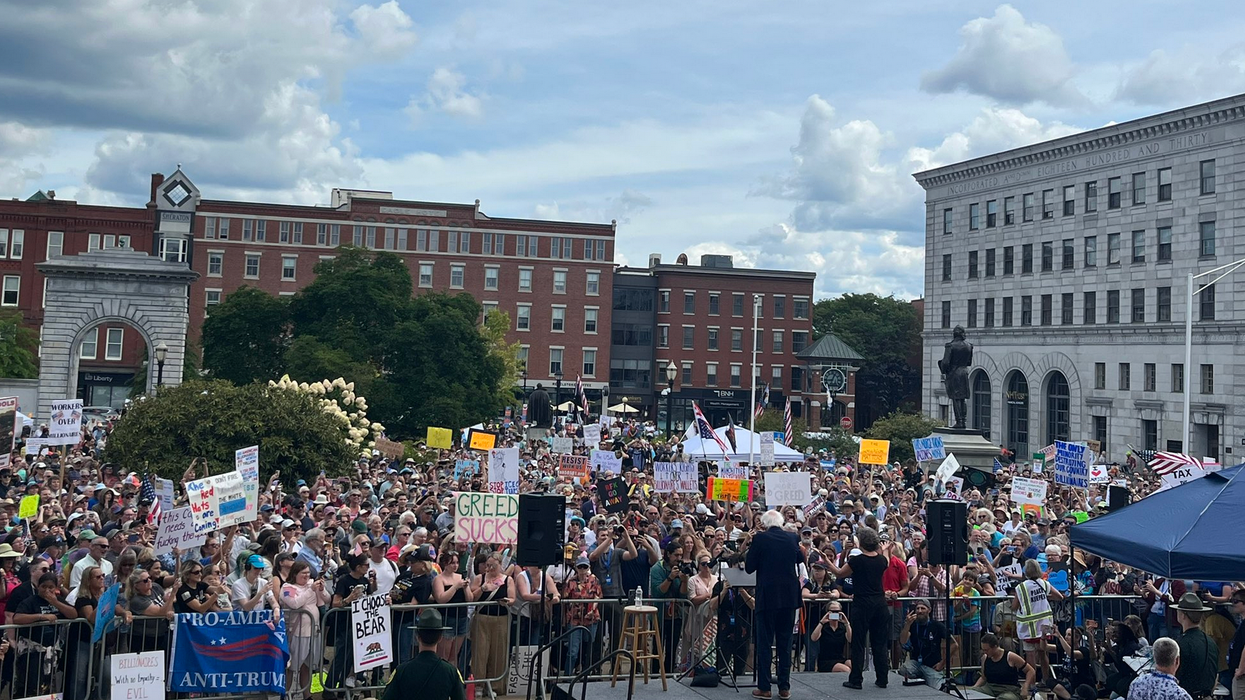
"Workers are fighting for a society where public schools take precedence over private profits, healthcare is prioritized over hedge funds, and affordable housing is valued more than homelessness," said May Day Strong.
This is a developing story... Please check back for possible updates.
Americans turned out across the United States on Monday for more than 1,000 demonstrations against President Donald Trump and other oligarchs "to reclaim worker power against billionaires who hoard unprecedented wealth and power."
The "Workers Over Billionaires" protests are being led by the May Day Strong Coalition, which is made up of dozens of organizations including the AFL-CIO, American Federation of Teachers, National Union of Healthcare Workers, and advocacy groups like Americans for Tax Fairness, Indivisible, Our Revolution, and Public Citizen.
Demonstrations took place or are set to happen in big cities, small towns, and communities in between all across the nation. Sen. Bernie Sanders (I-Vt.) and Rep. Ro Khanna (D-Calif.) spoke at a rally in Concord, New Hampshire, where Sanders—whose "Fight Oligarchy Tour" has been drawing huge crowds across the country—vowed that "together, we will create an economy and government that work for all, not just the 1%."
Khanna said that "today on Labor Day, we must recognize the workers across the country who build our economy and strengthen our nation. We need to fight for a living wage and stronger unions as we work to reindustrialize America."
Sanders took his Fighting Oligarchy Tour to Portland, Maine on Monday, where he was joined by guests including Graham Platner, an oyster farmer who is running to unseat five-term Republican US Sen. Susan Collins.
In a video posted on the social media site Bluesky before the rally, Platner said he "could not think of a better day to be a pro-labor candidate."
"Organized labor is the basis of the movement that we are going to have to build to retake this country for working people," Platner added.
May Day Strong said Monday's mobilizations aim "to build collective action against billionaires taking over the US government."
"Building upon momentum from May Day, Good Trouble Lives On, No Kings, and key impromptu actions in the streets and the workplace, Workers Over Billionaires will reach communities nationwide, tapping rural and city workers to stop the billionaire agenda that continues to burden everyone," the coalition said. "As the federal government continues to enable the ultrarich, working people are stepping onto pavement to stop their greed and protect their families."
"Working families want to live in a country that puts workers over billionaires," the coalition added. "Workers are fighting for a society where public schools take precedence over private profits, healthcare is prioritized over hedge funds, and affordable housing is valued more than homelessness."
In New York, actions included a rally outside Trump Tower in Manhattan, where demonstrators demanded a $30 an hour minimum wage. Members of groups including One Fair Wage (OFW) staged a "Restaurant in the Street" demonstration "designed to highlight the struggle of working people and launch the New York Living Wage for All campaign."
"The action coincides with the release of a new OFW report, Making America Affordable Now: The Case for a Living Wage for All, which finds that nearly half of US workers—67 million people—earn less than $25 an hour," One Fair Wage said. "In New York, 41% of workers fall below that threshold."
OFW said that the demand for a living wage is the "next generation of the Fight for $15," warning that "past wage gains have been erased by historic inflation, skyrocketing rents, and cuts to Medicaid and SNAP," the federal Supplemental Nutrition Assistance Program.
"It also highlights how gimmicks like Trump's 'No Tax on Tips' proposal do little to address workers' needs, since two-thirds of tipped workers earn too little to benefit," OFW added.
In Chicago, at least hundreds of people from dozens of groups including the Chicago Teachers Union, Teamsters, and healthcare and hospitality workers rallied against Trump's Project 2025-inspired evisceration of federal agencies and the social safety net.
Chicago Mayor Brandon Johnson denounced Trump's threat to send federal forces into the Windy City in a similar occupation to the one underway in Washington, DC, leading chants of "No troops in Chicago! No troops in Chicago! Invest in Chicago!"
American Federation of Teachers president Randi Weingarten told Chicago protesters that "what has happened in this country is that the billionaires don't understand this country was created in protest and resistance to fight off a king, not to recreate a king."
Chicago protester Mark Petersen told NBC Chicago: "I think solidarity among workers is probably the most important thing we can do right now. We're looking at our country get disassembled from the top down, and the best thing we can do is unite from the bottom up."
Hotel workers at the Hilton Americas-Houston downtown went on strike before dawn Monday, demanding a $23 hourly minimum wage. They kicked off their planned nine-day strike with a protest at 6:00 am, during which workers chanted, "Aquí estamos, y no nos vamos"—"We are here, and we won't leave."
"The workers are feeling this need urgently," Franchesca Caraballo, president of Unite Here Local 23's Texas chapter. "We have to take it up several notches here to turn up the pressure on this company."
In Indianapolis, marchers chanted, "No fascists, support unions, support workers."
AFL-CIO president Liz Shuler said ahead of the protests: "Every single thing working people have won for ourselves in this country's history—it's not because we asked those in power. It's not because they were handed to us. It's because we fought for them relentlessly."
Saqib Bhatti, executive director of Action Center on Race and the Economy (ACRE), told USA Today that "it's important to show that there is opposition to the Trump-billionaire agenda in every community, big and small; it's not just cities that are united against what's happening... it's all towns, it's small towns that voted overwhelmingly for Trump."
Monday also saw the launch of the Department of Class Solidarity (DOCS), "a permanent national war room tracking nearly 1,000 US billionaires, their wealth, corporate holdings, and political contributions."
"This Labor Day weekend, we are not resting," DOCS said on social media. "The oligarchs are snatching away our healthcare, our livelihoods, and our rights. Now is the time to act."
DOCS and allied groups rallied for a "Hamptons Billionaire Shutdown" on Long Island.
🔥 March on Billionaires Lane in the Hamptons — one of the densest concentrations of billionaires in the world.Oligarchs are hiding in their mansions as they bankroll attacks on us with fortunes they plundered from us.The working class is rising. ✊ #PeopleOverBillionaires #FightOligarchy
[image or embed]
— Our Revolution (@our-revolution.bsky.social) September 1, 2025 at 1:33 PM
"The Hamptons is where right-wing billionaires like Bill Ackman and Dan Loeb plot and plan in their hundred-million-dollar mansions, ensconced from the workers they exploit," DOCS said. "Time to give them a taste of their own medicine."

"This is a government that is by, and for, the CEOs and billionaires," said AFL-CIO president Liz Shuler.
Although US President Donald Trump's administration likes to boast that he puts "American workers first," several news reports published on Monday document the president's attacks on the rights of working people and labor unions.
As longtime labor reporter Steven Greenhouse explained in The Guardian, Trump throughout his second term has "taken dozens of actions that hurt workers, often by cutting their pay or making their jobs more dangerous."
Among other things, Greenhouse cited Trump's decision to halt a regulation intended to protect coal miners from lung disease, as well as his decision to strip a million federal workers of their collective bargaining rights.
Liz Shuler, president of the AFL-CIO, told Greenhouse that Trump's actions amount to a "big betrayal" of his promises to look out for US workers during the 2024 presidential campaign.
"His attacks on unions are coming fast and furious," she said. "He talks a good game of being for working people, but he's doing the absolute opposite. This is a government that is by, and for, the CEOs and billionaires."
Heidi Shierholz, president of the Economic Policy Institute, similarly told Greenhouse that Trump has been "absolutely, brazenly anti-worker," and she cited him ripping away an increase in the minimum wage for federal contractors that had been enacted by former President Joe Biden as a prime example.
"The minimum wage is incredibly popular," she said. "He just took away the minimum wage from hundreds of thousands of workers. That blew my mind."
NPR published its own Labor Day report that zeroed in on how the president is "decimating" federal employee unions by issuing March and August executive orders stripping them of the power to collectively bargain for better working conditions.
So far, nine federal agencies have canceled their union contracts as a result of the orders, which are based on a provision in federal law that gives the president the power to terminate collective bargaining at agencies that are primarily involved with national security.
The Trump administration has embraced a maximalist interpretation of this power and has demanded the end of collective bargaining at departments that aren't primarily known as national security agencies, including the Environmental Protection Agency and the National Weather Service.
However, Trump's attacks on organized labor haven't completely intimidated government workers from joining unions. As the Los Angeles Times reported, the Trump administration's cuts to the National Park Service earlier this year inspired hundreds of workers at the California-based Yosemite, Sequoia, and Kings Canyon national parks to unionize.
Although labor organizers had been trying unsuccessfully for years to get park workers to sign on, that changed when the Trump administration took a hatchet to parks' budgets and enacted mass layoffs.
"More than 97% of employees at Yosemite and Sequoia and Kings Canyon national parks who cast ballots voted to unionize, with results certified last week," wrote the Los Angeles Times. "More than 600 staffers—including interpretive park rangers, biologists, firefighters, and fee collectors—are now represented by the National Federation of Federal Employees."
Even so, many workers who succeed in forming unions may no longer get their grievances heard given the state of the National Labor Relations Board (NLRB).
As documented by Timothy Noah in The New Republic, the NLRB is now "hanging by a thread" in the wake of a court ruling that declared the board's structure to be unconstitutional because it barred the president from being able to fire NLRB administrative judges at will.
"The ruling doesn't shut down the NLRB entirely because it applies only to cases in Louisiana, Mississippi, and Texas, where the 5th Circuit has jurisdiction," Noah explained. "But Jennifer Abruzzo, who was President Joe Biden's NLRB general counsel, told me that the decision will 'open the floodgates for employers to forum-shop and seek to get injunctions' in those three states."
Noah noted that this lawsuit was brought in part by SpaceX owner and one-time Trump ally Elon Musk, and he accused the Trump NLRB of waging a "half-hearted" fight against Musk's attack on workers' rights.
Thanks to Trump and Musk's actions, Noah concluded, American oligarchs "can toast the NLRB's imminent destruction."
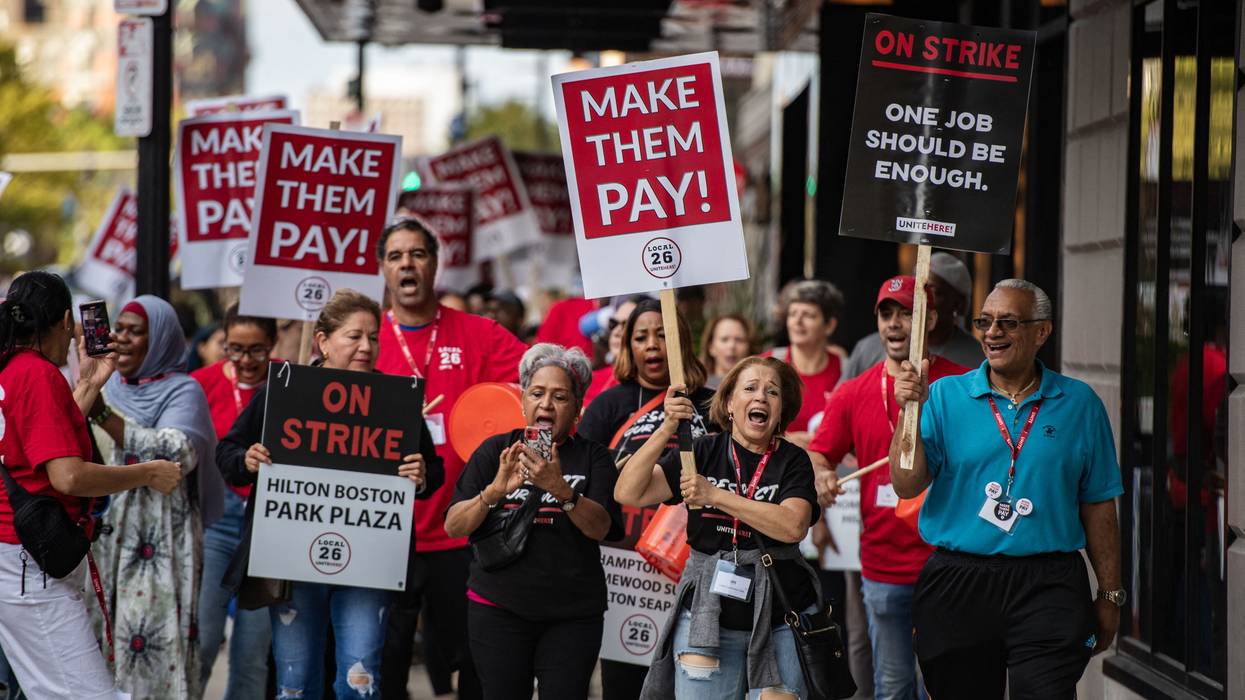
Most of the long-overdue planks on this Domestic Compact for America are supported by both liberal and conservative families who live, work, and raise their children here.
Running on the following Domestic Compact for America is a winning election strategy for candidates at the local, state, and national levels.
Most of these long-overdue programs are supported by both liberal and conservative families who live, work, and raise their children, facing unaddressed necessities of life and livelihoods.
Labor Day celebrations should be about more than department store sales and clambakes. America’s labor unions, at both the national and local levels, should circulate this agenda widely on Labor Day, because it is also a Compact for American Workers.
This agenda is being sent to Liz Shuler, president of the AFL-CIO (see the letter sent to her on August 27, 2024), and to the presidents of other major unions, including those representing postal workers, flight attendants, electrical workers, autoworkers, steelworkers, service workers, nurses, textile workers, and agricultural workers.
You might ask yourself: How many of these protections and benefits is US President Donald Trump opposing? These are good yardsticks by which to compare his deceptive rhetoric with his misdeeds.
The basic question is, whose side are you on? The key elements of the Compact are:
Why has the Democratic Party declined to lead with such an agenda, which has been proposed for years by various citizen groups? (See winningamerica.net.)
One reason is special interest campaign money. Another is that the Democratic Party contracts out many of its campaigns to corporate-conflicted consulting firms that have long pushed weak messaging that leads voters to keep wondering what the party stands for. These consulting firms know the answer—have the party do what is necessary to outraise the GOP in campaign contributions from corporate PACs, the super wealthy, and Wall Street titans.
When the labor union chiefs just write campaign checks to the Democratic Party without demanding an authentic, publicly visible agenda for workers, the pressure is off the party’s leadership to cease being a corporate party or to recruit younger leaders to provide needed energy from the Democratic National Committee down to the grassroots. Without this energy, there is no serious effort to mobilize informed voters who demand these changes and overdue redirections. (See Roots Action, founded by Jeff Cohen and Norman Solomon.)
Here is to a more vibrant, respectful LABOR DAY.
For more information about what workers can do to advance their interests, see my book Civic Self-Respect—Chapter 2: “I, the Worker.”