
SUBSCRIBE TO OUR FREE NEWSLETTER
Daily news & progressive opinion—funded by the people, not the corporations—delivered straight to your inbox.
5
#000000
#FFFFFF
To donate by check, phone, or other method, see our More Ways to Give page.


Daily news & progressive opinion—funded by the people, not the corporations—delivered straight to your inbox.
Public pensions must exit Exxon to protect workers' savings and retirement.
It is no secret that ExxonMobil poses some of the most powerful opposition to climate action at every level of government. Environmentalists have long pointed out that Exxon Knew about climate change, and instead of pivoting their business model to a more sustainable energy future, buried the evidence and began a decades-long disinformation campaign.
Leaders across the country have wisened up to the oil major's dirty politics, which is why the House Oversight Committee has been investigating Exxon and its peers, and state attorneys general have sued the company for damages. Most recently, California AG Rob Bonta, alongside environmental organizations like the Sierra Club, sued the company for lying to the public about the recyclability of plastics.
If the tide is turning against Exxon, why haven't investors caught on?
Unrestricted funding for companies engaged in fossil fuel expansion threatens workers' right to dignified retirement safety, a right that unions have fought hard to win.
ExxonMobil sparked headlines and investor outrage this spring when the company sued its own shareholders over a climate-related shareholder resolution. Public pensions representing trillions in worker savings across the country pushed back and mounted a vote-no effort against CEO Darren Woods and Director Joseph Hooley, but Wall Street asset managers watered down their efforts instead offering unwavering support of Exxon.
To add insult to injury, Woods made an appearance at the Council of Institutional Investors—a nonprofit dedicated to advocating for the investor rights of public, union, and private employee benefit funds—in September. There, he promised to continue to crack down on "extreme" investors who are concerned that the company's business model has loaded the economy with systemic financial risks and instability. Never mind that such a definition of extreme would describe many of the institutions present, which represent over 15 million workers and $5 trillion in assets under management.
But perhaps most indicative of ExxonMobil's commitment to business-as-usual pollution is the bonds they've issued this fall, with a maturity date of 2074.
These long-dated bonds represent unrestricted funds for ExxonMobil to continue to pursue fossil fuel expansion and plastic pollution well past most of the world's—and investors'—Net Zero by 2050 goals. This is an especially risky gamble for investors with long-term obligations, including public pension funds that manage millions of workers' retirement savings.
Not only is the future of oil and gas uncertain, but prolonged pollution wrought by disinformation and investor cash increases economy-wide systemic risks. Investors—and the everyday people who rely on institutions to manage their savings—will be left holding the purse strings as climate change wreaks havoc. Moreover, bond ownership does not come with the shareholder rights investors hope to use to influence company behavior. This gives Exxon complete freedom to use the funds however it wishes, even if that's out of alignment with investor interests.
This increasing risk is why we joined California Common Good and pension beneficiaries to testify during a recent CalPERS Board meeting to ask CalPERS to issue a moratorium on purchasing Exxon bonds.
The Sierra Club represents millions of members, many of whom are saving for retirement in the face of an uncertain future and working tirelessly to protect the communities and places they love. Whether relying on a public pension plan or a private asset manager, our members rely on investment professionals to keep their futures in mind. Unrestricted funding for companies engaged in fossil fuel expansion threatens workers' right to dignified retirement safety, a right that unions have fought hard to win. That's why we call on investors, particularly public pension funds, to refuse to participate in Exxon's bond issuances.

The milestone, one campaigner said, should "give hope to folks that we are making an impact."
An earlier version of this story said that 16,000 institutions had divested. The correct number is 1,600 and it has been updated to reflect that.
More than 1,600 institutions like universities, pension funds, and governments that hold more than $40.6 trillion in assets have now divested from fossil fuels, the Global Fossil Fuel Divestment Movement announced Friday.
The announcement comes days after the 28th United Nations Climate Change Conference wrapped with a call for "transitioning away from fossil fuels" but stopped short of agreeing to the stronger "phaseout" of oil, gas, and coal backed by climate advocates and frontline communities.
"This number is huge," Amy Gray, Stand.earth climate finance associate director and coordinator of the Climate Safe Pensions Network, told Common Dreams. To put it in perspective, $40.6 trillion is equal to a little less than half of global gross domestic product.
The scale of the divestments to date, said Gray, "should show and give hope to folks that we are making an impact and we are making a difference and changing things for the better, regardless of these elitist events where the everyday person and the folks in the Global South and other places are discounted."
A Decade of Divestment
Friday's update to the Global Fossil Fuel Divestment Commitments Database reflects around a decade of organizing, Gray said. Organizers at 350.org started tracking divestment commitments when Gray and current Stand.earth climate finance director Richard Brooks worked there. When the pair moved to launch a climate finance team at Stand.earth, they brought the database with them.
While the divestment movement has seen ups and downs over that decade, Gray said it had picked up momentum over the last five or six years. In less than two years, the number of institutions divesting jumped by 120, holding a combined $1.4 trillion in assets.
"We've definitely seen a massive increase in divestment commitments as the divestment movement has built itself out and gotten stronger," Gray said.
"This milestone follows years of attempted shareholder engagement, now a proven futile strategy, with fossil fuel corporations hell-bent on our destruction."
Notable victories in 2023 included PMT, the largest private pension in the Netherlands; New York University, the National Academy of Medicine, and the Church of England.
The Church of England divestment was especially notable, Gray said, because of the statement that accompanied it. The church emphasized that it had tried to engage with the oil and gas companies it was invested in and urged them to adopt policies in line with the Paris agreement, but the companies did not change.
"The decision to disinvest was not taken lightly," Alan Smith, first church estates commissioner, said at the time. "Soberingly, the energy majors have not listened to significant voices in the societies and markets they serve and are not moving quickly enough on the transition. If any of these energy companies come into alignment with our criteria in the future, we would reconsider our position. Indeed, that is something we would hope for."
Gray remembered thinking at the time that it was the best divestment statement she'd ever read.
"It was really powerful," she said.
The Church of England wasn't the only institution that thought it could persuade Big Oil to change its ways without divesting.
"This milestone follows years of attempted shareholder engagement, now a proven futile strategy, with fossil fuel corporations hell-bent on our destruction," Brooks said in a statement. "Instead of financing climate chaos-causing fossil fuels, violence, and extraction, financial institutions like big banks and pension funds must protect people and planet alike, cutting ties with fossil fuels and reinvesting in proven community-led climate-safe solutions."
People vs. Fossil Fuels
The success of the divestment movement has been driven by "people power, 100%," Gray said.
This includes larger organizations like Stand.earth or the Sierra Club and big-name activists like Bill McKibben or former New York Comptroller Tom Sanzillo, but ultimately comes down to smaller grassroots efforts.
"It's the little group in Wisconsin that's working on divesting their pension fund," Gray said. "It's a small group in the Bay Area who is pressuring Citi or one of the big banks, and it's the kids at the colleges."
"Oil companies are finding it increasingly difficult to raise financing amid rising ESG and sustainability concerns."
There's evidence that all this activism is making a difference for the industry. The "cost of capital" for funding new fossil fuel projects has risen steeply in the last decade, from 8% to 10% to around 20% as of 2021, according to Bloomberg.
During the same time, the cost for financing renewables has dropped from that same 8% to 10% to between 3% and 5%.
Bloomberg Intelligence analyst Will Hares laid the divergence at the feet of the push for environmental and social governance (ESG) in investing.
"Oil companies are finding it increasingly difficult to raise financing amid rising ESG and sustainability concerns, while banks are under pressure from their own investors to reduce or eliminate fossil-fuel financing," Hares said.
Gray also added that Indigenous-led movements such as the Wet'suwet'en struggle against the Coastal GasLink pipeline in Canada have had a material impact on the industry.
The pipeline's costs have more than doubled during that time from an estimated $6.6 billion to $14.5 billion, CBC News reported this month.
At the same time, divesting from fossil fuels is actually a financial win for pension funds and other institutions: A study released this year by the University of Waterloo found that six U.S. pension funds would actually be $21 billion richer today if they had quit fossil fuels 10 years ago.
The Next 1,600
In the context of a disappointing outcome at COP28, President Joe Biden's greenlighting of drilling projects, and the specter of a second Trump presidency, the success of the divestment movement offers hope that climate campaigners can shift the world away from fossil fuels without needing to rely on international agreements or national legislation.
"It's not necessary to enact the change we need to see," Gray said. "We can change these systems of oppression from within."
Looking ahead to 2024, Gray thinks there's a good chance that California will finally pass legislation to divest its two pension funds, CalPERS and CalSTRS, from fossil fuels. The two funds, the largest public pensions in the country, control a total of $685 billion, including more than $42 billion in fossil fuels.
"Even the person with the smallest amount of investments can get involved."
If California does pass the legislation, it will "cause a massive ripple effect," Gray said.
"If we're able to divest the two largest pension funds in the country, there's nothing we can't divest."
Another thing Gray expects to see is more coordination between the efforts to divest from both fossil fuels and the weapons industry, as more and more people react with shock watching U.S.-made and -funded arms devastating the people of Gaza.
"War is a climate issue," Gray said.
For people not yet involved in the divestment movement, Gray recommends signing up for email updates from Stand.earth or the Climate Safe Pensions Network and looking up local climate groups and going to a meeting.
"Even the person with the smallest amount of investments can get involved," Gray said. "Anybody can join the climate movement, and we're always ready to help folks take that step."
Even in times of heartache, we find hope and resolve in our collective work to hold polluters accountable for their destruction, and to reclaim, repair, and rebuild healthy and safe communities.
On the heels of COP28, where world governments finally recognized the need to “transition away from fossil fuels” but failed to acknowledge the inevitable phaseout, the global fossil fuel divestment movement surpassed a major milestone, already leading the way to a fossil free world: 1,600+ institutions, representing $40.6 trillion in assets, are cutting ties with the toxic energy of the past.
This is a stark reminder: When oil companies are corrupting world governments (see: COP28) we fail to move at the pace and scale the climate crisis requires—but people power gets the goods.
2023 saw record-breaking climate chaos around the world, from fires and floods, to deadly heat and smoke—and fossil fuel corporations and their financiers are responsible.
Divestment is one (powerful) tool in our toolbox to take on fossil fuel greed and transform our energy and financial systems to be community-led, accessible, and democratized.
Swiss pension fund CPEG, the U.K.’s Wiltshire Pension Fund, and the largest private pension in the Netherlands are the latest to join the unstoppable movement. In 2023 alone, major divestment commitments were made by the Church of England, New York University, the National Academy of Medicine, and Triodos Bank.
From Fossil Free Research to Fossil Free Careers, the intergenerational, interracial divestment movement has helped create the political and public space to reclaim our economy from fossil fueled interest. Not only is a world beyond fossil fuels possible, it’s happening right now—it’s time for fossil fuel executives and their financiers to stop holding us back.
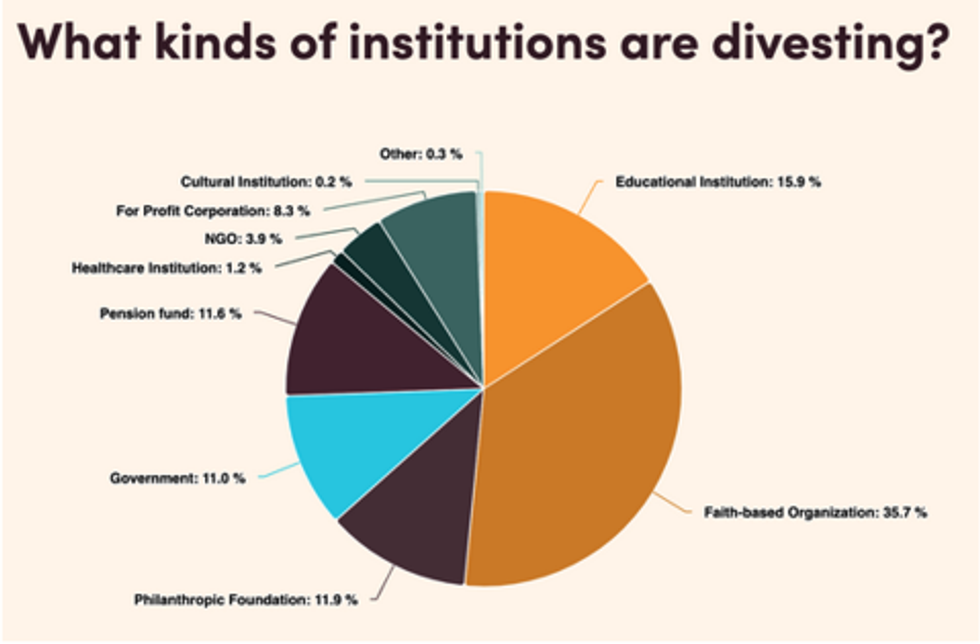
According to the Global Fossil Fuel Divestment Database, the world’s most comprehensive index of institutional fossil fuel divestment commitments managed by Stand.earth, divestment spans every sector of society—and continues to grow.
Surpassing 1,600 fossil fuel divestment commitments would not have been possible without millions of climate justice leaders and activists around the world, and countless economic, racial, and climate justice organizations. As the movement enters its 13th year, and sets sights on bigger victories, we also want to mark the steadfast support of Ellen Dorsey who is stepping down as head of the Wallace Global Fund (WGF). WGF has supported this movement from its inception, building upon the success of the Anti-Apartheid Divestment Movement.
From educational institutions and public pension funds, to faith-based and healthcare groups, to governments, nonprofits, and cultural institutions, major institutional investors have even reported consistent positive or neutral returns following divestment—despite broader economic volatility and insecurity.
More than a decade of data affirms that fossil fuel divestment is a winning financial strategy, including early adopters of divestment strategies reporting neutral or positive financial results. This follows years of attempted shareholder engagement, now a proven futile strategy, with fossil fuel corporations hell-bent on our destruction.
This includes Danish pension AkademikerPension, which engaged in a rigorous and transparent shareholder engagement process with fossil fuel companies, dropping the final oil major from its portfolio—Italian oil company Eni—because “top management in the oil and gas sector simply refuse to do so in manner consistent with the goals of the Paris agreement.”
Notably in its decision, AkademikerPension reported positive financial returns after shedding the last major oil and gas investments.
If 1,600+ institutional commitments doesn’t convince you, let’s look to the International Energy Agency (IEA): In its annual World Energy Outlook 2023 report released in October, the IEA revealed that our energy systems are already on track to transition off fossil fuels with demand decreasing significantly by 2030.
As IEA Executive Director Fatih Birol said:
The transition to clean energy is happening worldwide and it’s unstoppable. It’s not a question of “if,” it’s just a matter of “how soon”—and the sooner the better for all of us.
On top of this, a June 2023 foundational report from the University of Waterloo revealed that just six U.S. public pension funds would be $21 billion richer had they divested from fossil fuels a decade ago. This includes major pensions in the Climate Safe Pensions Network. Specifically, the two largest public pensions in the United States—CalPERS and CalSTRS collectively representing over $780 billion in assets—missed out on over $9.6 billion in returns.
Divestment is one (powerful) tool in our toolbox to take on fossil fuel greed and transform our energy and financial systems to be community-led, accessible, and democratized.
This strategy must be employed alongside solidarity with Indigenous and frontline fights to directly stop toxic and unnecessary and sovereignty-violating fossil fuel projects; together with the growing movement to stop the money pipeline from banks, pensions, and financial institutions to fossil fuel corporations; and with dozens of municipalities and states, most recently the state of California, launching lawsuits against major oil corporations for climate deception and damages.
Even in times of heartache, we find hope and resolve in our collective work to hold polluters accountable for their destruction, and to reclaim, repair, and rebuild healthy and safe communities.
Instead of financing climate chaos-causing fossil fuels, violence, and extraction, financial institutions like big banks and pension funds must protect people and the planet alike, cutting ties with fossil fuels and reinvesting in proven community-led climate-safe solutions. Together, the many will defeat the dirty money.
CalPERS and CalSTRS—collectively representing $780 billion and 2.5 million members—must act on their fiduciary duty and responsibly phase out fossil fuel holdings.
As world governments descended on New York City for Climate Week last month, California Attorney General Rob Bonta and Governor Gavin Newsom brought a momentous announcement: Following a year of record climate disasters, the state is suing the five biggest fossil fuel companies for climate damages and deception.
In this crucial move to hold the perpetrators of wildfires, floods, smoke, and deadly heat accountable for the destruction they are wreaking in our communities, the state of California joins dozens of municipalities with similar damages and deception lawsuits against major oil companies.
As far back as the 1970s, companies like Exxon, Chevron, and Shell knew all there was to know about the dangers of fossil fuel use causing global climate change—the very disasters we’re living through now. Instead of warning the rest of us, or pivoting their business models, the likes of Chevron doubled down on fossil fuels, all in the name of profit while the rest of us pay the cost.
There’s no room for coal, oil, and gas in any climate-safe investments.
So why are California’s public pension funds—CalPERS and CalSTRS, the two largest in the country—still gambling workers’ hard-earned savings on fossil fuels?
As revealed in a DeSmog exclusive, data pulled by Stand.earth and the Climate Safe Pensions Network from the Bloomberg Terminal reveals that CalPERS and CalSTRS collectively hold around $4.5 billion in Exxon Mobil, Shell, Chevron, ConocoPhillips, and BP, the five oil and gas corporations named as defendants in the lawsuit.
CalPERS and CalSTRS—collectively representing $780 billion and 2.5 million members—must act on their fiduciary duty and responsibly phase out fossil fuel holdings. There’s no room for coal, oil, and gas in any climate-safe investments.
That’s exactly what SB 252—California’s pension fossil fuel divestment bill—would achieve. The widely supported Fossil Fuel Divestment Bill, which passed the Senate in 2023, will head straight to the state Assembly in 2024.
To date, nearly 1,600 institutions representing over $40 trillion in assets have committed to fossil fuel divestment. In 2023 alone, new commitments came from the Church of England, New York University, and many more, after years of futile attempts to “engage with fossil fuel companies” and “help fossil fuel clients transition” failed.
Following the announcement of the lawsuit, Governor Newsom officially signed SB 253 and SB 261 into law—two of the three bills in California’s Climate Accountability Package (the third being SB 252). SB 253, the Climate Corporate Data Accountability Act, will require U.S.-based corporations doing business in California that make over $1 billion annually to publicly disclose their carbon footprint. SB 261, the Climate-Related Financial Risk Act, will require corporations, financial institutions, and insurers to report on climate-related financial risk.
As Governor Newsom said himself:
California taxpayers shouldn’t have to foot the bill for billions of dollars in damages—wildfires wiping out entire communities, toxic smoke clogging our air, deadly heat waves, record-breaking droughts parching our wells. With this lawsuit, California is taking action to hold big polluters accountable and deliver the justice our people deserve.
It’s time to bring the full Climate Accountability Package over the finish line, and pass SB 252 in 2024.
This is not only about divesting from fossil-fueled chaos, this is about correcting the course of California’s public pensions and aligning them with California’s climate-safe future: a future that includes renewable energy, Indigenous ecological leadership, affordable housing, and accessible healthcare and public transit for all. We have the opportunity to build a California where all of us can thrive.
To date almost 1,600 institutions worldwide with over 40 trillion dollars in assets have divested from fossil fuel companies; CalPERS and CalSTRS should join them.
Senate Bill 252, which requires California’s two large public employee pensions funds, CalPERS and CalSTRS, to divest from the 100 top oil and gas companies by 2030,
passed the state Senate in May. Divest means selling off any stock or bond holdings in these companies and not buying new fossil fuel stocks or bonds.
Divestment is a moral issue. We divested from companies doing business in Apartheid South Africa because we thought profiting from racial oppression was immoral. We divested from tobacco companies because knowingly selling and promoting a product that causes cancer is immoral. There is now a global fossil fuel divestment movement because fossil fuel companies are using their wealth and tremendous political power to block desperately needed climate change legislation—around the globe and right here in California.
In addition, like tobacco companies, the fossil fuel industry’s own scientists knew the harm their product was causing but the companies kept that knowledge secret and publicly denied it—even as they were extending the legs of drilling rigs to deal with sea level rise. Even today, fossil fuel companies are greenwashing rather than truly addressing climate change. Moreover, CalPERS unwittingly becomes party to that greenwashing, as when, for example, it promoted Exxon’s bogus net zero by 2050 claims to members.
When companies act this immorally and with such catastrophic consequences for human society and life on the planet, public pension funds should not engage with them as if they were good corporate citizens; they should instead divest.
A group of California coastal counties have sued 37 major oil companies for damages due to sea level rise. Their suit powerfully makes the moral case. Here are three quotes:
“Defendants have known for nearly 50 years that greenhouse gas pollution from their fossil fuel products has a significant impact on the Earth’s climate and sea levels.”
“With that knowledge, defendants took steps to protect their own assets from these threats through immense internal investment in research, infrastructure improvements, and plans to exploit new opportunities in a warming world.”
“Defendants’ conduct was so vile, base, and contemptible that it would be looked down upon and despised by reasonable people.”
You may be thinking this is all fine and well, but will divestment hurt pensioners? Fortunately, a number of studies indicate that divestment is financially prudent. For example, as the City of New York was considering divesting its three large retirement funds, it hired the financial consulting firms BlackRock and Meketa to independently write reports on divestment. Here is a quote from an article about the reports: “BlackRock and Meketa have separately concluded that investment funds have experienced no negative financial impacts from divesting from fossil fuels. In fact, they found evidence of modest improvement in fund returns.”
And SB 252 contains an “escape clause” such that if CalPERS thinks divesting from a fossil fuel company is not financially prudent, then it doesn’t have to divest.
What about engagement as an alternative strategy to divestment? Engagement is when owners of company stock try to get companies to change their practices through shareholder resolutions. There are several reasons why shareholder engagement, which can be a powerful strategy in some circumstances, is not likely to be effective in the case of fossil fuel companies and climate change.
First, what is needed, keeping the majority of fossil fuel reserves in the ground unburned, would represent astronomical financial losses to the fossil fuel industry. Not surprisingly then, the industry has fought tooth and nail against addressing climate change, and still claims today that all its reserves can and will be burned. Pope Francis put it this way, “Is it realistic to hope that those who are obsessed with maximizing profits will stop to reflect on the environmental damage which they will leave behind for future generations?”
Shareholder engagement promotes the image of fossil fuel companies as good corporate citizens, which actually strengthens their political power to fight climate legislation. This is exactly opposite the strategy of divestment, which aims to weaken the political power of fossil fuel companies by calling them out as bad actors, and thereby win climate legislation. Former Securities and Exchange Commission commissioner Bevis Longstreth in Climate Change and Investment in Fossil Fuel Companies: The Strategy of Engagement Won't Work said:
“Indeed, engagement is likely to assist Big Oil and Big Coal in postponing the day when governments limit the burning of fossil fuels … Engagement with institutional investors like Harvard gives the fossil fuel giants the protective cover they need to stretch out the transition process to renewables for as long as they can. It legitimizes talk over action.”
To date almost 1,600 institutions worldwide with over 40 trillion dollars in assets have divested from fossil fuel companies, including the state and city of New York retirement funds, the state of Maine, Quebec province, the Vatican, United Church of Christ, Episcopal Church USA, Unitarian Church, World Council of Churches, and the California State University and University of California systems. Senate Bill (SB) 252 now has 140 organizations offering official support including religious, environmental, and public health groups. Labor unions representing over 470,000 California workers have signed on in support of SB 252 including the California Faculty Association, California Federation of Teachers, AFSCME CA, California Nurses Association, and the ILWU.
In summary, when companies act this immorally and with such catastrophic consequences for human society and life on the planet, public pension funds should not engage with them as if they were good corporate citizens; they should instead divest. Arch Bishop Desmond Tutu said, “People of conscience need to break their ties with corporations financing the injustice of climate change.”
“It makes no sense to invest in companies that undermine our future,” he continued. “To serve as custodians of creation is not an empty title; it requires that we act, and with all the urgency this dire situation demands.”
The California Faculty Association is one of SB 252’s main sponsors, along with the nonprofit Fossil Free California. For more information on the bill, see https://fossilfreeca.org/divestment-legislation/.