
As we head towards the midterms, the president’s closing argument has mostly been about various people’s posteriors, but he has also taken the time to make several, um, substantive points.
One is his theory that solar panels become incredibly hot to the touch during their operation, and hence will kill “all the animals.” As he explained his theory, "The animals jump on them and they fry because those black panels are hotter than your stove.” This is not true, as anyone with a functioning brain should be able to easily figure out; there are of course tens of millions of homes and apartments with solar panels, and no reports of burns from touching them. Literally here is a video of a goat dancing on a solar panel. It turns out in fact there are dozens of these pictures online—goats on solar panels are an entire genre.
The second point he’s been making this week is that he is going to lower diesel costs by buying some of the fuel from Russia, thereby abrogating our country’s own sanctions and replenishing the Kremlin’s war budget. Indeed, the diesel is traveling on previously sanctioned tankers. As Svitlana Romanko, the intrepid leader of Ukraine’s Razom We Stand points out, this is utter betrayal: "Every barrel on board these ships exporting Russian fossil fuels is money for the missiles and drones Russia fires at Ukrainian homes every night, bringing more civilian casualties.” But since it’s President Donald Trump, it’s also utterly stupid, in that the quantities are too small to budge the high price of diesel, which, as the zealots at that radical website OilPrice.com write, is “set to persist well into 2027.” Of course, there’s another possible explanation—it’s all part of the grand corruption scheme that the Times has begun to unravel: as Anton Troianvoski and Eric Lipton document:
An American energy company intends to buy Russian technology and use it to access a massive supply of natural gas in Alaska, liquefy it, and export it to allies abroad.
The Kremlin and the White House were interested in the idea. President Vladimir V. Putin discussed the plan last month with President Trump’s peace envoys, Steve Witkoff and Jared Kushner, people familiar with the negotiations said, speaking on condition of anonymity to discuss sensitive diplomacy. It is one of a series of energy deals White House officials believe could help smooth relations with Moscow and eventually pave the way to end the war in Ukraine.
But it turns out that the company was not an all-American affair. The multibillion-dollar project has received secret funding from the same powerful Russian company that was to provide the technology, according to the energy executive who until last month led the US firm and two others involved in company negotiations.
Anyway, there was a third point the president made this week, this one purely monstrous. It came in a speech in oil-patch Lubbock, Texas, where, in an effort to boost flailing Senate candidate Ken Paxton, he declared an end to any real federal oversight of methane emissions from the fossil fuel industry. As Sara Sneath reports:
At a Trump rally in Corpus Christi earlier in the day, Trump shouted out Harold Hamm, saying the founder of Continental Resources was in the audience. In April, Continental Resources wrote a letter to the EPA [Environmental Protection Agency] pushing back against measures in the methane rule that prohibit routine flaring of associated gas.
Hamm, careful readers will remember, was the president’s chief donation bundler from the oil and gas industry during the last presidential campaign. Anyway, it’s worth remembering that
Last year, the US emitted more methane from its oil and gas sector than any other country in the world. Methane is responsible for at least a quarter of today’s warming.
Julia Kane, a researcher for Fieldnotes, said the Trump Environmental Protection Agency was giving oil and gas corporations exactly what they want. “The oil and gas industry says it’s a ‘good-faith’ partner eager to help craft regulations, but time and time again it’s worked behind the scenes to delay and weaken them,” she said.
All of this, of course, is pretty much par for the course. You could pick any week in the last two years and come up with roughly the same kind of idiocy and perfidy and graft; the Trump presidency is an ongoing evil MadLibs.
The trouble with his current gust of malignity, however, is that right now a pair of Democrats in the Senate—Sheldon Whitehouse of Rhode Island and Martin Heinrich of New Mexico—have been trying to persuade their colleagues, and by extension the rest of the country, to support a “permitting reform” bill that would make it easier to build energy stuff. It’s traveling under the name BAAJA, for Bipartisan American Affordability and Jobs Act, I guess on the grounds that “affordability” is something all right-minded people support (except, of course, for Trump who thinks it, like global warming, is a “hoax.”) Anyway, the grand bargain these two senators have struck with the oil industry is hundreds of pages long, and would overturn much of the environmental review process in America.
If you have any doubts about the necessity of making changes in how we review things, read Ezra Klein and Derek Thompson’s Abundance. But the devil comes in the details—or rather, the devil is Donald Trump, and the pertinent detail is whether he can be contained in a meaningful way. Obviously Whitehouse and Heinrich knew that this would be an issue, and they did their best to build in some guarantees that it wouldn’t be able for him to use it push dirty energy at the expense of clean. But from the start there have been questions about this—I wrote two weeks ago about Harvard professor Jody Freeman, so centrist in this work that she actually served on the board of a major oil company, who said:
A close read suggests it's structurally designed to lock in and subsidize natural gas & other fossil projects over cleaner renewables for years to come, using the courts and taxpayer dollars.
Since then, what you might call normie Democrats have been sounding increasingly urgent alarms in increasingly urgent language, and urging the drafters of this massive legislation—currently scheduled for a vote five days after the election—to figure out how to amend key provisions. Exhibit No. 1 here would be John Podesta, the insider’s insider. White House chief of staff for Bill Clinton, counselor to Barack Obama on climate and to Joe Biden on energy policy, chair of Hillary Clinton’s presidential campaign—I think it’s safe to say he understands presidential power as well as anyone alive. So it landed with a thud two days ago when he told Jael Holzman that the bill as written would hand Trump a “loaded howitzer.” He focused on the sections around “permitting certainty,” which were written to try and keep the president from interfering (as obviously he has been doing) with clean energy projects. But:
This was “one place where I think they made a huge mistake,” Podesta said, calling the restriction on revoking or rescinding decisions “one of the worst provisions of the bill.” He complimented lawmakers for trying to address Trump’s attacks on already-permitted renewable energy projects, including stop-work orders on offshore wind facilities under construction, and for seeking commitments from the administration to continue permitting projects in exchange for a deal.
However, Podesta said they are “going to have to take it out” or significantly revise it because he believes this language would allow Trump to illegally approve projects on sensitive or protected lands and courts would not be able to force the government to undo approvals that violate the law. He argued this would mean Trump could permit development in many areas land conservation groups, tribes, and anti-drilling advocates have long fought to protect from industry, including the Chaco Culture National Historic Park in New Mexico, the Boundary Waters Canoe Area Wilderness in Minnesota, and the Bears Ears National Monument in Utah.
“I think they have handed Trump not just a loaded gun, but they’ve handed him a loaded Howitzer to go after public lands, to permit stuff that even if it’s illegal can’t be reversed by the courts,” Podesta said. “They’re going to have a permit gorge like you’ve never seen, not really caring about whether they’re going through the legal steps to do it, and under this bill, those can’t be reversed. That’s got to change if this bill’s going to pass.”
Abigail Dillen, president of EarthJustice, who have been leading the legal fight against Trump’s environmental extremism, followed up Podesta’s warning:
Over the next two years, BAAJA would create more legal runway for this president to make corrupt deals and green-light harmful projects of all kinds, and it would constrain any future president from repairing the damage. People can reasonably differ on long-term projections. But once you know what’s in this bill, how BAAJA plays under Trump should be clear as glass…
Most sweepingly, the bill’s certainty provisions would render Trump permitting decisions irrevocable with very limited exceptions. The next administration would likely inherit a raft of destructive and unpopular projects, and BAAJA would make it wildly risky financially and even impossible for the next president to revisit them. To be clear, the damage would not be confined to energy-related projects. Think detention centers, petrochemical complexes, data centers on public lands—whatever kinds of projects appeal to this president.
And here’s Carl Pope, former executive director of the Sierra Club and an environmentalist so centrist he once barnstormed the country with fracking executives touting the desirability of natural gas:
Title IV, “Permit Certainty,” is the draft’s most troubling section. Environmental policy has historically improved through two linked processes: identifying new risks and applying existing clean up technologies to abate them; in parallel, pushing research on clean up technology options and then adopting stronger standards as science and technology advance. Title IV works to obstruct both.
For example, a data center permitted to use fossil-fuel power could claim protection even after cleaner, cheaper alternatives become available for their needs. Likewise, if regulators later discovered dangerous contamination—such as PFAS, or “forever chemicals” in a watershed—the provision could impede stronger water-quality standards needed to protect nearby residents.
What BAAJA describes as a regulatory floor may function as a public-health ceiling. Instead of preserving agencies’ ability to respond to new evidence, it could lock in yesterday’s permits and yesterday’s pollution standards, under which millions of tons of unnecessary pollution are emitted by outmoded power plants.
For the first few weeks, this fight has been mostly confined to very elite and in-the-know circles. Earlier this week, for instance, Tom Steyer came out for the bill on the grounds that it “beats the status quo.” When I saw it, I flashed back to a gathering convened on his ranch 15 years ago: I shared a cabin there with… John Podesta and Carl Pope. We shouldn’t have this closed a political circle on questions this large.
So it’s good to see that policy is increasingly joined by politics in this debate: Given that we’re hoping for a blue wave in next Tuesday’s election, it may be hard to persuade Democrats to go along with the Whitehouse-Heinrich plan, because the conventional wisdom is starting to harden around the Ossoffian ideal that the best way to deal with Trump is to stand up to him.
A fairly important straw in the wind came earlier this week when four key Senators—Oregon’s Jeff Merkley and Ron Wyden, Ed Markey from Massachusetts, and Tammy Duckworth from Illinois—wrote a letter to Whitehouse, Heinrich, and their Republican co-sponors arguing that the Trump administration has clearly enforced environmental laws unfairly over the last two years and there is every indication they will keep trying to do so. As they pointed out, the Department of Energy has admitted to canceling billions of dollars in grants to states that had voted for Kamala Harris:
This vindictive, partisan discrimination based on whether a grantee is in a State represented by two Democratic Senators that President Trump lost in the 2024 election is disgraceful. It violates core constitutional protections, harms communities comprised of Americans from across the political spectrum, and, ironically, harms millions of Trump voters who live in these States. No American should be caught in the crosshairs of such a brazenly corrupt scheme. No one has explained why a Senator from a targeted State should help the Trump administration fast-track fossil fuel projects while it refuses to restore funding that Trump officials admitted was terminated on an illegal, partisan basis.
They propose a test of whether or not the Trump administration is serious going forward:
It would be compelling if, before the motion to proceed vote, the Trump administration directed DOE to 1) reinstate every award it terminated in October 2025 that it has not already restored, 2) to allow recipients to draw down those funds under the original award terms, and 3) to commit in writing that it will not terminate an award because of the political identity of the recipient’s State or the party affiliation of its elected officials.
While such action may not fully address the wide range of concerns individual Senators have about various portions of this complex legislation, it would represent an important first step and carry far more weight with us and, more importantly, our constituents whose awards were illegally terminated, than mere informal assurances that the Trump administration will stop interfering with clean energy projects.
As Rachel Frazin notes in The Hill, this constitutes a high bar, especially since Merkley is likely to succeed Whitehouse as the chair of the Senate’s Environment Committee should the Dems win the chamber—it’s considerably higher than the sign off on a few wind projects that former DOE Secretary Jennifer Granholm suggested this week would be signal enough. (And as Heatmap reported this week, Trump hasn’t been signing off on those anyway—in fact, it appears that they’re thinking of banning the importation of wind turbine equipment on “national security grounds”). According to Frazin, the letter from the four Senators
represents a fracture in the Democratic caucus. It’s not entirely clear how widespread the sentiment is among Democrats, but if enough of them vote against the bill, it could hamper its chances.
And the odds of that happening seem to me to be increasing, because news of the bill seems to be escaping DC containment. Remember—this election is being largely fought over data centers, which Americans truly hate. Paul Krugman Thursday morning called the polling on these data factories “astonishingly negative” and provided a nifty little chart to drive the point home.
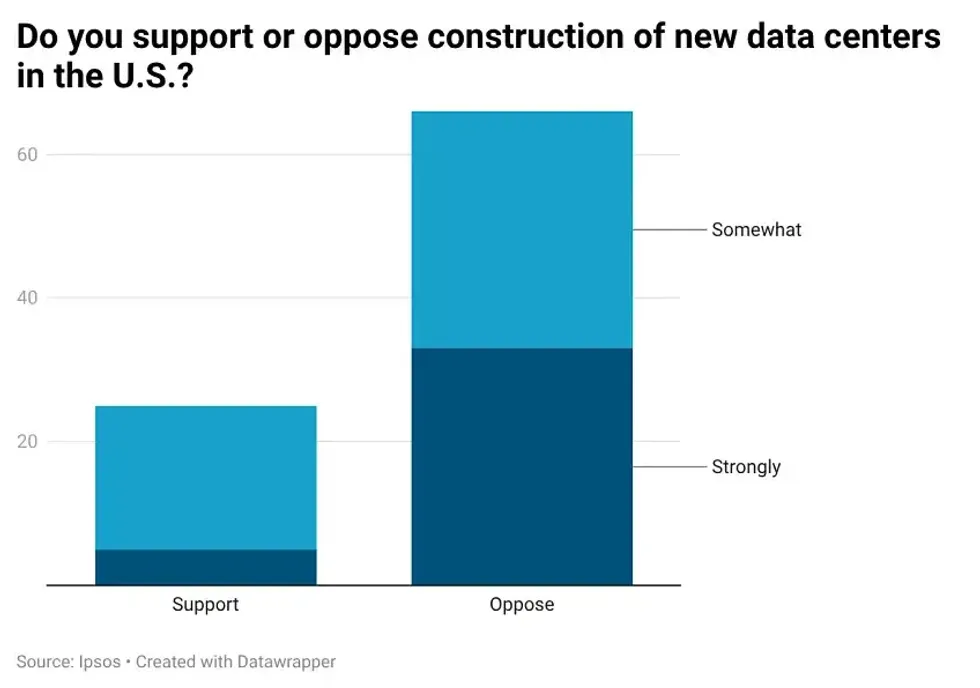
Essentially, no one (who isn’t an oligarch) strongly supports them, and most of the country hates them. So if the permitting bill might make it easier to build them—well, my guess is that many politicians in both parties are a little wary now of the data center issue, and don’t want to get crosswise on it. Too many traditional allies are up in arms—here, for instance, is the new NAACP resource for Black voters opposing data centers, complete with a great picture of Justin Pearson waging a remarkable campaign for Congress on the issue. Here’s the letter from the Climate Justice Alliance, with more than a hundred frontline groups coming together to say:
Your closed-door deal bolsters the work of the Trump administration which is hell-bent on dismantling environmental justice at every turn, and we are beyond outraged at what you are saying our lives are worth. Reject this travesty.
Equally pointedly, in Heinrich’s New Mexico this week, students walked out of classes to protest data centers and they linked their protest directly to the permitting bill:
“We will not get back the last 20 years of climate progress Project Jupiter will undo,” Isabelle Taylor-Ault, a student organizer and junior at NMSA, said to the crowd outside the Roundhouse in Santa Fe. “You, the adults, the ones supposed to be fighting for us, you may get the privilege of dying of old age, but our children will die from climate change.”
A handful of state lawmakers sitting on the interim Water and Natural Resources Committee—which was meeting on the Capitol’s third floor—headed down to watch the protest unfold.
In Albuquerque, protesters directed much of their ire toward US Sen. Martin Heinrich (D-NM), who recently unveiled a sweeping, bipartisan permitting reform bill that protesters say reduces tribal input and empowers fossil fuel companies to quickly break ground on more harmful projects.
More than 100 protesters marched from the UNM bookstore down Central Avenue to Heinrich’s downtown Albuquerque office. In front of a large sign that read, “Heinrich is a sellout,” protesters with YUCCA, as well as Indigenous and environmentalist groups, described the bill as a betrayal by a longtime champion for tribal and environmental causes.
Indeed, it didn’t take long after that demonstration for one of Heinrich’s colleagues—New Mexico congresswoman Melanie Stansbury—to come out swinging against the bill, saying she was “adamantly opposed” in what the New Mexico Political Report called a “rare public split” between members of the delegation.
The stakes are of course enormous. If the data center buildout continues (and in New Mexico, for instance, Oracle’s Project Jupiter depends on a gas pipeline), then a Sierra Club analysis just released says the new facilities would soon produce more greenhouse gas emissions than Mexico. As Eric Roston and Olivia Raimonde write:
The US power sector would emit 2.1 billion metric tons of carbon dioxide by 2030, after factoring in planned AI projects. That’s 618 million tons more than 2025 levels, by the Sierra Club’s calculations, or about a 42% increase.
A year and a half ago, researchers at the nonprofit environmental group would have estimated that the buildout and its impact would have been a quarter or half of current projections, said Jeremy Fisher, the Sierra Club’s principal adviser for climate and energy. “The numbers continue to sort of boggle our minds,” he said.
It’s hard to predict exactly how BAAJA would affect that, which is part of the problem: The bill is a bit of a black box, and the only thing we know for certain is that for the next two years Donald Trump occupies that black box, snarling about solar panels that kill all the animals and eager to do any favor that the fossil fuel industry demands.
So the key thing, of course, far beyond debate on this bill, is to try and defang that monster, and the chief method for that is simple: Win the elections Tuesday in as sweeping a fashion as possible. If you’re looking for a way to pitch in, there are plenty. For those of us of a certain age, Third Act’s Party Line senior-to-senior phone and text banking is operating day and night; if you’re a youngster, Seed the Vote can figure out ways to put you to work. I’m hunkered down for one last long weekend of all-out effort, and I hope you are too. We could come out of next week a different country, and wouldn’t that be sweet!
As we head towards the midterms, the president’s closing argument has mostly been about various people’s posteriors, but he has also taken the time to make several, um, substantive points.
One is his theory that solar panels become incredibly hot to the touch during their operation, and hence will kill “all the animals.” As he explained his theory, "The animals jump on them and they fry because those black panels are hotter than your stove.” This is not true, as anyone with a functioning brain should be able to easily figure out; there are of course tens of millions of homes and apartments with solar panels, and no reports of burns from touching them. Literally here is a video of a goat dancing on a solar panel. It turns out in fact there are dozens of these pictures online—goats on solar panels are an entire genre.
The second point he’s been making this week is that he is going to lower diesel costs by buying some of the fuel from Russia, thereby abrogating our country’s own sanctions and replenishing the Kremlin’s war budget. Indeed, the diesel is traveling on previously sanctioned tankers. As Svitlana Romanko, the intrepid leader of Ukraine’s Razom We Stand points out, this is utter betrayal: "Every barrel on board these ships exporting Russian fossil fuels is money for the missiles and drones Russia fires at Ukrainian homes every night, bringing more civilian casualties.” But since it’s President Donald Trump, it’s also utterly stupid, in that the quantities are too small to budge the high price of diesel, which, as the zealots at that radical website OilPrice.com write, is “set to persist well into 2027.” Of course, there’s another possible explanation—it’s all part of the grand corruption scheme that the Times has begun to unravel: as Anton Troianvoski and Eric Lipton document:
An American energy company intends to buy Russian technology and use it to access a massive supply of natural gas in Alaska, liquefy it, and export it to allies abroad.
The Kremlin and the White House were interested in the idea. President Vladimir V. Putin discussed the plan last month with President Trump’s peace envoys, Steve Witkoff and Jared Kushner, people familiar with the negotiations said, speaking on condition of anonymity to discuss sensitive diplomacy. It is one of a series of energy deals White House officials believe could help smooth relations with Moscow and eventually pave the way to end the war in Ukraine.
But it turns out that the company was not an all-American affair. The multibillion-dollar project has received secret funding from the same powerful Russian company that was to provide the technology, according to the energy executive who until last month led the US firm and two others involved in company negotiations.
Anyway, there was a third point the president made this week, this one purely monstrous. It came in a speech in oil-patch Lubbock, Texas, where, in an effort to boost flailing Senate candidate Ken Paxton, he declared an end to any real federal oversight of methane emissions from the fossil fuel industry. As Sara Sneath reports:
At a Trump rally in Corpus Christi earlier in the day, Trump shouted out Harold Hamm, saying the founder of Continental Resources was in the audience. In April, Continental Resources wrote a letter to the EPA [Environmental Protection Agency] pushing back against measures in the methane rule that prohibit routine flaring of associated gas.
Hamm, careful readers will remember, was the president’s chief donation bundler from the oil and gas industry during the last presidential campaign. Anyway, it’s worth remembering that
Last year, the US emitted more methane from its oil and gas sector than any other country in the world. Methane is responsible for at least a quarter of today’s warming.
Julia Kane, a researcher for Fieldnotes, said the Trump Environmental Protection Agency was giving oil and gas corporations exactly what they want. “The oil and gas industry says it’s a ‘good-faith’ partner eager to help craft regulations, but time and time again it’s worked behind the scenes to delay and weaken them,” she said.
All of this, of course, is pretty much par for the course. You could pick any week in the last two years and come up with roughly the same kind of idiocy and perfidy and graft; the Trump presidency is an ongoing evil MadLibs.
The trouble with his current gust of malignity, however, is that right now a pair of Democrats in the Senate—Sheldon Whitehouse of Rhode Island and Martin Heinrich of New Mexico—have been trying to persuade their colleagues, and by extension the rest of the country, to support a “permitting reform” bill that would make it easier to build energy stuff. It’s traveling under the name BAAJA, for Bipartisan American Affordability and Jobs Act, I guess on the grounds that “affordability” is something all right-minded people support (except, of course, for Trump who thinks it, like global warming, is a “hoax.”) Anyway, the grand bargain these two senators have struck with the oil industry is hundreds of pages long, and would overturn much of the environmental review process in America.
If you have any doubts about the necessity of making changes in how we review things, read Ezra Klein and Derek Thompson’s Abundance. But the devil comes in the details—or rather, the devil is Donald Trump, and the pertinent detail is whether he can be contained in a meaningful way. Obviously Whitehouse and Heinrich knew that this would be an issue, and they did their best to build in some guarantees that it wouldn’t be able for him to use it push dirty energy at the expense of clean. But from the start there have been questions about this—I wrote two weeks ago about Harvard professor Jody Freeman, so centrist in this work that she actually served on the board of a major oil company, who said:
A close read suggests it's structurally designed to lock in and subsidize natural gas & other fossil projects over cleaner renewables for years to come, using the courts and taxpayer dollars.
Since then, what you might call normie Democrats have been sounding increasingly urgent alarms in increasingly urgent language, and urging the drafters of this massive legislation—currently scheduled for a vote five days after the election—to figure out how to amend key provisions. Exhibit No. 1 here would be John Podesta, the insider’s insider. White House chief of staff for Bill Clinton, counselor to Barack Obama on climate and to Joe Biden on energy policy, chair of Hillary Clinton’s presidential campaign—I think it’s safe to say he understands presidential power as well as anyone alive. So it landed with a thud two days ago when he told Jael Holzman that the bill as written would hand Trump a “loaded howitzer.” He focused on the sections around “permitting certainty,” which were written to try and keep the president from interfering (as obviously he has been doing) with clean energy projects. But:
This was “one place where I think they made a huge mistake,” Podesta said, calling the restriction on revoking or rescinding decisions “one of the worst provisions of the bill.” He complimented lawmakers for trying to address Trump’s attacks on already-permitted renewable energy projects, including stop-work orders on offshore wind facilities under construction, and for seeking commitments from the administration to continue permitting projects in exchange for a deal.
However, Podesta said they are “going to have to take it out” or significantly revise it because he believes this language would allow Trump to illegally approve projects on sensitive or protected lands and courts would not be able to force the government to undo approvals that violate the law. He argued this would mean Trump could permit development in many areas land conservation groups, tribes, and anti-drilling advocates have long fought to protect from industry, including the Chaco Culture National Historic Park in New Mexico, the Boundary Waters Canoe Area Wilderness in Minnesota, and the Bears Ears National Monument in Utah.
“I think they have handed Trump not just a loaded gun, but they’ve handed him a loaded Howitzer to go after public lands, to permit stuff that even if it’s illegal can’t be reversed by the courts,” Podesta said. “They’re going to have a permit gorge like you’ve never seen, not really caring about whether they’re going through the legal steps to do it, and under this bill, those can’t be reversed. That’s got to change if this bill’s going to pass.”
Abigail Dillen, president of EarthJustice, who have been leading the legal fight against Trump’s environmental extremism, followed up Podesta’s warning:
Over the next two years, BAAJA would create more legal runway for this president to make corrupt deals and green-light harmful projects of all kinds, and it would constrain any future president from repairing the damage. People can reasonably differ on long-term projections. But once you know what’s in this bill, how BAAJA plays under Trump should be clear as glass…
Most sweepingly, the bill’s certainty provisions would render Trump permitting decisions irrevocable with very limited exceptions. The next administration would likely inherit a raft of destructive and unpopular projects, and BAAJA would make it wildly risky financially and even impossible for the next president to revisit them. To be clear, the damage would not be confined to energy-related projects. Think detention centers, petrochemical complexes, data centers on public lands—whatever kinds of projects appeal to this president.
And here’s Carl Pope, former executive director of the Sierra Club and an environmentalist so centrist he once barnstormed the country with fracking executives touting the desirability of natural gas:
Title IV, “Permit Certainty,” is the draft’s most troubling section. Environmental policy has historically improved through two linked processes: identifying new risks and applying existing clean up technologies to abate them; in parallel, pushing research on clean up technology options and then adopting stronger standards as science and technology advance. Title IV works to obstruct both.
For example, a data center permitted to use fossil-fuel power could claim protection even after cleaner, cheaper alternatives become available for their needs. Likewise, if regulators later discovered dangerous contamination—such as PFAS, or “forever chemicals” in a watershed—the provision could impede stronger water-quality standards needed to protect nearby residents.
What BAAJA describes as a regulatory floor may function as a public-health ceiling. Instead of preserving agencies’ ability to respond to new evidence, it could lock in yesterday’s permits and yesterday’s pollution standards, under which millions of tons of unnecessary pollution are emitted by outmoded power plants.
For the first few weeks, this fight has been mostly confined to very elite and in-the-know circles. Earlier this week, for instance, Tom Steyer came out for the bill on the grounds that it “beats the status quo.” When I saw it, I flashed back to a gathering convened on his ranch 15 years ago: I shared a cabin there with… John Podesta and Carl Pope. We shouldn’t have this closed a political circle on questions this large.
So it’s good to see that policy is increasingly joined by politics in this debate: Given that we’re hoping for a blue wave in next Tuesday’s election, it may be hard to persuade Democrats to go along with the Whitehouse-Heinrich plan, because the conventional wisdom is starting to harden around the Ossoffian ideal that the best way to deal with Trump is to stand up to him.
A fairly important straw in the wind came earlier this week when four key Senators—Oregon’s Jeff Merkley and Ron Wyden, Ed Markey from Massachusetts, and Tammy Duckworth from Illinois—wrote a letter to Whitehouse, Heinrich, and their Republican co-sponors arguing that the Trump administration has clearly enforced environmental laws unfairly over the last two years and there is every indication they will keep trying to do so. As they pointed out, the Department of Energy has admitted to canceling billions of dollars in grants to states that had voted for Kamala Harris:
This vindictive, partisan discrimination based on whether a grantee is in a State represented by two Democratic Senators that President Trump lost in the 2024 election is disgraceful. It violates core constitutional protections, harms communities comprised of Americans from across the political spectrum, and, ironically, harms millions of Trump voters who live in these States. No American should be caught in the crosshairs of such a brazenly corrupt scheme. No one has explained why a Senator from a targeted State should help the Trump administration fast-track fossil fuel projects while it refuses to restore funding that Trump officials admitted was terminated on an illegal, partisan basis.
They propose a test of whether or not the Trump administration is serious going forward:
It would be compelling if, before the motion to proceed vote, the Trump administration directed DOE to 1) reinstate every award it terminated in October 2025 that it has not already restored, 2) to allow recipients to draw down those funds under the original award terms, and 3) to commit in writing that it will not terminate an award because of the political identity of the recipient’s State or the party affiliation of its elected officials.
While such action may not fully address the wide range of concerns individual Senators have about various portions of this complex legislation, it would represent an important first step and carry far more weight with us and, more importantly, our constituents whose awards were illegally terminated, than mere informal assurances that the Trump administration will stop interfering with clean energy projects.
As Rachel Frazin notes in The Hill, this constitutes a high bar, especially since Merkley is likely to succeed Whitehouse as the chair of the Senate’s Environment Committee should the Dems win the chamber—it’s considerably higher than the sign off on a few wind projects that former DOE Secretary Jennifer Granholm suggested this week would be signal enough. (And as Heatmap reported this week, Trump hasn’t been signing off on those anyway—in fact, it appears that they’re thinking of banning the importation of wind turbine equipment on “national security grounds”). According to Frazin, the letter from the four Senators
represents a fracture in the Democratic caucus. It’s not entirely clear how widespread the sentiment is among Democrats, but if enough of them vote against the bill, it could hamper its chances.
And the odds of that happening seem to me to be increasing, because news of the bill seems to be escaping DC containment. Remember—this election is being largely fought over data centers, which Americans truly hate. Paul Krugman Thursday morning called the polling on these data factories “astonishingly negative” and provided a nifty little chart to drive the point home.
Essentially, no one (who isn’t an oligarch) strongly supports them, and most of the country hates them. So if the permitting bill might make it easier to build them—well, my guess is that many politicians in both parties are a little wary now of the data center issue, and don’t want to get crosswise on it. Too many traditional allies are up in arms—here, for instance, is the new NAACP resource for Black voters opposing data centers, complete with a great picture of Justin Pearson waging a remarkable campaign for Congress on the issue. Here’s the letter from the Climate Justice Alliance, with more than a hundred frontline groups coming together to say:
Your closed-door deal bolsters the work of the Trump administration which is hell-bent on dismantling environmental justice at every turn, and we are beyond outraged at what you are saying our lives are worth. Reject this travesty.
Equally pointedly, in Heinrich’s New Mexico this week, students walked out of classes to protest data centers and they linked their protest directly to the permitting bill:
“We will not get back the last 20 years of climate progress Project Jupiter will undo,” Isabelle Taylor-Ault, a student organizer and junior at NMSA, said to the crowd outside the Roundhouse in Santa Fe. “You, the adults, the ones supposed to be fighting for us, you may get the privilege of dying of old age, but our children will die from climate change.”
A handful of state lawmakers sitting on the interim Water and Natural Resources Committee—which was meeting on the Capitol’s third floor—headed down to watch the protest unfold.
In Albuquerque, protesters directed much of their ire toward US Sen. Martin Heinrich (D-NM), who recently unveiled a sweeping, bipartisan permitting reform bill that protesters say reduces tribal input and empowers fossil fuel companies to quickly break ground on more harmful projects.
More than 100 protesters marched from the UNM bookstore down Central Avenue to Heinrich’s downtown Albuquerque office. In front of a large sign that read, “Heinrich is a sellout,” protesters with YUCCA, as well as Indigenous and environmentalist groups, described the bill as a betrayal by a longtime champion for tribal and environmental causes.
Indeed, it didn’t take long after that demonstration for one of Heinrich’s colleagues—New Mexico congresswoman Melanie Stansbury—to come out swinging against the bill, saying she was “adamantly opposed” in what the New Mexico Political Report called a “rare public split” between members of the delegation.
The stakes are of course enormous. If the data center buildout continues (and in New Mexico, for instance, Oracle’s Project Jupiter depends on a gas pipeline), then a Sierra Club analysis just released says the new facilities would soon produce more greenhouse gas emissions than Mexico. As Eric Roston and Olivia Raimonde write:
The US power sector would emit 2.1 billion metric tons of carbon dioxide by 2030, after factoring in planned AI projects. That’s 618 million tons more than 2025 levels, by the Sierra Club’s calculations, or about a 42% increase.
A year and a half ago, researchers at the nonprofit environmental group would have estimated that the buildout and its impact would have been a quarter or half of current projections, said Jeremy Fisher, the Sierra Club’s principal adviser for climate and energy. “The numbers continue to sort of boggle our minds,” he said.
It’s hard to predict exactly how BAAJA would affect that, which is part of the problem: The bill is a bit of a black box, and the only thing we know for certain is that for the next two years Donald Trump occupies that black box, snarling about solar panels that kill all the animals and eager to do any favor that the fossil fuel industry demands.
So the key thing, of course, far beyond debate on this bill, is to try and defang that monster, and the chief method for that is simple: Win the elections Tuesday in as sweeping a fashion as possible. If you’re looking for a way to pitch in, there are plenty. For those of us of a certain age, Third Act’s Party Line senior-to-senior phone and text banking is operating day and night; if you’re a youngster, Seed the Vote can figure out ways to put you to work. I’m hunkered down for one last long weekend of all-out effort, and I hope you are too. We could come out of next week a different country, and wouldn’t that be sweet!
- 75% of Likely US Voters Oppose Giving Big Oil Immunity From Climate Lawsuits ›
- Vote as if the Climate and the Future of Humanity Depend on It--Because They Do ›
- From the US to Brazil, Earth's Future Is on the Ballot ›
- A Vote for Trump Is a Vote for Hell on Earth ›
- Climate Groups Warn Third-Party Vote 'Could Hand Our Planet's Future Over to Trump' ›
- What the 2026 Election Could Mean for the Climate Crisis ›