

SUBSCRIBE TO OUR FREE NEWSLETTER
Daily news & progressive opinion—funded by the people, not the corporations—delivered straight to your inbox.
5
#000000
#FFFFFF
To donate by check, phone, or other method, see our More Ways to Give page.
Daily news & progressive opinion—funded by the people, not the corporations—delivered straight to your inbox.

Tiffany Finck-Haynes, (202) 222-0715, tfinckhaynes@foe.org, Kevynn Gomez, (202) 222-0709, kgomez@foe.org
To mark National Pollinator Week (June 17-23), more than 10,000 people across the country are joining a national week of action demanding that Kroger (NYSE: KR) help stop the "bee apocalypse." Customers are delivering letters to stores asking the nation's largest conventional grocery store to eliminate pollinator-toxic pesticides from its food supply chain and increase domestic organic food offerings to help stop the catastrophic decline of pollinators and other insects.
Pollinators and other insects could go extinct within a century, threatening a "catastrophic collapse of nature's ecosystems," the first comprehensive global meta-analysis of insect decline states. This is largely due to the widespread use of neonicotinoids and other toxic insecticides in industrial agriculture.
"To avoid the 'bee apocalypse' it is critical that Kroger immediately commit to stop selling food with pollinator-toxic pesticides," said Tiffany Finck-Haynes, pesticides and pollinators program manager at Friends of the Earth. "Kroger's food supply chain is at risk if it does not take immediate action."
Kroger lags behind its competitors on pesticide reduction. Costco updated its pesticide policy to encourage suppliers of fruits, vegetables and garden plants to phase out the use of chlorpyrifos and neonicotinoids, which will reduce farmworker and pollinator exposure.
"We ask Kroger to show leadership in corporate responsibility by adopting food safety policies that eliminate pesticides in the supply chain that are harmful to people and pollinators," said Alexis Luckey, executive director, Toxic Free North Carolina.
In February, Friends of the Earth and allies released a report that found Kroger's store-brand foods contain pollinator-toxic pesticides including glyphosate, organophosphates and neonicotinoids. A 2018 scorecard from Friends of the Earth found that most top food retailers, including Kroger, are failing to safeguard pollinators, like bees, and people from toxic pesticides.
"Bees and other pollinators are responsible for one out of three bites of food. By sourcing food grown with bee-killing pesticides, Kroger is threatening the future of food itself. It's time for Kroger to protect pollinators by reducing pesticides in its supply chain," said Katie Reilly, campaign manager at SumOfUs.
On average, beekeepers have lost 40 percent of their hives over the last decade and monarch butterflies have declined by more than 90 percent in under 20 years. The United Nations' Food and Agriculture Organization published a report warning that the diminishing state of the world's biodiversity jeopardizes our food security, nutrition, environment and more.
"Maryland beekeepers have lost an unsustainable 60% of hives in recent years. The unprecedented mass die-offs of pollinators and other insects, as well as the rise in cancer, neurological diseases and autism, are clear indicators that the chemical-intensive industrial food system and the poisons applied to our foods are anything but life-giving," said Bonnie Raindrop, legislative chair of Central Maryland Beekeepers Association.
"Systemic neonicotinoid insecticides and the broad range of pesticides that harm people and pollinators have no place in our food supply," said Drew Toher, community resource and policy director at Beyond Pesticides. "Kroger customers are asking the company to be part of the solution to the pollinator crisis by eliminating hazardous pesticides and expanding organic options."
Friends of the Earth fights for a more healthy and just world. Together we speak truth to power and expose those who endanger the health of people and the planet for corporate profit. We organize to build long-term political power and campaign to change the rules of our economic and political systems that create injustice and destroy nature.
(202) 783-7400
"We have said from the beginning, people, not politicians will be the final deciders on this DC power grab," said one campaigner. "We are moving forward to vote NO on Proposition A."
Although the US Supreme Court's right-wing supermajority on Friday greenlit President Donald Trump's voter purge database, it also helped deliver yet another blow to Missouri Republicans' push for a rigged congressional map.
"In 2022, the Missouri Legislature enacted a redistricting map for elections to the US House of Representatives. In 2025, the Missouri Legislature enacted a new map," says the high court's unsigned ruling. Like Republican legislators in other states, Missouri's lawmakers pursued the new districts in response to public pressure from the president.
"But under the Missouri Constitution as interpreted by the Supreme Court of Missouri, a new law such as the 2025 map does not take effect unless and until approved by voters in a referendum in the next election—at least where, as here, the number of voter signatures on the petition suffices to trigger a referendum," Friday's opinion explains.
Thus, on September 3, the document notes, "the Missouri Supreme Court ruled that the 2025 redistricting map 'is not the law and has never been the law' in Missouri—and will not take effect unless and until approved by Missouri voters by referendum in the 2026 election."
However, Missouri Republicans fought back. The following week, Justice Brett Kavanaugh—a Trump appointee and member of the court's right-wing supermajority—delivered the first blow to the 2025 map. Just days later, the full court agreed, again tossing the redrawn districts.
The high court reiterated its position for a third time on Friday, with no noted dissents: "In short, as a matter of state law, the 2022 map—not the 2025 map—must be used in the 2026 congressional election."
The justices also gave clear directions to the US District Court for the Eastern District of Missouri and the Court of Appeals for the 8th Circuit, stating that they "should not enjoin or otherwise prohibit the use of the 2022 map," and "should not order or otherwise require Missouri to use the 2025 map" in the November midterm elections.
Trump's Republican Party is trying to cling to control of both chambers of Congress in the face of the president's unpopular and illegal war on Iran, which has exacerbated the country's affordability crisis.
With early voting underway and Election Day less than six weeks away, the high court highlighted that "at this late date, ordering reversion to the 2025 map in the midst of an ongoing election would usher in electoral chaos."
Gov. Mike Kehoe—who last year called the special session to redraw the map and then signed House Bill 1—said that Friday's decision was "disappointing," but "nevertheless, Missouri will follow the court's order."
Meanwhile, Marina Jenkins, executive director of the National Redistricting Foundation, declared that "this victory is the final nail in the coffin of Missouri’s egregious mid-decade gerrymander for the 2026 midterms."
"Make no mistake: In the 2026 midterms, Missourians will not only vote on the Show Me State's 2022 congressional map, a map that keeps Kansas City together, but they will also have the opportunity to veto Republicans' egregious mid-decade gerrymander at the ballot box."
People Not Politicians Missouri, a campaign that has challenged the GOP map since it was passed a year ago and sought the latest intervention from the nation's top court, also welcomed its Friday decision.
"We are done with corrupt politicians trying to force their map into effect outside the process outlined in the Missouri Constitution," said the group's executive director, Richard von Glahn. "We have said from the beginning, people, not politicians will be the final deciders on this DC power grab. We are moving forward to vote NO on Proposition A."
Proposition A is the congressional map referendum. If enough voters oppose it, they can kill "the gerrymander that won't die," a map that targets the state's 5th Congressional District, currently held by Democratic US Rep. Emanuel Cleaver.
As The Associated Press reported Friday: "Cleaver was unopposed in the Democratic primary. Republican state Sen. Rick Brattin won a six-way Republican primary under the revised districts. They remain the candidates for the general election, even though the district boundaries have reverted to their prior lines."
Journalist Jamie Dupree called the Friday ruling a "loss for the GOP," adding that "the Missouri map will be 5R-2D instead of 6-1."
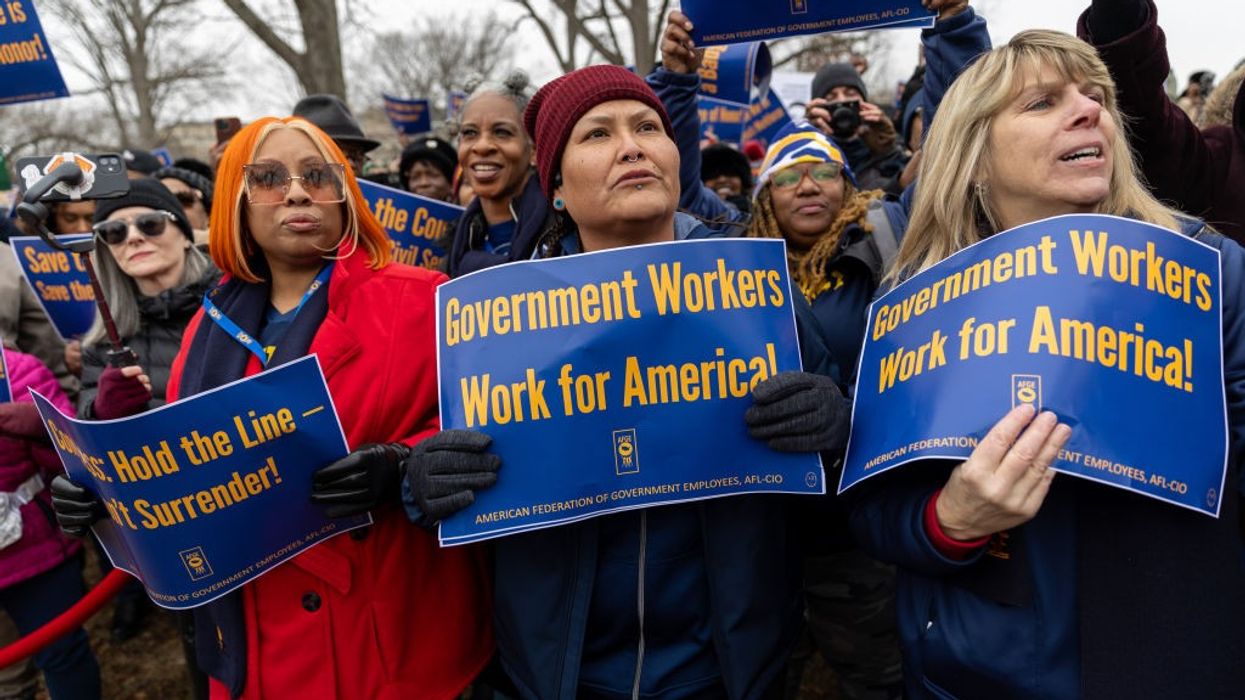
"We’re glad this settlement places limits on their ability to use federal workers as bargaining chips to push their extreme agenda during the next government shutdown, but the fight is far from over," said one union leader.
A coalition of federal employee unions won a settlement Friday requiring the Trump administration to abandon its policy authorizing mass layoffs during government shutdowns, after unions sued to block the firings of thousands of public servants.
“Today, working people won,” American Federation of Government Employees (AFGE) president Everett Kelley said in a statement. “The administration tried to turn a shutdown into an excuse to fire the public servants who kept this country running without a paycheck on payday, and we refused to let it stand. We fought back, we held the line, and they backed down.”
“The people they tried to fire are hardworking Americans who care for our veterans, keep our airports safe, and make sure Social Security checks go out on time," Kelley added. "They deserve to be treated with dignity and respect for their service, not used as pawns in a political fight they had no part in creating."
The settlement announced Friday settles litigation stemming from the Trump administration's actions during the 43-day government shutdown in 2025, which was the longest in US history. The administration had directed agencies to implement reductions in force (RIFs) targeting workers whose programs it deemed inconsistent with President Donald Trump's agenda.
Roughly 4,200 employees at seven federal agencies—including the Environmental Protection Agency and departments of Commerce, Education, Health and Human Services, Homeland Security, Housing and Urban Development, and Treasury—received RIF notices.
A federal judge in California subsequently blocked the administration from carrying out the layoffs, and workers separated through the shutdown-related RIFs were reinstated.
Under Friday's settlement, the Office of Management and Budget (OMB) and Office of Personnel Management must notify agencies within 30 days that previous guidance authorizing shutdown-related RIFs has been rescinded. Agencies must remove blanket authorization for such layoffs from their shutdown contingency plans. If an agency later seeks to modify its plan to permit RIFs during a shutdown, it must provide the unions with 30 days' notice and publicly post the revised plan.
The settlement represents a significant setback for the Trump administration's broader effort to remake the federal workforce largely spearheaded by Russell Vought, director of Trump's OMB. Vought co-authored the policy portion of Project 2025, the Heritage Foundation-led blueprint for a right-wing overhaul of the federal government that includes dramatic cuts to critical public programs and abolishing or gutting essential agencies.
The case was initially brought by AFGE and the American Federation of State, County, and Municipal Employees (AFSCME) and later expanded to include several other unions, including the National Treasury Employees Union, Service Employees International Union, American Federation of Teachers (AFT), and National Federation of Federal Employees.
“Only an administration that wanted to hurt workers and help billionaires would use a government shutdown as a cynical pretext to fire tens of thousands of federal employees,” AFT president Randi Weingarten said Friday.
"Today’s victory is yet another rebuke to this administration’s illegal attacks on the people who keep this country running," she added. "And if they try it again, we will be waiting in the courts and on the streets to send a message that the American people won’t stand for these bully-boy tactics that hold workers’ careers to ransom to pursue a craven political agenda.”
While welcoming the win, AFSCME president Patrick Moran warned that "this billionaire-run administration continues to put politics between these essential workers and their public service, at great expense to our communities."
"We’re glad this settlement places limits on their ability to use federal workers as bargaining chips to push their extreme agenda during the next government shutdown," he added, "but the fight is far from over."

"Netanyahu not only has unleashed vicious crimes onto Palestinians, but he failed his own people."
As Prime Minister Benjamin Netanyahu returned to Israel after using his United Nations speech "to repeat baseless lies meant to sanitize his genocide of Palestinians" in the Gaza Strip, The New York Times on Friday corroborated Haaretz's recent reporting that the Israeli leader was warned about the Hamas-led October 7, 2023 attack that resulted in the war.
Haaretz reported earlier this month that during a September 2023 phone call, United Arab Emirates President Mohammed bin Zayed Al Nahyan told Netanyahu about now-deceased Hamas leader Yahya Sinwar's plans "for a major event" targeting Israel.
Netanyahu not only denied receiving that notice but also sent a "warning letter," threatening to file a libel lawsuit against the Israeli newspaper and journalists Shlomi Eldar and Ruth Yuval. In response, Haaretz said that it stood by their work.
A trio of Times journalists backed up that exposé on Friday, reporting that "a person who said they had spoken with Sheikh Mohammed and another person who said they had been briefed by someone on the call between the two leaders told The New York Times that the Emirati leader had secretly reported to Mr. Netanyahu that Hamas was considering a major attack."
"The warning from the Emirati leader, however, never reached the leaders of Israel's security establishment, according to five former senior Israeli officials. Mr. Netanyahu gathered his security chiefs days later, on October 1, 2023, for a meeting about the situation in the Gaza Strip, and never mentioned the warning," reported the US-based paper, which reviewed meeting minutes.
The minutes show that Netanyahu "pushed back when some security officials said that Israel should consider military strikes against senior Hamas leaders in Gaza who were overseeing attacks against Israelis in the West Bank," and suggested such action "might sabotage the prospect of Saudi Arabia establishing diplomatic relations with Israel," according to the Times.
While the Emirati foreign ministry and Netanyahu's office did not respond to the Times' requests for comment, the paper also revealed that months after the reported September 2023 phone call, the UAE's president told then-Central Intelligence Agency Director William Burns that "he had spoken to Mr. Netanyahu about a looming threat of violence in the West Bank or the Gaza Strip carried out by Hamas," according to someone familiar with that discussion. The paper's sources were granted anonymity.
The Times' reporting came just days after an Emirati source commented on the Haaretz article. As the Israeli paper detailed:
"UAE discusses security matters with other countries through the relevant entities, and does not discuss such details at the level of national leaders," the source told UAE state-owned newspaper The National. He did not deny that the two leaders spoke, nor did he refute Haaretz's report.
In 2024, the Financial Times reported that The National is owned by Sheikh Mansour bin Zayed Al Nahyan, the UAE's vice president and the president's brother. It also reported that the site aligns with the government's position and practices self-censorship on issues deemed sensitive or problematic by the authorities.
Noting that Netanyahu reportedly declined to pass the warning along to his intelligence agencies, investigative journalist Eli Clifton, a co-founder and senior adviser at the US-based Quincy Institute for Responsible Statecraft, asked: "Why? Did he welcome the attack as an opportunity to wage war?"
Mehdi Hasan, who founded the outlet Zeteo, similarly wrote "wonder why" on social media.
Journalist Zaid Jilani declared that "Netanyahu not only has unleashed vicious crimes onto Palestinians, but he failed his own people."
Israel's next parliamentary elections are scheduled for October 27.
Ryan Bohl, a senior Middle East and North Africa analyst at risk intelligence firm RANE, said that it is "as close to an October surprise as one gets in Israel. If I was a betting man, I'd be betting against Netanyahu being next PM."
Reminder that the Trump administration is trying to destroy the ICC in order to protect this man.www.nytimes.com/2026/09/25/w...
[image or embed]
— Brian Finucane (@bcfinucane.bsky.social) September 25, 2026 at 1:02 PM
In a series of decisions seen as signs that Netanyahu and his allies are worried about holding on to power, Israel's Central Elections Committee—which is chaired by a Supreme Court justice but dominated by members of the Knesset's governing coalition—just disqualified all Arab-majority political parties and multiple candidates, while rejecting similar petitions for right-wing parties.
Israel's Supreme Court is set to review those decisions next week, and may overturn some or all of them before the elections.
While Netanyahu's allies on the committee tried to bar potential challengers from running, the prime minister briefly traveled to New York City to speak at the UN General Assembly—despite being the subject of a 2024 International Criminal Court arrest warrant issued over Israel's decimation of Gaza, which human rights groups and scholars have denounced as genocide.
As Netanyahu claimed in his speech that "Israel didn't commit genocide," but rather "prevented genocide," at least hundreds of protesters filled New York's streets and argued that the Israeli leader "needs to be tried in The Hague."

"Remember when Donald Trump promised to get rid of ‘waste, fraud, and abuse’ in Washington?" said one senior Democratic senator. "Well, GAO continues to uncover incompetence and waste at the highest levels of ICE."
The Trump administration's deadly immigration crackdown has not only resulted in widespread abuse of detained immigrants, it has also wasted millions of dollars on facilities and services that were never used, were quickly abandoned, or were far more expensive than necessary, according to an audit published Thursday by the Government Accountability Office.
The nonpartisan congressional watchdog found that US Immigration and Customs Enforcement (ICE) has poured billions of dollars into six detention expansion initiatives since January 2025 without the comprehensive planning needed to determine whether the investments were necessary, affordable, or capable of meeting federal detention standards.
"ICE pursued this and the other initiatives without necessary analysis and planning," the GAO said, concluding that the agency's approach has already resulted in "millions of dollars of waste."
The report contends that "urgent planning" is "needed to avoid further waste of taxpayer dollars."
Heather MacLeod, director of Homeland Security and Justice at GAO, said Friday that "we just saw a real lack of planning overall."
"The lack of planning has really led to stops and starts which have ultimately resulted in waste," she added.
Among the most striking examples highlighted in the report is the administration's purchase of 11 warehouses for roughly $1.07 billion, with plans to convert them into detention centers. ICE subsequently decided to sell seven of the properties. More than $20 million had already been spent on costs—including security and zoning assessments—that cannot be recovered.
In May, More Perfect Union detailed how members of Trump's inner circle were cashing in on the warehouse-buying spree.
The GAO also exposed spending for almost no apparent use at Guantánamo Bay. For example, after Trump ordered officials to expand immigration detention capacity at the US military base in Cuba, the Pentagon assembled tents intended to accommodate thousands of people. However, DHS subsequently determined that the tents failed to meet ICE detention standards and they were dismantled, costing approximately $2.85 million.
Meanwhile, an average of just 16 immigrants per day were detained at Guantánamo during fiscal year 2026. Pentagon and State Department inspectors general had previously found that roughly $68 million had been committed for immigration detention there between October 2024 and May 2026, while ICE separately committed approximately $43 million through June 2026.
The report also highlights the now-shuttered Florida facility commonly known as Alligator Alcatraz. The Federal Emergency Management Agency awarded Florida a $608.4 million detention support grant, even though there was no agreement or contract authorizing the facility to detain immigrants, according to senators who requested an investigation into the matter.
The GAO's findings came after Congress approved an unprecedented $45 billion for ICE detention expansion under Trump's so-called One Big Beautiful Bill Act, a boon for the private prison industry. Yet the agency still lacks a comprehensive strategic plan governing how many beds it needs, where they should be located, or how to account for detainees' medical and other needs.
This, as more than 50 people have died in ICE custody during Trump’s second term.
ICE has also failed to adequately consider long-term affordability, according to the new report. As of July, the agency had spent $2.5 billion purchasing warehouses and detention facilities but had only estimated operating costs for the first three years—even though some of the funding supporting the expansion expires after fiscal year 2029.
A separate GAO investigation published in June found millions in waste and serious safety and operational deficiencies at Camp East Montana at Fort Bliss in El Paso, Texas. The nation's largest immigrant detention facility opened last year under a $1.3 billion contract.
Responding Friday to the new GAO report, a DHS spokesperson told CBS News that ICE is "working at turbo speed on cost-effective and innovative ways to deliver on the American people's mandate for mass deportations of criminal illegal aliens."
Senate Minority Whip Dick Durbin (D-Ill.) said on social media in response to the GAO revelations: "Remember when Donald Trump promised to get rid of ‘waste, fraud, and abuse’ in Washington? Well, GAO continues to uncover incompetence and waste at the highest levels of ICE."
"Americans are outraged at ill-conceived immigration detention projects," he added, "and it’s time to hold DHS and ICE responsible."
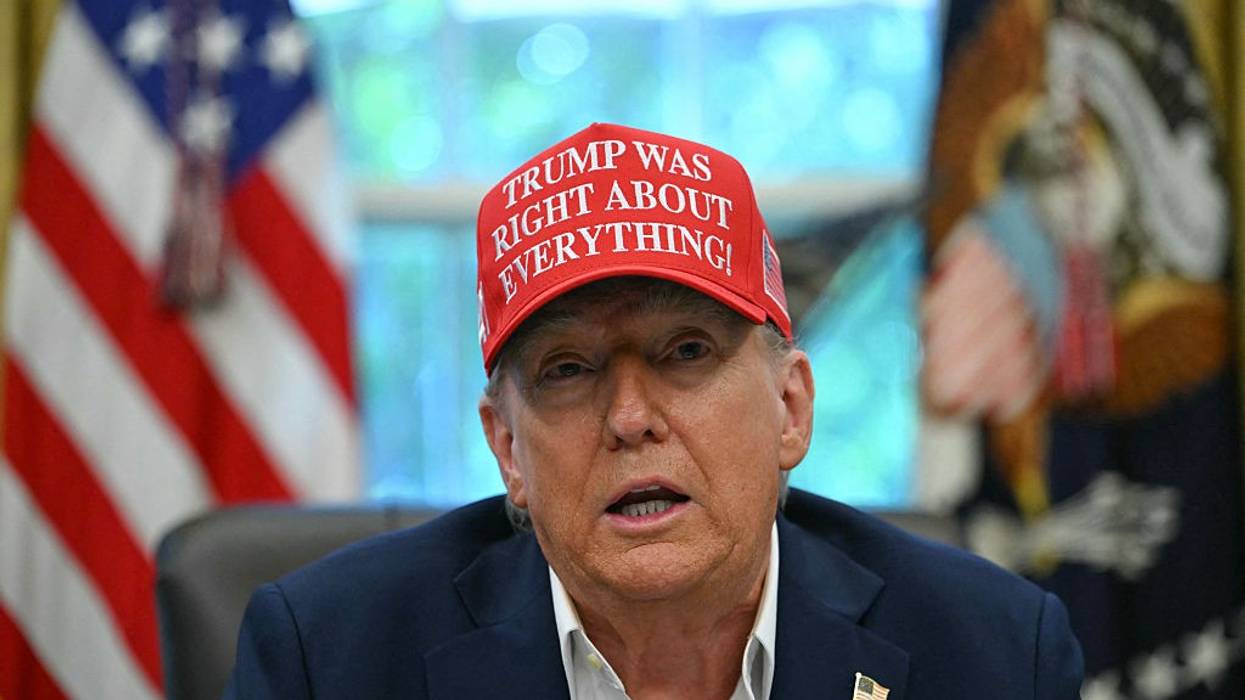
"President Trump, MAGA Inc., and anyone else who breaks campaign finance laws must be held accountable to help ensure that our political system is free of corruption."
An election spending watchdog on Friday accused President Donald Trump of committing a "clear-cut violation of campaign finance law" through his stated control over spending decisions made by the MAGA Inc. super political action committee.
Citing decades of legal precedent, the Campaign Legal Center (CLC) argued that federal office holders are prohibited from directing spending for super PACs, which raise money outside the scope of federal campaign laws.
Saurav Ghosh, director of federal campaign finance reform at CLC, noted that Trump has stated publicly on multiple occasions that he will decide where MAGA Inc.'s $400 million war chest will be deployed in the 2026 elections—which Ghosh said would be flatly illegal.
"Our laws are clear: No federal officeholder or candidate is allowed to direct the money raised or spent by a super PAC," said Ghosh. "President Trump, MAGA Inc., and anyone else who breaks campaign finance laws must be held accountable to help ensure that our political system is free of corruption."
Last week, CLC filed a complaint with the Federal Election Commission (FEC) that cited statements Trump made to reporters, whom he told funds raised by MAGA Inc. were "my money that I control."
This statement alone, the group said, was "a remarkable admission of a serious campaign finance violation."
The complaint then asked the FEC to seek "appropriate sanctions for any and all violations" of campaign finance law committed by Trump and MAGA Inc., "including civil penalties sufficient to deter future violations and an injunction prohibiting the respondents from any and all violations in the future."
While MAGA Inc. has a formidable stash of campaign cash at its disposal, it is unclear how much of an impact it will have on the 2026 midterms given that polls show the president and his party are in a deep hole with voters.
A report from The New Republic published last week revealed that the pro-Trump super PAC is plugging significant money into at least 17 districts that the president won by more than five points in 2024, and six districts that he won by more than 10 points.
David Wasserman, elections analyst for Cook Political Report, told The New Republic that this spending in pro-Trump districts is "an acknowledgment that things have shifted in a huge way since 2024."
"Republicans have hemorrhaged support among independent voters, they’ve got a real enthusiasm problem," said Wasserman, "and as a result, districts that ordinarily would vote handily for Trump and Republicans are now in play."
A Friday report in The Washington Post examined the states where Trump is preparing to campaign in the coming days, and found the president is being deployed in deep-red states such as Alabama and Oklahoma.
"Oklahoma is a state Trump won in 2024 with 66% of the vote—and won all 77 counties," the Post reported. "In Alabama, Trump won with 65%."
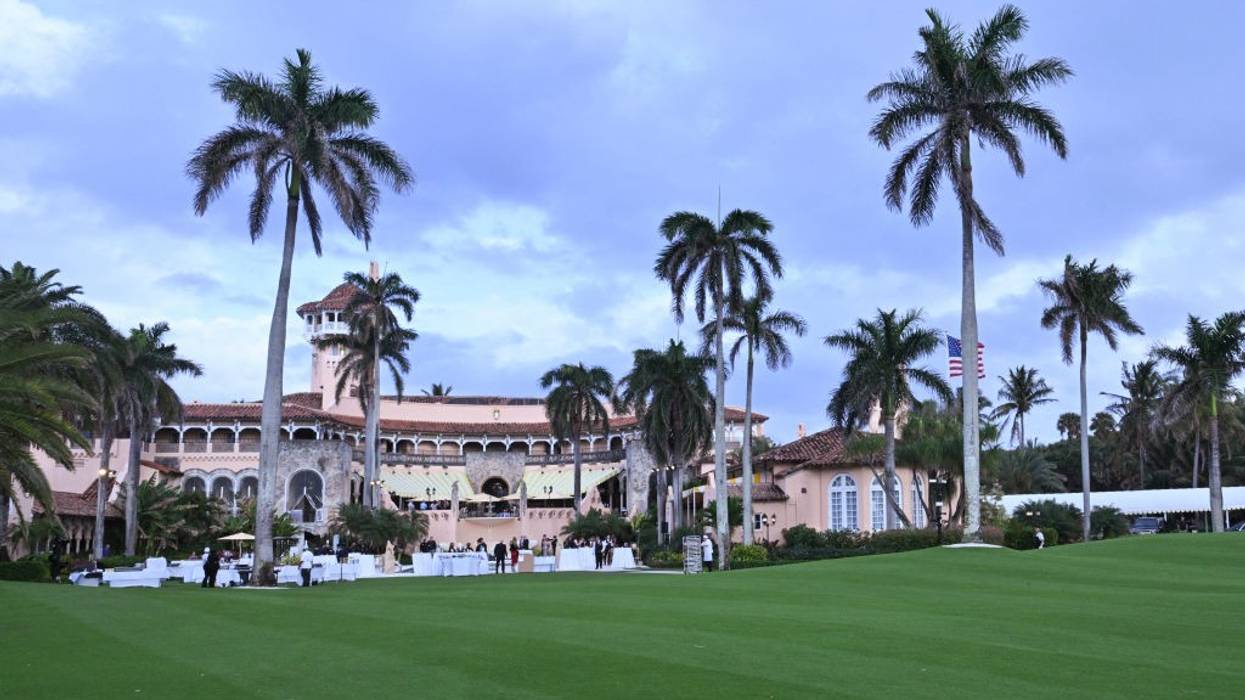
Trump has said that communities that don't want data centers "want to end up being backwards and poor."
President Donald Trump has said every American should want a data center in their town. But his home county in Florida just voted to block them.
In a 6-0 vote, commissioners in Palm Beach County—home to the president's luxurious private club and second residence, Mar-a-Lago—voted to enact a one-year moratorium on the construction of new "large-scale" data centers that use at least 50 megawatts of power.
The moratorium, approved on Thursday, came after Palm Beach residents expressed concerns shared by Americans around the country who’ve seen data centers move into their communities. Palm Beach already has some smaller data centers. But in July, it rejected a proposal for the 600MW Project Tango, following warnings about its potential effects on local wetlands and on families’ pocketbooks.
"Many communities want the economic benefits that data centers bring, but we all fear the higher power bills, the negative environmental impact, disruptive noise, and the depletion of water resources," explained one supporter of the moratorium at a county commission meeting on Thursday, according to the local ABC affiliate.
A poll conducted last month by Embold Research and published by Heatmap Pro found that 75% of Americans now oppose the building of AI data centers in their area, including 61% who registered strong opposition. Aversion to data centers crosses party lines, with majorities of Democrats, Republicans, and independents viewing them negatively.
As AI companies spend tens of millions bankrolling Trump and Republican candidates, members of the president's Cabinet, including Commerce Secretary Howard Lutnick and Energy Secretary Chris Wright, have scoffed at Americans' concerns about the tremendous water and energy use of data centers, which have been well documented as jacking up utility prices.
In a social media post last month, Trump himself said the only reason communities would not want a data center nearby is if they "want to end up being backwards and poor." Before that, he said that "smart communities" were "begging for them."
Sen. Bernie Sanders (I-Vt.), who has become one of Capitol Hill's leading critics of data centers and the artificial intelligence models they power, has said that if Trump truly finds data centers so desirable, he should “lead by example” by having his friend and megadonor, tech billionaire Elon Musk, build one at Mar-a-Lago.
"Trump says communities that oppose data centers will end up 'backwards' and 'poor,'" Sanders remarked Friday on social media. "Yesterday, Mar-a-Lago’s own Palm Beach County passed a year-long ban on these facilities."
"Maybe," the senator said, "Trump’s neighbors know something he doesn’t."
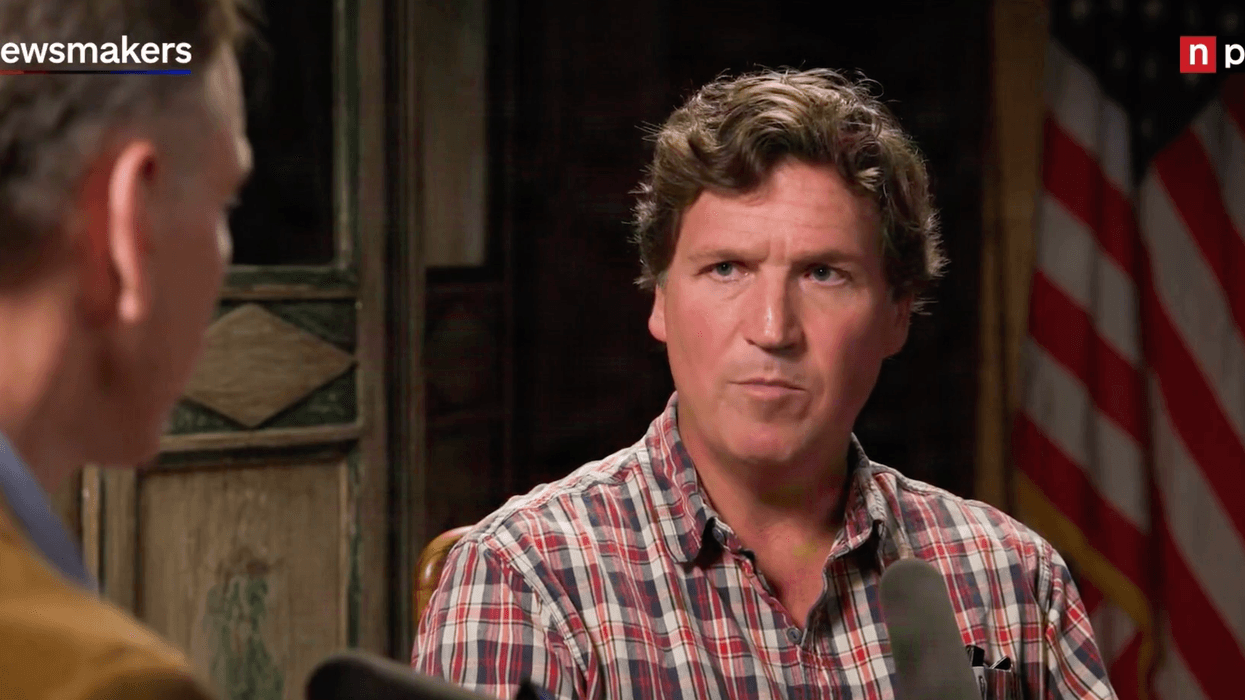
Carlson's account of his conversation with the president days before the US and Israel attacked Iran was "extremely disturbing," said one journalist.
New revelations from right-wing political commentator Tucker Carlson about President Donald Trump's push to wage war on Iran earlier this year prompted the latest calls for Cabinet members to invoke the 25th Amendment and force Trump out of office on the grounds that he is unable to fulfill the duties of the office—namely, to protect the security of the people of the United States.
"Days before the war began," Carlson told Steve Inskeep of NPR on Thursday, the president explicitly said that the outcome of the conflict didn't matter, because "in the end we all die, anyway."
Carlson revealed that he visited Trump in the Oval Office of the White House in late February, after having gone to Tel Aviv and interviewed Mike Huckabee, the US ambassador to Israel.
Trump expressed annoyance at Carlson, an on-and-off ally of the president over the years who claimed in April that he had "regrets" about supporting him, for challenging Huckabee on the US relationship with Israel.
Carlson had pressed Huckabee on his comment that "it would be fine if Israel took" over huge swaths of the Middle East, including parts of Lebanon, Syria, Iraq, Jordan, and Türkiye.
The host of "The Tucker Carlson Show" said he told Trump he had come away from his two-hour discussion with Huckabee understanding that the unprovoked war the US and Israel was days away from started was not aimed at ending Iran's nuclear program—which the president had claimed was taken out of commission in June 2025 by US strikes.
The Israeli threats against Iran, said Carlson, were actually aimed at ending Iran's "regional power," "diminishing the power" of the Gulf Cooperation Council, and ultimately "getting the US out of the Middle East because we constrain their ambitions" by maintaining a presence in countries in the region.
As the podcaster warned the president not to be manipulated by the Israeli government into taking military action against Iran, according to Carlson, "he looked at me and said, 'Yes, you're right, but in the end we all die, anyway, so it doesn't matter."
This is also 25th Amendment stuff. Extremely disturbing. pic.twitter.com/SnyqCwI3fL
— Ryan Grim (@ryangrim) September 25, 2026
"That's exactly what he said," said Carlson. "I said to him, shocked, ''But what about our kids and our grandkids, and like, our country?' And he goes, 'Argh!'... That's a verbatim exchange."
"I was shocked by that," he added. "Who lives or dies does matter, the future does matter."
The president's assertion that allowing Israel to push the US into war—something Secretary of State Marco Rubio also openly acknowledged had happened after the conflict began—could be disastrous for the US and lead to an untold number of American deaths, was called "extremely disturbing" by Drop Site News journalist Ryan Grim, who suggested Carlson's revelation should prompt the use of the 25th Amendment.
Journalist Pedro L. Gonzalez expressed wariness at the thought of taking Carlson at his word regarding his exchange with Trump and his current opposition to the president, while Carlson said he believed the need for Cabinet members to push Trump out of office predated the interview.
He said that Trump's threat of nuclear war in April, when he threatened to annihilate the "whole civilization" of Iran, "never to be brought back again," was grounds for invoking the 25th Amendment, with a majority of his Cabinet members voting to remove him from office.
Tucker Carlson: Trump should have been removed from office immediately when he threatened nuclear war pic.twitter.com/eYPbYBRsta
— FactPost (@factpostnews) September 24, 2026
"He should have been bundled up and taken out," said Carlson. "That's a crime."
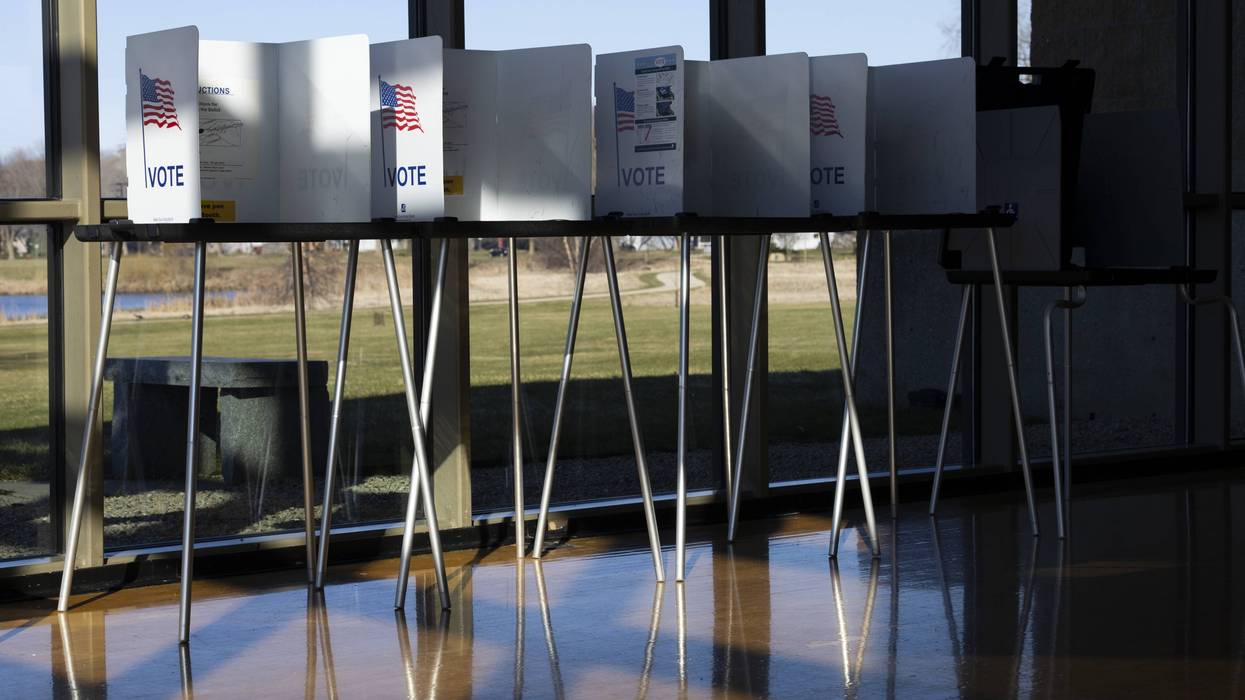
"The SAVE database has known errors, including incorrectly flagging numerous eligible citizens... as noncitizens," an election security expert told Common Dreams.
Many eligible voters may be at risk of having their voter registrations wrongfully canceled just weeks before the midterms after the US Supreme Court cleared the way on Friday for the Trump administration to screen voters using a database known for flagging naturalized citizens.
In a 6-3 decision, the court's conservative majority lifted a lower court order that blocked the Department of Homeland Security (DHS) from using and expanding the Systematic Alien Verification for Entitlements (SAVE) database—whose original purpose was to check if noncitizens qualified for government benefits—to trawl through state voter rolls and link them to information supposedly confirming citizenship.
The expanded SAVE system relied upon by the Trump administration has also incorporated federal immigration and Social Security records that can be outdated.
"Because Social Security data was never intended for verifying voter eligibility, [the Social Security Administration] has no reason to keep people’s immigration status up to date in cases where it isn’t relevant for their benefits," explained Nancy Altman, president of Social Security Works, on Friday.
"As a result," she said, "US citizens could wrongfully lose their right to vote."
Investigations and court records have documented eligible US citizens being wrongly targeted by voter-purge systems using flawed citizenship data. In Missouri and Texas, for example, investigations have found that the system wrongly flagged hundreds of eligible voters as noncitizens, often those born outside the US who have since become naturalized.
Halting the SAVE system's implementation in June, Judge Sparkle Sooknanan of the US District Court in Washington, DC, wrote that the Trump administration had “haphazardly combined and repurposed the private information of millions of Americans, including citizenship data that they knew to be unreliable."
But the Supreme Court's conservatives wrote on Friday, in an unsigned majority opinion, that the lower court's block on the use of SAVE impeded “the federal government’s efforts to assist state and local agencies in the proper administration of the midterm elections.”
In her dissent, the liberal Justice Ketanji Brown Jackson emphasized that "the harm caused by burdening or disenfranchising even a few lawful voters outweighs the nonexistent harm that the government experiences when it is prevented from taking an action that it likely lacks the authority to take."
The court did not issue a final ruling on SAVE's legality to scrutinize voting rolls. But the timing—less than six weeks before the November 3 midterm elections—means the administration can potentially use it to direct states to identify and purge purported noncitizens on their voter rolls.
"The Supreme Court’s decision today wrongly lifts the burden from DHS and puts it on the shoulders of voters," Pamela Smith, president and CEO of the election security nonprofit Verified Voting, told Common Dreams. "The SAVE database has known errors, including incorrectly flagging numerous eligible citizens, such as recently naturalized citizens, as noncitizens."
"Now more than ever," she said, "voters must check their registration well in advance of Election Day to ensure they are not swept up in a flawed system through no fault of their own."
Jon Sherman, the litigation director for the Fair Elections Center, told Common Dreams that the court's ruling did contain a "silver lining." It "acknowledged that the National Voter Registration Act cuts off systematic voter removal programs 90 days before a federal election." However, voters could still be individually flagged as potential noncitizens.
The use of citizenship data is part of a larger effort by Trump to "nationalize" voting to clamp down on what he claims, without evidence, is a rash of noncitizens voting. He has used unsubstantiated claims of mass illegal voting to justify his efforts to overturn his loss in the 2020 election to former President Joe Biden.
Earlier this month, the Supreme Court refused to let Trump enforce another portion of his voting executive order, which would have had the US Postal Service block mail-in ballots in states that did not turn over information about mail-in voters to the federal government.
There is little evidence that noncitizen voting, or voter fraud more generally, is a significant problem: The right-wing Heritage Foundation's nationwide database of alleged instances of voter fraud identifies just 99 total cases of suspected noncitizen voting dating back to the year 2000.
A Brookings Institution review of that data in 2024 found that across several swing states, all forms of fraud impacted less than one vote for every million, far below what would be needed to swing an election.
"The Supreme Court’s decision to allow DHS and states to use an error-ridden system is completely unacceptable and didn’t need to happen this close to the election," said Virginia Kase Solomón, the president and CEO of the watchdog group Common Cause. "This DHS system, which the federal government itself admits is flawed, has always been part of the Trump administration’s campaign to interfere in our elections and sow distrust—and it will fail."
The legal challenge to the SAVE database was brought by the League of Women Voters and several state affiliates, along with the Electronic Privacy Information Center (EPIC), who are represented by Democracy Forward, Citizens for Responsibility and Ethics in Washington (CREW), and the Fair Elections Center.
The coalition said Friday's decision was "profoundly disappointing, as it puts millions of Americans at risk of being unlawfully targeted by the administration’s unreliable voter purge database weeks before the midterm elections."
"However, this case is not over," it said. "The DC District Court ruled that the expanded SAVE program violated multiple laws. We will be doing everything in our power to protect Americans’ voting and privacy rights by ensuring that the district court decision stands."
Rep. Delia Ramirez (D-Ill.) said that with Friday's ruling, the Supreme Court had upheld a "Trump administration voter-suppression tactic."
"It's disappointing that the Supreme Court decided to capitulate to and enable an authoritarian, again," she said. "States must hold the line and do everything in their power to protect voting rights and our democracy!"
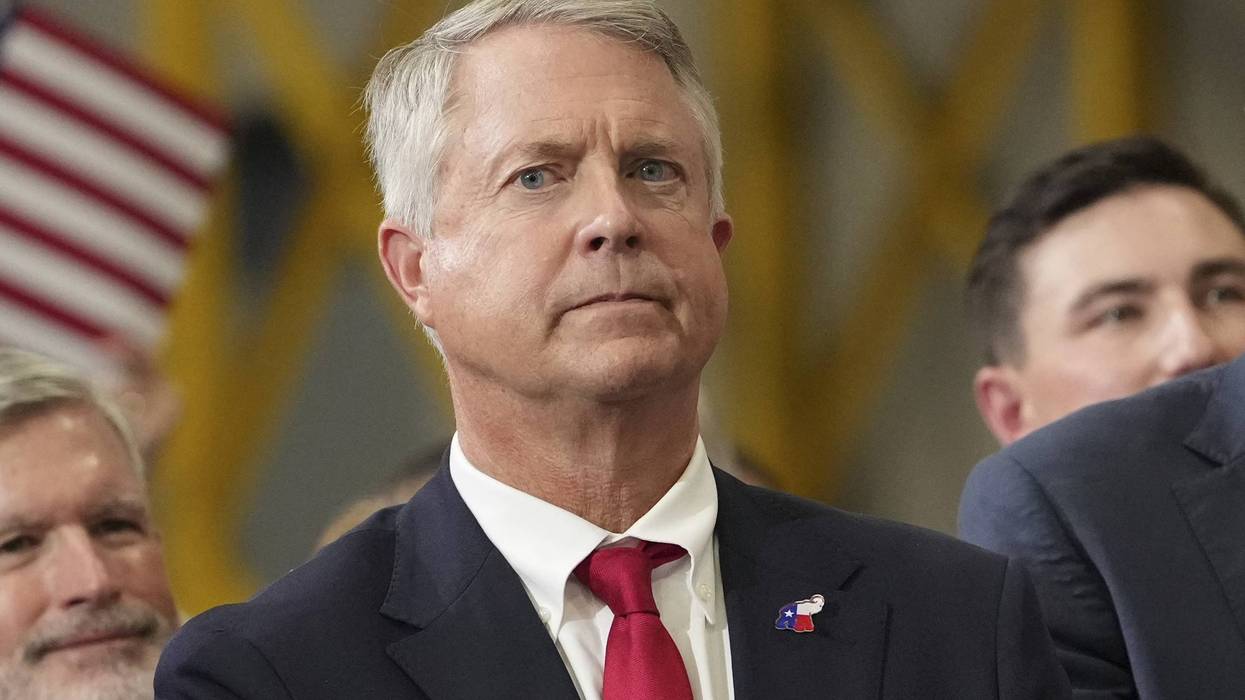
'The healthcare system is broken, but not for Roger Marshall. He's absolutely profiting from it."
The campaign of Kansas Democratic US Senate candidate Adam Hamilton on Friday released an ad highlighting incumbent Republican Sen. Roger Marshall's history of having patients arrested for medical debt.
The ad features Meischa Zimmerman, a one-time patient of Marshall, who prior to running for political office had a long career as an obstetrician-gynecologist.
Zimmerman begins the ad by recounting her 2011 arrest.
"One evening, I see [police] lights, I open the door, and it's a police officer," Zimmerman explains. "They arrested me because I didn't make a $50 payment to Roger Marshall."
"I was eight months pregnant," she continues. "And I said, 'Please do not handcuff me in front of my two-year-old daughter.'"
At the end of the ad, Zimmerman turns Marshall's aggressive debt collection tactics into an indictment of the for-profit US healthcare system.
"Roger Marshall preyed on the low-income families of Kansas," she says. "The healthcare system is broken, but not for Roger Marshall. He's absolutely profiting from it."
Meischa was Roger Marshall's patient. This is her story. pic.twitter.com/M6bmqK92gm
— Team Hamilton (@TeamHamiltonHQ) September 25, 2026
Zimmerman's story was highlighted earlier this month in a report from The New York Times, which found that Marshall filed lawsuits against more than 700 patients for medical debt, leading to at least 81 of them getting arrested.
Zimmerman owed Marshall $3,596 for a C-section her performed while delivering one of her children and, after his office sued her for outstanding medical debt, she agreed to undertake a monthly $50 payment plan.
Zimmerman told the Times that, while she tried to make the monthly payments, there were times when she couldn't keep up.
"I had to choose whether I’d pay my electricity," Zimmerman said, "or pay $50 to a doctor who didn’t need it."
Additionally, the law firm representing Marshall began charging 18% interest on her unpaid bill, which she said nearly doubled the total value she owed.
The Times story found that many patients Marshall sued didn't have anywhere close to the thousands of dollars in medical debt owed by Zimmerman, and that one of his patients was arrested for owing as little as $114.
The anti-Marshall ad drew praise from many political observers, who described it as a searing indictment of the Kansas Republican's character.
"This is a killer ad," wrote Larry Sabato, director of the University of Virginia's Center for Politics, in a social media post. "If Hamilton defeats Marshall for Senate in Kansas, include it in your analysis."
Bloomberg columnist Francis Wilkerson similarly described the ad as "among the best... I've seen."
Amanda Litman, president of Run for Something, declared after watching the ad that "Roger Marshall is a real piece of shit."
James Goodwin, policy director at the Center for Progressive Reform, argued that the ad was so strong that it could break through a key barrier progressives have long faced when challenging right-wing politicians.
"One of the structural advantages that Republicans have enjoyed the last 10 to 15 years is ordinary people didn't believe you when you told them how evil they were," Goodwin wrote. "After all, how could anyone be that evil? That's just the left exaggerating again, right? It feels like that is starting to fall apart."

“This is the sort of government propaganda one might expect in North Korea, not the United States of America, and it is an egregious and utterly illegal misuse of Americans’ hard-earned tax dollars,” said four lawmakers.
Outrage mounted Friday over a taxpayer-funded television advertisement glorifying President Donald Trump, with critics describing the 30-second spot as self-aggrandizing propaganda and questioning whether the administration violated federal law restricting the use of public money for partisan communications.
The ad—which aired this week on outlets including Fox News, Newsmax, and CBS—features a dizzying montage of Trump at rallies, White House events, sporting events, and alongside military personnel, captioned, "AMERICA WILL NEVER BE A COMMUNIST COUNTRY."
The refrain of R&B singer JMSN’s “Love Me” plays over the rapid-fire images. The spot concludes with a voiceover from Ultimate Fighting Championship CEO Dana White praising Trump as “the toughest, most resilient person that I’ve ever met.”
At the bottom of the screen, an alarming disclosure appears, reading, "Paid for by the US government."
The White House dismissed criticism of the ad—which aired ahead of November's midterm elections—by calling the spot a "public service announcement" intended to remind Americans “to love their country and understand what makes it worth defending.”
However, on Friday, US Sens. Patty Murray (D-Wash.) and Jack Reed (D-RI), along with Reps. Rosa DeLauro (D-Conn.) and Steny Hoyer (D-Md.), excoriated the clip.
“This is the sort of government propaganda one might expect in North Korea, not the United States of America, and it is an egregious and utterly illegal misuse of Americans’ hard-earned tax dollars,” the four senior congressional appropriators said in a joint statement.
“The law is not complicated," the lawmakers added. "You cannot use taxpayer dollars for political advertisements.”
Federal appropriations law—including the funding bill Trump signed earlier this year—prohibits the use of government funds for unauthorized “publicity or propaganda purposes,” while the Government Accountability Office (GAO) has interpreted the prohibition to encompass communications whose obvious purpose is “self-aggrandizement” or “puffery,” as well as “purely partisan” communications.
The consumer advocacy watchdog group Public Citizen on Friday filed a complaint with the GAO alleging the ad "violates laws prohibiting the use of government resources for propaganda, the Hatch Act, and other related laws."
"Whether or not President Trump was personally involved in the ad, it was conceived, produced, and distributed by Trump’s White House staff," Public Citizen said.
US Sen. Chris Murphy (D-Conn.) said Friday on social media that "every taxpayer, no matter your party, should be outraged by this."
"Your money is being used to fund campaign ads for Trump," the senator added. "It’s totally, completely [illegal]. He’s stealing your money for his campaign."
"The advertisement raises deep concerns about the Trump administration’s use of taxpayer dollars and its compliance with federal laws that prohibit the use of appropriated funds for the promotion of a political party or candidate," Sen. Maggie Hassan (D-NH) said Thursday.
“This taxpayer-funded political advertisement serves as yet another troubling example of President Trump’s growing list of expensive vanity projects—including the White House ballroom—that are estimated to cost over $1.8 billion, money that could have instead [been] spent lowering costs for Americans.”
Sam Stein, co-host of "The Bulwark Podcast," said, "What possible rationale could there be for using tax dollars to play that ad? This is just pure cult propaganda paid for by us."
@timmiller.bsky.social and @samsteindc.bsky.social react to a taxpayer-funded TV ad praising Trump, complete with “Love Me” playing over footage of the president.“This is just pure cult propaganda paid for by us.”
[image or embed]
— The Bulwark (@thebulwark.com) September 24, 2026 at 6:46 PM
Noting that Trump's approval rating has plunged below 30%, Stein added: "People are abandoning him... members of his own party are starting to distance themselves from him, and he uses that moment to have an ad [saying] please love me... It's desperate."
Tim Miller, Stein's co-host, called the ad "alarming" and "Orwellian."
Virginia Kase Solomón, president and CEO of the advocacy group Common Cause, said Friday in a statement that “taxpayer dollars should never be used to bolster the president’s self-esteem because his ego has been damaged."
"Running political messaging stamped with ‘Paid for by the US Government’ dangerously crosses the line from public service into authoritarian self-promotion," she added. "It also raises serious questions about whether it violates federal law barring tax dollars from being used for publicity or propaganda."
Others noted that the ad blasted communism as Trump rolled out the red carpet at a state dinner for Chinese President Ji Xinping, who is also the secretary general of the Chinese Communist Party.
"The clip’s heavy-handed anti-communist messaging also strikes a wildly hypocritical note, if not for anything but the fact that the Supreme Leader that ran it followed up by hosting China’s Xi Jinping with open arms, a flyover of US military planes, and a statue of a bald eagle," Jezebel's Danielle Han wrote on Friday.
Meanwhile, the controversy has spread beyond politics. JMSN—whose real name is Christian Berishaj—said that he never authorized Trump to use “Love Me,” writing that he would “never authorize my music to be used for ANY political agenda or campaign.”
"I am looking at lawyers," he added, "and handling this internally.”