SUBSCRIBE TO OUR FREE NEWSLETTER
Daily news & progressive opinion—funded by the people, not the corporations—delivered straight to your inbox.
5
#000000
#FFFFFF
To donate by check, phone, or other method, see our More Ways to Give page.
Daily news & progressive opinion—funded by the people, not the corporations—delivered straight to your inbox.
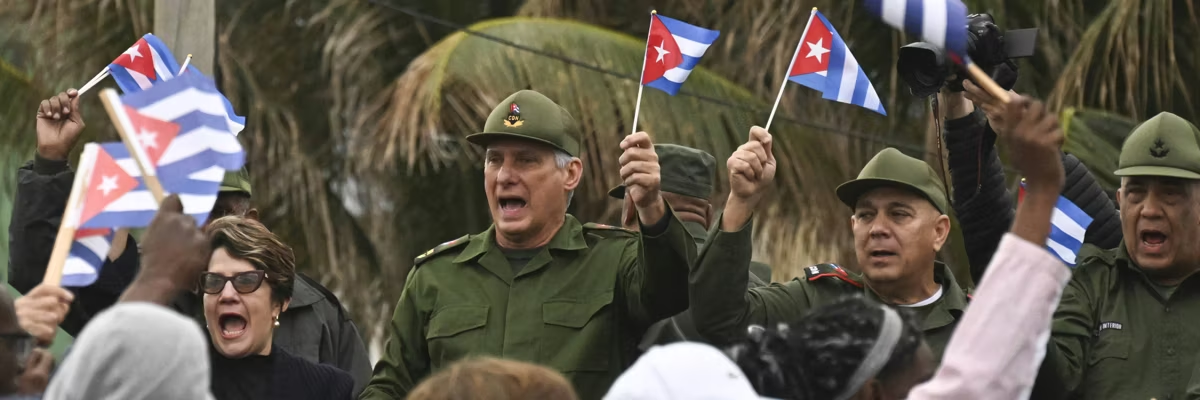
Cuban President Miguel Díaz-Canel takes part in a protest in front of the US Embassy in Havana on January 16, 2026.
"The US publicly threatens Cuba, almost daily, with overthrowing the constitutional order by force," said Miguel Díaz-Canel.
Cuban President Miguel Díaz-Canel on Tuesday condemned US President Donald Trump's open threat to forcibly seize control of the island nation and vowed that any such aggression would be met with "impregnable resistance."
"The US publicly threatens Cuba, almost daily, with overthrowing the constitutional order by force," Díaz-Canel wrote on social media. "And it uses an outrageous pretext: the harsh limitations of the weakened economy that they have attacked and sought to isolate for more than six decades."
"They intend and announce plans to seize the country, its resources, its properties, and even the very economy they seek to strangle to make us surrender," the Cuban president added. "Only in this way can the fierce economic war be explained, which is applied as collective punishment against the entire people. In the face of the worst scenario, Cuba is accompanied by a certainty: Any external aggressor will clash with an impregnable resistance."
Díaz-Canel's statement came a day after Trump said from the Oval Office of the White House that he believes he will have "the honor of taking Cuba" as it faces a grave humanitarian crisis fueled by the administration's oil embargo, which began shortly after the US abducted Venezuelan President Nicolás Maduro in early January.
"I think I can do anything I want with it," Trump said of Cuba on Monday.
The New York Times reported earlier this week that Trump administration officials are demanding Díaz-Canel's ouster as part of any negotiated deal between the two countries.
US Secretary of State Marco Rubio, the son of Cuban immigrants and a longtime supporter of regime change on the island, said publicly on Tuesday that Cuba "has to get new people in charge." Trump said earlier this month that he's "going to put Marco over there and we’ll see how that works out."
A YouGov poll out this week shows that more Americans disapprove than approve of the US embargo on Cuba. The same survey found that only 13% of US voters would support attacking Cuba, and a mere 18% would support using military force to overthrow the country's government.
Trump's threats came as his oil embargo and the broader, decadeslong, and illegal economic warfare against Cuba continued to take their toll on the island's population, most recently in the form of an island-wide blackout that lasted nearly 30 hours.
On Wednesday, the first delegation of the Nuestra América Convoy arrived in Havana as part of an effort by individuals and organizations to deliver critical humanitarian aid to the Cuban people as the US besieges the island's economy and threatens its sovereignty.
Nathan J. Robinson and Alex Skopic, editors of the left-wing magazine Current Affairs, announced Wednesday that they are heading to Cuba to cover the mission, which they characterized as part of a "proud tradition of internationalism" on the American left.
"Beyond food, medicine, and energy infrastructure, this mission sends a message," Robinson and Skopic wrote. "As Americans, we want to make it crystal clear that the Trump administration does not speak for us when it talks about 'taking over' Cuba, and we’re sickened by what Trump and Rubio are doing to the Cuban people in the name of U.S. foreign policy. But we’re determined to do what we can, and we’re going to make sure the people of Cuba do not stand alone."
Dear Common Dreams reader, It’s been nearly 30 years since I co-founded Common Dreams with my late wife, Lina Newhouser. We had the radical notion that journalism should serve the public good, not corporate profits. It was clear to us from the outset what it would take to build such a project. No paid advertisements. No corporate sponsors. No millionaire publisher telling us what to think or do. Many people said we wouldn't last a year, but we proved those doubters wrong. Together with a tremendous team of journalists and dedicated staff, we built an independent media outlet free from the constraints of profits and corporate control. Our mission has always been simple: To inform. To inspire. To ignite change for the common good. Building Common Dreams was not easy. Our survival was never guaranteed. When you take on the most powerful forces—Wall Street greed, fossil fuel industry destruction, Big Tech lobbyists, and uber-rich oligarchs who have spent billions upon billions rigging the economy and democracy in their favor—the only bulwark you have is supporters who believe in your work. But here’s the urgent message from me today. It's never been this bad out there. And it's never been this hard to keep us going. At the very moment Common Dreams is most needed, the threats we face are intensifying. We need your support now more than ever. We don't accept corporate advertising and never will. We don't have a paywall because we don't think people should be blocked from critical news based on their ability to pay. Everything we do is funded by the donations of readers like you. When everyone does the little they can afford, we are strong. But if that support retreats or dries up, so do we. Will you donate now to make sure Common Dreams not only survives but thrives? —Craig Brown, Co-founder |
Cuban President Miguel Díaz-Canel on Tuesday condemned US President Donald Trump's open threat to forcibly seize control of the island nation and vowed that any such aggression would be met with "impregnable resistance."
"The US publicly threatens Cuba, almost daily, with overthrowing the constitutional order by force," Díaz-Canel wrote on social media. "And it uses an outrageous pretext: the harsh limitations of the weakened economy that they have attacked and sought to isolate for more than six decades."
"They intend and announce plans to seize the country, its resources, its properties, and even the very economy they seek to strangle to make us surrender," the Cuban president added. "Only in this way can the fierce economic war be explained, which is applied as collective punishment against the entire people. In the face of the worst scenario, Cuba is accompanied by a certainty: Any external aggressor will clash with an impregnable resistance."
Díaz-Canel's statement came a day after Trump said from the Oval Office of the White House that he believes he will have "the honor of taking Cuba" as it faces a grave humanitarian crisis fueled by the administration's oil embargo, which began shortly after the US abducted Venezuelan President Nicolás Maduro in early January.
"I think I can do anything I want with it," Trump said of Cuba on Monday.
The New York Times reported earlier this week that Trump administration officials are demanding Díaz-Canel's ouster as part of any negotiated deal between the two countries.
US Secretary of State Marco Rubio, the son of Cuban immigrants and a longtime supporter of regime change on the island, said publicly on Tuesday that Cuba "has to get new people in charge." Trump said earlier this month that he's "going to put Marco over there and we’ll see how that works out."
A YouGov poll out this week shows that more Americans disapprove than approve of the US embargo on Cuba. The same survey found that only 13% of US voters would support attacking Cuba, and a mere 18% would support using military force to overthrow the country's government.
Trump's threats came as his oil embargo and the broader, decadeslong, and illegal economic warfare against Cuba continued to take their toll on the island's population, most recently in the form of an island-wide blackout that lasted nearly 30 hours.
On Wednesday, the first delegation of the Nuestra América Convoy arrived in Havana as part of an effort by individuals and organizations to deliver critical humanitarian aid to the Cuban people as the US besieges the island's economy and threatens its sovereignty.
Nathan J. Robinson and Alex Skopic, editors of the left-wing magazine Current Affairs, announced Wednesday that they are heading to Cuba to cover the mission, which they characterized as part of a "proud tradition of internationalism" on the American left.
"Beyond food, medicine, and energy infrastructure, this mission sends a message," Robinson and Skopic wrote. "As Americans, we want to make it crystal clear that the Trump administration does not speak for us when it talks about 'taking over' Cuba, and we’re sickened by what Trump and Rubio are doing to the Cuban people in the name of U.S. foreign policy. But we’re determined to do what we can, and we’re going to make sure the people of Cuba do not stand alone."
Cuban President Miguel Díaz-Canel on Tuesday condemned US President Donald Trump's open threat to forcibly seize control of the island nation and vowed that any such aggression would be met with "impregnable resistance."
"The US publicly threatens Cuba, almost daily, with overthrowing the constitutional order by force," Díaz-Canel wrote on social media. "And it uses an outrageous pretext: the harsh limitations of the weakened economy that they have attacked and sought to isolate for more than six decades."
"They intend and announce plans to seize the country, its resources, its properties, and even the very economy they seek to strangle to make us surrender," the Cuban president added. "Only in this way can the fierce economic war be explained, which is applied as collective punishment against the entire people. In the face of the worst scenario, Cuba is accompanied by a certainty: Any external aggressor will clash with an impregnable resistance."
Díaz-Canel's statement came a day after Trump said from the Oval Office of the White House that he believes he will have "the honor of taking Cuba" as it faces a grave humanitarian crisis fueled by the administration's oil embargo, which began shortly after the US abducted Venezuelan President Nicolás Maduro in early January.
"I think I can do anything I want with it," Trump said of Cuba on Monday.
The New York Times reported earlier this week that Trump administration officials are demanding Díaz-Canel's ouster as part of any negotiated deal between the two countries.
US Secretary of State Marco Rubio, the son of Cuban immigrants and a longtime supporter of regime change on the island, said publicly on Tuesday that Cuba "has to get new people in charge." Trump said earlier this month that he's "going to put Marco over there and we’ll see how that works out."
A YouGov poll out this week shows that more Americans disapprove than approve of the US embargo on Cuba. The same survey found that only 13% of US voters would support attacking Cuba, and a mere 18% would support using military force to overthrow the country's government.
Trump's threats came as his oil embargo and the broader, decadeslong, and illegal economic warfare against Cuba continued to take their toll on the island's population, most recently in the form of an island-wide blackout that lasted nearly 30 hours.
On Wednesday, the first delegation of the Nuestra América Convoy arrived in Havana as part of an effort by individuals and organizations to deliver critical humanitarian aid to the Cuban people as the US besieges the island's economy and threatens its sovereignty.
Nathan J. Robinson and Alex Skopic, editors of the left-wing magazine Current Affairs, announced Wednesday that they are heading to Cuba to cover the mission, which they characterized as part of a "proud tradition of internationalism" on the American left.
"Beyond food, medicine, and energy infrastructure, this mission sends a message," Robinson and Skopic wrote. "As Americans, we want to make it crystal clear that the Trump administration does not speak for us when it talks about 'taking over' Cuba, and we’re sickened by what Trump and Rubio are doing to the Cuban people in the name of U.S. foreign policy. But we’re determined to do what we can, and we’re going to make sure the people of Cuba do not stand alone."